Vælg en side

Industrial Power Transmission · Technical Guide

Metric vs. Inch Roller Chain: Understanding the Global Standards Gap

A definitive technical guide for UK engineers, procurement managers, and plant operators navigating the critical differences between ISO metric and ANSI inch-based roller chain standards — and what getting it wrong can cost you.

ISO 606 · BS Standards
ANSI B29.1
B2B · UK Market
Ever Power Engineering

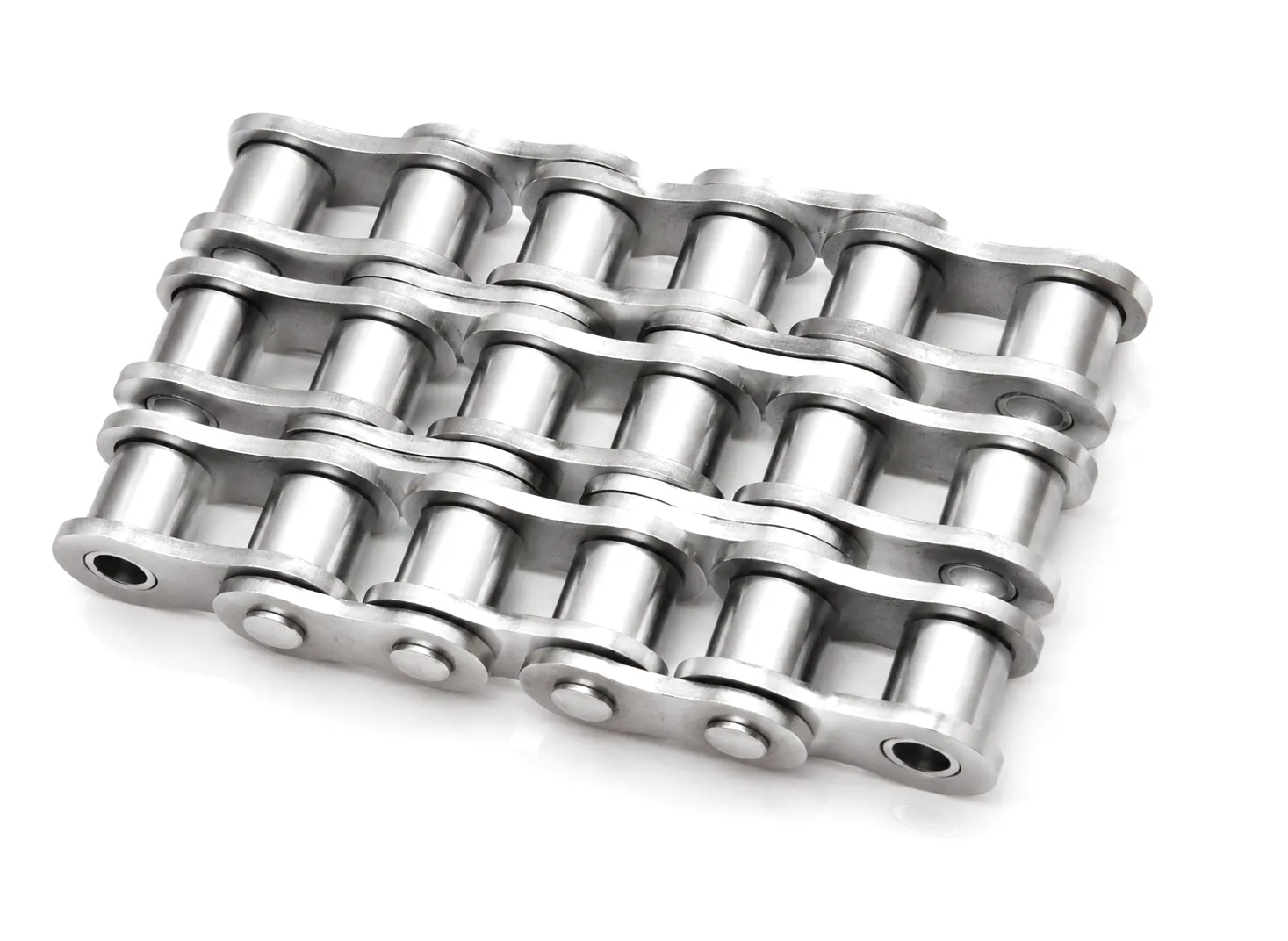
Roller chain manufacturing — metric and inch standards

Walk the shop floor of any manufacturing facility in Birmingham, Sheffield, or Leeds — facilities that have run continuous production for decades — and you will almost certainly find both metric and inch-specification roller chains operating side by side, often without the maintenance team fully appreciating the distinction. This is not carelessness. It is the predictable outcome of a global standards gap that has persisted for well over a century, rooted in the divergence between the British and American engineering traditions that shaped early mechanised industry. Roller chain, the deceptively simple loop of interlinked steel plates and precision-machined rollers, is the backbone of countless drive systems across the UK’s food processing, automotive, agricultural, mining, and packaging sectors. Yet the word “roller chain” on its own tells a procurement manager almost nothing useful, because two parallel and largely incompatible standards govern how these chains are dimensioned, rated, and supplied. Understanding why that gap exists, what it means technically, and how to specify correctly is no longer optional knowledge — it is a fundamental competency for anyone responsible for plant uptime.

The Two Standards That Divide the World of Roller Chain

ISO 606 / BS Standard
The ISO 606 standard — adopted almost universally in continental Europe and embedded into British Standards as BS 228 and later updated through EN equivalents — defines chain pitch in millimetres. A typical designation might read 08B-1, 10B-1, 16B-2, and so on, where the number before the letter denotes pitch in increments and “B” marks British/European origin. This standard governs the roller diameter, inner plate width, outer plate thickness, pin diameter, and breaking load in consistent SI units. For a plant engineer in Sheffield running a conveyor for steel forgings, specifying an 08B simplex chain means every reputable European or Asian supplier will deliver a part that meshes correctly with existing sprockets without modification. The ISO system was designed around the metric world — rational, decimal, and interchangeable across borders — which is one reason the British manufacturing sector largely adopted it after metrication in the 1970s, even as legacy inch-spec machines continued to operate on factory floors well into the 1990s.

ANSI B29.1 / Inch Standard
ANSI B29.1, the American National Standard, defines roller chain pitch in fractions of an inch. The numbering convention is equally systematic but entirely different: the first digit (or two digits) of the chain number multiplied by eight gives the pitch in eighths of an inch. So a #40 chain has a pitch of 4/8 inch — exactly 12.7 mm — which happens to coincide almost precisely with the ISO 08A designation, yet the two are not interchangeable due to differences in roller diameter, inner width, and breaking load. A #80 chain carries a pitch of one inch (25.4 mm). This is the system that dominates North American industry, much of the oil and gas sector worldwide, and crucially, it governs the specification of chains used on many American-manufactured agricultural machines, construction equipment, and industrial gearboxes that have been imported into the UK in large quantities. Plants in the Midlands running John Deere or Caterpillar-linked machinery, for example, will frequently encounter ANSI-spec roller chains that cannot be replaced directly with an ISO equivalent of the same nominal pitch.

How a Roller Chain Actually Works: The Engineering Principle
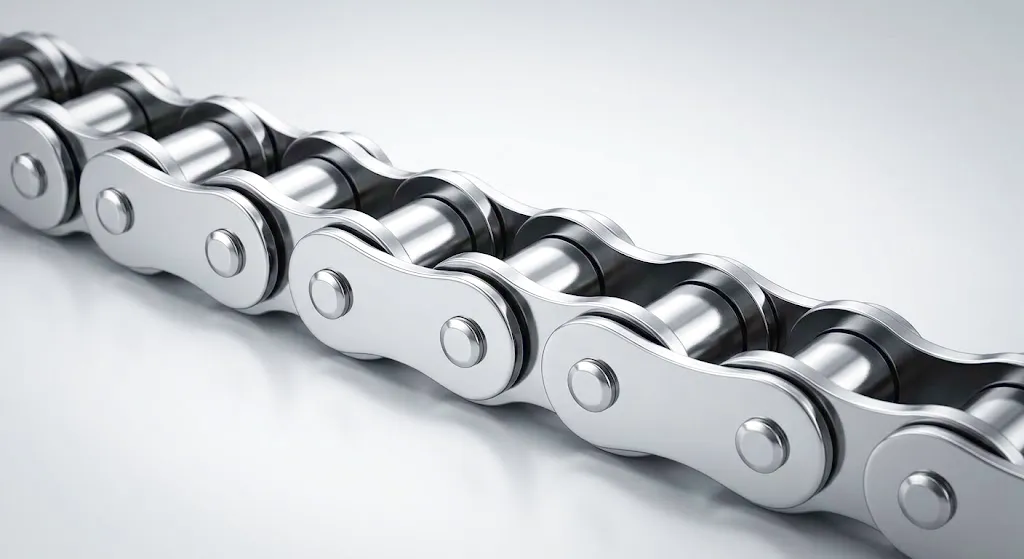
Roller chain mechanism close-up

The operating principle of a roller chain relies on a deceptively elegant interaction between two distinct mechanical actions occurring simultaneously at every sprocket tooth. As the chain engages the sprocket, each link pivots about the pin connecting it to the adjacent link, and the roller — a precision-hardened steel sleeve sitting between the pin bushing and the sprocket tooth — begins to rotate. This rolling contact replaces what would otherwise be a sliding friction event, reducing the contact stress between chain and tooth profile by several orders of magnitude compared to a plain-link or block chain design. The result is a transmission element with mechanical efficiency in the range of 97 to 99 percent under normal operating conditions, a figure that holds relatively consistent across a wide range of speeds and loads.

The chain itself is a composite structure. Inner links — comprising two inner plates, a bushing pressed into each plate, and the roller riding on that bushing — alternate with outer links, each consisting of two outer plates with press-fitted pins passing through the bushings of the adjacent inner links. The pitch of the chain, the centre-to-centre distance between adjacent pin centrelines, is the single most critical dimension in defining compatibility. Where metric and inch chains diverge is not just in this one dimension; the proportional relationships between pitch, roller diameter, inner width, and plate height differ between the two standards, which means a sprocket cut for ISO 16B-1 will not correctly drive an ANSI #80 chain even though their pitches are both nominally 25.4 mm. The polygon action — the characteristic chordal rise-and-fall of the chain as it wraps onto the sprocket — also behaves differently because the tooth geometry was designed to a different standard. This is precisely why substituting one for the other without professional verification can lead to accelerated wear, premature sprocket tooth damage, and, in high-load applications, catastrophic failure.

Technical Performance Parameters: Metric vs. Inch Roller Chain

Reference data for common sizes across both standards. All breaking loads based on minimum tensile strength per standard specification.

Parameter ISO 08B-1 ANSI #40 ISO 16B-1 ANSI #80 ISO 24B-1 ANSI #120
Tonehøjde 12.70 mm 12.70 mm (1/2″) 25.40 mm 25.40 mm (1″) 38.10 mm 38.10 mm (1-1/2″)
Rullediameter 8.51 mm 7.92 mm 15.88 mm 15.88 mm 25.40 mm 22.23 mm
Indvendig bredde 7.75 mm 7.94 mm 17.02 mm 15.88 mm 25.40 mm 25.40 mm
Min. Tensile Strength 17,8 kN 17,8 kN 60.0 kN 57.8 kN 160.0 kN 133.4 kN
Plademateriale Carbon / Alloy Steel Kulstofstål Legeret stål Carbon / Alloy Steel Legeret stål Legeret stål
Overfladebehandling Carburising, Through-hardening, Zinc/Nickel Plating (grade/application dependent)
Typisk maks. hastighed Up to 3,200 rpm Up to 3,400 rpm Up to 1,600 rpm Up to 1,700 rpm Up to 900 rpm Up to 950 rpm
Governing Standard ISO 606 / DIN 8187 ANSI B29.1 ISO 606 / DIN 8187 ANSI B29.1 ISO 606 ANSI B29.1

Materials Science Behind the Chain: What the Steel Grade Actually Means

⚙️
Kulstofstål
Medium-carbon steel (typically 0.40–0.55% C content) forms the backbone of standard-grade roller chains across both metric and inch specifications. After forming, the plates and pins undergo induction hardening or carburising, producing a surface hardness in the range of 58–62 HRC while maintaining a tough core that resists impact loading. Carbon steel chains are economical and widely available throughout the UK distribution network, making them the default choice for general-purpose conveying, agricultural drives, and light-to-medium industrial applications where operating temperatures remain below 200°C and corrosion is not a primary concern.
🔩
Alloy Steel (High-Strength)
Where operating loads are severe — as in steel handling lines in Rotherham, heavy presses in the Black Country, or quarrying equipment in South Wales — alloy steel compositions containing chromium, molybdenum, or nickel additions provide substantially greater fatigue resistance. Chromium-molybdenum steel (analogous to EN 4130 / 4140 in British terms) permits breaking loads 30–40% higher than standard carbon steel at the same chain size, or alternatively allows a smaller, lighter chain to carry the same duty. This is particularly significant in heavy industrial machinery where minimising chain mass reduces dynamic loading at high chain speeds, extending both chain and sprocket life considerably.
🛡️
Stainless Steel (304 / 316)
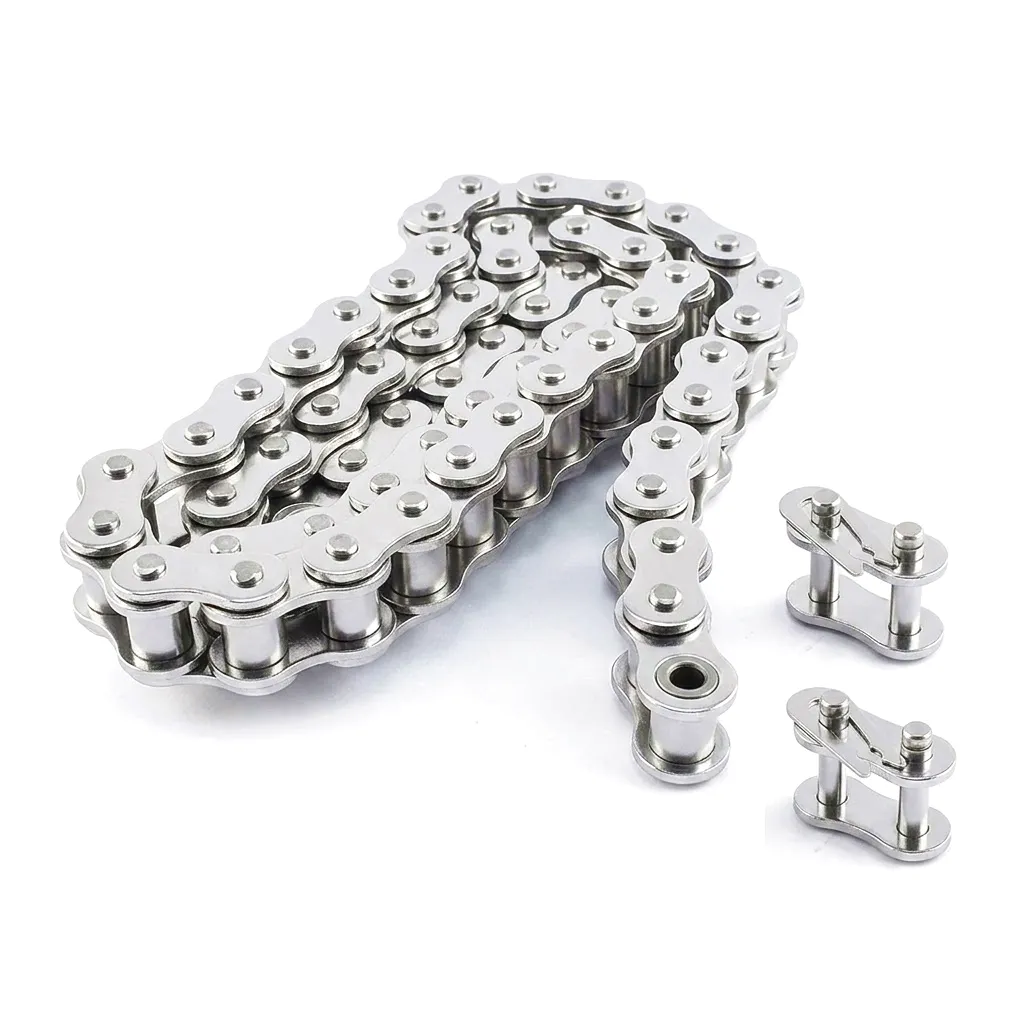
Food-grade processing lines across the UK — from the major poultry processing operations in Norfolk and Lincolnshire to large beverage manufacturers in Burton-on-Trent — require chains that can withstand regular wash-down with aggressive sanitising chemicals without surface corrosion that could contaminate product. Stainless steel roller chains, most commonly in 304 or 316L grades, provide the corrosion resistance to meet UK food safety legislation while maintaining acceptable mechanical strength. The trade-off is hardness: stainless cannot be hardened to the same degree as carbon steel, so stainless chains typically carry breaking loads 25–35% lower than equivalent carbon-steel chains, a constraint that must be accounted for at the design stage.
🔬
Nickel-Plated & Specialist Coatings
Nickel-plated roller chains bridge the gap between standard carbon steel and full stainless construction. The electroplated nickel layer — typically 10–25 microns thick — provides a meaningful improvement in corrosion resistance over bare steel at a fraction of the cost of stainless. Additional surface treatments available through specialist manufacturers include zinc dichromate plating for outdoor agricultural applications, PTFE-impregnated lubricant coatings for reduced-maintenance or cleanroom environments, and high-temperature oxidation-resistant finishes for chains operating in proximity to furnaces or kilns, where ambient temperatures can exceed 300°C on lines in the UK glass or ceramics sectors.

Featured High-Strength Roller Chain Products

Højstyrke rullekæde 120HSP-00
ANSI · Caterpillar Grade
Engineered to ANSI #120 specification with enhanced plate tensile ratings, this chain is purpose-designed for Caterpillar earthmoving and construction equipment. The 120HSP-00 uses an alloy steel composition with precision-ground pins and shot-peened plates to extend fatigue life under the cyclical shock loading typical of dozer and excavator undercarriage drives. For UK plant hire companies and construction firms operating Cat equipment across sites from the Scottish Highlands to the South of England, this is the specification that delivers guaranteed dimensional interchangeability with OEM sprockets and verified load ratings.

Se produktdetaljer →

Højstyrke rullekæde C100HSP-00
ISO C-Type · Caterpillar Grade
The C100HSP-00 addresses the metric-side counterpart requirement, providing ISO-equivalent dimensioning while maintaining Caterpillar OEM performance standards. Manufactured with an extended sidebar for increased plate section modulus, this chain delivers superior resistance to side-bending and twisting under the uneven terrain loading conditions encountered on UK construction and agricultural sites. The chain undergoes a proprietary heat treatment sequence — normalising, carburising, and tempering — that produces a case depth specifically calibrated for the impact resistance demands of plant machinery operating in the demanding clay-heavy soils of areas like the East Anglian Fens or the chalk downlands of Wiltshire.

Se produktdetaljer →

Core Technical Advantages of Precision Roller Chain

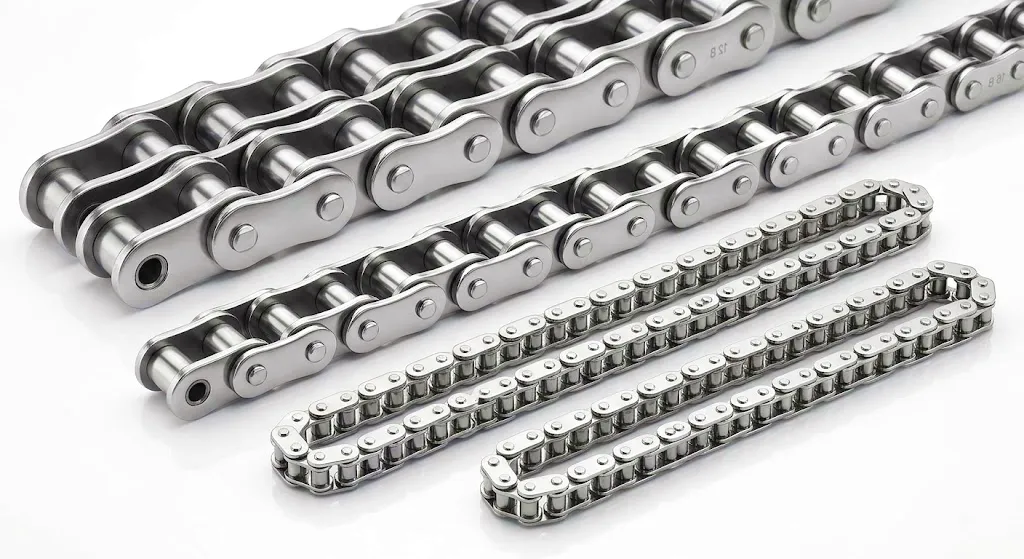
Ever Power roller chain precision components

Transmission Efficiency > 98%
Rolling contact at the sprocket tooth eliminates the sliding friction inherent in other drive types, delivering power loss figures consistently below 2% under normal lubricated operation.
Synchronous, Slip-Free Drive
Unlike V-belts or flat belts, roller chain provides a positive, slip-free engagement with the sprocket teeth, maintaining exact speed ratios irrespective of torque fluctuation — critical for indexing, timing, and coordinated multi-axis drives.
High Load Capacity per Unit Weight
The compact cross-section of a roller chain relative to its breaking load enables high-ratio reduction drives in confined spaces — an advantage exploited extensively in UK machine tool designs where envelope constraints are significant.
Wide Speed and Torque Range
A single roller chain type can span from low-speed, high-torque haulage drives at a few rpm through to precision indexing drives at several thousand rpm, simply by varying the sprocket sizes — flexibility that alternative transmission media cannot match.
Durability Under Contamination
Properly specified and hardened roller chain maintains functional performance in conditions involving dust, grit, and mild chemical exposure that would destroy a belt drive within days — a practical necessity for outdoor machinery and agricultural equipment in UK field conditions.
Ease of Length Adjustment
Adding or removing links allows precise centre-distance adjustment without replacing the entire drive assembly — a significant operational benefit for UK maintenance teams working to tight shift schedules where extended downtime for complex re-engineering is simply not acceptable.

Industrial Application Scenarios Across Key UK Sectors

From the heavy rolling mills of South Yorkshire to the food processing parks of East Anglia, roller chain is embedded in the operational fabric of British industry. The choice between metric and inch specification is not merely an administrative detail — it directly determines compatibility, lead time, and total cost of ownership across every one of these sectors.
🏭
Automotive Manufacturing — West Midlands
The automotive assembly plants concentrated around Coventry, Solihull, and the broader West Midlands corridor rely on roller chain drives at multiple stages of the production process: transfer line indexing, overhead conveyor systems, automated welding line sequencers, and component wash stations. In this environment, both ISO and ANSI chains appear on the same facility floor, as imported American-designed tooling coexists with European-spec machinery. The consequences of specifying a chain of the wrong standard can range from excessive noise and vibration through to chain jumping and tool crash — neither of which is tolerable in a line producing hundreds of vehicles per shift. Precision roller chain to ISO 606 or ANSI B29.1 — correctly matched to the sprocket profile — is the engineering non-negotiable.
🌾
Agricultural Machinery — East Anglian Arable Farms
Agricultural machinery — combines, balers, potato harvesters, grain drills — represents one of the single largest end-use categories for roller chain in the UK. The machinery operated on the large arable farms of Cambridgeshire, Norfolk, and Lincolnshire is overwhelmingly American-designed, meaning ANSI-spec chains dominate. The combine separator drives, crop elevator augers, and straw walker cranks on a typical modern combine are all ANSI chains, and the seasonal nature of the operation means failures occurring at harvest cannot wait weeks for a non-stocked part. Having the correct chain specification — and a supplier who can guarantee next-day delivery to a rural Norfolk address — is the difference between a profitable harvest and a catastrophic loss. ISO chains must not be used as substitutes in these applications without verified compatibility checks.
🥩
Food Processing — Hygiene-Grade Conveyors
Major food processing operations — meat and poultry processing plants in Yorkshire and the East Midlands, large-scale bakeries in the Thames Valley, and seafood processing facilities in Scottish coastal ports — demand roller chains that meet strict hygiene requirements under UK food standards regulations. This typically means stainless steel construction to ISO standards (most UK food plant equipment is European-designed), with NSF-approved food-grade lubricants applied to the chain. The ISO standard’s wider inner link widths at some common sizes can be advantageous in food processing as they allow more lubricant retention in the bushing-pin interface between wash-down cycles, extending the relubrication interval and reducing contamination risk.
⛏️
Mining and Quarrying — North Wales and Yorkshire
Slate quarrying in North Wales, coal reclamation in South Yorkshire, and limestone extraction in the Peak District all subject roller chains to the most punishing conditions encountered anywhere in British industry: shock loading from raw material impacts, abrasive stone dust penetrating every gap in the chain assembly, and intermittent operation cycles that create severe thermal cycling in the steel. In these environments, heavy-duty ANSI-spec chains — typically #80H or #100H, with thick outer plates and larger pin diameters — are the first choice for bulk material handling conveyors and crusher drives. The ANSI heavy series (H-suffix) provides plate thickness 10–20% greater than standard series, a margin that translates directly into measurable fatigue life extension under impact loading.
📦
Packaging and Distribution — Midlands Logistics Hubs
The major distribution and fulfilment centres now clustered around the M1 and M6 motorway corridors — serving the entirety of the UK consumer market — rely on roller chain driven sortation systems, pallet conveyors, and automated storage-retrieval mechanisms running 24 hours a day. In this high-throughput, high-availability environment, chain specification is a total cost of ownership question rather than a one-time procurement decision. Every chain selection must account for lubrication interval, anticipated elongation rate, ease of in-situ replacement, and supplier stock availability. ISO metric chains are generally preferred in this sector, as European-manufactured conveyor systems dominate the UK market, and metric specification allows procurement teams to qualify multiple suppliers across the EU without compatibility risk.
⚙️
Steel and Metal Processing — Sheffield and Rotherham
Sheffield’s surviving special steels and precision engineering sector, along with the broader South Yorkshire metals cluster, remains one of the heaviest users of large-pitch roller chain in the UK. Rolling mill drives, bloom transfer tables, bar conditioning lines, and heat treatment furnace conveyor systems all specify chains at pitches of 38.1 mm (ISO 24B / ANSI #120) and above, where the torque figures are enormous and chain failure represents not just lost production but serious safety risk. The distinction between ISO and ANSI is particularly significant at these larger pitches, as the breaking load difference between equivalent ISO and ANSI chains at 38.1 mm pitch can exceed 25 kN — a difference with real implications for safety factor calculations in a laden rolling line drive.

Ever Power rullekæde produktionslinje
Precision roller chain link assembly
Heavy duty roller chain for industrial use

Manufacturer Spotlight

Ever Power: Precision Manufacturing for Both Standards

Ever Power operates a purpose-built roller chain manufacturing facility equipped to produce both ISO 606 metric and ANSI B29.1 inch-specification chains to full standard compliance — a manufacturing capability that very few global suppliers can claim.

🔧
Dual-Standard Production
Ever Power’s production lines are tooled and calibrated for both ISO 606 and ANSI B29.1 specifications, with full dimensional traceability on every batch. UK importers and plant operators can source metric and inch chains through a single supply chain relationship, eliminating the complexity of managing multiple qualified vendors.
🏗️
Custom Specification Capability
Beyond standard catalogue chains, Ever Power offers engineered-to-order chains for applications where standard specifications are insufficient. Non-standard pitches, extended sidebar heights for increased plate section modulus, special inner widths for unique conveyor pan configurations, and attachment chain variants with custom A1/A2/K1 plate extensions can all be produced to customer drawings, with typical turnaround lead times that remain competitive with European distributors’ standard-stock delivery.
📋
Quality Assurance and Documentation
Every batch leaving Ever Power’s facility is accompanied by a full material certificate and dimensional inspection report. Hardness testing, tensile testing to proof load, and per-pitch measurement are standard — not optional — ensuring that UK customers operating under maintenance regimes governed by Health and Safety Executive requirements have the documentary evidence needed to demonstrate that the chain installed meets the design specification.
🌍
Supply Chain and Logistics
Ever Power maintains pre-positioned stock of the most common ISO and ANSI chain sizes, enabling rapid despatch to UK customers via established freight routes. Orders placed through ever power’s sales team are routed and documented with full commercial invoices and packing declarations, ensuring smooth customs clearance into the UK market and predictable landed-cost calculations for procurement managers working to fixed maintenance budgets.

Ready to specify the right roller chain for your application?

Our engineering team will review your duty requirements and confirm the correct ISO or ANSI specification, materials grade, and surface treatment for your application — at no charge.

✉ Få et tilbud — [email protected]

Customer Success Story: Sheffield Steel Processor Resolves Mixed-Standard Chain Crisis

Location: Sheffield, South Yorkshire  |  Sector: Special Steel Processing  |  Challenge: Mixed ISO / ANSI Specification Confusion

A medium-sized special steels processor operating a bar conditioning line in Attercliffe, Sheffield, had been experiencing recurring chain failures on their roller table drive — a system responsible for feeding steel bars from the cooling bed into the inspection and sizing equipment. The line had originally been built with a mix of German-manufactured conveyor equipment using ISO 16B-2 duplex chains and a secondhand American rolling mill roller table section that used ANSI #80 double-pitch chains. Over years of maintenance, various technicians had cross-specified replacement chains, assuming that because the pitches were nominally identical at 25.4 mm the chains were interchangeable. They were not — and the consequence was accelerated sprocket wear, intermittent chain jumping, and two complete line shutdowns in a single quarter, each costing the business approximately £18,000 in lost production.

The plant’s maintenance manager contacted Ever Power’s technical sales team, who conducted a remote review of the machine builder’s documentation and the chain samples retrieved from the line. The diagnosis was straightforward: the ISO 16B-2 chains and the ANSI #80 chains have meaningfully different roller diameters — 15.88 mm versus 15.88 mm in this case, which appeared identical, but the critical difference lay in the inner link width (17.02 mm ISO versus 15.88 mm ANSI) and the pin diameter tolerances. Mixing chains of both standards in the same loop had created variation in the chain’s effective pitch-to-sprocket engagement geometry, causing uneven load distribution across links and the observed accelerated wear.

Ever Power supplied a full ISO 16B-2 replacement set for the European conveyor sections and custom-documented ANSI #80 double-pitch chains for the American roller table sections, both within a ten-working-day lead time. The plant also received a laminated specification card mounted at the maintenance station identifying the correct replacement chain for each numbered drive position on the line — a simple measure that has prevented repeat cross-specification errors. In the fourteen months since the replacement, the Sheffield facility has recorded zero unplanned chain failures on the bar conditioning line, and the annual chain replacement cost has fallen by 34% as sprocket wear rates returned to design-life levels.

What UK Customers Say About Ever Power Roller Chain

★★★★★

“We were sourcing both ISO and ANSI chains from three different distributors and constantly dealing with lead time uncertainty. Ever Power consolidated our supply into a single account, and the dimensional certification they provide on every delivery has satisfied our quality audit requirements without additional in-house incoming inspection. The technical support when we were sizing replacement chains for our new press was genuinely knowledgeable — they flagged a load calculation error in our original spec that would have led to premature failure.”

— Procurement Manager, Automotive Press Shop, Coventry
★★★★★

“The 120HSP-00 high-strength chain we ordered for our Caterpillar-based surface miner has now completed one full operating season — approximately 2,200 hours — with no measurable elongation beyond the 1.5% service limit. We changed chains on a calendar basis previously with standard-grade alternatives and were seeing replacement at 900–1,100 hours. The extended service life alone covers the price premium many times over, and the fact that it fits the OEM sprockets perfectly without any shimming or adjustment work is exactly what our field engineers need.”

— Plant Manager, Opencast Operations, County Durham
★★★★★

“We needed a custom attachment chain variant for our poultry processing conveyor — a non-standard A2 plate extension with drilled mounting holes on every fifth link. Three UK distributors told us it was a minimum 12-week lead time with a large minimum order quantity. Ever Power came back with a sample within three weeks and matched our drawing tolerances within 0.05 mm. The stainless steel specification was exactly right for our wash-down environment and the NSF lubricant compatibility they confirmed saved us a significant regulatory paperwork exercise.”

— Engineering Director, Food Processing Equipment, Lincolnshire

Ofte stillede spørgsmål

Common questions from UK engineers and procurement teams about roller chain specification, supply, and pricing.

How do I tell whether my existing roller chain is ISO metric or ANSI inch specification when there is no visible marking on it?
Measure the inner plate width with a vernier calliper. At the 25.4 mm pitch size, an ISO 16B-1 chain will measure approximately 17.02 mm inner width, while an ANSI #80 will measure 15.88 mm. This single measurement is usually sufficient to identify the standard without any manufacturer markings. At smaller pitches, the roller diameter provides another reliable differentiating measurement — at 12.7 mm pitch, ISO 08B has a roller diameter of 8.51 mm versus ANSI #40’s 7.92 mm. If in doubt, contact Ever Power’s technical team with your measured dimensions and they will confirm the standard.
What is the typical price difference between standard ISO roller chain and a high-strength or heavy-duty ANSI roller chain when ordering for a UK plant?
High-strength and heavy-series ANSI chains typically carry a price premium of 25–50% over standard carbon steel ISO chains at equivalent pitch sizes, reflecting the additional alloy content, the more demanding heat treatment specification, and in many cases enhanced quality control and dimensional documentation requirements. However, when total cost of ownership is considered — accounting for extended service life, reduced sprocket replacement frequency, and avoided unplanned downtime costs — the high-strength specification almost invariably provides better value in any application where loads are significant. Request a comparative quote from Ever Power by emailing [email protected] with your current chain reference and annual consumption volume.
Which roller chain supplier in the UK can provide both ISO and ANSI specification chains from a single source with documented material certification?
Ever Power is a manufacturer — not a distributor — capable of supplying both ISO 606 and ANSI B29.1 chains with full material and dimensional certification from a single manufacturing source. This removes the risk of receiving non-conforming products that have been re-labelled or improperly stored in a distribution chain. UK customers can reach Ever Power’s technical sales team directly at [email protected] to discuss requirements, request certificates, and obtain a competitive quote.
How long does delivery typically take when ordering a custom-specification roller chain for an agricultural machine operating in East Anglia during the UK harvest season?
For standard catalogue items held in stock at Ever Power’s facility, typical delivery to a UK address via express freight is seven to ten working days. Custom-specification chains — non-standard pitches, special attachment variants, or unusual material grades — generally require a lead time of three to five weeks from drawing approval. For agricultural customers with seasonal criticality during harvest periods in July through September, Ever Power recommends placing replacement chain orders no later than April to ensure stock is on-site ahead of the operating season, avoiding the risk of an emergency procurement situation during peak demand when freight capacity is constrained.
What is the correct way to measure roller chain elongation to know when a chain operating in a Sheffield steel processing plant should be replaced?
Chain elongation is measured by taking the distance across a fixed number of links — typically 12 to 24 inner pitches — using a chain wear gauge or a steel rule under light tension, and comparing the measured length against the nominal dimension for a new chain. Industry convention is to replace the chain when elongation reaches 2% for most applications, or 1.5% in precision indexing or high-speed drives. On a heavy steel processing line in Sheffield or Rotherham, where sprocket replacement costs are high, initiating replacement at 1.5% elongation is strongly recommended, as beyond this point accelerated sprocket tooth wear begins to compound the maintenance cost. Regular measurement on a documented schedule is more cost-effective than time-based replacement.
Where can a Birmingham-based automotive parts manufacturer get a competitive quote for stainless steel roller chain suitable for a chemical wash line?
Stainless steel roller chain for chemical wash or surface treatment line applications can be quoted directly by contacting Ever Power at [email protected]. When requesting a quote, include the chain pitch (ISO or ANSI designation if known), the duty — line speed, load per strand, cycle frequency — the specific chemical environment (acid, alkali, solvent), the operating temperature range, and any known regulatory or food-contact classification requirements. Ever Power’s team can recommend the appropriate stainless grade (304 or 316L depending on the chemical exposure) and advise on compatible food-grade or chemical-resistant lubricants to maximise chain service life in the wash environment.

Ever Power Industrial Chain Division · [email protected]

Supplying precision roller chain to ISO 606 and ANSI B29.1 standards for UK manufacturing, agriculture, and heavy industry.

redigeret af gzl