Product Description
Product Description
Roller Chains – ANSI, BS/DN, Anti-Corrosive and Attachment Types
Roller chains are important components and accessories in the whole conveyor belt system. They are used combined with roller sprockets as drive system to ensure the stable and smooth conveying and transmitting. We can supply all kinds of roller chains for you. Just refer to the following introduction, and decide which 1 is suitable for you. As for the detailed specifications, you can get them in 3 ways:
ANSI standard roller chains are the most widely used power transmission chains in the USA. A true powerhouse in precision & quality, the Nitro ANSI chains are built to handle a broad range of applications across many industries. Rigorous quality standards ensures every chain consistently adheres to our requirements for strength and dependability. ANSI chains come in a several options including multiple strands for applications with higher horsepower requirements.
| Chain Number | Pitch | Inner Width | Roller Diameter | Overall Width | Pin Diameter | Plate Height | Plate Thickness |
| # | P | b1 | d1 | L | d2 | h2 | T |
| 25-1* | 1/4 | 1/8 | 0.130 | 0.311 | 0.091 | 0.228 | 0.030 |
| 35-1* | 3/8 | 3/16 | 0.200 | 0.488 | 0.141 | 0.346 | 0.050 |
| 40-1 | 1/2 | 5/16 | 0.312 | 0.653 | 0.156 | 0.469 | 0.060 |
| 41-1 | 1/2 | 1/4 | 0.306 | 0.541 | 0.141 | 0.390 | 0.050 |
| 50-1 | 5/8 | 3/8 | 0.400 | 0.815 | 0.200 | 0.585 | 0.080 |
| 60-1 | 3/4 | 1/2 | 0.469 | 1.571 | 0.234 | 0.709 | 0.094 |
| 80-1 | 1 | 5/8 | 0.625 | 1.287 | 0.312 | 0.949 | 0.125 |
| 100-1 | 1-1/4 | 3/4 | 0.750 | 1.590 | 0.375 | 1.188 | 0.156 |
| 120-1 | 1-1/2 | 1 | 0.875 | 1.980 | 0.437 | 1.425 | 0.187 |
| 140-1 | 1-3/4 | 1 | 1.000 | 2.141 | 0.500 | 1.663 | 0.219 |
| 160-1 | 2 | 1-1/4 | 1.125 | 2.551 | 0.562 | 1.889 | 0.250 |
| 180-1 | 2-1/4 | 1-13/32 | 1.406 | 2.866 | 0.687 | 2.047 | 0.281 |
| 200-1 | 2-1/2 | 1-1/2 | 1.562 | 3.161 | 0.781 | 2.375 | 0.312 |
| 240-1 | 3 | 1-7/8 | 1.875 | 3.760 | 0.937 | 2.791 | 0.375 |
Incorporating links that are twice as long as standard roller chains, the roller chain is intended for long drives, low-to-moderate-speed applications, and uses sprockets with at least 24 teeth. They have been produced with thicker sides plates in order to handle higher working loads than standard chains. With a more robust side plate, heavy roller chains maintain their strength and stability over longer periods of time.
Hollow pin roller chain is essentially the same thing as a standard roller chain just with “hollow-pins”. This not only decreases the chain weight, but it also gives you the ability to place extended pins through the chain for conveying product. Many applications include; bakeries, overhead conveyors, elevators, poultry, agricultural, and a wide range of other applications.
| Size | Pitch (P) | (W) | (R) | (D) | (d) | Hollow Pin Length | (F) | (H) | (T) | Weight |
| 40HP | 0.500″ | 0.313″ | 0.312″ | 0.221″ | 0.157″ | 0.689″ | 0.689″ | 0.472″ | 0.059″ | 0.35 LBS/ FT |
| 50HP | 0.625″ | 0.375″ | 0.400″ | 0.283″ | 0.202″ | 0.854″ | 0.854″ | 0.591″ | 0.079″ | 0.58 LBS/ FT |
| 60HP | 0.750″ | 0.500″ | 0.469″ | 0.333″ | 0.236″ | 1.055″ | 1.055″ | 0.713″ | 0.094″ | 0.81 LBS/ FT |
| 80HP | 1.000″ | 0.625″ | 0.625″ | 0.449″ | 0.318″ | 1.276″ | 1.276″ | 0.950″ | 0.125″ | 1.46 LBS/ FT |
|
| Size | Pitch (P) | (K) | (W) | (R) | (D) | (F) | (T1) | (T2) | (H) | Weight (LBS/ FT) | ||
| 04B-2 | 0.236″ | 0.217″ | 0.110″ | 0.158″ | 0.073″ | 0.524″ | — | — | 0.197″ | 0.154 | ||
| 05B-2 | 0.315″ | 0.222″ | 0.118″ | 0.197″ | 0.091″ | 0.571″ | — | — | 0.280″ | |||
| 06B-2 | 0.375″ | 0.403″ | 0.225″ | 0.250″ | 0.129″ | 0.941″ | 0.039″ | 0.051″ | 0.323″ | 0.496 | ||
| 08B-2 | 0.500″ | 0.548″ | 0.305″ | 0.335″ | 0.175″ | 1.260″ | 0.059″ | 0.059″ | 0.469″ | 0.872 | ||
| 10B-2 | 0.625″ | 0.653″ | 0.380″ | 0.400″ | 0.200″ | 1.457″ | 0.059″ | 0.059″ | 0.579″ | 1.127 | ||
| 12B-2 | 0.750″ | 0.766″ | 0.460″ | 0.475″ | 0.225″ | 1.697″ | 0.071″ | 0.071″ | 0.634″ | 1.529 | ||
| 16B-2 | 1.000″ | 1.255″ | 0.670″ | 0.625″ | 0.326″ | 2.756″ | 0.126″ | 0.157″ | 0.819″ | 3.433 | ||
| 20B-2 | 1.250″ | 1.435″ | 0.770″ | 0.750″ | 0.401″ | 3.169″ | 0.138″ | 0.177″ | 1.571″ | 5.076 | ||
| 24B-2 | 1.500″ | 1.904″ | 1.000″ | 1.000″ | 0.576″ | 4.217″ | 0.197″ | 0.236″ | 1.224″ | 9.321 | ||
| 28B-2 | 1.750″ | 2.345″ | 1.220″ | 1.100″ | 0.626″ | 5.083″ | — | — | 1.457″ | 11.09 | ||
| 32B-2 | 2.000″ | 2.305″ | 1.220″ | 1.150″ | 0.701″ | 5.102″ | — | — | 1.662″ | 14.571 | ||
| 40B-2 | 2.500″ | 2.846″ | 1.500″ | 1.550″ | 0.901″ | 6.358″ | — | — | 2.083″ | 21.378 | ||
| 48B-2 | 3.000″ | 3.599″ | 1.800″ | 1.900″ | 1.151″ | 7.803″ | — | — | 2.512″ | 33.4 | ||
| 56B-2 | 3.500″ | 4.197″ | 2.100″ | 2.125″ | 1.351″ | 9.039″ | — | — | 3.063″ | 46.765 |
Certifications
| Shipping Cost: Estimated freight per unit. | To be negotiated |
|---|
| Type: | Metal Conveyor Belt |
|---|---|
| Material: | Metal |
| Inside Material: | Metal |
| Samples: | US$ 50/Piece 1 Piece(Min.Order) | Order Sample |
|---|
| Customization: | Available | Customized Request |
|---|
Can roller chains be used for power transmission in automotive applications?
Yes, roller chains can be used for power transmission in automotive applications. However, it’s important to note that roller chains are not commonly used as the primary method of power transmission in modern automotive systems. The automotive industry has largely transitioned to other technologies such as timing belts and gears for power transmission. Nevertheless, roller chains can still be found in some automotive components and systems. Here’s a detailed answer to the question:
1. Engine Timing: Roller chains are commonly used in internal combustion engines to drive the camshafts and synchronize the opening and closing of the engine’s valves. The timing chain ensures precise timing between the crankshaft and camshaft, allowing for efficient engine operation.
2. Transfer Cases: In certain four-wheel-drive and all-wheel-drive vehicles, roller chains are used in the transfer case to transmit power from the transmission to the front and rear axles. The roller chain in this application allows for smooth and efficient power transfer between the different drivetrain components.
3. Other Applications: While roller chains are not as prevalent in other automotive systems, they can be found in some secondary applications such as power steering systems, engine oil pumps, and accessory drives.
It’s important to consider the specific requirements of the automotive application when determining the suitability of a roller chain. Factors such as load capacity, speed, temperature, and environmental conditions need to be carefully evaluated. Additionally, regular maintenance and lubrication are crucial to ensure the longevity and reliable performance of the roller chain in automotive applications.
How do roller chains handle angular misalignment between sprockets?
Roller chains are designed to accommodate a certain degree of angular misalignment between sprockets. Here’s a detailed answer to the question:
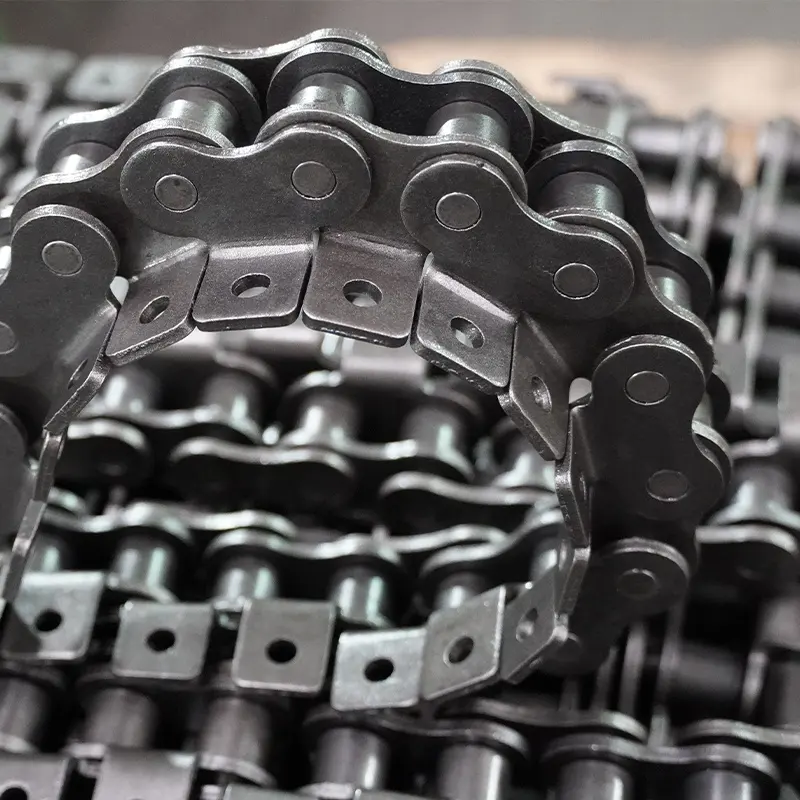
1. Flexibility: Roller chains have inherent flexibility, allowing them to adapt to slight misalignments between sprockets. The chain links can articulate and adjust their position to compensate for the angular misalignment. This flexibility helps to reduce stress on the chain and the sprockets.
2. Chain Articulation: The individual chain links in a roller chain are connected by pins, allowing them to rotate and articulate as the chain engages with the sprockets. This articulation enables the chain to follow the angular movement of the sprockets and maintain proper engagement. It helps to distribute the load evenly across the chain and minimize concentrated stresses on individual chain links.
3. Tolerance for Misalignment: Roller chains have a certain tolerance for angular misalignment between the sprockets. The exact amount of misalignment that a chain can handle depends on factors such as chain size, pitch, and design. However, it’s important to note that excessive misalignment can lead to accelerated wear, increased noise, and reduced chain life.
4. Proper Alignment: While roller chains can tolerate some degree of angular misalignment, it’s still essential to aim for proper sprocket alignment whenever possible. Proper alignment helps to optimize chain performance, minimize wear, and extend the lifespan of the chain and sprockets. Aligning the sprockets correctly ensures that the chain engages smoothly and uniformly with the sprocket teeth, reducing the risk of premature wear or failure.
5. Regular Inspection and Maintenance: To ensure optimal performance and longevity, it’s important to regularly inspect the roller chain system for any signs of misalignment or excessive wear. Routine maintenance, such as lubrication and tension adjustment, helps to mitigate the effects of misalignment and promotes smooth operation.
While roller chains can handle a certain degree of angular misalignment, it’s always recommended to minimize misalignment and strive for proper sprocket alignment to ensure optimal performance, efficiency, and longevity of the chain and sprocket system.


editor by CX 2023-08-30