Açıklama
Side Bow Chains Attachments
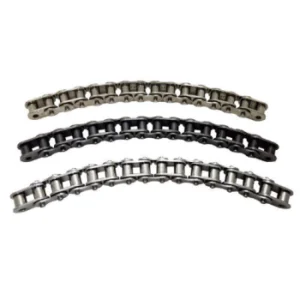
Side bow chains distinguish themselves through deliberate engineering tolerances that permit lateral deflection far beyond what conventional roller chains tolerate. An enlarged clearance between pin and bushing—coupled with meticulously calibrated play between inner and outer link plates—endows these chains with the essential pliancy to negotiate curved trajectories without binding or excessive wear. Industries deploy them wherever conveyance paths demand smooth directional transitions: think serpentine live-roll conveyors, radius-guided transfer lines, or enclosed drag systems threading through confined machinery footprints.
Carbon steel variants deliver robust economy for general-duty environments. Stainless steel executions—often 304 or the more resilient 316 grades—resist aggressive corrosion in washdown zones or chemically laden atmospheres. Chain lengths adapt readily to application geometry, while comprehensive attachment kits streamline field integration by bundling every requisite component.

Specifications of SB Series Side Bow Chains

| Chain No. | Pitch | Roller diameter | Width between inner plates | Pin diameter | Pin length | Inner plate depth | Plate thickness | Side bow radius | Ultimate tensile strength | Average tensile strength | Weight per meter | |
| P | d1 max | b1 min | d2 max | L max | Lc max | h2 max | t/T max | R | Q min | Q0 | q | |
| mm | mm | mm | mm | mm | mm | mm | mm | mm | kN/lbf | kN | kg/m | |
| 40SB | 12.700 | 7.95 | 7.85 | 3.96 | 16.9 | 18.1 | 11.7 | 1.50 | 350 | 13.8/3136 | 15.20 | 0.80 |
| 43SB | 12.700 | 7.95 | 7.85 | 3.45 | 18.3 | 19.5 | 11.7 | 1.50 | 305 | 12.0/2727 | 13.20 | 0.64 |
| 50SB | 15.875 | 10.16 | 9.40 | 4.37 | 20.7 | 22.7 | 14.9 | 2.03 | 400 | 20.6/4681 | 22.70 | 1.09 |
| 60SB | 19.050 | 11.91 | 12.57 | 5.34 | 26.6 | 28.4 | 18.0 | 2.42 | 500 | 15.7/3568 | 17.30 | 1.54 |
| 63SB | 19.050 | 11.91 | 12.68 | 5.08 | 28.8 | 30.6 | 17.2 | 2.42/2.03 | 350 | 12.5/2840 | 20.00 | 1.40 |
| 80SB | 25.400 | 15.88 | 15.75 | 7.19 | 34.0 | 37.3 | 24.0 | 3.25 | 711 | 40.9/9201 | 42.00 | 2.60 |
| #06BSBF1 | 9.525 | 6.35 | 5.72 | 3.05 | 13.5 | 15.0 | 8.2 | 1.30 | 300 | 8.0/1818 | 8.80 | 0.60 |
| 08BSB | 12.700 | 8.51 | 7.75 | 3.97 | 17.4 | 18.7 | 11.8 | 1.60 | 400 | 14.0/3182 | 15.40 | 0.70 |
| 08BSBF1 | 12.700 | 8.51 | 7.75 | 3.97 | 16.3 | 17.6 | 11.8 | 1.6/1.2 | 400 | 12.8/2909 | 14.10 | 0.65 |
| 10BSB | 15.875 | 10.16 | 9.65 | 4.50 | 20.1 | 21.5 | 14.7 | 1.70 | 400 | 15.6/3545 | 17.20 | 0.93 |
| 12BSB | 19.050 | 12.07 | 11.68 | 5.12 | 23.1 | 24.8 | 16.0 | 1.85 | 500 | 20.5/4658 | 22.60 | 1.16 |
| 16BSB | 25.400 | 15.88 | 17.22 | 7.90 | 36.5 | 39.7 | 21.0 | 3.7/3.0 | 500 | 55.6/12635 | 64.00 | 2.53 |
| #C2050SB | 31.750 | 10.16 | 9.40 | 5.08 | 21.3 | 22.6 | 15.0 | 2.03 | 800 | 21.8/4954 | 24.00 | 0.84 |
| #C2060SBF1 | 38.100 | 11.91 | 12.57 | 5.08 | 26.8 | 28.8 | 18.0 | 2.42 | 800 | 21.8/4954 | 24.00 | 1.17 |
| #C2062F6SB | 38.100 | 22.23 | 12.57 | 5.34 | 26.6 | 29.0 | 23.0 | 2.42 | 1100 | 15.7/3568 | 17.30 | 2.27 |
#Straight side plates
Details of Side Bow Chain Attachments
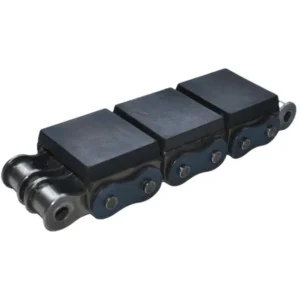
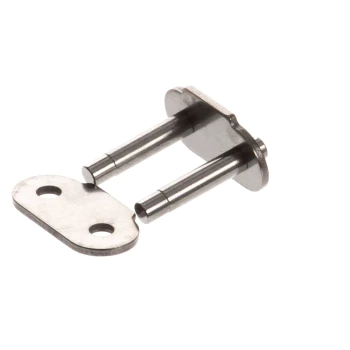
Attachments transform the base side bow chain into a purpose-built conveying medium. Extended pins accept K-style or M-style lugs for direct payload securement. Bent tabs, flat carrier plates in engineered polymers, or specialised conveyor flights bolt on effortlessly. The chain’s inherent side-flex capability remains uncompromised thanks to conical pin profiles or bi-conical bushings in select designs—features that minimise stress concentration during tight-radius negotiation.
These augmentations—whether simple bent attachments or complex slat carriers—exploit the chain’s augmented articulation. The result: reliable transport around arcs where rigid-link chains would seize or impose punishing side loads.
Sprockets Engineered for Chain Compatibility and Endurance
Sprockets remain the critical interface in any chain drive. Most side bow chains conform dimensionally to ISO 606 or ANSI B29.1 standards, enabling them to mesh seamlessly with standard roller chain sprockets. Clearance augmentation resides within the chain itself; tooth geometry needs no modification in the majority of cases.
Material Considerations in Sprocket Selection
Stainless steel sprockets—predominantly AISI 304—excel in corrosive or sanitary settings. For extreme chemical aggression or marine exposure, 316-grade offers superior pitting resistance. Carbon steel or case-hardened alloy sprockets suffice where environmental threats remain minimal yet high torque transmission prevails.
Idler sprockets equipped with integral ball bearings reduce frictional drag on return strands, prolonging system life in high-cycle operations.
Standards and Interchangeability Nuances
ISO sprockets dominate across American, European, and Asian machinery ecosystems due to their rigorous dimensional control. Metric equivalents provide greater flexibility, especially when mating with European-origin chains. Interchangeability prevails in most pairings. Rare exceptions arise from proprietary tooth forms or non-standard hub configurations.
Geometric Parameters That Dictate Performance
Chain pitch and roller diameter dictate sprocket tooth count and profile. Wide-tooth designs accommodate broader chains or those carrying heavy attachments. Narrow-tooth variants suit compact, high-speed drives. Bore diameter must align precisely with the drive shaft—keyed, splined, or taper-lock mounting ensures concentricity and torque transfer without slippage.
Wheel-like sprockets, toothed to engage chain rollers, bridge distances unattainable by meshing gears alone. Their kinship to bicycle drivetrains is unmistakable: precision engagement, minimal backlash, efficient power transmission over extended centre distances.
As a professional transmission parts manufacturer and supplier in China, HZPT offers a variety of high-quality drive chains and sprockets for sale. Contact now!