
Опис
Exploring Side Bow Roller Chains: Engineered for Lateral Articulation
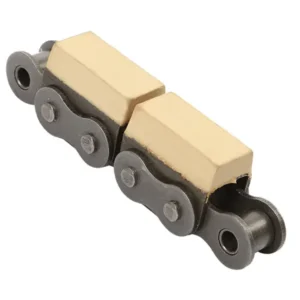
Side bow chains represent a specialized variant within the roller chain family, distinguished by their capacity for pronounced lateral deflection. Unlike conventional roller chains that prioritize linear rigidity, these chains incorporate deliberate clearances and modified geometries to enable smooth negotiation of curved paths. Industries reliant on serpentine conveying routes—such as food processing lines, bottling operations, and intricate assembly systems—frequently deploy side bow chains to maintain continuous motion without abrupt transitions or auxiliary transfer mechanisms.
The core innovation lies in the augmented tolerance between pins and bushings, coupled with narrowed inner link plates. This configuration permits partial articulation in the horizontal plane while preserving vertical joint integrity. Chains in the SB series, encompassing models from 40SB through 80SB, along with select British Standard derivatives, exemplify this design philosophy.

Fundamental Design Principles
Engineers achieve side bow functionality through two principal approaches. The first employs a conical pin profile, tapering subtly to facilitate angular displacement within the bushing bore. This variant tends toward economy yet exhibits modest compromises in pitch precision and long-term endurance under sustained high-velocity duty cycles. The alternative configuration relies on deliberately loosened tolerances between cylindrical pins and bushings. Superior durability emerges here, accompanied by enhanced fatigue resistance and more consistent chain elongation characteristics—attributes particularly valuable in demanding, high-speed environments.
Custom fabrications further expand applicability. Manufacturers can integrate specialized coatings, stainless steel construction for aggressive media, or extended pins to accommodate plastic flights and modular attachments. Such adaptability ensures compatibility across diverse operational envelopes.
Specifications of SB Series Side Bow Chains

| Chain No. | Pitch | Roller diameter | Width between inner plates | Pin diameter | Pin length | Inner plate depth | Plate thickness | Side bow radius | Ultimate tensile strength | Average tensile strength | Weight per meter | |
| P | d1 max | b1 min | d2 max | L max | Lc max | h2 max | t/T max | R | Q min | Q0 | q | |
| mm | mm | mm | mm | mm | mm | mm | mm | mm | kN/lbf | kN | kg/m | |
| 40SB | 12.700 | 7.95 | 7.85 | 3.96 | 16.9 | 18.1 | 11.7 | 1.50 | 350 | 13.8/3136 | 15.20 | 0.80 |
| 43SB | 12.700 | 7.95 | 7.85 | 3.45 | 18.3 | 19.5 | 11.7 | 1.50 | 305 | 12.0/2727 | 13.20 | 0.64 |
| 50SB | 15.875 | 10.16 | 9.40 | 4.37 | 20.7 | 22.7 | 14.9 | 2.03 | 400 | 20.6/4681 | 22.70 | 1.09 |
| 60SB | 19.050 | 11.91 | 12.57 | 5.34 | 26.6 | 28.4 | 18.0 | 2.42 | 500 | 15.7/3568 | 17.30 | 1.54 |
| 63SB | 19.050 | 11.91 | 12.68 | 5.08 | 28.8 | 30.6 | 17.2 | 2.42/2.03 | 350 | 12.5/2840 | 20.00 | 1.40 |
| 80SB | 25.400 | 15.88 | 15.75 | 7.19 | 34.0 | 37.3 | 24.0 | 3.25 | 711 | 40.9/9201 | 42.00 | 2.60 |
| #06BSBF1 | 9.525 | 6.35 | 5.72 | 3.05 | 13.5 | 15.0 | 8.2 | 1.30 | 300 | 8.0/1818 | 8.80 | 0.60 |
| 08BSB | 12.700 | 8.51 | 7.75 | 3.97 | 17.4 | 18.7 | 11.8 | 1.60 | 400 | 14.0/3182 | 15.40 | 0.70 |
| 08BSBF1 | 12.700 | 8.51 | 7.75 | 3.97 | 16.3 | 17.6 | 11.8 | 1.6/1.2 | 400 | 12.8/2909 | 14.10 | 0.65 |
| 10BSB | 15.875 | 10.16 | 9.65 | 4.50 | 20.1 | 21.5 | 14.7 | 1.70 | 400 | 15.6/3545 | 17.20 | 0.93 |
| 12BSB | 19.050 | 12.07 | 11.68 | 5.12 | 23.1 | 24.8 | 16.0 | 1.85 | 500 | 20.5/4658 | 22.60 | 1.16 |
| 16BSB | 25.400 | 15.88 | 17.22 | 7.90 | 36.5 | 39.7 | 21.0 | 3.7/3.0 | 500 | 55.6/12635 | 64.00 | 2.53 |
| #C2050SB | 31.750 | 10.16 | 9.40 | 5.08 | 21.3 | 22.6 | 15.0 | 2.03 | 800 | 21.8/4954 | 24.00 | 0.84 |
| #C2060SBF1 | 38.100 | 11.91 | 12.57 | 5.08 | 26.8 | 28.8 | 18.0 | 2.42 | 800 | 21.8/4954 | 24.00 | 1.17 |
| #C2062F6SB | 38.100 | 22.23 | 12.57 | 5.34 | 26.6 | 29.0 | 23.0 | 2.42 | 1100 | 15.7/3568 | 17.30 | 2.27 |
#Straight side plates
Comparative Geometry Insights
Observe how inner plate widths remain slimmer relative to equivalent standard roller chains, reducing interference during curvature. The side bow radius parameter quantifies permissible bend severity; tighter radii demand correspondingly greater internal clearances, influencing overall chain dynamics and wear distribution.
Distinct Advantages Over Conventional Roller Chains
Side bow chains excel in applications necessitating continuous curvilinear travel. Their reduced centering projection—facilitated by centrally grooved inner links—permits deeper pivot immersion during transitions, yielding superior lateral stability even at elevated chain speeds. Operating costs often prove lower than segmented conveyor alternatives employing multiple transfer points or specialized radius sprockets.
Bi-directional flexibility constitutes another salient feature. Chains readily deflect leftward or rightward without preferential orientation, simplifying layout design in complex routing scenarios. For elevated temperature regimes or mildly corrosive atmospheres, stainless variants or proprietary surface treatments extend service intervals markedly.
Wear characteristics benefit from advanced metallurgy and pre-tensioning protocols. High pretension mitigates initial elongation, while enhanced fatigue endurance withstands cyclic loading inherent in curved trajectories. In aggregate, these attributes position side bow chains as a robust, versatile solution for modern conveying challenges.
Compatible Sprockets and System Integration
Most side bow chains interface seamlessly with standard sprockets conforming to ISO or ANSI specifications. Tooth profiles remain unchanged, eliminating the need for bespoke wheel geometries in the majority of installations. Material selection spans carbon steel for general duty through 304 or 316-grade stainless for sanitary or aggressive environments. Idler sprockets incorporating integral ball bearings further enhance tension management in extended curved spans.
Correct sprocket selection hinges on precise matching of chain pitch, roller diameter, and bore requirements. Wide-tooth configurations suit heavier loads, whereas narrower profiles optimize lighter, high-speed duties. Bore dimensions must accommodate shaft tolerances to preclude misalignment-induced wear.
As a professional transmission parts manufacturer and supplier in China, HZPT offers a variety of high-quality drive chains and sprockets for sale. Contact now!