Enquiries: [email protected] — Fast response, UK B2B supply
Why Roller Chain Lubrication Is Not Optional
Inside every roller chain drive, three distinct contact zones are permanently under stress. The pin-to-bushing interface bears the full articulation load every time a link enters or exits the sprocket. The bushing-to-roller interface deals with the friction generated as the roller seats against each sprocket tooth. The roller-to-sprocket tooth interface transmits the actual drive force. In a poorly lubricated chain, metal-to-metal contact develops progressively at all three points. The result is a phenomenon UK maintenance engineers often describe simply as “elongation” — technically, wear elongation — where the pitch of the chain increases beyond the tolerance that the mating sprockets were designed to accommodate. Once elongation reaches approximately 3% for most standard chains, the chain can no longer seat correctly on the sprockets, accelerating both wear and vibration until failure becomes inevitable.
Adequate lubrication, when applied correctly by the appropriate method, performs several functions simultaneously. It separates the metal surfaces with a fluid film that carries load and dissipates heat, reducing the coefficient of friction at each contact zone. It flushes wear debris and contamination out of internal clearances rather than allowing abrasives to embed and grind away surface material. It also provides a degree of corrosion protection on internal surfaces that are otherwise impossible to treat with external coatings. Sheffield’s heavy-duty steel fabrication sector and Birmingham’s precision machining industry both make extensive use of roller chains in environments where moisture, fine metallic particulate, and cutting fluid mist are ever-present — making the choice of lubrication method as important as the choice of chain grade itself.
The ISO 10823 standard, which most British industrial procurement teams reference, recognises that no single lubricant application method is universally optimal. Selection must account for peripheral speed (measured at the pitch circle of the smaller sprocket), the applied load, whether the system runs continuously or intermittently, and the practicality of access for maintenance. What follows is a detailed examination of each primary method, structured to help engineers weigh these variables against their own installation conditions.
Udvalgte rullekædeprodukter
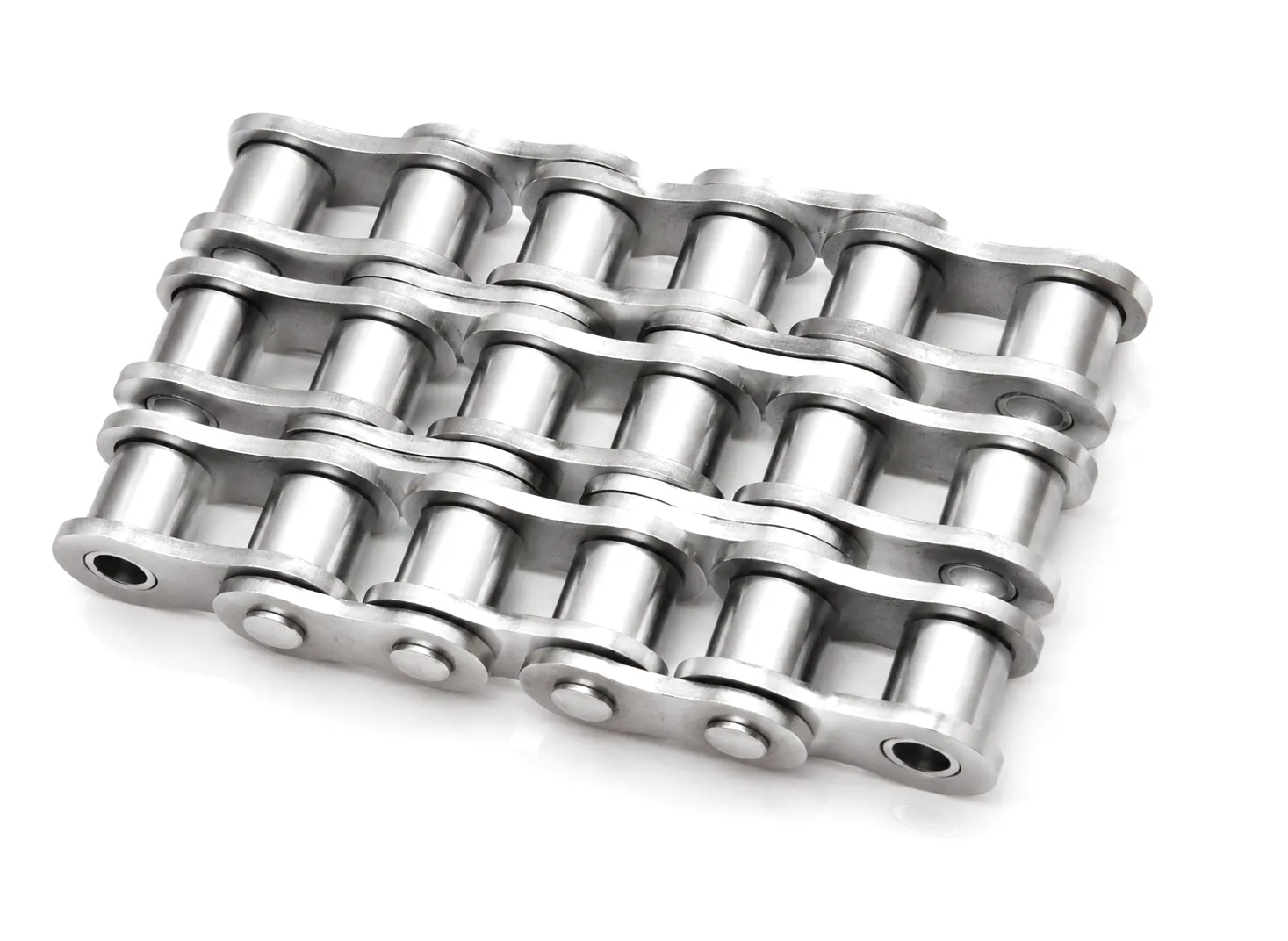
Højstyrke rullekæde 120HSP-00
Engineered for Caterpillar-class machinery applications requiring maximum tensile strength and precision pitch consistency under extreme cyclic loading.
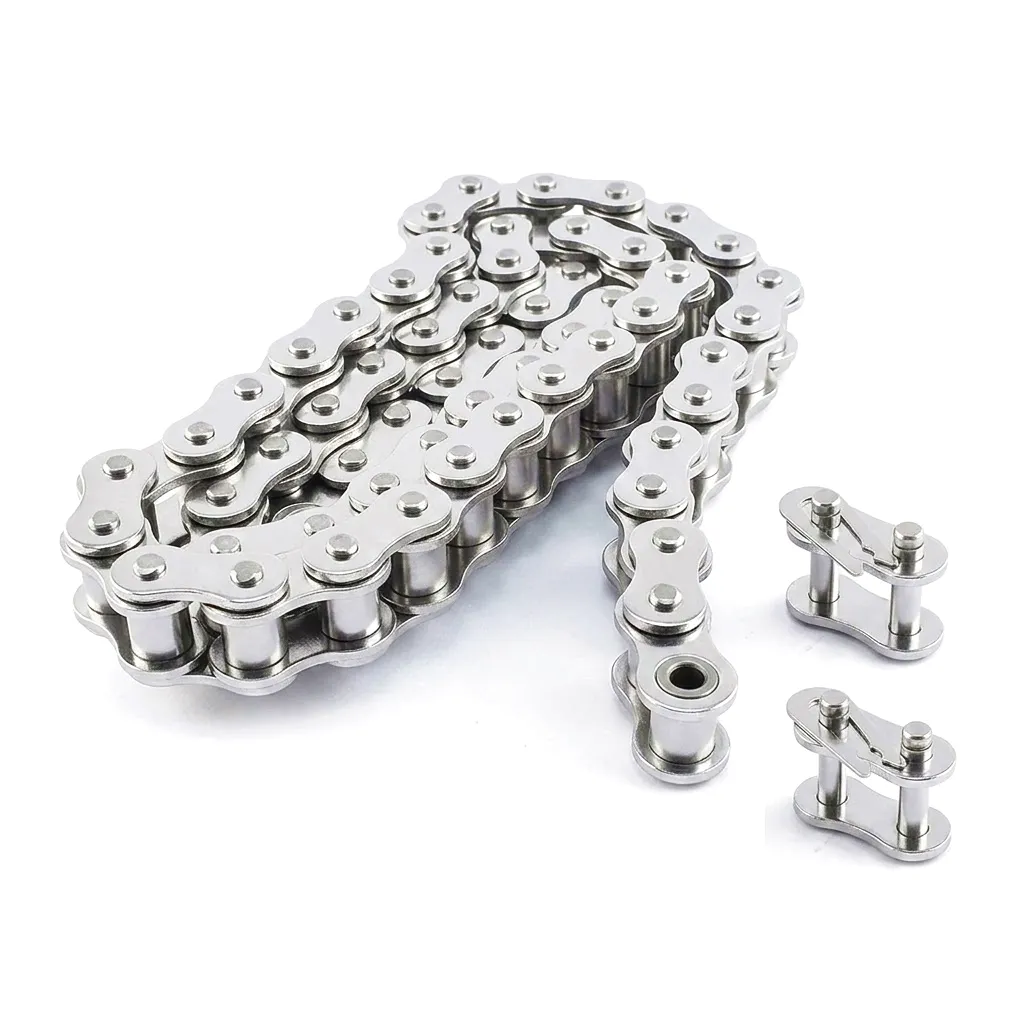
Højstyrke rullekæde C100HSP-00
C100HSP-00 series roller chain delivers outstanding fatigue resistance and dimensional accuracy, purpose-matched to Caterpillar equipment requirements in mining, construction, and heavy logistics.
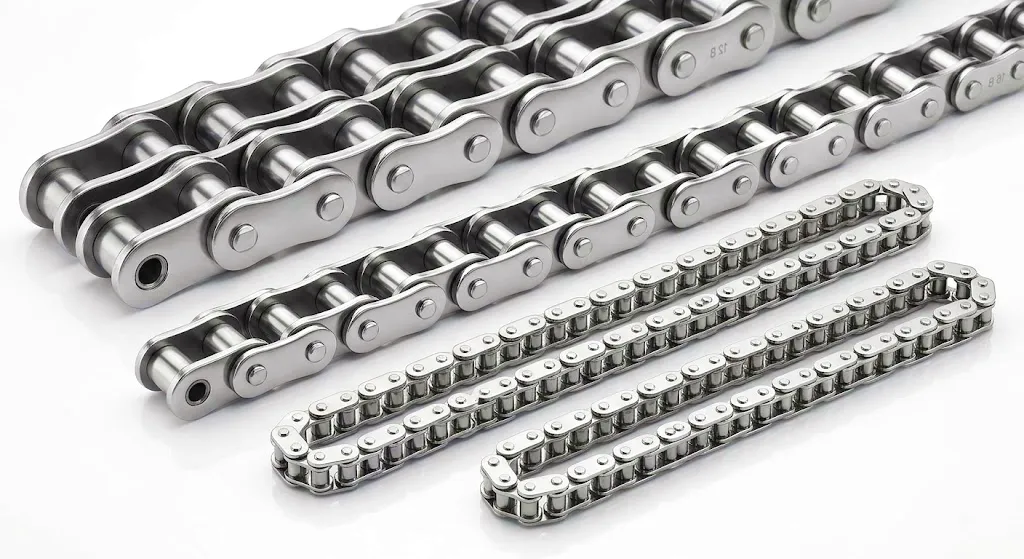
Drip Lubrication: Controlled Delivery for Low-to-Medium Speed Chains
SPEED RANGE
< 4 m/s
Pitch-circle velocity
TYPICAL OIL GRADE
ISO VG 100
–220 depending on load
BEST SUITED
Light–Medium
Load duty cycles
COST
Low
Capital & running costs
Oil Bath Lubrication: Continuous Immersion for Medium-Speed Drives
Oil bath lubrication represents the next tier of lubrication intensity. Here, the lower run of the roller chain is designed to run continuously through a sump of oil contained within a sealed or semi-sealed chain case. As the chain rotates, it carries oil from the bath up to the working surfaces and the sprocket mesh, and the surplus oil drains back into the sump by gravity. This continuous, self-renewing supply makes oil bath systems substantially more reliable than drip methods for medium-speed applications — typically covering the peripheral speed range from approximately 4 m/s up to around 8–10 m/s depending on pitch and load conditions.
The engineering of the oil bath installation must be done carefully, particularly with regard to the immersion depth. If the chain dips too deeply into the oil sump, it agitates the oil excessively, generating heat through churning losses and promoting foaming that compromises the film-forming capability of the lubricant. The recommended immersion depth for the chain link plates is typically in the range of 6–12 mm below the oil surface during operation — enough to ensure adequate pickup without generating excessive turbulence. In UK manufacturing environments where chain case temperature monitoring is not universal, engineers often identify churning issues first through unexpected oil temperature rises or the appearance of aeration in the sump oil.
Another often-overlooked factor is oil level maintenance. Bath lubrication systems are only as reliable as the discipline applied to monitoring and topping up the sump. In facilities across the West Midlands automotive supply chain, where multi-shift operations are standard, it is not uncommon for oil levels to drop significantly between scheduled checks, particularly in systems with worn case seals that allow slow oil migration. Establishing a regular inspection interval — typically every two weeks for moderate-duty drives — and using sight glasses or dip markers rather than relying on estimates is good practice that many facilities underinvest in.
Oil changes in bath systems should be performed at intervals determined by operating temperature and the degree of contamination experienced. For sealed systems in relatively clean environments, annual oil changes are typical. In foundries, steel rolling mills, or food processing plants where airborne contamination is significant — scenarios common in Sheffield’s remaining metals processing sector — more frequent changes prevent abrasive particle accumulation that would otherwise accelerate wear despite the presence of a continuous oil supply.
Disc (Splash) Lubrication: Mechanical Throw for Enclosed High-Speed Drives
Forced-Feed Pressure Circulation: Premium Lubrication for High-Speed, High-Load Drives
Forced-feed, or pressure circulation, lubrication systems represent the highest tier of roller chain lubrication technology. Here, a dedicated gear pump — or a branch circuit from a larger plant lubrication system — delivers oil under controlled pressure through hard pipework or flexible hose to a nozzle or jet directed precisely at the open side of the chain strand, immediately before the chain engages the sprocket. The jet penetrates the interior of the chain at the point of maximum articulation, delivering lubricant directly to the pin-bushing interface where it is needed most rather than relying on capillary action or centrifugal throw to migrate inward.
For roller chain drives operating above approximately 14 m/s — or for heavily loaded chains at lower speeds where heat rejection and consistent film maintenance are critical — forced-feed lubrication is not a luxury but an engineering necessity. The oil flow rate delivered by the pump is typically controlled by a flow valve and monitored by a pressure switch or flow meter, allowing the system to trigger an alarm or shutdown in the event of pump failure, blocked lines, or dangerously low reservoir level. In critical production lines — paper mills in north-west England, cement plants in the Peak District, or offshore platform ancillary drives — this fail-safe functionality translates directly into production security that no gravity-fed system can offer.
The hydraulic circuit associated with forced-feed systems typically incorporates an oil cooler — often a simple shell-and-tube or plate heat exchanger — to manage the thermal load that high-speed, high-power roller chain drives generate. Without temperature control, the oil viscosity will drop as the system heats up, reducing film-forming capability precisely when loading is highest. A bypass thermostat valve can be incorporated so that cold oil at startup bypasses the cooler until the oil reaches operating temperature, preventing excessive viscosity that would raise pump outlet pressure and stress seals.
Nozzle positioning deserves careful attention in forced-feed installations. The jet should be aimed at the inner face of the chain — specifically at the gap between the inner and outer link plates on the slack side of the drive, as the chain enters the small sprocket. At this point the link is about to articulate and the pin is at its most accessible. Directing the jet at the taut side or at the outer plates achieves little beyond wetting the external surfaces, which provides minimal protection to the internal bearing surfaces where wear actually occurs. This distinction is one that separates engineering-led roller chain installations from those specified purely on cost.
Roller Chain Lubrication Methods: Technical Performance Comparison Table
| Parameter | Drip | Oil Bath | Disc / Splash | Forced-Feed |
|---|---|---|---|---|
| Max Peripheral Speed (m/s) | Up to 4 | 4 – 8 | 8 – 14 | > 14 (and critical loads) |
| Lastkapacitet | Light – Medium | Medium | Medium – Heavy | Heavy |
| Typical Oil Viscosity (ISO VG) | 100 – 220 | 100 – 320 | 68 – 220 | 46 – 150 |
| Cooling Effect | Minimal | Moderate | Moderate | Good (with cooler) |
| Contamination Flushing | Poor | Moderate | Moderate | Good (with filtration) |
| Required Enclosure | Not required | Sealed case | Sealed case | Enclosed / Guarded |
| Fail-Safe Monitoring | Manual only | Sight glass | Sight glass | Pressure switch / Flow meter |
| Capital Cost | £ Low | ££ Moderate | ££ Moderate | £££ Higher |
| Ideal Industry Segment (UK) | Light packaging, conveyors | Agri, food processing | Automotive, logistics | Steel, mining, paper |
Industrial Application Scenarios: Matching Method to Environment
Automotive Assembly — Birmingham & Coventry
Transfer lines, body-shop conveyors, and component handling systems running at medium-to-high speeds in multi-shift environments benefit from disc or forced-feed systems. The heat generated by continuous duty and the contamination from machining coolant mist require lubricant delivery methods that actively purge debris and maintain consistent film thickness regardless of chain temperature variation between shifts.
Agricultural Machinery — East Midlands & East Anglia
Combine harvesters, balers, and grain handling equipment present a challenging lubrication scenario: slow chain speeds during full-load harvesting, seasonal operation, and extreme dust contamination. Oil bath systems with sealed cases are standard on enclosed drives, while drip lubrication or manual application remains common on exposed roller chains on agricultural equipment where access for maintenance is limited during the harvest season across Lincolnshire and Norfolk operations.
Steel Processing — Sheffield & Scunthorpe
Rolling mill ancillary drives, scale conveying systems, and slab handling equipment in Sheffield’s surviving steel industry demand forced-feed lubrication as standard. Scale particles, steam, and elevated ambient temperatures render any passive lubrication system entirely inadequate. Forced-feed systems with filtration and coolers maintain the roller chain in serviceable condition in environments where a poorly lubricated chain would fail within days, causing production losses that far exceed the cost of a properly specified lubrication system.
Food Processing — Yorkshire & Humberside
Roller chains in food processing facilities face a unique regulatory constraint: lubrication must be food-grade (NSF H1 or H2 classified) to protect product integrity. This affects viscosity selection and fluid compatibility. Drip systems using food-grade chain oil are widely used on slow conveyors, while bath and forced-feed systems deploying food-grade lubricants are appropriate for faster, enclosed drives. The washdown regimes common in Yorkshire poultry and bakery operations mean that roller chain lubrication systems must be capable of reestablishing adequate film coverage quickly after each hygiene cycle.
Customer Success: Sheffield Steel Fabrication — Forced-Feed Upgrade Case Study
Heavy Steel Fabrication
Lubrication Method Upgrade
A structural steel fabricator based in the Attercliffe industrial corridor of Sheffield was experiencing recurring roller chain failures on the drive systems serving their heavy plate conveying lines. The chains — duplex roller chains operating at approximately 6 m/s under full load — were being lubricated by an oil bath system installed when the facility was commissioned over fifteen years earlier. The chain case seals had deteriorated, the sump oil level was difficult to monitor reliably, and scale contamination entering through worn case joints was accelerating pin-bushing wear to the point where the maintenance team was replacing chains every three to four months at significant cost in both parts and unplanned downtime during shift changes.
Working with Ever Power’s technical team, the facility’s engineering manager specified a transition to a forced-feed lubrication circuit incorporating an in-line 10-micron filter, a compact plate oil cooler, and stainless-steel jet nozzles directed at the chain entry point on both the primary drive and the return strand. Ever Power supplied matched replacement roller chains in a high-strength, sealed-joint variant pre-lubricated with the forced-feed system’s operating oil grade. The upgraded system was commissioned during a planned maintenance weekend, requiring no structural modifications to the existing chain case beyond fitting new case seals and drilling the nozzle mounting points.
The outcome, monitored over the following twelve months, showed chain wear elongation reduced from the previous 3% failure threshold reached in under 90 days, to a measured 0.8% elongation at twelve months of continuous operation — well within the replacement threshold. The facility’s maintenance planner estimated the total first-year saving in chain replacement parts, labour, and production downtime exceeded £28,000, making the capital cost of the forced-feed system recover in under six months.
“Ever Power’s roller chains were the first we’ve run through our forced-feed system that actually maintained their specified pin-bushing clearance at the twelve-month inspection. Previous suppliers’ chains showed measurable wear within six months despite identical operating conditions. The dimensional consistency from Ever Power is genuinely in a different class.”
— Maintenance Engineering Manager, Heavy Fabrication Facility, Sheffield
“We specified Ever Power for a custom pre-lubricated roller chain variant for our food-grade conveyor application in our Leeds facility. The team not only sourced NSF H1 compliant lubricant but confirmed compatibility with our washdown detergents before supply. That level of technical support from a chain supplier is genuinely unusual and saved us a significant amount of validation work.”
— Production Engineering Director, Food Processing Plant, Leeds
“We moved our West Midlands automotive parts facility entirely to Ever Power’s high-strength roller chain range after trial on two lines. The disc lubrication system we run at 11 m/s showed no abnormal wear after nine months — compared to the 4-month replacement cycle we’d been on with our previous supplier. Procurement and delivery were straightforward, with full certification documentation provided on the first order.”
— Plant Manager, Automotive Components Supplier, Solihull
Selecting the Right Lubrication Method: A Practical Decision Framework
The selection process for roller chain lubrication method is most reliably structured around three primary variables: chain peripheral speed, applied transmitted power per strand, and operating environment. The ISO 10823 standard provides a graphical chart that plots these variables against recommended lubrication type — a reference that experienced UK maintenance engineers and procurement specialists consult as standard when specifying new drives or evaluating existing systems for upgrade.
Environmental factors modify the theoretical selection significantly. A system that the ISO chart would classify as suitable for oil bath lubrication might require forced-feed if the operating environment generates heavy contamination — as would be the case in the raw material handling areas of cement plants in Derbyshire or the dusty conditions of aggregate processing facilities across the Pennine quarrying belt. Conversely, a system theoretically requiring disc lubrication might be adequately served by an oil bath if speeds are at the lower end of the range, the load factor is modest, and the operating environment is clean and enclosed.
Maintenance practicality is a legitimate engineering input, not a compromise to apologise for. A forced-feed system installed in a location where maintenance access is difficult and pump serviceability is limited is a worse engineering choice than a well-implemented oil bath system that maintenance staff can inspect and service routinely. The best lubrication method is the one that will be maintained consistently at the correct condition over the full service life of the roller chain installation — a principle that applies as much to a small conveyor drive in a Lancashire textile mill as to a heavy-duty chain drive in a North Sea platform support vessel’s deck machinery.
One dimension that is frequently underestimated in UK industry is the interaction between the lubrication method and the chain’s factory pre-lubrication state. High-quality roller chains supplied by manufacturers such as Ever Power incorporate factory-applied lubricant within the pin-bushing clearance during assembly, delivered under controlled conditions that ensure complete internal wetting before the chain is ever subjected to load. This pre-lubrication is particularly important for drip-fed and bath-lubricated chains, where penetration of the operating lubricant into internal clearances is indirect and relies on articulation rather than pressure injection. Beginning service life with a well-lubricated chain rather than a dry or inadequately lubricated one extends the service interval until the first measurable wear is detected and reduces the critical run-in wear that often disproportionately shortens overall chain life.
Frequently Asked Questions About Roller Chain Lubrication
Ever Power — UK B2B Supply
Ready to Specify the Right Roller Chain for Your Drive?
Whether you need standard ISO series chains, Caterpillar-spec high-strength product, or a custom pre-lubricated variant for a specific UK industrial application, Ever Power’s technical team is ready to assist.
redigeret af gzl