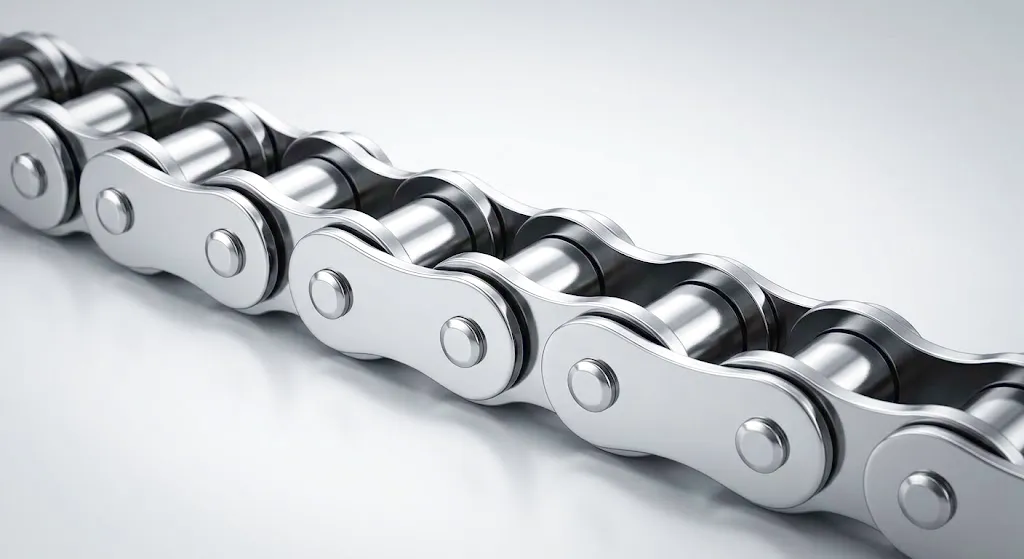
Curved conveyor systems present a mechanical challenge that straight-run chains simply cannot meet. Wherever a production line needs to redirect product flow around corners, bends, or spiral inclines — without adding a transfer point that introduces complexity, cost, and potential product damage — side-bow roller chain steps in as the engineered solution. Unlike standard ANSI or BS roller chain, side-bow chain is purpose-designed to flex laterally, allowing the chain to navigate horizontal curves while maintaining continuous drive engagement with sprockets or guide tracks. For UK manufacturers in food processing, automotive assembly, pharmaceuticals, and distribution logistics — sectors concentrated in and around Birmingham, Sheffield, Coventry, and the wider East Midlands — this chain type has become indispensable to modern lean-flow line design.
The engineering principle behind side-bow roller chain rests on the geometry of its inner and outer link plates. Conventional roller chain plates are rectangular with parallel sides, making the assembly rigid in the lateral plane. Side-bow chain replaces these with barrel-shaped or specially contoured plates whose curved profiles allow adjacent links to articulate — not only in the vertical plane as standard chain does — but also through a controlled horizontal arc. The degree of lateral flexibility is measured as the side-bow angle per link pitch, and it varies across different chain series to suit different conveyor bend radii. Getting this selection right from the outset avoids premature wear, fatigue cracking, and the unplanned downtime that UK plant managers simply cannot afford in a competitive manufacturing environment.
How Side-Bow Roller Chain Works: The Mechanical Principle
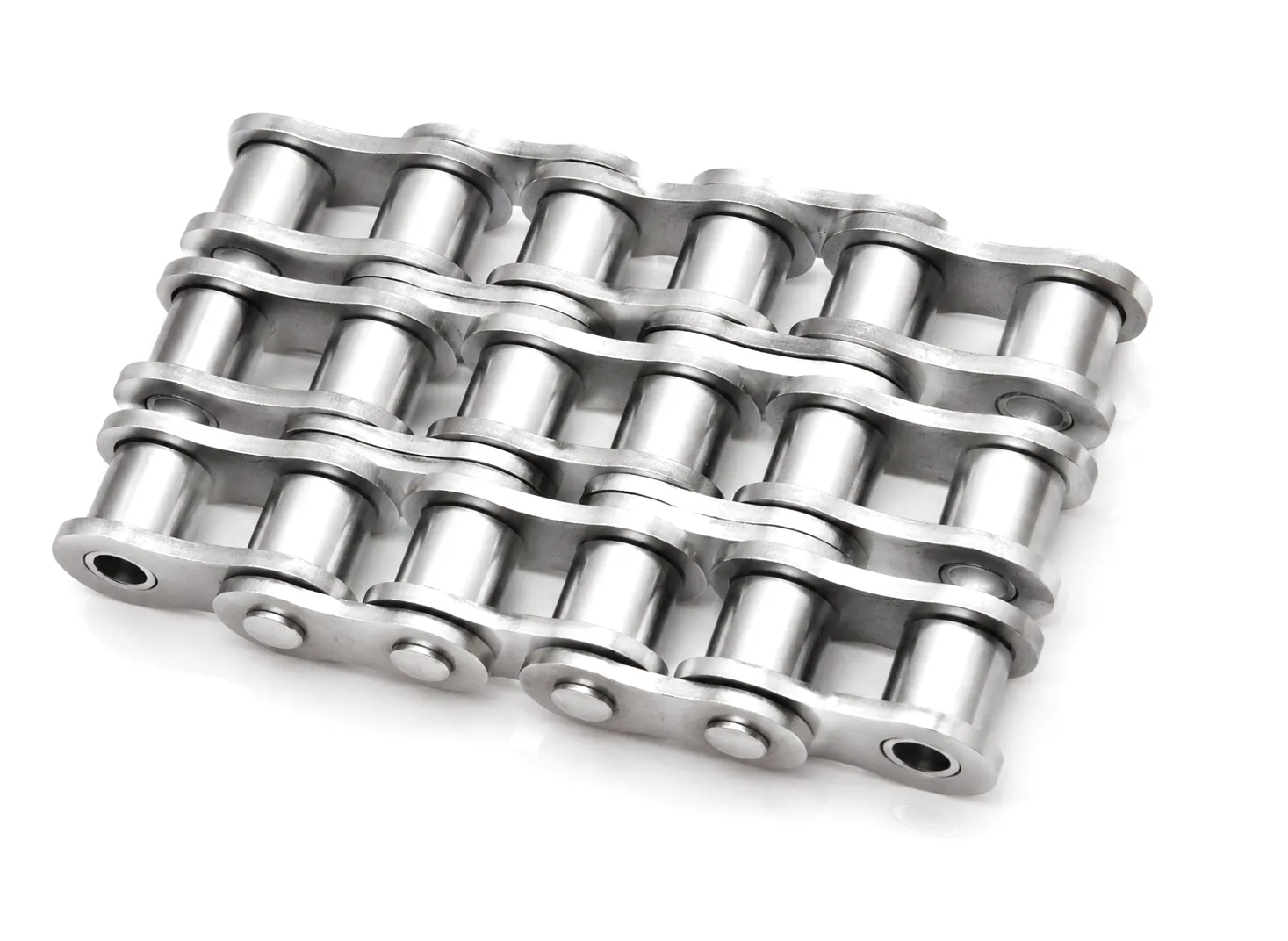 The mechanics of side-bow roller chain are rooted in controlled link articulation. Each link assembly consists of an inner link plate pair joined by a bush and roller, connected to an outer link plate pair via a precision-ground pin. In a standard roller chain, the clearance between the pin and bush is just enough to allow rotation in one plane. In a side-bow chain, the pin diameter is slightly reduced relative to the hole diameter in the plate, and crucially, the plate thickness at the link head is tapered or radiused. This geometry allows each link joint to rotate a few degrees sideways — typically 0.5° to 3° per pitch depending on the chain series — without inducing stress concentration at the plate or pin. Across a full metre of chain with 40 or 50 pitches, that small per-link angle compounds into a smooth, continuous horizontal curve capable of navigating 90° or even 180° bends within remarkably compact radii.
The roller itself plays a critical secondary role in curved operation. As the chain traverses a bend, the rollers on the outer arc travel a longer path than those on the inner arc, generating differential forces across the chain width. High-quality side-bow chains use hardened rollers with tight dimensional tolerances so that contact pressure against guide rails or sprocket teeth distributes evenly. A poorly manufactured roller with out-of-round geometry will develop flat spots within weeks on a curved conveyor, raising vibration levels and accelerating wear on guide channels. This is why the manufacturing precision of the roller — its roundness, hardness, and surface finish — matters far more on curved conveyors than on straight-run systems where dynamics are relatively benign.
Drive engagement on curved sections is typically achieved through a flat-top or attachment plate chain that rides along a guide rail rather than engaging a conventional toothed sprocket at the bend. The sprockets drive the chain on the straight entry and exit sections, while the guide rail — often UHMWPE or hardened steel — steers the chain around the curve. The side-bow geometry ensures that as the chain presses against the outer guide at each link joint, the load distribution is smooth and predictable. Engineers designing these systems for facilities in Sheffield’s advanced manufacturing sector or the automotive plants around Birmingham use the chain’s lateral stiffness rating and minimum bend radius specification as the two primary parameters for system layout.
Engineered for Caterpillar-pattern heavy equipment, delivering outstanding tensile strength and fatigue resistance in demanding curved drive applications.
C-series configuration with heavy-gauge side plates, ideal for curved conveyor drives where lateral flexibility and high load capacity must be balanced precisely.
Core Manufacturing Materials and Metallurgical Grade Selection
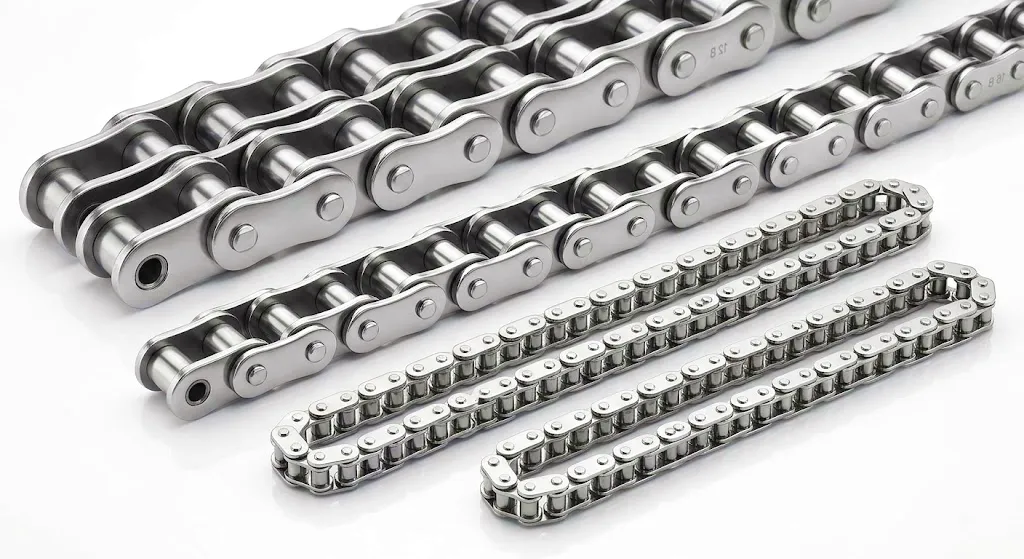
The performance of a side-bow roller chain in a curved conveyor application is fundamentally governed by the material specification of its five key components: the side plates, the bush, the pin, the roller, and the connecting hardware. Each of these sees a distinct stress environment during curved operation, and material selection must address not just tensile load but also fatigue cycling, abrasive contact, and — in sectors like food processing or pharmaceuticals — corrosion resistance and hygiene compliance.
Link plates in standard-duty side-bow chain are manufactured from medium-carbon alloy steel — typically a grade equivalent to BS 970 535M15 or the Japanese SCM415 standard — cold-blanked and then case-carburised to achieve a surface hardness of 58–62 HRC while retaining a tough, ductile core. The carburising depth for side-bow plates is calibrated carefully: too shallow a case and the plate head will wear rapidly at the bore; too deep and the plate becomes brittle at the root radius, initiating fatigue cracking under the lateral bending that curved conveyors impose. For high-load or elevated-temperature applications — such as paint-shop overhead conveyors in automotive facilities around Coventry — nickel-chromium steel grades are substituted for their superior hardenability and retained hardness at temperatures up to 200°C.
The pin is the highest-stressed single component in a side-bow chain. Under normal straight-run loading the pin experiences pure torsion and bending; on a curved conveyor it additionally carries a side load component that rotates with each link pitch as the chain arcs through the bend. High-quality pins are manufactured from chrome-molybdenum bar stock, through-hardened to 40–45 HRC for a uniform hardness profile, then ground to h6 tolerances on the outer diameter. This combination of material toughness and dimensional precision ensures that the pin-bush contact — the highest wear couple in the assembly — remains within design clearance limits for the rated service life, even under the oscillating side loads of curved operation. In hygienic environments such as food production facilities across the Yorkshire Dales or Lincolnshire’s agricultural processing sector, stainless steel grade 316L is specified for all chain components to meet industry hygiene standards.
Case-carburised SCM415 / BS 535M15. Surface 58–62 HRC, tough core. Used in majority of industrial curved conveyor applications.
Retains hardness up to 200°C. Specified for automotive overhead conveyors, paint shops, and heat-treatment tunnel applications.
Full corrosion resistance, washdown compatible. Mandatory for food, beverage, pharmaceutical, and meat processing conveyors.
Oil-impregnated sintered bronze or polymer-lined bush variants for lube-free operation in clean rooms and enclosed environments.
Technical Performance Parameters: Side-Bow Roller Chain Specification Table
| Parámetro | Pitch 3/4″ (19.05 mm) | Pitch 1″ (25.4 mm) | Pitch 1-1/4″ (31.75 mm) | Pitch 1-1/2″ (38.1 mm) |
|---|---|---|---|---|
| Breaking Load (min.) | 22.2 kN | 31.3 kN | 44.5 kN | 60.0 kN |
| Max. Lateral Bow Angle (per link) | +/- 1.5° | +/- 2.0° | +/- 2.5° | +/- 3.0° |
| Minimum Bend Radius (horizontal) | 600 mm | 800 mm | 1,000 mm | 1,200 mm |
| Plate Material | Alloy Steel / SS316L | Alloy Steel / SS316L | Alloy Steel / Ni-Cr | Alloy Steel / Ni-Cr |
| Pin Hardness | 40–45 HRC | 40–45 HRC | 40–45 HRC | 40–45 HRC |
| Roller Surface Hardness | 58–62 HRC | 58–62 HRC | 58–62 HRC | 58–62 HRC |
| Operating Temperature (std.) | -10°C to +150°C | -10°C to +150°C | -10°C to +200°C | -10°C to +200°C |
| Max. Allowable Load (working) | 5.5 kN | 7.8 kN | 11.1 kN | 15.0 kN |
| Chain Mass (per metre) | 1.4 kg/m | 2.5 kg/m | 3.8 kg/m | 5.4 kg/m |
Core Technical Advantages of Side-Bow Roller Chain
A single continuous side-bow chain loop can navigate multiple bends in sequence, removing the transfer conveyors, pop-up wheels, and dead-plates that conventional systems require at direction changes. This directly reduces line complexity, maintenance costs, and the risk of product spillage or damage at transitions — a significant benefit in bottling lines, packed goods logistics, and component assembly operations across the UK’s food and drink sector.
UK manufacturing sites — many housed in Victorian-era industrial buildings or constrained brownfield developments around Sheffield and Manchester — often cannot accommodate the large turning circles that belt conveyor curve sections demand. Side-bow roller chain’s minimum bend radius, as low as 600 mm for smaller pitch variants, allows conveyor designers to route product lines through architecturally complex spaces that would otherwise require expensive building modifications or a complete redesign of the production layout.
The geometric design of side-bow chain does not compromise tensile load capacity compared with equivalent-pitch standard roller chain. The breaking loads cited in the specification table above are comparable to ANSI or BS equivalent straight-run chain ratings. This means engineers are not forced to upsize the chain series when applying it in curved sections, which would increase the chain mass, drive power requirement, and sprocket cost across the entire system installation.
When correctly specified and lubricated, high-quality side-bow roller chain achieves service lives of 8,000–15,000 operating hours in typical curved conveyor applications. The controlled clearance at the pin-bush joint, combined with case-hardened wear surfaces, distributes side-wear evenly rather than concentrating it at one failure point. For UK operations running 24/7 shifts — common in pharmaceutical packaging sites in the home counties or logistics hubs around the East Midlands — these extended intervals translate directly into measurable OEE improvements.
The graduated lateral articulation of side-bow chain means the chain tracks through guide curves without the periodic chordal impact seen in straight chain engaging small-diameter sprockets. Combined with precision-ground rollers and carefully specified internal clearances, well-manufactured side-bow chains run substantially quieter than improvised curved conveyor solutions involving modified standard chain, making them suitable for environments where noise regulations — such as those enforced by the UK’s Control of Noise at Work Regulations 2005 — must be observed.
Side-bow chain is routinely manufactured with flat-top attachment plates, K-attachments, or bent-lug attachments that allow direct product carriage or fixture mounting. The attachment geometry is designed to maintain product stability even as the chain navigates a horizontal curve, which is essential in applications such as glass bottle conveying in the UK’s beverage sector, where bottles must remain upright through multi-bend line layouts within bottling halls.
Industrial Application Scenarios for Side-Bow Roller Chain
Food and Beverage Processing Lines — Yorkshire and the Humber
Yorkshire’s food manufacturing corridor — running through Hull, Doncaster, and Leeds — is home to some of the UK’s largest ready-meal, bakery, and beverage production facilities. These operations typically run complex multi-bend conveyor layouts on hygienically sensitive production floors where the ability to negotiate corners without transfer points is not just a convenience but a food safety requirement. Side-bow roller chain in stainless steel 316L configuration allows the conveyor to be completely pressure-washed and sanitised in place, with no dead-plate zones where food residue can accumulate. Pitch sizes of 19.05 mm and 25.4 mm dominate this sector, matched with UHMWPE guide rails that minimise chain wear and eliminate the risk of metallic contamination on the production floor.
Automotive Body-Shop and Overhead Conveyors — West Midlands and Coventry
The automotive manufacturing cluster around Birmingham and Coventry relies heavily on overhead power-and-free conveyors to move body-in-white assemblies, painted shells, and sub-assemblies through multi-stage production sequences. These conveyors must navigate complex 3D layouts — combining vertical inclines with horizontal curve transitions — within building structures designed decades ago. Side-bow roller chain with nickel-chromium alloy link plates is the chain of choice here: it handles the dual demand of elevated temperatures in paint and e-coat tunnels, where ambient temperatures can reach 180–200°C, while still delivering the lateral flexibility needed to negotiate the tight horizontal radii that arise when re-routing lines around support columns and service runs in these constrained environments.
Pharmaceutical Packaging and Blister-Pack Lines — Oxford and the Thames Valley
Pharmaceutical manufacturing in the Thames Valley and around Oxford demands conveyor systems that combine absolute cleanliness with precise, smooth product transport. Blister packs, vials, and bottled medications are fragile — even a small vibration peak or lateral jolt as the product passes through a conveyor bend can cause breakage or misalignment that triggers costly visual inspection and rejection. Self-lubricating side-bow roller chain — featuring oil-impregnated sintered bronze or PTFE-lined polymer bushes — eliminates the need for external lubrication in these controlled environments, where lubricant contamination of pharmaceutical products would have regulatory consequences. The ability to specify the chain with ISO class 6 tolerances on all ground components gives validation engineers the dimensional evidence they need for equipment qualification documentation.
Distribution Logistics and E-Commerce Fulfilment — East Midlands and Corby
The concentration of major distribution centres and e-commerce fulfilment operations in the East Midlands — particularly around Corby, Northampton, and the M1/M6 logistics corridor — means that compact, high-throughput curved conveyor systems have become one of the fastest-growing application areas for side-bow roller chain. These facilities process thousands of parcels per hour across intricate multi-level conveyor networks that must fit within large but architecturally fixed building footprints. Side-bow chain enables the spiral and helical conveyor sections that route packages between mezzanine levels and sortation zones, maintaining continuous positive drive even on steep inclines where belt slip would cause costly sortation errors. In these 24/7 operations, the chain’s service life and the availability of same-day replacement stock from a reliable UK-serving supplier are defining factors in total cost of ownership.
Steel and Metal Processing — Sheffield and South Yorkshire
Sheffield’s steel sector — though transformed since the twentieth-century decline of mass steelmaking — remains home to specialist high-value metal processing, forging, and precision engineering operations. Within these facilities, side-bow roller chain serves in heat treatment furnace transfer conveyors, shot-blasting line entry systems, and multi-stage washing and drying sequences where the chain must perform reliably in abrasive environments with intermittent high-temperature exposure. Heavy-pitch roller chain in the 38.1 mm range, manufactured from nickel-chromium alloy with heat-resistant O-ring seals at the pin joints, is commonly specified here to handle loads of 15 kN and above while negotiating the 90° bends that are unavoidable in these linear-process layouts.
Ever Power: Precision Manufacture, Deep Customisation, and Supply Chain Certainty
Ever Power has invested over two decades in developing its industrial chain manufacturing capability into one of the most technically complete operations available to global B2B buyers. The company’s production infrastructure covers every stage of the chain manufacturing process in-house: steel bar selection and incoming material certification, precision cold-drawing and blanking of link plates to ANSI/BS tolerances, carburising and hardening in controlled-atmosphere furnaces, pin centreless grinding to h6 tolerances, roller turning and ID/OD grinding, assembly and pre-load stretching, and final dimensional verification against customer-specific acceptance criteria. This fully vertical production model is what allows Ever Power to guarantee dimensional and metallurgical consistency between batches — a requirement that engineering buyers at Tier 1 automotive suppliers and pharmaceutical OEM facilities rightly insist upon.
The customisation capability at Ever Power’s facility goes well beyond adjusting pitch and breaking load. The engineering team routinely develops bespoke side-bow chain specifications that match the precise bend radius geometry of a customer’s existing conveyor guide system — meaning the chain is designed around the conveyor rather than forcing the conveyor designer to compromise on radii to suit a catalogue item. For British conveyor builders sourcing for new facility builds or legacy conveyor refurbishments — common in the maintenance and capital projects pipelines of food production, distribution, and automotive customers — Ever Power can deliver engineering drawings, 3D CAD models, and material certification packs alongside physical product, enabling smooth integration into the project documentation chain required by UK health and safety and quality management frameworks.
Supply chain reliability is not an afterthought at Ever Power. The company maintains finished goods buffer stock for its most popular side-bow chain configurations, with expedited airfreight shipping available for urgent replacement orders to minimise unplanned downtime at customer facilities across the UK. Consistent lead times, consolidated shipment coordination through established UK freight partners, and proactive stock alerts for long-term supply agreements give procurement managers the forward visibility they need to maintain their own lean inventory positions without the risk of production stoppages.
Customer Success: Barnsley Ready-Meal Facility Eliminates Transfer-Point Failures
A mid-sized ready-meal manufacturer operating two production facilities on the outskirts of Barnsley, South Yorkshire, had been running a chilled product conveyor system with a series of belt-to-belt transfer points at every direction change in the layout. The facility produced around 80,000 packaged meals per shift and had recorded an average of three to five conveyor-related production stoppages per week, the majority caused by products catching or tipping at the transfer dead-plates between belt segments. Each stoppage cost approximately 12 minutes of output at the main tray-sealing line, accumulating to a measurable annual throughput loss with direct impact on contracts with major UK grocery retailers.
The company’s engineering manager made contact with Ever Power after reading technical documentation on continuous-curve conveyor solutions for food manufacturing environments. Following an on-site survey and CAD-based layout analysis, Ever Power’s engineering team recommended a 19.05 mm pitch stainless steel 316L side-bow roller chain with flat-top attachment plates and UHMWPE guide channels to replace four separate belt conveyor sections and their associated transfer assemblies. The new chain ran a single continuous circuit through two 90° bends and one 45° sweep, completely eliminating the problematic dead-plate zones. The custom specification included a reduced lateral bow angle per link — 1.2° versus the catalogue standard — to suit the existing guide channel geometry, achieved through minor plate contouring at the pressing stage in Ever Power’s factory.
The installation was completed over a single planned weekend shutdown. In the eight months since commissioning, the production line has recorded zero conveyor-related stoppages attributable to the modified sections, and the reduction in product damage at direction changes has eliminated a secondary quality inspection resource that had been permanently deployed at one of the removed transfer points. The engineering manager estimates the total project payback period at under ten months when the recovered output, reduced maintenance labour, and secondary headcount saving are combined.
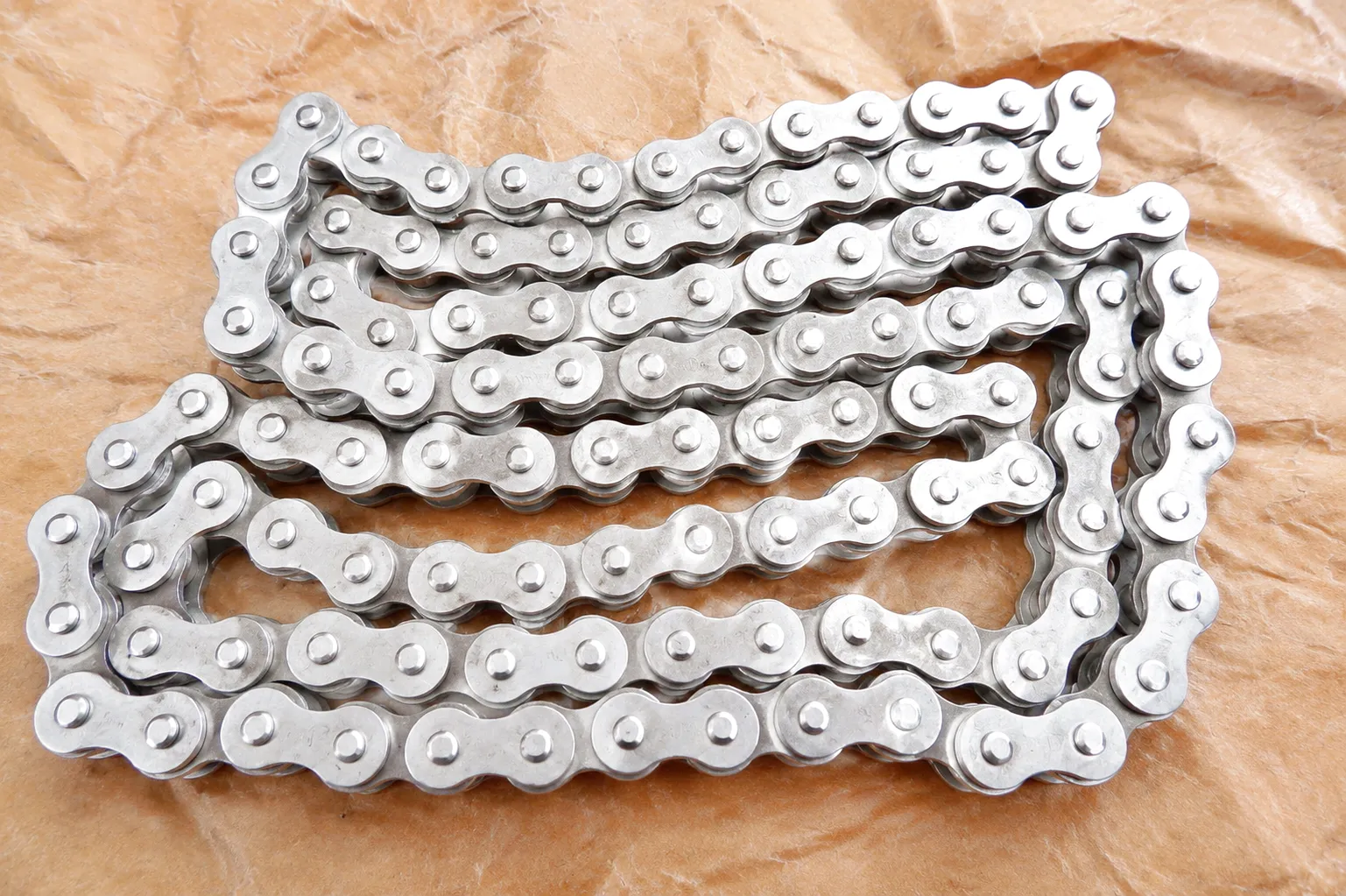
“The custom bow angle they produced to match our existing guide channels was exactly to drawing. Not a single shimming adjustment needed on installation. Ever Power’s attention to the dimensional specifics saved us at least a day on-site.”
“We’ve been through three different chain suppliers in seven years on this line. Ever Power’s 316L side-bow chain is the first that has gone past twelve months without visible elongation on the curved sections. The material quality is clearly a step above what we were buying before.”
“Response time from initial enquiry to delivered drawings was four working days. For a conveyor OEM on a tight project schedule, that kind of turnaround from a custom chain supplier is genuinely rare. The chain itself arrived with full EN 10204 3.1 material certs — exactly what our automotive end client specifies.”
Design and Selection Guide: Choosing the Right Side-Bow Chain Specification
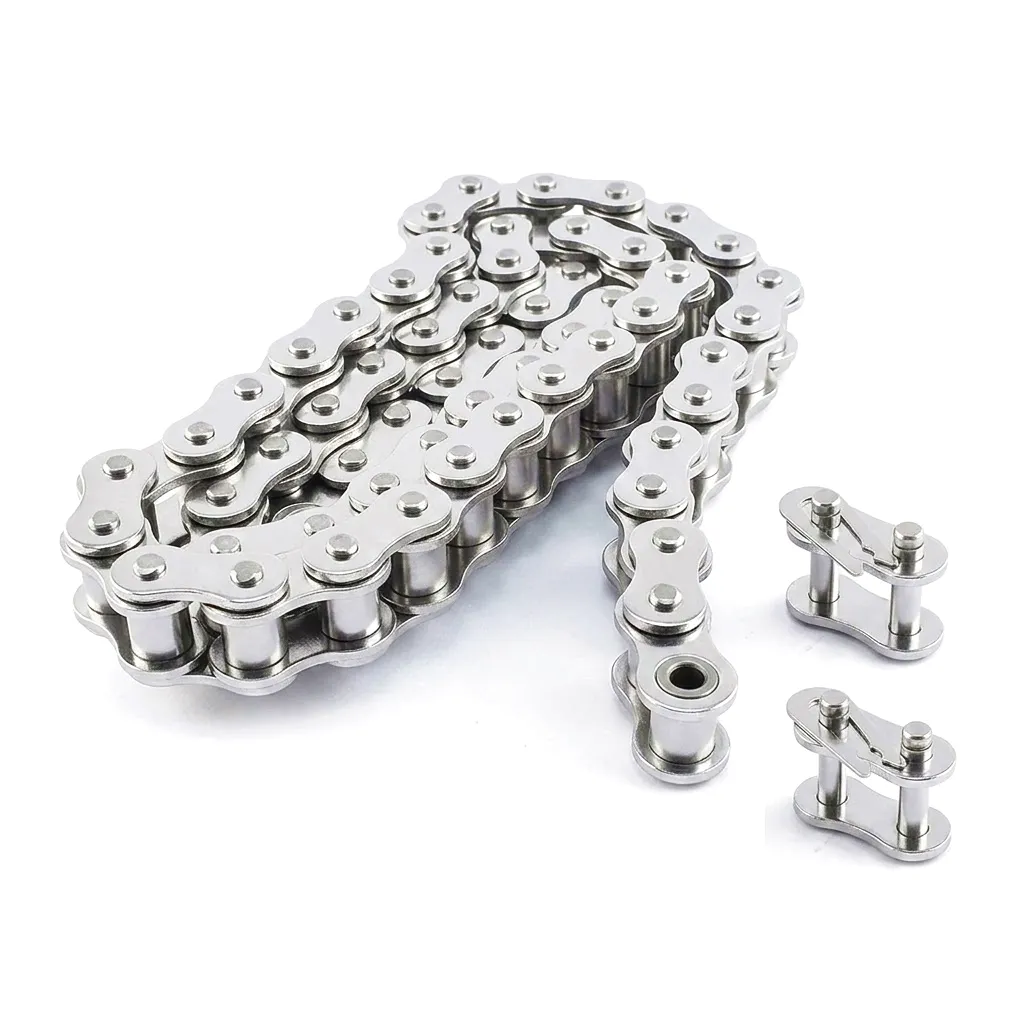
Selecting the correct side-bow roller chain specification for a curved conveyor application involves five parameters that must be determined before issuing a purchase enquiry. Skipping any of these leads either to an unnecessarily expensive chain or, more dangerously, to a chain that will fail prematurely and invalidate any warranty coverage the supplier might otherwise provide.
Measure the tightest horizontal curve in the guide system and confirm this is equal to or greater than the chain’s rated minimum bend radius. Verify in both plan view and any combined incline-plus-curve sections where the effective radius reduces.
Calculate the total chain pull, accounting for product weight, chain self-weight, friction in the guide channels, and any incline forces. Apply a service factor of 1.5–2.5 depending on starting frequency and shock loads, then compare against the chain’s rated maximum allowable working load.
Specify the operating temperature range, exposure to washdown chemicals, humidity, abrasive particulates, or food-contact requirements. This determines whether standard alloy steel, SS316L, or Ni-Cr grades are appropriate, and whether self-lubricating bush options are needed.
Confirm whether the chain carries products directly (requiring flat-top or attachment-plate variants) or acts purely as a drive chain. Specify attachment pitch — every link, every other link, or custom intervals — and define any hole patterns or mounting features required in the attachment plate.
Determine whether continuous drip lubrication, manual periodic lubrication, or a fully dry/self-lubricating chain is required. Self-lubricating variants cost more up-front but eliminate lubrication maintenance entirely, which is often the lowest total cost option across a 5-year service life in 24/7 operations.
Frequently Asked Questions — Side-Bow Roller Chain for UK Buyers
Send your bend radius, load requirements, and environmental specification to the Ever Power engineering team for a detailed technical proposal and commercial quotation.