 Within any chain drive system, it is easy to focus solely on the chain itself — its pitch, its tensile strength, the steel specification of its link plates. What is far less often examined with the same rigour is the sprocket: specifically, the precise geometry of each tooth that contacts the chain rollers. The tooth profile is not an incidental detail. It is the interface where all mechanical energy transfers from the driving shaft to the driven shaft, and where the consequences of poor design accumulate over thousands of operating hours. In UK manufacturing environments — from the forging shops of Sheffield to the automotive assembly lines of the West Midlands — roller chains operate under demanding duty cycles, often in contaminated or thermally variable conditions. In these settings, the gap between a well-profiled sprocket and a mediocre one can mean the difference between a drive that outlasts its intended service interval and one that consumes maintenance budget at a rate nobody budgeted for.
Understanding what the tooth profile actually does — mechanically, tribologically, and dynamically — is the starting point for any serious effort to extend the service life of a roller chain installation. This article walks through that understanding with enough technical depth to be genuinely useful to engineers making specification decisions, while remaining accessible to procurement and maintenance professionals who need to evaluate suppliers and make the case for quality internally.
What the Tooth Profile Actually Does
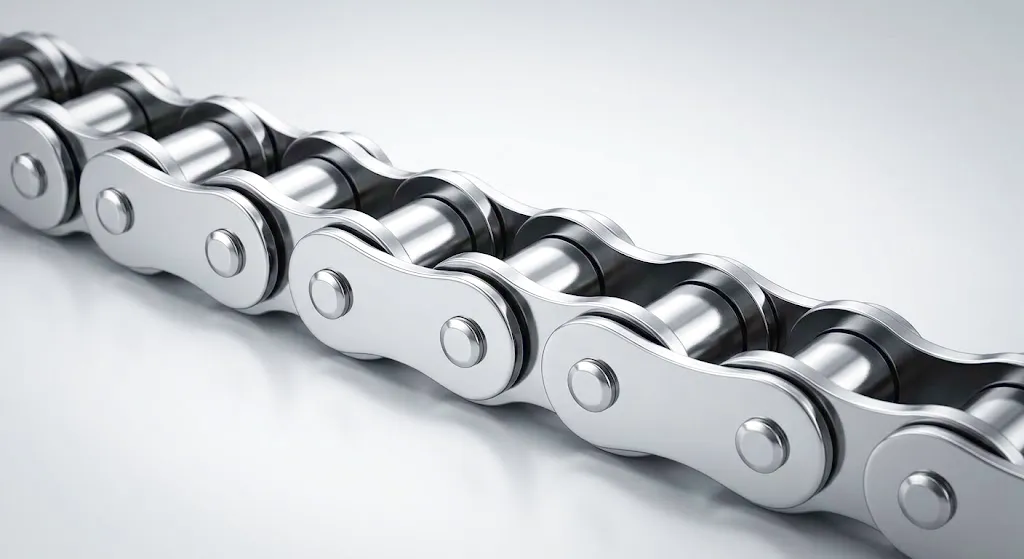
When a roller chain engages a sprocket, the rollers do not simply drop into a pocket and stay there passively. Each roller approaches the tooth at a specific angle, makes contact at a point that shifts depending on chain tension and speed, rolls into the seating curve, and then leaves the tooth as the chain wraps around and departs. This sequence happens hundreds of times per minute at typical industrial speeds. The tooth profile — encompassing the seating curve radius, the working flank geometry, the topping radius, and the pressure angle — determines how smoothly that sequence occurs and how evenly the load is distributed across the contact area.
A tooth profile that is correctly proportioned to the chain’s nominal pitch and roller diameter creates a situation where the roller seats fully before any meaningful load transfer begins. This means the impact energy at engagement is absorbed gradually rather than delivered as a shock pulse into the link plates and bearing pins. The result is quieter operation, lower peak stresses in the chain components, and reduced material fatigue over time. Conversely, a tooth form that is slightly off — even by fractions of a millimetre in seating curve radius — causes the roller to contact the flank before seating properly, which concentrates load on a small area and initiates accelerated wear from the very first engagement cycle.
The working flank angle, which defines the effective pressure angle during load-bearing contact, controls how the tangential driving force is transmitted. A shallower pressure angle keeps more of the force acting in the intended direction of chain travel, reducing the lateral component that pushes the chain sideways and loads the side plates against the sprocket flanges. This matters enormously in roller chain applications where misalignment is difficult to eliminate entirely, as is common in agricultural machinery, food processing conveyors, and the kind of retrofit industrial installations found throughout manufacturing regions like Birmingham and Coventry.
고강도 롤러 체인 제품 추천
고강도 롤러 체인 120HSP-00
Precision-engineered for Caterpillar equipment demands. The 120HSP-00 delivers superior tensile strength with a tooth-seating geometry optimised for heavy-shock load environments — ideal for UK construction and quarrying operations where duty cycles are severe and downtime costs are significant.
고강도 롤러 체인 C100HSP-00
The C100HSP-00 brings extended pitch capability and enhanced link plate fatigue resistance to the Caterpillar drive train. Tooth engagement geometry on matched sprockets is held to tighter tolerances than standard ISO profiles, supporting consistent performance across the full service life without elongation-induced pitch error build-up.
Seating Curve Geometry and Its Impact on Roller Chain Wear
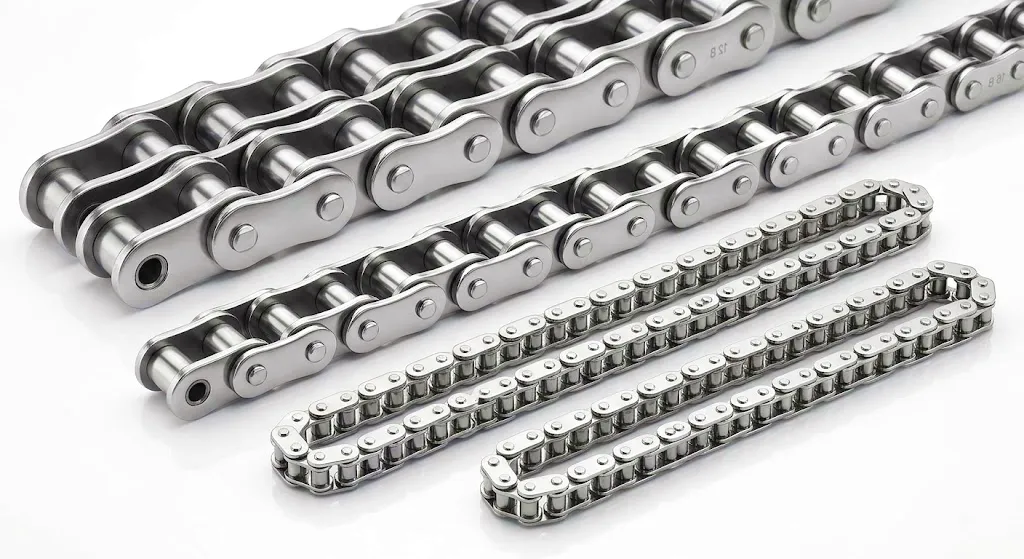 The seating curve — sometimes called the bottom radius — is the concave portion of the tooth that cradles the roller when the chain is under load. ISO 606 and the equivalent British standard specify this radius as a function of roller diameter, but the standard allows a range rather than a single value. Manufacturers operating at the upper end of that tolerance range create looser engagement that gives the roller more freedom of movement within the tooth pocket, which feels like a reasonable safety margin but actually introduces micro-impacts every time the chain changes speed or direction. Over a shift-long operating period, those micro-impacts add up to wear volumes that would surprise most maintenance engineers who have not measured them directly.
The optimal seating radius is one that holds the roller snugly enough to prevent this rocking motion while still allowing the roller to rotate freely. Roller rotation matters because it distributes the contact stress over the circumference of the roller rather than concentrating it on a single arc, which would produce flat-spotting. A tooth with a seating curve ground to within a micron of the target radius, using a CNC profile grinding process, consistently outperforms a tooth cut by conventional hobbing without final grinding — particularly after the drive has accumulated enough hours for the initial surface finish differences to manifest as measurable pitch variation.
Roller Chain & Sprocket Technical Performance Parameters
Representative values for standard British Standard simplex roller chains per ISO 606 / BS228
| Chain Standard | 피치(mm) | 롤러 직경(mm) | 최소 인장 강도(kN) | Tooth Seating Radius Range (mm) | Typical Sprocket Material | 표면 경도(HRC) |
|---|---|---|---|---|---|---|
| BS 06B-1 | 9.525 | 6.35 | 9.1 | 3.28 – 3.33 | C45 / Grade 50 | 48 – 52 |
| BS 08B-1 | 12.70 | 8.51 | 18.2 | 4.40 – 4.46 | C45 / Alloy steel | 50 – 55 |
| BS 10B-1 | 15.875 | 10.16 | 22.4 | 5.24 – 5.31 | 42CrMo4 | 52 – 58 |
| BS 12B-1 | 19.05 | 11.91 | 29.0 | 6.15 – 6.23 | 20MnCr5 | 55 – 60 |
| BS 16B-1 | 25.40 | 15.88 | 60.0 | 8.19 – 8.29 | 42CrMo4 / SCM440 | 58 – 62 |
| BS 20B-1 | 31.75 | 19.05 | 95.0 | 9.82 – 9.95 | 16MnCr5 case-hardened | 60 – 64 |
* Seating radius tolerance ranges follow ISO 606:2015 and BS 228. Actual hardness values depend on heat treatment process selected.
Working Flank Design: Balancing Load Capacity and Smooth Disengagement
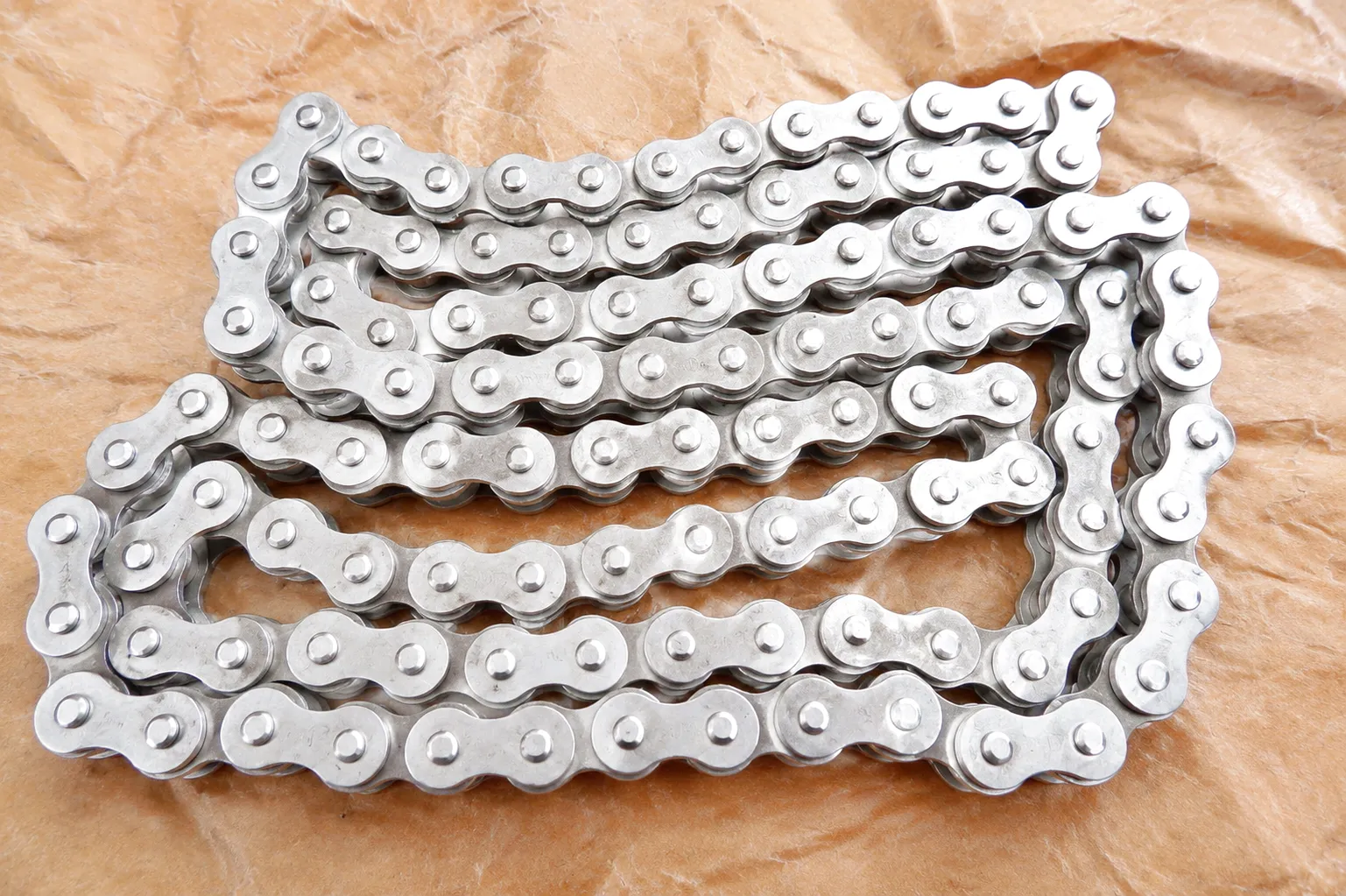 The working flank is the part of the sprocket tooth that bears the primary driving load. In a correctly sized and tensioned roller chain drive, the working flank should be loaded across a broad contact band rather than at a single point, and the angle of that flank should direct the resultant force as nearly as possible toward the line connecting the two sprocket centres. Deviations from this ideal — caused by worn sprockets, incorrect chain pitch due to elongation, or simply a poorly specified tooth form from the outset — introduce force components that work against the drive’s intended geometry.
One of the important practical points for UK drive system engineers is that the working flank angle interacts directly with the wrap angle of the chain on the sprocket. A small sprocket running at high speed with a shallow wrap angle already struggles to distribute load across multiple teeth simultaneously. If the tooth profile is additionally such that only one or two teeth are ever truly load-bearing, the Hertzian contact stresses at those teeth become enormous, producing surface fatigue and pitting within a fraction of the chain’s theoretical life. This is a failure mode that the Sheffield steel industry, for example, would recognise from conveyors and roll drives where high loads and smaller sprocket diameters are unavoidable due to space constraints.
The transition curve that connects the working flank to the seating curve must be smooth and continuous. A sharp transition — which can result from a worn cutter or incorrect setup during sprocket manufacture — creates a stress concentration at that junction. Under cyclic loading, this concentration can initiate a fatigue crack in the sprocket tooth root. In cast iron sprockets, commonly used in lower-speed applications throughout British food processing plants and textile machinery, this type of cracking can propagate rapidly because cast iron has limited crack arrest capability compared to wrought steel.
Core Materials in Roller Chain and Sprocket Manufacturing
Case-Hardening Steels
Grades 16MnCr5 and 20MnCr5 are the workhorses of quality sprocket manufacture. The low-carbon core remains tough enough to resist shock fracture while the carburised outer layer reaches 58–64 HRC, providing the wear resistance needed at the tooth flank contact zone. These grades are widely stocked in the UK through distributors like Aalco, making repair sprocket supply relatively straightforward for maintenance teams.
Induction-Hardened Medium Carbon
C45 and 42CrMo4 are chosen when the designer wants selective hardening of the tooth profile only, leaving the hub and bore region in a tougher, lower-hardness condition. Induction hardening generates a compressive residual stress layer at the tooth surface, which actively inhibits fatigue crack initiation. This approach is increasingly favoured in UK heavy industry where retrofit sprockets must fit existing bore dimensions and keyway configurations without the distortion risks associated with through-hardening.
Stainless Steel Grades
AISI 316L and 304 are used where corrosion resistance takes priority over maximum hardness — food and beverage production, pharmaceutical conveying, and coastal or marine installations. Tooth profile accuracy is harder to hold in stainless because the material work-hardens rapidly during machining, demanding sharper tooling, lower cutting speeds, and more frequent tool changes. Well-resourced manufacturers account for this in their process design; budget suppliers typically do not, resulting in sprocket tooth profiles that are out of tolerance before the sprocket even leaves the factory.
Engineering Polymers
Nylon PA66 and acetal (POM-C) sprockets find application in light-duty conveyors, packaging machinery, and applications where metal-on-metal noise is unacceptable. The tooth profile geometry for polymer sprockets differs subtly from steel equivalents — slightly larger seating radii are used to account for the greater elastic deformation of the polymer under load, and tooth heights are often increased slightly to maintain adequate contact during that deformation. Dimensional stability at elevated temperatures must be considered because polymer sprockets can distort significantly above 80°C, which changes the effective tooth profile.
Working Principle: How Sprocket Tooth Profile Controls Chain Motion
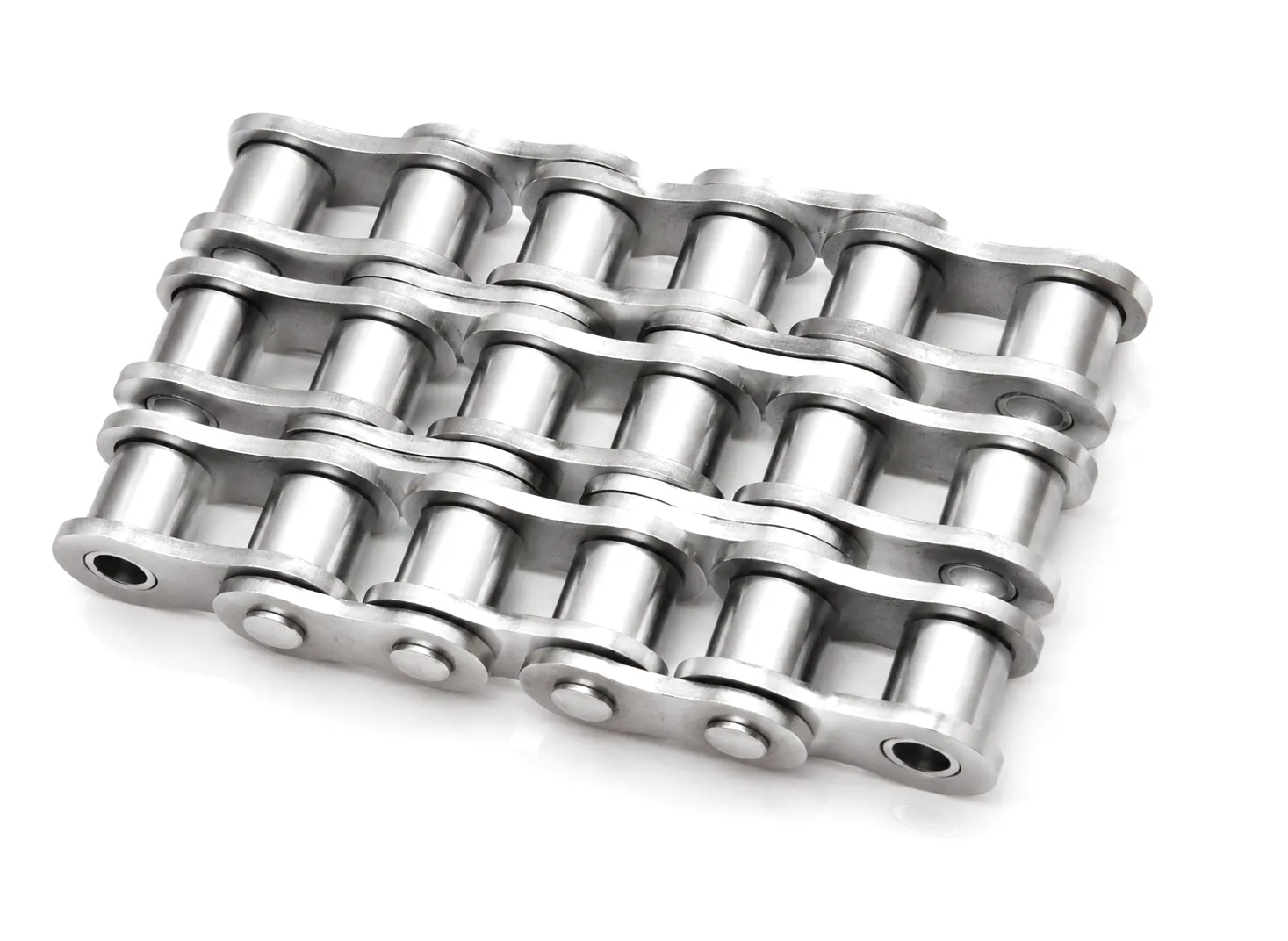 The mechanical principle underpinning roller chain and sprocket interaction is often described as a polygon effect. Because the chain is composed of rigid links of fixed pitch, as it wraps around a sprocket it does not follow a true circular arc but rather a polygon whose number of sides equals the sprocket tooth count. This means the chain’s linear velocity is not constant even when the sprocket rotates at constant angular velocity — it rises and falls slightly with each pitch of engagement. The amplitude of this velocity variation is inversely related to the number of teeth on the sprocket: a 9-tooth sprocket produces roughly four times the velocity variation of an 18-tooth sprocket at the same pitch.
The tooth profile modulates this effect. A profile with a longer, more gradual engagement curve — where the roller makes contact with the tooth flank at a greater distance from the pitch circle before migrating into the seating position — effectively extends the engagement period for each tooth. This extended engagement dampens the velocity pulse because the load transfer happens over a larger arc of sprocket rotation. The practical consequence, which roller chain drive engineers working with high-speed packaging lines or precision conveyors in places like Swindon or Milton Keynes will recognise immediately, is that correctly profiled sprockets reduce vibration-induced positional errors in the driven system.
Chain elongation — the gradual increase in effective pitch that results from bearing pin and bush wear — eventually causes the roller chain to ride up the tooth flanks toward the tooth tip rather than seating correctly. The tip radius of the tooth profile is engineered to accommodate a defined amount of this elongation before engagement becomes geometrically incompatible with the sprocket. British Standards guidance suggests replacing a roller chain that has elongated beyond 1.5% of its nominal pitch length, but the actual threshold at which engagement quality degrades depends significantly on the tip radius and flank geometry of the specific sprocket in use.
영국 제조업 부문 전반에 걸친 산업 응용 시나리오
🏭 Heavy Industrial Conveying — West Midlands & Sheffield
Steel and forging plants across Sheffield and Rotherham operate roller chains on billet transfer conveyors and quenching line drives where temperatures routinely exceed 200°C and contamination from scale and lubricants is constant. The sprocket tooth profile in these applications must be designed for the higher effective pitch of a thermally expanded chain while maintaining engagement quality. High-tooth-count sprockets with induction-hardened working flanks and case-hardened seating curves are standard in this sector, with the roller chain itself typically specified to a high-strength grade with solid rollers rather than hollow to resist the impact loads from heavy billets.
🌾 Agricultural Machinery — East Anglia & Yorkshire
Combine harvesters, balers, and seed drill drives operating across the arable farming regions of East Anglia and the Yorkshire Wolds subject roller chains and sprockets to highly seasonal but intensively loaded operating patterns. The tooth profile challenge here is combining adequate strength for shock loads — from stone ingestion, straw blockages, and crop density variation — with the dimensional stability needed to function across the wide temperature and humidity ranges of a British harvest season. Sprockets for agricultural roller chain applications typically use a wider tooth face than industrial equivalents to improve lateral chain retention and reduce the risk of chain derailment during side loads.
🍟 Food Processing & Packaging — Lincolnshire & Herefordshire
Food processing facilities in Lincolnshire and the Wye Valley use roller chains on washdown-rated conveyors, portioning lines, and packaging equipment where the sprocket must be manufactured from food-grade approved materials with smooth, crevice-free tooth profiles that do not trap organic matter. The tooth profile in this context must also accommodate the use of NSF H1 lubricants, which have lower viscosity and film strength than industrial lubricants. This makes tooth surface finish even more critical — a Ra value below 0.8 micrometres on the working flank is typically specified to maintain adequate hydrodynamic lubrication at the contact zone.
🚗 Automotive Manufacturing — West Midlands
Assembly line conveyors and transfer drives at automotive plants across Coventry and Birmingham operate at precisely controlled speeds where velocity uniformity from the roller chain drive directly affects product positioning accuracy. Tooth profile tolerance requirements in automotive conveying are therefore substantially tighter than in general industry, with profile form errors typically required to be within ±0.015 mm rather than the ±0.05 mm that might be acceptable elsewhere. Automotive buyers increasingly demand traceability documentation for sprocket tooth profile measurements, covering every tooth on every sprocket in a safety-critical drive.
Core Technical Advantages of Precision-Profiled Roller Chain Sprockets
Extended Service Life: CNC-ground tooth profiles hold dimensional tolerance across the full tooth population, eliminating the uneven load distribution that causes individual teeth to fail prematurely. Drive systems using precisely profiled components demonstrably achieve 40–60% longer service intervals than those using hobbed-only sprockets with the same nominal specification.
Reduced Noise and Vibration: The polygon effect and engagement impact are both controlled by tooth profile geometry. A correctly proportioned engagement curve reduces the peak impact velocity at tooth-roller contact, which directly reduces the acoustic energy radiated by the drive. This is relevant not only for operator comfort but also for compliance with UK workplace noise regulations under the Control of Noise at Work Regulations 2005.
Better Lubricant Film Retention: A smooth, geometrically accurate tooth surface retains the lubricant film better than a rougher, less accurate one. Lubricant film breakdown at the roller-tooth contact is the primary mechanism for adhesive wear in roller chain drives, so improved film retention under the same lubrication regime directly extends the wear-out period of both the chain and the sprocket.
Compatibility Across Chain Elongation Stages: A well-engineered tip radius profile maintains acceptable engagement geometry even as the roller chain elongates through normal service. This means the drive does not become suddenly and catastrophically incompatible with a slightly worn chain — instead, engagement quality degrades gradually and predictably, giving maintenance teams time to plan replacement rather than responding to unexpected failures.
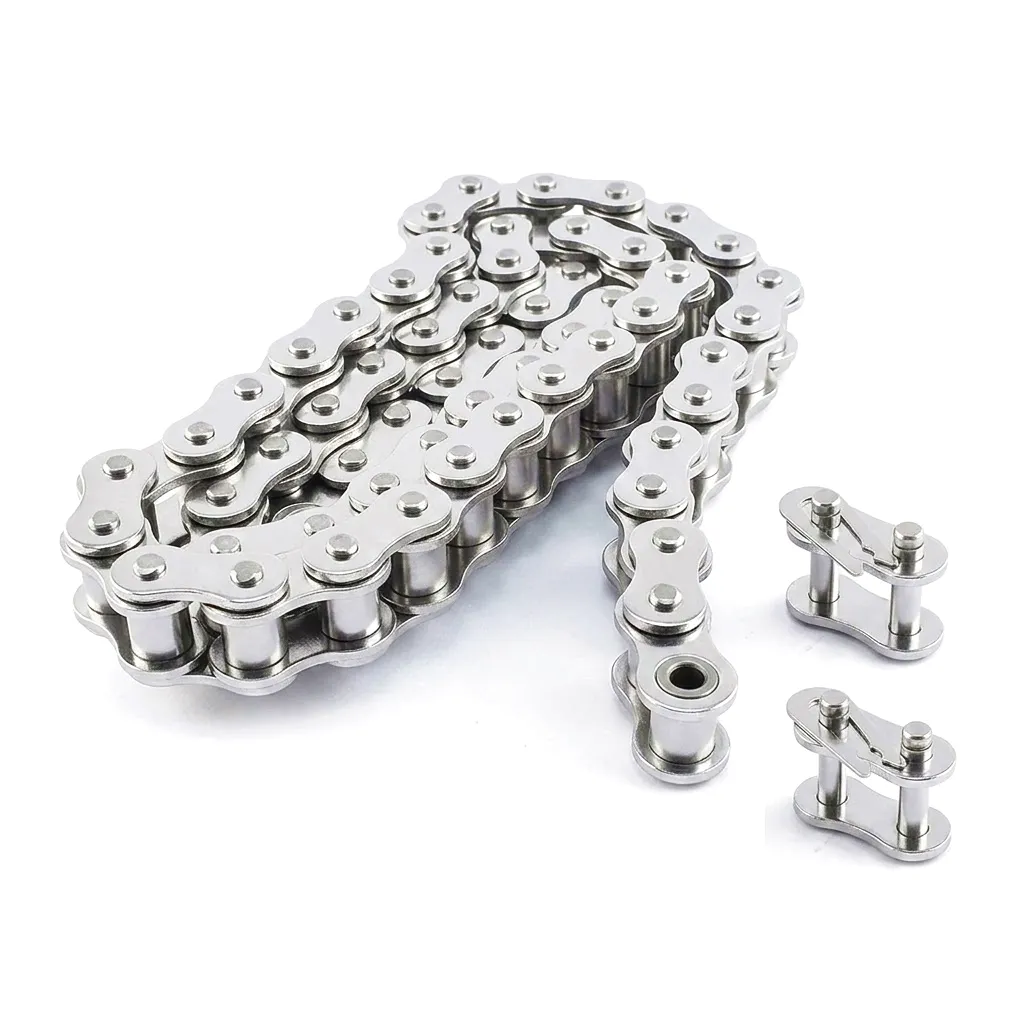 Ever Power operates a vertically integrated roller chain and sprocket manufacturing facility equipped with multi-axis CNC profile grinding centres, automated CMM inspection systems, and in-house heat treatment capability spanning gas carburising, induction hardening, and cryogenic treatment for retained austenite control. This combination of process capability allows Ever Power to hold sprocket tooth profile tolerances that consistently meet or exceed the requirements of the most demanding application categories — automotive, precision conveying, and high-speed power transmission — without the lead times typically associated with specialty manufacture.
고객 성공 사례
Sheffield Steel Plant Cuts Conveyor Downtime by 63% with Precision Roller Chain Sprockets
A medium-sized steel processing facility in Sheffield was experiencing chronic problems with its billet transfer conveyor — a 45-metre long roller chain drive running BS 16B-2 duplex chain at approximately 18 metres per minute under variable loads reaching 12 tonnes. Maintenance records showed an average of 1.8 unplanned stoppages per month, typically caused by chain derailment or sprocket tooth shear on the drive end unit. Each stoppage averaged 4.7 hours of lost production time. The maintenance manager had replaced the chain on three occasions in two years but continued using the same cast iron sprockets that had been in service since the conveyor’s original installation.
Ever Power’s application engineering team visited the facility, took dimensional measurements from a sample sprocket, and identified that the tooth seating radius was worn to a point where the chain rollers were contacting the working flank at an angle 12 degrees steeper than the design intent. This was causing the roller chain to effectively climb the tooth under high load rather than engaging and seating cleanly. The team designed a replacement sprocket set in 42CrMo4 with induction-hardened tooth profiles, a modified tip radius providing 15% greater elongation tolerance, and a re-engineered seating curve radius matched to the actual roller diameter of the worn-in chain. Within the first three months of operation after installation, unplanned stoppages fell to 0.7 per month. Six months later, the Sheffield plant’s engineering director reported zero tooth-related failures and a 63% overall reduction in conveyor-related downtime.
“The tooth profile work Ever Power did for our conveyor system was proper engineering — not just supplying a part, but understanding why we were having the failure in the first place. The modified seating geometry made an immediate, measurable difference to how the chain ran. We’ve seen nothing like the tooth shear problems we had before.”
— Engineering Director, Sheffield Steel Processing Plant
“We specified Ever Power’s high-strength roller chain for our Caterpillar equipment rebuild after struggling with cheaper alternatives that wore out far too quickly. The engagement quality is noticeably better — the drive runs quieter, the chain doesn’t slap against the guards, and we’ve extended our lubrication intervals because the tooth surfaces stay cleaner longer. Strong value for a safety-critical application.”
— Plant Maintenance Manager, West Midlands Quarrying Operation
“Ordered custom stainless sprockets from Ever Power for our food-grade conveying system in Lincolnshire. The surface finish on the tooth profiles met our Ra specification out of the box, and the dimensional report they provided covered every tooth — not just a sample. For a client who needed full traceability, that documentation package was exactly right. Delivery was faster than we’d expected for a custom order.”
— Procurement Lead, Lincolnshire Food Processing Facility
자주 묻는 질문
Answers to the questions UK engineers and procurement teams ask most often about roller chain and sprocket tooth profile selection
How does the sprocket tooth profile affect the overall service life of a roller chain in a UK steel plant?
The tooth profile directly controls how evenly load is distributed across the chain rollers during each engagement cycle. In a steel plant environment, where shock loads and thermal expansion both act on the drive system, a correctly profiled sprocket maintains clean roller seating across a wider range of operating conditions than a nominally correct but poorly finished tooth. The practical result is that the chain wears at a more uniform rate — without the localised high-wear zones that develop when certain rollers bear disproportionate loads — which extends the interval before pitch elongation reaches the replacement threshold.
What is the typical price range or cost difference between a standard and a precision-ground roller chain sprocket when sourcing from a UK supplier?
Precision-ground sprockets typically carry a unit price 25–60% higher than hobbed equivalents in the same tooth count and material, reflecting the additional machining time, tooling cost, and inspection overhead. However, when evaluated against total drive ownership cost — including chain replacement cycles, unplanned downtime, and labour — the premium almost always generates a positive return within the first full service interval. Request a quote from Ever Power to get pricing specific to your pitch, tooth count, and material requirement.
Which roller chain sprocket material is best suited for food processing applications in the UK where both corrosion resistance and tooth profile accuracy are critical?
AISI 316L is the most widely specified material for food-contact sprockets in UK facilities, meeting EC 1935/2004 requirements for food-contact materials. For applications where higher hardness is needed — high-speed or abrasive product contact — precipitation-hardened grades such as 17-4 PH can achieve 38–42 HRC through heat treatment without the corrosion concerns of through-hardened carbon steels. Profile accuracy must be verified by CMM inspection because 316L work-hardens during machining in a way that can cause dimensional drift if cutting parameters are not tightly controlled.
Where can I find a reliable roller chain supplier in the UK who can provide custom sprocket tooth profiles with full traceability documentation for an automotive assembly plant in Birmingham?
Ever Power supplies custom sprockets with full material certificates, dimensional inspection reports covering every tooth, and heat treatment records to automotive customers including facilities in the West Midlands. DDP delivery to Birmingham is standard. Contact [email protected] with your tooth count, pitch, material specification, and required traceability level to receive a detailed quotation.
How do I know when my roller chain drive sprockets in a Sheffield industrial application need replacing due to tooth profile wear rather than just the chain itself?
The clearest indicator is hooked tooth profile — when the working flank becomes concave on the leading face as a result of the roller digging into the tooth material rather than rolling across it. You will also notice the chain riding noticeably higher on the tooth tips when under load compared to the seated position under no load. Noise increases are a reliable early warning because the roller impact energy rises as the seating geometry degrades. A go/no-go gauge matched to the original tooth profile can be used for systematic inspection without requiring full sprocket removal.
What customisation options are available when ordering roller chain sprockets from Ever Power, and how quickly can a custom quote be provided for a UK manufacturing facility?
Ever Power offers customisation across tooth profile geometry, material and heat treatment specification, bore and hub configuration, face width, and surface coating or treatment. Modified pressure angles, extended tip radii, and double-flank forms for reversing drives are all available as engineered solutions. Custom quotations for standard modifications are typically turned around within 24–48 hours of receiving the technical specification. More complex profile engineering work requiring simulation or prototype testing is quoted with a development schedule included. Send enquiries to [email protected].
Ready to Improve Your Drive Performance?
Contact Ever Power for Roller Chain and Sprocket Solutions
Whether you need standard BS or ANSI roller chain, high-strength Caterpillar-series chain, or a fully custom sprocket profile engineered to your application — Ever Power has the capability and the process control to deliver it to UK shore.
[email protected] | DDP Delivery to UK | Custom Engineering Available
gzl님이 편집함