Seite wählen

Field Engineering Guide · Ever Power

Roller Chain Failure Analysis: A Step-by-Step Field Inspection Method

A structured, hands-on approach to diagnosing roller chain wear, fatigue, and misalignment failures — drawn from decades of industrial transmission experience across the UK manufacturing sector.

Birmingham · Sheffield · Leeds
Heavy Industry · Conveyor · Agricultural
2,500+ Words · Technical Reference

Roller Chain Industrial Application

In factories across Birmingham, Sheffield, and the wider industrial heartlands of the UK, roller chain is one of the most relied-upon mechanical components in production — and yet, paradoxically, one of the most neglected until something goes catastrophically wrong. The failure of a single roller chain in a conveyor line or packaging system can halt an entire production run, trigger costly downtime, and create significant safety hazards for operatives on the floor. What makes roller chain failure particularly frustrating is that, in the vast majority of cases, early warning signs were present weeks or even months before the final break. A disciplined field inspection programme, carried out by personnel who understand what to look for and how to interpret what they see, can reduce unplanned stoppages by a substantial margin — and extend chain service life far beyond manufacturer estimates.

This guide sets out a practical, step-by-step methodology for roller chain failure analysis in the field. It covers the fundamental mechanics of how a roller chain operates under load, the primary failure modes that engineers encounter across industries ranging from automotive manufacturing to agricultural processing, the diagnostic techniques that allow you to distinguish between fatigue failure and lubrication failure, and the corrective actions that address root causes rather than just symptoms. Whether you are a maintenance engineer in a Leeds food processing plant or a reliability technician serving multiple sites across the Midlands, this reference will sharpen your inspection approach and give you a shared language for documenting and escalating chain condition issues.

How a Roller Chain Actually Works — And Why It Fails

Working Principle & Failure Mechanics

The Basic Drive Mechanism

A roller chain transmits power through a positive mesh engagement between hardened steel rollers and the teeth of a sprocket. Each link in the chain assembly consists of inner plates held together by a steel bushing, and outer plates joined by a pin. As the driving sprocket rotates, its teeth engage successive rollers, pulling the chain forward and pushing the driven sprocket to rotate. The load is distributed across multiple rollers simultaneously, which gives roller chain its characteristic ability to handle high torque at relatively low speeds. The rollers themselves rotate on the bushings during sprocket engagement, converting sliding friction into rolling friction and dramatically extending component life — provided that the contact surfaces are properly lubricated and the geometry of the sprocket teeth is matched correctly to the chain pitch. When any element in this system degrades — whether through wear, contamination, improper tensioning, or shock loading — the failure signature it leaves behind is distinctive and readable to a trained eye.

🔍

Why Failure Modes Matter More Than Failure Events

The single most common mistake in reactive maintenance is treating every chain failure as the same event — ordering a replacement, fitting it, and moving on without investigating what caused the original chain to fail prematurely. This approach guarantees that the replacement chain will fail in the same way, often in an even shorter timeframe because the underlying system condition has not been corrected. Roller chain failures broadly fall into several categories: elongation wear on pin-bushing interfaces, fatigue fracture of plates or rollers under cyclic loading, corrosion pitting in aggressive environments, and damage from foreign object ingress. Each of these failure types responds to a specific corrective measure. Elongation wear demands better lubrication or a higher-grade chain; plate fatigue requires a review of load calculations and chain selection; corrosion failure necessitates either material upgrading or environmental controls; and foreign object damage points to housing or guarding deficiencies. Distinguishing between them in the field is the core skill this guide is designed to develop.

Kernmaterialien in der Rollenkettenfertigung

Material Science & Grade Selection
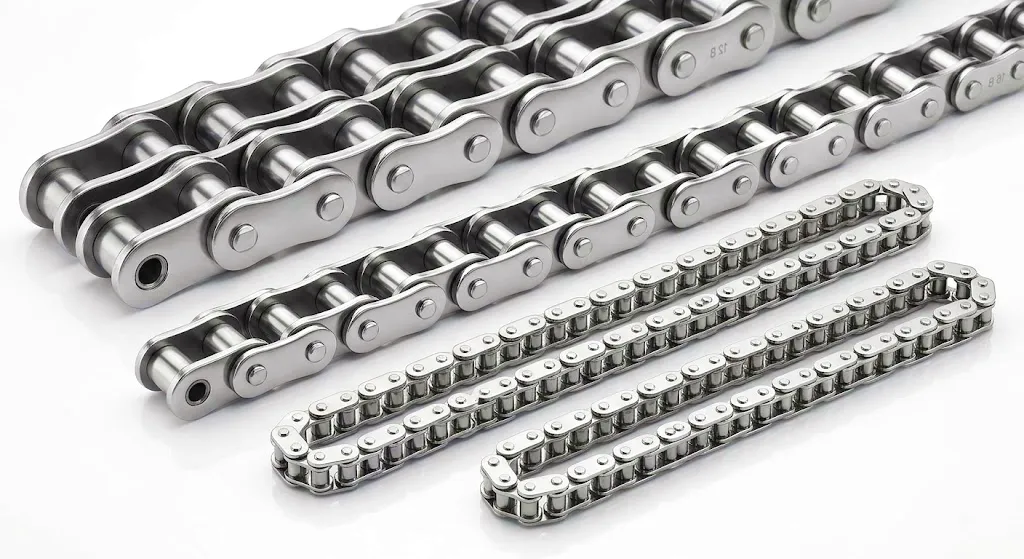
Roller Chain Material Close-Up

The material specification of a roller chain is not merely a matter of grade on paper — it directly determines the chain’s susceptibility to specific failure modes under real operating conditions. Understanding what your chain is made of gives you a head start in predicting where it will fail and what that failure will look like. Standard roller chains intended for general industrial use are typically manufactured from medium-carbon steel, through-hardened to achieve a surface hardness in the range of 58–62 HRC on the pins and 56–60 HRC on the bushings. This hardness level provides the necessary resistance to the pin-bushing wear that accounts for the vast majority of chain elongation in service. The rollers are similarly hardened, with an additional emphasis on impact toughness to absorb the shock of engagement with sprocket teeth at speed.

Specialist applications across UK industry demand elevated material grades. In the food processing facilities of Yorkshire and the dairy operations of the rural Midlands, stainless steel roller chains — typically AISI 304 or 316 — are required to meet food-grade hygiene standards and to withstand wash-down regimes involving caustic cleaning agents. In high-temperature furnace conveyor applications in Sheffield’s remaining steel processing operations, chains may be specified in nickel-chrome alloy or even ceramically coated variants. Agricultural chains operating in the dusty, abrasive conditions of harvest season demand greater wear allowance in pin-bushing clearances. Ever Power supplies all of these grades, manufacturing to DIN 8187 and ISO 606 standards, with additional factory certifications covering traceability of material batches.

Kohlenstoffstahl
General industry standard; 58–62 HRC pin hardness; cost-effective high-volume applications
🔮
Stainless Steel 316
Food & beverage, pharmaceutical; corrosion-resistant; wash-down compliant
💥
Nickel-Chrome Alloy
High-temperature furnace conveyors; thermal resistant up to 400°C; low creep
🌿
Agricultural Grade
Extended pin-bushing clearance; dust and abrasive tolerant; heavy shock load rated

The Step-by-Step Field Inspection Method

Diagnostic Protocol for Maintenance Engineers
01
Step

Visual Pre-Inspection: Static Chain Assessment

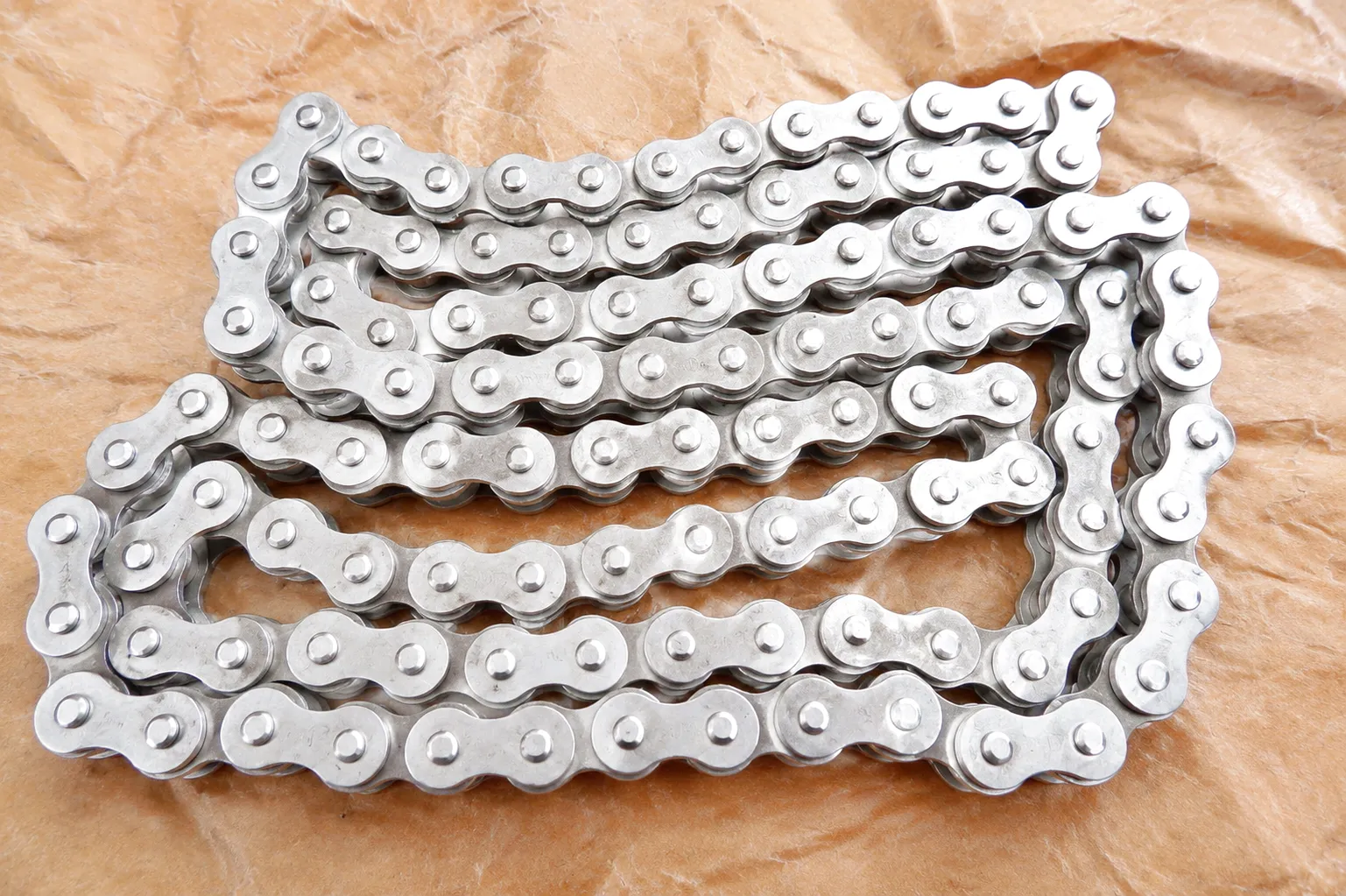
Before a chain is touched, it should be visually assessed with the drive at rest and with appropriate lockout-tagout procedures in place. Stand at a position where you can view the entire chain run from both the tight side and the slack side. What you are looking for at this stage is macro-scale deviation from normal geometry: does the chain sag excessively between sprockets, suggesting overtension or elongation? Are there sections that appear kinked, indicating a stiff link? Is there visible rust, discolouration, or surface deposits that suggest contamination or lubricant breakdown? In plants across Birmingham and the Black Country, where older conveyor systems are still operating in relatively humid indoor environments, early-stage surface corrosion is one of the most commonly missed warning signs during rapid visual checks. Take photographs from multiple angles before proceeding to physical measurement. Good documentation is the foundation of any reliable inspection regime, and photographs with timestamps form an invaluable comparative record when you return to the same drive in three months. Note whether the chain has any areas of bright metal visible on the rollers or sideplates — this indicates active metal-to-metal contact without lubricant film, and it demands immediate attention. Check for missing or damaged snap-link connecting links, which are frequent failure initiation points in chains that have been fieldjoined rather than replaced as complete assemblies.

02
Step

Elongation Measurement: The 1% Rule in Practice

Chain elongation measurement is the most quantitative element of the field inspection process and the most reliable single indicator of remaining service life. Elongation in a roller chain does not occur because the steel stretches plastically — at normal working loads, chain plates remain within their elastic limit. What actually happens is that the bore of each bushing wears slightly against the surface of each pin over millions of contact cycles, and this accumulated wear across every pin-bushing interface in the chain adds up to a measurable increase in overall chain length. Industry guidance, reflected in ISO 606 and in the technical bulletins published by major roller chain suppliers, is that a chain should be replaced when its elongation exceeds 1.5% of its nominal pitch-length for standard drives, or 1.0% for high-speed or precision indexing applications. To measure elongation in the field, you need a steel rule or a vernier calliper and knowledge of the nominal pitch of your chain. For a standard 1/2-inch (12.7 mm) pitch chain, measure the total length spanning 24 links. The nominal length over 24 links would be 304.8 mm; if your measurement shows 309.4 mm, your chain has elongated by approximately 1.5% and is at the end of its service life. Where a wear gauge is available, it should be the preferred measurement tool, as it directly compares the current pin-to-pin dimension against the manufacturer’s new and worn limits — eliminating the risk of cumulative ruler measurement error over multiple links.

03
Step
Roller Chain Sprocket Engagement

Sprocket Tooth Profile Inspection

A worn chain running on a worn sprocket will fail far faster than either component would in isolation. Sprocket tooth inspection must therefore accompany every roller chain assessment, and the condition of the teeth tells its own story about the quality of engagement that the chain has been experiencing. Healthy sprocket teeth have a smooth, slightly polished contact surface at the pitch circle, with no undercutting, hooking, or thinning of the tooth tips. When a roller chain has elongated significantly, the contact point between roller and tooth migrates outward toward the tip of the tooth — a phenomenon sometimes called “riding up.” Over time, this causes the tooth tips to thin and develop a characteristic hooked profile as the trailing face of the tooth wears disproportionately. This hooked condition is a definitive indicator that the chain has been running in a worn-elongated state for an extended period, and it means the sprocket must be replaced alongside the chain. Fitting a new roller chain to hooked sprockets will destroy the new chain within days in a demanding environment like the fabrication shops of Sheffield or the heavy press lines operating in the West Midlands. Run your thumb carefully along each tooth from root to tip — any sharp edges, ridges, or asymmetry between the leading and trailing flanks of the tooth should be flagged and recorded.

04
Step

Lubrication Condition Assessment

Lubrication failure is directly responsible for more premature roller chain failure than any other single factor, yet it is also the most preventable failure mode of all. A well-lubricated roller chain should show a thin, even film of clean oil at the pin-bushing interface — the critical wear zone that drives elongation. In the field, you assess lubrication condition through a combination of visual inspection, odour, and tactile assessment. Wipe the side of a roller and a plate with a clean white cloth: a thin amber or light brown film is normal and indicates the lubricant is doing its job; a black, gritty deposit indicates that lubricant has been in service too long and has accumulated metallic wear particles, forming a lapping compound that accelerates wear rather than preventing it; a dry, clean surface with no lubricant film indicates either a failed automatic lubrication system or an inadequate manual re-lubrication interval. The inside of the bushing-pin interface is not accessible directly, but the condition of the outer surfaces and the rate of elongation measured in Step 2 together give a reliable proxy for lubrication sufficiency. Where chain is operating in cold or dusty environments — as is common in agricultural machinery across the East Midlands and East Anglia — be aware that some lubricants thicken dramatically in low temperatures, leading to starvation at the pin-bushing interface despite apparently adequate lubricant quantity. Specifying the correct viscosity for operating temperature is as important as specifying the correct quantity.

05
Step

Dynamic Run Assessment: Reading the Chain in Motion

Once static assessment is complete and it is safe to briefly run the drive under observation, a dynamic assessment provides additional diagnostic information that is simply not visible in a stationary chain. Begin by observing the chain at low load conditions, watching the entry and exit of the chain on the driven sprocket. A correctly tensioned, properly lubricated roller chain should enter the sprocket smoothly, with each roller seating quietly in the tooth gap. Any audible clicking at the point of engagement suggests roller wear, flat spots on rollers, or pitch mismatch between a worn chain and a newer sprocket. A pronounced rhythmic vibration or oscillation in the slack span of the chain — what engineers sometimes call “whip” or “wave” — indicates that chain tension is insufficient. This is distinct from structural slack caused by elongation, which appears as steady catenary sag rather than dynamic oscillation. Listen also for higher-frequency noise: a continuous grinding or scraping sound often indicates chain contact with a housing or guide rail, which if left uncorrected will cause rapid sideplate wear and fatigue crack initiation at the plate edges. On roller chain drives in the heavy logistics operations of Leeds and Manchester, where chains operate at higher speeds to maintain throughput, these acoustic signatures are particularly pronounced and can often be detected during a normal walkthrough of the facility with trained ears, even before formal inspection is scheduled.

06
Step

Failure Root-Cause Classification and Reporting

The final step in the field inspection process is converting your observations into a structured root-cause classification that drives corrective action. Without this step, the data gathered in Steps 1 through 5 risks being lost, misinterpreted, or — most damagingly — filed away without triggering any system-level change. A practical field report for a roller chain inspection should record the chain type and pitch, the measured elongation percentage, the lubrication condition rating (using a simple four-level scale: adequate, marginal, degraded, absent), the sprocket tooth condition code, and any abnormal noise or vibration observations from the dynamic run. Against each finding, the report should specify the primary root cause from a closed list — wear-fatigue, lubrication failure, tensioning deficiency, misalignment, material incompatibility, or impact/overload — and assign a corrective action with a timeframe and responsible person. This structured approach is increasingly being aligned with digital CMMS platforms across UK manufacturing sites, where inspection findings feed directly into work order generation and predictive maintenance scheduling. Ever Power’s technical sales team can assist UK clients in developing standardised inspection checklists tailored to their specific chain types and operating environments, ensuring that the data collected in the field is consistently structured and comparable across inspection cycles.

Roller Chain Failure Mode Reference Table

Technical performance parameters, failure signatures, and corrective action reference for field engineers.

Failure Mode Visual Signature Typical Elongation % Primary Cause Corrective Action
Wear Elongation Smooth bright surfaces on pins; no cracking; catenary sag 1.0%–2.5% Lubrication deficiency; normal service cycle exhaustion Replace chain; review lube schedule
Plate Fatigue Fracture Transverse crack at pin hole; beach marks on fracture face <0.5% Overload; shock loading; undersized chain selection Upsize chain; review load calculations
Roller Fracture Cracked or missing rollers; impact marks on sprocket teeth Variable High-speed engagement; sprocket tooth profile mismatch Replace rollers or chain; check sprocket profile
Corrosion Pitting Reddish-brown pitting on plates and rollers; surface scaling 0.5%–1.5% Exposed environment; inadequate sealing; wrong material grade Upgrade to SS316 or nickel-plated; improve housing
Stiff Links Chain bends asymmetrically; kinks visible; lateral rigidity 0%–0.8% Contamination; corrosion between pin and bushing; cold joints Identify and flex stiff links; replace section or full chain
Sideplate Wear (Guiding) Polished or grooved outer plate edges; shiny lateral wear tracks 0.3%–1.0% Chain fouling guide rail or housing; misalignment Realign drive; adjust guide clearance
Pin Rotation / Walking Pin heads rotated from original press position; loose outer plates <0.5% Assembly defect; shock overload exceeding press-fit retention Replace chain; investigate shock load source

High-Strength Roller Chain Products for Heavy Industry

Engineered to outperform under the toughest UK industrial conditions.
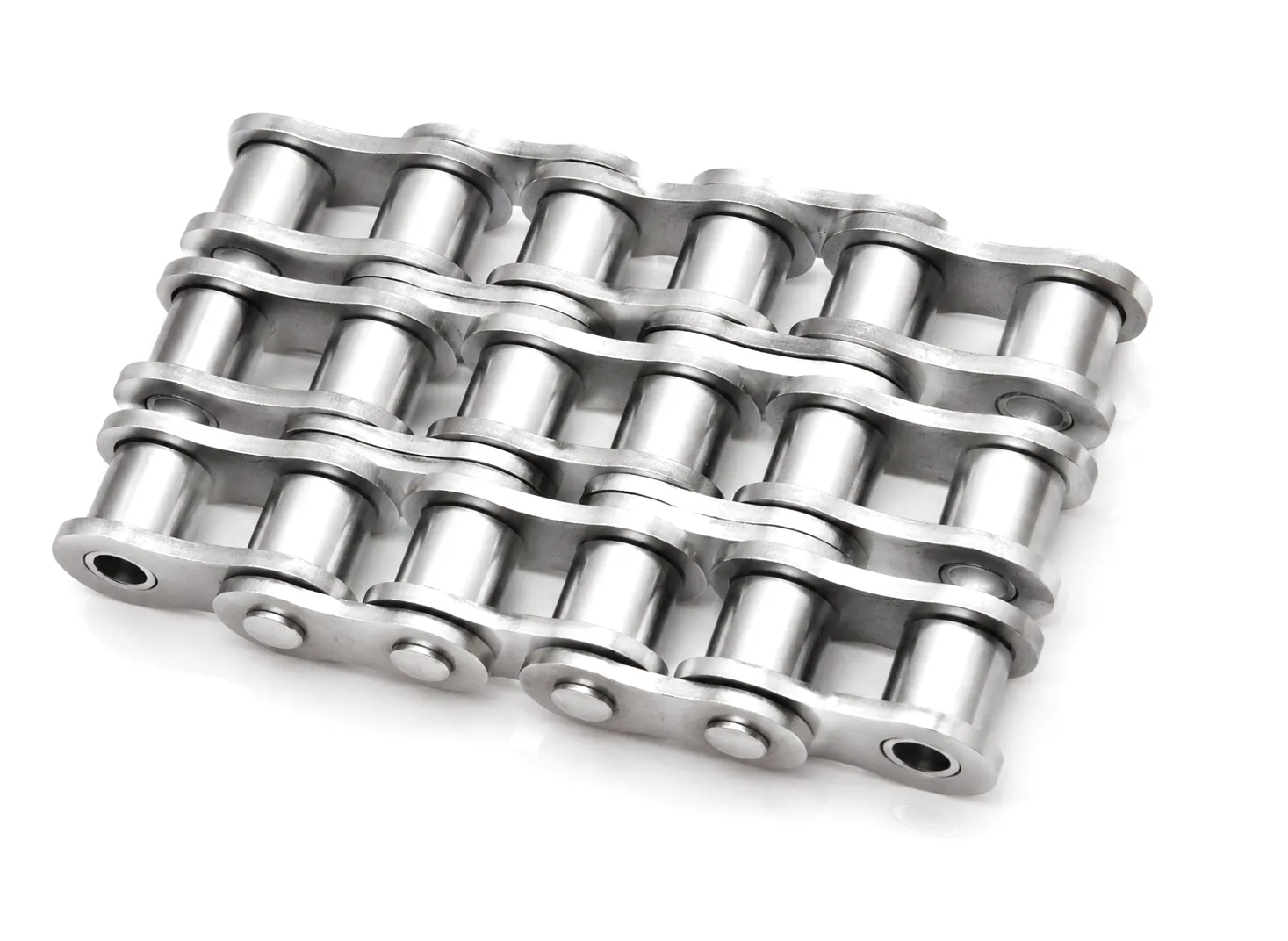
High Strength Series

Hochfeste Rollenkette 120HSP-00

Hochfeste Rollenkette 120HSP-00 für Caterpillar

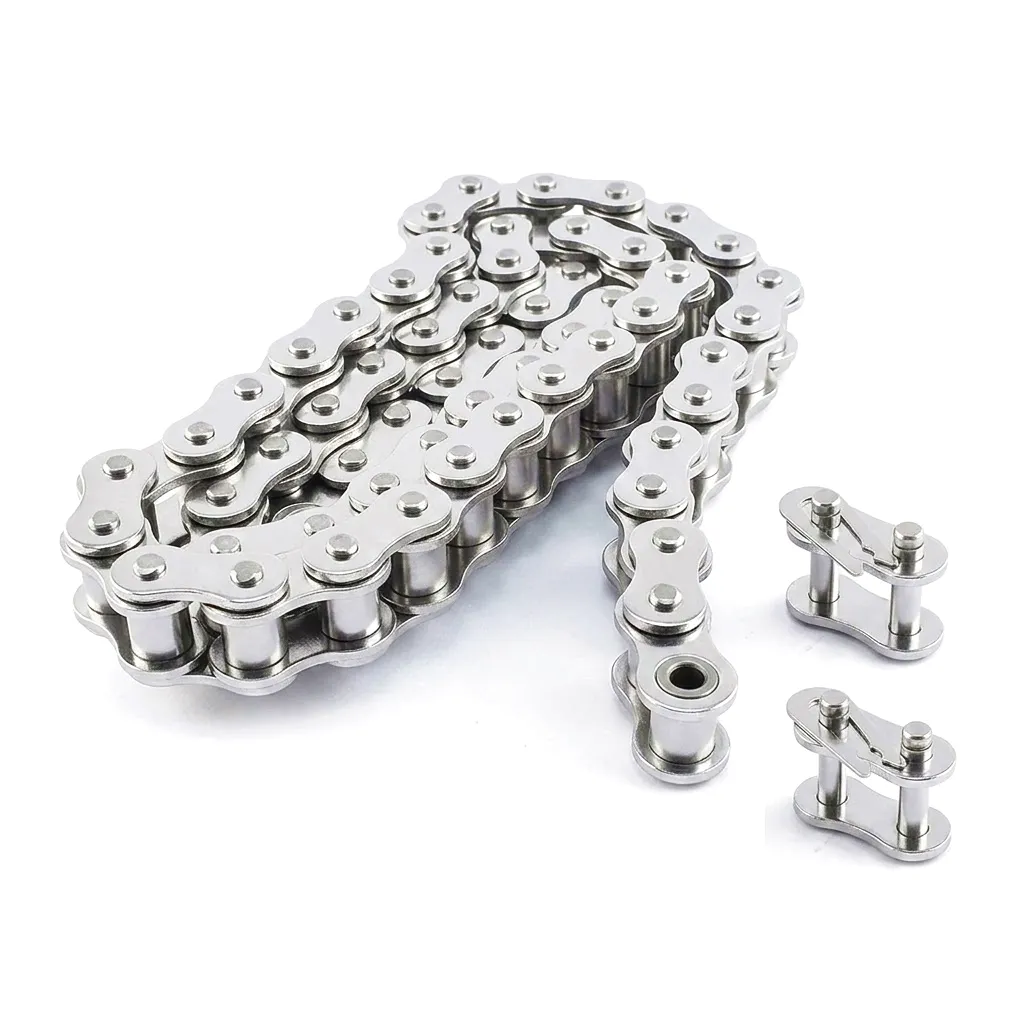
Engineered for Caterpillar heavy equipment, the 120HSP-00 delivers exceptional fatigue resistance and extended wear life under the demanding load cycles of mining, construction, and bulk material handling applications across UK and international markets. Its heat-treated pin and bushing assembly achieves surface hardness ratings that significantly exceed standard BS/ISO benchmarks, making it an ideal specification for any operation looking to reduce the frequency of roller chain replacement intervals and the associated maintenance overhead.
Produktdetails ansehen →

Caterpillar OEM-Fit

Hochfeste Rollenkette C100HSP-00 für Caterpillar

Hochfeste Rollenkette C100HSP-00 für Caterpillar

The C100HSP-00 represents Ever Power’s premium offering for Caterpillar-platform machinery requiring roller chain that meets or exceeds OEM dimensional and performance specifications. With a breaking load engineered to a substantial safety margin above the Caterpillar equivalent specification, it serves reliably in the high-duty-cycle environments of aggregate processing, earthmoving, and large-scale forestry operations. UK distributors and fleet maintenance managers will appreciate the consistent batch quality and the full material traceability documentation that accompanies every Ever Power shipment.

Produktdetails ansehen →

Industrielle Anwendungsszenarien für Rollenketten

Where roller chain is critical — and what specific failure risks apply in each environment
Roller Chain Application Industrial

🏭

Automotive Manufacturing — Midlands

Conveyor and transfer line drives in vehicle body assembly plants across the West Midlands impose continuous, high-tension roller chain duty with frequent start-stop cycles. Fatigue-plate failure and roller fracture under shock engagement are the dominant failure modes in this environment. Chain selection in automotive body-in-white lines typically demands simplex or duplex chains with high fatigue ratings and precise pitch tolerance to maintain synchronisation on transfer fixtures.
🌿

Agricultural Harvesting — East Anglia & East Midlands

Combine harvesters, balers, and grain handling equipment across the agricultural regions of East Anglia subject roller chain to severe abrasive contamination from crop dust, soil particles, and moisture — precisely the conditions that accelerate pin-bushing wear and promote corrosion. Agricultural roller chain typically employs wider pin-bushing clearances to tolerate the abrasive particles that inevitably enter the joint, combined with sealed joints on premium-grade chains for extended service in muddy field conditions.
🍕

Food Processing — Yorkshire & Lancashire

Food and beverage processing plants across Yorkshire — from dairy operations in the Dales to large-scale ready-meal facilities around Leeds — require roller chain that is not only mechanically reliable but also compliant with food contact regulations. Stainless steel roller chain in AISI 316 grade, with self-lubricating bushings and NSF-H1-approved food-grade grease, eliminates the contamination risk of standard lubricants and tolerates the high-pressure wash-down regimes that hygiene protocols demand.

Steel and Metals Processing — Sheffield & Rotherham

Sheffield’s speciality steel producers and Rotherham’s metals processing operations subject roller chain in furnace charge conveyors and hot-rolling ancillary drives to radiant heat, scale contamination, and sustained high-torque demands. At operating temperatures exceeding 200°C, standard lubricants carbonise rapidly, destroying the lubricant film at the pin-bushing interface and dramatically accelerating elongation. High-temperature alloy chain, with appropriately rated dry-film lubricants or graphite-dispersion lubricants, is the standard specification in these demanding environments.
📦

Logistics and Distribution — Greater Manchester & Leeds

High-throughput distribution centres in the logistics corridors around Manchester and Leeds operate roller chain conveyor systems at relatively high speeds for extended duty cycles, often running twenty-two or more hours per day. Fatigue life at elevated cycling frequency becomes the critical design criterion in these applications, and acoustic monitoring of chain engagement noise is a practical early-warning method given the challenge of getting maintenance access to running conveyors during productive hours. Predictive replacement scheduling based on hours-run or cycle-count is now standard in the leading third-party logistics operations across the North of England.

Manufacturing Capability

Ever Power: Precision-Built Roller Chain for Demanding Applications

Ever Power has built its reputation as a specialist manufacturer of precision roller chain and associated power transmission components for industries where component failure is not an operational inconvenience but a serious commercial and safety event. The Ever Power manufacturing facility operates to ISO 9001 quality management standards, with a dedicated metrology laboratory maintaining dimensional traceability to national standards for every production batch. All roller chain produced for industrial export — including the growing UK market — undergoes 100% proof-load testing on automated test rigs, with chain breaking strength measured statistically across each production batch to confirm performance against catalogue ratings. Material traceability is maintained from steel coil through to finished chain, with full chemical and mechanical testing records available on request for quality-critical supply chains.

Customisation capability at Ever Power extends well beyond standard pitch and strand count options. The engineering team works directly with UK procurement and maintenance specialists to specify roller chain that addresses the precise failure mode history of a given application — whether that means selecting an elevated-hardness surface treatment to combat abrasive wear in a quarrying conveyor, developing a custom attachment configuration for a specialist agricultural machine, or producing roller chain with extended pin shanks to accommodate non-standard frame widths in a retrofit project. Lead times on custom orders are typically shorter than comparable European manufacturers, and Ever Power’s logistics partnerships ensure reliable delivery into UK ports with full customs documentation provided.

📧 Get a Custom Quote from Ever Power

ISO
9001 Certified Quality
100%
Proof-Load Tested
DIN
8187 / ISO 606 Compliant
7+
Steel & Alloy Grades Stocked

Customer Success Story: Aggregate Processing Plant, Sheffield

Real-World Impact · South Yorkshire Heavy Industry

Meridian Aggregates Ltd., operating a primary crushing and screening facility in the Attercliffe industrial corridor of Sheffield, had been experiencing an average roller chain replacement cycle of fourteen weeks on their main vibratory screen conveyor drives. The facility runs two ten-hour production shifts daily, processing up to 800 tonnes of quarried stone aggregate per day. Each chain replacement required a four-hour planned maintenance window and consumed two sets of chain across the primary conveyor array, with additional downtime costs from ancillary systems taken offline during the work. The maintenance manager had identified roller chain as a disproportionate contributor to the site’s total planned maintenance cost and opened a procurement review with a view to identifying a higher-specification product that could extend replacement intervals.

Ever Power’s UK technical sales contact carried out a site visit and conducted a full inspection of the failed chains according to the step-by-step protocol described in this article. The analysis identified pin-bushing elongation wear as the primary failure mode, with a secondary contribution from abrasive stone dust ingress accelerating the wear rate. The existing chain specification — a standard carbon steel simplex chain — was inadequate for the abrasive conditions. Ever Power proposed a bespoke solution: a custom-pitch duplex roller chain with sintered metal bushings pre-impregnated with a high-viscosity synthetic lubricant and side plates upgraded to alloy steel with a surface hardness increase of approximately 8 HRC over the previous specification. The connecting links were redesigned from snap-clip type to solid-plate cottered type to eliminate the failure-initiation point that field inspection had identified at the original link positions.

The Ever Power chains were installed and began service monitoring in the second quarter of the following year. At the twenty-two-week mark — eight weeks beyond the previous maximum service life — the chains were inspected and found to be within serviceable elongation limits, with no evidence of the abrasive pitting that had characterised the failed predecessor chains. The maintenance team has since extended the planned replacement interval to thirty weeks, reducing annual chain replacement frequency by more than half and returning a documented saving of over £28,000 per year in direct material and planned downtime costs at this single site. The Sheffield installation has since become a reference case that Ever Power’s UK team uses when consulting with similar aggregate and quarrying operations across the North of England and Scotland.

Was unsere britischen Kunden sagen

★★★★★

“The custom sintered bushing chain Ever Power specified for our Sheffield aggregate screens has run thirty weeks without a replacement — that is more than double what we were getting from our previous supplier. The inspection report they provided at the start of the project gave us genuine confidence that they understood our application, not just the catalogue.”

Tom Hartley
Maintenance Manager · Meridian Aggregates Ltd., Sheffield
★★★★★

“We switched our food processing line chains to Ever Power’s stainless 316 roller chain after persistent corrosion failures with our previous specification. Eighteen months in, we have had zero unplanned stoppages attributable to chain failure, and the chains are passing our hygiene inspection regime with no staining or surface degradation. The delivery lead times are also considerably better than we experienced with European equivalents.”

Sarah Ingham
Engineering Director · Holt’s Food Manufacturing, Leeds
★★★★★

“What impressed me most about Ever Power was the depth of technical knowledge their team brought to the application review. Most chain suppliers send you a catalogue and a price. Ever Power sent an engineer who asked the right questions about our Caterpillar excavator drive cycles and came back with a high-strength roller chain specification that addressed the root cause of our failures rather than just offering a direct replacement.”

James Whitfield
Plant Equipment Manager · Northern Construction Group, Birmingham

Technical Advantages of Ever Power Roller Chain

Why engineers across UK industry specify Ever Power for demanding drive applications

🔳

Superior Fatigue Resistance

Shot-peened sideplates and induction-hardened pins provide fatigue limits that consistently exceed BS/ISO catalogue ratings, delivering extended service intervals in high-cycle applications.

📈

Extended Wear Life

Precision bushing bore finishing reduces pin-bushing contact stress, cutting the elongation rate under equivalent lubricating conditions by up to 35% versus lower-grade alternatives. Field data from UK aggregate operations supports this claim.

🔧

Deep Customisation Capability

Non-standard pitch, extended shank pins, specialist attachments, custom strand counts — Ever Power’s tooling library and engineering team can accommodate specifications that catalogue suppliers cannot. Samples typically dispatched within four working weeks.

📄

Full Batch Traceability

Chemical composition certificates, mechanical test reports, and dimensional inspection records are standard deliverables with every industrial order. Essential for regulated supply chains across UK defence, rail, and infrastructure sectors.

Häufig gestellte Fragen

Answers for engineers and procurement teams across UK industry

Q
How do I know when my roller chain in a Birmingham manufacturing plant needs to be replaced before it actually breaks?
The most reliable indicator is elongation measurement: measure the span of 24 links with a steel rule or calliper and compare it to the nominal pitch-length. When elongation exceeds 1.5% for standard drives, replacement is due. Secondary signals include audible clicking on engagement, visible catenary sag on the slack span, and a black or gritty lubricant condition indicating advanced wear particle contamination. Structured monthly inspection using the six-step method described in this article will reliably identify replacement need three to six weeks ahead of failure in most industrial environments.
Q
What is the typical price difference between standard carbon steel roller chain and stainless steel roller chain for UK food processing applications?
Stainless steel roller chain in AISI 316 grade typically carries a price premium of between 2.5 and 4 times the equivalent carbon steel specification for the same pitch and strand count. However, the total cost of ownership calculation for food processing sites — where wash-down corrosion destroys standard chain far more rapidly and where any contamination incident carries serious regulatory consequences — almost always favours the stainless option when replacement frequency is correctly modelled. Contact Ever Power’s UK sales team for a competitive quotation on food-grade roller chain supply, tailored to your specific pitch and length requirements.
Q
Which roller chain supplier in the UK can provide custom specifications with fast delivery for urgent maintenance requirements in Sheffield heavy industry?
Ever Power maintains a stocked inventory of standard industrial roller chain pitches for same-week despatch to UK addresses, and operates a dedicated fast-track channel for urgent maintenance supply requirements. For custom specifications, Ever Power’s engineering team can turn around a technical proposal within 48 hours of receiving application data, and sample units for standard-adjacent custom dimensions are typically available within two to three weeks. Reach the UK sales team directly at [email protected] with your drive specifications and urgency timeframe.
Q
How does roller chain elongation cause sprocket damage, and when should I replace both the chain and the sprocket at the same time?
As a roller chain elongates, the effective pitch of the chain increases relative to the nominal pitch of the sprocket. This causes the contact between rollers and sprocket teeth to migrate radially outward — the chain effectively rides up the teeth, loading the tooth tips and tips rather than the pitch circle. Over time, this concentrated tip loading causes the tooth tips to thin and develop the hooked asymmetric profile that is the signature of advanced sprocket wear. The rule of thumb in field inspection practice is that if a chain has elongated beyond 1.0%, its sprocket should be inspected for hooked teeth and replaced if any hooked profile is detectable. Fitting a new chain on a hooked sprocket will typically destroy the new chain in 20–30% of its expected service life.
Q
Where can I get a competitive quote for bulk roller chain supply for an agricultural machinery maintenance contract covering operations across the East Midlands?
Ever Power welcomes enquiries from agricultural machinery dealers and contract maintenance organisations seeking competitive roller chain supply terms for seasonal or annualised purchasing. Volume pricing structures are available for agricultural-grade chain covering standard pitches from 1/2 inch through 2 inches, with sealed-joint and extended-clearance options for abrasive field conditions. Send your specification list and estimated annual volumes to [email protected] and the Ever Power UK team will respond with a tailored bulk supply quotation within one business day.
Q
What are the most common roller chain failure modes in the logistics and distribution sector in Leeds and Manchester, and how can I prevent them?
In high-throughput logistics facilities, the dominant failure modes are fatigue-driven plate cracking at high cycling frequencies and wear elongation accelerated by inadequate automatic lubrication system maintenance. The most effective preventive measures are a structured monthly inspection cycle using the elongation measurement and dynamic noise assessment methods described in this article, plus a review of automatic lubricator output rates at quarterly intervals to ensure lubricant is actually reaching the pin-bushing interface in the required quantities. Acoustic monitoring of chain engagement, achievable with low-cost decibel meter apps during a walkthrough, provides a useful between-inspection health check that does not require stoppage of the conveyor.

Ready to Reduce Roller Chain Downtime at Your Facility?

Contact Ever Power’s UK technical sales team for a no-obligation application review, a competitive chain supply quotation, and access to our full field inspection checklist template — free for all new enquiries.

📧 Get a Free Quote Now

[email protected] · Ever Power · ISO 9001 Certified Manufacturer

bearbeitet von gzl