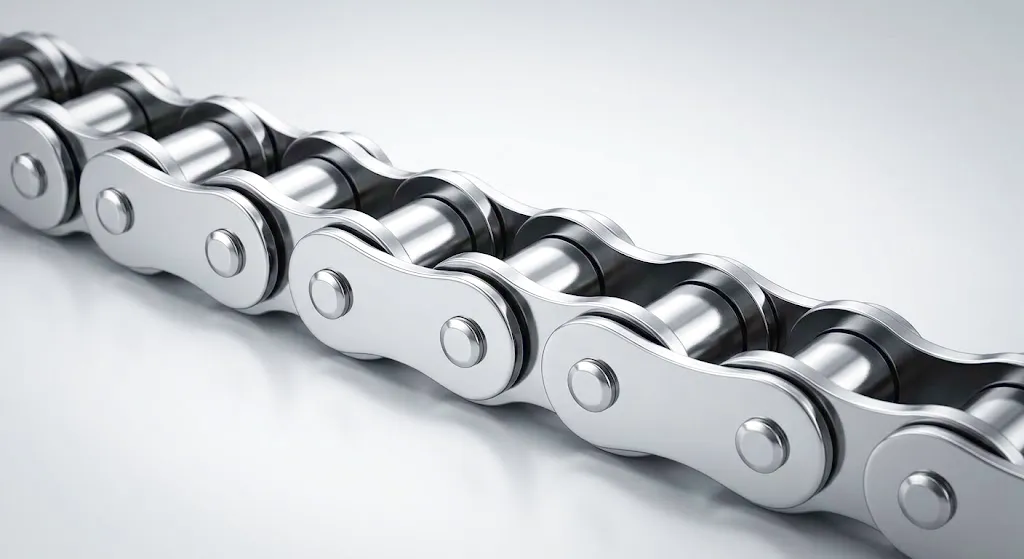
Walk into any food processing facility in Lincolnshire, any offshore supply yard along the Scottish coast, or a water treatment plant in the Thames Valley, and you will immediately encounter the same engineering challenge: power must be transmitted reliably through environments that actively attack steel. Salt spray, caustic cleaning agents, humid condensation cycles, and even the natural acidity of food byproducts all conspire to undermine the integrity of conventional roller chain — the workhorse of mechanical power transmission worldwide. When unprotected carbon steel meets these conditions repeatedly, the result is accelerated oxidation, pitting corrosion, and ultimately catastrophic chain failure at the worst possible moment in a production cycle.
Nickel-plated roller chain addresses this vulnerability through a metallurgical surface treatment that fundamentally alters the chain’s electrochemical relationship with its operating environment. Rather than adding a cosmetic layer, the electrodeposition of nickel creates a crystalline barrier tightly bonded to the base steel substrate — one that resists oxidation at the molecular level, reduces friction against corrosive media, and maintains dimensional integrity far beyond what paint, grease alone, or simple galvanising can achieve. For UK maintenance engineers and procurement specialists who need reliable uptime, predictable service intervals, and traceable quality standards, understanding precisely how this protection mechanism works — and where its performance limits lie — is not a technical luxury but an operational necessity.
The Science of Protection
The Electrochemical Mechanism Behind Nickel-Plated Roller Chain Corrosion Resistance
Corrosion is fundamentally an electrochemical process: in the presence of an electrolyte — which might be seawater, acidic food residue, alkaline cleaning chemicals, or simply humid industrial air — dissimilar metals create a galvanic cell. Electrons flow from the more anodic material (iron in standard steel) to the cathode, progressively dissolving the anodic metal. Conventional roller chain made from carbon steel has essentially no defence against this reaction once lubricant films are washed away or contaminated.
Nickel sits higher in the galvanic series than iron and forms a passive oxide layer — nickel oxide (NiO) — almost instantaneously upon exposure to oxygen. This passivation layer is self-regenerating: even if it is scratched or partially abraded by chain articulation, re-exposure to air immediately recreates the barrier. Electrodeposited nickel applied to roller chain typically ranges from 8 to 20 microns in thickness, depending on the intended service severity. At this depth, the deposit penetrates into the micro-topography of the steel surface rather than sitting as a brittle cap, creating mechanical as well as chemical adhesion. The resulting bond strength is far superior to hot-dip zinc coatings and dramatically outperforms organic paint systems in impact, flex, and abrasion resistance — all of which are conditions inherent to operating roller chain.
A secondary protection mechanism involves nickel’s lubricating quality. Nickel-plated surfaces exhibit a lower coefficient of friction than bare steel in boundary lubrication conditions — precisely the regime that roller chain operates in during start-stop cycles or when lubricant supply is marginal. The practical result is that nickel-plated roller chain continues to transmit power with reduced wear even when operating conditions degrade the lubrication film, which is exactly the failure scenario that most frequently shortens standard chain service life in harsh environments across Birmingham’s food manufacturing corridor or Sheffield’s coatings and surface treatment plants.
Core Materials: What Nickel-Plated Roller Chain Is Made Of
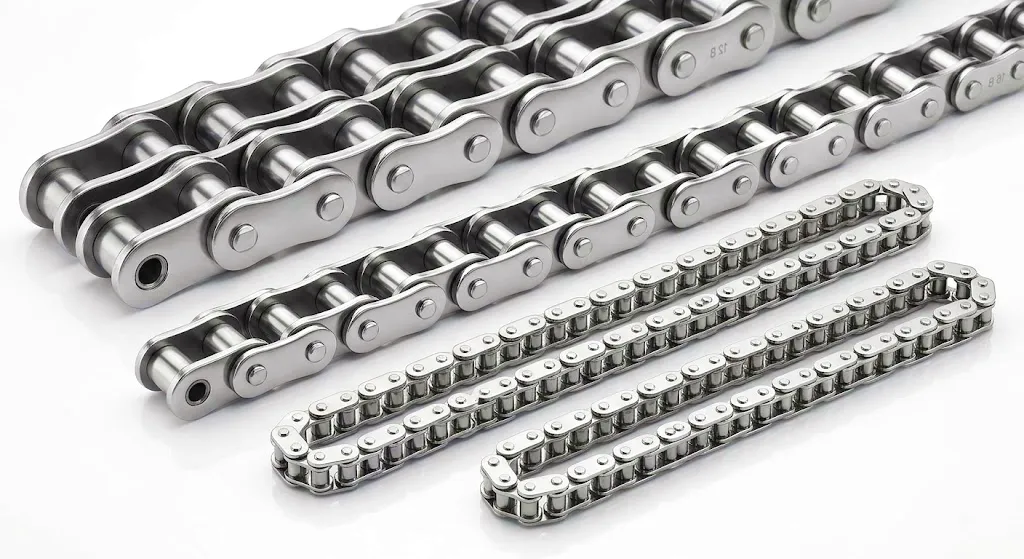
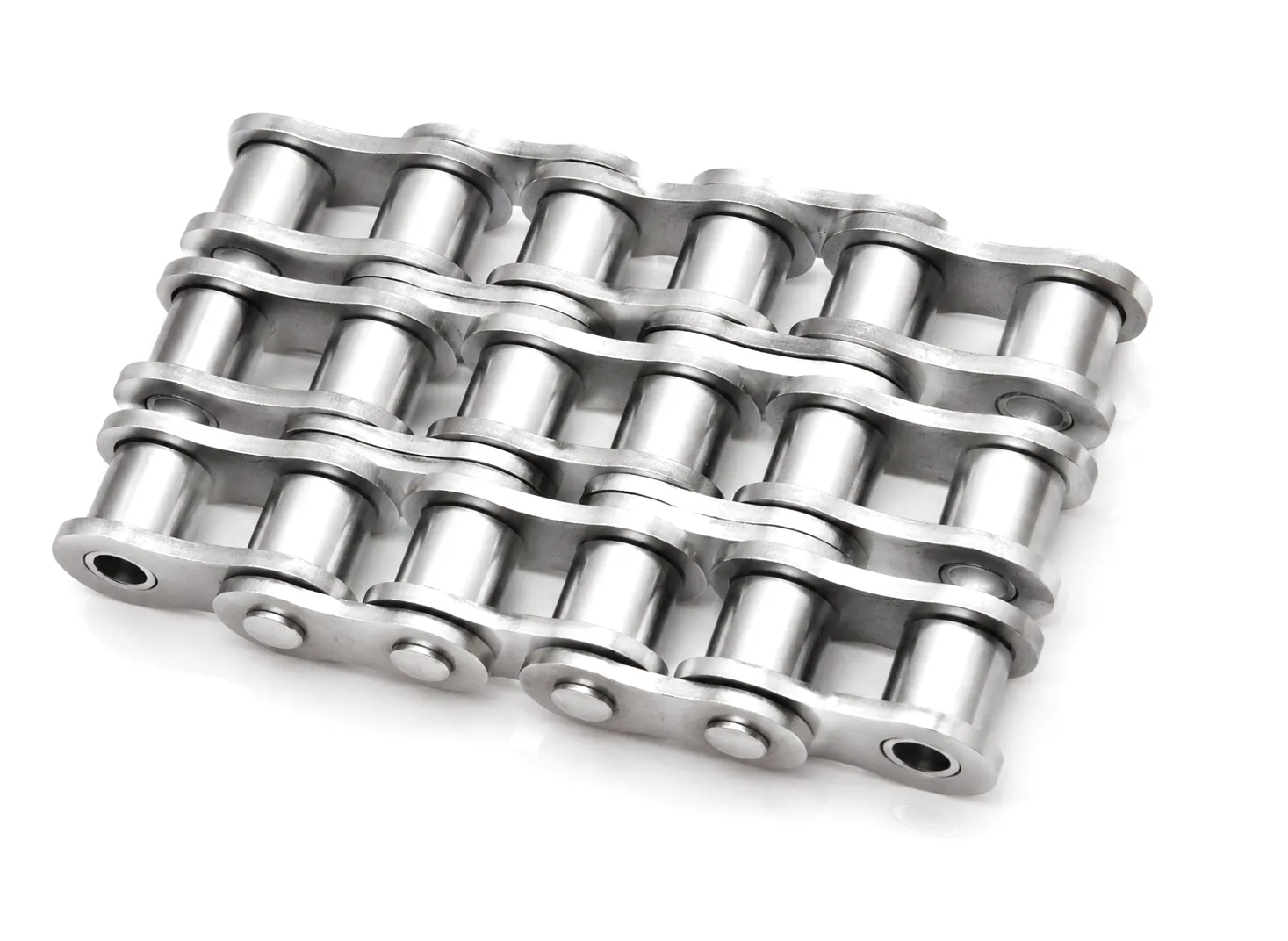
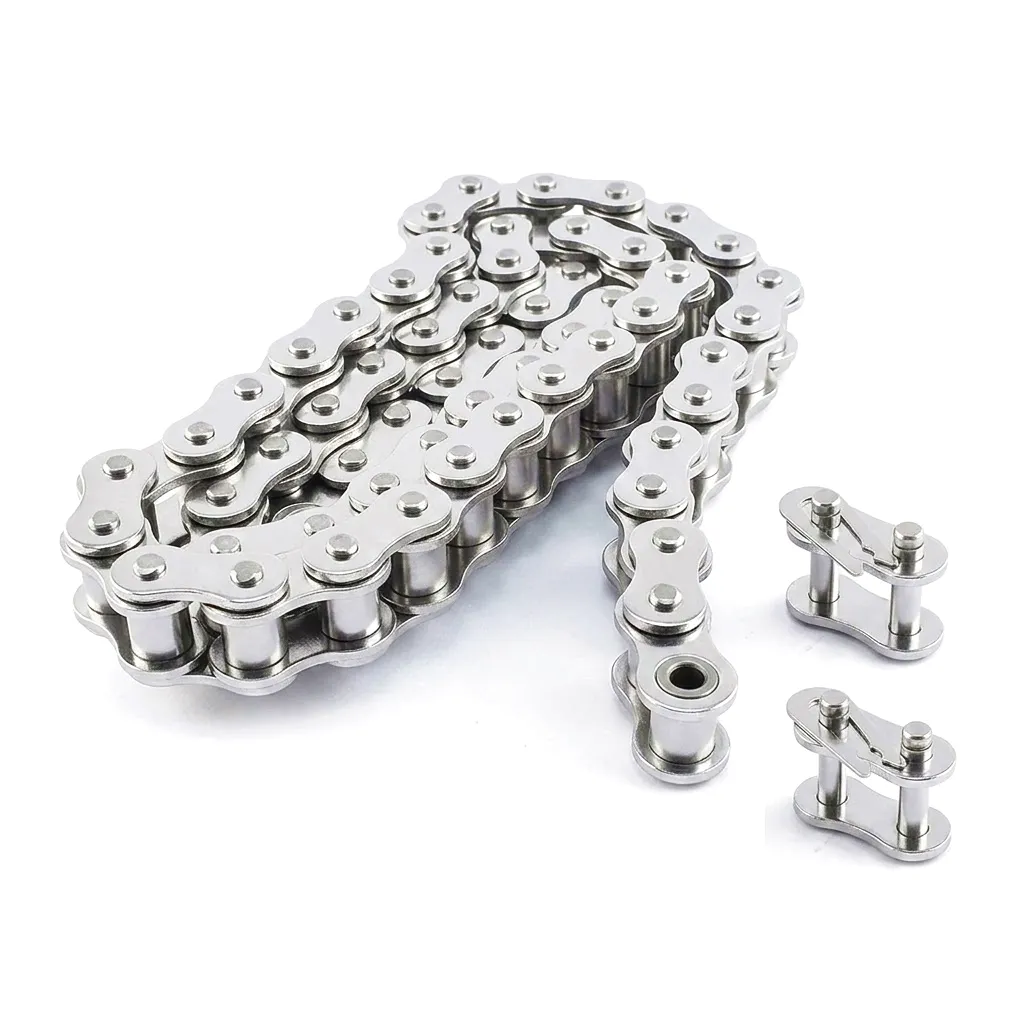
The material stack of a quality nickel-plated roller chain is a carefully engineered composite. The core components — inner plates, outer plates, pins, bushings, and rollers — are manufactured from medium or high-carbon steel, typically in the 0.40–0.55% carbon range, or from case-hardened alloy steels for high-load variants. These steels provide the tensile backbone: inner and outer plates carry the load, while hardened pins and bushings form the articulating joints that must resist both fatigue and abrasion simultaneously.
Rollers — the cylindrical components that engage the sprocket teeth — are often manufactured from bearing-quality steel and independently heat-treated to achieve surface hardness values in the range of 56–62 HRC. This ensures that as the chain wraps and unwraps around sprockets under load, the contact stress is absorbed by a material that can resist deformation without fracture. In nickel-plated variants, the roller surface receives the same electrodeposited treatment as the link plates, maintaining corrosion protection at the highest-stress contact point.
The electrodeposition process uses a nickel sulphamate or nickel sulphate bath at controlled pH, temperature, and current density. Bright nickel plating produces a reflective, high-purity deposit; semi-bright nickel introduces sulphur-free layers for improved ductility, which is particularly valuable in dynamic applications where the chain flexes millions of times per year. After plating, components are baked at controlled temperatures to relieve hydrogen embrittlement — a critical step often skipped by lower-quality suppliers that leads to premature brittle fracture in service. Ever Power’s manufacturing process incorporates full hydrogen embrittlement relief as standard.
Seven Technical Advantages That Set Nickel-Plated Roller Chain Apart
Unlike paint or organic coatings that provide protection only while intact, the nickel oxide passive layer reforms spontaneously after surface damage. In practice this means the chain continues to resist corrosion at articulation points where constant flexing would crack any alternative coating system within weeks of operation.
Food processing operations across Yorkshire and the East Midlands routinely subject conveyor chains to high-pressure hot-water wash-down with caustic detergents. Standard carbon steel chains corrode rapidly under these conditions. Nickel-plated chains in independently verified testing demonstrate three to five times greater resistance to surface degradation, translating directly to fewer planned shutdowns and lower replacement costs over a three-year maintenance horizon.
Electroplated nickel applied at controlled thickness and with proper hydrogen embrittlement relief does not compromise the base steel’s mechanical properties. ANSI/ISO-standard roller chain in nickel-plated form retains its full tensile strength rating — critical for high-horsepower drive systems in mining equipment operating in South Wales or aggregate processing in the Scottish Highlands where chain failure carries substantial safety and liability implications.
Nickel maintains its passive oxide characteristics across a wide temperature spectrum — from -40°C in cold-storage conveyor systems to sustained temperatures approaching 300°C in industrial dryer and oven conveyor applications. This thermal stability is particularly relevant for UK brewery and bakery operations, where chains must perform reliably in both refrigerated raw ingredient handling and high-temperature pasteurisation or baking conveyor sections within the same facility.
Salt spray testing to BS EN ISO 9227 — the standard reference used across UK corrosion-protection specifications — demonstrates that nickel-plated roller chain sustains 500+ hours of continuous salt spray exposure before first-corrosion appearance at normal coating thicknesses. For coastal industrial sites along the North Sea coast, in Aberdeen’s oil support sector, or at portside facilities in Liverpool and Southampton, this resistance is the difference between annual chain replacement and multi-year service intervals.
Nickel’s inherent surface slipperiness in boundary conditions means lubrication intervals can be extended by 30–40% compared to standard carbon steel chains operating under identical loads and speeds. In environments where re-lubrication is operationally difficult — such as enclosed conveyor tunnels in automated distribution centres around Milton Keynes, or overhead drive systems in busy manufacturing cells — this characteristic alone can justify the modest cost premium of nickel-plated chain over standard alternatives.
Because nickel plating adds only 8–20 microns per surface — which is dimensionally negligible relative to chain pitch tolerances — nickel-plated roller chain is fully interchangeable with existing ANSI and ISO-standard sprocket systems. Engineers upgrading from standard to nickel-plated chain on existing drive systems face zero redesign burden, zero tooling changes, and zero lead time for sprocket replacement. Maintenance teams can switch over during a planned service window with no disruption to connected equipment.
High-Performance Roller Chain for Caterpillar and Heavy-Duty Drive Systems
Engineered to Caterpillar OEM dimensional and strength specifications, this heavy-duty roller chain delivers the tensile strength and dimensional precision required for demanding construction and earthmoving drive systems. Available with nickel-plated surface treatment for applications in aggressive environments.
The C100HSP-00 series targets high-cycle, high-load Caterpillar drive configurations where standard commercial chain would experience accelerated pitch elongation. The enhanced plate geometry and precision pin-bushing fit maintain pitch accuracy over extended service periods, reducing wear-related sprocket damage and lowering total cost of ownership in equipment-intensive UK quarrying and construction sectors.
Nickel-Plated Roller Chain — Technical & Performance Parameters
| 매개변수 | Specification / Range | Standard Reference | Notes |
|---|---|---|---|
| 피치 범위 | 6.35 mm (No. 25) to 76.2 mm (No. 60-3) | ANSI B29.1 / ISO 606 | Simplex, duplex, triplex available |
| Nickel Plate Thickness | 8 – 20 microns (standard); up to 30 microns (severe service) | ASTM B689 / BS EN 12540 | Bright or semi-bright deposit |
| Tensile Strength (No. 40) | 14.1 kN minimum (fully compliant with standard spec) | ANSI B29.1 | Plating does not reduce tensile rating |
| Salt Spray Resistance | 500 – 800 hours (first rust, neutral salt fog) | BS EN ISO 9227 | vs ~8 hr for bare carbon steel |
| 작동 온도 | -40°C to +300°C | ISO 1275 | Lubricant selection determines upper range |
| Surface Hardness (Pin) | 56 – 62 HRC | Rockwell C scale | Case-hardened alloy steel substrate |
| Allowable Load (No. 40) | Approx. 980 N (dynamic working load) | ANSI B29.1 | Apply service factor for shock loads |
| Corrosion Media Resistance | pH 4–10; resistant to dilute acids, alkalis, food acids | EN 248 / ASTM B117 | Not suitable for strong mineral acids or halogens |
| Pitch Elongation Limit | Max 3% elongation before replacement (standard) | BS ISO 9633 | Wear-reducing coating extends this interval |
| Lubrication Interval Extension | 30 – 40% longer vs. bare steel | Internal test data (Ever Power labs) | Conditions: 25°C, medium humidity, 50% load |
Where It Works
Industrial Application Scenarios Across the UK
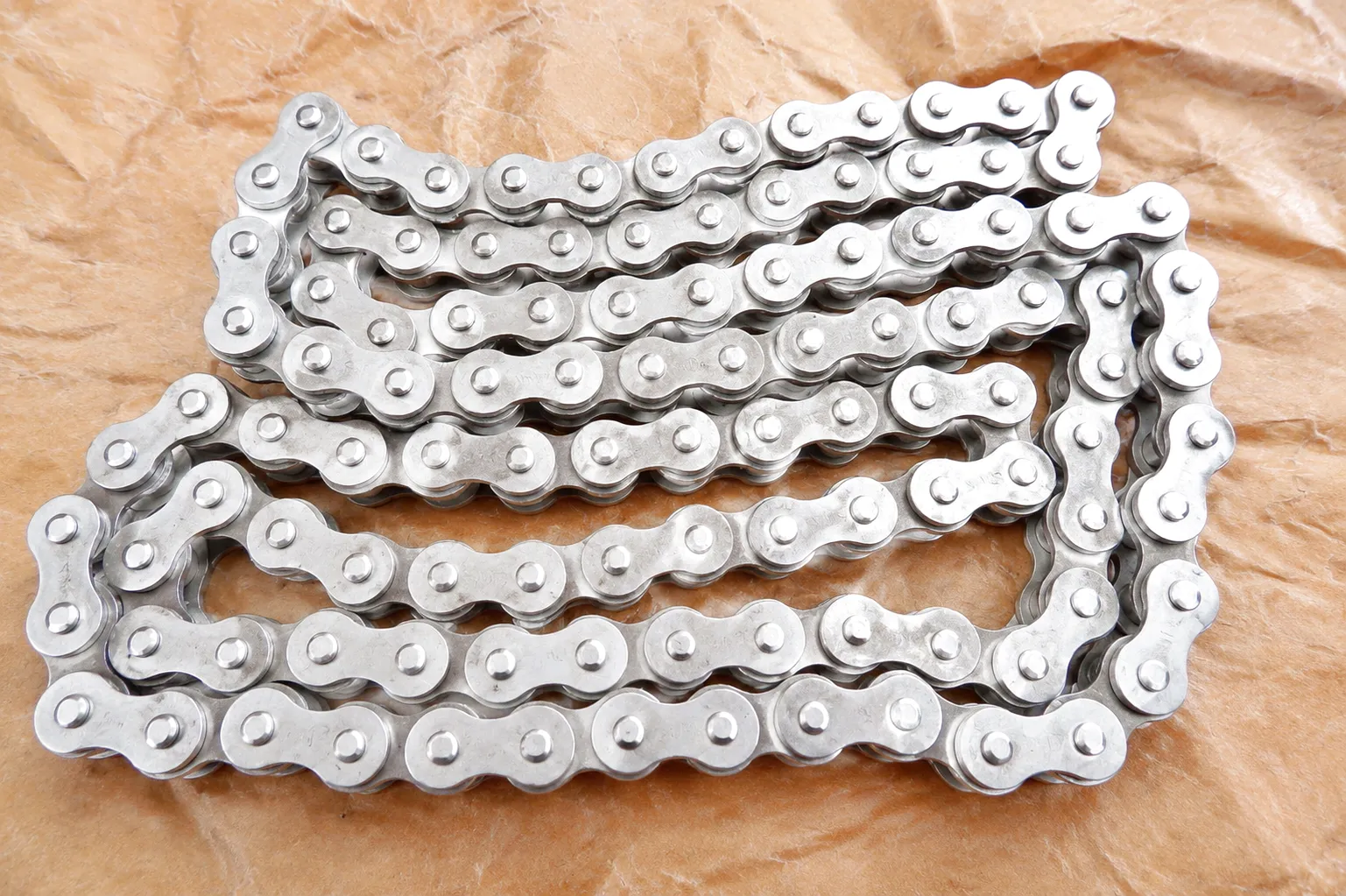 UK food processing is one of the country’s largest manufacturing sectors by employment, and the conveyor and drive chains within these facilities endure some of the most relentless wash-down regimes of any industry. High-pressure hot-water cleaning at 80°C or above, combined with caustic detergents rated at pH 12–13, destroys standard chain lubrication films in a single cleaning cycle. Nickel-plated roller chain retains corrosion resistance through repeated wash-down cycles, and its smooth surface finish reduces the likelihood of food particle retention at joints — a critical consideration for BRC and SALSA food safety certification, which UK food manufacturers are obliged to maintain for major retail supply contracts.
In poultry processing plants around Lincolnshire, malting facilities in Burton-on-Trent, and ready-meal production sites across West Yorkshire, the chain’s resistance to lactic acid, acetic acid, and alkaline CIP (Clean-in-Place) chemicals determines whether the line runs to schedule or faces an unplanned shutdown. Nickel-plated roller chain has become the go-to specification for engineers who have experienced the cost of premature standard chain failure in these environments.
 UK water companies operating under Ofwat regulation face substantial penalties for service outages, which makes mechanical reliability of drive chains in bar screen systems, sludge conveyors, and clarifier drives a high-priority maintenance concern. The permanent atmospheric humidity in enclosed water treatment structures, combined with the presence of hydrogen sulphide gas from anaerobic biological processes and chlorine-based disinfectants in clean-water stages, creates an unusually aggressive multi-vector corrosive environment that challenges even stainless-steel components.
Nickel-plated roller chain specified for water and wastewater duty should incorporate sealed joints where possible to prevent direct electrolyte ingress at the pin-bushing interface — the most vulnerable articulation point. At sites such as the major treatment works serving Bristol, Oxford, or the Greater Manchester conurbation, annual replacement of corroded chain in bar screen drives represents a significant and avoidable maintenance expenditure. A switch to correctly specified nickel-plated chain can extend replacement intervals from twelve to thirty-six months based on documented field experience at comparable facilities.
Portside equipment — ship-to-shore crane drives, dock-leveller mechanisms, marine conveying systems, and vessel loading gear — operates in continuous exposure to sea-salt aerosol. The chloride ion concentration in North Sea coastal air is sufficient to initiate pitting corrosion on bare steel surfaces within hours of first exposure. For offshore supply base operators in Aberdeen, ferry terminal operators in Portsmouth, and bulk grain terminal operators along the Humber, the total cost of corrosion on unprotected drive chain runs to hundreds of thousands of pounds annually across a fleet of equipment.
Nickel-plated roller chain for marine service is typically specified in ANSI 50 through ANSI 80 pitch sizes, with maximum allowable working loads calculated with a conservative service factor to account for dynamic shock loads from wave-induced vessel movement during loading operations. The combination of salt spray resistance verified to BS EN ISO 9227 and retained tensile strength post-plating makes nickel-plated chain the technically justified choice for new-build marine equipment specifications and scheduled overhaul programmes alike.
There is an appealing irony in the fact that facilities which apply corrosion-resistant coatings to other products must themselves operate drive and conveyor chains in environments saturated with corrosive chemical vapours. Sheffield’s advanced manufacturing cluster and the metal-finishing industry concentrated around the West Midlands both present this challenge. Acid pickling baths for chromate conversion, phosphate pre-treatment tanks, and the acid mist associated with electroplating operations create a vapour-phase corrosion attack on overhead conveyor chains, jig handling chains, and barrel plating line drive chains.
Nickel-plated roller chain is not the only candidate for this application — plastic chain and stainless steel are alternative approaches — but its combination of mechanical load-carrying capability, compatibility with standard sprockets, and resistance to moderate acid vapour makes it the most cost-effective solution for medium-duty conveyor systems where stainless steel would be over-specified and plastic chain would lack the requisite tensile strength.
고객 성공
Case Study: Grimsby Seafood Processor Eliminates Unplanned Chain Failures
A mid-sized seafood processing company operating filleting and portioning lines in Grimsby — one of the UK’s most significant fish processing centres — had been experiencing conveyor drive chain failure at an average frequency of once every four months. Each failure triggered an emergency maintenance response and a production line shutdown averaging six to eight hours. At a throughput value of approximately £12,000 per hour for their main line, the cumulative cost of these incidents, including replacement chain, emergency callout labour, and lost production, exceeded £80,000 in a single operating year. The underlying chain specification was a standard ANSI 50-1 in carbon steel, maintained on a weekly re-lubrication schedule that proved inadequate when combined with three daily hot-water wash-down cycles at 75°C with approved food-safe alkaline detergent.
Their maintenance manager contacted Ever Power following a recommendation from a peer at a West Yorkshire bakery who had resolved a similar problem with nickel-plated chain. Ever Power’s technical team conducted a remote application review, examining the wash-down chemical specification, load calculations, and chain speed parameters. The recommendation was to transition to Ever Power’s nickel-plated ANSI 50-1 with semi-bright deposit at 12 microns, combined with sealed inner links and a food-grade NLGI 2 lithium complex grease lubrication applied via drip oiler on a four-weekly interval — an eight-fold reduction in re-lubrication frequency versus the previous weekly manual schedule.
The first set of Ever Power nickel-plated chain was installed during a planned quarterly maintenance window. Thirty months later, not a single unplanned failure has been recorded on the lines converted to the new specification. The chain was inspected at the twelve-month service check and showed measured pitch elongation of 0.9% — well within the 3% replacement threshold — and negligible surface corrosion. The maintenance manager estimates the total annual saving, combining labour, chain cost, and avoided downtime, at approximately £65,000 per year against the prior standard-chain regime, with projected full payback on the premium specification within the first four months of operation.
What UK Engineers Say About Ever Power Nickel-Plated Roller Chain
“We’ve been through three different suppliers trying to solve our wash-down chain problem on the poultry processing line. Ever Power’s nickel-plated chain is the first product that has genuinely solved it rather than just delaying the failure. Eighteen months in and the chain looks almost identical to when it was fitted. The pitch measurement we took at the last planned maintenance was spot on. The technical support team actually understood what we were asking and gave us the right specification first time — no upselling, just solid engineering advice.”
“The pricing was competitive — not the cheapest option we were quoted, but the technical documentation was in a different league from the other suppliers. Full plating thickness certificates, tensile test reports, and a proper application datasheet rather than a generic catalogue page. For our procurement team, that kind of traceability matters because we operate under an OHSAS 18001 framework and need to demonstrate the specification basis for critical drive components. Delivery to our site near Aberdeen was faster than we’d been told to expect. Will be ordering the C100HSP-00 series next.”
“We run a metal finishing line in the Black Country — the atmosphere in our facility is not kind to anything ferrous. We’ve tried several chain types over the years and nickel-plated has always been our specification of choice, but the quality varied significantly between suppliers. Ever Power’s plating uniformity is noticeably better under inspection — no thin spots at the pin holes or at the plate edges where other suppliers’ deposits tend to be thinner. We had a custom extended-pin version quoted and delivered within three weeks, which fitted our existing sprockets perfectly. The customisation capability and the quality consistency are why we’ve moved our full annual chain spend to Ever Power.”
자주 묻는 질문