 In almost every heavy industrial setting — from agricultural machinery in the Yorkshire Dales to conveyor systems servicing port logistics on the Thames — roller chains are expected to perform under constant cyclic stress, thermal fluctuation, and abrasive contamination. The moment a chain begins to elongate beyond its acceptable tolerance, the entire drivetrain efficiency degrades. Sprocket teeth begin to engage improperly, vibration increases, load distribution becomes uneven, and what started as a marginal wear issue accelerates into catastrophic component failure. The engineering reality is that elongation is not a single event: it is a progressive mechanical phenomenon driven by multiple simultaneous processes occurring at every link interface.
The Physics Behind Chain Elongation: Pin and Bushing Wear
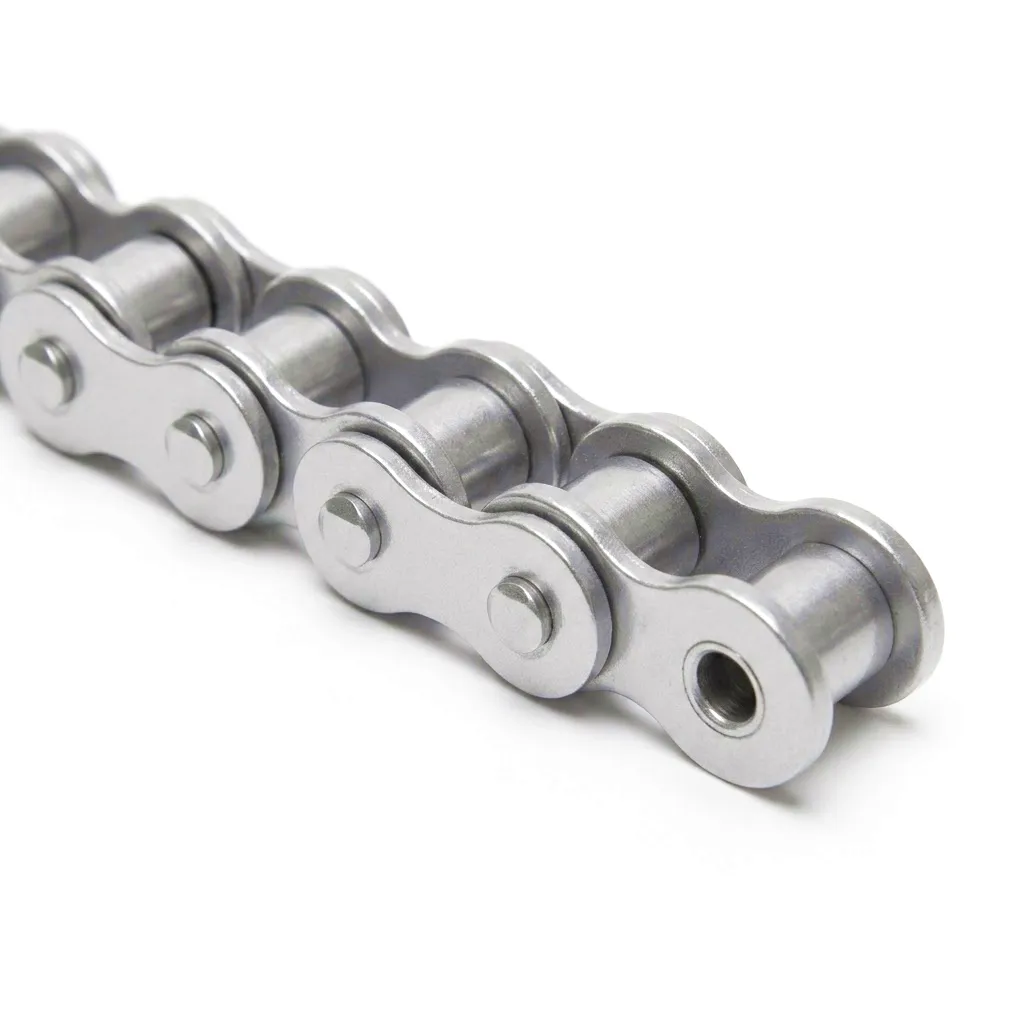
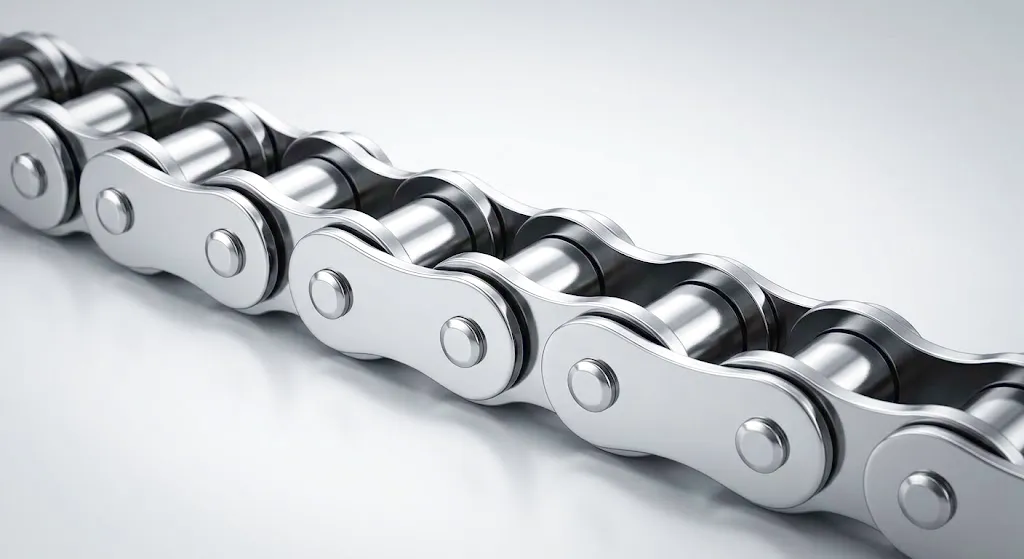
When engineers and technicians talk about a roller chain “stretching,” they are not describing elastic deformation in the classical sense. True polymer or metal elongation under tension is a real but minor contributor. The dominant mechanism is progressive pin-and-bushing wear — the gradual removal of material at every pivot point across each chain link. Each time the chain articulates around a sprocket tooth, the pin rotates fractionally within the bushing bore. Under load, these two hardened surfaces press against each other at enormous contact pressures, measured in gigapascals at the micro-contact level. With every revolution, minute quantities of steel are abraded away. Multiply that by millions of articulation cycles over a service life, and the aggregate effect becomes significant: the pin-to-pin pitch distance grows incrementally, and the overall chain length — measured across a fixed number of links — becomes measurably longer than its nominal specification.
The geometry of this wear pattern is worth examining in detail. In a new roller chain, the clearance between pin outer diameter and bushing inner bore is controlled to tight tolerances — often within ±0.01 mm in precision-grade chains. As wear proceeds, the bore diameter grows and the pin diameter shrinks, incrementally increasing the effective pitch length. Industry standards, including those referenced by the British Standards Institution (BSI) and ISO 606, define acceptable chain elongation limits at 1.5% to 3% of nominal pitch length, depending on application severity and sprocket geometry. Beyond these limits, the chain roller no longer seats correctly in the sprocket valley, contact transfers to the tip of the tooth rather than the root, tooth flank wear accelerates dramatically, and the risk of tooth-jump or chain-skip events rises sharply — both of which carry serious safety implications on industrial machinery operating in facilities from Sheffield foundries to automotive assembly plants in the Midlands.
Four Root Causes That Accelerate Roller Chain Elongation
Understanding the specific drivers of wear allows engineers to make targeted interventions.
Oil film breakdown at pin-bushing interfaces is the single greatest accelerator of roller chain elongation under normal operating conditions. Without an adequate lubricant film, metal-to-metal contact occurs at full contact pressure. Boundary lubrication regimes generate temperatures at asperity contacts that can locally exceed 600°C, thermally softening the case-hardened surfaces and removing material at rates up to 20 times greater than properly lubricated joints. Industrial roller chains operating in UK manufacturing environments — particularly in food processing facilities where oil types are regulated by NSF H1 standards — require carefully specified lubricants applied at the correct intervals and volumes to maintain film continuity across all operational speeds and load cycles.
In agricultural applications — prevalent across East Anglia, Lincolnshire, and the Scottish Borders — roller chains operate in environments saturated with fine mineral dust, crop silica, and soil particulates. These abrasive particles infiltrate the pin-bushing clearance gap and act as a lapping compound, grinding away hardened surfaces with every articulation cycle. Even particles in the 5–20 micron range are sufficient to accelerate wear significantly when trapped under load between hardened steel surfaces. Sealed chain designs with O-ring or X-ring lubrication retention technology address this mechanism directly by preventing particle ingress while maintaining internal lubrication reservoirs between service intervals.
Sustained operation above the chain’s rated working load accelerates plastic deformation within the link plate eyes and pin holes, effectively changing the geometry of the bearing area even before surface wear becomes the dominant factor. Shock loading events — common on quarrying equipment in South Wales and limestone extraction operations across the Peak District — generate instantaneous forces many times the nominal chain load. These transient spikes cause micro-plastic flow at the contact zones, permanently enlarging the bearing interface dimensions. The cumulative effect appears indistinguishable from surface wear elongation in a chain audit, but the root cause and the preventive solution are fundamentally different: adequate shock absorber integration and correct chain selection by dynamic load factor rather than static rated load alone.
A chain installed with excessive slack will experience dramatically amplified dynamic loading every time the slack is taken up by sudden load application. The resulting impulse forces concentrate at individual pin joints rather than distributing evenly across the full chain strand, rapidly accelerating localised wear at the highest-stress link interfaces. Conversely, a chain installed too tight eliminates the necessary clearance for the pin to rotate smoothly in the bushing, increases bearing pressure at all joints simultaneously, and generates elevated operating temperatures throughout the strand. Correct tensioning — typically 1–3% of centre distance sag for horizontal drives and tighter for vertical or inclined configurations — is as critical to chain life as material grade or lubrication regime selection.
Material Science and Heat Treatment: What Determines Wear Resistance
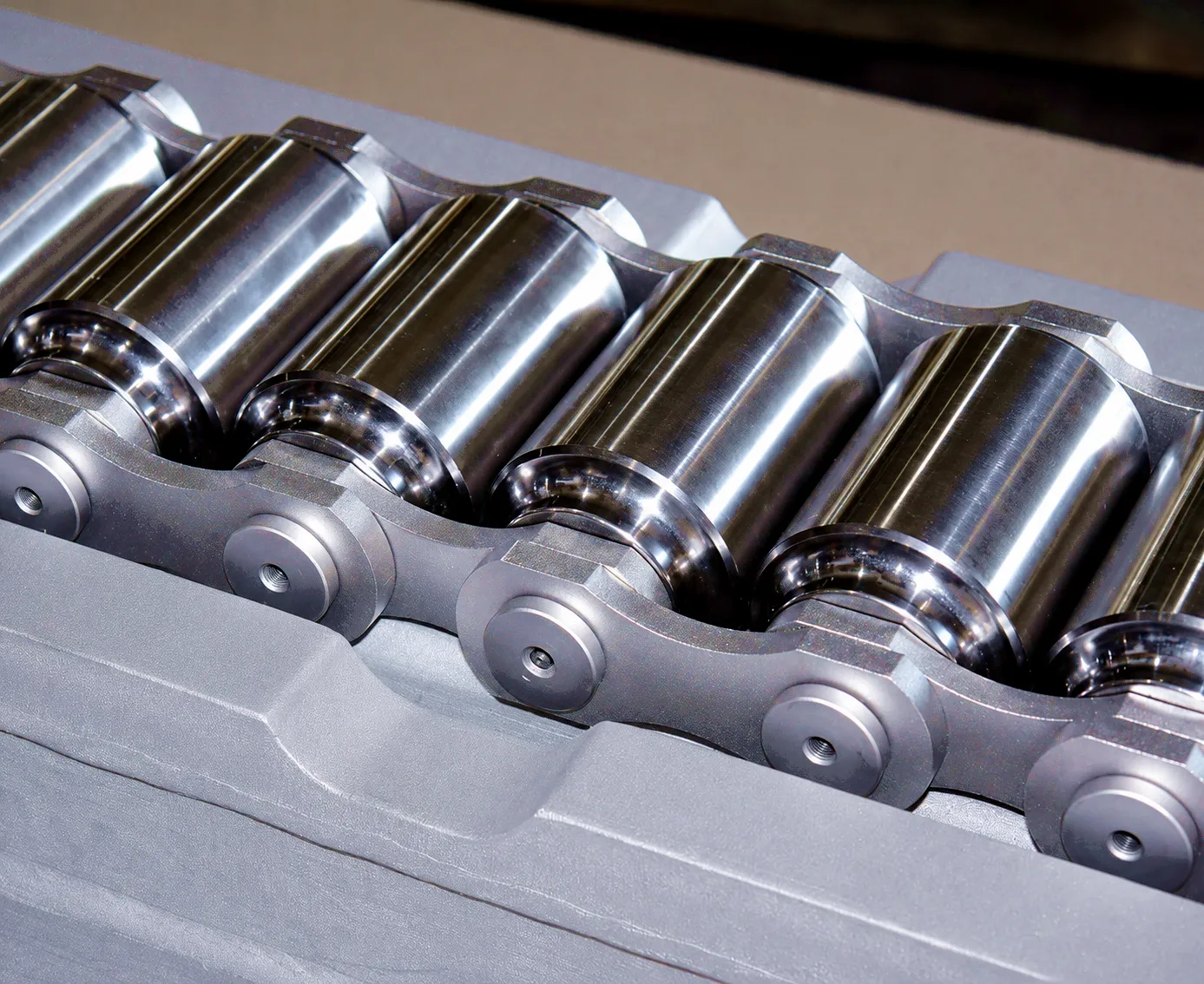
The longevity of a roller chain under real service conditions is inseparable from the metallurgical specification of its components. Every element in the chain assembly — pin, bushing, inner plate, outer plate, and roller — must be manufactured from a material appropriate to its specific stress state and wear mode. Pins carry the highest bending loads and must resist both fatigue crack initiation and surface abrasion simultaneously. Modern high-performance roller chain pins are manufactured from alloy steels such as 20CrMnTi or equivalent case-hardening grades, carburised to achieve surface hardness values of 58–64 HRC while maintaining a tough, ductile core with hardness in the 35–45 HRC range. This combination of hard surface and resilient core defines the engineering concept of case depth optimisation — a measurable variable that directly predicts fatigue and wear life under dynamic loading.
Bushings experience the most complex wear geometry in the entire chain assembly. During articulation, the pin sweeps through an arc within the bushing bore, generating a non-uniform Hertzian contact pressure distribution that is highest at the pin entry and exit positions within each sprocket engagement cycle. Premium bushing materials — high-carbon chromium steels with controlled retained austenite levels below 20% after heat treatment — provide the combination of high hardness, dimensional stability under thermal cycling, and adequate toughness to resist brittle fracture under shock loading. The retained austenite control is particularly significant: excessive retained austenite leads to dimensional changes during service as it transforms to martensite under stress, contributing to a progressive bore expansion that resembles and compounds wear-driven elongation.
Link plates carry predominantly tensile fatigue loads, and their material specification prioritises fatigue endurance limit over surface hardness. Medium-carbon steels, through-hardened to 40–48 HRC, provide the optimal balance between fatigue strength — measured by the stress amplitude sustainable for 10 million cycles without failure — and the ductility required to prevent brittle fracture in cold ambient conditions, which is an important consideration for chains operating in outdoor agricultural environments in Scotland or northern England during winter months when temperatures can drop to -15°C.
58–64 HRC
35–45 HRC
58–62 HRC
40–48 HRC
54–61 HRC
Featured: Rubber Top Roller Chains for Specialised Conveying Applications
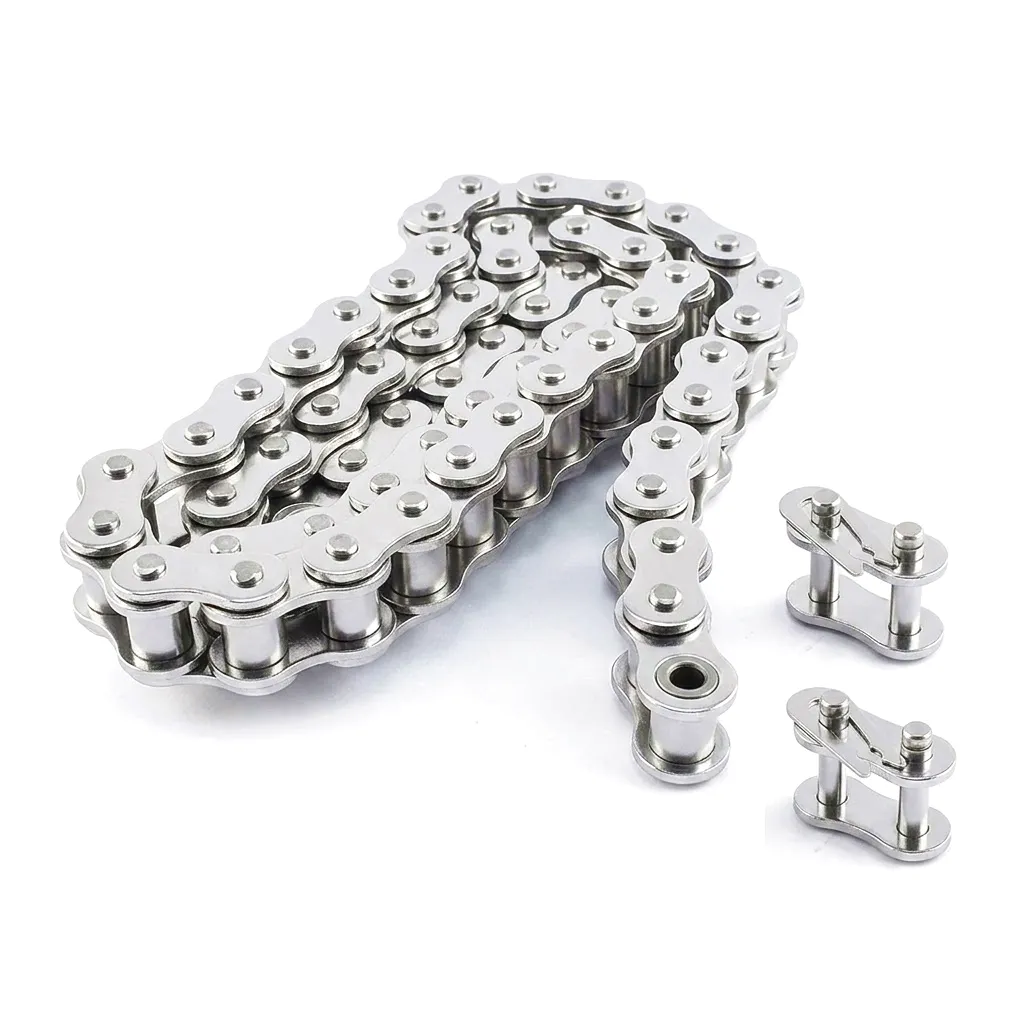
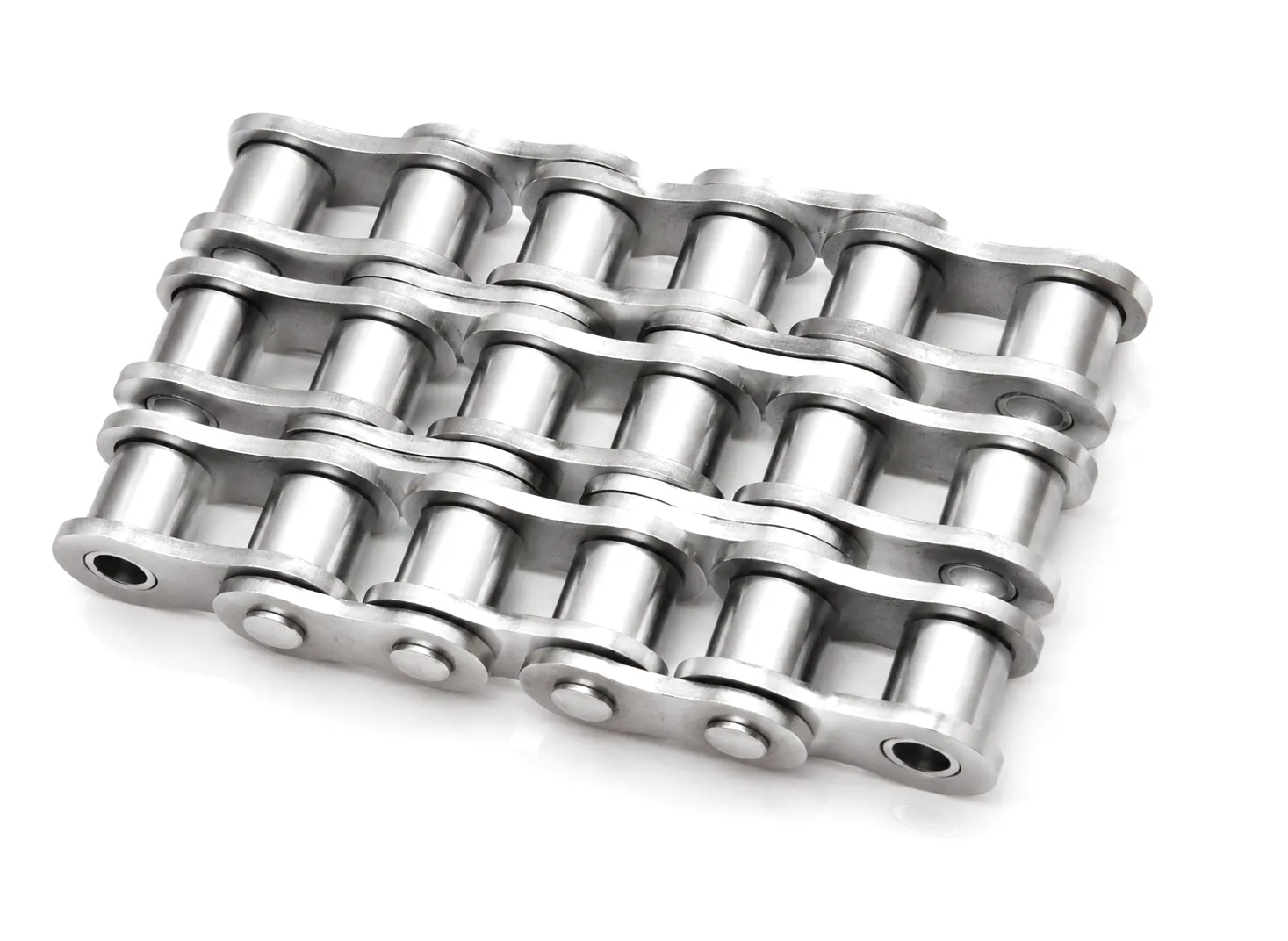
The 24B-G1 features vulcanised rubber attachment pads engineered to provide positive grip on fragile or irregularly shaped products. The base chain is manufactured to BS/ISO 606 specification with enhanced case depth on pins and bushings, delivering elongation resistance significantly above standard grade. Preferred in UK bottling, packaging, and food production facilities where gentle product handling and extended service intervals are both critical.
View product details →
The 20B-G1 combines the structural integrity of a full-pitch BS 20B base chain with bonded rubber attachment blocks that resist oil, mild acids, and temperatures to 80°C. Widely adopted in UK manufacturing sectors including automotive parts handling in the West Midlands and pharmaceutical packaging lines throughout Hertfordshire and Cambridgeshire, where cleanability, wear life, and product contact surface compliance are non-negotiable requirements.
View product details →
Roller Chain Technical Performance and Specification Table
Reference data for standard BS/ISO series chains. Data reflects Ever Power precision manufacturing tolerances.
| Chain Size (BS) | Βήμα (mm) | Φόρτιση θραύσης (kN) | Max Elongation Limit | Διάμετρος καρφίτσας (mm) | Plate Thickness (mm) | Operating Temp. | Lubrication Type |
|---|---|---|---|---|---|---|---|
| 08Β-1 | 12.70 | 18.0 | 3.0% | 4.45 | 1.60 | -20°C to +150°C | Manual / Bath |
| 10Β-1 | 15.875 | 22.2 | 3.0% | 5.08 | 1.70 | -20°C to +150°C | Drip / Bath |
| 16Β-1 | 25.40 | 60.0 | 2.0% | 8.28 | 4.00 | -20°C to +150°C | Drip / Forced |
| 20Β-1 | 31.75 | 95.0 | 1.5% | 10.19 | 4.50 | -15°C to +160°C | Forced / Spray |
| 24Β-1 | 38.10 | 160.0 | 1.5% | 14.63 | 6.00 | -15°C to +160°C | Forced / Spray |
| 32Β-1 | 50.80 | 250.0 | 1.5% | 17.81 | 7.00 | -10°C to +180°C | Forced Pressure |
| 48Β-1 | 76.20 | 400.0 | 1.5% | 23.81 | 9.60 | -10°C to +180°C | Forced Pressure |
Industrial Application Scenarios Where Elongation Management is Critical
Each sector presents unique elongation challenges. Knowing these means specifying chains that genuinely fit the environment.
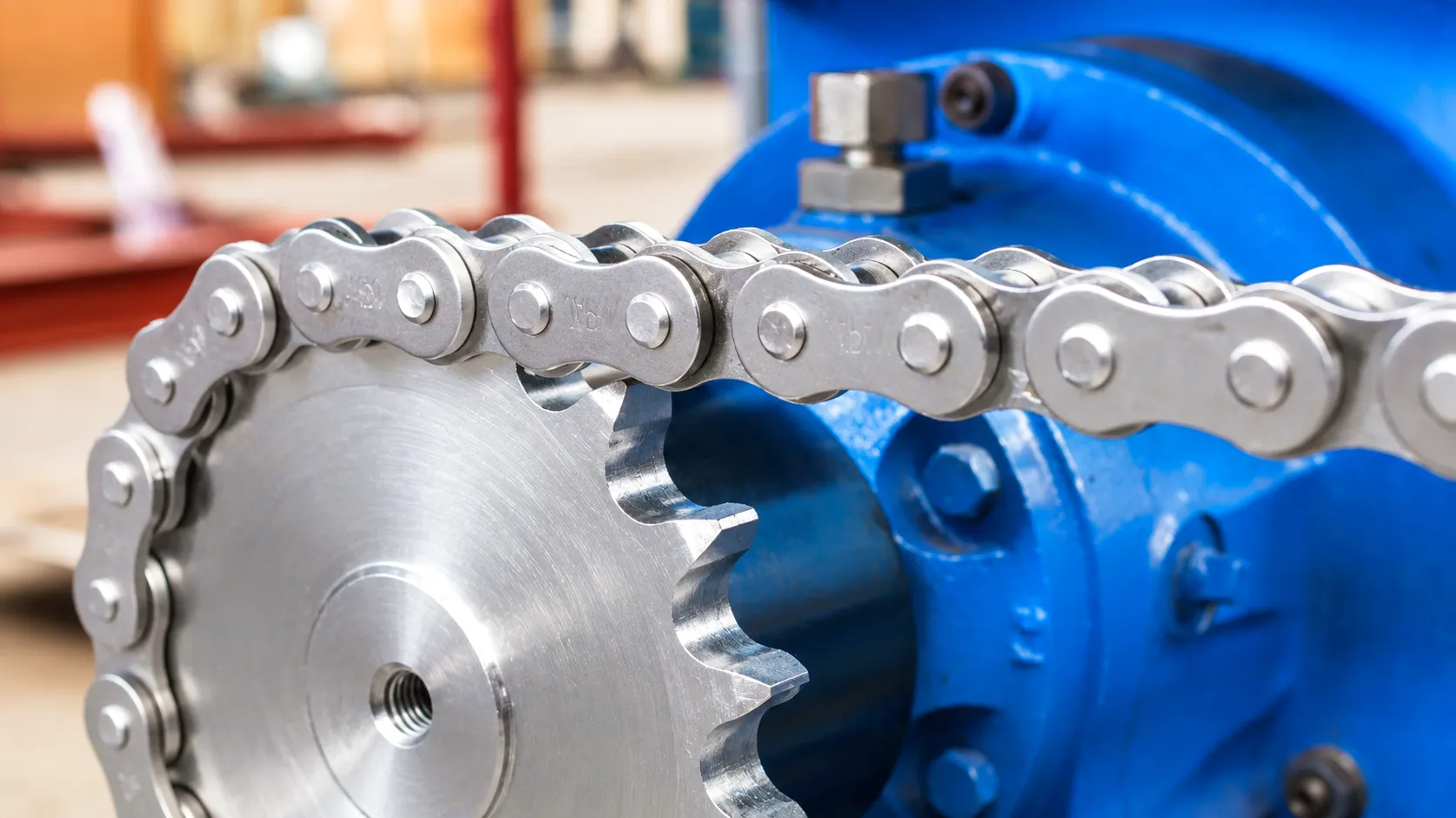
Sheffield Steel Processor Cuts Chain Replacement Costs by 42%
A documented account of how targeted chain specification changes transformed a maintenance budget.
A Sheffield-based cold-rolling and slitting centre processing carbon and alloy steel strip had been experiencing roller chain failures on its primary coil handling conveyor system at intervals of between six and nine months — well below the 18-month theoretical service life indicated by the chain manufacturer’s published load rating. The facility operates three shifts continuously, and each chain replacement event required a planned eight-hour shutdown, costing approximately £22,000 in lost throughput and maintenance labour. Chain inspection at each replacement revealed consistent patterns of heavy pin-and-bushing wear and measurable elongation averaging 2.8% across the drive strand — sufficient to cause the observed tooth-skip incidents that triggered each shutdown.
The facility’s maintenance engineering team engaged Ever Power’s technical support team, who conducted an application analysis based on the submitted load data: a 180 kN static working load with an assessed shock factor of 1.8 due to the coil start-stop loading profile, combined with ambient mill scale contamination and an existing oil bath lubrication system that was supplemented only once per shift. The analysis identified two compounding problems: the specified chain was underrated for the effective dynamic load after shock factor application, and the lubrication interval was insufficient to maintain film integrity during the temperature rise in the third shift, when ambient temperatures near the rolling mill increased lubricant viscosity loss.
Ever Power proposed a transition to a 24B-2 duplex chain with a 20% higher case depth specification on pins and bushings, combined with an automated chain lubrication unit set to a timed drip cycle appropriate for the operating speed and temperature range. A custom chain length was manufactured to the facility’s exact strand specification with pitch verification at every link. The first service interval under the new specification exceeded 16 months without measurable elongation beyond 0.8%, reducing the annual maintenance event frequency from approximately two to less than one per year. Annualised savings against the previous maintenance schedule exceeded £30,000, representing a payback period of under four months on the combined chain and lubrication system investment.
What UK Industrial Customers Say About Ever Power Roller Chains
“We moved to Ever Power 24B-1 chains across our press shop conveyor lines twelve months ago after repeated issues with premature elongation from our previous supplier. The difference has been noticeable from the first inspection interval — wear rates are significantly lower, and we have not had a single tooth-skip event since installation. The technical data provided before the order helped justify the specification change internally.”
“The customisation process was straightforward and well managed. We needed an attachment chain with a specific extended tab configuration for our straw baler discharge conveyor, and Ever Power produced prototypes within three weeks with full dimensional documentation. The batch we ordered for the harvest season performed through the full campaign without any elongation issues — a first for that machine in four years of operation.”
“Ordering through Ever Power for our quarry conveyor overhaul gave us a level of technical engagement that we had not previously experienced from a chain supplier. The application analysis report they provided before order placement identified a tensioning geometry issue that we corrected before installation — almost certainly preventing an early failure. The chains themselves have now been in service for eleven months under full load and are tracking well within acceptable elongation limits.”
How to Measure Roller Chain Elongation Accurately in the Field
A step-by-step approach used by maintenance engineers across UK industrial facilities.
Apply a representative working tension to the chain before measurement. A slack chain will give a false reading as the pin clearances are not loaded consistently. For manual measurement, a spring balance pulling the chain taut to approximately 5% of its rated working load is adequate for standard industrial assessment.
Measure across a minimum of 12 links and preferably 24 or more for accurate results. Longer measurement spans reduce the proportional error of individual measurement uncertainty, giving a more reliable elongation percentage. For chains with standard pitches, 12 links of a 25.4 mm pitch chain spans 304.8 mm nominally — any increase from this baseline reflects wear-driven elongation.
A steel rule is inadequate for precision elongation assessment. Use a vernier calliper or a digital chain pitch gauge with 0.01 mm resolution. Measure from the centreline of the pin at one end to the centreline of the pin at the other end of the measurement span. Repeat at three different points along the chain strand to identify any localised wear anomalies.
Elongation % = ((Measured length − Nominal length) / Nominal length) × 100. Compare the result against the replacement threshold for your specific application. Chains operating on large-sprocket drives can often run to 3% before tooth engagement deteriorates; chains on small sprockets of 17 teeth or fewer should typically be replaced at 1.5% to avoid accelerated sprocket tooth wear and potential tooth-jump risk.
Common Questions About Roller Chain Stretch and Wear
How much roller chain elongation is acceptable before I need to replace it on a UK industrial conveyor system? +
What is the average cost of a heavy-duty roller chain replacement for a Birmingham manufacturing facility, and how can I get an accurate supplier quote? +
Which type of roller chain lasts longest in agricultural machinery operating in muddy UK field conditions throughout the harvest season? +
How do I find a reliable roller chain supplier based in or shipping to Sheffield who can also offer custom manufactured chain specifications? +
When should I replace my roller chain versus replacing both the chain and the sprockets on a UK food processing line? +
What does roller chain elongation price impact look like for a UK quarry operation when chains fail earlier than expected due to poor specification? +
EVER POWER ROLLER CHAIN MANUFACTURERS
Specify with Confidence. Order with Clarity.
Custom roller chain solutions for UK industrial and agricultural applications. Technical support, competitive pricing, and documented quality from receipt to despatch.
✉ Request a Quote: [email protected]
επεξεργασία από gzl