Section 01
Understanding the Architecture: How Single-Strand and Multi-Strand Roller Chains Differ
Single-Strand
One Row. Maximum Simplicity.
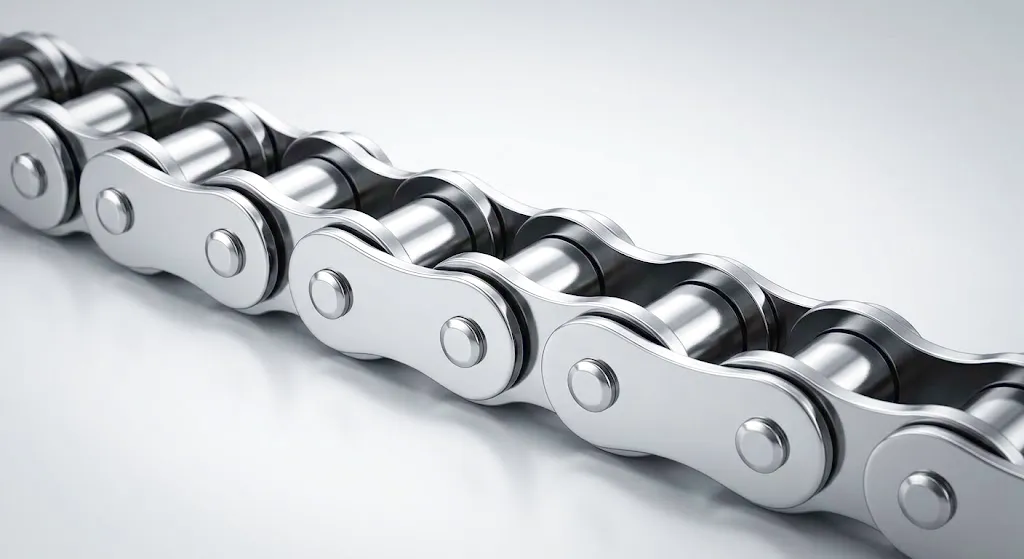
A single-strand roller chain consists of one continuous row of alternating inner links and outer links. It is the most widely deployed configuration in the world precisely because it covers an enormous range of general-purpose power transmission tasks with a compact width, straightforward alignment requirements, and the lowest possible unit cost. A single-strand chain meshes with a single-row sprocket on both the driving and driven shaft, meaning the entire drive system demands minimal lateral clearance — a genuine advantage in machines where space between rotating elements is constrained. For applications where peak torque demands fall within the rated breaking load of a standard pitch chain, this configuration delivers excellent reliability at low total cost of ownership. In UK industry, single-strand chains are the backbone of light-to-medium conveyors, agricultural seed drills, packaging machinery, and general industrial gearboxes found across the Midlands manufacturing belt.
Multi-Strand
Parallel Strands. Multiplied Capacity.
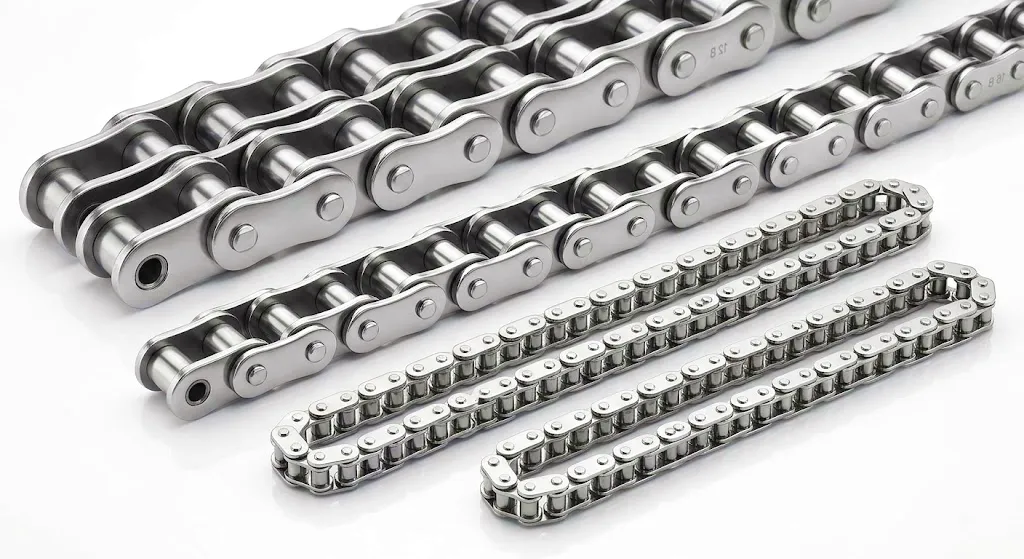
A multi-strand roller chain shares the same pitch, pin diameter, and roller dimensions as its single-strand counterpart, but connects two, three, four, or even more parallel rows of link plates through common pins. Each additional strand carries approximately the same proportion of the total load, so a duplex (2-strand) chain roughly doubles the transmittable power at a given speed without increasing the chain pitch. This is the key engineering trade-off: moving from a single-strand to a multi-strand configuration allows the engineer to either transmit higher power through the same pitch, retain the same power output at a smaller pitch (with advantages in weight and high-speed performance), or increase the factor of safety under severe shock loading. Multi-strand configurations are the preferred choice on heavy steel-mill conveyors in Sheffield, large-scale paper machinery in the north of England, heavy agricultural balers, and mining conveyors where a single-strand chain would be approaching or exceeding its rated capacity under continuous duty.
Section 02
Working Principle: How Roller Chains Transmit Power
Section 03
Core Material Composition: What Roller Chains Are Made From
Material selection determines wear life, corrosion resistance, and maximum operating temperature — three variables that differ markedly across the industrial environments where roller chains operate in the UK. Here is what goes into each major component and why it matters in practice.
⚙
Plăci de legătură
High-carbon steel (typically 0.45%–0.65% C) cold-stamped and then heat-treated to achieve surface hardness of HRC 40–55 while retaining a tough core. For corrosive food-industry environments common in Yorkshire and Lancashire processing plants, stainless steel (304 or 316L grade) plates are substituted, accepting a modest reduction in fatigue strength in exchange for excellent resistance to caustic cleaning chemicals.
🔩
Pini
Case-hardened alloy steel, ground to tight diameter tolerances (typically ±0.005 mm on premium grades). The pin carries the shear force between the inner and outer plate pairs and must resist both fatigue bending under cyclic loading and fretting wear at the plate press-fit interface. Shot-peening of pin surfaces introduces compressive residual stresses that extend fatigue life by up to 30% on chains used in heavy shock-load environments such as mining conveyors.
🔧
Bucșe
Deep-drawn from low-carbon steel tube and sintered to carry an oil-impregnated bronze layer on the inner bore in self-lubricating variants. The bushing provides the primary bearing surface for the rotating roller and the articulating pin, and its internal bore diameter is the most wear-critical dimension in the entire chain assembly. Bushing wear causes pitch elongation — the single most common reason roller chains are condemned during preventive maintenance inspection in UK facilities.
🎡
Role
Seam-welded or solid-drawn high-carbon steel, hardened and ground to a close outer diameter tolerance. The roller is the element that directly contacts the sprocket tooth, and its outer hardness — typically HRC 58–62 — must be balanced against brittleness risk. In food-safe applications where metallic contamination is a regulatory concern, nylon or UHMWPE rollers are sometimes specified, though with significantly reduced load ratings and maximum operating temperatures.
Section 04
Technical Advantages: Single-Strand vs. Multi-Strand in Practice
The following advantages apply specifically to each configuration and reflect the real-world engineering experience of UK maintenance engineers and OEM machine builders operating in demanding production environments.
Single-Strand Advantages
- Lowest acquisition cost per unit of transmitted power in the light-to-medium duty range — critical for cost-sensitive UK contract manufacturers competing on tight margins.
- Narrowest possible chain width, enabling the most compact drivetrain envelope where lateral clearance between rotating machinery is restricted by existing structural steelwork.
- Simplest alignment requirements — a single-strand chain tolerates slightly more lateral sprocket misalignment before load distribution is adversely affected, reducing commissioning time and ongoing alignment maintenance costs.
- Straightforward replacement in the field using standard connecting links, clip-type spring clips, or rivet-type connecting links — all widely stocked through UK industrial distributors for immediate availability.
- Lighter weight per metre reduces dynamic loads on bearings at high operating speeds, extending bearing service life in applications with large, fast-moving sprockets.
Multi-Strand Advantages
- Dramatically higher power transmission capacity within the same chain pitch — a duplex chain achieves approximately 1.7× the power rating of an equivalent simplex chain due to shared load distribution across multiple plate sets.
- Reduced pitch for equivalent power allows operation at higher sprocket tooth counts, smoothing the polygonal effect, lowering chain speed variation per revolution, and reducing vibration and noise levels on high-cycle machinery.
- Enhanced shock-load tolerance — when a sudden impact or torque spike occurs, the multi-strand configuration distributes the impulse load across more pin cross-sections and plate shear areas, substantially reducing the risk of sudden failure.
- Better retained strength under elevated operating temperatures because the greater number of load-bearing elements ensures that slight thermal softening in any one component does not bring the chain close to its working limit.
- Preferred by UK OEM machinery builders for the heavy steel, paper, and aggregate processing sectors where planned maintenance windows are short and maximum time-between-overhaul is a contractual requirement.
Produse recomandate
High-Performance Roller Chain Products
For high-demand heavy equipment drives — particularly Caterpillar-platform machinery — Ever Power produces two precision-engineered high-strength roller chain variants that represent the upper tier of the product range.
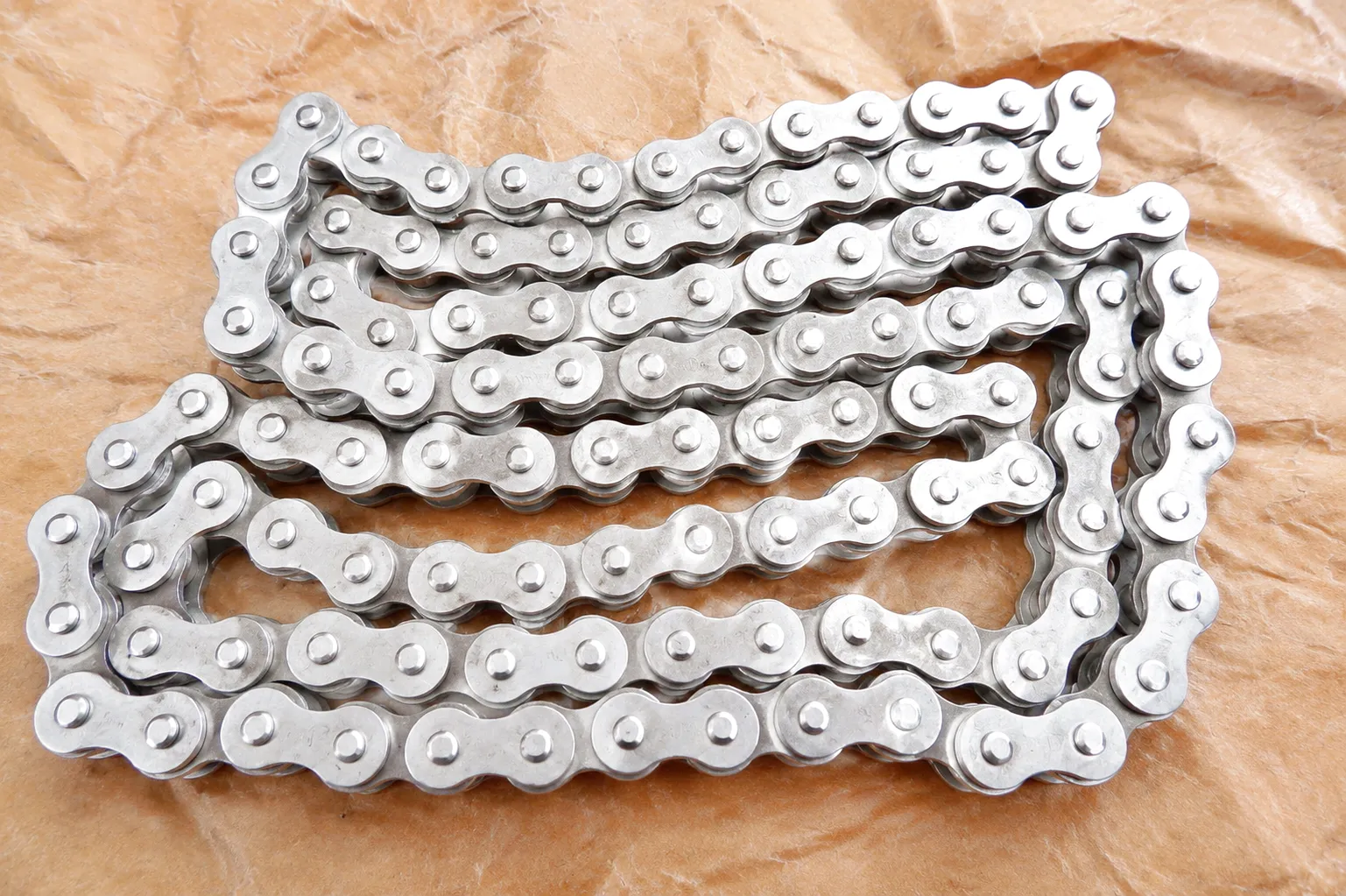
Cat Platform · Caterpillar Series
High Strength Roller Chain 120HSP-00
Engineered specifically for Caterpillar equipment drives requiring a 3-inch pitch (76.2 mm) heavy-duty series chain with enhanced plate thickness and shot-peened pins for maximum fatigue resistance under continuous heavy-load operation.
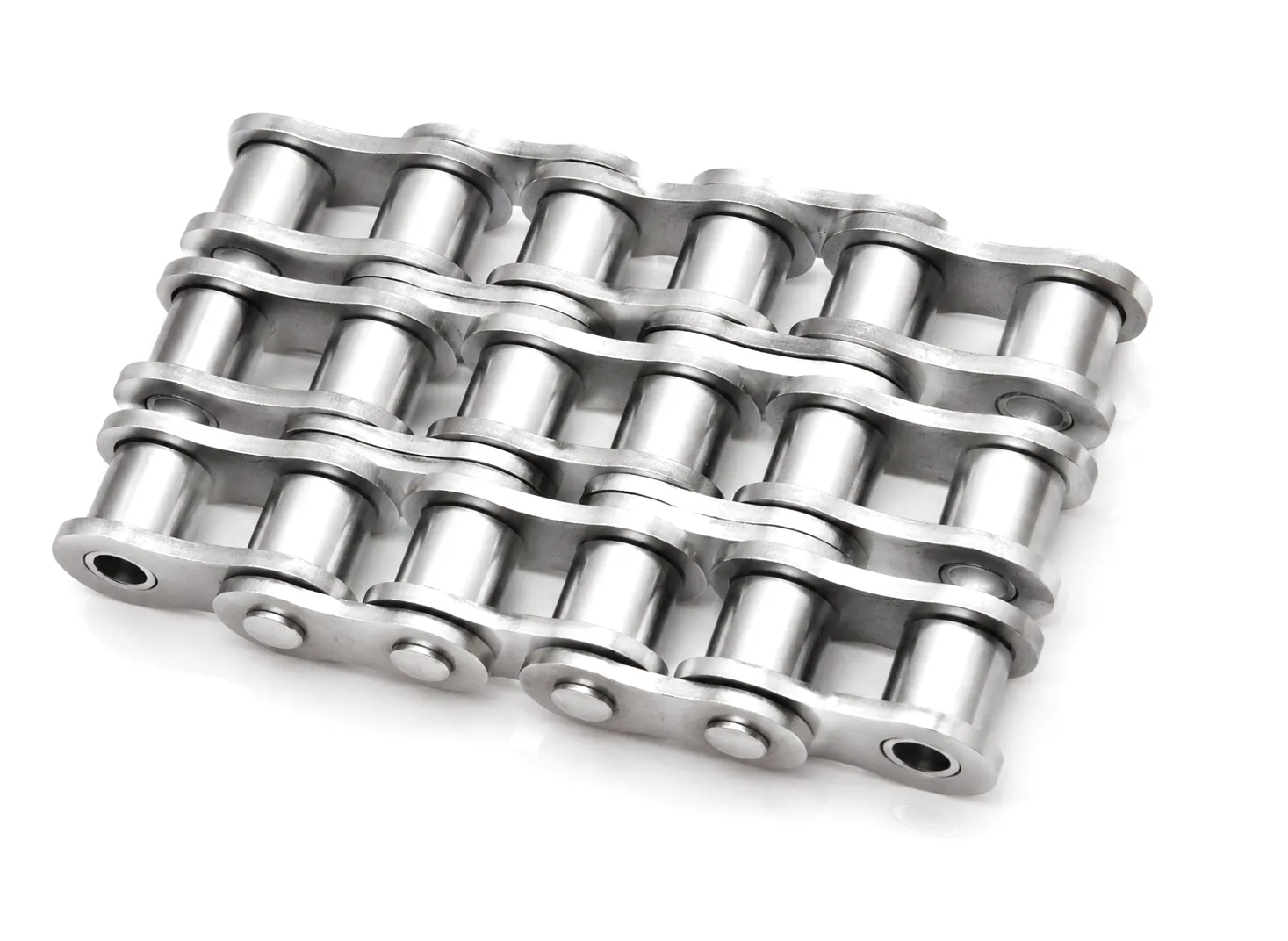
Cat Platform · C-Series Heavy
High Strength Roller Chain C100HSP-00
The C100HSP-00 is a 2-inch pitch Caterpillar-specific high-strength variant delivering exceptional tensile strength with a heat-treated alloy steel construction throughout. Particularly well-suited to multi-strand drivetrain builds where each individual chain must meet the most stringent OEM replacement specifications.
Section 05
Technical Performance Parameters: Roller Chain Comparison Table
The table below presents key technical and performance parameters for standard roller chain configurations conforming to ISO 606 / BS 228 specifications. Values are representative of industrial-grade chain at normal operating temperatures (10–60 °C) with adequate lubrication. Actual rated power values depend on sprocket size, speed, and duty cycle — consult the applicable chain manufacturer’s power rating tables for exact application sizing.
| Parametru | Simplex (1-Strand) | Duplex (2-Strand) | Triplex (3-Strand) | 4-Strand |
|---|---|---|---|---|
| ISO 606 Pitch Range (mm) | 6.35 – 76.2 | 6.35 – 76.2 | 6.35 – 76.2 | 9.525 – 50.8 |
| Power Rating Multiplier (vs. simplex) | ×1.0 | ×1.7 | ×2.5 | ×3.3 |
| Typical Tensile Strength — 1-inch pitch (kN) | 31.1 | 55.6 | 83.4 | 110.8 |
| Drive Efficiency (% with full lubrication) | 98 – 99 | 97 – 98.5 | 97 – 98 | 96 – 97.5 |
| Max. Speed — 1-inch pitch, 19T sprocket (m/s) | Up to 12 | Up to 10 | Up to 8 | Up to 7 |
| Plate Material (Standard) | High-carbon steel HRC 40–55 | High-carbon steel HRC 40–55 | High-carbon steel HRC 40–55 | Alloy steel HRC 50–62 |
| Operating Temperature Range (°C) | -30 to +200 | -30 to +200 | -30 to +200 | -20 to +180 |
| Relative Component Cost (vs. simplex) | ×1.0 | ×1.85 | ×2.65 | ×3.40 |
| Alignment Sensitivity | Low | Medium | Ridicat | Very High |
Section 06
Industrial Application Scenarios: Where Each Configuration Excels
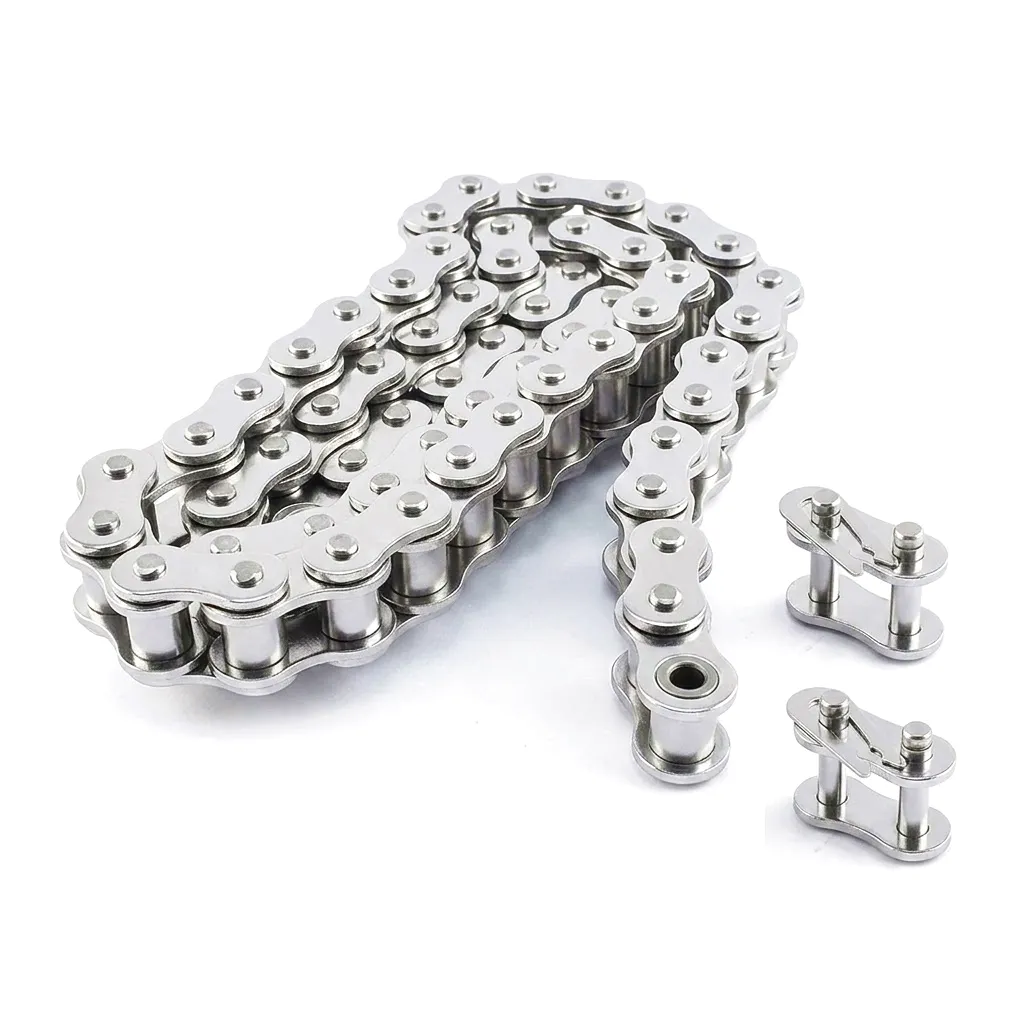
⛱ Automotive Manufacturing — West Midlands
Body-in-white conveyor lines in Birmingham automotive plants run at precisely controlled speeds under moderate, steady tensile loads. Single-strand roller chain in pitch sizes of 19.05 mm (3/4 inch) or 25.4 mm (1 inch) dominates this application because the loads are predictable, the speed is low-to-medium, and the drive centres are fixed. Multi-strand configurations appear on the heaviest platform-transfer conveyors where car bodies exceed 1 tonne per carrier.
⚿ Steel Processing — Sheffield
Rolling mill cooling bed conveyors and bar-handling tables in Sheffield’s steel sector are among the most demanding roller chain applications in UK industry. High ambient temperatures, heavy impact loads from steel bar contact, and the requirement for long service intervals between shutdowns make triplex and quad-strand roller chain the standard — running on large-diameter cast alloy sprockets with hardened tooth faces to match the chain’s wear resistance.
🌿 Agricultural Machinery — East Anglia
PTO-driven combine harvesters, round balers, and forage wagons operating across the flat arable farmland of East Anglia and Lincolnshire use a mixture of single-strand drive chains for lighter header and auger drives, and duplex or triplex chains on threshing cylinder and cleaning shoe drives where peak torque during heavy crop ingestion creates severe intermittent shock loads. The chains must also tolerate field contamination with soil, crop residue, and moisture — conditions where sealed O-ring or X-ring chain variants are increasingly specified.
⛬ Food Processing — Yorkshire
Slaughterhouse overhead conveying lines, bakery oven conveyor chains, and fish processing washing lines in Yorkshire and Humberside demand stainless steel roller chain construction throughout, with FDA-approved food-grade lubricants applied at controlled intervals. Single-strand simplex chain in 304-grade stainless dominates lighter conveyor sections; duplex configurations appear on the overhead-trolley main drive lines where hanging loads combined with high cycle counts would exhaust simplex capacity within a single seasonal production campaign.
⛏ Mining and Quarrying — Wales and Northern England
Longwall mining conveyors, underground armoured face conveyors, and surface-mount aggregate screening machines in the Welsh coalfields and Pennine quarry sector push roller chain to its absolute performance limits. Multi-strand configurations from duplex through to 6-strand chains are used on main haulage drives, running at slow speeds but under enormous tensile loads driven by the sheer weight and abrasion of coal or rock product. Shot-peened, pre-loaded chains with integral O-ring seals are mandatory on underground drives where re-lubrication intervals may stretch to several weeks.
🚧 Paper and Packaging — Scotland
Pulp and paper mills in Scotland run continuously for months between planned shutdowns, meaning roller chain specifications carry extreme reliability weighting. Duplex and triplex chains drive wire-section and press-section conveyors where the chain must maintain consistent pitch accuracy — any elongation beyond 1.5% causes reel-winding register errors with costly quality implications. Sealed chain or nickel-plated variants are preferred in wet-end zones where constant water spray and chemical sizing agents would accelerate corrosive attack on standard steel chains.
Excelență în producție
Ever Power: Precision Engineering and Custom Roller Chain Solutions
Ever Power operates a vertically integrated manufacturing facility combining precision CNC machining, heat treatment, and automated assembly with rigorous quality control at every production stage. For UK customers who import directly from our factory for OEM machine builds or MRO replenishment programmes, Ever Power offers a level of customisation depth that off-the-shelf distribution simply cannot match.
🔬
Pitch-Perfect Customisation
Ever Power engineers custom roller chain to non-standard pitches, extended-pin configurations, side-flexing layouts, and attachment chain designs that standard catalogue items cannot address. UK OEM builders who have legacy machines with obsolete chain specifications find this capability invaluable — we can reverse-engineer from a worn sample chain and produce a dimensionally identical replacement in the correct material grade.
⚙
Material Specification Flexibility
Standard carbon steel, 304 stainless, 316L stainless, nickel-plated, zinc-plated, or chrome-vanadium alloy steel construction — Ever Power’s supply chain covers every common material specification and can source certified special-grade steels for demanding traceability requirements. All heat treatment processes are conducted in controlled-atmosphere furnaces with batch-traceable hardness testing and Charpy impact data available on request for safety-critical applications.
📦
Supply Chain Reliability for UK Importers
Ever Power ships direct to UK ports on consolidated sea freight schedules with lead times tailored to quarterly replenishment programmes. For time-critical MRO requirements, air freight options ship directly from our factory with commercial invoice and packing list documentation pre-formatted for UK customs clearance procedures. Minimum order quantities are negotiable for established accounts, and bonded stockholding arrangements are available for high-volume regular customers.
Ready to discuss a custom roller chain specification for your UK operation?
Section 07
The Configuration Decision: A Practical Engineering Framework
Choosing between single-strand and multi-strand roller chain is not a guessing exercise — it follows a structured engineering process that every experienced UK plant engineer applies, whether consciously or instinctively. The following framework organises the key decision variables into a logical sequence.
1
Calculate Required Power and Speed
Start with the drive power in kW and the input shaft speed in rpm. Apply the appropriate service factor from the relevant standard (ANSI/ASME B29.1 or ISO 606 annexe tables) to account for shock loading, number of chain strands, and centre distance. If the corrected design power falls within the published power rating for a simplex chain at your required pitch, you have your answer. If it exceeds the simplex limit, move to duplex and re-check before assuming triplex is necessary.
2
Evaluate Available Lateral Space
A duplex chain occupies roughly twice the width of an equivalent simplex, and triplex three times — not including sprocket hub overhang, which must also fit within the bearing span. On retrofits inside existing machine frames — a common scenario in UK plant maintenance — this width constraint frequently governs the decision. If the shaft centres and frame dimensions prohibit a multi-strand configuration wide enough for the required power, the correct engineering response is to use a larger pitch simplex chain or to upgrade the drive to a different type (e.g., toothed belt) rather than force an oversized chain assembly into an inadequate space.
3
Assess Maintenance and Lubrication Capability
Multi-strand chains demand more rigorous lubrication management and more precise alignment maintenance. If the plant’s maintenance resource is limited, or if the drive is installed in an area difficult to access for regular inspection — underground conveyor drives, for example — either specify sealed chain variants (O-ring or X-ring) to extend re-lubrication intervals or step down to a larger simplex chain that is more tolerant of imperfect maintenance practice. The best chain for a resource-constrained operation is the one that will realistically receive adequate care in service.
4
Consider Total Cost of Ownership
The purchase price of a multi-strand chain is higher than simplex, but the relevant comparison for UK plant engineers is total cost of ownership over a defined asset life. If using a multi-strand configuration at a smaller pitch allows longer sprocket tooth life, reduced vibration-induced bearing failures, or fewer unplanned stoppages, the premium over simplex is nearly always justified on a net present value basis. British manufacturing environments, where skilled maintenance labour costs are high and production downtime is exceptionally costly, generally support investing in the higher-specification configuration when the application sits near the capacity boundary of the simpler option.
Customer Success
Case Study: Upgrading Conveyor Drive Performance at a Sheffield Steel Fabrication Plant
Locaţie
Sheffield, South Yorkshire
Sector
Heavy Steel Fabrication
Chain Supplied
Triplex 38.1 mm pitch, alloy steel
A structural steel section manufacturer operating in the Don Valley industrial corridor came to Ever Power following repeated premature failure of their existing cooling bed conveyor drive chains. The plant ran a 45-metre roller conveyor designed to transport freshly-extruded steel sections from the forming press to a quench station, with sections ranging from 20 kg to 380 kg per piece and an irregular loading rhythm that created significant shock impulses whenever a heavy section contacted the conveyor at speed. The existing drive had been specified with a single-strand, 1.5-inch pitch chain based on average load calculations, completely overlooking the peak shock loads generated during heavy section drop-on events.
The plant’s engineering team contacted Ever Power’s technical sales department in early spring with worn samples, original machine drawings, and a load-cycle data log from a recently installed condition monitoring system. Our application engineers reviewed the data and identified that the peak instantaneous tension during heavy section placement events reached 4.2 times the calculated average running tension — placing the existing simplex chain at 94% of its minimum breaking load during normal production. The correct specification was a triplex 38.1 mm pitch chain in chrome-vanadium alloy steel with shot-peened pins and pre-loaded connecting links, giving a calculated peak loading of just 31% of breaking load under worst-case shock events.
Ever Power produced the first supply batch within four weeks of order confirmation, including custom offset links to match the existing sprocket hub face width precisely. The plant installed the new triplex chain set during a planned August bank holiday shutdown. In the twelve months since installation, the conveyor has recorded zero unplanned chain-related downtime compared with an average of 3.7 stoppages per quarter under the previous specification — a total maintenance saving that the plant’s operations director estimated at over £85,000 in combined labour, lost production, and replacement chain costs.
Ce spun clienții noștri
⭐⭐⭐⭐⭐
“The triplex chain Ever Power specified for our cooling bed drive has genuinely transformed reliability on that line. Twelve months without a chain break — after years of battling failures every few weeks. Their technical team actually understood our shock-loading problem rather than just quoting us the standard catalogue. The pre-loaded offset links were exactly right for our sprocket dimensions. Exceptional product quality and real engineering support.”
— Maintenance Engineering Manager, Don Valley Steel Fabrication, Sheffield
⭐⭐⭐⭐⭐
“We specified Ever Power’s duplex stainless roller chain across our overhead trolley conveyor system and the performance has been outstanding. Running food-grade production seven days a week with caustic wash cycles every shift, and the chain has shown minimal elongation even after eight months of continuous service. The price per metre was very competitive for the material specification, and delivery to our Harrogate site was faster than we expected on our first order. We will not be shopping elsewhere.”
— Engineering Director, North Yorkshire Food Processing Group, Harrogate
⭐⭐⭐⭐⭐
“Ever Power supplied us with a custom single-strand attachment chain for our agricultural baler production line — non-standard pitch with extended straight sidebar links that we couldn’t source anywhere domestically at an acceptable lead time. They produced a sample set within three weeks and matched our dimensional requirements to within 0.03 mm on every critical dimension. The production batch followed within five weeks. This is the kind of responsive, technically capable supplier relationship that UK machinery builders genuinely need.”
— Design Engineer, Agricultural Machinery OEM, Grantham, Lincolnshire
FAQ · Voice Search Ready
Frequently Asked Questions — Roller Chain UK
What is the typical price difference between a single-strand and a duplex roller chain for a UK industrial conveyor?
In the UK market, a duplex roller chain of the same pitch typically costs between 1.7 and 1.9 times the price of an equivalent simplex chain — not exactly double, because some fixed manufacturing costs (such as pin grinding) are amortised across the additional strand width. The exact cost difference varies with pitch size, material grade, and order volume. Direct import pricing from Ever Power through a request for quote is generally 25–40% more competitive than buying the equivalent specification through UK industrial distribution for quantities of 100 metres or more.
How do I know when a roller chain on a UK manufacturing plant conveyor needs replacing, and what signs should maintenance teams look for?
The industry standard replacement criterion for roller chain is pitch elongation — when the chain has stretched beyond 1.5% to 2% of its nominal pitch length, replacement is required to prevent the chain riding out over sprocket teeth and jamming. Maintenance teams should measure over a fixed number of links (typically 12 to 20 links) using a purpose-made chain wear gauge or a steel rule with a precise datum pin set. Additional replacement indicators include visible plate cracking, link pin bending (indicated by uneven sideboard gaps), roller cracking or missing rollers, and chain skip or jump under load.
Which roller chain suppliers in the UK can provide ISO 606 certified duplex and triplex chain with full material traceability documentation?
For ISO 606 certified multi-strand chain with full material traceability — including mill certificates, heat treatment records, and dimensional inspection reports — buyers have two main routes: domestic UK distributors stocking imported chain from major Asian or European manufacturers, or direct import from a vertically integrated manufacturer such as Ever Power who controls the entire production process. The direct import route gives buyers access to the actual factory test documentation rather than a distributor-reissued certificate, which matters for applications in safety-regulated industries such as mining, lifting, and food contact machinery under UK PSSR and PUWER regulations.
Where can I get a competitive quote for custom roller chain with attachment links for an agricultural machinery OEM project based in Lincolnshire or the East Midlands?
For attachment chain quotations — including side-tab, top-tab, extended-pin, or bent-tab attachments in any pitch and strand count — the fastest route to a competitive and technically correct quote is a direct enquiry to Ever Power at [email protected]. Attach your drawing or a marked-up ISO catalogue reference, specify your pitch, attachment type, attachment spacing, material grade requirement, and annual volume estimate, and a technical sales engineer will respond with a fully itemised quotation typically within two working days. UK OEM customers in the East Midlands agricultural machinery sector are among Ever Power’s most active customer groups.
What is the difference between an O-ring chain and a standard roller chain, and when should UK plant engineers specify O-ring chain over a conventional design?
An O-ring roller chain is identical to a standard roller chain in its outer dimensions and pitch, but incorporates toroidal rubber seals (O-rings) between the inner and outer link plates at each pin location. These seals trap a pre-packed grease charge inside the pin-bushing joint, maintaining lubrication for extended periods without external re-greasing. UK plant engineers should specify O-ring chain in applications where re-lubrication is impractical (underground mining drives, outdoor agricultural machinery in season), where external lubricant contamination of the product is a regulatory problem (open-line food conveyors), or where high ambient dust or grit would rapidly contaminate conventional chain oil and accelerate abrasive wear. The penalty is a modest increase in chain stiffness and a small reduction in maximum permissible operating speed compared with an equivalent standard chain.
How does a multi-strand roller chain compare in cost and performance to simply using a larger pitch single-strand chain for a heavy-duty drive in a Birmingham factory?
This is a genuine engineering choice faced regularly by drive system designers in the West Midlands. A larger pitch simplex chain is simpler to align, easier to replace, and typically cheaper per unit of chain length. However, larger pitch means larger rollers and greater polygonal action — the cyclical speed variation that occurs as each link engages a sprocket tooth — which generates more vibration and limits the maximum permissible operating speed. A multi-strand chain at a smaller pitch often achieves the same power rating with far less vibration, quieter operation, and longer sprocket life, because the smaller pitch allows more sprocket teeth to share the load simultaneously. For drives running above 5 m/s or in noise-sensitive environments, the multi-strand smaller-pitch solution is almost always the correct answer.
Need a Roller Chain Specification for Your UK Operation?
Contact Ever Power’s technical team today for a detailed product recommendation and competitive quotation.
© Ever Power Roller Chain Manufacturers · Technical Content · edit by gzl