Select Page

Mechanical Power Transmission ยท Technical Deep Dive

How Roller Chain Engages a Sprocket: The Mechanics of Chordal Action

Understanding the precise interplay between roller chain and sprocket geometry is fundamental to specifying, maintaining, and optimising drive systems across heavy industry โ€” from agricultural combines rolling across the North Yorkshire plains to conveying lines inside Sheffield’s advanced manufacturing plants.

๐Ÿ“… Updated July 2026
|
๐Ÿ“‹ 3,200+ words
|
๐ŸŒ UK Industrial Focus
|
๐Ÿ›  Power Transmission Engineering

What Chordal Action Actually Means โ€” and Why It Matters

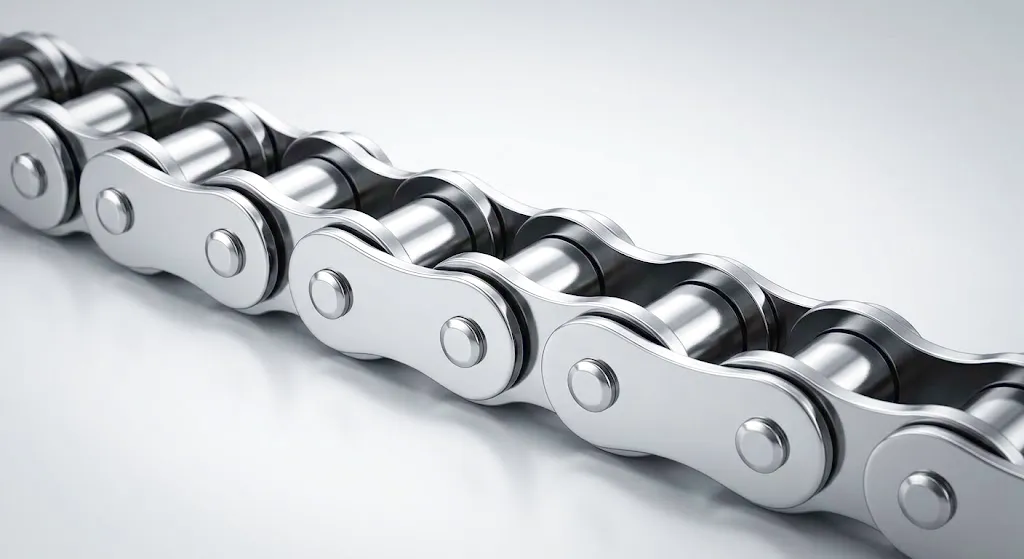
Roller chain meshing with sprocket โ€” Ever Power

When a roller chain wraps around a sprocket, the rollers do not travel in a perfect circle. They ride on the crests of the sprocket teeth at a radius that represents the circumscribed circle โ€” more commonly called the pitch circle โ€” yet the chain itself links together in straight, rigid segments between pin centres. This geometric mismatch is the root of what engineers call chordal action, and it produces a characteristic rise-and-fall velocity variation that is unavoidable in any roller chain drive. Understanding it is not an academic exercise; it directly determines how smoothly a conveyor line runs inside a Birmingham automotive press shop, how quietly a food-processing line operates in a West Yorkshire packing facility, and how long a roller chain service life can be realistically expected in demanding industrial contexts across the United Kingdom.

The polygon effect, as chordal action is sometimes called, means that as each link enters engagement with a sprocket tooth, the pin sits on a chord rather than the arc of the pitch circle. The driven shaft therefore accelerates and decelerates rhythmically โ€” once per tooth pass. At lower sprocket tooth counts, this variation becomes pronounced. A five-tooth sprocket produces velocity oscillations that are clearly audible and damaging to connected machinery. A twenty-five-tooth sprocket reduces the same oscillation to a level that is largely imperceptible in normal operation. This single mechanical reality underpins nearly every recommendation in standard roller chain engineering practice, from minimum tooth counts to speed limits and lubrication intervals.

Ready to specify the right roller chain for your application?
Contact our engineering team for a tailored quotation.

Get a Quote โ†’

The Working Principle of Roller Chain Drive Systems

โš™
Positive Drive Engagement

Unlike friction-based drives such as flat belts, a roller chain transmits power through direct mechanical interlocking between hardened rollers and sprocket tooth profiles. Each roller seats into the tooth root under load, creating a positive drive that cannot slip under rated conditions. The geometry means that torque is transferred via a compressive contact force acting radially outward at each engaged tooth. This positive engagement is what makes roller chain indispensable in agricultural machinery, mining conveyors, and heavy press transfers โ€” applications where belt slip would be operationally catastrophic.

๐Ÿ“ˆ
The Chordal Rise Cycle

As the driving sprocket rotates, each successive roller enters the engagement zone and briefly occupies a position on the chord of the pitch circle. The roller then rises toward the pitch circle radius as the sprocket continues to turn, and the driven side of the chain accelerates correspondingly. When the roller exits from the tooth, the process reverses. The amplitude of this velocity fluctuation is described mathematically as a function of the sprocket pitch angle โ€” specifically, it is proportional to 1 minus the cosine of half the tooth angle. With a small tooth count, this produces significant velocity ripple, vibration, and accelerated wear on every component in the drivetrain.

๐Ÿ”—
Link Articulation and Wear

Every time a roller chain link articulates over a sprocket tooth, the pin and bush surfaces slide against each other under load. This sliding contact is the primary wear mechanism in any chain drive. Proper lubrication introduces an oil film that separates the metal surfaces, reducing the sliding friction that would otherwise progressively elongate the chain pitch through material removal. Chain elongation โ€” colloquially called chain stretch, though it is dimensional rather than elastic โ€” alters the pitch geometry and causes rollers to ride further up the sprocket tooth flanks, eventually leading to tooth hop, catastrophic disengagement, and, in the worst cases, equipment damage across entire production lines.

Core Materials That Define Roller Chain Performance
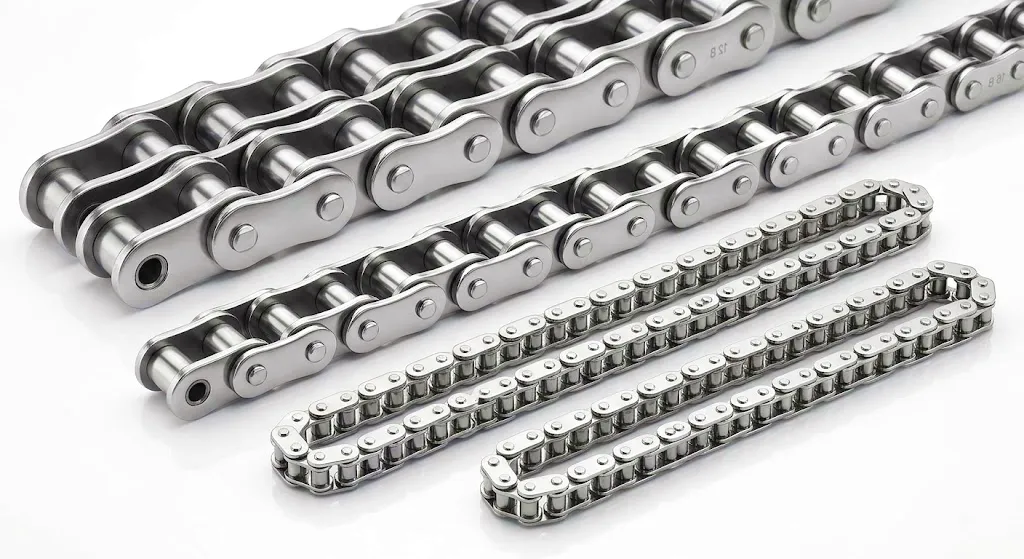
Roller chain material quality โ€” Ever Power manufacturing

The longevity and load-carrying capacity of any roller chain product is inseparably linked to the grades of steel used for each component. Modern high-performance roller chain is not a monolithic steel product; it is an engineered assembly in which each element is optimised for its specific mechanical function. The outer plates and inner plates carry the tensile load and must resist fatigue cracking under millions of repeated stress cycles throughout a service life that may span years of continuous operation in a demanding manufacturing environment. These plates are typically stamped from medium-carbon alloy steels โ€” often grades incorporating chromium and molybdenum additions โ€” then heat-treated to develop a combination of surface hardness and core toughness that resists both surface wear and the crack initiation that leads to sudden fracture.

The bush is perhaps the most critically loaded component in the chain assembly. It forms the inner bearing surface against which the pin oscillates with every tooth engagement cycle. Bushes are manufactured from carbon steel tubing, cold-drawn to precise dimensional tolerances, then case-hardened to a specified surface depth through carburising or carbonitriding. The hardened case provides wear resistance; the unhardened core resists impact fracture. Rollers, which take the direct contact load from the sprocket tooth, are similarly case-hardened and ground to tight dimensional specifications so that they seat cleanly into the tooth root geometry without chattering or bouncing. Pins are the tensile load-carrying elements; they are manufactured from alloy steel bar, precisely ground, and through-hardened or case-hardened depending on the pitch and the rated tensile strength target.

Side Plates
Medium-carbon alloy steel (Cr-Mo grades); fatigue-rated; heat-treated for tensile toughness
Bushes
Cold-drawn carbon steel; carburised or carbonitrided; case-hardened bearing surface
Rollers
Case-hardened alloy steel; precision-ground OD; tight tolerance seating in tooth root
Pins
Alloy steel bar; precision-ground; through- or case-hardened; primary tensile member
Special Grades
Stainless steel (304/316) for food/pharma; nickel-plated for corrosive atmospheres; self-lubricating sintered bush for inaccessible locations

Technical Advantages of Precision Roller Chain

โœ… High Power Density
Roller chain transmits substantially more power per unit weight than equivalent belt drives operating at similar speeds. The positive engagement mechanism eliminates the slippage losses that affect V-belt drives under transient load spikes, meaning that the rated power reaches the output shaft consistently. This efficiency advantage is particularly valuable in high-cycle continuous operations such as automated assembly lines in Coventry’s precision engineering sector, where even fractional energy losses compound over production shifts.
โœ… Exact Speed Ratio
The tooth-positive engagement means that the ratio between input and output shaft speeds is determined entirely by the number of teeth on the respective sprockets โ€” not by friction coefficients, tension, or material stretch. This makes roller chain an indispensable choice wherever indexing accuracy matters: packaging lines, textile machinery, printing presses, and CNC tool changer mechanisms all depend on this deterministic ratio to maintain register tolerances or synchronise multi-axis movements precisely.
โœ… Extended Service Life
A correctly lubricated and maintained roller chain running within its rated parameters will outlast most alternative drive components by a considerable margin. Modern case-hardened steel construction combined with tight dimensional tolerances means that quality chains routinely achieve service lives exceeding 15,000 operating hours in moderately loaded applications. This longevity directly reduces planned maintenance costs and unscheduled downtime โ€” a critical economic consideration for manufacturing operators in the East Midlands and similar high-output regions where production line stoppages carry significant financial penalties.
โœ… Dimensional Flexibility
Roller chain can be cut to any length by removing links and fitted with connecting links or half-links to accommodate non-standard centre distances. Multiple strands can be combined to handle higher loads without increasing pitch. The chain can also accommodate angular misalignment and centre distance changes through spring-loaded jockey sprockets or tensioner units. These dimensional adaptation capabilities give system designers in demanding sectors such as steel processing and bulk materials handling a degree of installation flexibility that no toothed belt of comparable rating can match.
โœ… Temperature and Environment Resistance
Steel roller chain operates reliably across temperature ranges that would cause synthetic belt materials to crack, soften, or lose rated strength. Quality chain maintains its mechanical properties from sub-zero operating environments encountered in cold-store logistics facilities to elevated temperatures found near process furnaces and kilns. Stainless steel variants extend the operating envelope further into chemically aggressive atmospheres, including salt spray, acidic wash-down environments in food processing, and coastal industrial sites experiencing Britain’s characteristic damp, chloride-laden air.
โœ… Multi-Shaft Drive Capability
A single endless roller chain loop can drive multiple shafts simultaneously by routing over intermediate sprockets at different points in the drive circuit. This capability is routinely exploited in agricultural machinery, printing lines, and bottling plants where a single power source must synchronise the rotation of several subsidiary shafts at precise ratios without the complexity of multiple gearbox stages. No belt drive technology can replicate this multi-point power distribution while simultaneously maintaining exact tooth-positive speed ratios at every take-off point.

Featured Products

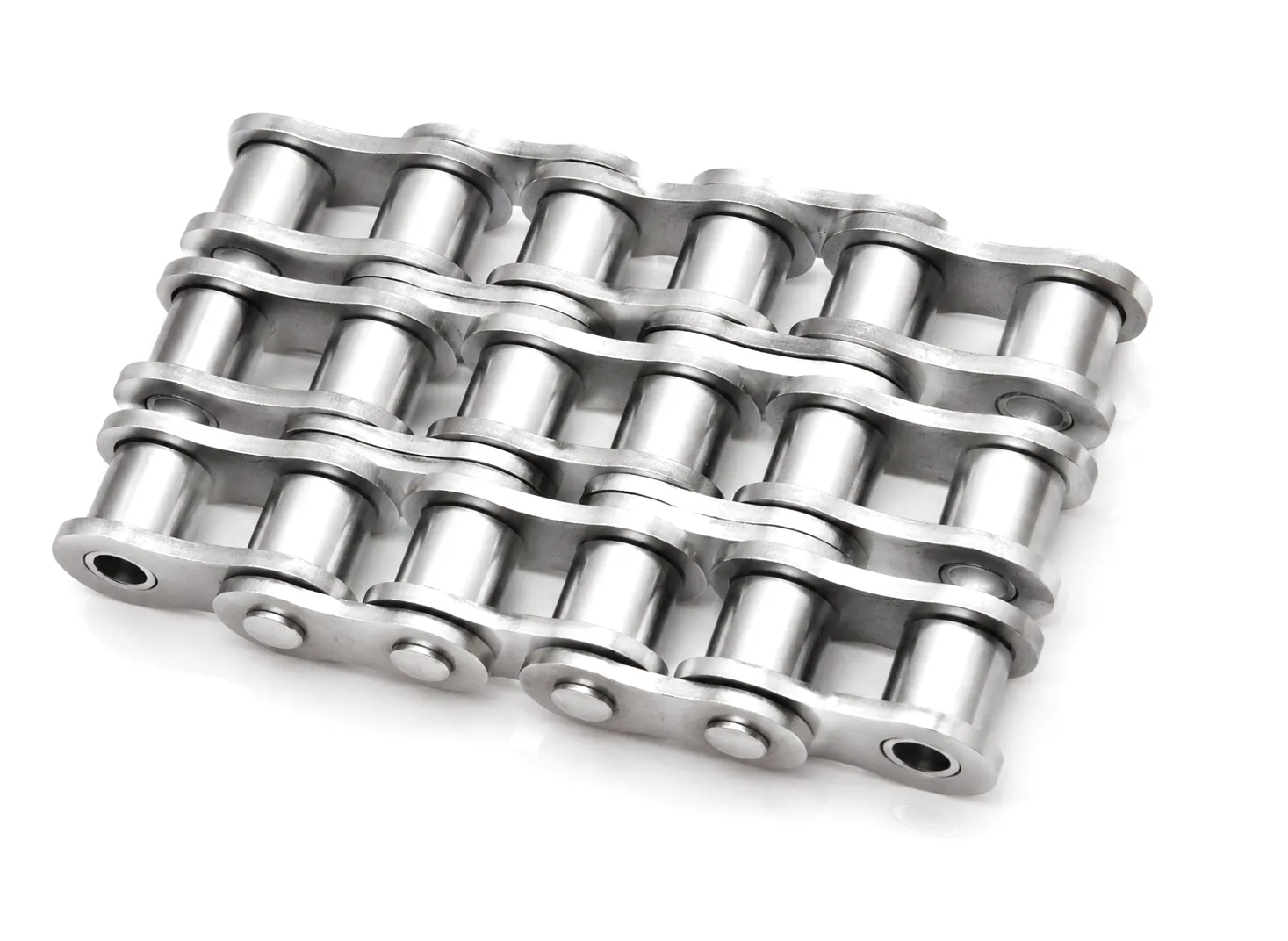
High-Strength Caterpillar-Compatible Roller Chain
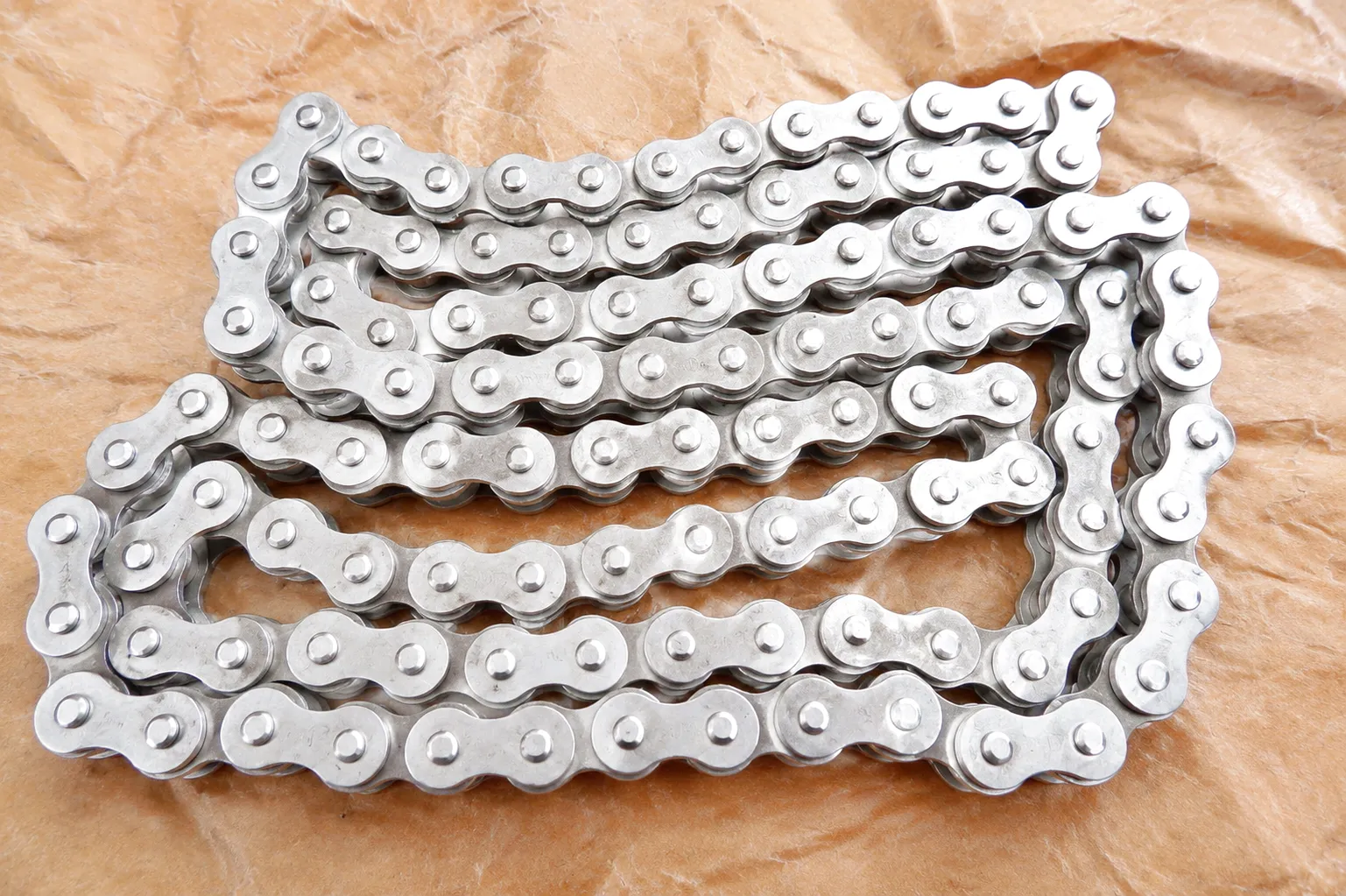
High Strength Roller Chain 120HSP-00 for Caterpillar

High Strength Roller Chain 120HSP-00
For Caterpillar Equipment

Engineered specifically for demanding Caterpillar heavy equipment applications, the 120HSP-00 incorporates shot-peened side plates, precision-hardened rollers, and a solid roller design that exceeds standard ANSI/ISO tensile ratings. Ideal for high-impact mining conveyors, excavator auxiliary drives, and forestry machinery operating in harsh outdoor environments across the Scottish Highlands and Welsh quarrying districts. The reinforced construction delivers measurably longer service intervals compared to standard chain grades.
View Product โ†’

High Strength Roller Chain C100HSP-00 for Caterpillar

High Strength Roller Chain C100HSP-00
For Caterpillar Equipment

The C100HSP-00 delivers enhanced tensile strength for Caterpillar applications where standard chain grades are insufficient for the applied shock and cyclic loading profile. Featuring a carbon steel construction with optimised heat treatment, this roller chain maintains dimensional stability under elevated tensile loads, resisting the pitch elongation that accelerates sprocket wear and increases drivetrain vibration. It is particularly well-suited to track loader drives, trenching machines, and other Caterpillar-platform equipment used extensively by UK civil engineering contractors and groundwork specialists.

View Product โ†’

Technical Performance Parameters โ€” Roller Chain Reference Table

The following table summarises key technical and dimensional parameters across a representative range of standard and heavy-duty roller chain pitches. Data conforms to ISO 606 and ANSI B29.1 standards. Exact ratings depend on specific chain series, strand count, service factors, and lubrication method โ€” contact our engineering team for application-specific calculations.

Chain Size / ISO No. Pitch (mm) Roller Dia. (mm) Inner Width (mm) Min. Tensile Strength (kN) Avg. Weight (kg/m) Max. Allowable Speed (m/s) Typical Application
06B / ANSI 35 9.525 6.35 5.72 8.9 0.36 Up to 8 Light conveying, instrument drives
08B / ANSI 40 12.70 8.51 7.75 17.8 0.69 Up to 7 General engineering, packaging machinery
10B / ANSI 50 15.875 10.16 9.65 22.2 0.93 Up to 6 Agricultural machinery, elevators
12B / ANSI 60 19.050 11.91 11.68 28.9 1.50 Up to 5.5 Steel processing, printing presses
16B / ANSI 80 25.400 15.88 17.02 60.0 2.71 Up to 4.5 Heavy conveyors, quarry equipment
20B / ANSI 100 31.750 19.05 19.56 95.0 3.73 Up to 4 Mining conveyors, offshore equipment
24B / ANSI 120 38.100 25.40 25.40 160.0 7.10 Up to 3 Heavy plant drives, Caterpillar applications

Industrial Application Scenarios for Roller Chain in the UK
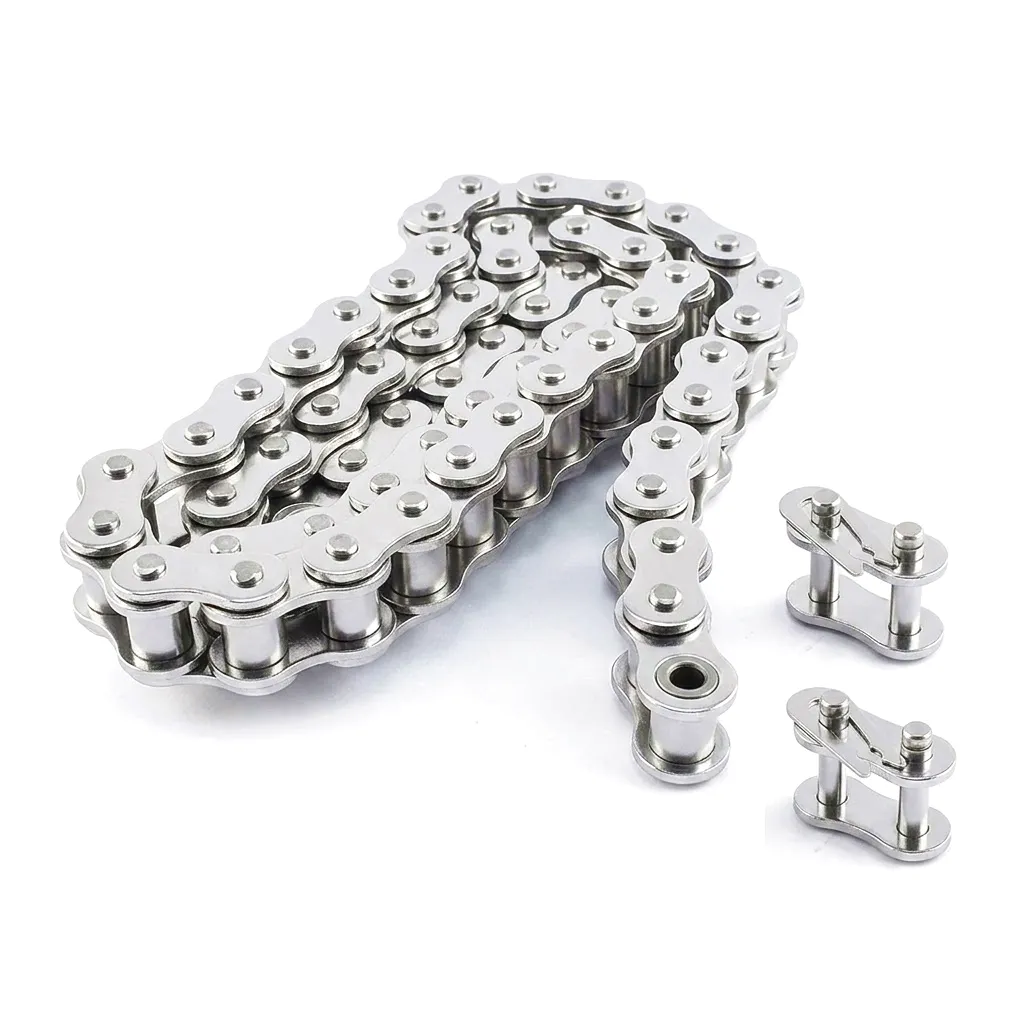
Roller chain industrial applications

Across British industry, the roller chain remains one of the most widely deployed power transmission components โ€” from the grain augers turning on Norfolk farms to the automated transfer lines inside Jaguar Land Rover facilities in the West Midlands. Its combination of positive engagement, high tensile capacity, and adaptability to a wide range of shaft centre distances and speed ratios makes it the default engineering choice wherever belts lack the load capacity and rigid couplings lack the layout flexibility. The following sectors represent the primary application domains for roller chain products within the UK market, though the mechanical principles and specification considerations are universal across all industrial geographies.

๐ŸŒฟ
Agricultural Machinery
From combine harvesters working the Lincolnshire flatlands to silage balers operating through Scottish summers, agricultural roller chain must endure shock loading, abrasive contamination, intermittent lubrication, and exposure to fertiliser chemicals and moisture. Heavy-duty agricultural chain in pitches from 15.875 mm to 38.1 mm powers straw walkers, header drives, grain elevator legs, and PTO-connected implements. Shot-peened construction and wide inner plates help absorb the impulsive loads from crop blockages and stone strikes that would crack standard chain side plates.
๐Ÿ—
Construction and Mining Equipment
Heavy excavators, crawler dozers, and track-mounted drilling rigs operating across UK quarrying and civil engineering sites subject their transmission chains to extreme cyclic loading, abrasive dust, and wide operating temperature swings. High-strength series chains โ€” including our Caterpillar-compatible 120HSP-00 and C100HSP-00 grades โ€” are engineered specifically to address these demands. Birmingham and Sheffield-based plant hire companies servicing HS2 groundworks and coastal protection projects rely on precisely this class of chain to maintain machine availability targets that contract penalties would otherwise undermine.
๐Ÿš—
Automotive Manufacturing
Production facilities in the West Midlands, South Wales, and Sunderland rely on roller chain to power overhead conveying systems, floor-mounted transfer lines, and paint-shop overhead conveyors. The requirement here is for extremely consistent pitch accuracy and low-vibration operation at sustained speeds so that body-in-white panels arrive at welding stations with consistent timing and without surface damage from vibration-induced swinging. Stainless variants are used through paint bake ovens; standard grades with polymer guides handle body shop transfers. Chain replacement intervals are co-ordinated with model changeover shutdowns to minimise the production impact of planned maintenance.
๐Ÿฝ
Food and Beverage Processing
UK food manufacturers operating under BRCGS and SALSA accreditation schemes face strict requirements around hygienic design and allergen control. Stainless steel 304 and 316 roller chain in pitches from 9.525 mm to 25.4 mm powers conveying, portioning, and packaging machinery across the industry. The smooth roller exterior facilitates clean-in-place washing procedures, and the absence of polymeric components means the chain can withstand high-temperature steam cleaning without degradation. Self-lubricating sintered bush variants eliminate the need to introduce food-incompatible lubricants into the production zone, a requirement for direct-contact food conveying in biscuit, cheese, and poultry processing plants.
๐Ÿ“ฆ
Logistics and Warehousing
The expansion of logistics and fulfilment infrastructure around the M1, M6, and M42 corridors has driven significant demand for reliable conveyor chain in sortation systems, cross-belt sorters, and pallet handling equipment. These installations require roller chain with consistent pitch accuracy to synchronise multiple sections of a conveyor network at precise relative speeds โ€” any dimensional variation introduces pallet positioning errors that trigger downstream jams and halt the sorting operation. Long service life is a commercial necessity: a fulfilment centre running three-shift, 365-day operations has minimal tolerance for chain replacement during operational windows.
โšก
Energy and Marine Sectors
Offshore platforms in the North Sea, tidal energy test sites around Orkney, and the increasingly significant UK offshore wind sector all deploy roller chain in deck machinery, anchor windlasses, and subsea positioning equipment. The corrosive marine atmosphere demands nickel-plated or fully stainless chain, and the impulsive loading from wave-induced motion requires chains with high impact resistance and generous safety factors. Reliability in these environments is non-negotiable: component failures at sea translate directly into vessel downtime, costly helicopter or vessel support, and potential HSE regulatory consequences under UK offshore safety legislation.

Manufacturing Excellence

Ever Power โ€” Precision Roller Chain Manufacturing and Custom Engineering

Ever Power roller chain factory

Ever Power has built its manufacturing reputation on a foundation of metallurgical knowledge, precision machining, and a supply chain management capability that allows us to deliver consistent quality across high-volume orders and complex custom engineering programmes. Our production facilities operate to ISO 9001 quality management standards, with in-process inspection at every critical manufacturing stage โ€” from incoming raw material verification through heat treatment monitoring and finished-product pitch measurement. This rigorous approach to process control is what allows Ever Power to offer confident performance guarantees to export buyers across the United Kingdom, Europe, and beyond.

Our customisation capabilities are a genuine differentiator in the global roller chain market. Where many suppliers offer only catalogue products in standard pitches and configurations, Ever Power routinely engineers bespoke chain assemblies to customer specifications. Custom attachment plates โ€” with drilled, tapped, or slotted profiles โ€” extend roller chain into conveying and positioning applications far beyond simple power transmission. Extended pin assemblies, rubber-cushioned rollers for noise-sensitive applications, corrosion-resistant coatings, and modified inner widths for non-standard sprocket gauges are all within our standard engineering scope. UK distributors and OEM manufacturers are encouraged to submit their technical drawings and load calculations for a free engineering review.

๐ŸŽฏ Custom Pitch Lengths
Non-standard chain lengths assembled to exact link count; connecting link configurations on request
๐Ÿ”ง Attachment Plates
K1, K2, A1, A2 standard and fully bespoke profiles; drilled, tapped, or flanged to drawing
๐Ÿ›  Multi-Strand Assemblies
Duplex, triplex, and beyond; precision-matched strand pitch for even load distribution
๐Ÿ“‹ Material Certification
Mill certificates and heat treatment records supplied; third-party testing coordination available
๐Ÿšš UK Supply Chain
Consolidated sea freight and air freight options; UK-based distribution partners for urgent orders
๐Ÿ“Š OEM Programme
Dedicated account management for machinery OEMs; call-off contract pricing; private-label packaging
Get a Competitive Quote from Ever Power
Send us your specifications, quantities, and delivery requirements. Our team will respond within one business day with a detailed quotation and technical review.

๐Ÿ“ง Get a Quote

Customer Success Story: Sheffield Steel Processor Reduces Unplanned Downtime by 64%

Case Study ยท Sheffield, South Yorkshire

Meridian Flat Products Ltd, a coil slitting and cut-to-length steel processing operation based on the outskirts of Sheffield, had been experiencing persistent reliability problems with the drive chains on their primary coil recoiling line. Three separate unplanned stoppages during a single quarter โ€” each requiring emergency maintenance callouts during a late-shift or weekend window โ€” had combined to cost the business an estimated ยฃ47,000 in lost production and overtime labour, before accounting for the capital cost of replacement chain on each occasion.

64%
Reduction in unplanned downtime

The root cause analysis conducted with the maintenance engineering team identified two compounding problems. The chain originally fitted was a standard-grade product that had been selected on price rather than on an assessment of the actual shock loading profile at the coil reel drive. The coil changeover cycle imposed repeated shock torques that exceeded the fatigue design envelope of the chain’s side plates, accelerating crack initiation and leading to sudden plate fracture. Simultaneously, the existing lubrication system was under-delivering oil to the pin-bush interfaces during the peak torque phase of each reel acceleration event, exacerbating wear rates between planned service intervals.

Ever Power’s application engineering team worked with Meridian’s maintenance manager to specify a duplex 16B high-strength chain assembly with shot-peened side plates and an elevated minimum tensile strength rating. The chain pitch and strand count were selected to reduce operating stress per strand to below 25% of the minimum breaking load, providing a generous safety factor against the measured shock loading profile. An oil bath lubrication system was recommended to replace the existing drip-feed arrangement, ensuring consistent lubrication film maintenance across the full operating cycle including acceleration transients. The custom chain assembly was delivered within four weeks from order confirmation, with full material certification included.

Following installation of the Ever Power duplex assembly, Meridian Flat Products recorded zero unplanned chain-related stoppages across the subsequent twelve-month monitoring period. Planned chain inspection intervals, initially set at six months, were extended to eight months following two consecutive clean inspections, reducing further the maintenance resource demand on the recoiling line team. The total first-year saving relative to the previous twelve-month average maintenance cost profile was calculated by Meridian’s engineering director at approximately ยฃ82,000 โ€” representing a payback period of under eight weeks on the Ever Power supply investment.

Customer Reviews
โ˜…โ˜…โ˜…โ˜…โ˜…

“The duplex 16B assemblies Ever Power supplied have been running continuously for over a year without a single unplanned stop. The material certification and engineering support we received during the selection process gave us genuine confidence that we were specifying the right product for our operating conditions โ€” not just ordering the nearest catalogue item.”

โ€” David Hartley, Maintenance Engineering Manager, Meridian Flat Products Ltd, Sheffield
โ˜…โ˜…โ˜…โ˜…โ˜…

“I was initially sceptical about switching to an imported chain product for a critical production drive, but the dimensional accuracy of the Ever Power chain was measurably better than our previous supplier โ€” our sprocket wear rates have dropped noticeably since the changeover. The lead time and documentation package were both exactly as promised, which matters enormously when we’re planning around a scheduled maintenance window.”

โ€” Susan Bray, Production Engineering Director, Meridian Flat Products Ltd, Sheffield
โ˜…โ˜…โ˜…โ˜…โ˜…

“The Ever Power team’s willingness to review our drive calculation and flag that we were underspecified on strand count before we placed the order saved us from repeating the same mistake a second time. That kind of pre-sales technical engagement is genuinely rare in the chain supply market. The custom delivery schedule they arranged worked perfectly with our shutdown timeline.”

โ€” Tom Ashworth, Plant Maintenance Supervisor, Meridian Flat Products Ltd, Sheffield

Reducing the Impact of Chordal Action in Drive System Design

Roller chain sprocket engagement precision

Experienced transmission engineers mitigate chordal action effects through a combination of specification choices that address the underlying geometry rather than simply attempting to absorb the resulting vibration after the fact. The most effective single intervention is to specify a larger number of teeth on the driving sprocket, which reduces the tooth pitch angle and the corresponding velocity variation amplitude. Industry practice generally recommends a minimum of seventeen teeth on the driving sprocket for moderate-speed drives and at least twenty-one teeth for applications where smooth, low-vibration operation is important โ€” such as drives connected to sensitive measuring equipment or precision indexing machinery in aerospace subcontract manufacturing facilities around Bristol and Derby.

Pitch selection is the second key lever. A smaller pitch chain running at higher rotational speed on a larger-tooth sprocket produces lower velocity ripple amplitude than an equivalent larger-pitch chain. The trade-off is that smaller pitch chains have lower rated tensile strengths, requiring duplex or triplex strand arrangements for heavy loads. This is an engineering optimisation problem with multiple variables, and the correct answer depends on the specific load spectrum, speed, centre distance, and maintenance access constraints of each installation. Ever Power’s engineering team is available to work through these calculations with UK buyers as part of the quoting process, with no obligation to purchase.

๐Ÿ“ˆ Increase Tooth Count
More sprocket teeth = smaller pitch angle = lower velocity variation. Minimum 17T driving; 21T+ preferred for smooth drives.
๐Ÿ”Ž Use Smaller Pitch
Smaller pitch + higher speed on larger sprockets reduces ripple. Multi-strand for load capacity; duplex/triplex standard options.
๐Ÿ”ง Control Centre Distance
Optimal centre distance = 30 to 50 chain pitches. Avoid exact multiples of chain pitch to prevent resonant pulsing harmonics.
๐Ÿ’ง Lubricate Correctly
Consistent lubrication minimises pin-bush wear that causes pitch elongation, which magnifies chordal action effects as the chain ages.
๐Ÿ”„ Tension the Slack Span
Correct slack-side sag (approximately 1โ€“2% of centre distance) damps resonant oscillations without overloading bearings or accelerating wear.

Frequently Asked Questions About Roller Chain

How does chordal action in a roller chain drive actually affect the machinery connected to it?
Chordal action produces a rhythmic velocity variation โ€” once per sprocket tooth โ€” that generates vibration in the driven shaft, bearings, and connected machinery. At low tooth counts and high speeds, this vibration is energetic enough to loosen fasteners, accelerate bearing fatigue, produce audible noise in the drive enclosure, and, in extreme cases, excite resonant vibration in machine frames or supporting structures. Driven components such as rolls, drums, or indexing tables receive a non-constant input velocity that can produce surface quality defects on processed materials or positioning errors in automated systems. Specifying a higher tooth count sprocket is the most direct engineering remedy.
What is the typical roller chain price range for industrial heavy-duty grades available to UK buyers, and what drives the cost difference?
Pricing varies substantially with pitch, strand count, material grade, and order volume. Standard simplex roller chain in common pitches (08Bโ€“16B) is generally available at competitive rates for quantities from a few metres upwards. Heavy-duty and high-strength grades โ€” including Caterpillar-compatible series such as our 120HSP-00 โ€” carry a premium that reflects the additional material cost, extended heat treatment cycles, and more rigorous inspection requirements. Custom attachment chain adds further to the unit price but often delivers a whole-system cost saving by eliminating fabricated attachment components. To obtain an accurate current price or quote for your specific requirement, please contact Ever Power at [email protected] with pitch, series, quantity, and delivery location details.
Which type of roller chain supplier in the UK offers the most reliable delivery lead times for urgent maintenance replacement orders on Caterpillar plant?
For Caterpillar-specific chain grades such as the 120HSP-00 and C100HSP-00, sourcing directly from a specialist manufacturer with dedicated stock holding is the most reliable route for urgent maintenance requirements. Ever Power supports UK industrial buyers through an established logistics partnership that offers express air freight consolidation for urgent orders, typically landing into UK hubs within five to seven working days for stocked sizes. For plant operators in Birmingham, Leeds, Sheffield, or Manchester where Caterpillar equipment density is high, we recommend discussing a consignment stock arrangement or a call-off blanket order to ensure critical chain grades are available without the lead time risk of individual spot orders.
How often should roller chain in a heavy agricultural combine harvester operating in East Anglian conditions be inspected and replaced?
Agricultural chain in combine applications should be inspected at the start of each harvest season and again mid-season if throughput has been heavy. The critical measurement is chain pitch elongation: a chain that has elongated by more than 2% of its nominal pitch across a 30-link test span should be replaced regardless of apparent visual condition, as the pitch mismatch will cause accelerated sprocket wear that destroys the sprocket teeth long before the chain itself fails visually. East Anglian harvesting conditions โ€” dusty during cereal harvest, potentially wet and abrasive during root crop campaigns โ€” are particularly demanding on lubrication retention. Heavy-duty agricultural chain with internal grease reservoirs significantly extends service intervals in these conditions.
Where can a UK manufacturing company get a custom roller chain quotation with material certification included in the price?
UK manufacturers requiring custom roller chain with full material certification โ€” including steel mill certificates, heat treatment records, and dimensional inspection reports โ€” can contact Ever Power directly at [email protected]. Our standard quotation process includes a technical review of the application parameters, a proposed specification, and a unit price breakdown covering chain, certifications, and freight to a UK port or named delivery address. Certification documentation is generated during production and supplied in hard copy or digital format as the customer prefers. For regulated industries such as offshore oil and gas, nuclear support, and food processing, we can coordinate third-party inspection and expedite testing to ASTM or BS EN standards.
What is the difference between standard and high-strength roller chain, and when does a Sheffield-area steel plant actually need to upgrade?
Standard roller chain is manufactured to minimum tensile strength requirements set by ISO 606 or ANSI B29.1 for a given pitch. High-strength chain โ€” sometimes marketed as HB (heavy duty) or SP (super) series โ€” exceeds these minima through a combination of enhanced plate geometry (greater cross-sectional area or increased plate height), superior alloy selection, and more rigorous heat treatment. The practical result is a higher breaking load and, critically, a higher fatigue life under repeated shock loading. A Sheffield steel processing plant should consider upgrading when: drive calculations show operating loads within 60% of the standard chain’s minimum breaking load; when shock loading factors require multipliers above 1.5; or when unexplained chain fatigue failures are occurring at intervals shorter than twelve months. In these situations, the cost premium for high-strength chain is typically recovered within the first avoided-failure event.

Note to editor: FAQPage + Speakable JSON-LD Schema for the FAQ module above is provided separately below the article HTML. โ€” edit by gzl

Specify the Right Roller Chain โ€” Get a Quote Today

Tell us your application, pitch requirement, load specification, and delivery location. Ever Power’s engineering team will respond within one business day with a full technical recommendation and competitive quotation.


๐Ÿ“ง [email protected]

Response within 1 business day ยท Material certification included ยท Custom engineering supported

ยฉ Ever Power Transmission ยท Precision Roller Chain Manufacturer ยท [email protected] ยท edit by gzl