How Roller Chain Actually Works Inside a Packaging Machine
The Anatomy of a Chain Link
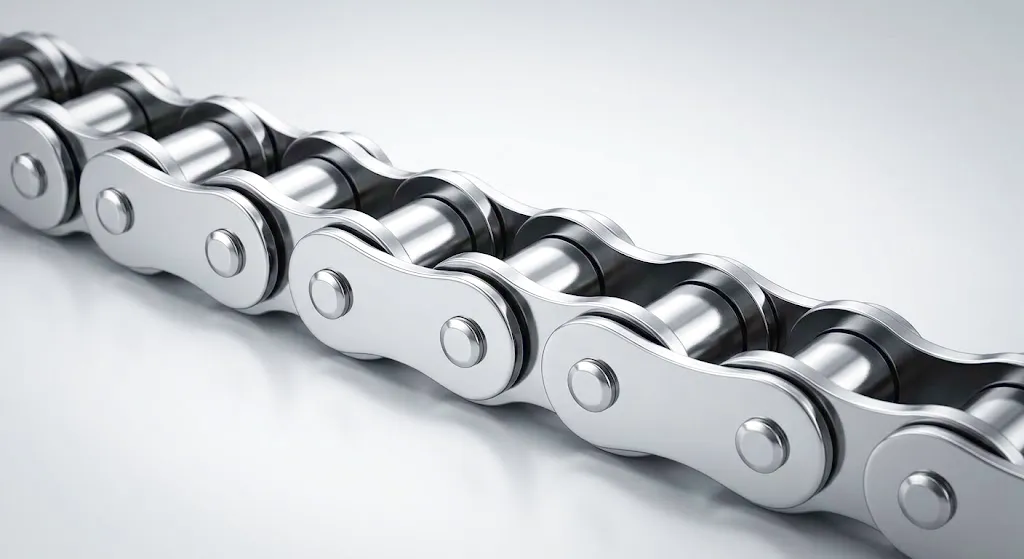
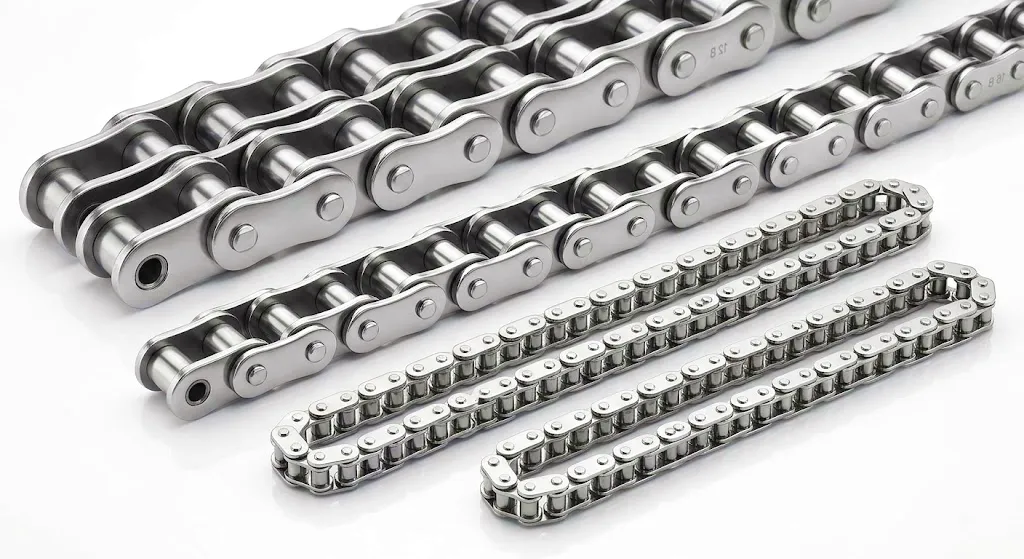
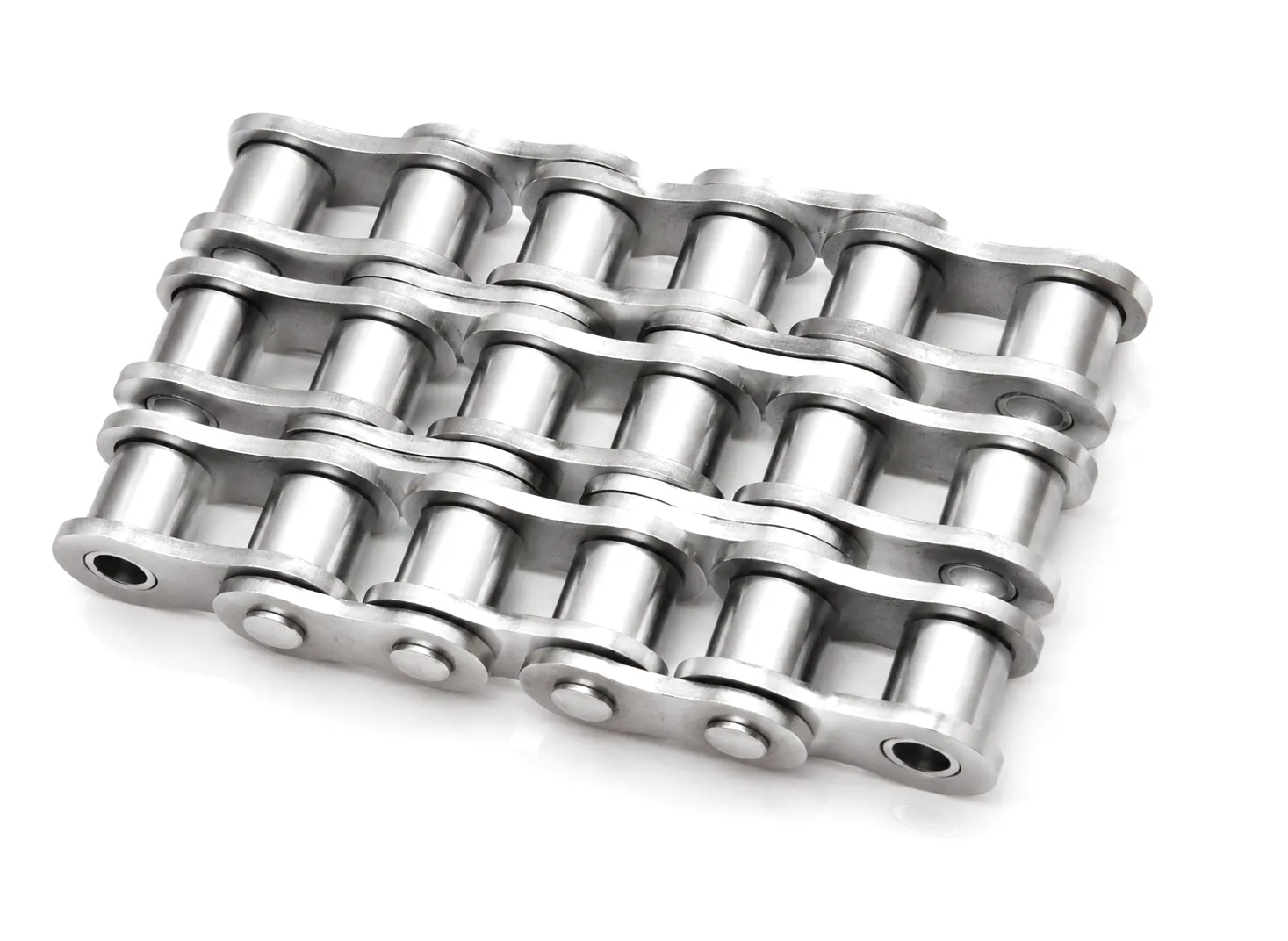
A standard roller chain consists of alternating inner and outer link plates, steel rollers, bushings, and connecting pins. The inner link plate holds the bushing, around which the roller rotates freely. The outer link plate is press-fitted onto the pin ends, clamping the assembly. When the chain engages a sprocket tooth, the roller rolls along the tooth profile rather than sliding — this rolling action dramatically reduces friction and heat, which is why a well-maintained roller chain achieves transmission efficiencies of 98% to 99% under rated load. In packaging machinery, this efficiency matters acutely because drive motors are often sized close to minimum to maintain energy compliance ratings under the UK’s Energy Technology List (ETL) framework. Every unnecessary efficiency loss translates directly into motor overheating and premature inverter trips during peak production runs.
Engagement Geometry and Indexing Precision
Pitch accuracy governs everything. The chain pitch — the centre-to-centre distance between adjacent pin holes — must match the sprocket pitch with tolerances measured in hundredths of a millimetre. In packaging equipment handling small-format containers such as blister packs, sachets, or aerosol cans, indexing errors larger than 0.15 mm at the chain engagement point translate into misaligned filling nozzles, skewed label placement, or incomplete seals. International standard ISO 606 defines pitch tolerances for precision roller chain, and chain conforming to this standard is the minimum acceptable specification for most UK-supplied packaging OEM equipment. Chains supplied to pitch deviations wider than ISO 606 limits cause progressive sprocket wear, introduce chordal action — the cyclical speed variation inherent in any chain-sprocket system — and accelerate the vibration that rattles sensors and proximity switches loose on high-speed filling lines.
Power Transmission Mechanics at Speed
The rated working load of a roller chain is the result of three intersecting material properties: tensile strength of the link plates, shear strength of the pins, and fatigue resistance of the plate perforations under cyclic loading. At packaging machine speeds — where chain linear velocities of 1.2 m/s to 4 m/s are common — fatigue loading rather than static tensile load governs chain life. Every chain link passes through a tension-relaxation cycle each time it wraps around a sprocket. At 4 m/s linear velocity on a #40 chain with an 80-tooth drive sprocket, each link completes more than 12,000 load cycles per hour. Over a three-shift, seven-day operation at a logistics hub in Coventry or a confectionery plant in Leeds, a substandard chain reaches its fatigue limit within weeks rather than the 18 to 24 months that a correctly specified, properly lubricated precision chain should deliver.
Core Materials: What Separates Packaging-Grade Chain from General Purpose
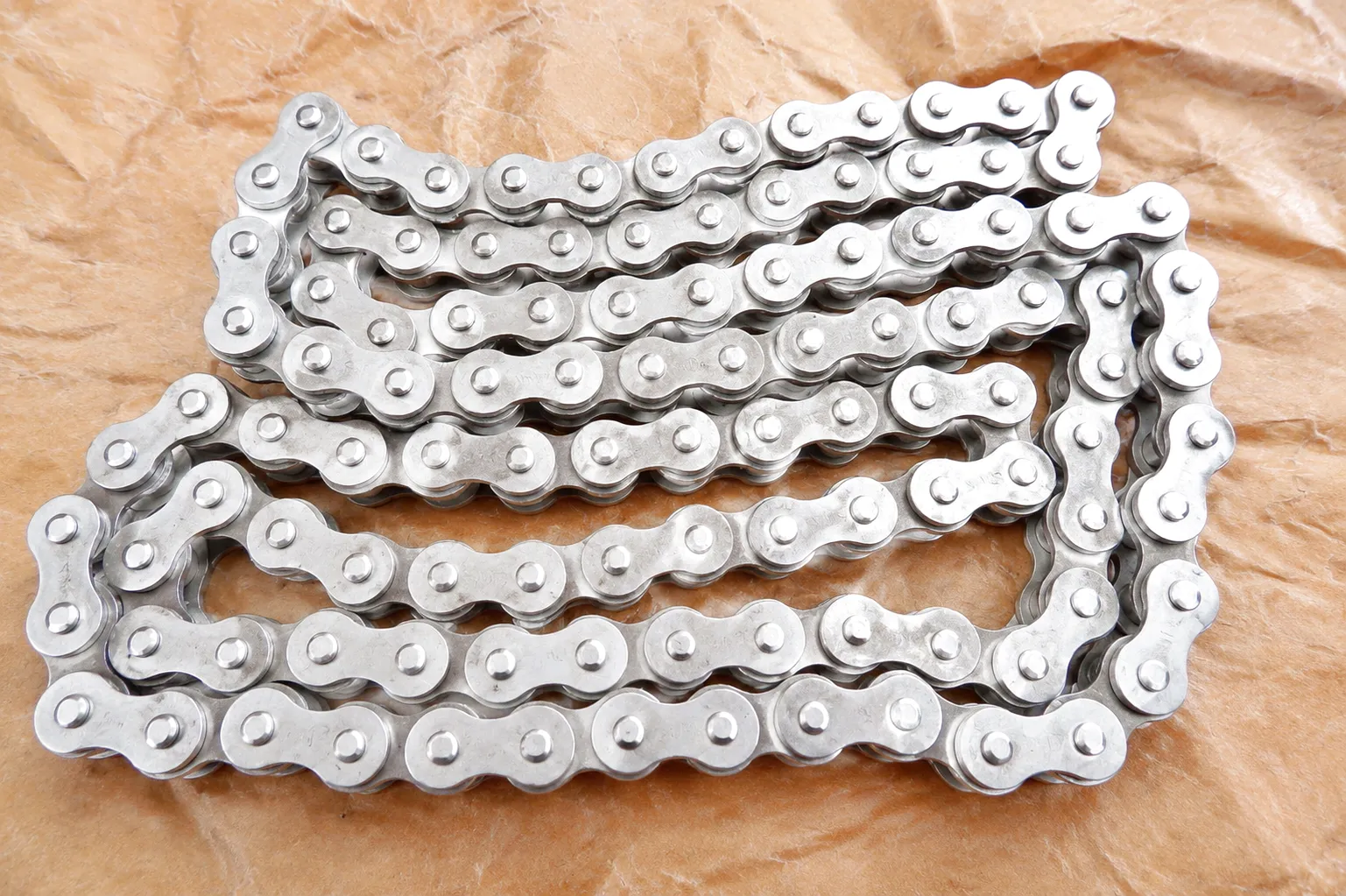
Carbon Steel (40Cr / 45Mn2)
High tensile strength, excellent fatigue resistance, cost-effective for non-food-contact drive zones. Core hardness 38–45 HRC after heat treatment.
Stainless Steel (AISI 304 / 316)
Corrosion resistance against chloride-bearing sanitisers, mandatory for wash-down zones. AISI 316 with Mo for chloride pitting protection in dairy and seafood environments.
Engineered Polymer Components
Nylon, UHMWPE, and Delrin rollers reduce noise and eliminate metal contamination risk in pharmaceutical and nutraceutical lines where detectable-metal protocols are enforced.
Food-Grade Sealed / Self-Lubricating
O-ring sealed and sintered bushing variants pre-charged with NSF H1 food-grade lubricant extend re-lubrication intervals from days to months, critical in zones with limited maintenance access.
Τεχνικές παράμετροι απόδοσης αλυσίδας κυλίνδρων
The following table consolidates the principal technical parameters for roller chain grades commonly deployed in UK packaging machinery. Values are indicative of precision-grade chain conforming to ISO 606. Actual working loads should be calculated with appropriate service factors applied per ISO 10823 guidelines, accounting for drive ratio, number of chain strands, and lubrication type.
| Chain Standard | Βήμα (mm) | Φόρτιση θραύσης (kN) | Μέγιστη ταχύτητα (m/s) | Διάμετρος καρφίτσας (mm) | Διάμετρος κυλίνδρου (mm) | Τυπικό Υλικό | Packaging Application |
|---|---|---|---|---|---|---|---|
| 04B / ANSI #25 | 6.00 | 3.5 | Up to 5.5 | 2.31 | 3.30 | SS 304 / CS | Mini blister line indexing |
| 06B / ANSI #35 | 9.525 | 8.9 | Up to 4.5 | 3.28 | 6.35 | SS 316 / CS 40Cr | Labelling / capping head |
| 08B / ANSI #40 | 12.70 | 17.8 | Up to 3.8 | 3.96 | 8.51 | CS 45Mn2 / SS 316 | Main conveyor drive |
| 10B / ANSI #50 | 15.875 | 22.2 | Up to 3.5 | 5.08 | 10.16 | CS 40Cr HT | Carton erecting / sealing |
| 12B / ANSI #60 | 19.05 | 28.9 | Up to 3.2 | 5.72 | 11.91 | CS 45Mn2 / SS 304 | Pallet accumulation conveyor |
| 16B / ANSI #80 | 25.40 | 60.0 | Up to 2.8 | 8.28 | 15.88 | CS 40Cr / SS 316 | Heavy-load infeed / outfeed |
CS = Carbon Steel · SS = Stainless Steel · HT = Heat Treated · Values per ISO 606 precision grade. Service factors per ISO 10823 must be applied for final chain selection.
Core Technical Advantages of Precision Roller Chain in Packaging
Industrial Application Scenarios Across UK Packaging Sectors
Customer Success Story: Sheffield Food Manufacturer Cuts Chain Failures by 87%
ΜΕΛΕΤΗ ΠΕΡΙΠΤΩΣΗΣ
Sheffield-based convenience food manufacturer · Chilled ready meal production · MAP line 7, 8, and 9
Hartwell Foods Ltd, a contract manufacturer of chilled ready meals based in the Attercliffe industrial area of Sheffield, operates three parallel MAP (Modified Atmosphere Packaging) lines that run 18 hours per day, five days per week, producing meals under private label for major UK grocery retailers. In 2023, the maintenance team recorded 14 unplanned chain-related stoppages across the three lines over a six-month period, with a combined production loss of approximately 38 hours and replacement chain costs totalling £6,800 from their previous supplier. The root cause analysis identified two primary failure modes: corrosion-induced plate cracking on the carry strand of Line 7’s main conveyor, and fatigue fracture of inner link plates on Lines 8 and 9’s sealing station drives following shortened re-lubrication intervals during peak production weeks.
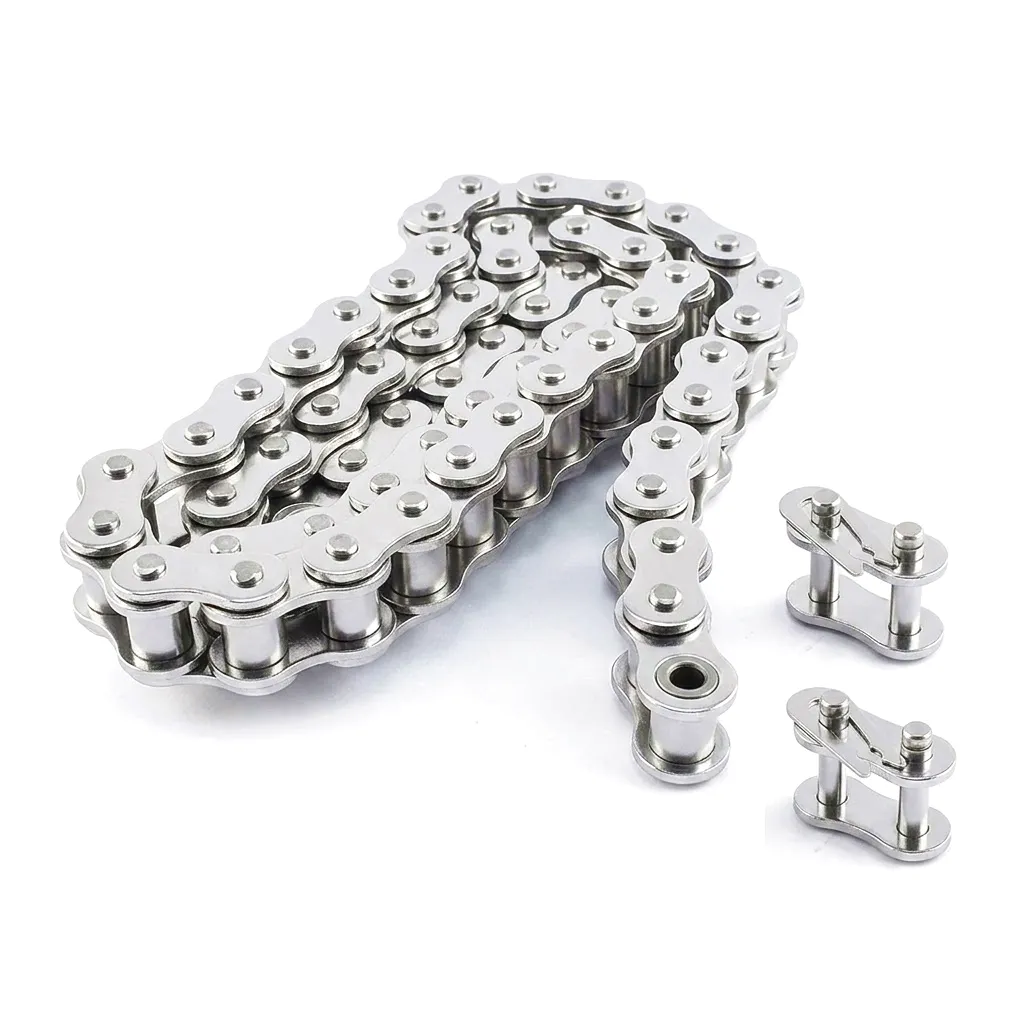
The engineering team contacted Ever Power with a chain specification brief covering three drive stations per line with differing pitch, attachment type, and lubrication requirements. Ever Power’s technical team reviewed the load calculations, operating temperatures, wash-down chemical concentrations, and lubrication access constraints for each station, then proposed AISI 316 stainless precision chain with sintered self-lubricating bushings for the sealing station drives and food-grade O-ring sealed AISI 316 chain for the main conveyor carry strand. Custom extended-pin attachments were manufactured to interface with the existing plate conveyor flights without modification to the machine frame.
Following installation across all three lines during a planned quarterly maintenance window, Hartwell Foods monitored performance over the following 12 months. The results were significant: chain-related unplanned stoppages reduced from 14 incidents to just 2 — both attributable to operator-error lubrication omissions on a single station — representing an 87% reduction. The self-lubricating chain on the sealing station drives operated through 14 weeks without re-lubrication on Lines 8 and 9, eliminating the lubrication scheduling conflict that had been contributing to fatigue failures. The total cost of chain and associated maintenance over the 12 months was £4,300 — a saving of £2,500 against the previous year’s spend, before accounting for the value of the recovered production hours.
What UK Packaging Engineers Say About Ever Power
“We specified Ever Power’s AISI 316 self-lubricating chain for our sealing station drive after persistent failures with our previous supplier’s standard stainless chain. The difference in corrosion performance through our daily sodium hypochlorite wash-down has been remarkable — we haven’t had a chain-related stoppage on that station in eleven months. The material certification pack provided satisfied our BRCGS documentation requirement without any additional paperwork requests.”
James Hartley, Engineering Manager
MAP Chilled Foods Processor, Sheffield, UK
“The custom attachment chain Ever Power produced for our bottle conveyor infeed was exactly to drawing on first delivery. The extended-pin configuration we required meant a very specific tolerance on pin protrusion — Ever Power’s inspection report confirmed every unit was within 0.05 mm of nominal. For our OEM business supplying beverage machinery to breweries across the Midlands, this level of supply chain reliability is not optional — it directly affects our own delivery commitments to customers.”
Rachel Pemberton, Procurement Director
Packaging Machinery OEM, Birmingham, UK
“Our blister packaging lines run three shifts, and the chain on the thermoforming index drive is critical path — if it stops, the whole line stops. After switching to Ever Power’s food-grade sealed precision chain, we extended our planned chain replacement interval from eight weeks to six months based on elongation monitoring data. The total cost of ownership argument was straightforward. The technical team at Ever Power was also helpful in confirming NSF H1 lubricant compatibility during our product change qualification process — that kind of application support is rare from a chain supplier.”
David Thornton, Maintenance Team Leader
Pharmaceutical Blister Packaging, Nottingham, UK