Selectează o Pagină

Transmisie industrială de putere · Piața din Marea Britanie

Roller Chain in Packaging Machinery

Speed, Hygiene, and Reliability Requirements — A Technical Deep Dive for UK Packaging Engineers and Plant Managers

📍 Birmingham · Sheffield · Manchester
🔗 3,000+ Word Technical Guide
✦ Ever Power Engineering

Ever Power Roller Chain for Packaging Machinery

Inside any high-output packaging line — whether it is filling carbonated drinks at a Birmingham beverage plant, sealing vacuum pouches in a Sheffield food facility, or wrapping pharmaceutical products across a climate-controlled clean room in Manchester — one mechanical component keeps every motion synchronised: the roller chain. Often obscured beneath conveyor guards and machine frames, this precision-engineered element dictates the tempo of entire production floors. It transmits power from drive motors to conveyor belts, indexing tables, filling heads, capping units, and labelling stations with a positional accuracy that no belt or friction drive can match. In the UK packaging industry, where line speeds regularly reach 400 to 1,200 packs per minute and hygiene inspections are non-negotiable, selecting the correct roller chain specification is not a secondary consideration — it is a core engineering decision that directly determines throughput, maintenance intervals, and food safety compliance.

The demands placed on roller chain in packaging environments are distinctly different from those in general industrial applications. Speed requirements push bearing and pin surface velocities beyond thresholds that expose every weakness in heat treatment quality and lubrication design. Hygiene mandates, particularly under the British Retail Consortium Global Standard for Food Safety (BRCGS) and the Food Standards Agency (FSA) guidelines, prohibit petroleum-based lubricants in zones where incidental food contact is possible, shifting the specification toward sealed, food-grade, or self-lubricating chain variants. Simultaneously, the mechanical reliability bar is exceptionally high — an unplanned stoppage on a multi-shift production run at a distribution hub serving major UK supermarket chains carries penalties that dwarf the cost of any premium chain purchase. Understanding these intersecting demands in depth is the starting point for every engineer responsible for keeping a packaging line profitable.

How Roller Chain Actually Works Inside a Packaging Machine

⚙️

The Anatomy of a Chain Link

A standard roller chain consists of alternating inner and outer link plates, steel rollers, bushings, and connecting pins. The inner link plate holds the bushing, around which the roller rotates freely. The outer link plate is press-fitted onto the pin ends, clamping the assembly. When the chain engages a sprocket tooth, the roller rolls along the tooth profile rather than sliding — this rolling action dramatically reduces friction and heat, which is why a well-maintained roller chain achieves transmission efficiencies of 98% to 99% under rated load. In packaging machinery, this efficiency matters acutely because drive motors are often sized close to minimum to maintain energy compliance ratings under the UK’s Energy Technology List (ETL) framework. Every unnecessary efficiency loss translates directly into motor overheating and premature inverter trips during peak production runs.

🔄

Engagement Geometry and Indexing Precision

Pitch accuracy governs everything. The chain pitch — the centre-to-centre distance between adjacent pin holes — must match the sprocket pitch with tolerances measured in hundredths of a millimetre. In packaging equipment handling small-format containers such as blister packs, sachets, or aerosol cans, indexing errors larger than 0.15 mm at the chain engagement point translate into misaligned filling nozzles, skewed label placement, or incomplete seals. International standard ISO 606 defines pitch tolerances for precision roller chain, and chain conforming to this standard is the minimum acceptable specification for most UK-supplied packaging OEM equipment. Chains supplied to pitch deviations wider than ISO 606 limits cause progressive sprocket wear, introduce chordal action — the cyclical speed variation inherent in any chain-sprocket system — and accelerate the vibration that rattles sensors and proximity switches loose on high-speed filling lines.

📐

Power Transmission Mechanics at Speed

The rated working load of a roller chain is the result of three intersecting material properties: tensile strength of the link plates, shear strength of the pins, and fatigue resistance of the plate perforations under cyclic loading. At packaging machine speeds — where chain linear velocities of 1.2 m/s to 4 m/s are common — fatigue loading rather than static tensile load governs chain life. Every chain link passes through a tension-relaxation cycle each time it wraps around a sprocket. At 4 m/s linear velocity on a #40 chain with an 80-tooth drive sprocket, each link completes more than 12,000 load cycles per hour. Over a three-shift, seven-day operation at a logistics hub in Coventry or a confectionery plant in Leeds, a substandard chain reaches its fatigue limit within weeks rather than the 18 to 24 months that a correctly specified, properly lubricated precision chain should deliver.
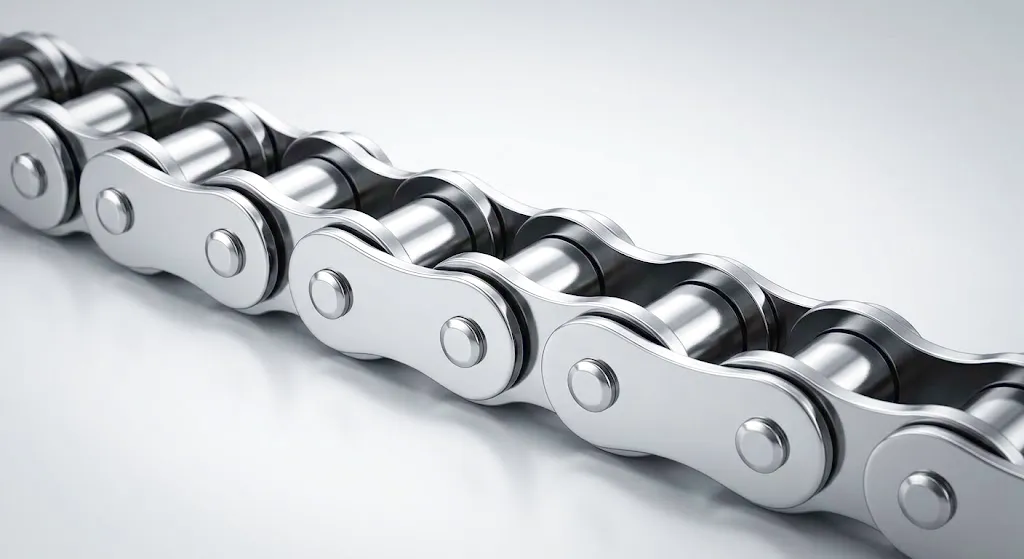
High Strength Roller Chain for Industrial Use

Produse recomandate

High-Strength Chains for Heavy Machinery

For packaging lines that handle heavy containers, multi-lane conveyors, or operate in elevated temperature environments, standard-duty roller chain reaches its working load limits under daily conditions. High-strength variants — engineered with shot-peened link plates, through-hardened pins, and carburised bushings — deliver significantly elevated fatigue resistance without increasing chain pitch or external dimensions. This matters greatly in retrofit situations where the machine frame and sprocket centres are already fixed.

Core Materials: What Separates Packaging-Grade Chain from General Purpose
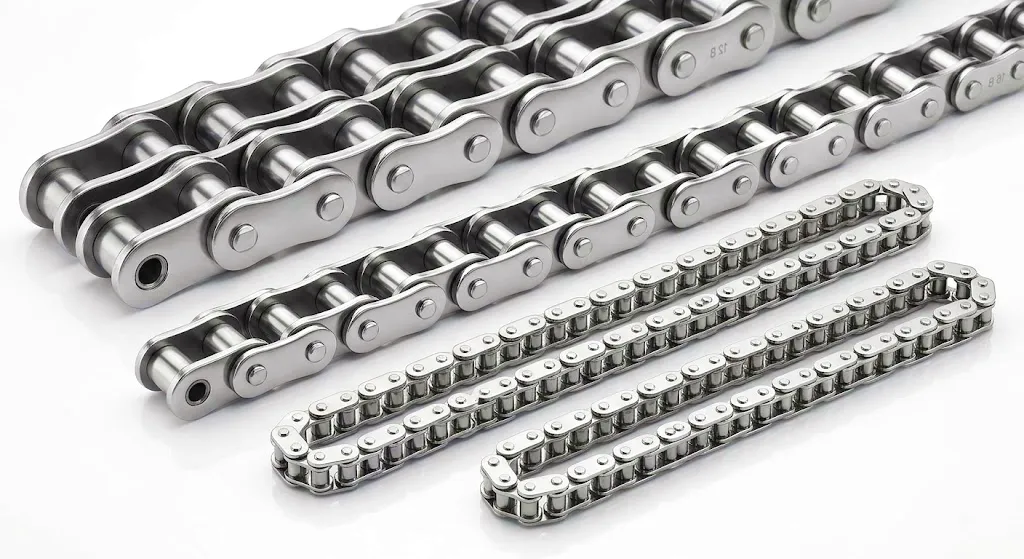
Roller Chain Material Quality

The material selection for roller chain used in packaging machinery departs significantly from that of agricultural or conveying chain. In the packaging sector, three distinct categories of chain material are deployed depending on the specific zone of the machine, the proximity to product, and the cleaning regime in place. Carbon steel alloys in the 40Cr and 45Mn2 families remain the standard for non-contact zones. These alloys, typically quenched and tempered to a core hardness of 38 to 45 HRC after carburisation, provide the fatigue life and tensile strength demanded by high-speed drive systems. The link plates are stamped from sheet stock, punched to ISO 606 dimensional tolerances, and then individually hardness-tested before assembly — a quality step that separates precision chain from commodity product and is directly relevant to the decision-making of procurement managers at UK packaging OEMs who supply retailers including Tesco, Sainsbury’s, and Marks & Spencer.

Stainless steel — predominantly AISI 304 and AISI 316 — is specified wherever wash-down procedures with hot water, steam, or caustic cleaning agents are routine. The 316 grade, with its additional molybdenum content, provides superior resistance to pitting corrosion from chloride-bearing sanitising agents. In a shellfish processing plant on the Scottish coast or a dairy production line in Cheshire, chain corrosion from daily chemical cleaning cycles destroys standard carbon steel within weeks. Stainless chain at equivalent pitch and breaking load costs considerably more than carbon steel, but the total cost of ownership — factoring in replacement frequency, planned maintenance labour, and production downtime cost — consistently favours the stainless specification over a twelve-month horizon. The third and increasingly adopted material category is engineered polymer, deployed in the rollers and sometimes the entire outer link plates of hybrid chain designs for ultra-low-contamination zones in pharmaceutical and nutraceutical packaging environments.

🔩

Carbon Steel (40Cr / 45Mn2)

High tensile strength, excellent fatigue resistance, cost-effective for non-food-contact drive zones. Core hardness 38–45 HRC after heat treatment.

⚗️

Stainless Steel (AISI 304 / 316)

Corrosion resistance against chloride-bearing sanitisers, mandatory for wash-down zones. AISI 316 with Mo for chloride pitting protection in dairy and seafood environments.

🧪

Engineered Polymer Components

Nylon, UHMWPE, and Delrin rollers reduce noise and eliminate metal contamination risk in pharmaceutical and nutraceutical lines where detectable-metal protocols are enforced.

🛡️

Food-Grade Sealed / Self-Lubricating

O-ring sealed and sintered bushing variants pre-charged with NSF H1 food-grade lubricant extend re-lubrication intervals from days to months, critical in zones with limited maintenance access.

Parametrii de performanță tehnică ai lanțului cu role

The following table consolidates the principal technical parameters for roller chain grades commonly deployed in UK packaging machinery. Values are indicative of precision-grade chain conforming to ISO 606. Actual working loads should be calculated with appropriate service factors applied per ISO 10823 guidelines, accounting for drive ratio, number of chain strands, and lubrication type.

Chain Standard Pas (mm) Sarcină de rupere (kN) Viteză maximă (m/s) Diametrul știftului (mm) Diametru rolă (mm) Material tipic Packaging Application
04B / ANSI #25 6.00 3.5 Up to 5.5 2.31 3.30 SS 304 / CS Mini blister line indexing
06B / ANSI #35 9.525 8.9 Până la 4,5 3.28 6.35 SS 316 / CS 40Cr Labelling / capping head
08B / ANSI #40 12.70 17.8 Up to 3.8 3.96 8.51 CS 45Mn2 / SS 316 Main conveyor drive
10B / ANSI #50 15.875 22.2 Up to 3.5 5.08 10.16 CS 40Cr HT Carton erecting / sealing
12B / ANSI #60 19.05 28.9 Up to 3.2 5.72 11.91 CS 45Mn2 / SS 304 Pallet accumulation conveyor
16B / ANSI #80 25.40 60.0 Up to 2.8 8.28 15.88 CS 40Cr / SS 316 Heavy-load infeed / outfeed

CS = Carbon Steel · SS = Stainless Steel · HT = Heat Treated · Values per ISO 606 precision grade. Service factors per ISO 10823 must be applied for final chain selection.

Core Technical Advantages of Precision Roller Chain in Packaging
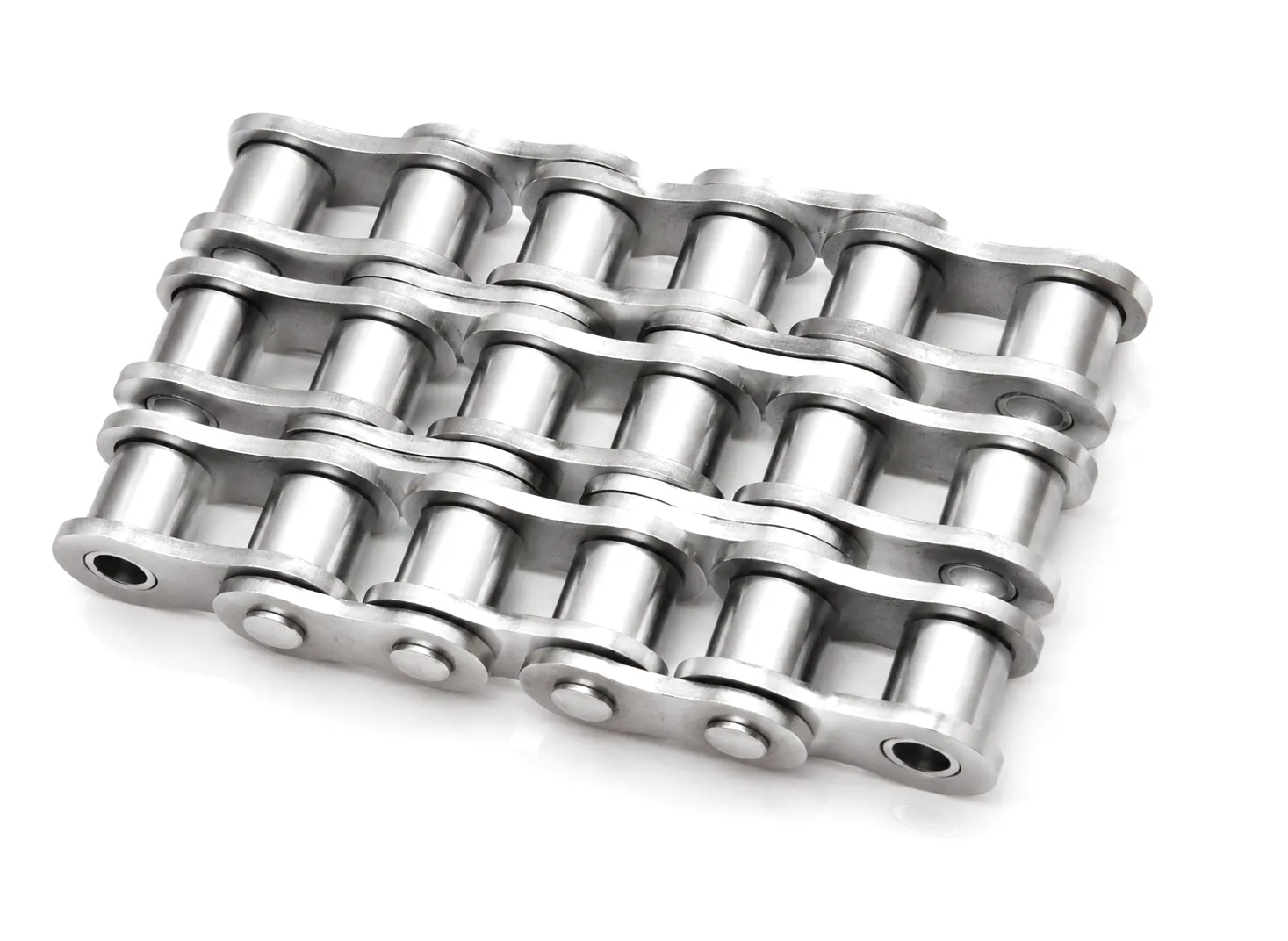
Precision Roller Chain Advantages

When packaging machinery engineers evaluate drive system options, the persistance of roller chain as the dominant solution across four decades of technological evolution is not accidental. Its combination of high positional accuracy, mechanical robustness, simple maintenance, and wide pitch-and-load range availability makes it uniquely suited to the variable-speed, variable-load, high-duty-cycle operating profiles of modern automated packaging lines. The following technical advantages define why precision roller chain continues to be the drive element of choice even as servo-belt and direct-drive alternatives emerge at premium price points.

🎯

Positive Drive, Zero Slip

Unlike belt drives, roller chain transmits torque through mechanical engagement of chain links with sprocket teeth. There is no tension-dependent slip mechanism. This positive drive characteristic is critical in registration-sensitive packaging operations — filling nozzle positioning, label placement, and seal bar engagement all depend on the chain arriving at an exact angular position at an exact moment in the machine cycle. Deviations cause rejects, and rejects erode the production efficiency metrics that UK packaging contractors are contractually obligated to maintain for retail supply chain customers.

High Transmission Efficiency

Precision roller chain achieves 98% to 99% power transmission efficiency across the full design speed range when lubrication conditions are maintained. This compares favourably with V-belt drives at 93% to 97% efficiency and toothed flat belts at 95% to 97%. In a packaging plant running 16-hour daily shifts, the cumulative energy saving from choosing correctly lubricated roller chain over a belt drive of equivalent nominal rating can be measurable against the facility’s total electricity bill — increasingly relevant to UK manufacturers facing elevated industrial energy costs following the post-2022 energy market restructuring.

🔧

Modular Replaceability

Roller chain can be shortened or extended by adding or removing individual links. This modularity has enormous practical value in a packaging environment where machine configurations change frequently to accommodate new product formats. Switching from a 750 ml bottle conveyor to a 250 ml pouch line may require shortening chain runs at multiple stations. A skilled maintenance technician can complete the chain adjustment during a planned format changeover without specialist tooling, maintaining the short changeover times that UK contract packagers depend on to meet flexible retail supply agreements with multiple SKUs.

🌡️

Wide Temperature Tolerance

Standard carbon steel roller chain operates reliably across a temperature range of -20°C to +150°C. Stainless steel variants extend the upper limit to above +200°C. This thermal tolerance spans the full operational range of UK packaging environments — from blast-freezing tunnel conveyors in frozen food facilities in Grimsby to hot-fill bottling lines operating at 85°C product temperatures in beverage plants. The capacity to maintain dimensional stability and lubrication film integrity through this range without alternative drive-element replacements simplifies the drive system engineering of multi-temperature packaging facilities.

Industrial Application Scenarios Across UK Packaging Sectors
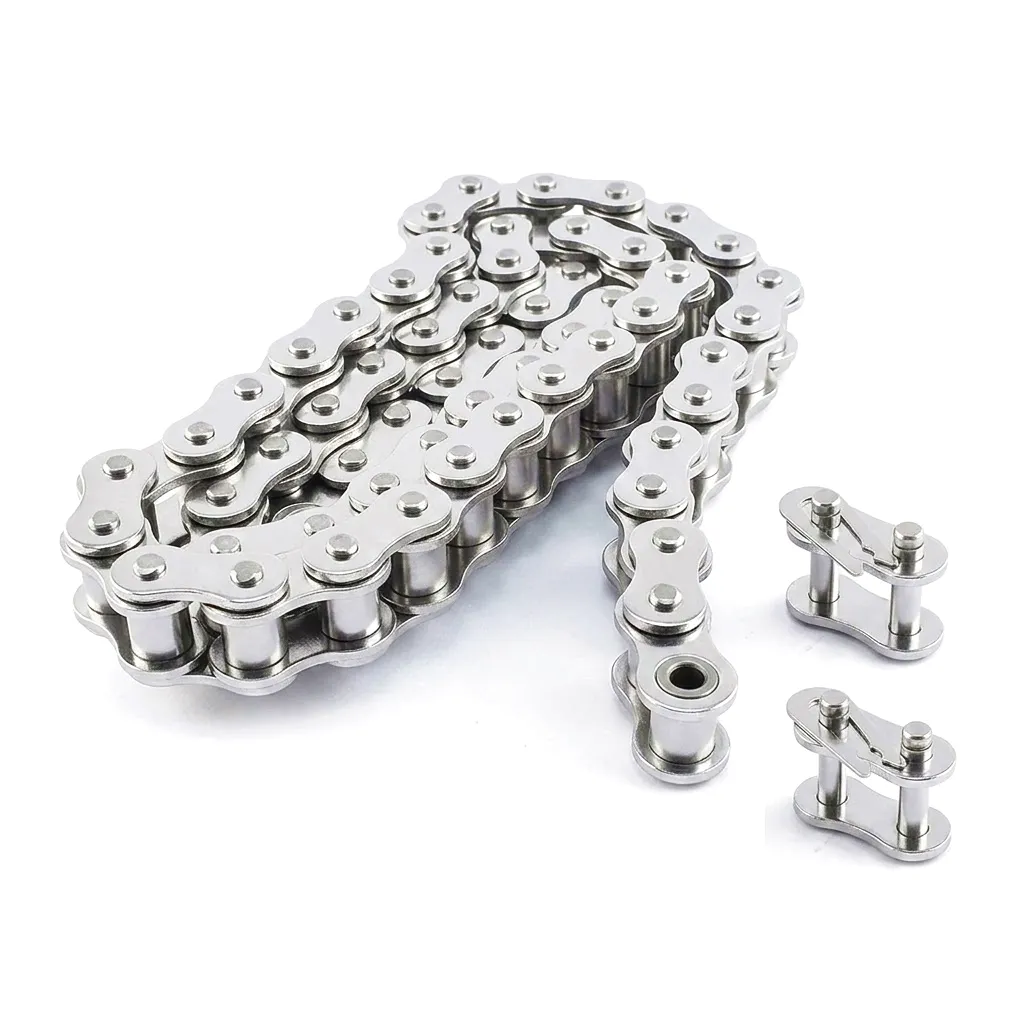
🍺

Beverage Filling & Capping — Birmingham, Coventry

High-speed beverage lines at facilities supplying supermarket distribution centres in the Midlands operate filling carousels at 600 to 1,200 containers per minute. Roller chain drives the star wheel and timing screw mechanisms that space, orient, and advance containers to each filling valve with sub-millimetre repeatability. Chain on these drives is typically ANSI #40 or #50 in either food-grade sealed carbon steel or AISI 316 stainless, depending on whether the lubrication zone is enclosed or exposed to the product pathway. Misalignment between the chain drive and the sprocket faces — even of 0.5° — accelerates side-plate wear to the point where chains require replacement within 400 hours rather than the designed 8,000 hours, making precision sprocket alignment a mandatory commissioning step. At plants in Coventry and Wolverhampton serving national brands, roller chain replacement during unplanned downtime can cost upward of £4,000 per incident when production loss and emergency logistics are costed together.

🧴

Pharmaceutical Blister Packaging — Sheffield, Nottingham

In pharmaceutical packaging environments across Sheffield and Nottingham, the regulatory framework is demanding in ways that go beyond simple mechanical performance. The MHRA (Medicines and Healthcare products Regulatory Agency) requires documented evidence of component material traceability and freedom from contamination risk. Roller chain used in blister forming, tablet inserting, and foil sealing stations must therefore be specified as either stainless steel with sintered self-lubricating bushings or engineered polymer hybrid chain with detectable additive packages. NSF H1 food-grade lubricants are the minimum acceptable lubrication standard. Chain pitch control is critical because blister cavity registration errors of more than 0.3 mm produce unsealed tablet pockets that fail leak testing and trigger line rejection events. Chains supplied to the pharmaceutical packaging sector by established manufacturers carry material test certificates and dimensional inspection reports as standard documentation, forming part of the Equipment Qualification dossier maintained under GMP validation protocols.

🥩

Food MAP & Vacuum Packaging — Leeds, York

Modified Atmosphere Packaging (MAP) and vacuum skin packaging lines at food processors in Leeds, York, and the wider Yorkshire region handle chilled meat, prepared meals, and seafood at operating temperatures of 2°C to 10°C. This cold, damp environment accelerates corrosion on unprotected chain surfaces. AISI 316 stainless roller chain is the standard specification, and daily wash-down with sodium hypochlorite solutions at concentrations up to 200 ppm requires chain with superior crevice corrosion resistance at pin-bushing interfaces. Self-lubricating chain variants charged with food-grade PTFE-based lubricants eliminate the contamination risk of applied lubricants in proximity to open product. The re-lubrication interval for standard stainless chain on these lines is typically three to five days; self-lubricating chain extends this to six to eight weeks, reducing the food safety risk window associated with manual lubrication operations during production hours.

📦

Secondary & Tertiary Packaging — Logistics Hubs, Milton Keynes

At major logistics and distribution centres — the massive automated fulfilment parks around Milton Keynes, Daventry, and Corby that serve e-commerce and retail networks — roller chain operates in case packing, palletising, and stretch wrapping systems. These secondary and tertiary packaging operations run continuous 24-hour cycles with load profiles that frequently approach the rated working load of the chain. ANSI #60 and #80 grade chains are common on heavy-load pallet conveyor lines. Predictive maintenance programmes at the larger logistics operators now incorporate chain elongation monitoring using ultrasonic measurement devices that detect pitch increase from internal wear without removing the chain from service. A chain that has elongated beyond 1.5% of its nominal pitch requires replacement before it begins skipping sprocket teeth — a failure mode that, on a high-throughput palletising line, causes product damage and conveyor jams that take hours to clear.

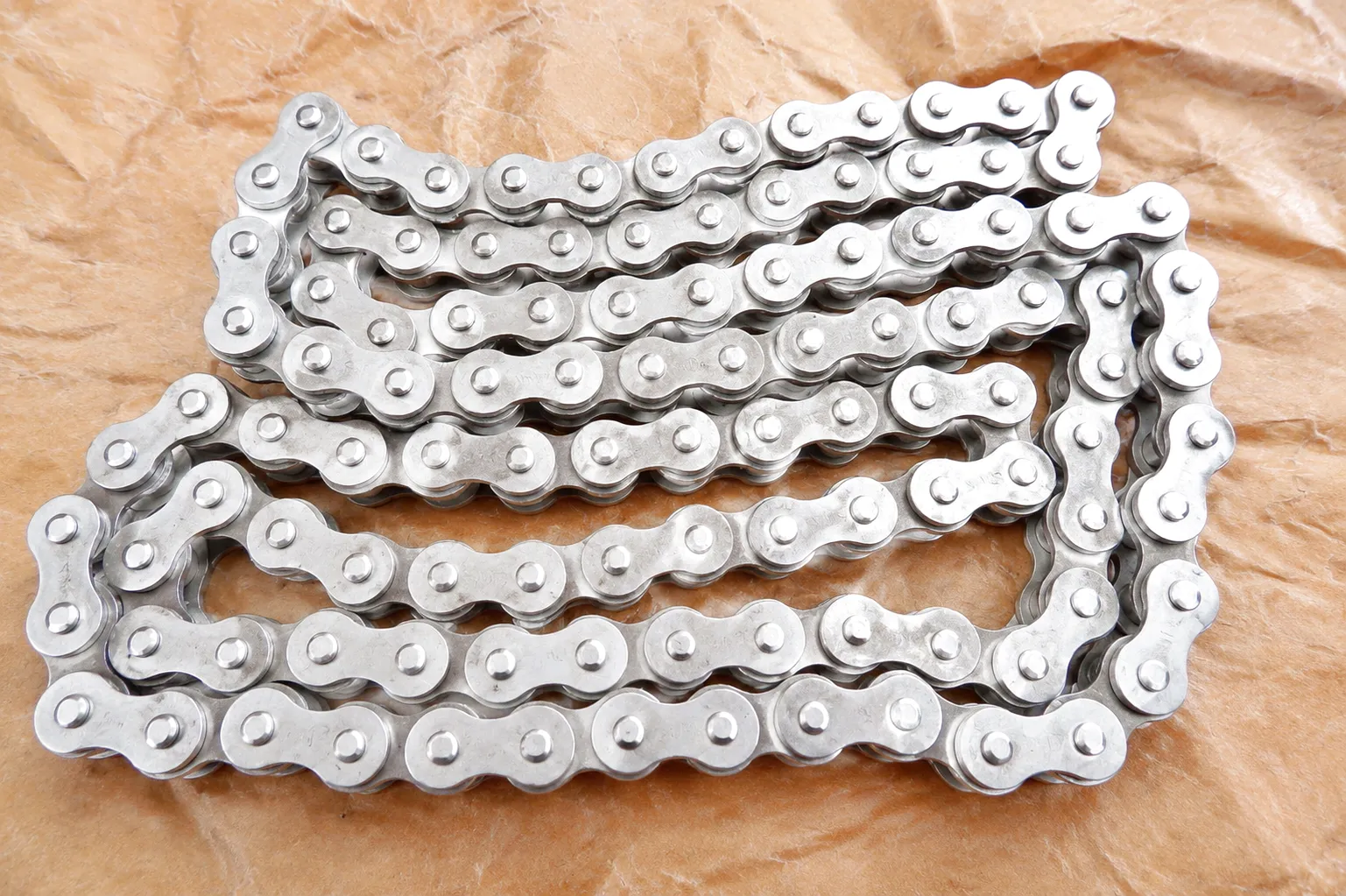
Roller Chain Application in Packaging

Confectionery and Snack Packaging — Manchester, Blackpool

Confectionery production lines in Greater Manchester and Lancashire handle products ranging from individual wrapped sweets at 800 per minute to multi-pack chocolate bars. The high sugar content in these environments creates a unique challenge for roller chain: sugar dust settling on chain surfaces combines with even trace quantities of lubricant to form a hygroscopic cementitious layer that dramatically increases drive friction and can bond chain links over extended shutdowns. The recommended mitigation is food-grade sealed chain with no exposed lubrication surfaces, combined with compressed air purging of chain enclosures at the start of each shift. In facilities operating under BRCGS Grade AA certification — a certification increasingly demanded by UK supermarket buyers — the documented evidence that chain lubrication materials meet NSF H1 category requirements must be maintained in the hygiene management system as a prerequisite for continued retail supply contracts.

Excelență în producție

Ever Power: Precision Roller Chain Manufactured to the Demands of UK Packaging

Ever Power stands as a leading specialist in the design and manufacture of roller chain solutions for the most demanding industrial environments, with a decade-long track record of supplying precision chain components to packaging OEMs and end-users across the United Kingdom, Germany, France, and North America. The manufacturing facility operates a vertically integrated production model — from raw steel procurement through heat treatment, precision grinding, assembly, and testing — under a quality management framework aligned to ISO 9001:2015. This end-to-end manufacturing ownership means that Ever Power can guarantee dimensional and metallurgical consistency across every chain produced, eliminating the specification deviation risk that plagues multi-vendor supply chains.

Customisation is the core of Ever Power’s value proposition to the packaging industry. Non-standard attachments — bent plates, extended pins, side-guiding tabs, accumulation rollers, plastic top plates — are designed and produced within the same facility as the base chain, ensuring that attachment geometry and installation dimensions are precisely matched. UK packaging OEMs sourcing machine-specific chain assemblies from Ever Power routinely report that custom chain lead times run to 15 to 28 working days against standard commodity lead times, a logistics advantage when machine programme schedules are tight. Material certifications, test reports, and dimensional inspection sheets accompany every order as standard documentation, enabling rapid incorporation into equipment qualification and maintenance documentation systems.

🏭Vertical Integration

Raw steel to finished chain in-house, ensuring metallurgical consistency impossible with assembled supply chains.

📐Custom Engineering

Attachments, extended plates, food-grade sealing, and non-standard pitches produced to drawing within 15–28 working days.

📋Full Documentation

Material certs, dimensional inspection reports, and hardness test certificates supplied standard — GMP/FDA/BRCGS ready.

🚚UK Logistics Support

Stocked standard grades available for express despatch, ensuring packaging plants in Birmingham, Leeds, and Manchester maintain minimal downtime on emergency replacements.

Customer Success Story: Sheffield Food Manufacturer Cuts Chain Failures by 87%

CASE STUDY

Sheffield-based convenience food manufacturer · Chilled ready meal production · MAP line 7, 8, and 9

Hartwell Foods Ltd, a contract manufacturer of chilled ready meals based in the Attercliffe industrial area of Sheffield, operates three parallel MAP (Modified Atmosphere Packaging) lines that run 18 hours per day, five days per week, producing meals under private label for major UK grocery retailers. In 2023, the maintenance team recorded 14 unplanned chain-related stoppages across the three lines over a six-month period, with a combined production loss of approximately 38 hours and replacement chain costs totalling £6,800 from their previous supplier. The root cause analysis identified two primary failure modes: corrosion-induced plate cracking on the carry strand of Line 7’s main conveyor, and fatigue fracture of inner link plates on Lines 8 and 9’s sealing station drives following shortened re-lubrication intervals during peak production weeks.

The engineering team contacted Ever Power with a chain specification brief covering three drive stations per line with differing pitch, attachment type, and lubrication requirements. Ever Power’s technical team reviewed the load calculations, operating temperatures, wash-down chemical concentrations, and lubrication access constraints for each station, then proposed AISI 316 stainless precision chain with sintered self-lubricating bushings for the sealing station drives and food-grade O-ring sealed AISI 316 chain for the main conveyor carry strand. Custom extended-pin attachments were manufactured to interface with the existing plate conveyor flights without modification to the machine frame.

Following installation across all three lines during a planned quarterly maintenance window, Hartwell Foods monitored performance over the following 12 months. The results were significant: chain-related unplanned stoppages reduced from 14 incidents to just 2 — both attributable to operator-error lubrication omissions on a single station — representing an 87% reduction. The self-lubricating chain on the sealing station drives operated through 14 weeks without re-lubrication on Lines 8 and 9, eliminating the lubrication scheduling conflict that had been contributing to fatigue failures. The total cost of chain and associated maintenance over the 12 months was £4,300 — a saving of £2,500 against the previous year’s spend, before accounting for the value of the recovered production hours.

What UK Packaging Engineers Say About Ever Power

★★★★★★

“We specified Ever Power’s AISI 316 self-lubricating chain for our sealing station drive after persistent failures with our previous supplier’s standard stainless chain. The difference in corrosion performance through our daily sodium hypochlorite wash-down has been remarkable — we haven’t had a chain-related stoppage on that station in eleven months. The material certification pack provided satisfied our BRCGS documentation requirement without any additional paperwork requests.”

James Hartley, Engineering Manager

MAP Chilled Foods Processor, Sheffield, UK

★★★★★★

“The custom attachment chain Ever Power produced for our bottle conveyor infeed was exactly to drawing on first delivery. The extended-pin configuration we required meant a very specific tolerance on pin protrusion — Ever Power’s inspection report confirmed every unit was within 0.05 mm of nominal. For our OEM business supplying beverage machinery to breweries across the Midlands, this level of supply chain reliability is not optional — it directly affects our own delivery commitments to customers.”

Rachel Pemberton, Procurement Director

Packaging Machinery OEM, Birmingham, UK

★★★★★★

“Our blister packaging lines run three shifts, and the chain on the thermoforming index drive is critical path — if it stops, the whole line stops. After switching to Ever Power’s food-grade sealed precision chain, we extended our planned chain replacement interval from eight weeks to six months based on elongation monitoring data. The total cost of ownership argument was straightforward. The technical team at Ever Power was also helpful in confirming NSF H1 lubricant compatibility during our product change qualification process — that kind of application support is rare from a chain supplier.”

David Thornton, Maintenance Team Leader

Pharmaceutical Blister Packaging, Nottingham, UK

Întrebări frecvente


What type of roller chain is best for food-safe packaging machinery operating under UK BRCGS standards?

For packaging machinery subject to UK BRCGS Grade AA certification, the correct specification is AISI 316 stainless roller chain with either sintered self-lubricating bushings (pre-charged with NSF H1 lubricant) or O-ring sealed construction. Both designs eliminate the contamination risk of externally applied lubricants in food-contact proximity zones. The AISI 316 grade, rather than 304, is preferred because of its superior resistance to pitting corrosion from chloride-bearing sanitising agents used in wash-down routines at facilities handling meat, dairy, and produce. Material certification confirming steel grade and mechanical properties must be retained in the site’s hygiene management documentation as evidence of BRCGS compliance.


How much does a custom-specification roller chain for a packaging machine typically cost from a UK supplier, and what affects the price?

Custom roller chain pricing varies considerably based on four principal factors: material grade (carbon steel versus stainless steel 316 typically carries a 2.5x to 4x price premium), pitch and strand count, attachment complexity, and order volume. For AISI 316 precision chain in common packaging pitches (08B through 12B), unit prices from quality-focused suppliers like Ever Power typically run between £8 and £28 per link metre depending on pitch and attachment configuration. O-ring sealed and self-lubricating variants add 35% to 80% to the base chain cost but reduce replacement frequency and lubrication labour to deliver a lower total cost of ownership over 12 months. For an accurate quote tailored to your specific machine application, contact Ever Power at [email protected] with your chain standard, pitch, number of strands, attachment requirement, and annual consumption volume.


Where can I find a reliable roller chain supplier who offers fast delivery to manufacturing plants in Birmingham and the West Midlands?

Ever Power maintains stocked inventories of the most common precision roller chain grades for express despatch to customers across the West Midlands, including Birmingham, Coventry, Wolverhampton, and Walsall. Standard grades in carbon steel and AISI 304 stainless are available for next-working-day delivery via standard UK parcel carriers. For urgent emergency replacements during production breakdowns, the technical sales team at [email protected] can confirm stock availability and despatch arrangements within the same working day. Custom chain with non-standard attachments requires 15 to 28 working days manufacturing lead time, so stocking a minimum buffer quantity of critical-path chain at the facility is strongly advised for plants running continuous production schedules.


How do I know when roller chain on my packaging line needs to be replaced before it causes a breakdown or product rejection?

Chain replacement should be triggered by elongation measurement, not time alone. A roller chain that has elongated beyond 1.5% of its nominal pitch length due to pin and bushing wear is at risk of skipping sprocket teeth under load. Elongation measurement is performed with a calibrated chain wear gauge applied over a minimum of 12 links; most gauge sets indicate a clear replacement threshold for common packaging chain pitches. Additional visual indicators requiring immediate replacement include visible corrosion pitting on link plates, tight links that do not flex freely through the full chain arc, and lateral deflection exceeding chain width — the latter indicating pin wear that compromises load-carrying geometry. Packaging lines in food environments should incorporate chain inspection into weekly maintenance routines, with a logged elongation measurement recorded for each critical drive station to enable trend-based replacement scheduling.


Which roller chain pitch is correct for high-speed packaging machinery running at speeds above 600 packs per minute in a Sheffield food plant?

At production rates above 600 packs per minute, chain linear velocity on most packaging conveyor drive stations runs between 1.5 m/s and 3.5 m/s. The correct pitch selection balances maximum allowable speed against the required power transmission capacity. For lighter conveyor and indexing drives, ANSI #35 (9.525 mm pitch) or ISO 06B provides the speed capability with low pitch polygon effect. For main conveyor drives carrying heavier loads, ANSI #40 (ISO 08B, 12.70 mm pitch) is the most common precision packaging chain, offering a balance of breaking load (17.8 kN minimum for precision grade), manageable pitch polygon effect at packaging line speeds, and wide availability of AISI 316 stainless variants. For specific applications, the correct approach is to calculate the required transmitted power at maximum chain speed, apply an appropriate service factor, and select pitch to ensure the working load remains below 20% of the chain’s minimum breaking load — the industry thumb rule for achieving the fatigue life margin that packaging continuous-duty applications require.


How can I get a quote for roller chain with custom attachments from a manufacturer who understands UK pharmaceutical packaging requirements?

To receive a detailed quotation for custom attachment roller chain for pharmaceutical packaging applications, contact Ever Power at [email protected] with the following information: chain standard and pitch (e.g., ISO 08B, 12.70 mm), attachment type and dimensions (drawings or sketches welcome), material grade required (typically AISI 316 for pharmaceutical environments), lubrication specification (NSF H1 sealed, self-lubricating, or dry-running), and annual consumption estimate. Ever Power’s technical team will review the application against pharmaceutical GMP requirements, confirm material certification availability, and provide a detailed quotation typically within two to three working days. Documentation packages for GMP equipment qualification, including material test certificates to EN 10204 3.1 standard, are available as part of the supply.

⚙️

Ready to Specify the Right Roller Chain?

Tell Ever Power your application details — chain pitch, material grade, attachment type, and production environment — and receive a detailed technical quotation with full material documentation within 2–3 working days.

✉ Obțineți o ofertă — [email protected]

ISO 9001:2015 Certified · NSF H1 Food-Grade Variants Available · Full Material Certification Supplied

editat de gzl