पृष्ठ चुनें

तकनीकी ज्ञान श्रृंखला · यूके संस्करण

Leaf Chain vs. Roller Chain: Which Is Right for Lifting and Tensioning Applications?

A rigorous engineering comparison for procurement managers, plant engineers, and maintenance teams across the UK’s manufacturing heartland — from Birmingham’s fabrication workshops to Sheffield’s specialist steel plants.

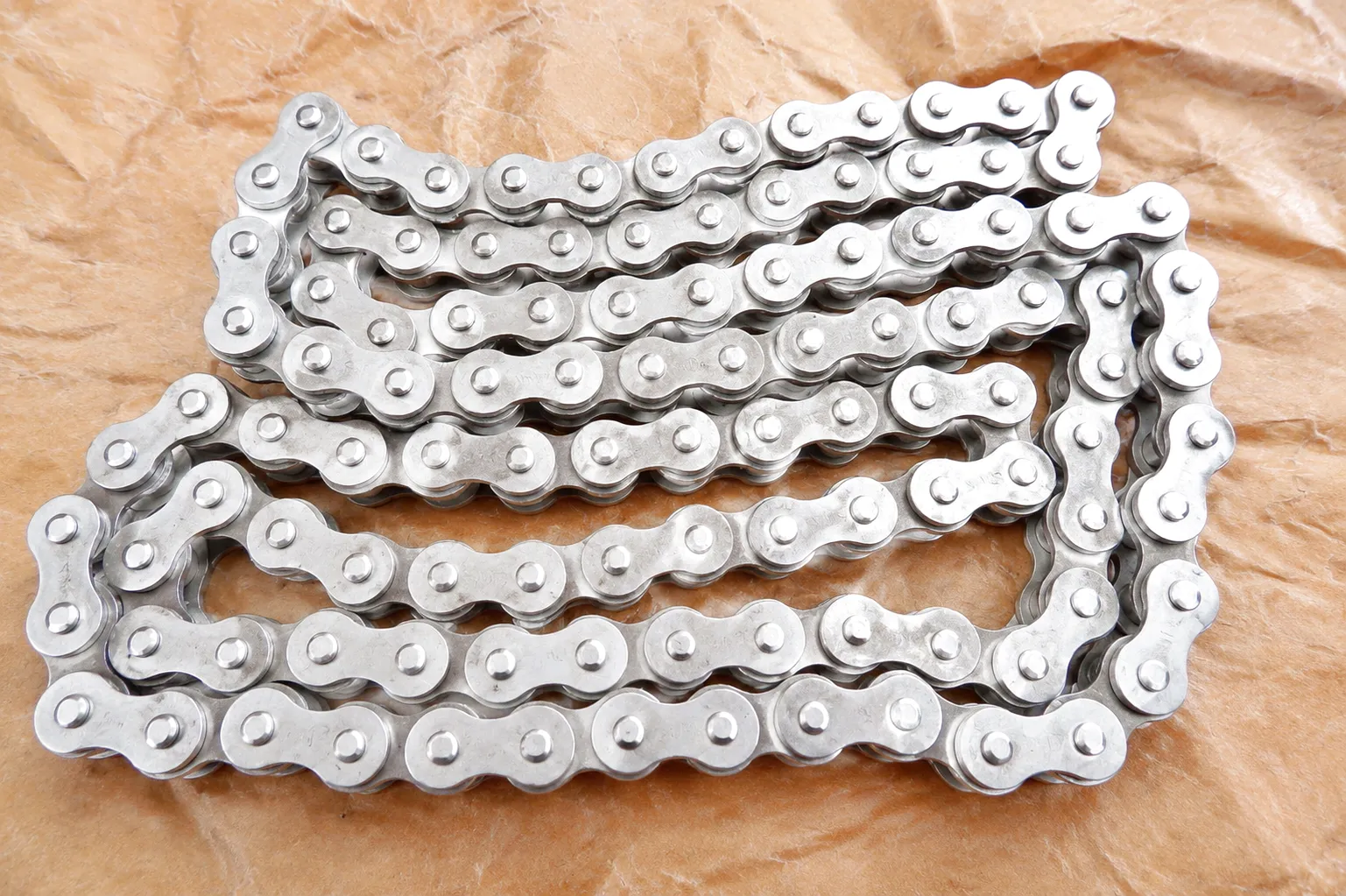
Roller chain close-up — industrial grade transmission components

When engineers and procurement specialists in the UK sit down to specify a chain drive or lifting mechanism, they frequently find themselves weighing two fundamentally different technologies: leaf chain and roller chain. On the surface, both are steel link-based power transmission devices. In practice, they are engineered for entirely different mechanical duties, and selecting the wrong type carries real consequences — from premature wear and unplanned downtime to safety incidents in forklift masts or conveyor systems. Understanding the structural, material, and operational distinctions between these two chain families is therefore not a matter of academic preference. It is a practical engineering decision that shapes procurement costs, maintenance schedules, and long-term asset reliability for factories from Coventry to Leeds.

The global roller chain market continues to grow as automation, packaging, and agricultural mechanisation expand, while leaf chain retains its dominant position in vertical lifting and precise tensioning duties. Both categories have seen significant advances in materials science and surface treatment over the past decade, and both are subject to rigorous ISO and ANSI standards. What has not changed is the core engineering logic that defines when each type is the correct specification. This article examines that logic in detail, with reference to material science, performance data, UK industrial applications, and guidance on sourcing from a supplier capable of precision customisation.

इंजीनियरिंग के मूल सिद्धांत

How Roller Chain and Leaf Chain Actually Work

ROLLER CHAIN

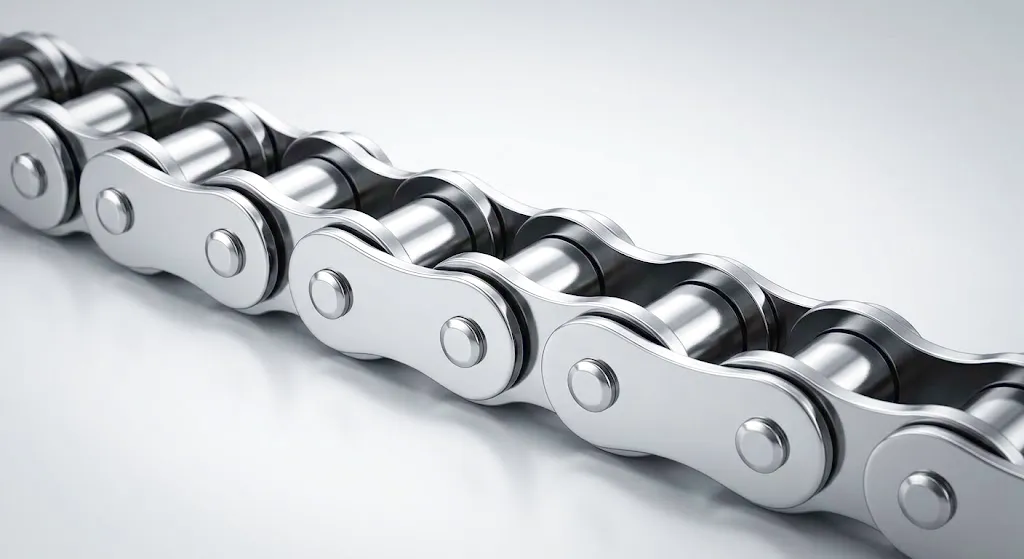
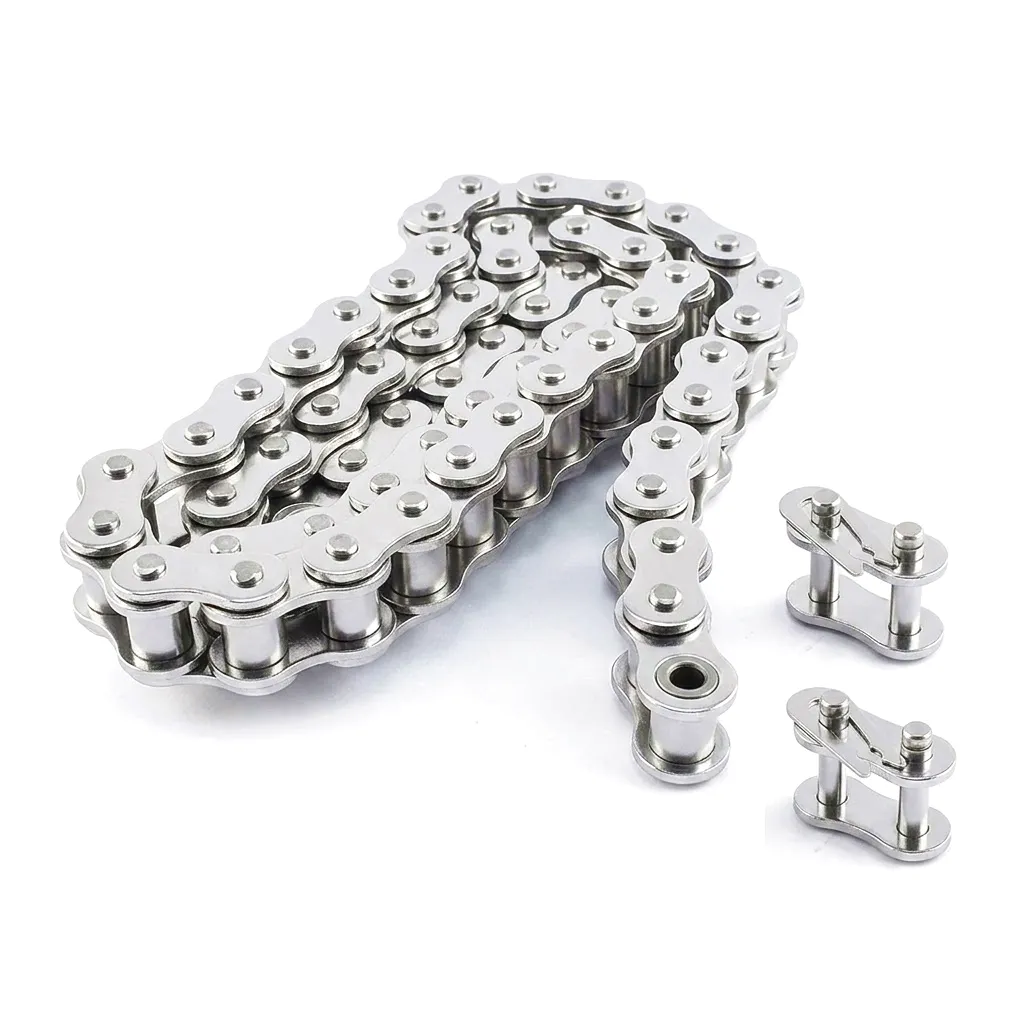
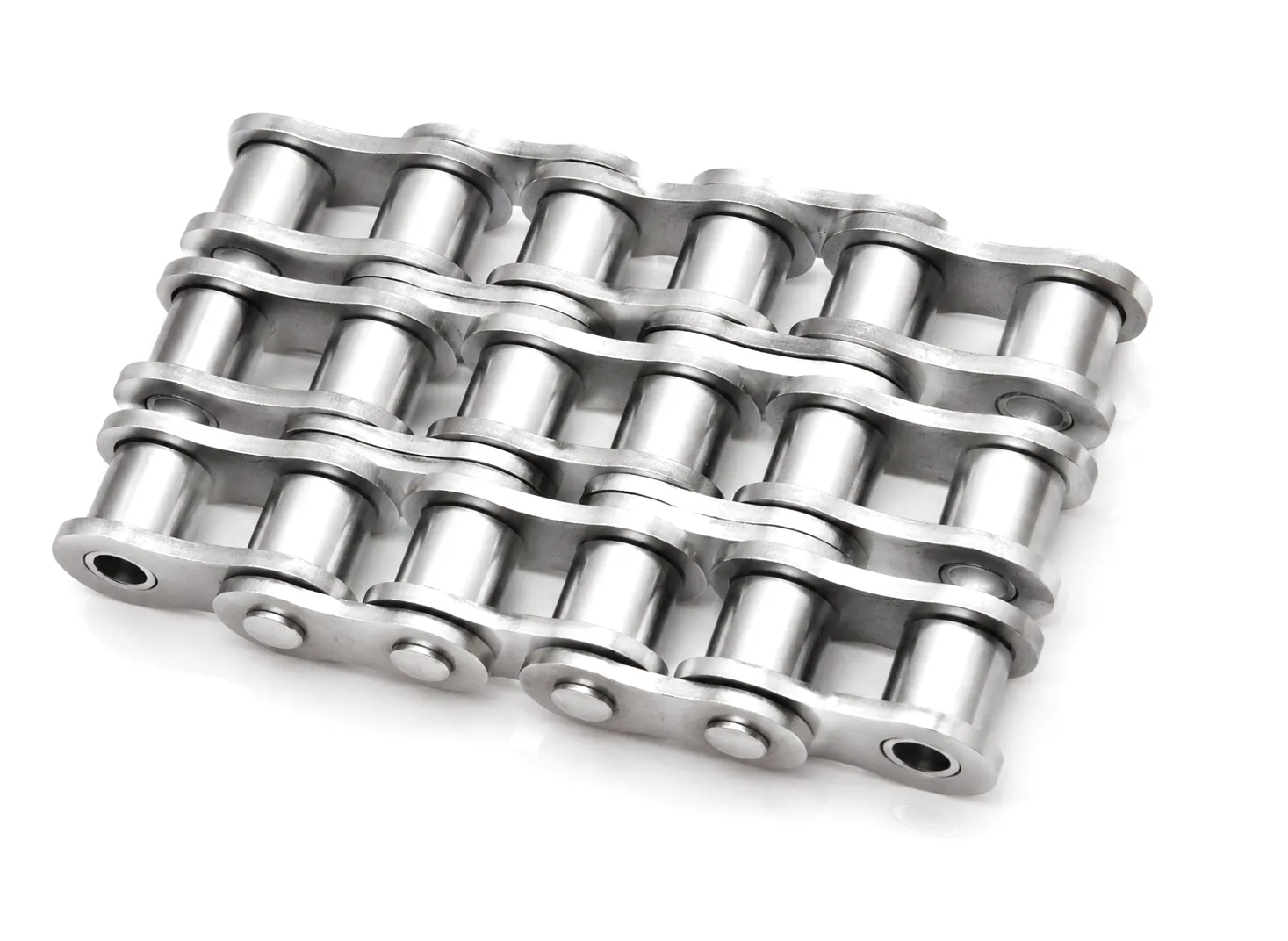
A roller chain operates through the engagement of hardened steel rollers — mounted on bushings between inner link plates — with the teeth of a sprocket. As the sprocket rotates, each tooth captures a roller, and the chain is pulled forward. The roller itself rotates freely on the bushing during engagement, which dramatically reduces friction and wear at the point of contact compared with a fixed sliding surface. This rolling contact is the defining mechanical principle that makes roller chain so efficient for power transmission — typical transmission efficiencies of 97% to 99% are achievable under correct lubrication. The pitch, which is the distance between pin centres, governs compatibility with sprocket geometry and is standardised across ISO 606 and ANSI B29.1 for simplex, duplex, triplex, and higher-strand configurations. The structure — inner plates, outer plates, pins, bushings, and rollers — works in concert to distribute tensile and shock loads across multiple contact points simultaneously, giving the chain its characteristic combination of high tensile strength and operational flexibility. For UK manufacturers operating automated conveyors, packaging lines, and agricultural equipment, this combination of efficiency and standardisation makes roller chain the default power transmission choice in the vast majority of rotating applications.

LEAF CHAIN

Leaf chain — sometimes called balance chain or forklift chain — is built on a completely different structural logic. It consists of alternating rows of interlaced link plates connected by pins, with no rollers and no bushings. The entire load-bearing function is accomplished by the link plates themselves, which are stacked in increasing quantities to build tensile strength. This link plate assembly is articulated purely through pin-to-plate bearing contact, which means leaf chain is not designed to mesh with sprocket teeth in a power-transmitting role. Instead, it is anchored at both ends and placed under tension, typically guiding a vertical load over a sheave or anchor pin. Forklift mast systems are the canonical application: as the hydraulic cylinder extends, the leaf chain transmits the lifting force to the carriage assembly. The absence of rollers and bushings means the chain is more compact for a given tensile strength, and the multiple lacing configurations (such as AL444, BL534, or BL646) allow precise engineering of the plate count to match exact load requirements. For industrial facilities in the Midlands running high-frequency forklift operations or precision tensioning systems, understanding this structural distinction prevents catastrophic misspecification.
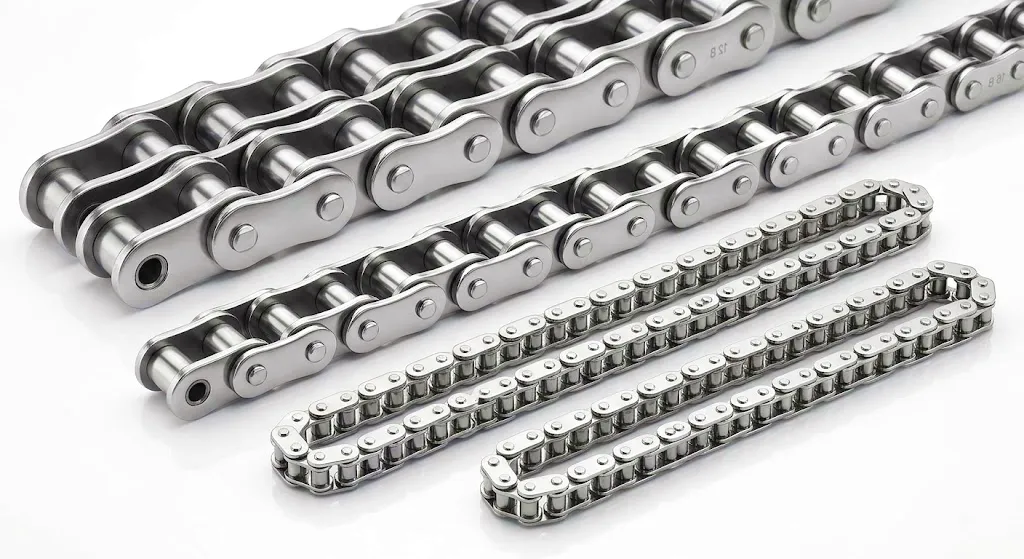
Industrial roller chain transmission system in manufacturing plant

Material Science: What These Chains Are Made From

The material specification of both chain types has advanced considerably over the past two decades, driven by demands for longer service intervals and operation in corrosive or high-temperature environments common across UK heavy industry. Standard roller chain is typically manufactured from carbon steel — specifically grades equivalent to SAE 1045 or SAE 1050 for pins and plates — combined with case-hardened bushings and rollers. The case hardening process, usually through carburising or induction hardening, creates a hard outer surface that resists wear while retaining a tough, ductile core that absorbs shock loads without brittle fracture. This dual-property structure is critical for applications where a conveyor encounters sudden jam loads or a drive chain must absorb the shock of a motor start under full load.

For demanding environments, stainless steel roller chain — typically AISI 304 or AISI 316 — offers excellent corrosion resistance at the cost of reduced tensile strength compared with carbon steel equivalents. In food processing facilities across Yorkshire and the North West, stainless chain is the mandated specification for hygiene compliance. Nickel-plated carbon steel represents a cost-effective middle ground for moderate corrosion resistance. Leaf chain, by contrast, prioritises raw tensile and fatigue strength above all else, typically using high-carbon or alloy steel plates heat-treated to achieve tensile strengths exceeding 1000 MPa in premium grades. The pin material must resist both bearing wear and bending fatigue across millions of articulation cycles — a duty that demands carburised alloy steel. Specialist coating options, including zinc-nickel plating and PTFE treatment, extend service life in salt-laden warehouse environments common in coastal British ports.

Performance Advantages

Core Technical Advantages: Roller Chain

HIGH TRANSMISSION EFFICIENCY

Rolling contact between hardened rollers and sprocket teeth minimises friction losses, routinely delivering mechanical efficiency between 97% and 99%. This is a significant advantage over belt drives in heavy-duty industrial applications where energy costs across a plant’s lifetime are a primary procurement consideration. For a manufacturing facility in the West Midlands running multiple conveyor lines around the clock, even a half-percentage-point improvement in drive efficiency translates to measurable savings on electricity bills — a factor UK engineers factor into total cost of ownership calculations with increasing rigour given current energy pricing.

PRECISE SPEED RATIOS

Because the chain pitch and sprocket tooth count define the transmission ratio with absolute mathematical precision, roller chain drives deliver a positively synchronised output without the slip that characterises V-belt or flat belt drives. In packaging machinery, textile production lines, and automated assembly systems — sectors with significant concentrations across the East Midlands and Yorkshire — this slip-free transmission is essential for maintaining consistent product quality and throughput rates. The ability to achieve exact speed ratios by changing sprocket tooth counts without modifying the chain itself also provides significant flexibility during machine upgrades or retooling, reducing engineering time and capital expenditure.

🔨
MULTI-STRAND SCALABILITY

Roller chain can be assembled in duplex, triplex, or higher strand configurations to multiply load-carrying capacity without increasing pitch size. This scalability allows engineers to match the chain drive precisely to power requirements while maintaining compact drive geometry — particularly valuable in retrofit applications where existing sprocket centres and housing dimensions impose constraints. UK plant engineers tasked with uprating a drive on an existing conveyor frame find multi-strand roller chain the most practical route to increased capacity without structural modification.

Core Technical Advantages: Leaf Chain

EXCEPTIONAL TENSILE STRENGTH

Because leaf chain uses the full cross-section of multiple stacked link plates as the load-bearing element — with no material removed for bushings or rollers — it achieves the highest tensile strength per unit width of any chain type. Heavy-duty BL-series leaf chains can carry working loads exceeding 160 kN in large lacing configurations, making them the only credible choice for high-capacity forklift masts, crane hoist lines, and counterbalance tensioning systems. No roller chain of equivalent pitch and width approaches this load capacity, which is why leaf chain remains the irreplaceable standard for vertical lifting duty in logistics warehouses and distribution centres throughout the UK.

🔒
FATIGUE RESISTANCE IN CYCLIC LIFTING

Leaf chain is purpose-engineered for cyclic tensile loading — the repeated application and release of high axial loads — which is precisely the duty cycle of a forklift or crane. The link plate geometry and heat treatment are optimised to resist fatigue crack initiation at pin holes, which is the primary failure mode under millions of lift cycles. Roller chain, by contrast, is engineered for torsional and bending loads during mesh with a sprocket, and its plate geometry is not optimised for pure axial fatigue. Specifying roller chain in a forklift mast application is therefore a structural engineering error that risks premature fatigue failure under load — a safety-critical consequence that UK Health and Safety Executive guidance on lifting equipment specifically addresses.
★ Featured Products

कैटरपिलर के लिए उच्च शक्ति वाली रोलर चेन 120HSP-00

HEAVY-DUTY SERIES
कैटरपिलर के लिए उच्च शक्ति वाली रोलर चेन 120HSP-00
Engineered to Caterpillar OEM specifications with premium carbon steel plates, shot-peened for fatigue resistance. Ideal for construction machinery, heavy conveyor drives, and mining equipment.
उत्पाद देखें →


कैटरपिलर के लिए उच्च शक्ति वाली रोलर चेन C100HSP-00

PREMIUM SERIES
कैटरपिलर के लिए उच्च शक्ति वाली रोलर चेन C100HSP-00
C-series heavy strand configuration delivering enhanced tensile capacity for continuous-duty machinery. Specially treated for extended lubrication intervals in remote-site and offshore applications.
उत्पाद देखें →


Technical Performance & Parameter Comparison Table

पैरामीटर Roller Chain (Standard) Roller Chain (Heavy-Duty HSP) Leaf Chain (BL Series)
Primary Function विद्युत पारेषण Heavy Power Transmission Lifting / Tensioning
मानक आईएसओ 606 / एएनएसआई बी29.1 ISO 606 / OEM Spec ISO 4347 / ANSI B29.8
पिच रेंज 6.35 mm – 101.6 mm 31.75 mm – 76.2 mm 12.7 mm – 50.8 mm
प्लेट सामग्री Carbon Steel SAE 1045 Alloy Steel (shot-peened) High-Carbon Alloy Steel
पिन सामग्री Carburised Carbon Steel Carburised Alloy Steel Carburised Alloy Steel
सतही कठोरता (एचआरसी) 56–62 (rollers/bushings) 58–64 (rollers/bushings) 58–64 (pin surface)
तन्यता शक्ति (विशिष्ट) 14.1 kN – 250 kN 89 kN – 320 kN 16.8 kN – 610 kN
परिचालन तापमान -10°C to +150°C -10°C to +150°C -20°C to +120°C
Transmission Efficiency 97% – 99% 97% – 99% N/A (tensioning duty)
Corrosion Protection Options Stainless / Nickel-plated / Zinc Nickel-plated / Zinc Zinc-Nickel / PTFE Coat
Typical Safety Factor min. 7:1 min. 7:1 min. 4:1 (lifting duty)

Precision roller chain manufacturing process

UK Industrial Applications

Application Scenarios Across the UK’s Industrial Landscape

🏢 Automotive Manufacturing — Midlands Sector

The West Midlands automotive supply chain — encompassing Coventry, Birmingham, and Wolverhampton — represents one of the largest concentrations of roller chain usage in the UK. Assembly line conveyors, component transfer systems, press feeds, and robotic palletising lines all rely on precision roller chain drives to maintain the exact timing sequences that modern automated production demands. In these environments, the positive-engagement principle of roller chain ensures that robotic arm movements and conveyor positions are synchronised to within fractions of a millimetre, which is non-negotiable for body-in-white assembly operations. Multi-strand heavy-duty roller chain is commonly specified on heavy press transfer lines where conveyor loads exceed what single-strand drives can sustain. The ability to replace worn chain sections without dismantling entire machines — using connecting links and half links — reduces planned maintenance downtime, a critical commercial consideration for plants operating on just-in-time schedules for OEM supply.

⚒ Steel & Metals Processing — Sheffield / Rotherham

Sheffield’s speciality steel and metals sector remains one of the most demanding environments for chain drives in the UK. Rolling mill auxiliary drives, billet transfer tables, bar mill entry guides, and walking-beam furnace mechanisms all consume substantial quantities of heavy-pitch roller chain. The elevated ambient temperatures near furnace areas require chain specified for extended high-temperature performance, with high-temperature-rated lubricants and hardened components that maintain dimensional stability under thermal cycling. In crane and hoist applications within steel fabrication shops across Rotherham and the Don Valley, leaf chain is the standard for the vertical hoisting element, providing the tensile capacity and fatigue resistance to sustain multi-tonne lifting cycles across extended shift patterns. Ever Power’s capacity to produce custom pitch and lacing configurations means that plant engineers replacing discontinued OEM chain specifications in ageing steelworks infrastructure are not forced into costly machinery modifications.

📦 Logistics & Warehousing — Nationwide Distribution Hubs

The UK’s logistics and warehousing sector — anchored around distribution hubs in Northampton, Lutterworth, and the East Midlands logistics corridor — consumes both roller chain and leaf chain in significant volumes. Automated pallet conveyor systems, tote sorters, and cross-belt lines are predominantly driven by roller chain, exploiting its efficiency and positively synchronised engagement for precise package routing. Forklift trucks — which represent the indispensable interface between automated conveyor systems and racking storage — depend entirely on leaf chain for their mast lifting function. A single large-format distribution centre may simultaneously house hundreds of forklifts, each carrying two leaf chains in the mast. The maintenance programme for leaf chain in this context involves regular elongation measurement (replacement is triggered when chain has elongated beyond 2% of nominal pitch length under the manufacturer’s specified test load), lubrication cycles, and visual inspection for plate cracking — a structured regime that professional facilities managers across the logistics sector now build into their planned preventative maintenance schedules as a standard compliance requirement.

🌿 Agricultural & Food Processing — East Anglia / Yorkshire

In East Anglian crop processing facilities and Yorkshire food manufacturing plants, roller chain operates across a spectrum from combine harvester header drives to industrial bread oven conveyors. The shared challenge in both environments is exposure to particulate matter — grain dust, flour, and organic debris — which accelerates chain wear unless sealed or self-lubricating chain variants are specified. O-ring and X-ring sealed roller chain, which pre-packs lubricant within the bushing-pin interface behind an elastomeric seal, dramatically extends service life in these conditions by excluding abrasive particles from the bearing surfaces. In food production areas with washdown requirements, stainless steel roller chain or NSF-H1 food-grade lubricant-compatible chain is the mandated specification. The tensioning of conveyors, particularly on inclined sections moving product between levels within a processing facility, often employs leaf chain anchored between a take-up unit and the conveyor frame — a tensioning function that leaf chain performs with greater precision and reliability than spring or gravity tensioners in high-vibration applications.

Heavy-duty roller chain for industrial conveyor applications UK

Construction & Mining: Caterpillar-Compatible High-Strength Series

Construction machinery and mining equipment represent arguably the harshest environment in which roller chain must perform. Excavators, bulldozers, crawler cranes, and continuous miners operating on UK infrastructure projects and quarrying sites across Wales, Scotland, and the North of England subject their drive chains to a combination of impact loading, abrasive contamination, thermal cycling, and exposure to hydraulic fluid and diesel fuel. The कैटरपिलर के लिए उच्च शक्ति वाली रोलर चेन 120HSP-00 and the कैटरपिलर के लिए उच्च शक्ति वाली रोलर चेन C100HSP-00 address this duty directly, with shot-peened plates for enhanced fatigue performance, interference-fitted pins for superior joint rigidity, and pre-stressed assembly that reduces running-in elongation — extending the period before the first field adjustment is required.

These chains are dimensionally matched to Caterpillar OEM sprocket specifications, meaning they are drop-in replacements that eliminate the need for sprocket replacement alongside chain renewal — a significant saving on already expensive major maintenance operations. For UK plant hire companies and quarry operators managing large fleets of heavy mobile plant, the extended service life of shot-peened HSP-series chain reduces the frequency of chain-change operations, which in tracked machine applications typically requires significant disassembly labour. Procurement teams sourcing these chains have found the value-in-use calculation — comparing acquisition cost against chain-change frequency and associated labour — strongly favours premium HSP specification over standard chain for high-utilisation plant.

विनिर्माण उत्कृष्टता

Ever Power: Precision Chain Manufacturing & Customisation

Ever Power’s manufacturing operations are built around the principle that chain is not a commodity — it is a precision engineered component whose performance determines the reliability of the customer’s entire machine or process. The company’s production environment integrates computer-controlled heat treatment furnaces, automated shot-peening lines, and CMM (coordinate measuring machine) quality verification at each critical stage, from raw link plate blanking through to final assembly and proof loading. This level of manufacturing rigour reflects the reality that a chain failing in a forklift mast, a steel plant crane, or an automotive assembly line is not simply a maintenance event — it carries safety, production continuity, and liability consequences of the first order.

The customisation capability that defines Ever Power’s value proposition to UK industrial buyers extends beyond simple length-cutting. Engineering consultation is available for specifying non-standard pitches required to match legacy machinery, alternative lacing configurations for leaf chain requiring higher or lower tensile capacities than standard catalogue grades, and material upgrades to stainless, duplex stainless, or surface-treated variants for specific environmental requirements. The supply chain management function operates a stockholding model calibrated to the lead times that UK procurement teams actually require — with express despatch options and documentation packages that support LOLER compliance for lifting chain applications and CE marking requirements for machinery integration.

240+
Domain Network Sites
आईएसओ
606 / 4347 Certified
Custom
Pitch & Lacing MOQ
LOLER / CE Documentation
Full test certificates, material traceability documents, and CE declarations of conformity available for UK lifting equipment compliance.
Express UK Despatch
Stockholding model calibrated to UK procurement lead time requirements with express shipping options to all mainland UK addresses.

ग्राहक सफलता की कहानी
Sheffield, South Yorkshire — Heavy Fabrication Sector

Resolving Premature Chain Failure on a Structural Steel Processing Line

Industrial chain application Sheffield steel plant

A structural steel fabrication company based in Sheffield — operating a plate processing line that cuts, drills, and marks structural sections for the UK civil construction supply chain — had been experiencing unacceptably high rates of roller chain failure on its main transfer conveyor drive. The plant ran two production shifts daily, and over a 12-month period the drive chain had required emergency replacement four times, with each incident causing an average of six hours of unplanned downtime. The chain being used was a standard BS28B-2 duplex roller chain sourced from a general industrial distributor, specified as a direct replacement for the original equipment chain without reference to updated load calculations following a process speed increase implemented 18 months earlier.

The engineering team at Ever Power conducted a remote application review using the actual drive data provided by the Sheffield plant’s maintenance manager — motor output, conveyor geometry, chain speed, and load spectrum from production records. The analysis identified that the speed increase had elevated dynamic chain tension beyond the fatigue limit of the standard duplex configuration, with the wear elongation patterns on the failed chain sections confirming cyclic fatigue rather than lubrication failure. The recommendation was to upgrade to a heavy-duty series duplex chain with shot-peened plates and a redesigned lubrication schedule using a penetrating viscosity-grade oil applied by an automatic drip lubricator. Following the switch, the Sheffield plant ran the upgraded chain for eleven months across both production shifts without a single chain-related stoppage. The reduction in unplanned downtime alone — valued at the company’s internal contribution rate — recovered the incremental cost of the premium chain specification within the first two months of operation.

★★★★★

“Switching to Ever Power’s heavy-duty duplex specification chain was the right call. We went from four emergency chain changes in a year to zero in eleven months. The application review they provided was genuinely useful engineering support — not just a product sale.”

David Hargreaves
Maintenance Manager, Structural Steel Fabrication — Sheffield, South Yorkshire
★★★★★

“We needed a custom leaf chain lacing for an older Linde forklift mast that no UK distributor could source off the shelf. Ever Power had it manufactured and delivered within the lead time they quoted. The documentation pack covered everything we needed for our LOLER inspection — material cert, test certificate, full traceability.”

Janet Forsythe
Fleet Maintenance Supervisor, Logistics Distribution Centre — Northampton
★★★★★

“The stainless roller chain we sourced from Ever Power for our food processing conveyor has now been running for over a year under CIP washdown conditions — the previous chain from another supplier lasted around four months before showing serious corrosion at the pin-plate interface. Excellent product, realistic pricing, and their technical team actually knew what they were talking about.”

Mark Colburn
Engineering Procurement, Food Manufacturing Plant — Leeds, West Yorkshire

Decision Framework: When to Choose Which Chain

The practical decision between roller chain and leaf chain should not be driven by familiarity or price — it should be driven by the mechanical duty the chain must perform. The diagnostic framework below reduces the selection decision to its engineering essentials. If the chain’s primary job is to transmit rotational motion from one shaft to another by meshing with sprockets, the answer is roller chain. If the chain’s primary job is to carry a tensile load — whether lifting a vertical mass or maintaining tension in a static or slow-moving system — the answer is leaf chain. There are applications, such as counterbalanced tensioning systems on certain types of vertical machining centre and some crane trolley traversing mechanisms, where the boundary between these duties can appear blurred. In those cases, the key question is whether sprocket engagement (even slow) occurs. If it does, roller chain provides correct geometry. If the chain bears load purely through its pins and plates without sprocket engagement, leaf chain provides maximum efficiency and fatigue performance for the same cross-sectional area of steel.

Application Requirement रोलर चेन पत्ती श्रृंखला
Sprocket engagement / power transmission
Vertical lifting (forklift, crane hoist)
Highest tensile strength per unit width
High-speed continuous conveying
Static or slow tensioning duty △ Possible
Food-grade / washdown environments ✓ (SS grade) △ Limited
Multi-strand power scaling △ Via lacing

अक्सर पूछे जाने वाले प्रश्नों

Your Questions Answered: Roller Chain & Leaf Chain in the UK

Q — SPECIFICATION
What is the difference between leaf chain and roller chain when I am trying to select the right product for a forklift lifting system in a UK warehouse?

Roller chain is designed to mesh with sprocket teeth and transmit rotational power; it is the correct choice for conveyor drives, machine feeds, and gearbox outputs. Leaf chain carries pure tensile loads without sprocket engagement — it is the correct and, under LOLER 1998, the compliant specification for forklift mast applications throughout the UK. Mixing these types is a serious engineering error with safety implications.

Q — PRICING
How much does heavy-duty roller chain typically cost for a manufacturing plant in Birmingham, and where can I get a competitive quote for bulk supply in the UK?

Heavy-duty roller chain pricing varies significantly with pitch, strand count, surface treatment, and order volume. Standard duplex chain in mid-pitch sizes typically ranges from several pounds to tens of pounds per metre at single quantities, with substantial volume pricing available for orders by the reel or drum. For accurate pricing and bulk supply quotations to Birmingham or any UK delivery address, contact Ever Power directly at [email protected] with your chain specification, quantity, and delivery postcode.

Q — COMPLIANCE
Which standard governs leaf chain inspection intervals for forklift operations in the United Kingdom, and how often should I replace the chain under LOLER requirements?

The Lifting Operations and Lifting Equipment Regulations 1998 (LOLER) require a thorough examination of all lifting equipment, including forklift mast chains, at least every 12 months for equipment used to lift persons and at least every six months in other lifting applications, or as specified in an examination scheme prepared by a competent person. ISO 4347 and the forklift manufacturer’s service manual define the elongation and wear limits that trigger replacement — typically 2% pitch elongation under defined test load. Always consult a qualified competent person for your specific fleet and duty cycle.

Q — SUPPLIER
Where can I find a reliable roller chain supplier in the UK who offers custom pitch specifications and can provide full material traceability documentation for my Sheffield engineering firm?

Ever Power manufactures and supplies roller chain and leaf chain to custom specifications including non-standard pitches, alternative lacing configurations, and specialist material grades, with full material traceability certificates available for every order. Delivery to Sheffield and across South Yorkshire can typically be arranged within quoted lead times. Contact [email protected] with your specification requirements for a tailored quotation.

Q — SELECTION
How do I know whether my food processing conveyor line in Leeds needs stainless steel roller chain, and what is the cost difference compared with standard carbon steel chain?

If the conveyor is in a wet processing zone, a washdown area, or any zone where food contact is possible — directly or through splash — stainless steel roller chain is the safe specification. AISI 316 stainless offers superior chloride resistance for washdown with sanitisers. The premium over equivalent carbon steel chain is typically 2.5 to 4 times by unit price, but the substantially extended service life under wet, corrosive conditions means the total lifecycle cost is frequently lower. Request a formal cost-of-ownership comparison alongside your price enquiry.

Q — MAINTENANCE
When should I replace my roller chain instead of re-lubricating it, and what visible signs of wear should my maintenance team in a Coventry automotive plant watch out for?

Roller chain replacement is triggered when the chain has elongated beyond 1.5% to 2% of nominal pitch length (measurable with a standard chain wear gauge over a defined number of links), when visible side-plate cracking or corrosion pitting is present, or when roller deformation or bushing scoring can be felt or seen. Stiff links that resist articulation indicate inner plate-to-plate corrosion or lubrication failure and should be treated as replacement indicators. Lubricating a chain that has already reached the elongation threshold does not restore it to safe service — replacement is the only correct action at that point.

Ready to Source?

Get a Technical Quote from Ever Power

Tell us your chain type, pitch, quantity, and delivery location anywhere in the UK. Our engineering team will review your application and return a specification-matched quotation with full technical documentation.


✉ Email Us: [email protected]

जीजेडएल द्वारा संपादित