How Roller Chain and Leaf Chain Actually Work
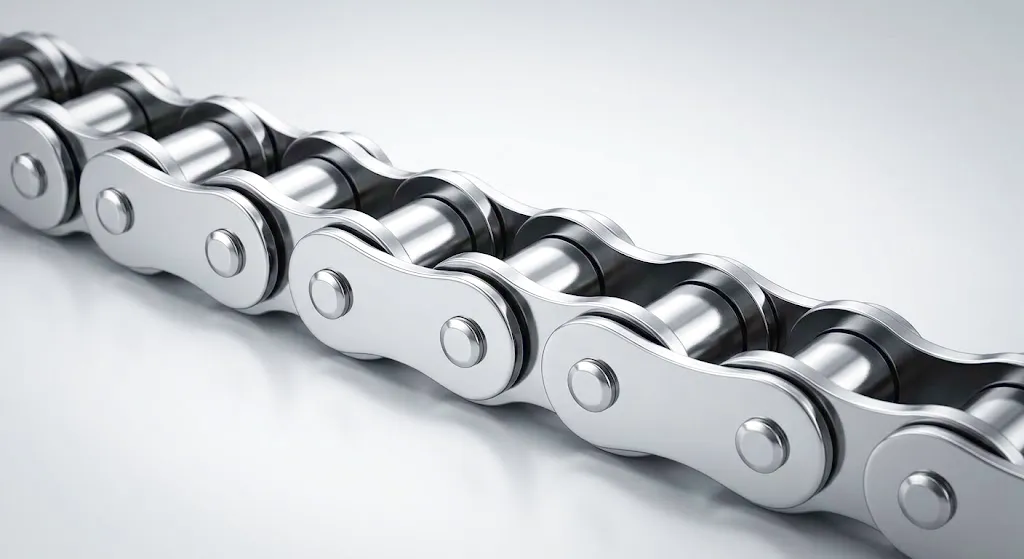
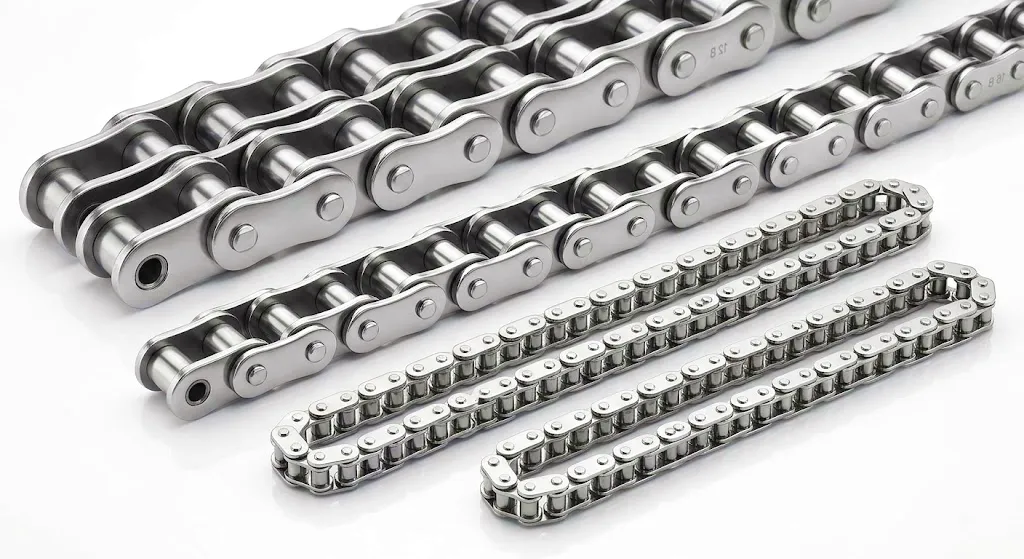
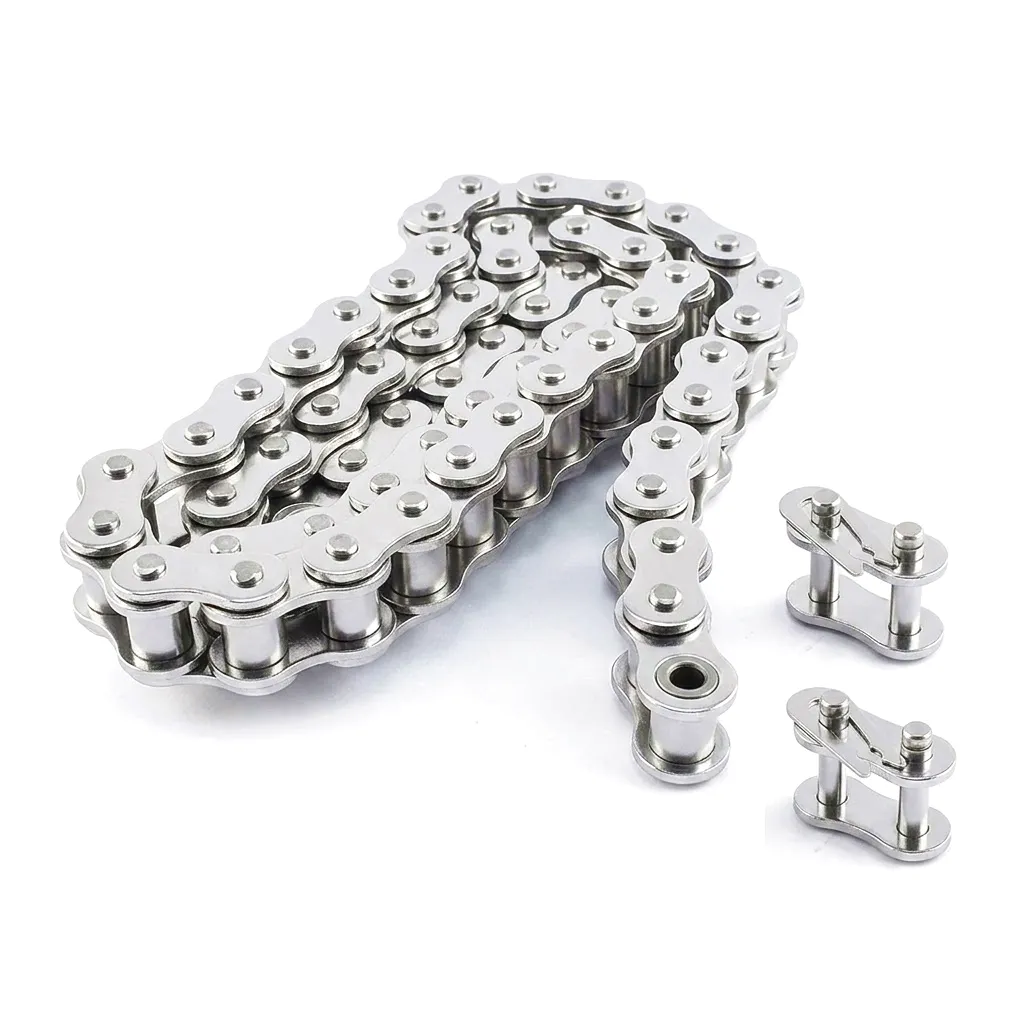
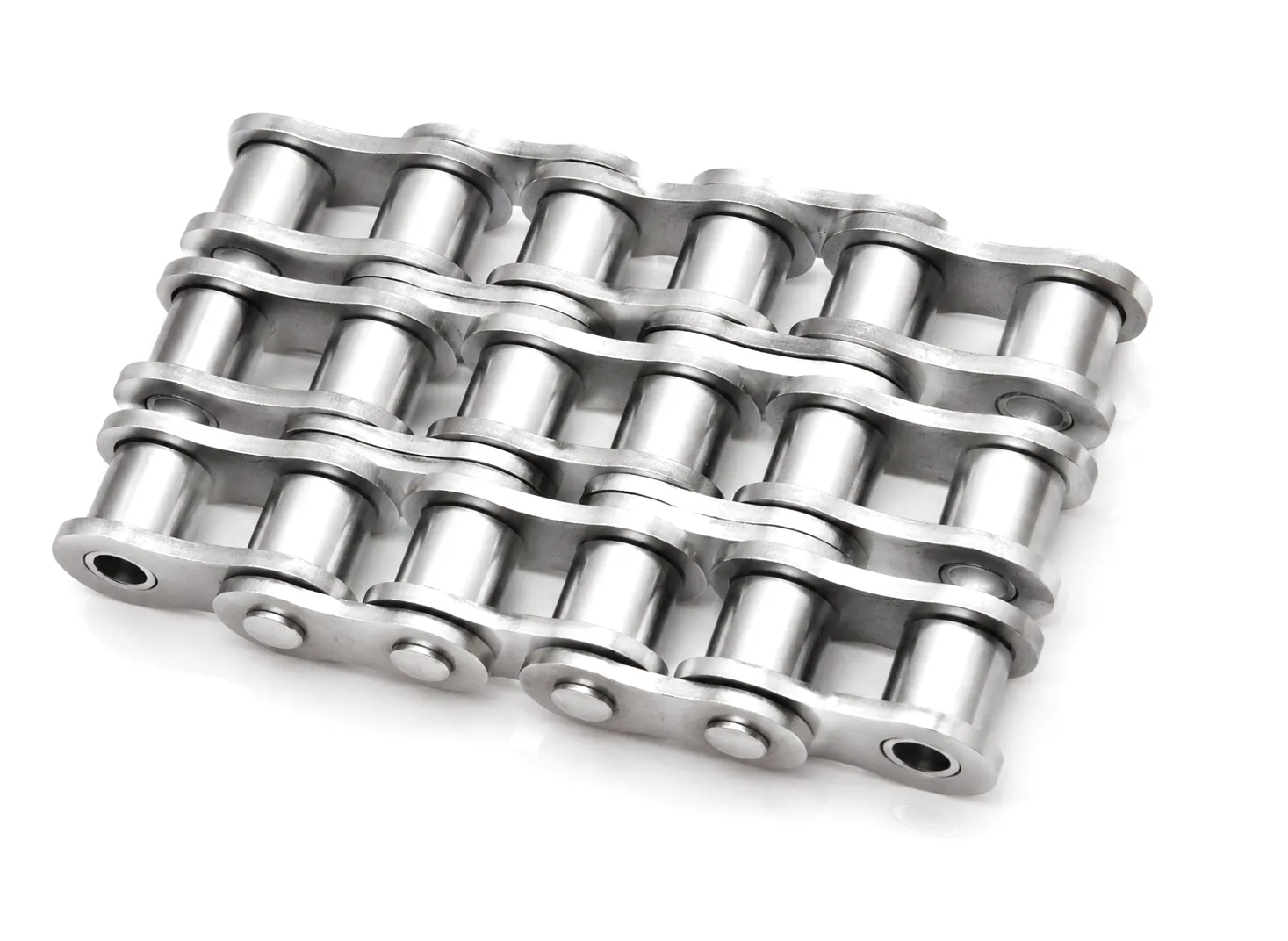
A roller chain operates through the engagement of hardened steel rollers — mounted on bushings between inner link plates — with the teeth of a sprocket. As the sprocket rotates, each tooth captures a roller, and the chain is pulled forward. The roller itself rotates freely on the bushing during engagement, which dramatically reduces friction and wear at the point of contact compared with a fixed sliding surface. This rolling contact is the defining mechanical principle that makes roller chain so efficient for power transmission — typical transmission efficiencies of 97% to 99% are achievable under correct lubrication. The pitch, which is the distance between pin centres, governs compatibility with sprocket geometry and is standardised across ISO 606 and ANSI B29.1 for simplex, duplex, triplex, and higher-strand configurations. The structure — inner plates, outer plates, pins, bushings, and rollers — works in concert to distribute tensile and shock loads across multiple contact points simultaneously, giving the chain its characteristic combination of high tensile strength and operational flexibility. For UK manufacturers operating automated conveyors, packaging lines, and agricultural equipment, this combination of efficiency and standardisation makes roller chain the default power transmission choice in the vast majority of rotating applications.
Leaf chain — sometimes called balance chain or forklift chain — is built on a completely different structural logic. It consists of alternating rows of interlaced link plates connected by pins, with no rollers and no bushings. The entire load-bearing function is accomplished by the link plates themselves, which are stacked in increasing quantities to build tensile strength. This link plate assembly is articulated purely through pin-to-plate bearing contact, which means leaf chain is not designed to mesh with sprocket teeth in a power-transmitting role. Instead, it is anchored at both ends and placed under tension, typically guiding a vertical load over a sheave or anchor pin. Forklift mast systems are the canonical application: as the hydraulic cylinder extends, the leaf chain transmits the lifting force to the carriage assembly. The absence of rollers and bushings means the chain is more compact for a given tensile strength, and the multiple lacing configurations (such as AL444, BL534, or BL646) allow precise engineering of the plate count to match exact load requirements. For industrial facilities in the Midlands running high-frequency forklift operations or precision tensioning systems, understanding this structural distinction prevents catastrophic misspecification.
Core Technical Advantages: Roller Chain
Rolling contact between hardened rollers and sprocket teeth minimises friction losses, routinely delivering mechanical efficiency between 97% and 99%. This is a significant advantage over belt drives in heavy-duty industrial applications where energy costs across a plant’s lifetime are a primary procurement consideration. For a manufacturing facility in the West Midlands running multiple conveyor lines around the clock, even a half-percentage-point improvement in drive efficiency translates to measurable savings on electricity bills — a factor UK engineers factor into total cost of ownership calculations with increasing rigour given current energy pricing.
Because the chain pitch and sprocket tooth count define the transmission ratio with absolute mathematical precision, roller chain drives deliver a positively synchronised output without the slip that characterises V-belt or flat belt drives. In packaging machinery, textile production lines, and automated assembly systems — sectors with significant concentrations across the East Midlands and Yorkshire — this slip-free transmission is essential for maintaining consistent product quality and throughput rates. The ability to achieve exact speed ratios by changing sprocket tooth counts without modifying the chain itself also provides significant flexibility during machine upgrades or retooling, reducing engineering time and capital expenditure.
Roller chain can be assembled in duplex, triplex, or higher strand configurations to multiply load-carrying capacity without increasing pitch size. This scalability allows engineers to match the chain drive precisely to power requirements while maintaining compact drive geometry — particularly valuable in retrofit applications where existing sprocket centres and housing dimensions impose constraints. UK plant engineers tasked with uprating a drive on an existing conveyor frame find multi-strand roller chain the most practical route to increased capacity without structural modification.
Core Technical Advantages: Leaf Chain
Because leaf chain uses the full cross-section of multiple stacked link plates as the load-bearing element — with no material removed for bushings or rollers — it achieves the highest tensile strength per unit width of any chain type. Heavy-duty BL-series leaf chains can carry working loads exceeding 160 kN in large lacing configurations, making them the only credible choice for high-capacity forklift masts, crane hoist lines, and counterbalance tensioning systems. No roller chain of equivalent pitch and width approaches this load capacity, which is why leaf chain remains the irreplaceable standard for vertical lifting duty in logistics warehouses and distribution centres throughout the UK.
Leaf chain is purpose-engineered for cyclic tensile loading — the repeated application and release of high axial loads — which is precisely the duty cycle of a forklift or crane. The link plate geometry and heat treatment are optimised to resist fatigue crack initiation at pin holes, which is the primary failure mode under millions of lift cycles. Roller chain, by contrast, is engineered for torsional and bending loads during mesh with a sprocket, and its plate geometry is not optimised for pure axial fatigue. Specifying roller chain in a forklift mast application is therefore a structural engineering error that risks premature fatigue failure under load — a safety-critical consequence that UK Health and Safety Executive guidance on lifting equipment specifically addresses.
Technical Performance & Parameter Comparison Table
| Parameter | Roller Chain (Standard) | Roller Chain (Heavy-Duty HSP) | Leaf Chain (BL Series) |
|---|---|---|---|
| Primary Function | Kraftöverföring | Heavy Power Transmission | Lifting / Tensioning |
| Standard | ISO 606 / ANSI B29.1 | ISO 606 / OEM Spec | ISO 4347 / ANSI B29.8 |
| Tonhöjdsområde | 6.35 mm – 101.6 mm | 31.75 mm – 76.2 mm | 12.7 mm – 50.8 mm |
| Plattmaterial | Carbon Steel SAE 1045 | Alloy Steel (shot-peened) | High-Carbon Alloy Steel |
| Pin Material | Carburised Carbon Steel | Carburised Alloy Steel | Carburised Alloy Steel |
| Surface Hardness (HRC) | 56–62 (rollers/bushings) | 58–64 (rollers/bushings) | 58–64 (pin surface) |
| Tensile Strength (typical) | 14.1 kN – 250 kN | 89 kN – 320 kN | 16.8 kN – 610 kN |
| Driftstemperatur | -10°C to +150°C | -10°C to +150°C | -20°C to +120°C |
| Transmission Efficiency | 97% – 99% | 97% – 99% | N/A (tensioning duty) |
| Corrosion Protection Options | Stainless / Nickel-plated / Zinc | Nickel-plated / Zinc | Zinc-Nickel / PTFE Coat |
| Typical Safety Factor | min. 7:1 | min. 7:1 | min. 4:1 (lifting duty) |
Application Scenarios Across the UK’s Industrial Landscape
Resolving Premature Chain Failure on a Structural Steel Processing Line
“Switching to Ever Power’s heavy-duty duplex specification chain was the right call. We went from four emergency chain changes in a year to zero in eleven months. The application review they provided was genuinely useful engineering support — not just a product sale.”
“We needed a custom leaf chain lacing for an older Linde forklift mast that no UK distributor could source off the shelf. Ever Power had it manufactured and delivered within the lead time they quoted. The documentation pack covered everything we needed for our LOLER inspection — material cert, test certificate, full traceability.”
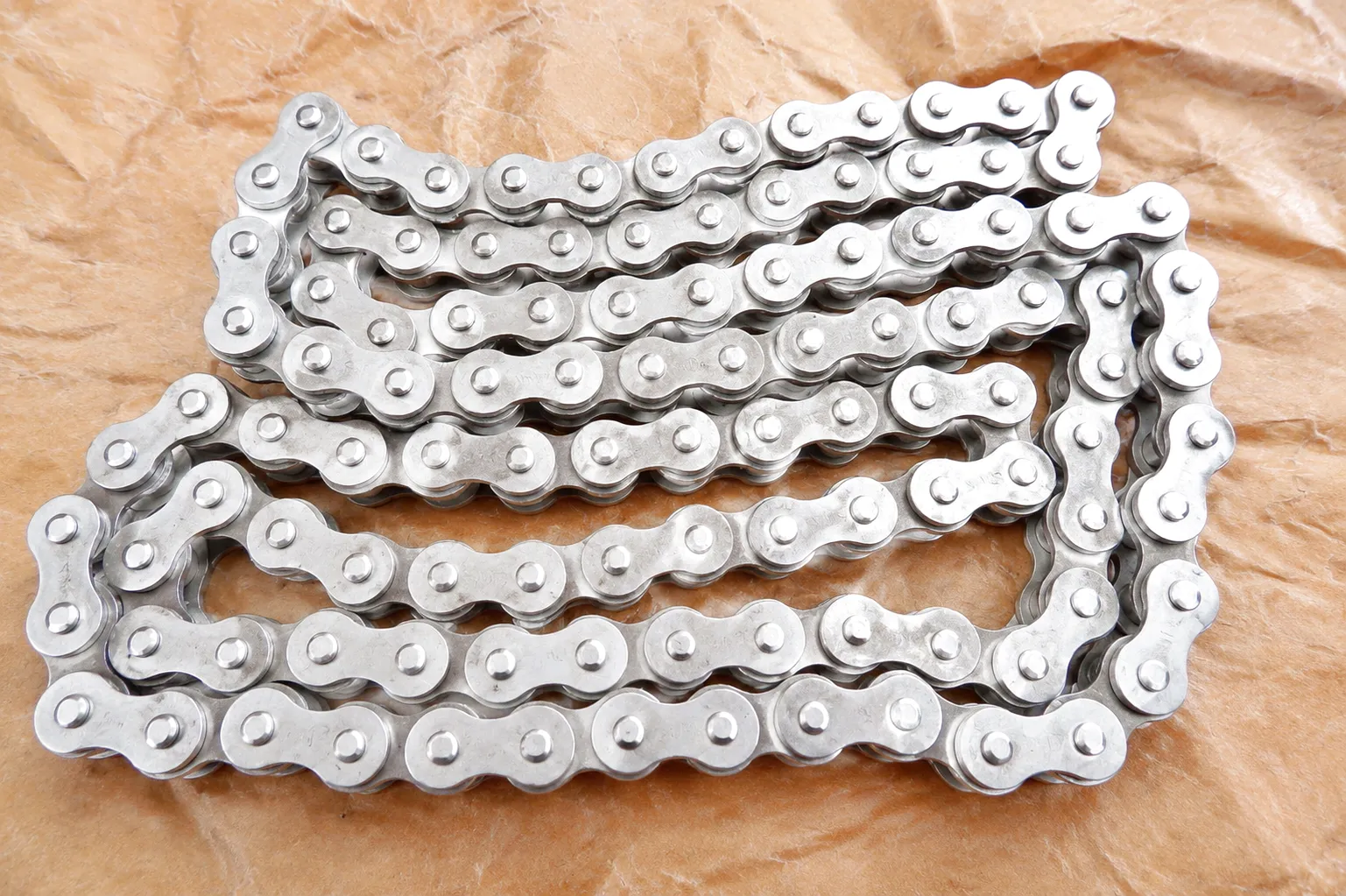
“The stainless roller chain we sourced from Ever Power for our food processing conveyor has now been running for over a year under CIP washdown conditions — the previous chain from another supplier lasted around four months before showing serious corrosion at the pin-plate interface. Excellent product, realistic pricing, and their technical team actually knew what they were talking about.”
Decision Framework: When to Choose Which Chain
The practical decision between roller chain and leaf chain should not be driven by familiarity or price — it should be driven by the mechanical duty the chain must perform. The diagnostic framework below reduces the selection decision to its engineering essentials. If the chain’s primary job is to transmit rotational motion from one shaft to another by meshing with sprockets, the answer is roller chain. If the chain’s primary job is to carry a tensile load — whether lifting a vertical mass or maintaining tension in a static or slow-moving system — the answer is leaf chain. There are applications, such as counterbalanced tensioning systems on certain types of vertical machining centre and some crane trolley traversing mechanisms, where the boundary between these duties can appear blurred. In those cases, the key question is whether sprocket engagement (even slow) occurs. If it does, roller chain provides correct geometry. If the chain bears load purely through its pins and plates without sprocket engagement, leaf chain provides maximum efficiency and fatigue performance for the same cross-sectional area of steel.
| Application Requirement | Rullkedja | Lövkedja |
|---|---|---|
| Sprocket engagement / power transmission | ✓ | ✗ |
| Vertical lifting (forklift, crane hoist) | ✗ | ✓ |
| Highest tensile strength per unit width | ✗ | ✓ |
| High-speed continuous conveying | ✓ | ✗ |
| Static or slow tensioning duty | △ Possible | ✓ |
| Food-grade / washdown environments | ✓ (SS grade) | △ Limited |
| Multi-strand power scaling | ✓ | △ Via lacing |
Your Questions Answered: Roller Chain & Leaf Chain in the UK
Roller chain is designed to mesh with sprocket teeth and transmit rotational power; it is the correct choice for conveyor drives, machine feeds, and gearbox outputs. Leaf chain carries pure tensile loads without sprocket engagement — it is the correct and, under LOLER 1998, the compliant specification for forklift mast applications throughout the UK. Mixing these types is a serious engineering error with safety implications.
Heavy-duty roller chain pricing varies significantly with pitch, strand count, surface treatment, and order volume. Standard duplex chain in mid-pitch sizes typically ranges from several pounds to tens of pounds per metre at single quantities, with substantial volume pricing available for orders by the reel or drum. For accurate pricing and bulk supply quotations to Birmingham or any UK delivery address, contact Ever Power directly at [email protected] with your chain specification, quantity, and delivery postcode.
The Lifting Operations and Lifting Equipment Regulations 1998 (LOLER) require a thorough examination of all lifting equipment, including forklift mast chains, at least every 12 months for equipment used to lift persons and at least every six months in other lifting applications, or as specified in an examination scheme prepared by a competent person. ISO 4347 and the forklift manufacturer’s service manual define the elongation and wear limits that trigger replacement — typically 2% pitch elongation under defined test load. Always consult a qualified competent person for your specific fleet and duty cycle.
Ever Power manufactures and supplies roller chain and leaf chain to custom specifications including non-standard pitches, alternative lacing configurations, and specialist material grades, with full material traceability certificates available for every order. Delivery to Sheffield and across South Yorkshire can typically be arranged within quoted lead times. Contact [email protected] with your specification requirements for a tailored quotation.
If the conveyor is in a wet processing zone, a washdown area, or any zone where food contact is possible — directly or through splash — stainless steel roller chain is the safe specification. AISI 316 stainless offers superior chloride resistance for washdown with sanitisers. The premium over equivalent carbon steel chain is typically 2.5 to 4 times by unit price, but the substantially extended service life under wet, corrosive conditions means the total lifecycle cost is frequently lower. Request a formal cost-of-ownership comparison alongside your price enquiry.
Roller chain replacement is triggered when the chain has elongated beyond 1.5% to 2% of nominal pitch length (measurable with a standard chain wear gauge over a defined number of links), when visible side-plate cracking or corrosion pitting is present, or when roller deformation or bushing scoring can be felt or seen. Stiff links that resist articulation indicate inner plate-to-plate corrosion or lubrication failure and should be treated as replacement indicators. Lubricating a chain that has already reached the elongation threshold does not restore it to safe service — replacement is the only correct action at that point.
Get a Technical Quote from Ever Power
Tell us your chain type, pitch, quantity, and delivery location anywhere in the UK. Our engineering team will review your application and return a specification-matched quotation with full technical documentation.