How Roller Chain Lubrication Works
and Why It Extends Service Life
A comprehensive engineering guide for procurement managers, maintenance engineers, and plant operators across the UK manufacturing sector.
🏭 UK Industry Focus
⚙️ B2B Procurement
The Anatomy of a Roller Chain and Its Tribological Challenge
Inner & Outer Link Plates
The structural backbone of every roller chain assembly, these hardened steel plates transmit tensile load between sprocket teeth. Their precise geometry — including the pitch holes and the press-fit tolerances holding the pins and bushings — must be maintained within micron-level accuracy. When lubrication fails, metal-to-metal contact at the pin-to-plate interface causes fretting corrosion and fatigue cracking, leading to sudden plate fracture under cyclic loading in high-duty environments such as Birmingham-area automotive press lines.
पिन और बुशिंग
The pin-bushing interface is the most tribologically demanding zone of any roller chain. During each engagement with the drive sprocket, the bushing rotates slightly on the pin, generating frictional heat and surface stress. Without adequate lubricant film thickness, the asperities on both mating surfaces interact directly, producing adhesive wear — a mechanism that removes material far faster than hydrodynamic fatigue. Carburised alloy steel pins with case hardness above 58 HRC are standard practice, yet even these harden surfaces yield rapidly without the protective boundary film that correct lubrication provides.
Rollers and Sprocket Engagement
Rollers rotate freely on the bushing outer diameter and engage the sprocket tooth profile with a rolling contact. This rolling motion — rather than sliding — is what gives the roller chain its mechanical efficiency advantage over plain chain designs. The roller-to-sprocket contact generates Hertzian stress that can exceed 1,000 MPa on the contact patch in heavy-duty conveying applications. Lubricant in the roller-to-bushing interface reduces frictional resistance during roller rotation, diminishing the impact energy transferred to both the sprocket teeth and the side plates on each seating engagement cycle.
Full Film (Hydrodynamic) Lubrication — The Target Regime
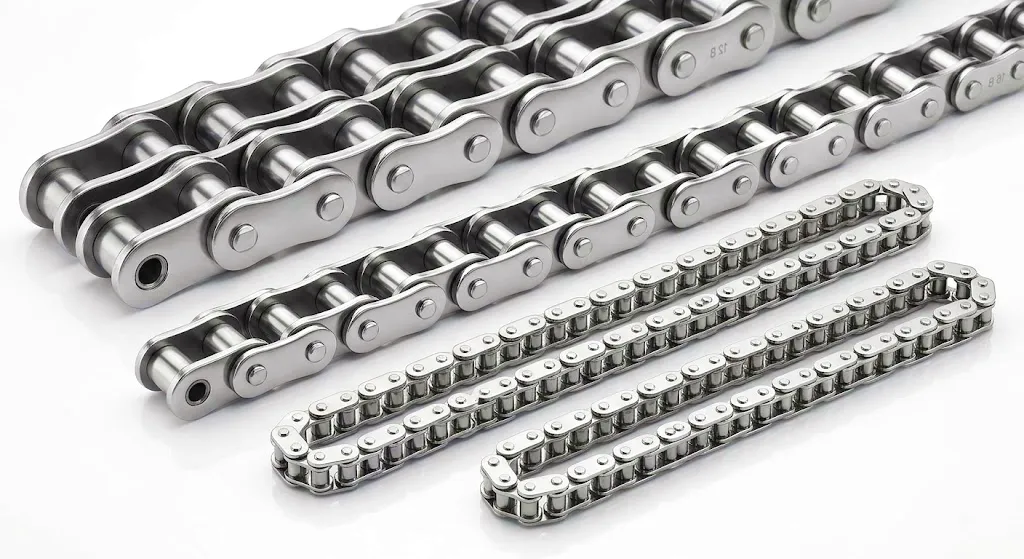
Full film hydrodynamic lubrication is the goal of any well-engineered lubrication system. The rotating pin and bushing act like a journal bearing: a coherent oil film separates the surfaces completely, and friction drops to its theoretical minimum. Wear essentially ceases, heat generation falls sharply, and power efficiency improves measurably. Achieving this regime in a roller chain running at 300 RPM under a 5 kN working load requires both correct oil viscosity grade (typically ISO VG 100–220 depending on ambient temperature) and consistent lubricant delivery to ensure the convergent film is never allowed to thin below the critical value.
Field data from conveyor installations in South Yorkshire’s steel processing sector consistently shows that chains operating in full film lubrication achieve two to three times the service life of identically specified chains running under inadequate lubrication. The economic argument for proper lubrication practice is rarely contested by experienced plant engineers.
The Four Principal Roller Chain Lubrication Methods
Manual / Periodic Brush Application
Applied by brush or squeeze bottle at regular service intervals — commonly every eight or twelve operating hours in UK maintenance schedules. Suitable for lightly loaded, slow-speed drives and backup systems where automation is not practical. The critical failure point is interval discipline: oil applied even two to three hours late on a high-temperature conveyor can initiate measurable pin wear. Many Sheffield forge shops and smaller foundries across the Midlands still rely on this method for secondary auxiliary drives, making technician training on correct application volume and oil selection commercially important.
Drip Feed Lubrication
A reservoir mounted above the chain releases metered drops of oil via an adjustable needle valve directly onto the inner link plates as they travel along the slack strand. Drip rates typically range from 4 to 20 drops per minute depending on chain speed and load. This method suits medium-duty drives operating at 100–500 RPM and is widely found in packaging line conveyors and light industrial machinery across logistics hubs in Milton Keynes and the East Midlands. The oil spreads by centrifugal action and capillary forces into the pin-bushing clearance as the chain articulates through sprocket engagement.
Oil Bath / Slinger Disc Lubrication
The lower chain strand runs through a sealed sump containing lubricant, with the chain dragging oil upward through the drive enclosure. At higher speeds, a slinger disc attached to the sprocket shaft dips into the sump and throws oil onto the chain via centrifugal force. This method reliably delivers lubricant without human intervention and supports higher operating speeds — typically 500 to 2,000 RPM. It is the standard approach for enclosed gearbox output drives on bulk handling equipment in UK ports and distribution centres, where chains must operate continuously under high cyclic loads without manual servicing between scheduled shutdowns.
Forced Circulation / Spray Lubrication
A dedicated pump continuously circulates filtered, temperature-controlled oil to spray nozzles positioned to direct lubricant precisely onto the inner link plate gap at the point where centrifugal force carries it into the pin-bushing clearance. This is the gold standard for high-speed, high-power drives — chain speeds above 2,500 RPM — such as primary drive systems on heavy press lines, forging presses, and large CNC transfer machines in tier-one automotive component suppliers across the West Midlands. Forced circulation also removes frictional heat from the chain, functioning as a combined lubrication and cooling system that is critical for maintaining dimensional stability in precision-pitch chains.
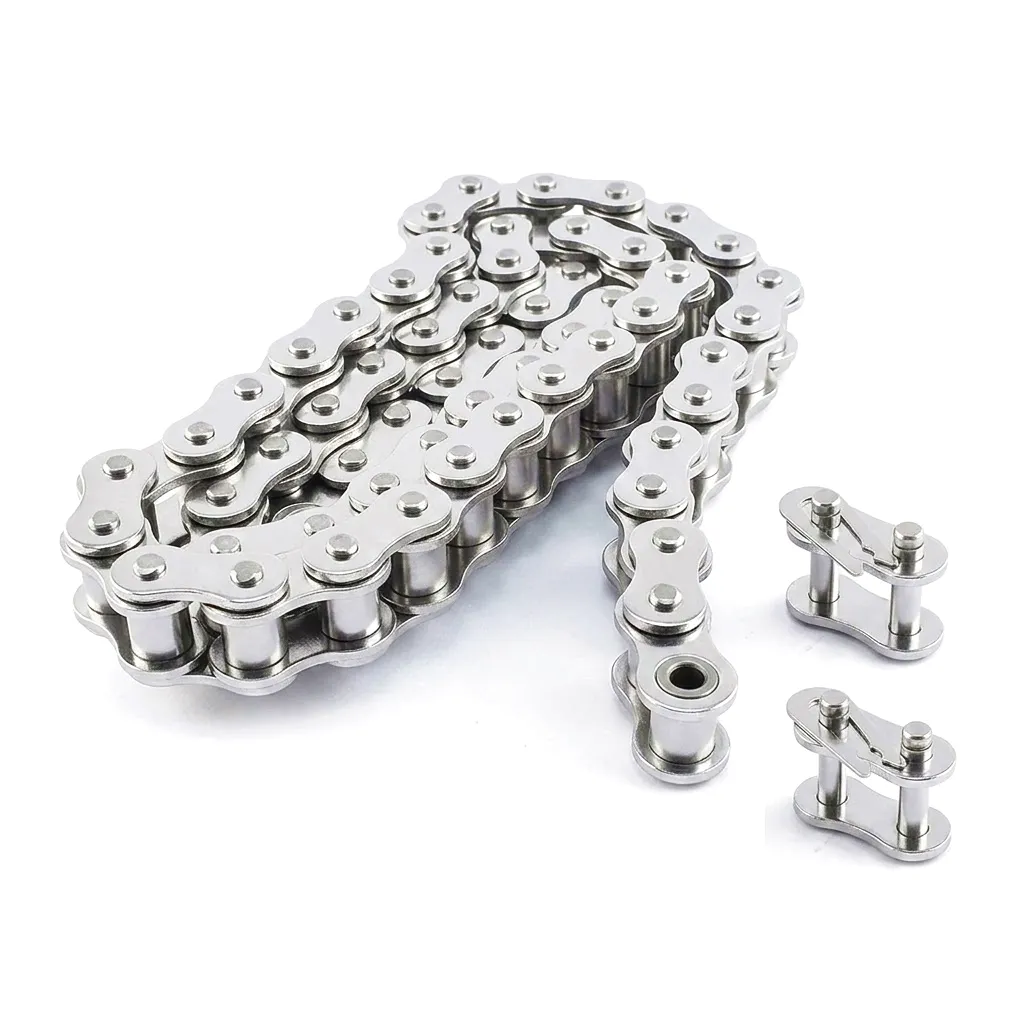
Stainless Steel (SS Chain)
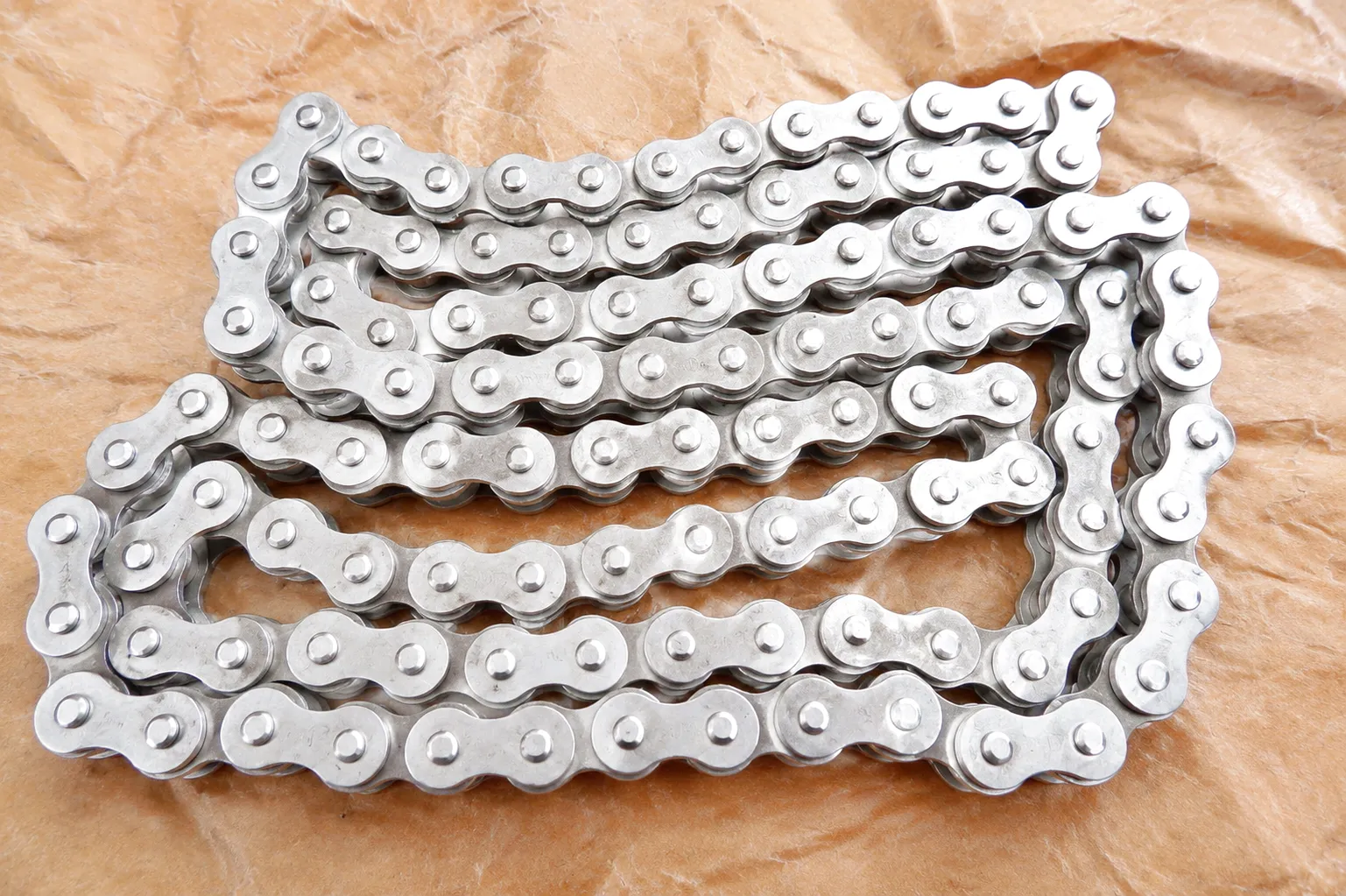
Grades 304 and 316 are specified for roller chain deployed in UK food processing, pharmaceutical manufacturing, and marine/offshore environments where standard carbon steel would corrode rapidly. The lower hardness achievable in stainless — typically 30 to 40 HRC — means that lubrication is even more critical to prevent rapid wear, as the surface cannot sustain contact stress as effectively as carburised alloy steel. Specialised food-grade lubricants approved to NSF H1 are mandatory in direct-contact food processing applications.
Nickel-Plated & Zinc-Treated Chain
Surface-treated chains offer a compromise between corrosion protection and the mechanical strength of alloy steel. Electroless nickel plating provides a uniform, hard coating (typically 45 to 55 HRC equivalent) that also reduces the adhesion of process contamination. These chains are common in the beverage bottling lines and chemical handling conveyors of the North West, where humidity and chemical exposure degrade unprotected carbon steel rapidly. Lubrication compatibility with the plating must be verified to avoid deposit formation that blocks the clearances.
Sintered Metal Bushings & Self-Lubricating Variants
For applications where periodic manual relubrication is impractical — overhead conveyor systems, clean room environments, or remote agricultural machinery operating in Lincolnshire’s harvesting sector — sintered bronze or oil-impregnated polymer bushing variants are available. These materials release lubricant under the heat and pressure of operation, providing a degree of self-lubrication. Whilst they do not replace the performance of an externally lubricated precision chain in heavy-duty service, they offer meaningful service life extension in lightly loaded, infrequently maintained systems.
Roller Chain Technical Performance Parameters
| पैरामीटर | Standard Range | Heavy-Duty Range | Notes |
|---|---|---|---|
| पिच का आकार | 3/8″ – 1″ (9.525 – 25.4 mm) | 1″ – 3″ (25.4 – 76.2 mm) | Per ISO 606 / ANSI B29.1 |
| Breaking Strength | 8 kN – 56 kN | 56 kN – 400+ kN | Verified per ISO 3696 test method |
| Pin Hardness | 58 – 62 HRC (surface) | 60 – 64 HRC (surface) | Carburised alloy steel |
| Operating Speed | Up to 1,500 RPM | Up to 4,000 RPM (forced lube) | Dependent on lubrication method |
| Operating Temp. (standard) | -10 °C to +150 °C | -40 °C to +400 °C (specialist) | Specialty alloys & coatings required above 150 °C |
| घिसाव सीमा पर बढ़ाव | +1.5% per BS/ISO standard | +1.0% (precision class) | Measure across full chain length |
| Recommended Lubricant Viscosity | ISO VG 68 – 100 (high speed) | ISO VG 150 – 220 (low speed, high load) | Adjusted for ambient temp. |
| Tensile Strength (link plate) | 900 – 1,100 MPa | 1,100 – 1,400 MPa | Q&T alloy steel |
| Mechanical Efficiency | 97 – 98% (well lubricated) | 94 – 96% (poorly lubricated) | Measured single-strand drive |
High Strength Roller Chain for Heavy Industrial Applications
कैटरपिलर के लिए उच्च शक्ति वाली रोलर चेन 120HSP-00
Engineered specifically for Caterpillar heavy equipment drivetrains, the 120HSP-00 delivers maximum fatigue resistance and dimensional precision under the extreme cyclic loads encountered in quarrying, civil construction, and mining operations — sectors with significant activity across the UK’s infrastructure development programmes. The chain features shot-peened link plates for enhanced fatigue life, interference-fit pins for zero axial play, and a surface treatment profile optimised for compatibility with Caterpillar’s own lubrication specifications. When properly lubricated, this chain consistently surpasses the OEM service life targets, reducing total cost of ownership on Caterpillar machinery deployed across UK construction sites.
कैटरपिलर के लिए उच्च शक्ति वाली रोलर चेन C100HSP-00
The C100HSP-00 is a compact-pitch, high-tensile roller chain designed for Caterpillar medium-duty equipment where space constraints limit the use of larger pitch chains. Its carburised bushing bore is maintained to tight tolerances — ± 0.005 mm — ensuring that oil film formation begins rapidly from first start-up and that lubricant retention between service intervals is maximised. The chain’s pre-loaded pin-plate press fit eliminates the initial elongation phase common in standard-grade roller chain, meaning it achieves full performance specification within the first few hours of running on Caterpillar equipment in UK plant hire and earth-moving fleets operating out of depots in the East Midlands and North West regions.
🚗 Automotive Component Manufacturing — West Midlands
The automotive supply chain concentrated around Birmingham, Coventry, and Wolverhampton places exceptionally demanding requirements on roller chain in press-line transfer systems, assembly conveyors, and robotic body-shop transfer equipment. Chain drives operating on these high-production lines typically run 18 to 24 hours per day, five to seven days per week, with chain speeds of 1,000 to 2,500 RPM and working loads that fluctuate rapidly with press cycle timing. Forced circulation lubrication systems are standard on new installations, and the roller chain selected must maintain dimensional stability — elongation below 1.0% — throughout planned maintenance intervals of 6,000 to 10,000 operating hours. Inadequate lubrication on a 500-tonne press transfer line can halt production worth hundreds of thousands of pounds per shift.
⚙️ Steel & Metals Processing — Sheffield & South Yorkshire
Sheffield retains a globally respected special steels and precision forgings sector, and roller chain appears throughout the production infrastructure — in coil handling equipment, furnace charging conveyors, and bar-to-bar transfer systems where ambient temperatures regularly exceed 80 °C near heat treatment zones. High-temperature lubrication with synthetic base fluids — polyalphaolefin or ester-based ISO VG 220 grades — is essential for chains near furnace exit conveyors. At these temperatures, mineral oil evaporates rapidly, leaving abrasive carbon deposits in the pin-bushing clearance that accelerate wear more aggressively than dry running in a cool environment. Chains operating under correct high-temperature lubrication protocols in South Yorkshire steel plants routinely achieve 18-month service intervals between replacement.
🌾 Agricultural & Food Processing — East Anglia & Lincolnshire
The breadth of food and agricultural processing across East Anglia and Lincolnshire creates demand for roller chain that must contend with contamination from soil, crop residues, water washdown, and cleaning chemicals. Stainless steel and nickel-plated roller chain with NSF H1-rated lubricants are standard specifications for chains in contact or near-contact with food products. Combine harvesters, grain augers, potato sorting lines, and packing conveyors all rely on roller chain as a primary motion transmission component. The seasonal, intermittent use patterns of agricultural machinery create their own lubrication challenge: chains stored over winter must retain a protective lubricant film that prevents corrosion during the off-season and provides adequate lubrication at the beginning of the next harvest cycle without requiring complete re-lubrication before field operation commences.
🏗️ Construction & Mining Equipment — Nationwide UK
Roller chain on Caterpillar and equivalent heavy construction plant operates under perhaps the harshest lubrication environment of any sector. Silica-laden soil ingress, waterlogging, impact loading from rock, and wide ambient temperature swings from Scottish Highland winters to summer heatwaves in southern England place extraordinary demands on both the chain steel and its lubricant. The high-strength Caterpillar-series chains from Ever Power are engineered with sealed-joint designs that retain factory-applied grease between service intervals, providing a degree of internal lubrication protection independently of external application routines. This is particularly valuable in remote UK construction sites where maintenance access is infrequent and service intervals are necessarily longer than in fixed plant installations.
Lubrication Mistakes That Cut Roller Chain Service Life Short
Wrong Viscosity Grade
Using a lubricant that is too light — for example, applying an ISO VG 32 hydraulic oil to a slow, heavily loaded conveyor chain — produces inadequate film thickness at the operating load, and rapid wear follows. Too heavy a viscosity at high speed prevents oil from penetrating the tight pin-bushing clearance, leaving the interface starved. UK maintenance teams frequently make this error when substituting a “general purpose” machine oil from the stores rather than specifying by ISO VG grade appropriate to the chain speed and ambient temperature.
Over-Lubrication and Contamination Trapping
Applying too much lubricant creates a sticky external coating on the chain that traps abrasive particles — metal swarf, grinding dust, or coal and mineral dust in mining environments — turning the outer chain surface into an abrasive lapping compound. This external abrasion grinds the roller outer diameter, the sprocket tooth flank, and the link plate side faces, generating secondary wear debris that then migrates into the pin-bushing clearance via capillary action. The solution is applying the correct small quantity of lubricant to the inner link plate gap — not flooding the outer chain surface.
Lubricant Applied to the Wrong Location
Many field technicians apply lubricant to the top of the chain — the outer roller and link plate surface — because it is visible and accessible. Oil applied here centrifuges off under chain tension and contributes little to pin-bushing lubrication. The correct application point is the inner link plate gap at the lower (slack) strand, where centrifugal force and capillary action draw the lubricant inward toward the pin-bushing clearance. This principle is one of the most frequently misunderstood aspects of manual chain lubrication across British industrial maintenance practice.
Ignoring Lubricant Change Interval
In oil bath and forced circulation systems, the lubricant must be changed at scheduled intervals. Oxidised oil develops acidic compounds and sludge that attack steel surfaces and block the fine filter elements protecting circulation pumps and spray nozzles. In UK manufacturing environments where planned maintenance intervals are often extended under production pressure, oil analysis programmes — drawing a sample from the sump or return line and measuring acid number, metal particle content, and viscosity — provide objective data on whether the lubricant change interval can safely be extended or must be brought forward to protect the chain and associated drive components.
Ready to discuss your roller chain specification? Our technical team provides detailed quotes and engineering consultation for UK procurement and maintenance teams.
Case Study: Extending Roller Chain Service Life by 140% at a Sheffield Forging Facility
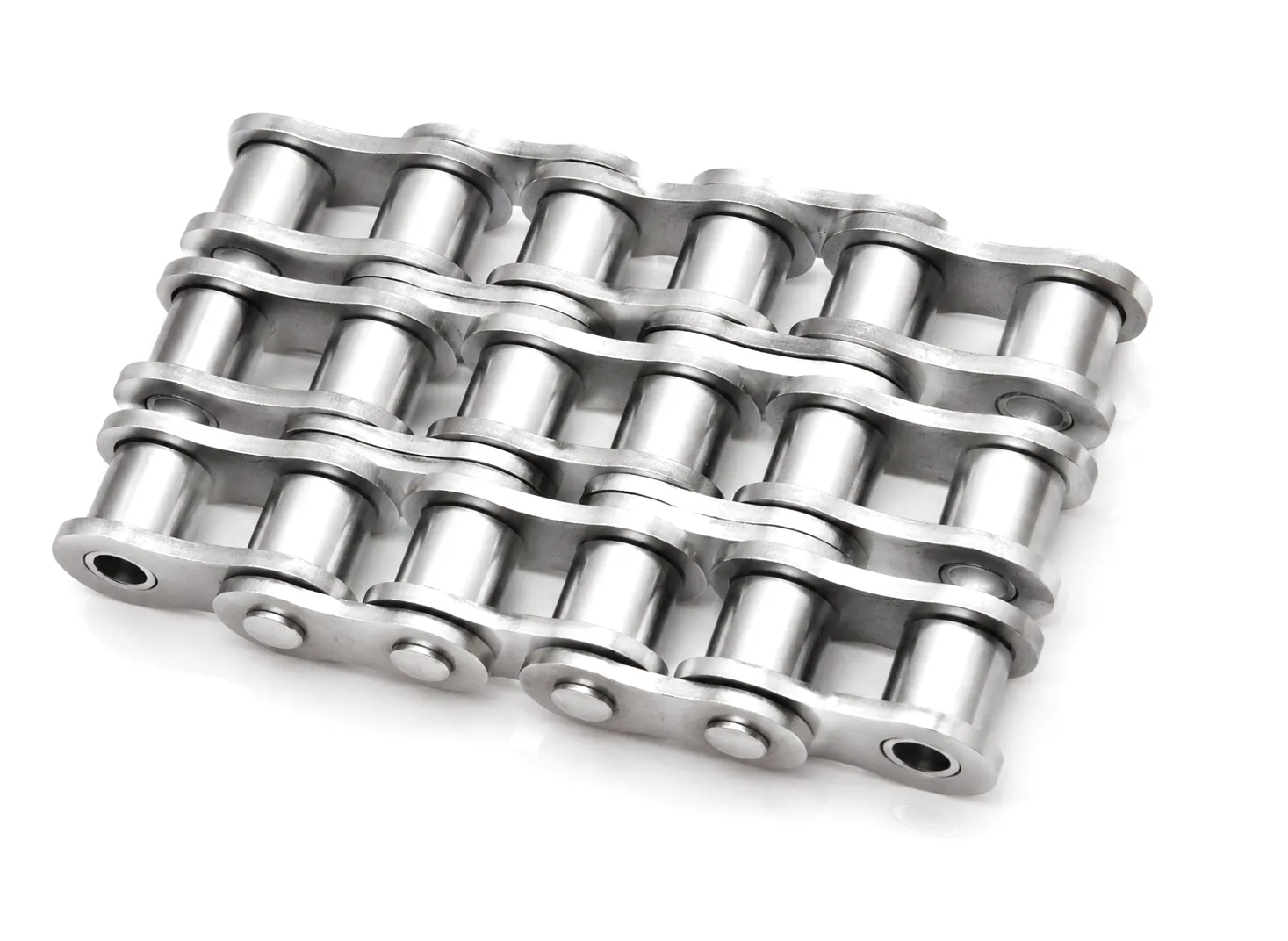
A precision drop forging company operating a three-shift production schedule in Sheffield came to Ever Power with a persistent operational problem: their 1.5-inch pitch, three-strand roller chain on the primary billet transfer conveyor was failing after an average of only seven months of service — well below the twelve-to-eighteen month life that the equipment OEM had specified. Unplanned chain failures during billet transfer caused significant safety risk from falling hot billets, production stoppages averaging four hours per failure event, and replacement chain costs that the plant maintenance manager estimated at over £28,000 per year across the three conveyor lines involved.
Ever Power’s technical team conducted an on-site assessment and identified two compounding issues. The chain specification — standard carbon steel with mineral oil bath lubrication — was inadequate for the ambient temperature at the conveyor output zone, which regularly measured 95 to 110 °C due to proximity to the furnace exit. Mineral oil was oxidising rapidly and thickening into a resinous deposit that was blocking pin-bushing clearances rather than lubricating them. At the same time, scale particles ejected from the hot billets were contaminating the oil bath without an adequate filtration system to remove them.
Ever Power supplied a custom-specified heavy-duty roller chain with an extended bushing bore heat treatment profile, surface-shot-peened link plates, and a synthetic PAO-based ISO VG 460 high-temperature lubricant delivered by a closed-loop forced circulation system with a 10-micron particulate filter. Within the first chain replacement cycle under the new specification, elongation measurements showed wear rates reduced by over 65% compared to the prior installation. At the seventeen-month review, the chain remained within the 1.0% elongation replacement threshold — a 140% extension of the previous average service life. Annual chain replacement costs fell from £28,000 to under £11,000, with zero unplanned failure events recorded during the entire period.
What UK Customers Say About Ever Power Roller Chain
“We replaced a UK-sourced standard chain with Ever Power’s custom heavy-duty specification on our forge transfer line. The difference in elongation rate was measurable within the first three months. Their technical team understood exactly what the high-temperature environment demands and specified accordingly — no guesswork, no catalogue-fitting. This is what proper engineering support from a chain supplier looks like.”
“We’ve been sourcing Ever Power’s Caterpillar-series roller chain for our plant hire fleet maintenance depot in Birmingham for the past two years. Dimensional consistency between production batches is exceptional — every link measures within tolerance without exception. When you’re fitting chain on Caterpillar dozer and excavator tracks under field conditions, consistent pitch geometry is what prevents rework. Lead times from their team have always met our procurement schedule without difficulty.”
“Our food processing line in Lincolnshire runs stainless steel roller chain through a daily high-pressure washdown cycle. Sourcing a chain that maintains dimensional stability and doesn’t require constant tension adjustment after washdown has been a long-standing challenge. Ever Power’s stainless specification — with the correct NSF H1 lubrication pre-applied — resolved the problem entirely. No more mid-shift elongation adjustments, and the chain has now run through two full harvest processing seasons without replacement.”
Roller Chain Lubrication Questions from UK Industrial Buyers
The correct lubrication interval depends on chain speed, load, ambient temperature, and the lubrication method used. For manual brush or drip application in medium-duty applications, intervals of 8 to 40 operating hours are typical. High-speed drives with oil bath or forced circulation systems can extend intervals to several hundred hours. Always use chain elongation measurement — not calendar time — as the primary indicator of wear progression.
For ambient temperatures above 80 °C, synthetic base fluids — polyalphaolefin (PAO) or ester-based lubricants — in ISO VG 220 to 460 grades are recommended. These resist oxidation and thermal breakdown far better than mineral oil, preventing the resinous deposits that block pin-bushing clearances and accelerate wear. Mineral oil should be avoided in high-temperature forge and steel processing environments across South Yorkshire’s facilities.
Contact Ever Power directly at [email protected] for a technical quotation. Supply the chain standard (ANSI/ISO), pitch, number of strands, required breaking load, and approximate annual quantity to receive a detailed price and lead time confirmation within 48 hours.
For food processing environments subject to daily washdown cycles, automatic drip feed or micro-dosing spray systems using NSF H1-approved food-grade lubricant offer the best balance of cost, hygiene compliance, and chain service life. These systems apply the minimum quantity of lubricant necessary, reducing contamination risk and eliminating the labour overhead of manual application on long conveyor lines.
Measure the length of a 24-link section under operating tension and compare against the nominal pitch length. A standard-grade roller chain should be replaced when elongation reaches 1.5% over nominal length (e.g., 610 mm measured across a section nominally 600 mm). Precision-class chain for indexing applications should be replaced at 1.0% elongation. Additionally, check for stiff links, cracked plates, and visible corrosion on each inspection.
Ever Power is a B2B roller chain manufacturer serving UK procurement teams directly, with the ability to produce custom pitch, attachment, material, and coating specifications alongside standard ANSI/ISO range items. International export logistics to UK destinations are handled with standard commercial documentation including material test certificates, conformance declarations, and packing suitable for UK import requirements. Contact the team at [email protected] for a supplier assessment discussion.
Heavy-duty and custom-specification roller chain typically carries a unit cost premium of 40 to 120% over standard catalogue chain, depending on the complexity of the modifications — specialist heat treatment, non-standard attachments, corrosion-resistant coatings, or extended breaking load ratings. However, the total cost of ownership calculation almost universally favours the premium specification when applied to high-value production equipment, because the combined savings in reduced replacement frequency, elimination of unplanned downtime, and lower maintenance labour costs far exceed the initial unit cost differential. Request a total cost of ownership comparison with your quote from Ever Power.
Speak to Ever Power’s Roller Chain Engineering Team
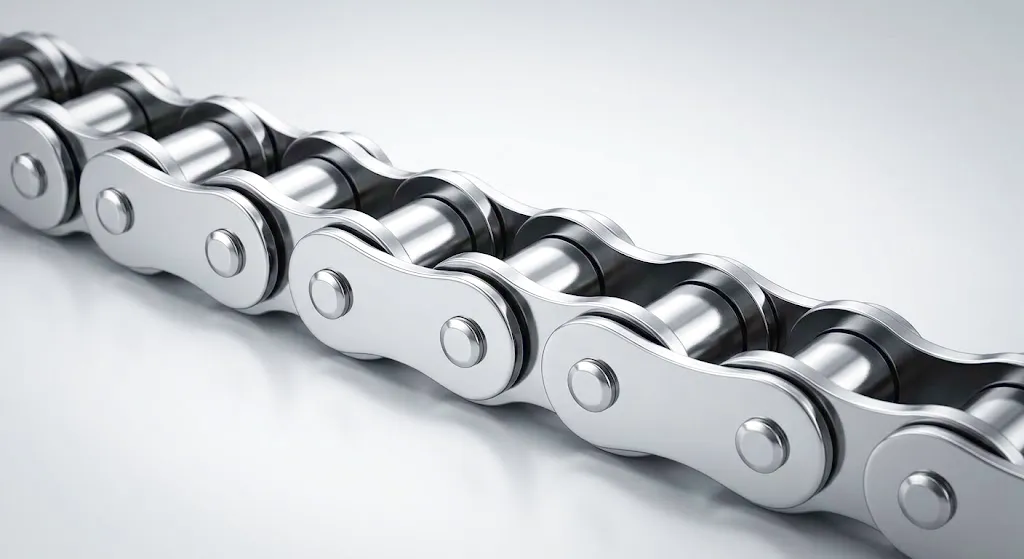
Whether you need standard roller chain shipped to a UK delivery address, or a fully custom-engineered specification for a demanding application in Sheffield, Birmingham, or anywhere else across the UK, Ever Power’s technical sales team is ready to provide expert guidance and a competitive quote.
📩 [email protected] — Request a Quote
जीजेडएल द्वारा संपादित