What Exactly Is Roller Chain Pitch — and How Is It Defined by Standard?
The Core Definition
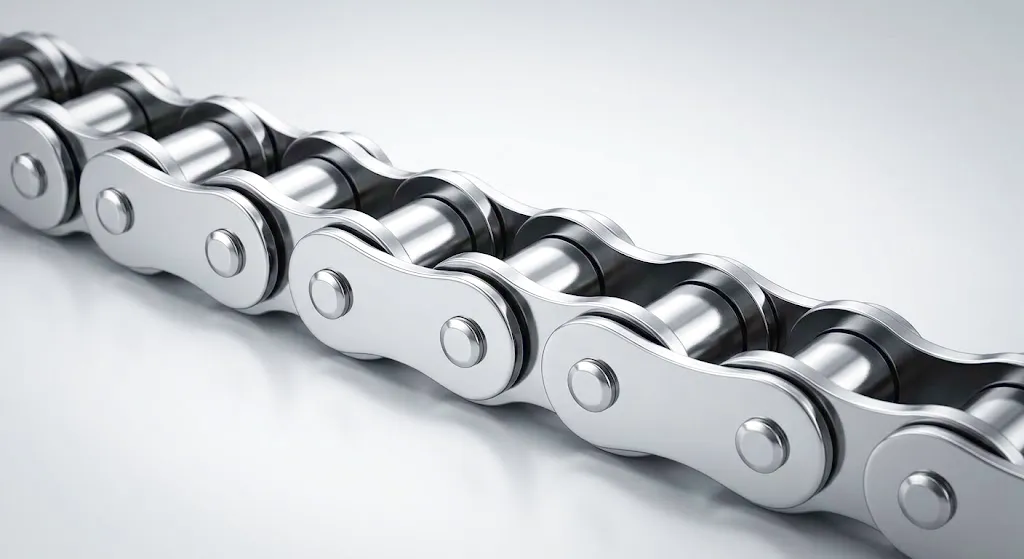
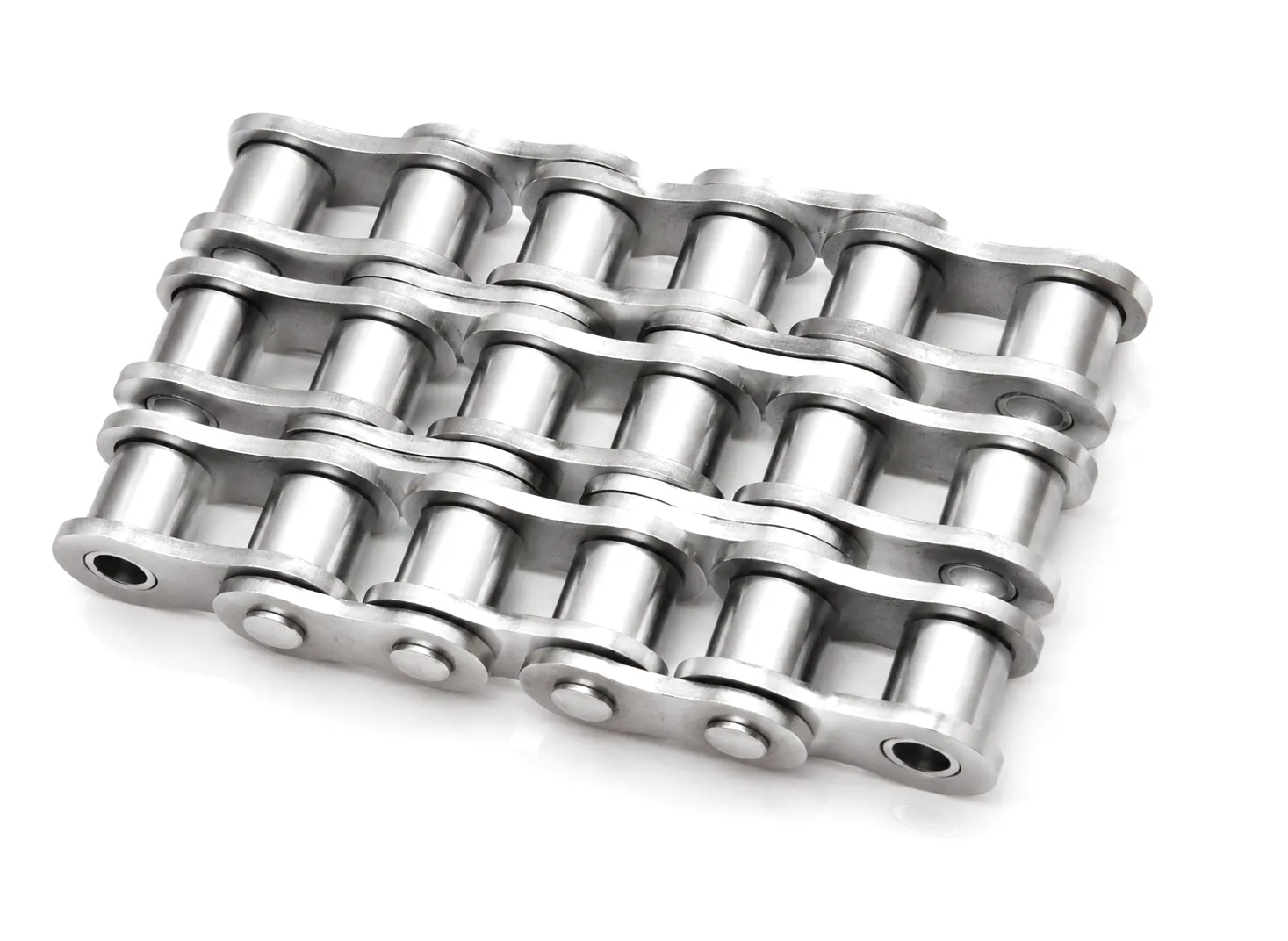
Pitch is the distance, measured in millimetres, from the centre of one connecting pin to the centre of the next. Under ISO 606 — which the UK aligns with through BS EN ISO 606 — standard pitches are defined at fixed increments: 6.35 mm (1/4″), 9.525 mm (3/8″), 12.7 mm (1/2″), 15.875 mm (5/8″), 19.05 mm (3/4″), 25.4 mm (1″), 31.75 mm (1-1/4″), 38.1 mm (1-1/2″) and beyond. The chain designation number is directly derived from the pitch: a 50-series chain carries a pitch of 5/8 inch, or 15.875 mm. An 80-series operates at 1 inch (25.4 mm). This seemingly simple number controls the geometry of every sprocket the chain must engage with — get it wrong and the chain cannot properly seat into the sprocket tooth form, leading to uneven load distribution and accelerated wear on both components simultaneously.
Why Standards Exist
The British Standards institution played a formative role in formalising roller chain pitch dimensions long before ISO harmonisation. The historical BS 228 standard governed simplex, duplex, and triplex roller chains for decades in UK manufacturing — and its influence is still felt in legacy equipment found in older Birmingham metalworking plants and Sheffield steel-handling facilities. The current harmonised standard BS EN ISO 606 ensures interoperability: a correctly measured and specified chain can be sourced from any ISO-compliant manufacturer worldwide without compromising system geometry. This is commercially vital for UK engineers who must maintain equipment using internationally sourced components, particularly post-Brexit, when supply chain flexibility has become more operationally critical than ever.
Pitch accuracy is not merely a manufacturing courtesy — it is a mechanical necessity. When the pitch of a roller chain deviates from nominal by as little as 0.1 mm over a ten-link span, the accumulated error is 1.0 mm, which is often enough to cause the rollers to miss the sprocket tooth root and ride on the tip instead. This tip-loading mode generates impact forces during each engagement cycle, multiplying stress on the pin–bush junction and dramatically shortening the fatigue life of the entire assembly. In high-speed applications exceeding 300 RPM — common in food-processing and packaging lines in the East Midlands — even minor pitch variation becomes a source of audible noise, measurable vibration, and progressive mechanical degradation. The cost of ignoring this is not simply the replacement chain: it is the scheduled maintenance window, the lost production, and in regulated industries, the potential compliance implications of unplanned downtime.
How to Measure Roller Chain Pitch: Methods, Tools, and Best Practice
Select Span Length
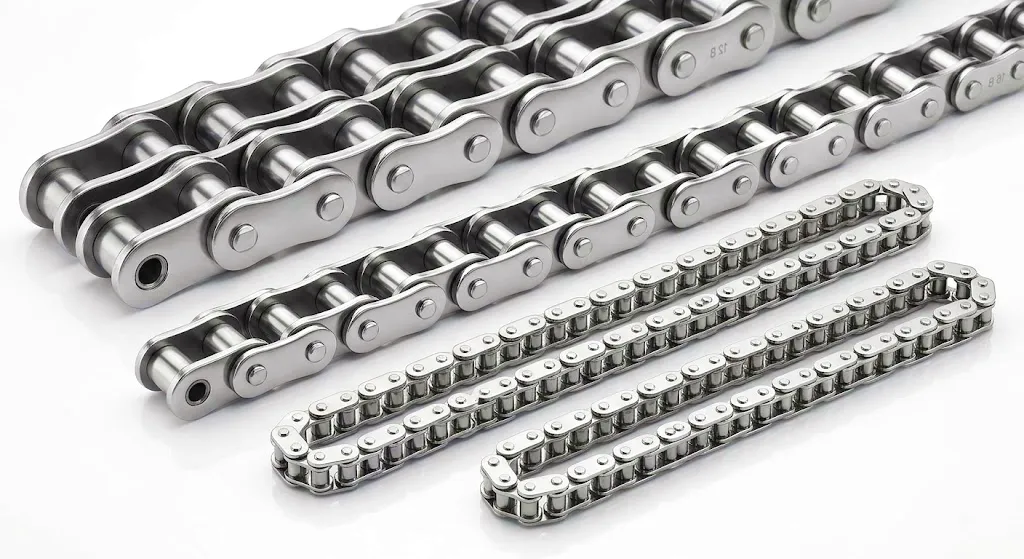
Always measure across a minimum of 20 pitches. Shorter spans amplify individual pin placement errors. For precision-critical applications, use 50-link spans.
Apply Consistent Tension
Slack chain gives false readings. Apply a reference tension load equivalent to roughly 2% of the chain’s minimum breaking load before measuring.
Control Temperature
Steel expands at approximately 12 × 10⁻⁶ per °C. Measure at reference temperature (20°C) or apply thermal correction factor for high-temperature installed chains.
Record and Calculate
Divide measured span by link count. Compare result against ISO tolerance band. Document findings for preventive maintenance records.
Working Principle: How a Roller Chain Transmits Power Through Engaged Pitch
Engagement Mechanics
Power transmission in a roller chain drive works through a deceptively elegant mechanism. The driving sprocket rotates, and its teeth engage successive rollers in the chain. Each roller, free to rotate on its bush, contacts the sprocket tooth flank and is drawn into the tooth root, where the tooth force acts tangentially to deliver torque. The roller’s ability to rotate during this engagement is what distinguishes a roller chain from a bush chain: it converts sliding friction into rolling friction at the sprocket–chain interface, reducing energy loss and wear rate simultaneously. This geometry means that pitch accuracy directly governs whether each roller seats correctly in the root circle of the sprocket — the precise point where force transfer efficiency is maximised. Incorrect pitch causes the roller to engage on the tooth flank rather than the root, shifting the contact point and introducing bending stresses that the sprocket tooth was not designed to carry.
The Chordal Effect
A fundamental behaviour intrinsic to all roller chain drives is the chordal action — also called the polygonal effect. Because the chain wraps around a sprocket as a polygon rather than a true circle, the linear velocity of the chain fluctuates sinusoidally as each successive roller enters engagement. The amplitude of this velocity fluctuation is inversely proportional to the number of sprocket teeth: a 12-tooth sprocket produces significantly greater velocity ripple than a 19-tooth sprocket running the same pitch. This is why minimum tooth counts are always specified in drive design. For UK machinery designers working on high-speed indexing applications — as common in Bristol aerospace component manufacturing or Coventry automotive assembly — understanding this dynamic behaviour is essential. Selecting a smaller pitch (and therefore a larger tooth-count sprocket for the same shaft geometry) is often the correct engineering trade-off for smoothness.
Core Materials: What Ever Power Roller Chains Are Actually Made From
नत्थी करना
Case-hardened alloy steel. Surface hardness 58–62 HRC. Core ductility preserved for fatigue resistance.
झाड़ी
Cold-drawn carbon steel tube, precision-sized for controlled interference fit. Internal bore tolerance ±0.005 mm.
रोलर
Through-hardened bearing steel. Outer diameter tolerance h5 class. Smooth rollover contact with sprocket tooth.
Inner / Outer Plates
High-carbon steel, punched and coined to h7 hole tolerance. Shot-peened on fatigue-critical models for compressive residual stress.
Specialty Variants
304 / 316L stainless for food-grade and corrosive environments. Nickel-plated for elevated moisture resistance. Plastic-coated rollers for low-noise applications.
Roller Chain Technical Performance Parameters — ISO 606 Reference Table
The table below provides the standardised technical data for commonly used roller chain series in UK industrial applications, cross-referenced against ISO 606 / BS EN ISO 606 specifications. These parameters are the baseline against which Ever Power’s quality control team measures every batch produced, and they represent the minimum data set any procurement engineer should verify when qualifying a new supplier. Tensile strength values shown are minimums; Ever Power chains routinely test 10–15% above these figures, reflecting the quality margin built into our manufacturing process.
| चेन नंबर | पिच (मिमी) | रोलर का व्यास (मिमी) | आंतरिक चौड़ाई (मिमी) | पिन का व्यास (मिमी) | Min. Tensile (kN) | वजन (किलोग्राम/मीटर) | विशिष्ट अनुप्रयोग |
|---|---|---|---|---|---|---|---|
| 25 | 6.35 | 3.30 | 3.18 | 2.31 | 3.14 | 0.10 | Light conveyor, instruments |
| 35 | 9.525 | 5.08 | 4.78 | 3.58 | 7.83 | 0.22 | Packaging, general machinery |
| 40 (08A) | 12.70 | 7.92 | 7.85 | 3.96 | 17.80 | 0.62 | Automotive, general industry |
| 50 (10A) | 15.875 | 10.16 | 9.40 | 5.08 | 21.80 | 0.92 | Food processing, agriculture |
| 60 (12A) | 19.05 | 11.91 | 12.57 | 5.94 | 31.30 | 1.33 | Conveyors, drives |
| 80 (16A) | 25.40 | 15.88 | 15.75 | 7.92 | 55.60 | 2.35 | Heavy industry, mining |
| 100 (20A) | 31.75 | 19.05 | 18.90 | 9.53 | 87.00 | 3.63 | Caterpillar OEM, heavy conveyors |
| 120 (24A) | 38.10 | 22.23 | 25.22 | 11.10 | 125.50 | 5.40 | Construction, forestry, large OEM |
Featured Products: High-Strength Caterpillar Replacement Chains
CAT REPLACEMENT
कैटरपिलर के लिए उच्च शक्ति वाली रोलर चेन 120HSP-00
The 120HSP-00 is an OEM-equivalent replacement roller chain for Caterpillar equipment operating at 38.1 mm pitch. Built to exceed standard ISO 606 minimum tensile values, this chain uses interference-fit press assembly for pin–plate joints and undergoes pre-loading during manufacture to close any initial stretch gap. Ideal for construction, quarrying, and bulk materials handling across UK sites from Yorkshire to Cornwall.
HIGH PERFORMANCE
कैटरपिलर के लिए उच्च शक्ति वाली रोलर चेन C100HSP-00
The C100HSP-00 operates at a 31.75 mm pitch (100-series) and is engineered for Caterpillar machines working in particularly demanding duty cycles — extended shift patterns, high-shock loading, and variable ambient temperatures typical of Scottish Highland construction projects and North Wales quarrying operations. The chain’s proprietary heat treatment profile produces a uniquely tough pin–bush interface, extending service intervals substantially compared to standard replacements.
Industrial Application Scenarios: Where Roller Chain Pitch Selection Is Mission-Critical
Core Technical Advantages of Ever Power Roller Chains
Pitch Accumulation Control
Ever Power’s assembly fixtures are calibrated to limit accumulated pitch error across any 12-link measuring span to within 50% of the ISO maximum tolerance — a tighter internal standard that ensures our chains will measure within spec even after re-testing with worn gauges in the field.
Advanced Heat Treatment
Our pins and bushings undergo a proprietary carburising cycle with controlled atmosphere to achieve consistent case depth of 0.4–0.7 mm. This prevents the shallow-case phenomenon that causes early spalling and dramatically shortens chain life in high-load applications like aggregate conveyors.
Pre-Loading at Assembly
Each chain is tensioned to a defined proof load — typically 15% of minimum breaking load — before despatch. This closes initial joint clearances and stabilises the pitch at its nominal value, so the chain enters service already past the break-in elongation phase.
Lubrication Retention Design
The precision bore–pin clearance maintained at Ever Power controls the oil film thickness within the bushing. Too much clearance and oil drains before reaching the working surfaces; too little and oil cannot enter. Getting this right is what separates a chain that lasts 8,000 hours from one that fails at 2,000.
100% Tensile Testing
Every chain length produced by Ever Power is proof-tested on a calibrated tensile bench before despatch. This is not a sampling-based QC process — every single assembly is tested. Breaking load certificates are available upon request for safety-critical applications and are supplied as standard for mining and construction chain orders above 50 m.
Ever Power Manufacturing Capabilities: Precision, Customisation, and Supply Chain Reliability
Need a Custom Specification?
Ever Power’s engineering team responds to technical enquiries within one working day. Send your application data — load, speed, centre distance, environment — and receive a specification recommendation with price indication.
Customer Success Story: Sheffield Aggregate Processing Plant
हमारे यूके के ग्राहक क्या कहते हैं
“The 120HSP-00 chains have genuinely transformed our maintenance schedule. We went from reactive replacements every 6–8 weeks to a planned 52-week cycle. The pitch consistency from batch to batch is the best we’ve seen from any supplier. When we put the gauge on, it reads correctly — every single time.”
“We specified a custom duplex chain with extended attachment tabs for our Birmingham automotive conveyor rebuild. Ever Power turned around the drawings within two days, answered every technical question clearly, and delivered the full order in four weeks. The chains were pre-loaded exactly as specified, and we saw zero break-in elongation in the first 500 operating hours.”
“We operate food-grade stainless conveyors in a wet environment — the pitch accuracy requirement is extremely strict because any position error at the sprocket engagement point translates into product misalignment on the packaging line. Ever Power’s stainless chains with 12.7 mm pitch were supplied with a dimensional report per batch, and they’ve met every measurement we’ve taken over 18 months of continuous operation.”
Recognising Pitch Wear: How to Know When Your Roller Chain Needs Replacing
Frequently Asked Questions — Roller Chain Pitch for UK Industry
Ready to Specify the Right Roller Chain for Your Application?
Ever Power’s engineering team is ready to review your application data, confirm the correct pitch specification, and provide a competitive quotation for ISO-certified roller chain delivered to any UK address. Send your enquiry now and receive a technical response within one working day.
✉ Request a Quote — [email protected]