What Exactly Is Roller Chain Pitch?
How to Measure Roller Chain Pitch: Step-by-Step Method
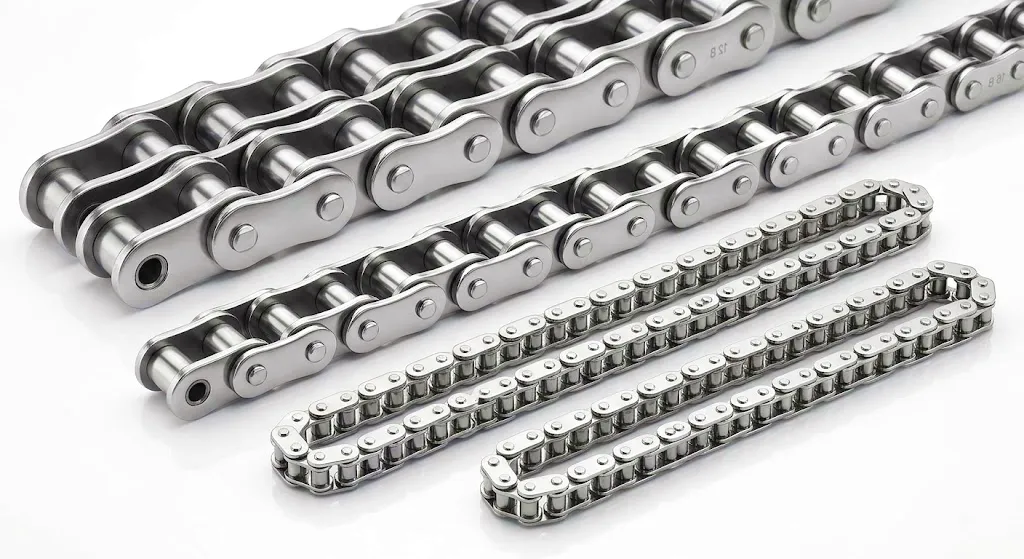
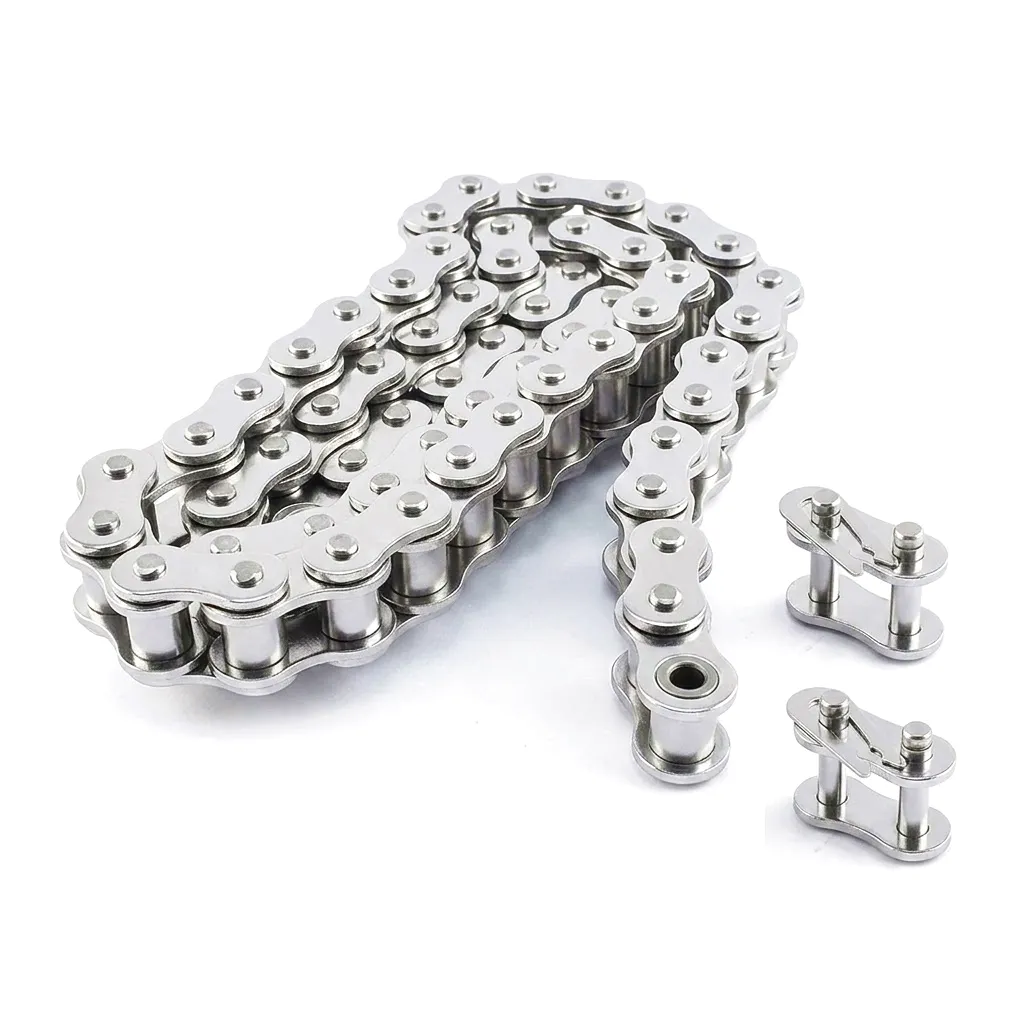
Lay the chain flat on a clean, level surface with moderate tension. Identify the centre of one roller pin — not the roller barrel itself but the pin passing through it. Pitch measurement must be taken from pin centre to pin centre, never from the outer edge of a roller to the outer edge of the next. Using the wrong reference points is the most common source of measurement error in maintenance workshops.
For standard industrial roller chain, a high-quality vernier calliper reading to 0.02 mm resolution is adequate. For precision conveyor chain used in pharmaceutical or electronics manufacturing environments, a digital gauge with 0.01 mm resolution is recommended. Place the calliper jaws at the dead centre of each pin. If the chain has been in service, clean the pins thoroughly with a degreasing agent before measuring, as built-up lubricant and debris can add false millimetres to your reading and lead to incorrect specification.
A single-link measurement is prone to error, especially on a worn chain where individual links may have elongated unevenly. Industry best practice — recommended by engineers across UK maintenance operations from the Midlands to the Northeast — is to measure across a span of 10 to 20 links, then divide the total by the number of pitches in that span. This averaging method eliminates local wear anomalies and provides a reliable actual-pitch value. If the measured pitch exceeds the nominal pitch by more than 1.5%, the chain should be replaced immediately regardless of apparent visual condition.
Once you have your average measured pitch, cross-reference it against the BS ISO 606 or ANSI B29.1 standard pitch table. This step confirms both the chain series designation (e.g., 08B, 10B, 12B in the British Standard system, or #40, #50, #60 in ANSI notation) and the maximum allowable wear elongation before replacement is necessary. British Standard and ANSI designations are not interchangeable — the geometric profiles of the rollers and inner link plates differ between systems, and mixing standards on the same drive is a leading cause of premature failure in UK industrial facilities.
Working Principle: How Roller Chain Transmits Power
Core Materials in Precision Roller Chain Manufacturing
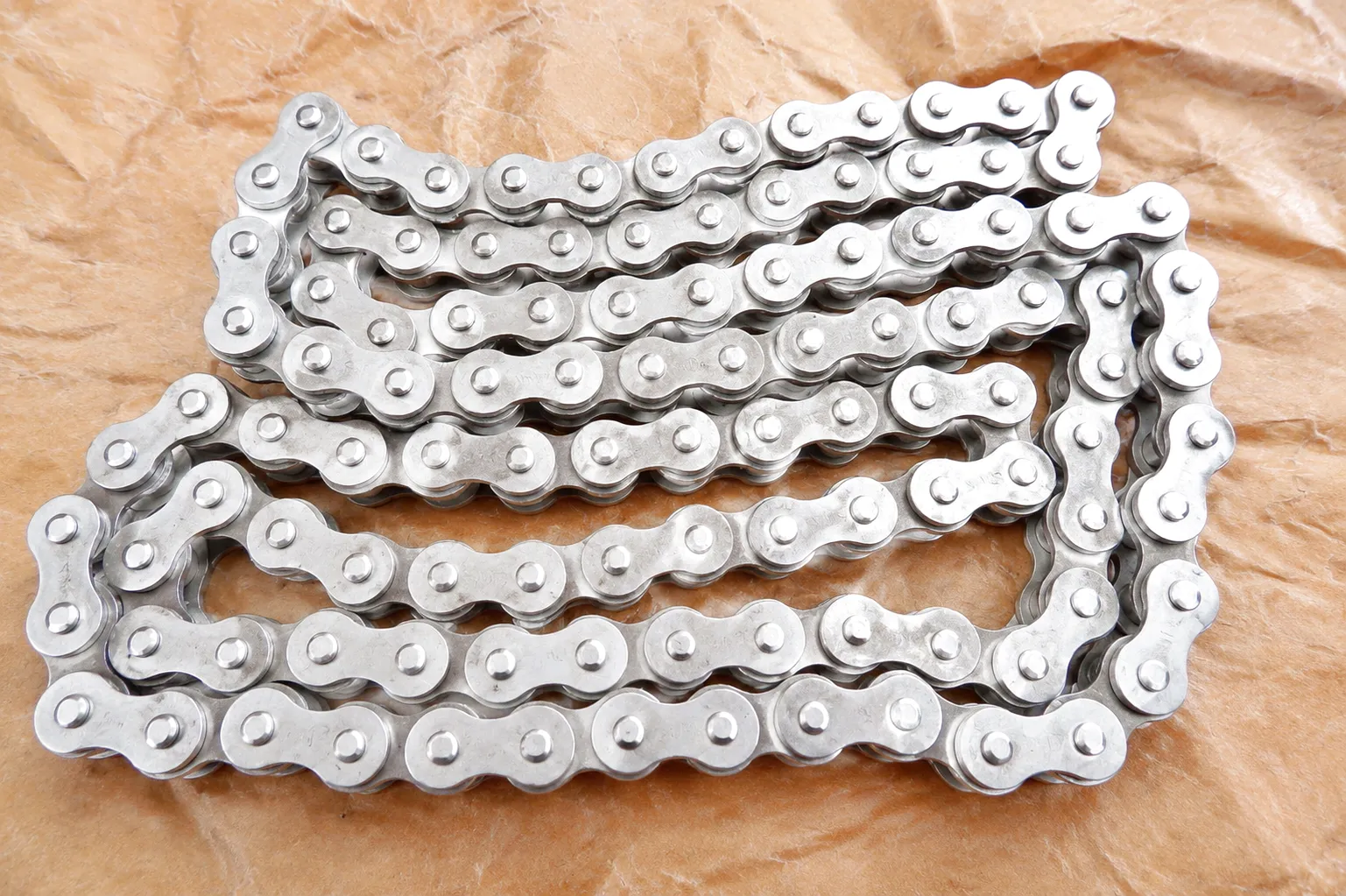
The most widely used material for standard industrial roller chain. SCM415 is a chromium-molybdenum alloy steel used for pins and bushings, providing a case-hardened surface with a tough core. 1045 medium-carbon steel forms outer and inner link plates, offering an ideal balance between tensile strength (typically 600 to 800 MPa) and fatigue resistance. These materials allow standard roller chain to handle tensile loads suitable for the vast majority of UK manufacturing and material handling applications at competitive cost.
Grade 304 and 316L stainless steel roller chain is the material of choice for food and beverage production lines, pharmaceutical packaging equipment, and marine or offshore applications — all sectors with a significant presence along the UK coastline and in the Southeast and Wales. 316L in particular offers superior resistance to chloride-induced corrosion and can withstand regular wash-down with cleaning agents, making it indispensable for hygiene-critical environments where carbon steel would rapidly corrode and contaminate product.
Where moderate corrosion resistance is required at a lower price point than full stainless, nickel-plated or zinc-electroplated roller chain provides an effective solution. These surface treatments are commonly specified for outdoor agricultural machinery, general-purpose conveyor systems exposed to dust and light moisture, and automotive components in the UK Midlands manufacturing corridor. The plating adds 10 to 20 micrometres of protective coating without altering the critical pitch dimensions, preserving sprocket compatibility.
In sealed or permanently lubricated roller chain variants, sintered oil-impregnated bushings are pressed onto the pins. These components slowly release lubricant under the heat of operation, maintaining adequate film thickness at the pin-bushing interface for extended service intervals. This design is particularly valuable in overhead conveyor systems, automated assembly lines, and packaging machinery where re-lubrication access is restricted — a common scenario in modern integrated manufacturing facilities across the UK’s growing logistics and fulfilment sector.
Core Technical Advantages of Industrial Roller Chain
Well-designed roller chain achieves power transmission efficiency of 97 to 99%, significantly outperforming belt drives (typically 92 to 96%) and comparable to gear drives, but at a fraction of the manufacturing cost and with far simpler installation and adjustment. This efficiency advantage is meaningful at scale — across hundreds of conveyor drives in a large distribution centre, the energy savings over a year are substantial. Many UK facilities transitioning to more sustainable operations are specifying roller chain drives specifically for this efficiency benefit.
Unlike friction drives such as V-belts or flat belts, roller chain transmits power through a positive mechanical engagement with the sprocket teeth. This means the speed ratio between driving and driven shafts remains absolutely constant regardless of load variations, temperature, or surface conditions. In precision timing applications — synchronised packaging lines, indexing conveyors, and robotic material handling — this slip-free characteristic is not merely advantageous but operationally essential. Roller chain is the only practical choice when position accuracy and repeatable motion matter.
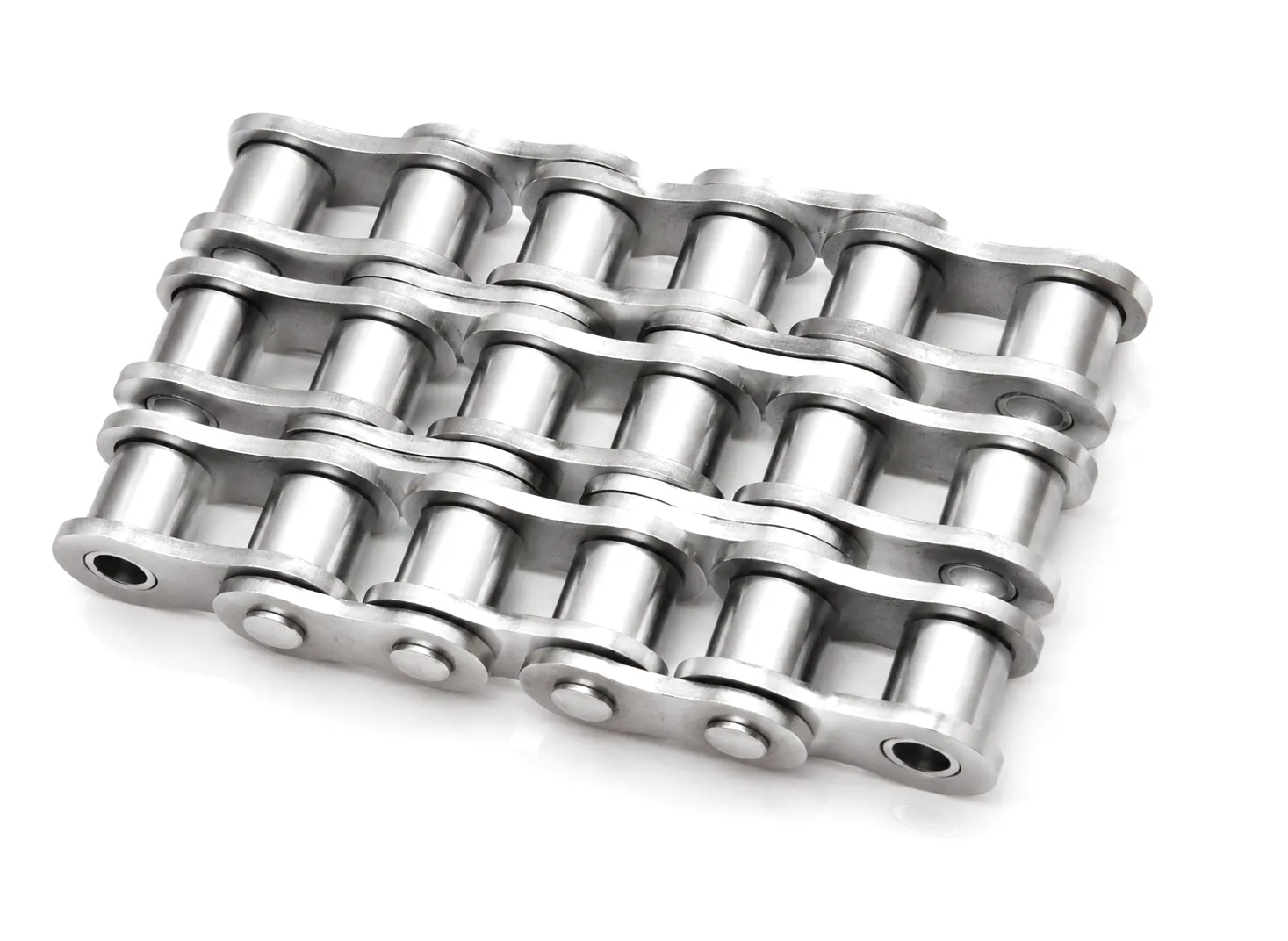
Roller chain is inherently modular. When a single strand is insufficient for the required torque, duplex (double strand) or triplex (triple strand) configurations multiply the load capacity without requiring a larger pitch. This flexibility allows engineers to fine-tune their drive design within existing spatial constraints — particularly valuable in the densely packed production environments common in UK automotive and aerospace component manufacturing, where retrofitting a heavier chain series might require modifications to frame, bearing housings, and shaft centres that a multi-strand solution of the same pitch avoids entirely.
With correct pitch selection, proper lubrication, and appropriate tension, industrial roller chain routinely achieves service lives of 15,000 hours or more in continuous duty applications. Case-hardened pins and bushings resist wear even under heavy cyclic loading, and the distributed contact between multiple links and sprocket teeth shares the load, preventing stress concentration. British Standard chains built to BS ISO 606 specifications are independently verified to meet these performance benchmarks, giving UK engineers and procurement managers documented confidence in the components they specify for critical infrastructure.
Featured Products: High Strength Roller Chain for Caterpillar Applications
Engineered for the demanding pitch requirements of Caterpillar heavy equipment, the 120HSP-00 series delivers exceptional tensile strength and fatigue resistance. The chain uses case-hardened alloy steel throughout its construction, with a precisely controlled pitch that ensures perfect meshing with Cat sprocket profiles even after extended hours of high-load operation. Ideal for UK construction fleets, quarry machinery, and heavy civil engineering equipment.
The C100HSP-00 addresses the specific pitch geometry of smaller Caterpillar undercarriage and auxiliary drive systems. Its compact cross-section maintains high strength-to-weight characteristics, making it suited to mobile plant equipment where weight reduction directly impacts fuel efficiency and operating cost. UK plant hire companies and infrastructure contractors running Caterpillar fleets will find this chain delivers the precision pitch compliance needed for reliable long-term performance in demanding ground conditions.
Roller Chain Technical Performance Parameters
The following table presents standard performance parameters across the most commonly specified British Standard (BS ISO 606) roller chain sizes. All values are representative of quality precision-manufactured chain and may vary slightly between manufacturers.
All values per BS ISO 606. Strength figures indicate minimum breaking load. Max. allowable load = safe working load for dynamic applications.
Industrial Application Scenarios Across UK Manufacturing
The West Midlands automotive corridor — encompassing Birmingham, Coventry, and Wolverhampton — remains one of Europe’s most concentrated vehicle manufacturing and components hubs. Roller chain drives here power stamping press synchronisation systems, body-in-white conveyor lines, and engine assembly transfers. The positive drive characteristic is critical: any slippage on a synchronised assembly line creates mis-index errors that cascade into quality failures and costly rework. 10B and 12B pitch chains in simplex and duplex configurations dominate press room applications.
Sheffield’s steel and speciality metals industry, still a global benchmark for high-grade alloys and forgings, relies heavily on roller chain in its rolling mill and furnace charging equipment. The extreme thermal and mechanical environments of these facilities demand chain manufactured from high-alloy steel with superior heat tolerance and consistently maintained pitch. Wear monitoring programmes in Sheffield mills typically track pitch elongation monthly using the multi-link measurement technique, and reputable chain suppliers can provide certified test data confirming dimensional compliance at delivery.
Across the arable flatlands of Lincolnshire, Nottinghamshire, and Cambridgeshire, agricultural roller chain powers grain augers, combine header drives, baler mechanisms, and straw walkers. Agricultural chain (typically to AS/NZS 4347 and corresponding BS standards) uses a larger pitch relative to strand width, trading speed for load capacity in the slow-to-medium speed, high-torque environments typical of harvesting equipment. Correct pitch measurement here is especially important at the start of harvest season, when chains that have rested all winter may have stiffened or developed uneven elongation that would cause engagement problems under load.
The UK’s food processing and pharmaceutical manufacturing sectors — with major facilities concentrated around Swindon, Cambridge, and the Thames Valley — demand stainless steel roller chain with close pitch control and validated surface finish. In these environments, roller chain is used in tablet press drives, blister packaging lines, and conveyor systems operating under HACCP-regulated hygiene conditions. Pitch accuracy directly affects the timing of dosing and inspection stations; any cumulative positional drift from pitch error translates to inspection misalignment and yield loss in high-speed tablet or capsule filling lines.
At major UK port facilities including Southampton and Felixstowe, roller chain provides the core drive mechanism for overhead gantry cranes, container spreader lifts, and ship-to-shore conveyor systems. The marine coastal environment demands nickel-plated or stainless steel variants with pitch tolerances that account for the thermal expansion typical in outdoor environments ranging from -10°C in winter to +35°C during summer peak operations. Chain specification engineers at these facilities work to ISO/BS standards and expect suppliers to provide full material certificates and dimensional inspection reports on delivery.
The UK’s rapidly expanding e-commerce fulfilment and logistics sector, concentrated in purpose-built distribution parks in Milton Keynes, Northampton, and along the M1 corridor, operates some of the country’s most intensive automated conveyor and sortation systems. In these facilities, roller chain runs 20 to 24 hours per day, 360+ days per year, powering vertical lift modules, crossbelt sorters, and divert mechanisms. The combination of near-continuous duty and high annual throughput means pitch control is a maintenance KPI tracked in real time using laser measurement devices, and chain replacement is managed on a predictive basis to avoid unplanned stoppages during peak trading periods.
Customer Success: Sheffield Steel Components & the 16B Pitch Challenge
Meridian Forge & Fabrication, a Sheffield-based precision steel components manufacturer supplying the UK rail and civil engineering sectors, was experiencing recurring conveyor chain failures on their billets transfer line. The facility runs two continuous annealing furnace conveyors, each carrying steel billets at temperatures up to 850°C at the workpiece surface. Their existing 16B roller chain, sourced from a European distributor, was showing visible pitch elongation within six to eight weeks of installation — far below the expected 12-month service life for this application.
The Meridian engineering team had been measuring pitch using the single-link method, which masked the uneven elongation that was actually occurring in the high-temperature zone of the chain path. After consulting with Ever Power’s technical team and adopting the 10-link averaging measurement protocol, the true extent of thermal-cycling-driven wear became clear. The pitch was exceeding the 1.5% elongation threshold in the central section of the furnace traverse after just four weeks — even though the chain appeared visually intact.
Ever Power engineered a modified 16B-1 chain with upgraded alloy steel pins manufactured from X40CrMoV5-1 hot-work tool steel, providing substantially higher tempering resistance and surface hardness retention at sustained elevated temperatures. The inner link plates were upgraded to 30CrMnSi and given a salt-bath nitriding treatment to improve surface wear resistance without embrittlement. Pin-to-bushing clearances were tightened beyond standard BS ISO 606 requirements to reduce the rate of lubricant film breakdown at operating temperature.
The result: the Ever Power custom chain achieved 13 months of service before pitch elongation reached the 1.5% replacement threshold — more than double the previous chain’s performance. Meridian Forge estimated an annual saving of approximately £28,000 in chain replacement parts and maintenance labour costs, plus a significant reduction in unplanned production downtime that had previously caused late deliveries to key rail infrastructure clients.
英国のお客様の声
“The pitch accuracy on Ever Power’s custom 16B chain is genuinely impressive. We’ve been tracking elongation weekly and it’s still well inside the replacement threshold at month nine. For a furnace conveyor application like ours, that’s exceptional performance. Their technical team understood our thermal environment immediately and proposed the right pin material without us having to specify it.”
“We switched our pharmaceutical packaging line in Swindon to Ever Power’s 316L stainless 10B chain after two years of frustrating performance from our previous supplier. The dimensional consistency is noticeably better — our sprocket engagement noise dropped immediately on installation and our wash-down cycle has had zero impact on the chain surface six months in. The material certification documentation they provided satisfied our QA team without any back-and-forth.”
“We run three Caterpillar D8 graders on a major motorway widening project near Birmingham and needed replacement 120HSP-00 chain at short notice after one undercarriage failure. Ever Power confirmed stock, despatched next working day, and the chain arrived correctly specified with no ambiguity about pitch matching. That’s exactly the kind of supply reliability you need when a machine is sitting idle on a contract site.”
英国におけるローラーチェーンに関するよくある質問
The most reliable approach is to clean the chain thoroughly to remove built-up lubricant and debris, then use a digital vernier calliper to measure the centre-to-centre distance across 10 to 20 consecutive links. Divide the total by the number of pitches in your span to get the actual average pitch. Compare this against the nominal pitch in the BS ISO 606 table — if elongation exceeds 1.5% of the nominal value, the chain should be replaced regardless of visual appearance.
Custom roller chain pricing depends on pitch size, material specification, quantity, and any additional surface treatments or attachment modifications required. Standard BS ISO 606 chain in carbon steel is generally available at competitive per-metre rates with short lead times. Custom or non-standard configurations require a formal quotation — contacting Ever Power directly at [email protected] allows the technical team to provide a competitive quote with documented lead time and delivery to your UK location within 3 to 5 working days for standard specifications.
For HACCP-regulated food processing applications in the UK, the most appropriate choice is typically a 316L stainless steel roller chain in 08B, 10B, or 12B pitch depending on your load and speed requirements. 316L offers superior resistance to chlorinated cleaning agents and passes direct product contact regulations in most UK and EU food safety frameworks. Self-lubricating sealed variants eliminate the risk of lubricant contamination. Always confirm with your hygiene officer that the chain’s material certificates and surface finish meet your specific HACCP control point requirements.
Ever Power supplies roller chain directly to UK customers including those in Birmingham and the wider West Midlands manufacturing region. Standard BS chain sizes are held in stock and can be despatched for next-day UK delivery. For bulk order enquiries or urgent replacement requirements, contact the sales team directly at [email protected] to discuss pricing tiers, stock availability, and expedited delivery arrangements. Volume discounts are available for scheduled blanket orders placed by regular customers.
In heavy-duty steel processing environments with elevated temperatures, abrasive dust, and high shock loads — such as those found in Sheffield’s rolling mills and forge shops — roller chain replacement intervals should be based on measured pitch elongation rather than time alone. Conduct multi-link pitch measurements monthly. Replace when pitch elongation reaches 1.5% of nominal. Under severe thermal or impact conditions, this threshold may be reached in as little as 8 to 12 weeks. Using an upgraded alloy steel or hot-work pin material, as Ever Power can supply, typically extends service intervals by 80 to 150% in these applications.
It matters significantly. British Standard (BS ISO 606) and ANSI roller chain share some nominal pitch values — both have a 1/2-inch pitch product, for example — but they differ in roller diameter, inner link plate width, and overall chain width. A BS 08B-1 chain and an ANSI #40 chain both have a 12.7 mm pitch but are not interchangeable on each other’s sprockets. UK machinery built to British standards should always use BS-specified chain. Fitting ANSI chain to a BS sprocket (or vice versa) creates uneven tooth engagement, accelerated side-plate wear, and a high risk of roller fatigue failure within a short operating period.
Whether you need standard BS stock chain for immediate despatch, a custom-engineered solution for a challenging application, or technical support identifying the correct pitch and material for your machinery — Ever Power’s team is ready to assist.
gzlによる編集