Roller Chain Breaking Load vs. Working Load: Key Differences Engineers Should Understand
A definitive technical reference for mechanical engineers, procurement managers, and plant operators across UK manufacturing sectors.
Power Engineering
UK Industrial Standards
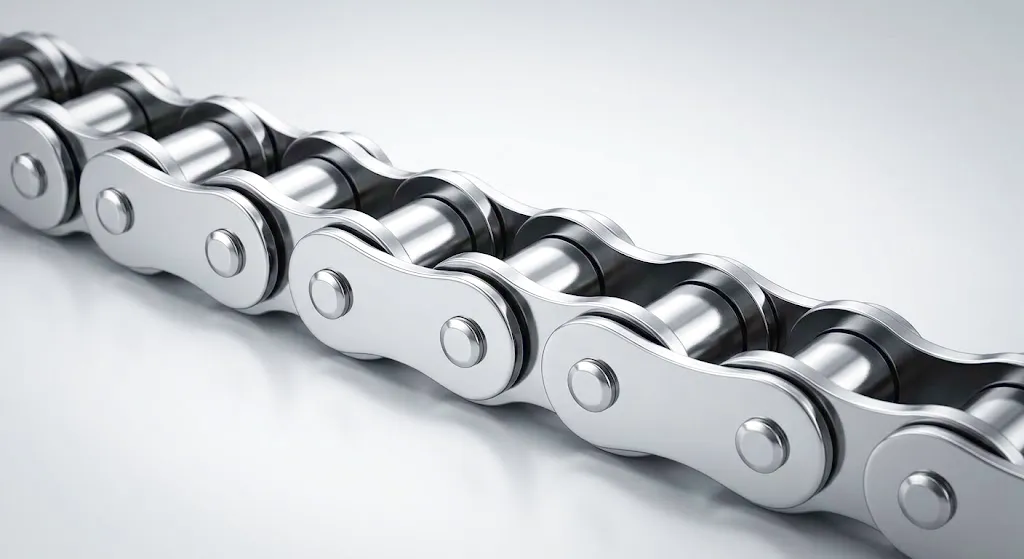
Walk through any heavy fabrication plant in Birmingham or Sheffield and you will find roller chains transferring power in applications that demand absolute mechanical reliability. These chains are not passive components — they are engineered systems that store, transmit, and absorb enormous mechanical energy. Yet one of the most persistently misunderstood topics in drivetrain specification is the relationship between breaking load and working load. Confusing the two, or applying an inadequate safety factor, has caused catastrophic equipment failures across the UK manufacturing sector. Understanding this distinction is not an academic exercise; it is a foundational engineering responsibility.
Breaking load — also referred to as minimum tensile strength — is the point at which a roller chain experiences structural failure under a static, axial pull test conducted under controlled laboratory conditions. It is the number printed on product datasheets and certified by ISO 606 or BS/ISO standards. Working load, by contrast, is the actual maximum dynamic load the chain should be subjected to during normal operation, accounting for shock, vibration, speed, lubrication quality, and environmental exposure. The gap between these two figures, expressed as the service factor or safety factor, is the engineering margin that separates a reliable drivetrain from an unpredictable one.
How Roller Chain Power Transmission Actually Works
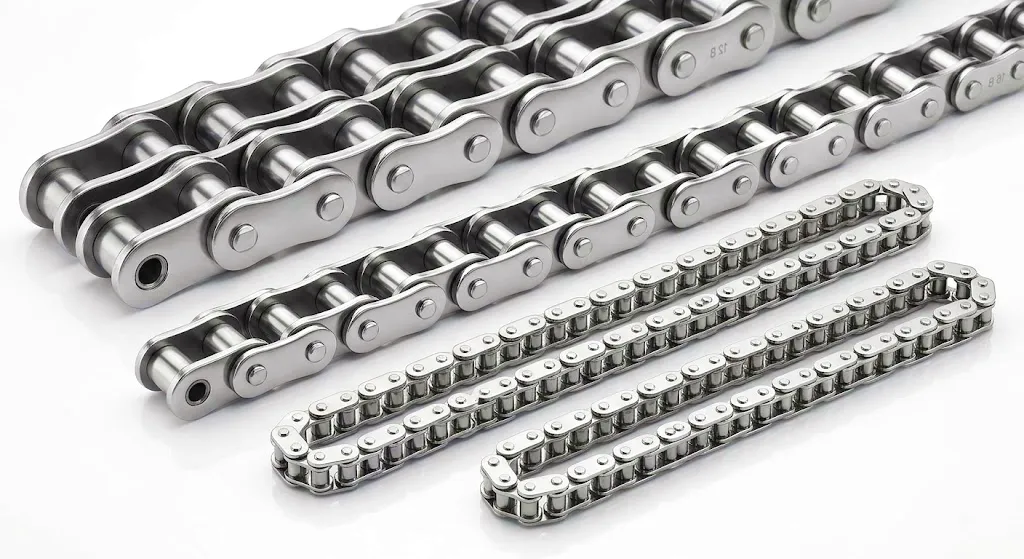
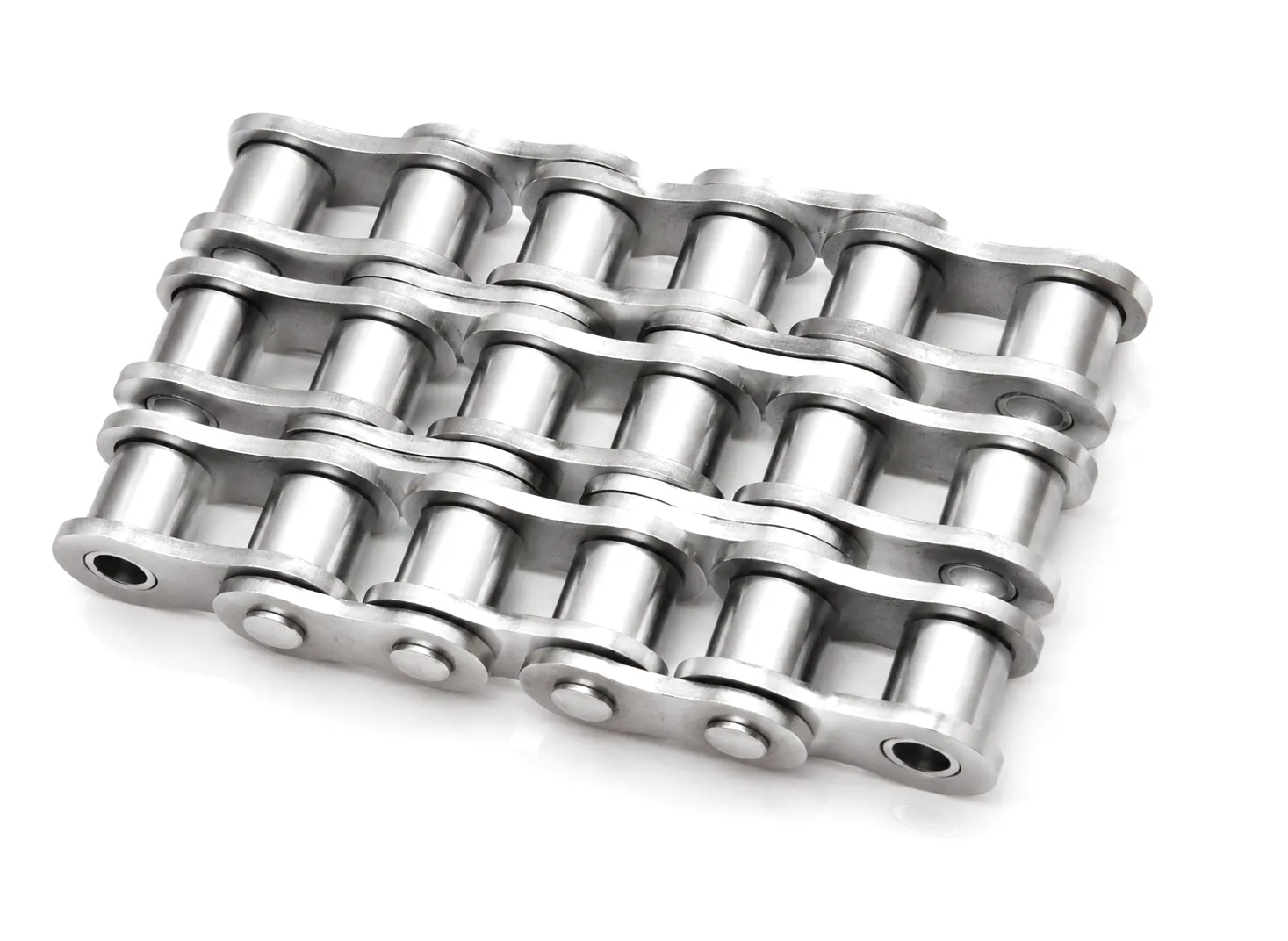
A roller chain transmits rotary motion and torque between two or more sprockets by engaging hardened rollers seated in precision link plates with the sprocket teeth. Each chain link consists of inner plates, outer plates, a pin, a bushing, and a freely rotating roller. When the sprocket tooth engages the roller, the load is distributed across the contact surface of the roller rather than being concentrated at a single point — a fundamental advantage over silent chain or flat belt systems. This rolling engagement dramatically reduces friction and extends both chain and sprocket life, provided the chain is operating within its designed load envelope.
The tension in a running roller chain is not uniform across its entire length. The tight side — the loaded strand pulling away from the driving sprocket — carries the working tension, which equals the transmitted power load plus centrifugal tension generated by the chain’s own mass at speed. The slack side carries only the catenary sag tension. Understanding this asymmetric tension distribution is essential for any engineer performing chain selection calculations, because it is the tight-side tension that approaches the working load limit and that must always be held within the specified service factor margin relative to the published breaking load.
The minimum force at which the chain fails during a static, monotonically increasing axial pull test. Governed by ISO 606 and expressed in kilonewtons (kN). This is a certification value, not an operational target.
The maximum permissible dynamic load during service. Calculated as: Working Load = Breaking Load ÷ Service Factor. For shock-heavy UK industrial environments, a service factor of 6 to 8 is common.
A multiplier applied to account for shock loading, speed variation, misalignment, environmental contamination, and maintenance intervals. Never select a chain without validating the service factor for your specific duty cycle.
Core Materials: Why Metallurgy Determines Load Capacity
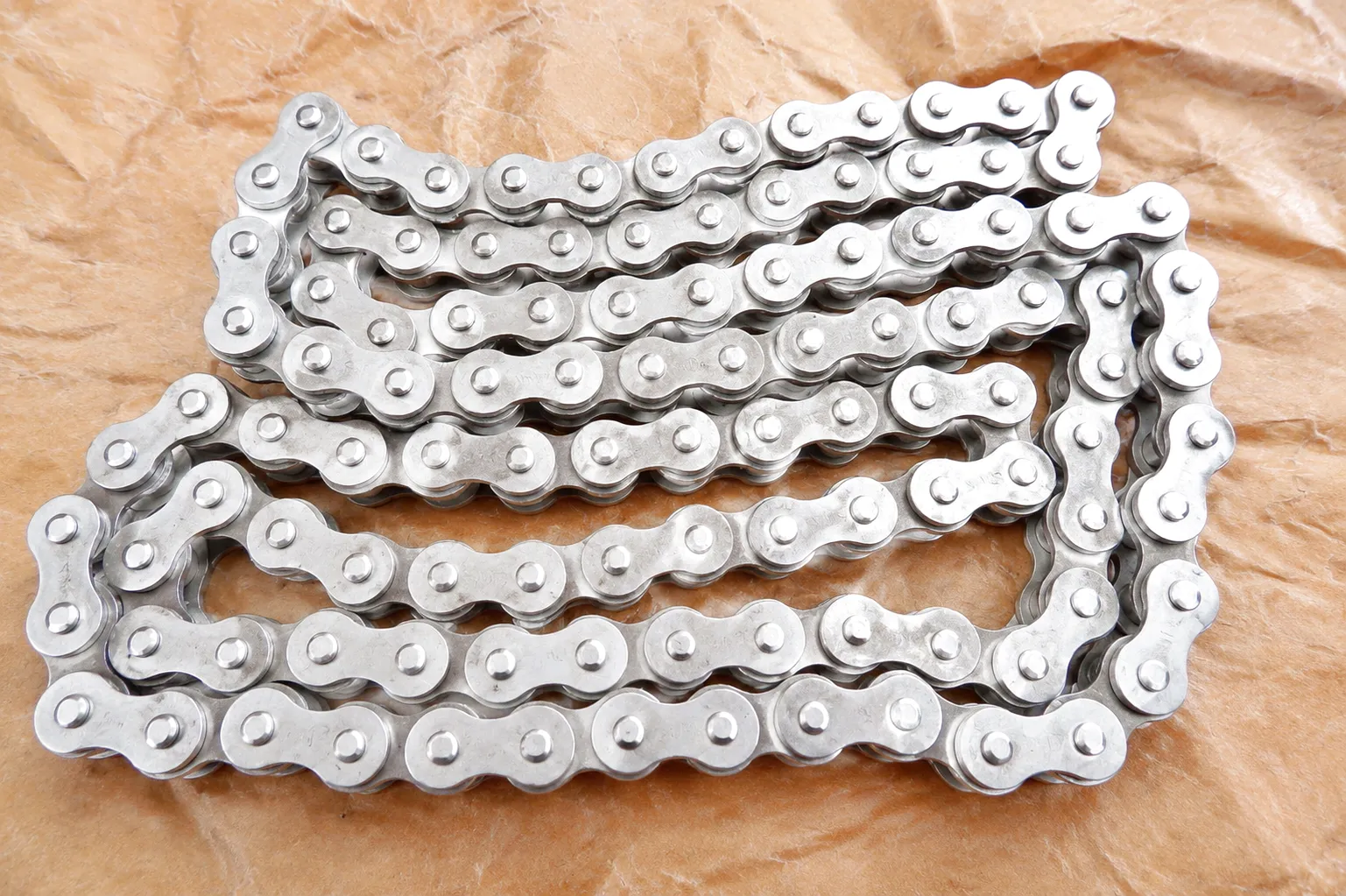
The breaking load of a roller chain is not an arbitrary figure — it is a direct consequence of the material grade, heat treatment protocol, and precision tolerances applied during manufacture. Link plates are predominantly produced from medium-carbon or alloy steel grades such as 45# carbon steel, 40Cr, or case-hardened 20MnCr5 for high-strength variants. The plate geometry, particularly the waist width and transition radii, is engineered to distribute stress concentration away from the pin-hole bore, which is historically the highest-stress point in the chain assembly.
Pins are manufactured from case-hardened alloy steel — typically 20CrMo or 20CrMnTi — carburised to a surface hardness of 58–62 HRC while maintaining a tough, ductile core that resists fatigue fracture. Bushings and rollers undergo similar induction hardening or carbonitriding processes to maximise wear resistance at the contact interface without sacrificing impact toughness. In demanding UK applications such as quarrying machinery in the Peak District or steel-rolling conveyors in the Tees Valley, these material choices directly determine how many million cycles of service a roller chain delivers before reaching its fatigue endurance limit.
Stainless steel grades — typically 304 or 316 — are specified in food processing facilities across Yorkshire and the Midlands, where corrosion resistance outweighs the marginal strength reduction compared to alloy steel variants. Nickel-plated and zinc-plated carbon steel chains occupy a cost-effective middle ground for general industrial environments where occasional moisture exposure is anticipated but not sustained immersion. The selection of coating or material grade has a computable effect on both breaking load and fatigue life, and Ever Power’s engineering team provides material certification documentation aligned with BSEN and ISO requirements for all supplied chains.
Standard industrial workhorse. High tensile strength, good fatigue resistance, cost-effective for the majority of UK manufacturing, construction, and materials handling applications.
Case-hardened for elevated breaking loads. Used in heavy-duty and agricultural drive systems, where dynamic shock loading from uneven terrain or sudden torque spikes is routine.
Preferred for food-grade, pharmaceutical, and marine environments. Breaking loads are lower than equivalent alloy steel chains; working load calculations must reflect this when specifying for corrosive environments.
Key Technical Advantages of High-Performance Roller Chains
Modern precision roller chains deliver performance advantages that extend well beyond simple power transmission. When properly selected and maintained, they provide a combination of efficiency, reliability, and adaptability that few other transmission technologies can match across the wide range of operating conditions found in UK industry, from automated packaging lines in Leeds to heavy mineral extraction equipment in South Wales.
Precision roller chains achieve power transmission efficiencies of 97–99% under correctly lubricated conditions. The rolling contact between roller and sprocket tooth, rather than sliding contact, dramatically reduces friction losses compared with flat belt or plain chain systems. Over a full production shift, this efficiency margin translates into measurable energy savings — a consideration of growing importance as UK manufacturers respond to escalating energy costs.
Multi-strand and duplex roller chain configurations distribute the transmitted load across multiple parallel strands, allowing roller chain assemblies to handle working loads far in excess of what a single-strand chain of the same pitch could manage. This architecture makes roller chains ideally suited to high-torque, low-speed drives found in paper mills, cement plants, and heavy fabrication workshops throughout the North of England.
High-grade roller chains manufactured with shot-peened link plates and precision interference-fit pin assembly demonstrate fatigue lives exceeding 15,000 operating hours under rated working loads. The shot-peening process introduces beneficial compressive residual stresses at the plate surfaces, which counteract the tensile stresses generated during dynamic loading and substantially extend the fatigue endurance limit of the assembly.
ISO-compliant roller chains offer dimensional interchangeability across suppliers — a significant operational advantage for UK plant maintenance teams managing multi-supplier drivetrain inventories. Chains conforming to BS ISO 606 pitch-dimension standards can be used with standard sprockets without modification, reducing downtime and simplifying spare parts procurement across distributed manufacturing sites.
Roller Chain Technical & Performance Parameters
The table below provides reference technical parameters for commonly specified ANSI and BS/ISO roller chain sizes. Breaking load figures represent minimum certified tensile strengths per ISO 606. Working loads are calculated at a conservative service factor of 7 — appropriate for moderate shock in UK industrial environments. Engineers should apply application-specific service factors as required by their drivetrain design conditions.
| Chain Standard | Hatve (mm) | Pim Çapı (mm) | Silindir Çapı (mm) | Breaking Load (kN) | Working Load @ SF7 (kN) | Maksimum Hız (m/s) | Malzeme Kalitesi |
|---|---|---|---|---|---|---|---|
| 06B-1 (BS) | 9.525 | 3.28 | 6.35 | 8.9 | 1.27 | 18 | Karbon Çelik |
| 08B-1 (BS) | 12.700 | 4.45 | 8.51 | 17.8 | 2.54 | 16 | Alaşımlı Çelik |
| 10B-1 (BS) | 15.875 | 5.08 | 10.16 | 22.2 | 3.17 | 14 | Alaşımlı Çelik |
| 16B-1 (BS) | 25.400 | 8.28 | 17.02 | 60.0 | 8.57 | 11 | Alaşımlı Çelik |
| 24B-1 (BS) | 38.100 | 14.63 | 25.40 | 160.0 | 22.86 | 8 | Alloy Steel CH |
| ANSI #80 / 16A | 25.400 | 7.94 | 15.88 | 55.6 | 7.94 | 12 | Alaşımlı Çelik |
| ANSI #120 / 24A-1 | 38.100 | 11.10 | 22.23 | 125.0 | 17.86 | 9 | Alloy Steel CH |
CH = Case-hardened. SF7 = Service Factor 7. Data based on ISO 606 certification standards. Always apply application-specific service factors.
Öne Çıkan Yüksek Mukavemetli Makaralı Zincir Ürünleri
For construction machinery, mining equipment, and heavy civil engineering applications — where shock loading regularly pushes roller chains toward their working load limits — Ever Power’s High-Strength series is engineered to deliver consistently higher breaking loads and extended fatigue life compared to standard commercial grade chains. These chains are manufactured under stringent quality protocols and are independently tested to confirm breaking load certification.
The 120HSP-00 is purpose-built for Caterpillar machinery drive applications where the standard chain breaking load is insufficient for the dynamic load spectrum encountered in continuous earthmoving or quarrying operations. It features enhanced pin-to-plate interference fit, extended heat treatment cycles, and high-precision roller seating for consistent engagement under extreme field conditions encountered across UK construction sites from the Lake District to the Highlands.
The C100HSP-00 addresses the demanding load profiles of mid-range Caterpillar machine drivetrains, offering a breaking load specification that provides the required safety margin even under worst-case shock loading scenarios. The chain undergoes 100% assembly inspection and load verification before dispatch, ensuring that every unit shipped to UK customers meets or exceeds its rated breaking load. Extended lubrication-retaining link geometry further reduces maintenance frequency in remote or difficult-access plant locations.
Birleşik Krallık Sektörlerinde Endüstriyel Uygulama Senaryoları
The roller chain’s combination of high breaking load, reliable working load predictability, and dimensional standardisation makes it the transmission component of choice across virtually every sector of UK heavy industry. Choosing the correct chain for each application requires matching the chain’s working load envelope — derived from its breaking load and appropriate service factor — to the actual load spectrum generated by the machine’s duty cycle.
In Birmingham’s automotive supply chain, roller chains drive conveyor systems and robotic assembly transfer lines where consistent speed and positioning repeatability are critical. Here, chains typically operate well within 25% of their breaking load, prioritising long service intervals over maximum load density. Sheffield’s steel fabrication sector presents a contrasting profile: chains driving billet transfer tables and rolling mill drive trains operate under sustained high torques with episodic shock peaks, pushing working loads to 35–45% of the breaking load at times and demanding conservative service factor application during design.
Overhead power-and-free conveyor systems, body transfer lines, and engine assembly carousels in plants across Coventry, Wolverhampton, and Solihull rely on roller chains to deliver consistent, synchronised movement. The roller chain working load is typically maintained below 20% of breaking load in these safety-critical applications, with service life targets of 3–5 years between planned replacements.
Extractive industries impose some of the most demanding load profiles on roller chains. Feeder conveyor drives, jaw crusher drives, and screening plant transmissions all experience sudden load spikes as oversized material enters the crushing chamber. High-strength roller chains with breaking loads of 125 kN or above are commonly specified, with service factors of 8 to 10 applied to establish conservative working load limits that accommodate worst-case operational transients.
Food processing lines use stainless steel or nickel-plated roller chains to comply with hygiene regulations while maintaining mechanical reliability. The reduced breaking loads of stainless steel chains — typically 20–30% lower than equivalent alloy steel sizes — must be factored into working load calculations. Wash-down environments also accelerate lubricant depletion, making self-lubricating O-ring or K1-coated variants the practical choice for sustained reliability between maintenance windows.
Container handling equipment, automated stacker cranes, and conveyor sorters at UK port logistics facilities demand roller chains that combine high working loads with corrosion resistance. The coastal marine environment accelerates chain degradation, meaning that material selection — zinc-nickel plating or full stainless construction — is as important as the breaking load specification when projecting maintenance intervals and total operating cost.
Calculating the Service Factor: A Practical Engineering Guide
The service factor bridges the gap between a chain’s certified breaking load and its safe operational working load. It is not a fixed constant — it is a composite multiplier assembled from several independent variables that each influence the probability of premature failure. UK industrial standards typically align with the ISO TR 10823 and BS 228 guidance documents when establishing service factor tables, though many machinery manufacturers publish their own application-specific recommendations.
The primary variables that feed into the service factor calculation are: load type (smooth, moderate shock, or heavy shock), the number of operating hours per day, the lubrication method (immersion bath, drip feed, or manual periodic), the ambient temperature range, and the degree of misalignment between driving and driven sprockets. A smooth-running packaging conveyor operating 8 hours per day with automatic oil-bath lubrication might justifiably use a service factor of 3 to 4. A jaw crusher drive running 24 hours per day in a dusty, vibration-intensive quarry environment should not be designed with a service factor below 8, and 10 is frequently specified by cautious design engineers to account for operational variability.
| Load Condition | 8 hrs/day | 16 hrs/day | 24 hrs/day |
|---|---|---|---|
| Smooth (conveyors, fans) | 3 – 4 | 4 – 5 | 5 – 6 |
| Moderate Shock (machine tools, compressors) | 5 – 6 | 6 – 7 | 7 – 8 |
| Heavy Shock (crushers, excavators, mills) | 7 – 8 | 8 – 9 | 9 – 10 |
Ever Power: Hassas Üretim ve Özel Makaralı Zincir Çözümleri
Ever Power operates an advanced precision manufacturing facility equipped with CNC link plate blanking presses, automated pin grinding lines, and centralised heat treatment furnaces capable of processing high-volume production runs to extremely tight dimensional tolerances. Every roller chain produced under the Ever Power brand undergoes tensile testing to verify breaking load compliance before release, with traceability documentation available to support customer quality assurance requirements.
The customisation capabilities at Ever Power are genuinely broad. Beyond standard pitch and strand count selection, Ever Power’s engineering team can modify plate thickness and geometry to adjust breaking load targets for unusual application load profiles, specify alternative pin and bushing materials for corrosive or high-temperature environments, and integrate attachment plates, extended pins, or carrier segments into standard chain assemblies for conveying applications that require product attachment or indexing. Lead times for custom assemblies are typically 4 to 6 weeks from drawing approval, with expedited scheduling available for UK customers with urgent commissioning deadlines.
For UK buyers, Ever Power maintains established logistics partnerships that support direct container shipments to major British ports including Felixstowe, Southampton, and Tilbury, with LCL consolidation services available for smaller order quantities. Documentation packages comply with UK import requirements post-Brexit, including material test certificates, CE-equivalent conformity declarations, and full dimensional inspection reports. Ever Power’s customer support team provides technical specification assistance and works directly with plant engineering teams to validate chain selection calculations before order placement.
Customer Success Story: Sheffield Structural Steel Fabricator
A Sheffield-based structural steel fabrication company operating two medium-capacity rolling mills and a semi-automated section bending line was experiencing recurring roller chain failures on the main billet infeed conveyors. Chains were failing in fatigue rather than overload — a characteristic pattern where cracking initiates at pin-hole stress concentrations in the link plates after repeated cycling through the dynamic load range, rather than from a single extreme load event.
The plant engineering team had originally specified a standard 16B-1 roller chain with a nominal breaking load of 60 kN. Their calculated working load was approximately 7.8 kN — a service factor of 7.7 on paper. However, an operational review revealed that the chain was operating at 24 hours per day during peak production runs, and the duty cycle included frequent starts under load as billets were positioned for rolling. These conditions compressed the effective service factor to approximately 5.5, eroding the fatigue margin and accelerating link plate crack propagation.
Ever Power’s application team proposed a transition to 16B-2 duplex roller chain — doubling the load path and restoring a genuine service factor of 10.8 against the actual operating working load — combined with a systematic transition to automatic drip-feed lubrication to eliminate the lubricant starvation identified during inspection. The custom duplex chain assembly was delivered to Sheffield within five weeks of drawing confirmation, and after an 18-month operational period the plant engineering manager reported zero in-service chain failures, a 40% reduction in planned maintenance intervals, and full recovery of the production uptime lost to previous unplanned stoppages.
Birleşik Krallık'taki Müşterilerimiz Ne Diyor?
“Ever Power took the time to understand our actual load cycle rather than just selling us the nearest standard product. The duplex chain they recommended has run for 18 months without a single failure — that’s exceptional performance for our application, and the technical documentation they provided satisfied our ISO quality audit completely.”
“We specified the C100HSP-00 high-strength roller chain for our Caterpillar-based aggregate screening plant in the Peak District. The breaking load margin gives us confidence even during unplanned overload events, and the chain wear rate at 6,000 operating hours is noticeably lower than what we experienced with our previous supplier. Logistics to our site were smooth and the material certificates were exactly what we needed.”
“As a procurement manager sourcing industrial chains for multiple UK sites, I need a supplier who can deliver consistent quality and match the technical specifications we set at design stage. Ever Power’s quoted breaking loads are accurate — we’ve independently tested samples and they consistently meet or exceed the certified figures. That level of reliability is rare, and it earns long-term supplier status from us.”
Sıkça Sorulan Sorular
The breaking load is the static force at which the chain fails in a controlled test — it is a certification benchmark. The working load is the actual maximum force the chain should handle during operation, calculated by dividing the breaking load by the service factor appropriate for your duty cycle. For UK industrial applications, which often involve shock loading, extended shift patterns, and variable ambient conditions, choosing the right service factor is just as important as selecting the correct chain pitch and breaking load.
You can request a quote directly by emailing Ever Power at [email protected] with your chain standard reference (e.g. 16B-2, ANSI #80), quantity, required breaking load, and any special material or coating requirements. Ever Power’s team will respond within 24 hours with pricing, lead time, and technical documentation. Deliveries to Birmingham and Sheffield are supported via established freight partnerships with UK distribution hubs.
For continuous 24-hour operation in quarrying or mining environments with heavy shock loading, specify a high-strength roller chain in a pitch size that provides a breaking load of at least 8 to 10 times your calculated peak working load. BS/ISO 24B or duplex 16B-2 chains are frequently chosen for primary drive applications. An application-specific service factor of 8 to 10 should be applied, and material certification should be requested to verify breaking load compliance before installation.
Custom roller chain pricing varies with pitch, strand count, material grade, surface treatment, and order volume. Standard commercial-grade chains are competitively priced; high-strength and custom-dimension variants carry a premium of 20–50% over standard catalogue pricing, reflecting additional manufacturing steps. Lead times for custom assemblies from Ever Power are typically 4 to 6 weeks from drawing approval, with faster turnaround available for priority orders. Contact [email protected] for a detailed quotation.
Key indicators that a roller chain is operating close to or beyond its working load limit include accelerated elongation beyond 2–3% of nominal pitch length (measured with a chain wear gauge), visible deformation of link plates at the pin-hole apertures, discolouration of pins or rollers from heat generated by increased friction, and irregular sprocket engagement characterised by audible impact noise. Regular inspection intervals and a documented chain elongation log are the most practical early-warning systems available to plant maintenance teams.
Ever Power supplies roller chains to UK customers with full material test certificate packages and breaking load verification reports as standard for high-strength and custom-specification orders. Deliveries are made to all major UK industrial regions — including the North West, South Yorkshire, West Midlands, and South Wales — via established freight partners. Documentation is provided in formats compatible with ISO 9001 quality management systems. Request a full certification package when enquiring at [email protected].
Ever Power’s engineering and commercial teams are available to assist with chain selection, load validation, and competitive pricing for UK B2B procurement.
Get a Quote — [email protected] →