Bir Sayfa Seçin

Basit Makaralı Zincirler

ISO 06B-1 to 48B-1 and ANSI 25-1 to 240-1 simplex roller chains, carbon steel and 316L stainless steel, minimum tensile strength 9.0–500 kN. Factory-direct from Ever Power. Request a quote: [email protected]

Stok kodu: 269595 Kategoriler:

Açıklama

Basit Makaralı ZincirlerRoller chain is one of the oldest and most reliable forms of mechanical power transmission still in active industrial service. From the steel mills of Sheffield to the agricultural machinery workshops of Lincolnshire, roller chain drives transmit torque quietly, efficiently, and with a durability that alternative drive systems rarely match over long operating cycles. The principle has not changed significantly since Hans Renold’s pivotal improvement of the bush roller chain in 1879 — and that consistency is itself a form of endorsement. What has changed is the precision with which roller chains are now manufactured, the range of materials from which they are produced, and the breadth of industrial applications they reliably serve. This guide covers the complete technical picture: working principle, material science, performance parameters, application environments, and the factors that determine whether a standard or custom-specification chain is the right choice for your drive.

Get a Quote — [email protected]

Makaralı Zincir Nasıl Çalışır: Mekanik Prensip

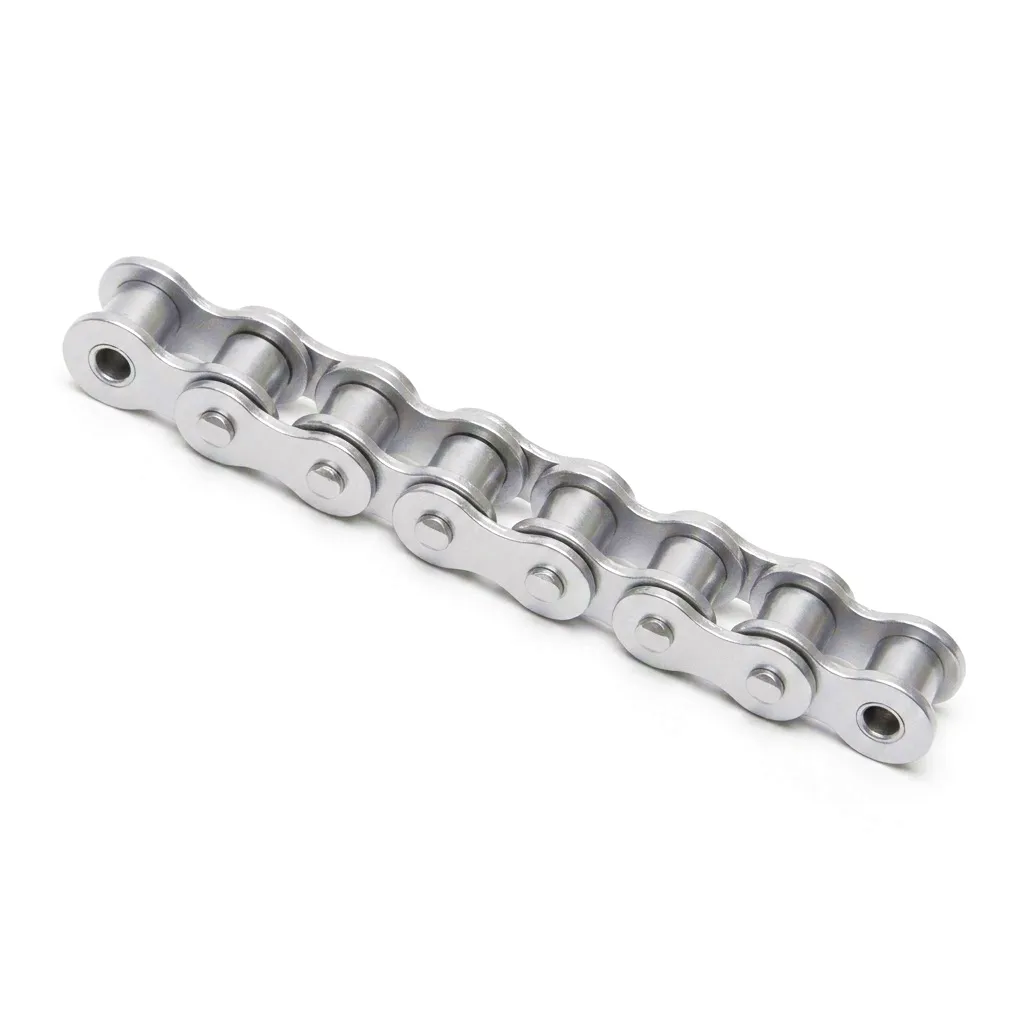
A roller chain drive consists of three elements: the chain itself, a driving sprocket, and one or more driven sprockets. The chain is an assembly of alternating inner and outer link plates, connected by hardened steel pins that pass through precision-formed bushings. A free-rolling steel roller sits on each bushing, and it is this roller that engages the tooth spaces of the sprocket. As the sprocket rotates, each tooth lifts a roller out of the chain’s natural catenary hang, carries it around the sprocket pitch circle, and deposits it onto the driven side. The roller’s ability to rotate independently of the bushing converts what would otherwise be sliding friction — the mechanism responsible for most chain wear in earlier designs — into rolling contact. Rolling friction is an order of magnitude lower than sliding friction, which is the fundamental reason roller chain drives achieve mechanical efficiencies of 97 to 99 percent under correctly lubricated conditions. The pitch of the chain — the distance between pin centres — is the defining dimensional parameter that must match the sprocket’s tooth spacing exactly. Any mismatch, even a fraction of a millimetre across accumulated links, produces uneven loading, increased noise, and accelerated sprocket tooth wear.

Chordal action is an inherent characteristic of all roller chain drives and deserves attention during the design phase. Because sprocket teeth are arranged on a polygon rather than a true circle, each roller engages at a slightly different radius as the sprocket turns, producing a periodic variation in chain speed and a corresponding impulse force transmitted to the shaft. The magnitude of chordal action decreases as sprocket tooth count increases — a 17-tooth sprocket produces approximately 2.2 percent speed variation per revolution, while a 25-tooth sprocket reduces this to around 0.8 percent. For precision indexing drives or applications where vibration is a concern, specifying a higher tooth count on the driving sprocket is a low-cost engineering intervention that yields measurable improvements in smoothness and reduces fatigue loading on connected components. Correct centre distance selection and chain tensioning also play a role: a chain run with insufficient slack cannot accommodate the slight length variation produced by chordal action, leading to cyclic overloading of the bearing surfaces.

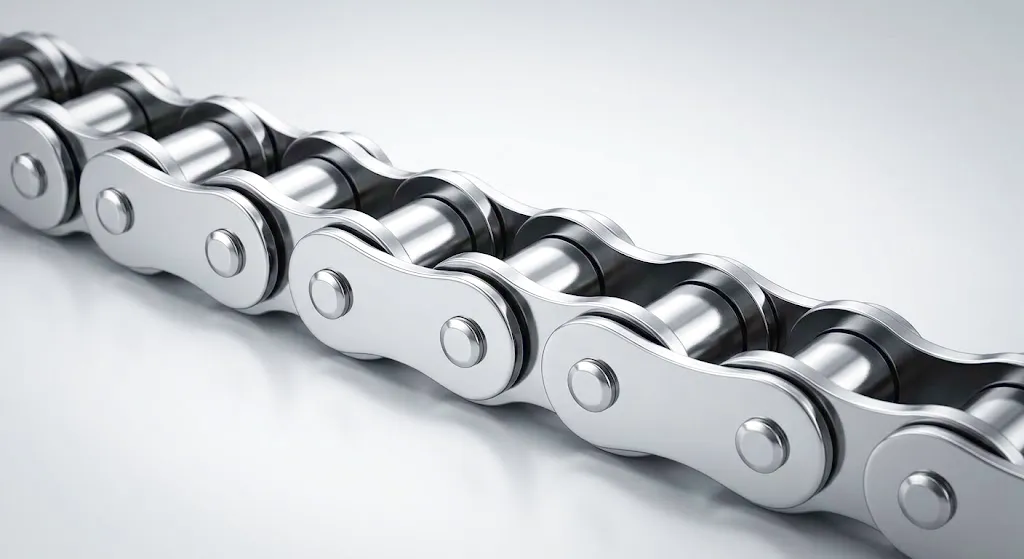
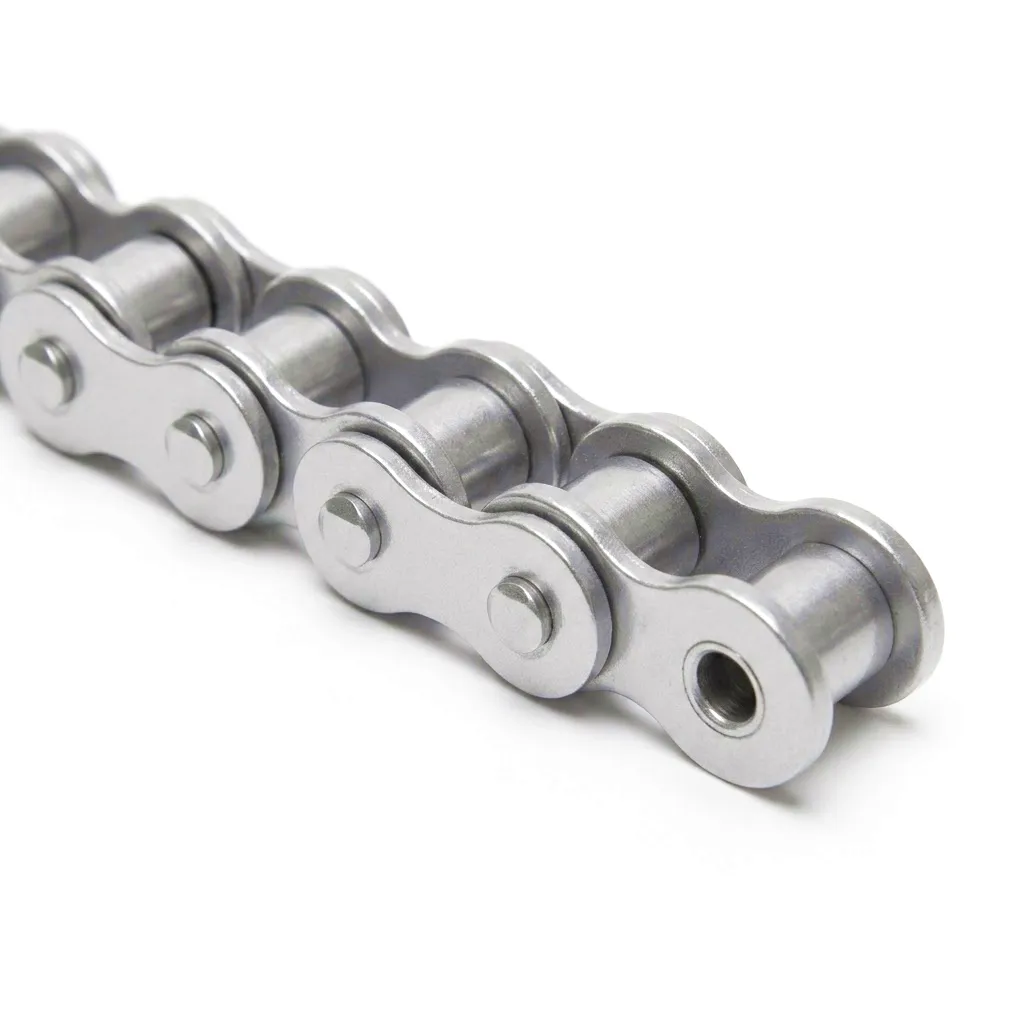
Industrial roller chain close-up — Ever Power UK

Material Science: What Roller Chain Is Made From

The mechanical performance of a roller chain is determined almost entirely by the materials selected for each component and the heat treatment applied to them. Side plates are cold-stamped from medium-carbon steel strip, typically SAE 1040 to SAE 1050 equivalent. The cold-forming process work-hardens the plate surface while leaving the core relatively ductile, providing resistance to fatigue crack initiation at the pin holes — which are the highest-stress locations in the plate assembly. Premium chain manufacturers, including Ever Power, use alloy steel grades such as 20CrMnTi for side plates in high-strength series, where the additional chromium and manganese content supports deeper case hardening and improved toughness at the pitch hole edge.

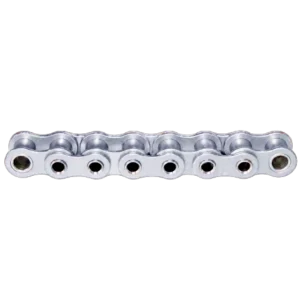
Pins are the most critically loaded component in the chain assembly. They are machined from alloy steel bar, gas-carburised to achieve a surface hardness of 58 to 64 HRC while maintaining a core hardness of 35 to 45 HRC. This differential hardness profile — a hard, wear-resistant case over a tough, impact-resistant core — is what allows pins to survive millions of articulation cycles without fracture. Bushings are through-hardened to 50 to 58 HRC and pressed into the inner link plates with a controlled interference fit that must be tight enough to prevent rotation under load, but not so tight as to induce cracking during assembly. Rollers are formed from carbon steel strip, hardened to 58 to 64 HRC, and in premium production are shot-peened to introduce compressive residual stress at the surface — a process that has been shown to extend roller fatigue life by 20 to 35 percent in independent testing. Stainless steel variants, manufactured from 304 or 316L grade, sacrifice some hardness for corrosion resistance and are specified for food processing, pharmaceutical manufacturing, and marine environments where contact with water, cleaning chemicals, or regulated substances makes carbon steel unsuitable.

Performance Parameters: Technical Specifications at a Glance

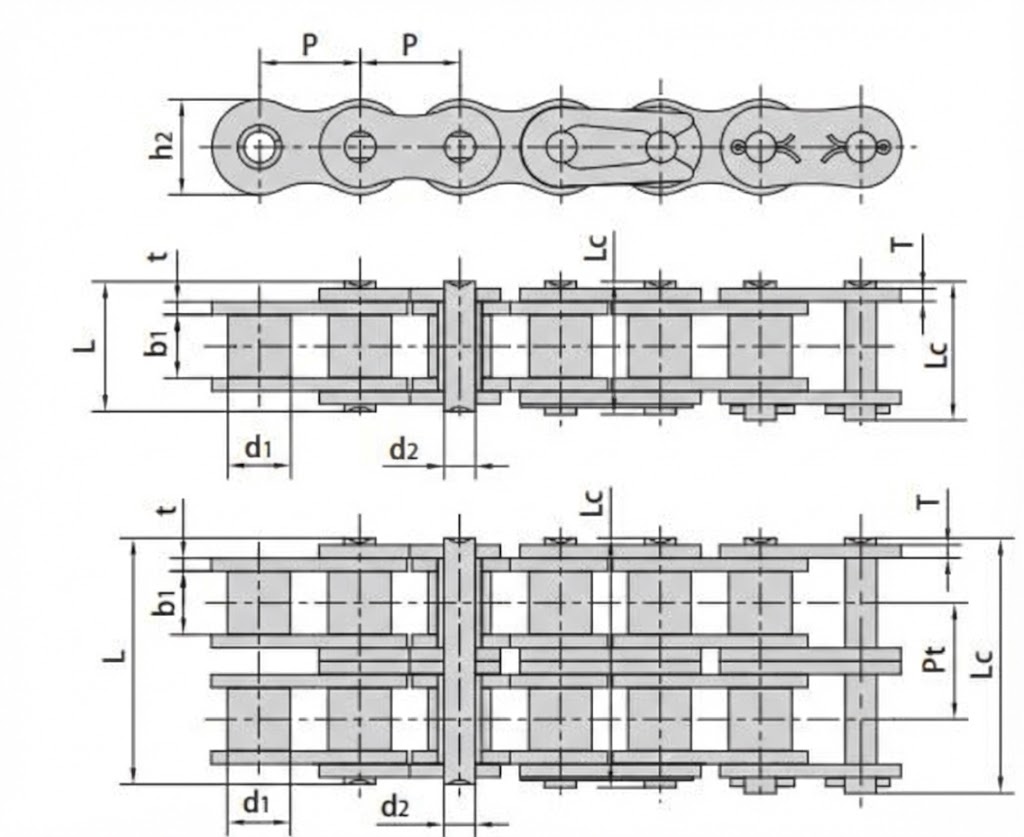
The table below presents key dimensional and performance data for the most commonly specified ISO 606 and ANSI B29.1 simplex roller chain sizes. Engineers specifying a roller chain drive should cross-reference these figures against the calculated design power (factored power load adjusted for service conditions) and the rated power tables published by the chain manufacturer for the specific pitch and speed combination under consideration.

Basit Makaralı Zincirler

Zincir No. Standart Hatve (mm) Silindir Çapı (mm) İç Genişlik (mm) Min. Tensile (kN) Max. Speed (RPM) Ağırlık (kg/m)
08B-1 ISO 606 12.70 8.51 7.75 17.8 3,000 0.69
10B-1 ISO 606 15.875 10.16 9.65 22.2 2,400 0.93
12B-1 ISO 606 19.05 12.07 11.68 28.9 2,000 1.15
16B-1 ISO 606 25.40 15.88 17.02 60.0 1,700 2.71
40-1 ANSI B29.1 12.70 7.92 7.85 17.8 3,200 0.62
60-1 ANSI B29.1 19.05 11.91 12.57 31.3 2,500 1.50
80-1 ANSI B29.1 25.40 15.88 15.75 58.0 1,800 2.60
120-1 ANSI B29.1 38.10 22.23 25.22 127.5 1,200 5.62

Data per ISO 606:2015 and ASME B29.1-2011. Max. speed values are indicative for simplex, well-lubricated drives on 19-tooth sprockets.

Makaralı zincir tahrik sistemlerinin temel teknik avantajları

Yüksek Mekanik Verimlilik

Under properly lubricated conditions, roller chain drives achieve efficiencies between 97 and 99 percent — figures that V-belt drives, which lose energy to flexing and slip, typically cannot match over extended service. This efficiency advantage is especially significant in high-torque, continuous-duty applications where even a one-percent improvement in drivetrain efficiency translates directly to measurable reductions in energy consumption and running cost.

No Slip, Precise Ratio Maintenance

Unlike belt drives, which are prone to slip under overload conditions and experience creep under sustained tension, a roller chain positively engages every sprocket tooth on every revolution. The speed ratio between driver and driven sprocket is therefore exact and constant — a critical requirement in packaging lines, printing machinery, and any application where timing relationships between multiple axes must be maintained within tight tolerances across the full production shift.

Adaptability to Harsh Environments

Roller chain performs reliably across a temperature range of approximately -40 degrees Celsius to +150 degrees Celsius in standard carbon steel grades, and to +300 degrees Celsius in high-temperature alloy variants. The chain structure is largely indifferent to oil, dust, and moderate chemical contamination — environments that would rapidly degrade rubber belts or damage precision gearbox seals. This environmental tolerance has made roller chain the default choice in quarrying, cement production, and heavy minerals processing operations across the UK’s industrial Midlands and northern regions.

Long Service Life with Predictable Wear

Roller chain wear is progressive and measurable. The primary mechanism is pin-and-bushing wear, which causes the chain to elongate over time — a phenomenon known as chain stretch, though the individual links do not actually stretch; the pitch increases as material is removed from the bearing surfaces. This elongation can be measured with a simple ruler or dedicated wear gauge, and replacement can be scheduled as part of a planned maintenance programme rather than as an emergency response to sudden failure. Most well-maintained drives achieve service lives of 15,000 to 25,000 hours before replacement is required.

Wide Range of Available Configurations

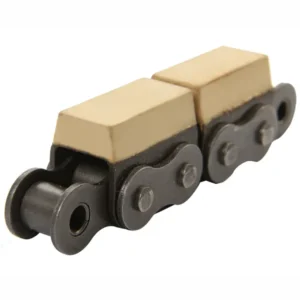
Standard roller chain is available in simplex (single-strand), duplex (two-strand), and triplex (three-strand) configurations, allowing load capacity to be increased without changing pitch or sprocket tooth count. Attachment plates, extended pins, and hollow-pin variants provide mounting points for conveyor flights, buckets, or pusher bars. Self-lubricating chains with sintered-alloy bushings impregnated with oil eliminate the need for external lubrication systems in inaccessible or cleanroom installations. Stainless steel, nickel-plated, and PTFE-coated variants address specific corrosion or hygiene requirements.

Lower Initial and Total Cost of Ownership

Compared to precision gearboxes or synchronous belt systems of equivalent power rating, roller chain drives have a significantly lower purchase price. Sprockets are simple components that can be produced from C45 steel bar on conventional CNC turning equipment, without the specialised tooling required for bevel or helical gearsets. Chain replacement — when it eventually becomes necessary — can be carried out by maintenance personnel with hand tools, without specialist knowledge or proprietary service tooling. For UK manufacturing operations managing tight maintenance budgets, this combination of low capital cost, simple maintenance, and long service intervals produces a compelling total cost argument.

Application Scenarios Across UK Industry

Basit Makaralı ZincirlerSteel manufacturing and metals processing represent the most demanding operating environment for roller chain in the UK industrial landscape. Rolling mills and furnace conveyor lines in Sheffield, Rotherham, and Scunthorpe run 24 hours a day under sustained high temperatures, with fine steel scale acting as an abrasive contaminant in the chain articulation. The roller chain runs that drive roller hearth furnace charging conveyors in these facilities operate at ambient temperatures between 60 and 120 degrees Celsius continuously, with periodic excursions above this range near furnace doors. The chains specified for these applications — typically ISO 16B-1 through 24B-1, or ANSI 80-1 through 120-1 — must be manufactured to tight pitch tolerances to maintain uniform load distribution across double-strand or triple-strand arrangements. Ever Power produces matched-pair chain sets for these environments, with strand-to-strand pitch variation held below 0.05 mm per 30 pitches, preventing the uneven load distribution that causes premature inner plate fatigue in one strand of a multi-strand drive.

Agricultural machinery is the single largest application segment for roller chain in UK industry by total metres consumed annually. Combine harvesters, balers, grain elevators, and root crop harvesters all rely heavily on roller chain drives for their primary power transmission and conveying functions. Seasonal demand peaks — harvest season running from July through October across the UK’s cereal and beet growing regions in Lincolnshire, Norfolk, and East Yorkshire — create intense pressure on replacement parts availability. A farm machinery dealer in Boston, Lincolnshire, servicing a fleet of 40 combine harvesters during a three-week harvest window has no tolerance for lead times measured in days; parts must be on the shelf or available next morning. This is precisely the supply chain argument for working with Ever Power, which maintains stockholding across the full ISO 10B-1, 12B-1, and 16B-1 range most commonly found in European agricultural equipment brands including CLAAS, Fendt, and New Holland.

Food and beverage processing plants use roller chain in environments governed by strict hygiene standards under BRCGS and HACCP frameworks. Operations in Grimsby — one of Europe’s largest fish processing centres — and the beverage production facilities clustered around Burton upon Trent and the East Midlands require chains that can withstand repeated wash-down with hot water and chlorine-based disinfectants without corroding or releasing contaminants into the product stream. Stainless steel roller chain in 304 or 316L grade, lubricated with food-grade mineral oil approved to NSF H1 standard, is the specification baseline for high-care production zones in these facilities. Solid outer-plate construction is specified where hollow-pin designs would create hygiene risk through bacterial accumulation in internal voids.

Quarrying and minerals extraction operations across Derbyshire, Cornwall, and the Welsh valleys subject roller chain to the combination of heavy shock loading, coarse abrasive contamination, and outdoor weathering that represents perhaps the harshest service environment encountered in UK industry. Primary jaw crusher feed conveyors run at very low speeds — often below 20 RPM — but carry loads measured in tens of kilonewtons per strand. The chain specified for these drives is typically ANSI 120-1 or 160-1 in carbon steel with a heavy-series side plate, selected for raw tensile strength and resistance to side-load fatigue rather than for speed capability. Maintenance intervals on quarry chain drives are often set at 2,000 operating hours or the equivalent of one full production season, whichever comes first, with chain elongation measured at each planned maintenance stop using a wear gauge calibrated to the 1.5 percent elongation replacement threshold.

Automotive manufacturing and general engineering in Birmingham’s broad manufacturing belt uses roller chain across final assembly conveyors, transfer lines, and component washing systems. The precision requirements here are different from heavy industry: chain length consistency across a 50-metre conveyor loop must be held within a few millimetres to prevent indexing errors on assembly stations. Pre-stretched chain — factory-run under controlled tension before cutting to length — eliminates the initial break-in elongation that otherwise requires manual tensioner adjustment during the first few hundred operating hours of a new conveyor installation.

Ever Power: Precision Manufacturing and Custom Chain Solutions

Ever Power operates advanced manufacturing facilities producing roller chain to both ISO 606 and ANSI B29.1 standards under a single ISO 9001:2015-certified quality management system. The production floor is equipped with CNC-controlled cold-forming presses for side plate manufacture, automated heat treatment lines with precision atmosphere control, and coordinate measuring machine (CMM) verification for 100 percent dimensional inspection of critical components in high-strength series production. Every chain batch is proof-load tested to 50 percent of the published minimum tensile strength before packaging, with test certificates available on request for safety-critical and regulatory applications.

Custom specification work is a core competency, not an afterthought. Ever Power’s engineering team works directly with procurement and design engineers to develop non-standard chain configurations including extended-pitch variants for large-diameter sprocket applications, modified side plate geometries for bespoke attachment requirements, oversized rollers for extended sprocket life in abrasive environments, and special surface treatments including zinc-nickel electroplating, black oxide, and PTFE dry-film coating. Minimum order quantities for custom variants begin at 50 metres for most configurations, with standard lead times of four to six weeks from drawing approval. For UK buyers requiring guaranteed stock availability, consignment stock arrangements can be established through Ever Power’s logistics partners, allowing critical spare chain to be held in a UK-based warehouse under bonded inventory terms — eliminating the lead time risk that otherwise makes high-value replacement chain a planning liability.

Get a Custom Quote from Ever Power

Customer Success Story: Aggregate Processing in Leeds

Pennine Aggregates Ltd — Leeds, West Yorkshire

Aggregate processing / quarry conveying / ANSI 120-1 heavy series

Pennine Aggregates Ltd operates two fixed-plant crushing and screening facilities in West Yorkshire, processing a combined total of approximately 650,000 tonnes of crushed limestone and recycled concrete aggregate per year. Their primary feed conveyor drives were specified with standard-grade ANSI 120-1 chain when the plant was commissioned in 2021, using American-made Caterpillar-based primary crusher equipment. By mid-2023, the operations manager was recording average chain replacement intervals of just eleven months — significantly below the eighteen-month target built into the plant maintenance budget. Investigation identified a combination of limestone dust contamination bypassing the chain guards, insufficient lubrication frequency at the lower run of the conveyor where the auto-lube system struggled to reach, and tensile capacity that was marginal during peak-throughput processing runs in wet limestone.

Following a technical review with Ever Power’s UK representative, Pennine trialled the Ever Power 120HSP high-strength series on one conveyor drive while running standard 120-1 chain on an adjacent drive for direct comparison. At the 14-month mark, the Ever Power HSP chain showed 38 percent less elongation than the standard chain in the parallel drive — confirming that the alloy steel construction and shot-peened rollers were delivering measurable wear resistance gains in real operating conditions rather than just in factory test data. The trial was extended to all conveyor drives at the Leeds facility in early 2024, and Pennine’s projected replacement intervals have since moved to 19 to 21 months — recovering the original design target and reducing annual chain procurement spend by approximately £22,000 across the site.

“We had written off hitting our eighteen-month change interval. The Ever Power HSP chain recovered it at nineteen months without any change to our lubrication regime. The elongation figures were the best we have seen on any chain across this site.”

D. Harrington, Operations Manager — Pennine Aggregates Ltd, Leeds

“I needed a non-standard attachment configuration for our transfer conveyor — modified A2 attachment plates at every third link. Ever Power turned around certified sample chain within five weeks of drawing approval, which was faster than two of our established European suppliers could quote. The dimensional certification was provided first time, no chasing.”

P. Thornton, Maintenance Engineer — Central Quarry Services, Wakefield

“We switched our food-grade conveyor lines to Ever Power stainless 10B-1 with NSF H1 lubricant. The 316L material certification and EN 10204 3.1 mill cert were included in the delivery documentation without being requested. That level of traceability is exactly what our BRCGS audit requires, and it saved our quality team a significant amount of follow-up time.”

R. Matthews, Quality Manager — Northern Food Processing Ltd, Grimsby

Sıkça Sorulan Sorular

What is the typical price range for industrial roller chain in the UK, and how do I get an accurate quote for my specific application?

Pricing varies considerably with pitch, material, quantity, and specification. Standard carbon steel ISO 08B-1 chain in volume quantities typically ranges from £4 to £8 per metre supplied to UK addresses; 316L stainless steel in the same pitch commands a premium of 60 to 120 percent over carbon steel. ANSI 80-1 in carbon steel generally runs £12 to £20 per metre depending on grade and quantity. To get an accurate quote that accounts for your specific chain number, required length, material, any attachment requirements, and delivery location, contact Ever Power directly at [email protected]. Quotes on standard sizes are typically returned within one working day.

Which roller chain standard should I be using for machinery manufactured in the UK or Europe, and how do I tell if my existing chain is ISO or ANSI?

UK and European-manufactured machinery defaults to ISO 606 (BS/ISO) chain — the B series designation such as 08B, 10B, 12B, 16B. ANSI chain (40, 50, 60, 80) is found on machinery imported from North America and in Caterpillar or John Deere equipment. You can identify your existing chain by measuring the pitch (pin-centre to pin-centre distance in millimetres) and the roller diameter, then cross-referencing against the ISO 606 or ANSI B29.1 tables. If your pitch is 12.70 mm and roller diameter is approximately 8.5 mm, you have ISO 08B-1. If roller diameter is approximately 7.9 mm at the same pitch, you have ANSI 40-1. The two are not interchangeable on the same sprocket.

How quickly can a roller chain supplier in the UK deliver replacement chain to a manufacturing site in Birmingham or Sheffield when there is an urgent breakdown?

For standard ISO and ANSI chain sizes held in UK stock, next-day delivery to Birmingham, Sheffield, and surrounding industrial areas is achievable through standard pallet or parcel courier services. Ever Power maintains relationships with UK-based distribution partners that allow urgent orders placed before midday to be despatched same day for next-morning delivery to most mainland UK postcode areas. For non-standard or custom-specification chain, lead times extend to four to six weeks from order confirmation. If you are operating a site where chain failure could cause significant production loss, setting up a consignment stock arrangement for your critical sizes eliminates the delivery lead time risk entirely — contact us to discuss the options for your specific site requirements.

When exactly should I replace a worn roller chain on a conveyor or drive system, and what measurement tells me it has reached the end of its service life?

The primary wear indicator is chain elongation — the increase in measured length caused by progressive pin-and-bushing wear. The standard replacement threshold is 1.5 percent elongation for precision power transmission drives (timing, indexing, packaging) and 3 percent for slow-speed conveying applications where dimensional consistency is less critical. To measure this in the field: select a 30-link section of chain, measure pin-centre to pin-centre across all 30 pitches, and compare against the nominal length (pitch multiplied by 30). For ISO 12B-1 with a 19.05 mm pitch, nominal 30-pitch length is 571.5 mm; replacement is due at 580.1 mm (1.5 percent elongation). Any chain showing cracked side plates, seized links, or visible roller damage should be replaced immediately regardless of elongation measurement.

Where can I find a reliable roller chain supplier in the UK who can also supply custom-specification chain with full material certification for food-grade or pharmaceutical manufacturing environments?

Ever Power supplies stainless steel roller chain with full EN 10204 3.1 mill certificates, NSF H1 lubrication options, and HACCP-compatible design documentation to food processing and pharmaceutical manufacturing customers across the UK. Our standard delivery documentation package for food-grade orders includes material certificates, dimensional inspection reports, and lubricant approval data sheets — the complete set of documents typically required to satisfy BRCGS site audits and internal quality management system requirements. To discuss your specific chain size, quantity, certification requirements, and delivery schedule, send enquiry details to [email protected] and a technical response will follow within one working day.

gzl tarafından düzenlendi