Textile machinery represents one of the most demanding environments for mechanical drive systems. Production floors in cities like Manchester, Leicester, and Bradford operate looms, warping machines, knitting frames, and finishing lines where the transmission system must deliver not just raw power, but a level of motion smoothness that directly influences fabric quality. A single skipped pitch or a vibration spike at the wrong moment can introduce tension variation, distort the weave pattern, or create surface defects that compromise entire production runs.
In this context, the roller chain — specifically engineered for low-noise, high-precision operation — has become the backbone of modern textile drive systems. Its ability to maintain consistent pitch engagement across thousands of hours of continuous operation, combined with controlled dynamic loading, makes it fundamentally different from the general-purpose variants used in agricultural or construction equipment. Understanding what separates a textile-grade roller chain from a standard specification is not merely an academic exercise; for procurement engineers and plant managers sourcing components across the UK, it is the difference between a production line that runs reliably and one that generates costly downtime.
How Roller Chain Drives Work in Textile Machinery
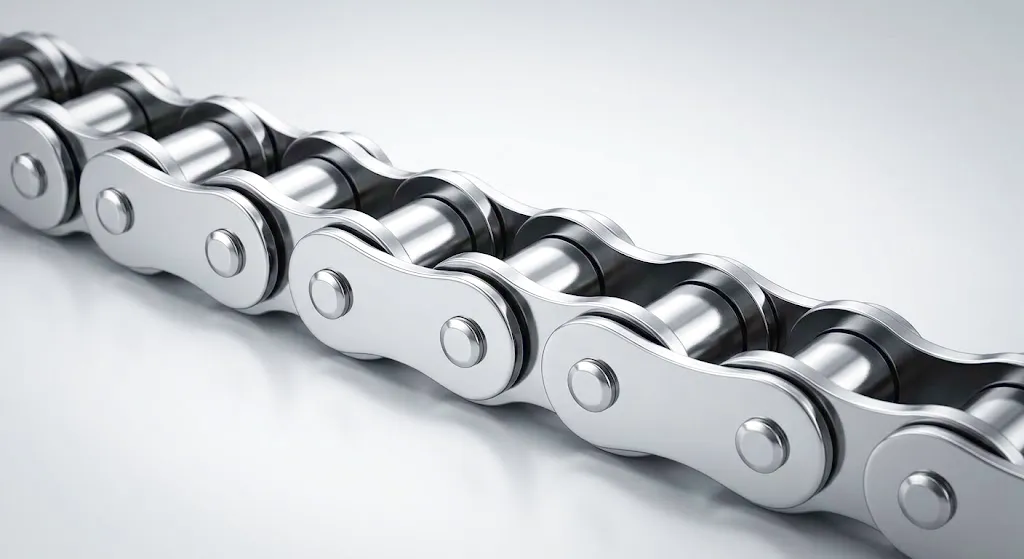
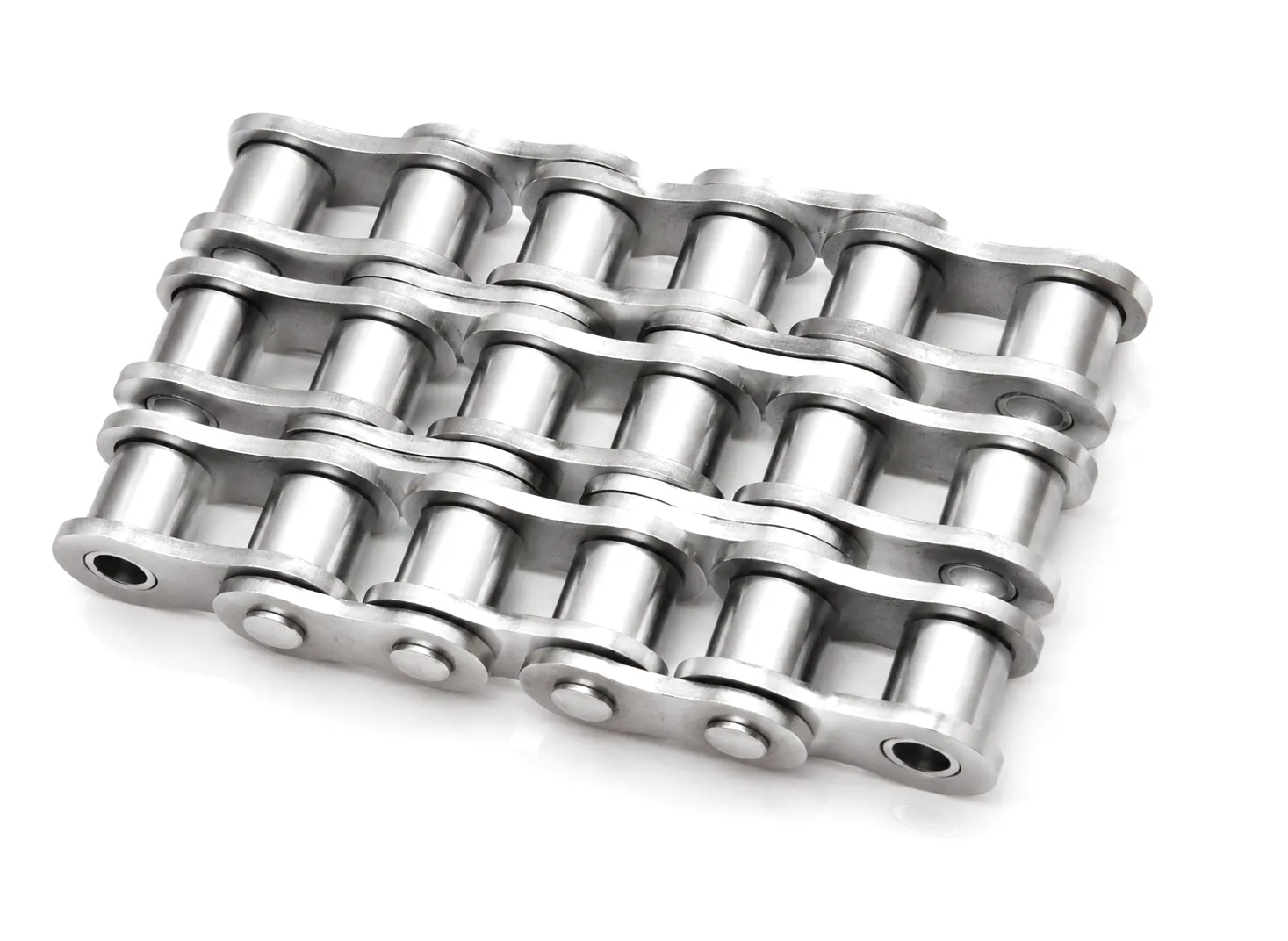
A roller chain transmits mechanical power through a series of interlinked components: inner plates, outer plates, pins, bushings, and the rollers themselves. As the drive sprocket rotates, its teeth engage successive rollers along the chain’s pitch, pulling the chain forward and transferring torque to the driven shaft. In most industrial settings this engagement is visible as a simple pulling force, but in textile machinery the physics becomes considerably more nuanced.
The critical performance parameter is polygonal action — the natural, unavoidable speed fluctuation that occurs as a chain wraps around a sprocket. Because a chain is composed of rigid links rather than a continuous flexible belt, the chain velocity oscillates slightly as each link pivots at the sprocket tooth. The amplitude of this oscillation is inversely proportional to the number of teeth on the sprocket: a 17-tooth sprocket produces roughly half the speed variation of a 9-tooth one. High-precision textile roller chains are therefore almost always specified with a minimum of 17 teeth on the small sprocket, with 21 to 25 teeth being the industry standard for loom and knitting machine drives. Combined with precision ground pins and hardened bushings that minimise backlash at the engagement point, this approach keeps velocity variation well below the threshold at which fabric defects become visible.
Noise in a roller chain drive originates from two primary events: the impact of the roller against the sprocket tooth during engagement, and the release shock as the roller exits the meshing zone. Textile environments, where operators work within metres of running machinery for entire shifts, impose strict noise limits — typically 75 dB(A) or below at a one-metre distance. Achieving this requires a combination of tight pitch tolerances, precision roller diameter control, and in many cases, sintered-metal or polymer-lined bushings that absorb contact energy rather than reflecting it as acoustic vibration.
Continuous lubrication between the pin and bushing interface is the single most important factor governing chain elongation over time. A textile-grade roller chain operating at 200 rpm on a modern rapier loom may complete over 10 million pitch engagements per day. Inadequate lubrication accelerates pin wear, causing the effective chain pitch to grow — a condition known as chain elongation — which progressively degrades sprocket meshing geometry, raises noise output, and eventually leads to skipping under load. Sealed-joint chains, in which a precision-fitted O-ring or X-ring retains grease inside the pin-bushing interface throughout the chain’s service life, have become the standard choice for enclosed textile drive systems where periodic manual oiling is impractical.
Core Materials Used in Precision Roller Chain Manufacturing
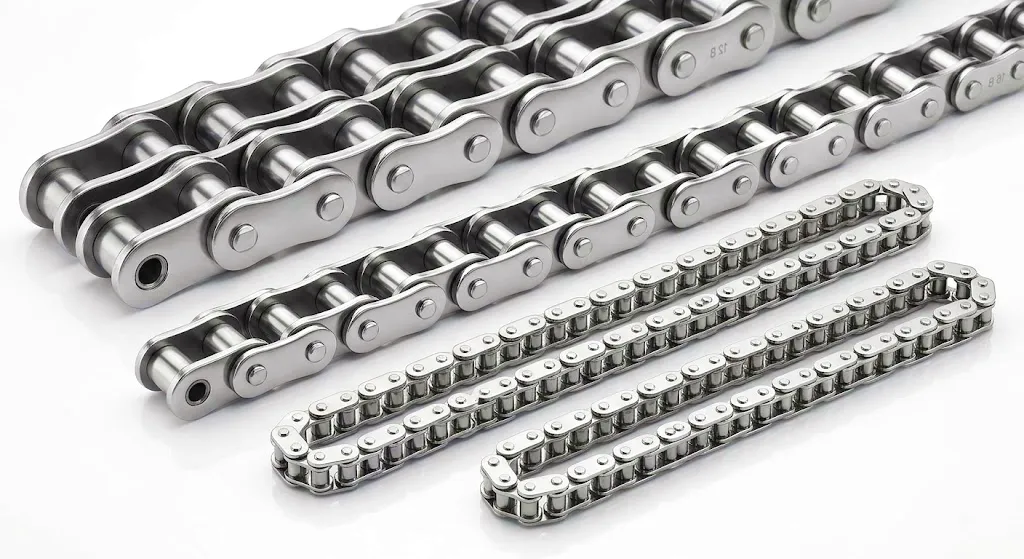
Material selection for textile-grade roller chain components is a multi-variable engineering decision that must balance hardness, toughness, fatigue resistance, and machinability. Chromium-molybdenum alloy steel (42CrMo4 or equivalent) is the most widely used material for plates and pins in high-load textile applications. This steel grade undergoes controlled carburising or induction hardening to achieve a surface hardness of 58–62 HRC while maintaining a tough core that resists crack propagation under the cyclic bending loads that textile machinery imposes on chain plates.
Rollers in textile-grade chains are typically manufactured from low-carbon case-hardening steels, such as 16MnCr5, which achieve high surface hardness after carburising while retaining a softer, energy-absorbing core. This combination is specifically chosen to reduce the acoustic impulse at sprocket engagement: a harder surface limits deformation wear, while the core ductility prevents the roller from acting as a rigid acoustic transmitter. The dimensional tolerances for roller diameter in a BS/ISO precision chain are typically ±0.005 mm — half the tolerance permitted in standard chains — and it is at this level of control that the difference between a quiet, smooth drive and a noisy, rough one begins.
Bushing material is equally critical. Sintered iron bushings impregnated with lubricating oil (ISO 6743 classification) are used in many sealed-joint textile chains to create a self-lubricating interface at the pin-bushing contact zone. For chains running in environments where fibre contamination is a concern — as in card room drives in Yorkshire woollen mills — bushings manufactured from oil-retaining sintered bronze provide superior resistance to abrasive wear compared to solid steel alternatives. The selection of stainless steel variants (typically 316L for plates and fasteners) addresses chains used in finishing and wet-processing sections, where exposure to bleaching agents, dye liquors, and hot water would rapidly corrode standard carbon steel components.
42CrMo4 alloy steel, carburised and hardened to 58–62 HRC surface. Shot-peened to introduce compressive residual stress that extends fatigue life under reverse bending conditions.
Case-hardened 20CrMnTi alloy steel. Precision ground to h5 tolerance on outer diameter. Low surface roughness (Ra 0.4 μm or better) is critical to achieving the designed film thickness in the EHD lubrication regime.
16MnCr5 case-hardened steel, 56–60 HRC surface. Tolerance on roller diameter: ±0.005 mm (ISO precision grade). Acoustic energy absorption from tough core reduces engagement noise by up to 4 dB compared with standard chains.
Sintered iron (standard) or sintered bronze (wet/abrasive environments). Oil-impregnated at 18–22% volume porosity. For corrosive environments: 316L stainless steel throughout.
Featured High-Strength Roller Chains — Caterpillar-Grade Performance
Heavy-gauge alloy steel construction, precision pitch, extended fatigue life under high-cycle textile and industrial drive conditions. ISO/ANSI compliant.
C-series heavy-duty variant with reinforced sidebar plates, optimised for high-speed, high-tension applications including warp beaming and continuous warping machines.
Technical Advantages of Textile-Grade Roller Chain
Why precision roller chain outperforms alternatives in textile drive systems
Precision-tolerance rollers and hardened-yet-resilient bushing combinations attenuate engagement shock, keeping operational noise within the 70–75 dB(A) range required by UK workplace exposure regulations (Control of Noise at Work Regulations 2005). This performance level is unachievable with standard commercial chains, which typically produce 80–88 dB(A) at equivalent speeds.
Manufacturing pitch tolerance held to ±0.05% across the chain assembly — versus ±0.1–0.2% for standard chains. This tighter tolerance dramatically reduces cumulative pitch error across multi-strand drives, ensuring that weft insertion in rapier looms and thread delivery in circular knitting machines remain synchronised to within a fraction of a millimetre per machine revolution. In high-speed warp preparation, this translates directly into beam quality and reduced end-breakage rates.
Through a combination of shot-peening (which introduces beneficial compressive residual stress into plate surfaces) and sealed-joint lubrication retention, textile-grade roller chains routinely achieve 12,000–18,000 hours of operational life in continuous production environments. For a two-shift textile mill running 16 hours per day, this equates to three to four years between chain replacement intervals — a significant reduction in maintenance overhead and unplanned downtime costs compared with standard chains that may require replacement every 12–18 months.
Modern high-speed circular knitting machines operate at 40 to 60 revolutions per minute at the dial, requiring chain speeds on drive circuits that can reach 3–4 m/s on the small sprocket. At these velocities, centrifugal forces acting on chain mass become significant contributors to dynamic tension. Precision chains, being manufactured to tighter mass distribution tolerances, exhibit substantially less centrifugal force variation per link — which reduces the dynamic tension amplitude and the associated vibration levels in the machine frame, protecting sensitive fabric-forming elements from resonance excitation.
Finishing sections in UK textile mills — including jet dyeing, pad-mangle ranges, and stenter frames — expose drive chains to hot alkaline wash liquors, steam, and chemical finishes. Stainless steel or nickel-plated roller chains designed for these conditions maintain corrosion resistance (salt spray test per ISO 9227 exceeding 500 hours) while preserving the pitch accuracy that chemical etching of standard carbon steel chains would destroy within weeks.
UK textile OEMs and end-users source machinery and replacement parts from across Europe, Asia, and North America. A roller chain that is manufactured to be interchangeable with both BS/ISO 606 and ANSI B29.1 sprocket systems eliminates the procurement complexity and extended lead times that arise when chains and sprockets originate from different standards families. Ever Power’s textile-grade chains are manufactured to provide interoperability across both standards unless otherwise specified.
Product Technical and Performance Parameters Table
Industrial Application Scenarios: Roller Chain in UK Textile Machinery
Sector-by-sector breakdown of precision drive requirements across the UK textile industry
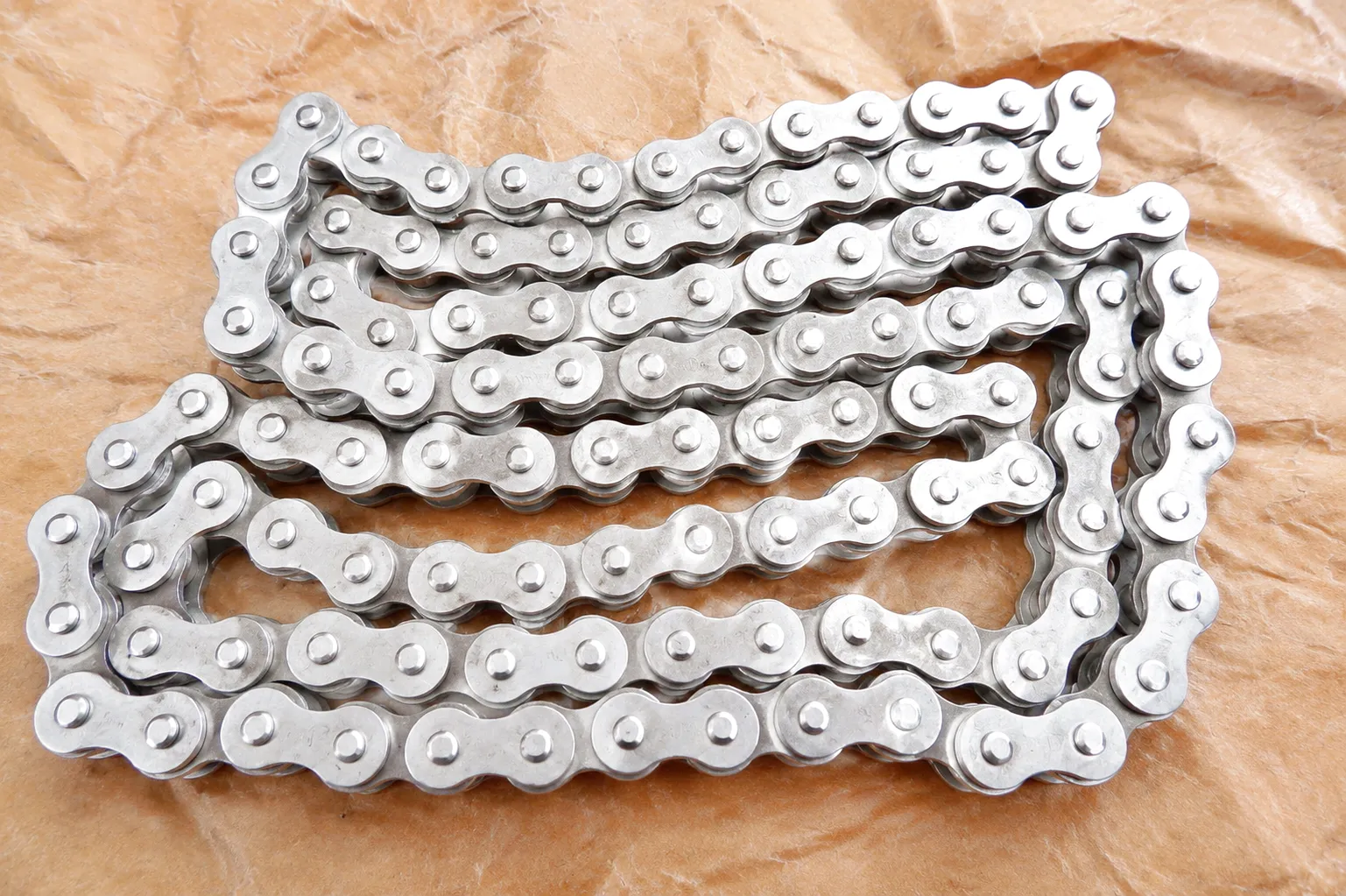
Loom Main Drive and Beat-Up Mechanisms — Lancashire and West Yorkshire. In both shuttle and shuttleless looms (rapier, airjet, and waterjet variants), the main drive transmits power from the motor to the crank shaft that drives the sley and reed, and from there to the take-up and let-off mechanisms. The roller chain on the sley drive typically operates at speeds of 1.5–3 m/s and must maintain precise phase relationships between the beat-up, shedding, and weft insertion cycles. Plants operating Dornier or Picanol rapier looms in Bradford and Burnley rely on pitch-accurate roller chains to maintain this synchronisation even as the chain warms up to operating temperature — which, without thermal compensation built into the chain design, can cause phase drift and weft insertion misalignment. Textile-grade chains, with their controlled elongation coefficients, allow these machines to run at rated speed from cold start to steady state without operator intervention.
Circular Knitting Machine Drive Trains — Leicestershire and Nottinghamshire. The knitting industry around Leicester and Nottingham operates hundreds of large-diameter circular knitting machines, each driven by a motor-to-machine chain drive that must deliver highly uniform rotational speed to the needle cylinder. Any torsional vibration introduced by the chain drive will be magnified by the cylinder’s rotational inertia and appear in the fabric as stitch length variation — effectively a structural defect that makes the fabric unsellable. Precision roller chains in this application typically use extended pitch (wider link spacing) designs that allow larger sprockets to be fitted within the confined geometry of the machine base, further reducing polygonal action and vibration amplitude. Multi-strand configurations (duplex or triplex) distribute the load across parallel chains, reducing per-strand tension and wear rate.
Warp preparation requires extreme let-off uniformity to avoid tension variation in the warp sheet, which would appear as defects in the woven structure. Roller chains driving warping drums must maintain constant pitch engagement across the full beam diameter range, from empty to fully wound. Sealed-joint chains with low elongation rate are essential in the old mill buildings around Huddersfield and Halifax, where machinery may not be aligned perfectly due to floor settlement, and chain compliance must compensate for minor misalignment without generating additional acoustic noise.
Stenter frames stretch and heat-set woven and knitted fabrics to their final dimensions. The fabric is gripped by a series of clips or pins carried on an endless chain running on both sides of the frame through a multi-zone oven at temperatures up to 220°C. The chains in stenter clip drives endure heat soak, chemical vapour from fabric finishes, and continuous cyclic tension. High-temperature rated roller chains, lubricated with PTFE-based or ceramic-additive greases and manufactured from heat-resistant alloy steels, are the only viable drive technology for this application.
Nonwoven production — needle-punching, spunbond, and hydroentanglement lines — uses roller chains to drive conveying aprons and doffer rollers at carefully controlled and matched speeds. These processes require speed matching between adjacent drive sections to within 0.1–0.5% to avoid fabric stretching or gathering, which would compromise web uniformity and product weight consistency. Multi-strand precision roller chains with dedicated tensioner systems achieve this performance level throughout the product width range from 1.6 m to 5.5 m.
The carpet weaving tradition in Kidderminster spans over 200 years, and today’s modern Axminster and Wilton carpet looms require roller chain drives for their complex pile yarn selection and positioning mechanisms. These chains operate at relatively low speeds but under high intermittent loads as gripper tubes or yarn carriers are accelerated and decelerated at high rates. Fatigue resistance across millions of start-stop cycles is the dominant design criterion, making shot-peened alloy steel construction with precision hardened pins the preferred specification for UK carpet mill procurement teams.
Customer Success Story: Precision Drive Overhaul at a Leicester Hosiery Manufacturer
A mid-size hosiery manufacturer in Leicester — operating a floor of 48 large-diameter circular knitting machines producing fine-gauge cotton and nylon sock blanks — was experiencing an escalating problem with fabric quality. Internal quality audit data showed that stitch length variation (coefficient of variation, or CV%) had been drifting upward over 18 months, correlating with a noise increase on the machine drive circuits. The plant’s maintenance team attributed the degradation to chain elongation, confirmed by measurement of chain length against original specification: several circuits had elongated by 2.3–2.8%, well beyond the 1.5% replacement threshold specified by Ever Power’s engineering team during the initial consultation.
Ever Power’s UK technical representative visited the facility and conducted a full drive audit, measuring operating chain tensions, sprocket wear profiles, and acoustic emission levels across a sample of 12 machines. The audit identified that the previous roller chain specification — a standard imported BS08B-1 without sealed joints — had been operating in boundary lubrication conditions due to the accumulation of nylon fibre dust blocking the lubrication ports in the machine housing. The recommended solution was Ever Power’s sealed-joint textile-grade 08B-1 precision chain with sintered bronze bushings, which retains internal lubrication regardless of external contamination.
The replacement programme, carried out over three scheduled weekend maintenance shutdowns, converted all 48 machines to the new specification. Follow-up quality audits conducted six months after completion recorded stitch length CV% improvements averaging 34% across the machine population, and acoustic surveys confirmed operating noise reductions of 6–9 dB(A) per machine — bringing the entire floor into compliance with the plant’s updated noise risk assessment. Annualised maintenance cost reduction, factoring in extended chain service life and reduced bearing replacement frequency due to lower vibration loading, was estimated at £28,000 per year relative to the previous specification.
What UK Customers Say About Ever Power Roller Chain
“We were replacing our previous chains every 14 months on our rapier looms in Bradford. After switching to Ever Power’s sealed-joint textile-grade specification, we have now run 22 months on the same chains with no measurable elongation beyond 0.9%. The noise reduction was immediately noticeable — our operatives commented on it the first morning back from the installation weekend. The technical data pack supplied with each consignment is thorough and gives our QA team confidence in the specification.”
“Our stenter frame clip chains were the weak point of our finishing line — we were seeing clip failures from chain fatigue every 8–10 months, causing significant rejects on heat-set polyester. Ever Power’s engineering team specified a custom alloy steel variant with modified clip attachment dimensions to suit our Brückner frame geometry. We are now 26 months into the first set with no failures. The lead time from enquiry to delivery of a fully customised specification was 18 working days, which was faster than we expected.”
“We source ever power roller chains for our carpet Axminster looms in Kidderminster. The performance consistency across batches is something we specifically tested over three consecutive orders — pitch tolerance measurement on 30 samples per order — and the variation is minimal. For a component that directly affects pile selection timing, that consistency matters enormously. The pricing is competitive when you factor in service life, and the UK-friendly technical support (not just a datasheet) is genuinely useful for our maintenance team.”
Ever Power Roller Chain — Product Gallery
Frequently Asked Questions — Roller Chain in Textile Machinery
Voice-search friendly answers to the questions UK buyers and engineers ask most often
For textile loom drives in the UK, a sealed-joint precision roller chain manufactured to BS/ISO 606 with sintered bronze or polymer-lined bushings and a minimum sprocket tooth count of 19–21 teeth delivers the lowest operating noise. The sealed joint retains internal lubrication despite fibre dust contamination, while the tight roller diameter tolerance (±0.005 mm) reduces engagement impact noise to the 70–75 dB(A) range required under the Control of Noise at Work Regulations 2005. Chains from Ever Power in the 08B-1 to 12B-1 range are most commonly specified for loom main drives in Bradford, Burnley, and Halifax.
Custom precision roller chain pricing depends on pitch, strand count, material specification (standard alloy steel, stainless, or nickel-plated), and the level of custom attachment or dimensional modification required. For standard textile-grade sealed-joint chains in 08B-1 or 10B-1 pitch, indicative supply pricing from Ever Power ranges from competitive volume rates for full-roll quantities (typically 10 m rolls) to per-length cut pricing for exact replacements. Lead time for standard textile-grade variants is 2–4 weeks ex-works, with expedited options at 7–10 working days. Contact our sales team at [email protected] for an application-specific quote.
In the UK, BS/ISO 606 is the primary applicable standard for roller chains, and the vast majority of European-manufactured textile machinery (Dornier, Picanol, Karl Mayer, Mayer and Cie) specifies BS/ISO pitch series chains. ANSI B29.1 chains use a slightly different pitch numbering and have different roller widths in certain sizes, making them non-interchangeable with BS/ISO sprockets without careful dimension checking. If your machinery was sourced from a US manufacturer, verify the sprocket tooth geometry before ordering. Ever Power offers dual-standard certification and can supply chains verified against both standards where required.
For wet processing environments in UK textile mills — jet dyeing machines, pad mangles, and washing ranges — 316L stainless steel roller chains are the appropriate specification. These chains resist the alkaline, acid, and chlorine-based chemistry used in bleaching, dyeing, and finishing processes without corrosion-induced pitch growth or plate fracture. Ever Power manufactures and supplies 316L stainless roller chains to UK finishing plants across the East Midlands, Yorkshire, and North West England, with documentation including material certificates and corrosion resistance data. Enquiries can be directed to [email protected].
The standard replacement criterion for textile precision roller chains is 1.5% elongation of the original pitch length — half the 3% limit applied to standard chains. Without a specialist chain wear gauge, a practical field method is to measure 20 pitches (links) with a steel rule against the original nominal dimension: if the measured length exceeds the nominal by more than 1.5%, the chain should be replaced. Audible changes are another indicator: a chain that is clicking, slapping, or has become noticeably noisier over a period of weeks is likely approaching or exceeding its wear limit. Pairing chain replacement with sprocket inspection — replacing sprockets that show hook-shaped or shark-fin tooth profiles — ensures the new chain engages cleanly and achieves its rated service life.
For multi-site maintenance contracts, Ever Power offers blanket order programmes that fix pricing for 12-month periods with scheduled delivery against call-off orders — reducing procurement administration and eliminating the risk of price fluctuation. To initiate a quotation, contact [email protected] with a consolidated list of chain specifications (pitch, strand count, grade, quantity per site per year), the delivery addresses and preferred delivery schedule, and any certification or documentation requirements. Our commercial team will prepare a consolidated quotation within 48 hours of receiving a complete brief.
Ready to Upgrade Your Textile Machinery Drive System?
Ever Power’s precision roller chain engineers are ready to review your application and provide a tailored recommendation with full technical documentation.
edit by gzl