部品表におけるローラーチェーンの指定方法:規格、コード、および許容誤差
A complete technical guide for UK procurement engineers, plant maintenance managers, and OEM designers who need to write roller chain specifications that are accurate, supplier-ready, and fully compliant with BS, ISO, and ANSI standards.
Writing a roller chain entry in a Bill of Materials sounds straightforward until the first supplier sends the wrong pitch, the wrong attachment type, or a chain that meets a completely different national standard. This situation is far more common than most engineers admit, and the root cause is almost always the same: the BOM specification was too vague, used informal shorthand, or mixed terminology from ANSI, ISO, and BS without clarifying which system took precedence. In UK manufacturing — from the precision engineering corridors of Coventry to the steel-intensive plants of Sheffield and the heavy fabrication yards around Birmingham — procurement teams face an additional layer of complexity because legacy British Standard references still appear in older technical drawings alongside modern ISO equivalents. A poorly written specification can result in six-week delivery delays, budget overruns on replacement orders, and unplanned downtime that ripples through an entire production schedule.
This guide breaks down exactly how to specify roller chain correctly in a BOM, covering the international standards families, chain designation codes, dimensional tolerances, attachment nomenclature, and the material and surface treatment declarations that a serious supplier will expect to see. The goal is to give engineers the vocabulary and the framework to write BOM entries that leave nothing ambiguous, reduce back-and-forth with suppliers to near zero, and protect the specifying company from receiving non-conforming product.
Understanding the Standards Landscape: BS, ISO, and ANSI
Why the standard family matters before you write a single code
BS (British Standard)
The legacy BS 228 standard governed roller chain in the UK for decades and is still referenced on drawings produced before the widespread adoption of ISO. BS 228 chains used pitch designations expressed differently from ISO, and inner plate depths were sometimes specified to tighter tolerances. Many older UK machinery installations — particularly in paper mills, food processing plants, and mining conveyors in regions like South Wales and County Durham — still carry original BS-rated chains. When encountering these in a BOM review, engineers must cross-reference carefully because a direct ISO substitution is not always dimensionally identical, especially in attachments and offset links.
ISO 606 / EN 28738
ISO 606 is now the dominant international standard for short-pitch precision roller chains, and it has been adopted in the UK as BS EN ISO 606. This is the standard that most modern UK manufacturers write into their BOM specifications as a default. ISO 606 defines pitch, roller diameter, inner link width, pin diameter, plate height, and the minimum tensile strength for each chain number. Chain designations under ISO follow a numeric system where the number directly encodes the pitch — for example, 08A carries a 12.7 mm pitch. The “A” series corresponds loosely to what American engineers know as ANSI dimensions, while the “B” series reflects the older British pitch increments.
ANSI B29.1
ANSI B29.1 governs roller chain in North America and uses a different numbering scheme where the first one or two digits represent eighths of an inch of pitch. A #80 chain, for instance, has a pitch of 1.000 inch (8 × 1/8″). The ANSI system is widely used by US-owned manufacturing plants operating in UK locations such as Swindon and Merseyside. When a UK BOM draws on US parent-company drawings, engineers sometimes receive ANSI chain numbers without context. Understanding that ANSI #60 is dimensionally very close to ISO 12A (but not identical in tolerances) prevents costly ordering errors.
Key BOM Rule: Always declare the governing standard family explicitly at the beginning of the chain specification line. Do not leave it to the supplier to guess. A BOM entry that reads “12.7mm pitch roller chain” is technically meaningless without a standard reference. An entry that reads “Roller Chain, 08B-1, BS EN ISO 606, single strand” leaves nothing open to interpretation.
Anatomy of a Roller Chain Designation Code
Decoding every suffix and prefix in the chain number
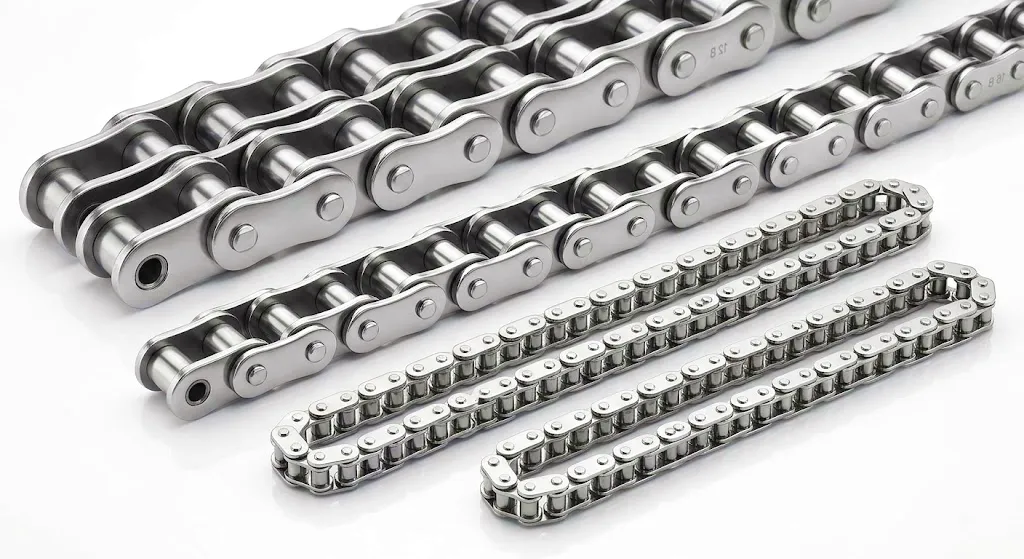
A roller chain designation code is a compressed specification in its own right, and reading it correctly is a prerequisite for writing accurate BOM entries. Under ISO 606, the designation follows a consistent structure: the leading digits identify pitch class, the letter suffix identifies the series, and trailing numbers identify strand count and any special configuration. Understanding each element prevents the most common BOM errors seen in UK engineering procurement.
Take the designation 16B-2 as an example. The “16” indicates a pitch of 25.4 mm (16 × 1/16 of an inch in the B-series pitch system — the B-series uses a denominator of 16 rather than the 8 used in the A-series). The “B” confirms this is the ISO B-series, which traces its origin to British Standard dimensions. The “-2” declares that this is a double-strand (duplex) chain. A triple-strand version would be 16B-3. If the chain were a simplex, the strand suffix is sometimes omitted, but for clarity in a BOM it should always be written explicitly as 16B-1 to prevent any ambiguity. Leaving out the strand count is one of the most common specification gaps encountered by procurement teams in factories across the Midlands.
(16 × 1/16″ = 25.4mm)
(B = ISO/British)
(Duplex)
(if applicable)
When the chain carries attachments — extended pins, bent or straight sidebar plates — these are denoted by additional suffixes following the strand designation. Under ISO 1275 (the companion attachment standard to ISO 606), A-type attachments feature holes or lugs on one sidebar plate only, while K-type attachments carry them on both sidebar plates simultaneously. The attachment pitch — meaning how many links apart each attachment is placed — is written as a prefix multiplier. So “K1-16B-1” means K-type attachments at every link on a simplex 16B chain, while “K2-16B-1” places attachments every second link. For UK food-processing conveyors in facilities near Lincolnshire or agricultural equipment around the East Riding of Yorkshire, attachment accuracy is not a cosmetic detail — it directly governs the spacing of product carriers and bucket flights.
Roller Chain Technical Specifications and Tolerance Table
Key dimensional data per BS EN ISO 606 — B-series and A-series
The table below presents the principal dimensional parameters, minimum tensile strengths, and weight data for the most widely procured roller chain sizes in UK industrial applications. All dimensions are in millimetres unless otherwise stated. Tolerances shown represent ISO 606 Class A (precision grade) limits, which are required for most powered transmission applications. Class B tolerances are more permissive and are acceptable for some conveyor applications where pitch accumulation over shorter chain lengths is acceptable.
| チェーン番号 (ISO) |
ピッチ (mm) |
ローラー径 (mm) |
内幅 (mm) |
ピン径 (mm) |
最小引張強度 Strength (kN) |
重さ (kg/m) |
Common UK 応用 |
|---|---|---|---|---|---|---|---|
| 06B-1 | 9.525 | 6.35 | 5.72 | 3.28 | 8.9 | 0.38 | Small machinery, packaging |
| 08B-1 | 12.700 | 8.51 | 7.75 | 4.45 | 17.8 | 0.70 | Automotive, light conveyor |
| 10B-1 | 15.875 | 10.16 | 9.65 | 5.08 | 22.2 | 0.93 | General industrial drives |
| 12B-1 | 19.050 | 12.07 | 11.68 | 5.72 | 28.9 | 1.35 | 農業機械 |
| 16B-1 | 25.400 | 15.88 | 17.02 | 8.28 | 60.0 | 2.70 | Sheffield steel mills, mining |
| 20B-1 | 31.750 | 19.05 | 19.56 | 10.19 | 95.0 | 3.85 | Heavy conveyor, quarrying |
| 24B-1 | 38.100 | 25.40 | 25.40 | 14.63 | 160.0 | 7.25 | Birmingham heavy fabrication |
| 32B-1 | 50.800 | 29.21 | 30.99 | 17.81 | 250.0 | 11.60 | Marine, offshore, energy |
Data per BS EN ISO 606. Minimum tensile strength values shown for simplex chains. Duplex and triplex chains carry proportionally higher tensile ratings. All tolerances Class A unless stated.
Material Declarations and Surface Treatment Codes in the BOM
What to specify beyond the chain number
The chain designation code tells a supplier the geometry. It does not, by itself, communicate anything about the material grade, the surface hardness, or any corrosion protection that the application requires. A roller chain that will operate in the wet food processing environment of a canning facility near Wigan or the salt-laden atmosphere of an offshore wind port near Hull needs a very different material specification from one serving as a dry power transmission drive inside a Birmingham machine shop. Failing to declare these requirements in the BOM creates a gap that suppliers will fill according to their default — which may be inadequate.
Standard carbon steel chains — the default for most industrial transmission applications — use plates made from medium-carbon or alloy steel hardened to surface values in the range of HRC 58–62 on pins and rollers, with softer plate cores to resist fracture. The material grade is generally not stated explicitly in the chain designation but should be captured in the BOM supplementary notes or through a material certificate requirement. For corrosive environments, the BOM must declare one of three material routes: stainless steel (type 304 or 316 depending on chloride exposure), nickel-plated carbon steel for moderate moisture, or food-grade self-lubricating chain where direct food contact is possible.
Carbon Steel (Standard)
Default grade for dry indoor power transmission. Good fatigue strength. BOM notation: “Standard grade carbon steel, no surface coating unless otherwise stated.”
ステンレス鋼316
Required for chloride-rich, washdown, or marine environments. Specify: “AISI 316 stainless steel throughout, all components including pins and rollers.” Higher cost; lower tensile than carbon equivalent.
Food-Grade / Self-Lubricating
Sintered bushes pre-impregnated with food-safe lubricant. Specify: “Oilite-type sintered bushes, H1 lubricant rated, compliant with FDA/EC 1935/2004.” Critical for UK food manufacturers.
Nickel Plated / Zinc
For moderate atmospheric corrosion or aesthetic requirements. Specify plating thickness in microns: “Electrolytic nickel plate, minimum 12µm, all external surfaces.” Common in pharmaceutical and electronic OEM applications.
Industrial Application Scenarios: Where Roller Chain BOM Accuracy Is Critical
Six UK sector profiles where specification errors cause real cost
Automotive Assembly — Midlands OEM Conveyors
Automotive body shell conveyors in West Midlands plants — particularly around Solihull and Coventry — use large multi-strand roller chain in overhead power-and-free configurations. BOM errors here typically involve mismatching the chain pitch to carrier trolley centres, or specifying the wrong attachment type for trolley finger engagement. The consequence is conveyor stoppage during production shifts, which carries six-figure cost implications per hour. Correct BOM entries for these applications must specify: chain designation, strand count, attachment type and pitch, working load (not merely tensile strength), and operating temperature range given that paint shop ovens operate above 200°C.
Steel Processing — Sheffield Rolling Mills
The remaining rolling mill and special steel operations around Sheffield use some of the heaviest roller chain in the UK — 32B and larger. The high ambient temperature, scale contamination, and shock loading from mill reversals mean that a BOM specification for these chains must go far beyond a standard designation. Engineers must include minimum tensile load, maximum allowable working load (typically 1/5 to 1/7 of MBS), chain elongation limit before replacement (usually 2% of a 25-link sample), and the lubrication regime. Grease-lubricated chain operating in scale-heavy environments may require sealed-joint or O-ring chain, which carries its own ISO designation suffix and must be declared explicitly.
Agricultural Machinery — East Anglian Harvesting Equipment
Combine harvesters, sugar beet harvesters, and potato lifting equipment operating across Lincolnshire, Cambridgeshire, and Norfolk use roller chain across multiple internal drives — header drives, threshing drum drives, and grain elevator chains. A single machine may carry eight to twelve different roller chain specifications. The BOM challenge is that agricultural chains are often sourced from a mix of OEM and aftermarket suppliers mid-season, and a vague BOM entry like “elevator chain 1-1/4 pitch” can result in delivery of a dimensionally similar but incompatible chain with different attachment geometry. Correct specification includes pitch in mm (not fractional inches), attachment letter code, and the original equipment reference number as a cross-check.
Construction Equipment — Scottish Highlands Plant Operations
Excavators, crawler cranes, and track-laying equipment operating in the challenging terrain of the Scottish Highlands and northern England rely on roller chain in their hydraulic pump drives, winch systems, and ancillary equipment drives. The specification challenge here is environmental tolerance: sub-zero start-up temperatures, mud ingress, and shock loading are routine. A BOM entry that fails to specify low-temperature lubricant compatibility, sealed joint construction, or increased plate thickness (available as a non-standard option from specialist manufacturers) exposes the equipment to chain fracture in conditions where field repair is extremely difficult and costly.
Food and Beverage Processing — Hygiene-Critical Environments
Major food processing facilities in Yorkshire, Cheshire, and the East Midlands run washdown protocols that make material specification absolutely critical. In these plants, a BOM entry that omits the material grade and lubricant type can result in installation of standard carbon steel chain that corrodes rapidly, contaminates product, and triggers HSE investigation. The correct BOM entry for hygienic-zone conveyor chain includes: ISO designation, stainless steel grade (316 minimum for direct-contact zones), lubricant compatibility (H1 NSF-approved only), attachment style, and a declaration of the relevant food safety regulation compliance (EU 1935/2004 for UK operations under the retained domestic equivalent).
Energy and Utilities — UK Power Generation Assets
Coal handling conveyors at legacy power stations, biomass fuel handling systems at newer generation sites near Drax and Lynemouth, and valve actuation chains in nuclear and water treatment plants all require roller chain BOM entries with full traceability demands. These applications require not only dimensional correctness but material certificates (typically to EN 10204 3.1 or 3.2 standard), heat batch traceability, and sometimes third-party inspection. A BOM entry for these critical applications must include the quality documentation requirement as a line item alongside the chain specification itself, because a chain delivered without the correct material certificate is commercially unacceptable regardless of its physical quality.
注目の高強度ローラーチェーン製品
キャタピラー用高強度ローラーチェーン 120HSP-00
Engineered specifically to exceed Caterpillar’s demanding OEM dimensional and tensile requirements, the 120HSP-00 chain uses alloy steel construction with heat-treated components and precision ground pins. This roller chain is the correct BOM choice when replacement documentation must reference the Caterpillar part series directly. The chain meets and exceeds the minimum tensile and fatigue cycle requirements specified for Caterpillar heavy equipment drive systems, making it suitable for construction, mining, and quarrying applications across the UK.
キャタピラー用高強度ローラーチェーン C100HSP-00
The C100HSP-00 series extends the heavy-duty Caterpillar-compatible programme to smaller pitch class applications. Manufactured with through-hardened alloy steel plates and precision interference-fit pins, this roller chain delivers fatigue resistance that significantly exceeds standard ISO-grade chain of equivalent pitch. For UK procurement teams managing mixed Caterpillar fleet maintenance across plant hire operations in the North East and Midlands, specifying the C100HSP-00 by name in the BOM — alongside the ISO designation — provides dual-reference clarity that eliminates substitution errors.
Tolerance Classes, Elongation Limits, and Inspection Requirements
What the BOM must say about acceptable dimensional variation
ISO 606 defines two tolerance classes for roller chain: Class A (precision) and Class B (standard). The distinction is significant in practice, particularly for high-speed drives and indexing mechanisms. Class A chains are manufactured to tighter pitch variation limits and have stricter control over roller diameter variation, inner width variation, and straightness. Class B chains are acceptable for low-speed conveyor applications but should not be specified for synchronised drives, timing applications, or any system where cumulative pitch error matters — which includes virtually all automated production line indexing applications seen in UK manufacturing.
Beyond tolerance class, a complete BOM specification for driven chain should include the maximum permissible elongation before replacement — the figure that triggers the chain’s end of working life. Under ISO 606 guidance, the conventional replacement trigger is 2% elongation measured over a 25-link sample under specified measuring load. A 2% elongation in a 16B chain (25.4mm pitch) means a 25-link section that should measure 635mm has extended to 647.7mm or greater. Writing this as a BOM requirement — “Maximum allowable elongation: 2% per ISO 606 Annex A, assessed over 25 links” — gives the maintenance team and the chain supplier a shared, unambiguous acceptance criterion.
BOM Inspection Declaration Example: “Roller Chain, 16B-1, BS EN ISO 606 Class A, 316 stainless steel, simplex, 5m delivery length. Material certificate EN 10204 3.1 required. Maximum pitch variation: per ISO 606 Table 4. Replacement elongation limit: 2% over 25-link sample. Supplier to provide dimensional inspection report per delivery.”
Ever Power: Precision Roller Chain Manufacturing and Custom BOM Fulfilment
Where specification accuracy meets manufacturing capability.
BOM-Ready Documentation
Ever Power provides full BOM-support documentation with every order: dimensional inspection reports, material certificates to EN 10204, and standard cross-reference sheets mapping our part numbers to ISO, BS, and ANSI equivalents. UK procurement teams receive exactly what their quality management systems require.
高度なカスタマイズ機能
Non-standard pitch, custom attachment geometry, increased plate thickness, special alloy grades, and proprietary surface treatments are all within Ever Power’s manufacturing scope. Our engineering team works from customer BOM specifications and reverse-engineering samples to deliver chains that match legacy machinery exactly — including chains where the original manufacturer no longer supports the part.
英国のサプライチェーンの信頼性
Ever Power maintains UK-accessible stock programmes for high-volume roller chain sizes with DDP delivery to any UK industrial address. Emergency orders for critical maintenance shutdowns are handled with priority despatch. Our logistics partners operate dedicated overnight freight lanes to major UK industrial regions including the Midlands, Yorkshire, and the North East.
Need a quotation matched to your BOM specification?
Send your chain designation, quantity, material requirement, and delivery requirement directly to our technical sales team. We respond with a matched specification quote within 24 hours on standard sizes.
Customer Success Story: Leeds Aggregate Processing Plant — Conveyor Chain BOM Overhaul
How specification accuracy saved a West Yorkshire operation six weeks of unplanned downtime annually
A mid-sized aggregate and crushed stone operation near Leeds in West Yorkshire had been experiencing repeated roller chain failures on its primary screening conveyor system — averaging approximately three significant chain breaks per quarter, each requiring a full shift stoppage and emergency repair. The plant maintenance manager contacted Ever Power after a particularly damaging failure that caused a section of chain to wrap around the drive sprocket and damage the conveyor structure itself.
An Ever Power technical engineer reviewed the plant’s existing BOM and found the conveyor chain specified simply as “1” pitch heavy-duty chain, conveyor grade.” No standard reference. No strand count. No material declaration. No attachment specification. The chain had been purchased from multiple suppliers over the years, with dimensional variations accumulating to the point where new chain was mixing poorly with worn sprockets sized for a slightly different pitch series.
Ever Power’s team measured the installed sprockets, assessed the drive loading, checked the operating environment (high abrasive dust, intermittent water ingress), and produced a corrected BOM entry: “16B-1 Roller Chain, BS EN ISO 606 Class A, carbon steel with nickel-plate coating, K-type attachments K2 pitch, 10m coils, MTC EN 10204 3.1 required.” Two subsequent supplies of chain to this specification — both from Ever Power — ran without a single failure through an eight-month period. The plant calculates the avoided downtime cost at over GBP 47,000 against an annual chain spend increase of approximately GBP 3,200 for the correctly-specified product.
“The documentation package from Ever Power was exactly what our QMS required — 3.1 certificates, dimensional inspection data, and a clear ISO cross-reference. No other supplier we’ve used has provided that without a separate request and three weeks of chasing. The chain itself has performed flawlessly in our screening plant environment.”
— Plant Maintenance Manager, Aggregate Processing, West Yorkshire
“We had a legacy conveyor chain on a 1980s installation where the original manufacturer had ceased trading. Ever Power’s engineering team matched our samples dimensionally to a custom 20B variant with modified attachment geometry. The whole process from inquiry to delivery took four weeks, which was remarkable for a non-standard item. Their custom capability genuinely saved us a complete conveyor redesign.”
— Engineering Director, Food Processing OEM, Birmingham
“We specify stainless 316 chain throughout our washdown zones and the price difference from standard suppliers was always significant. Ever Power’s stainless programme gave us ISO 606 Class A chain at a price competitive with the Class B stainless we had been settling for. The fatigue life improvement has been measurable — we’ve extended our planned replacement intervals by 35% with no increase in in-service failures.”
— Procurement Lead, Dairy Processing Facility, Cheshire
The Complete Roller Chain BOM Specification Checklist
Every data field your BOM entry must contain to be procurement-ready
e.g. 16B-1, 32B-2, 12B-1-K2
BS EN ISO 606 / ANSI B29.1 — declared explicitly
Class A (precision) or Class B (standard)
Simplex (-1), Duplex (-2), Triplex (-3)
A1, A2, K1, K2, etc. per ISO 1275
Standard carbon / AISI 304 SS / AISI 316 SS
None / Nickel plate (12µm min.) / Zinc / Shot-peened
Standard mineral / H1 food-grade / Dry (PTFE)
Standard / O-ring sealed / X-ring sealed
FDA / EC 1935/2004 (UK-retained) if food-grade
Open coil / 5m coil / 10m coil / Specific length
EN 10204 2.1 / 2.2 / 3.1 / 3.2
Required / Not required — state explicitly
ISO 606附属書Aによれば、通常25リンク以上で2%となる。
承認済みブランドリストまたは公開調達 ― 州の方針
よくある質問
英国における調達および仕様に関する実際の質問に対する実践的な回答
ISO 606とANSI B29.1のローラーチェーンの違いは何ですか?また、英国の部品表(BOM)にはどちらを指定すればよいですか?
ISO 606(英国ではBS EN ISO 606として採用)は、英国のほとんどの部品表仕様に適した規格です。ANSI B29.1は、1/8インチを基準とした異なるピッチシステムを採用しており、主に北米設計の機器で使用されています。ANSIとISOのチェーンサイズはピッチ寸法が似ているものが多いですが、ローラー幅、ピン径、および取り付け寸法はしばしば異なります。機械がANSI図面に基づいて設計され、スプロケットがANSI寸法で製造されていない限り、英国での調達にはISO 606を指定してください。
英国のサプライヤーから、カスタムアタッチメントチェーンのローラーチェーンの正しい価格または見積もりを入手するにはどうすればよいですか?
英国のサプライヤーまたはメーカーからカスタムアタッチメントローラーチェーンの正確な価格を取得するには、問い合わせ前に仕様書をすべて準備してください。仕様書には、チェーンの型番(例:16B-1)、アタッチメントの種類(A1、A2、K1、K2)、アタッチメントの間隔(リンクごと、2リンクごとなど)、材質グレード、表面処理、メートル単位の数量、および配送形態を記載してください。不完全な問い合わせは、見積もり作成に大幅な遅延を招きます。Ever Powerでは、仕様書をメールでご提供いただければ、24時間以内に見積もりをご提示いたします。
バーミンガムまたはミッドランズ地方で、メンテナンスの緊急事態に対応できるよう、当日または翌日発送可能な高耐久性ローラーチェーンを在庫しているサプライヤーはどこで見つけられますか?
Ever Powerは、バーミンガム、コベントリー、ウルヴァーハンプトン、および周辺地域を含むミッドランズ地方への優先配送体制を維持しています。標準チェーンサイズ(10B~32Bの単線および複線)は、通常翌営業日配送が可能です。特注サイズおよび非標準サイズについては、個別に査定いたします。メンテナンスの緊急対応が必要な場合は、チェーンの型番を明記の上、技術営業チームまでメールで直接ご連絡いただくのが最も迅速な対応となります。
英国の乳製品または飲料加工施設における食品グレードのコンベヤ用ステンレス鋼ローラーチェーンの仕様はどのように指定すればよいでしょうか?また、標準的な炭素鋼チェーンと比較して、一般的にどのくらいの価格差が生じるのでしょうか?
英国の食品グレードコンベヤ用途では、部品表には直接接触ゾーンにAISI 316ステンレス鋼(洗浄環境における塩化物耐性が優れているため、304よりも推奨)、H1定格のNSF承認潤滑剤または自己潤滑焼結ブッシュ、およびEC 1935/2004の英国保持相当規格への準拠を指定する必要があります。ステンレス鋼316ローラーチェーンは、サイズに応じて、同等の炭素鋼チェーンよりも通常150%から300%の価格プレミアムがかかります。しかし、洗浄条件下での耐用年数が長いため(コーティングされた炭素鋼の3~5倍になることが多い)、高サイクル用途では総所有コストが有利になります。
シェフィールドの製鉄所やイングランド北部の重工業工場が、既存のコンベヤ設備の交換用チェーンを指定する際に、どのローラーチェーン規格を使用すべきでしょうか?
1990年代以前にシェフィールド、ロザラム、その他北部の重工業地帯に設置された旧式のコンベヤには、BS 228規格に準拠したチェーンが使用されている場合があります。このようなチェーンを交換する際は、ISO規格やANSI規格の同等品を直接想定するのではなく、稼働中のリンクのピッチ、ローラー径、内幅を実際に測定し、寸法相互参照によってこれらの寸法を照合するのが最も安全な方法です。Ever Power社のエンジニアリングチームは、実物サンプルまたは寸法図面をご提供いただければ、英国のお客様向けにこの相互参照サービスを無償で提供しています。
標準的なISOグレードではなく、高強度または高負荷対応のローラーチェーンを使用すべきなのはどのような場合ですか?また、これは部品表(BOM)の記載内容にどのような影響を与えますか?
ヘビーシリーズローラーチェーン(チェーン番号に「H」の接尾辞が付くもの。例:16BH-1)は、同じピッチクラスの標準チェーンよりもリンクプレートが厚く、引張強度が高く、衝撃荷重に対する疲労耐性が向上しています。駆動装置が大きな負荷反転、衝撃荷重(骨材、採石、リサイクル用途でよく見られる)、または用途の安全率計算で標準チェーンよりも高い最小破断強度が要求される場合は、ヘビーシリーズを指定する必要があります。部品表(BOM)には、ヘビーシリーズの指定を明示的に記載する必要があります(「16B-1」ではなく「16BH-1」)。標準番号を与えられたサプライヤーは、自動的にヘビーシリーズにアップグレードするわけではないためです。
自信を持ってローラーチェーンを指定する準備はできましたか?
部品表(BOM)の仕様をEver Powerの技術チームにお送りいただければ、それに合わせたお見積もりをご提示いたします。標準サイズとカスタムサイズをご用意しており、英国の調達および品質管理要件に関する完全なドキュメントサポートも提供いたします。
[email protected] · エバーパワー · 精密ローラーチェーン製造