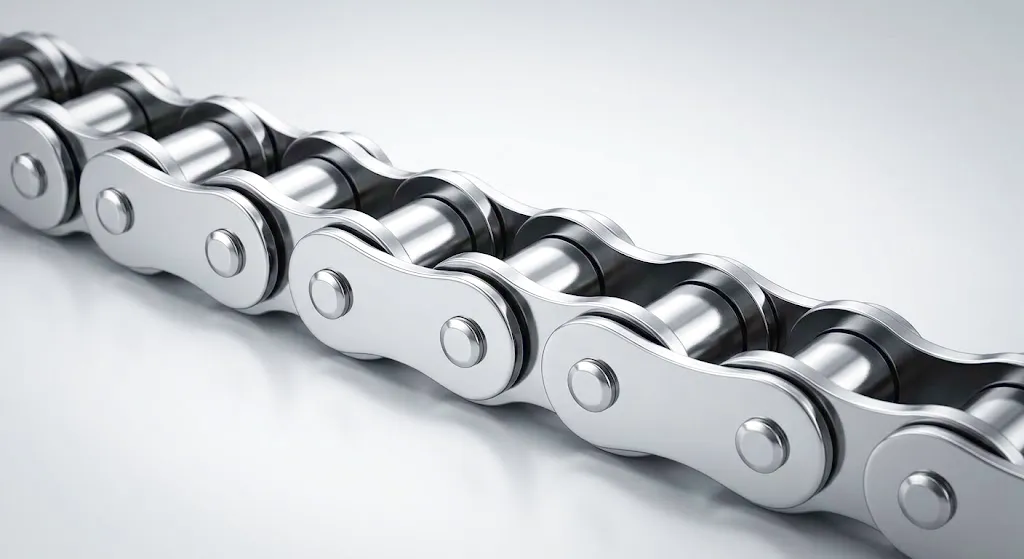
When a longwall mining machine in County Durham or an excavator on a major infrastructure contract in the Midlands fails mid-shift, the financial and safety consequences cascade instantly. At the centre of virtually every heavy-duty drive system in these environments sits the roller chain — a deceptively simple assembly of pins, bushings, rollers, and plates that translates engine torque into controlled, reliable mechanical motion. Understanding what separates a good roller chain from the wrong one is not an academic exercise; it is an operational necessity for anyone responsible for uptime in high-load industrial settings.
The roller chain market serving the UK’s mining and construction sectors has grown considerably more demanding over the past decade. Projects such as HS2 groundworks, offshore renewable foundations, and deep quarrying operations across Derbyshire and Yorkshire place unprecedented fatigue demands on drive components. Legacy chains rated for moderate agricultural or light-industrial duty simply buckle under continuous high-cycle loading at elevated temperatures, in abrasive grit, or under the impact shock loads that typify excavator slew drives and crusher feeders. This article unpacks the engineering behind heavy-duty roller chains — their composition, performance characteristics, application logic, and the factors that determine long-term total cost of ownership.
How Heavy-Duty Roller Chains Actually Work
⚙️
The Engagement Principle
A roller chain transmits power through the positive meshing of hardened rollers with sprocket teeth rather than friction. Each roller sits on a bushing, rotating freely as it contacts the sprocket tooth flank. This rolling engagement dramatically reduces tooth-face wear compared with silent chains or flat belts, delivering consistent pitch accuracy throughout the chain’s service life. In heavy mining applications — where torque spikes during rock-cutting can reach three to five times nominal operating load — that pitch consistency is what prevents tooth-jump events and catastrophic drive failure.
🔄
Pengagihan Beban
Under tension, the load path travels from the outer plate through the pin to the inner plate’s press-fit bushing. Multiple chain links share the transmitted force simultaneously across the sprocket wrap angle, spreading stress over several contact points rather than concentrating it at one. Heavy-duty designs achieve this across larger pitch dimensions — typically ANSI 80 through ANSI 240 — where the pin diameter, plate thickness, and bushing bore are all scaled proportionally to carry tensile loads well above 50 kN without permanent deformation. This geometric scaling is governed by ISO 606 and BS EN ISO 606:2015, the standard routinely specified in UK procurement contracts.
🛡️
Lubrication Film Mechanics
Pin-to-bushing articulation is where most heavy-duty roller chain wear originates. As each chain link flexes around the drive sprocket, the pin rotates inside the bushing under load. If an adequate oil film is present, the wear rate remains negligible across millions of cycles. Heavy-duty construction roller chains often feature pre-lubricated components sealed with O-ring or X-ring seals between the inner and outer plates, forming a reservoir around the pin-bushing interface. This sealed design retains lubricant even when the chain operates through abrasive rock dust, clay slurry, or high-pressure wash-down cycles — conditions that are routine on UK quarry sites in Cornwall and the Peak District.
Material Science Behind Heavy-Duty Roller Chains
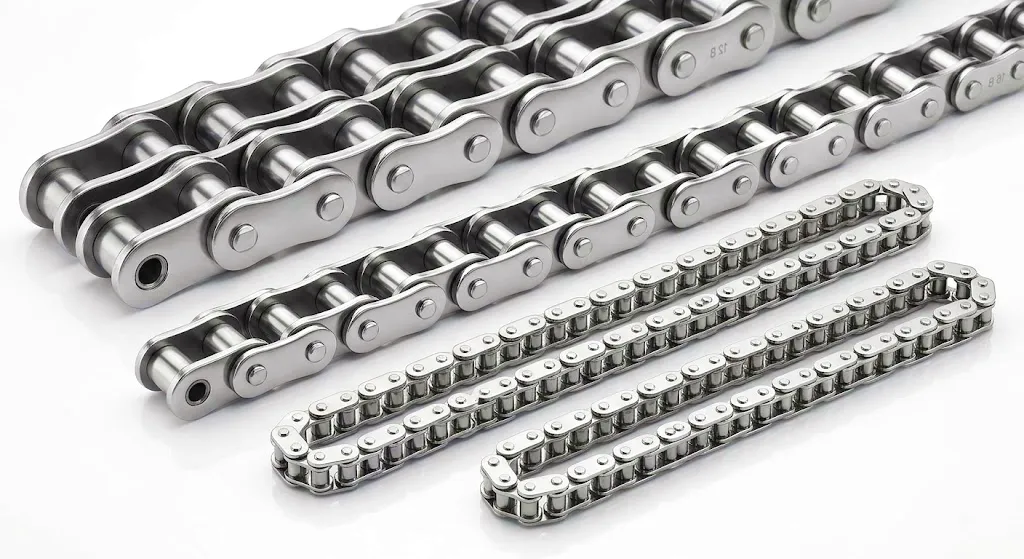
The metallurgical choices made during roller chain manufacture determine almost everything that follows — tensile strength, fatigue resistance, impact toughness, corrosion behaviour, and surface wear life. For mining and construction applications, these decisions are not arbitrary; they arise from decades of field failure analysis across operating environments that are far harsher than anything a standard conveyor system would present.
Pins in heavy-duty roller chains are typically produced from case-hardened chromium-molybdenum alloy steel (commonly 20CrMo or 20CrMnTi grades), giving a surface hardness of 58–62 HRC while retaining a tough, ductile core that absorbs impact loads without brittle fracture. Plates are stamped from carbon steel strip with controlled microalloying, then quenched and tempered to an intermediate hardness of 35–45 HRC — hard enough to resist fatigue crack initiation, yet compliant enough to deform plastically under shock loads rather than snap. Rollers are through-hardened to approximately 50–55 HRC; this slightly lower surface hardness compared to the pin ensures that the higher-value component (the pin assembly) outlives the roller, which is the designed wear element.
Corrosion protection choices vary by deployment. In coal mine ventilation conveyor systems in Nottinghamshire, zinc-nickel electroplating on the outer plates provides adequate galvanic protection without the dimensional changes that heavier coatings would introduce. In marine construction environments — particularly on North Sea platform supply vessels or coastal infrastructure work near Aberdeen — full stainless-steel construction using AISI 316L for plates and AISI 440C for rollers and pins is the engineered preference despite higher unit cost, since the alternative is accelerated pitting corrosion and unacceptable replacement frequency.
🔩
Pins & Bushings
20CrMo / 20CrMnTi alloy steel · Case hardened 58–62 HRC · Precision ground to h6 tolerance
🛡️
Plates
Quenched & tempered carbon-manganese steel · 35–45 HRC · Shot-peened for fatigue life extension
⭕
Penggelek
Through-hardened bearing steel · 50–55 HRC · Seamed or seamless tubing construction
💧
Seals
NBR / FKM O-rings or X-rings · Rated to 120°C continuous · Retains pre-packed grease under wash-down
Featured Products: High-Strength Roller Chains for Caterpillar Equipment
CAT OEM Compatible
The 120HSP-00 is engineered specifically to match Caterpillar OEM dimensional standards on large excavators and crawler dozers. It features a solid-bushing construction with hardened rollers and heavy-duty link plates — delivering breaking loads well above standard ANSI 120 chain while maintaining full pitch compatibility with Cat undercarriage sprockets. Its extended service intervals make it particularly cost-effective for high-utilisation contractors across the West Midlands and Northern England construction sectors.
Lihat Produk →
C-Series Heavy Duty
Designed for the demanding duty cycles of Caterpillar compact track loaders, skid steers, and mid-size excavators, the C100HSP-00 delivers exceptional fatigue resistance across the full range of swinging torque reversals typical in bulk earthmoving and demolition projects. The chain incorporates an X-ring seal system retaining a factory-packed synthetic grease charge, drastically extending re-lubrication intervals. This makes it ideal for construction projects at remote UK sites in Scotland, rural Yorkshire, or the Welsh valleys where routine maintenance access is limited.
Lihat Produk →
Core Technical Advantages of Heavy-Duty Roller Chain
Superior Tensile & Fatigue Strength
Heavy-duty roller chains achieve minimum tensile loads of 222 kN (ANSI 160) to 667 kN (ANSI 240), far exceeding medium-duty equivalents. The shot-peened plate surface compresses the outer layer into residual compressive stress, which significantly delays fatigue crack initiation under alternating tensile loading. For drives running 16–24 hours per day on UK aggregate conveyor systems, this translates directly into predictable overhaul intervals.
Impact & Shock Load Resistance
Construction and mining equipment generates sharp torque spikes — jaw crusher toggles, bucket-wheel reversals, and pile-driver hydraulic returns impose dynamic loads three to seven times the steady-state design load. The toughened plate geometry, with radiused relief at the pin holes, redirects stress away from the highest-concentration zones and into the broad plate body, reducing peak stress amplitude and extending chain life under these real-world conditions.
Sealed Lubrication Retention
O-ring and X-ring sealed roller chains maintain lubrication at the pin-bushing interface regardless of external contamination. Field studies in UK limestone quarry environments have shown that sealed roller chains achieve 3–5 times the service life of unsealed equivalents operating in the same grit-laden conditions. This life extension more than justifies the modest unit cost premium, particularly in remote sites where labour access for re-lubrication is expensive and disruptive.
Dimensional Interchangeability
Conformance to ANSI B29.1 and BS EN ISO 606:2015 means that well-manufactured heavy-duty roller chains from any compliant supplier are dimensionally interchangeable. Procurement teams at large UK plant hire companies benefit significantly from this standardisation: emergency replacement chains can be sourced from multiple approved suppliers without requiring sprocket or frame modifications, reducing unplanned downtime risk on critical project timelines.
Product Technical & Performance Parameters
| Chain Standard |
Pitch (mm) |
Min. Tensile Load (kN) |
Diameter Pin (mm) |
Plate Thickness (mm) |
Surface Hardness (HRC) |
Seal Type |
Aplikasi Lazim |
| ANSI 80 / ISO 16A |
25.40 |
55.6 |
7.94 |
2.4 |
58–62 |
Open / O-ring |
Compact loaders, auger drives |
| ANSI 100 / ISO 20A |
31.75 |
87.0 |
9.54 |
3.0 |
58–62 |
O-ring sealed |
Mid excavators, screening plants |
| ANSI 120 / ISO 24A |
38.10 |
127.0 |
11.11 |
3.6 |
58–62 |
X-ring sealed |
Cat 320/323 excavators, dozers |
| ANSI 160 / ISO 32A |
50.80 |
222.0 |
14.29 |
4.8 |
60–64 |
X-ring / metal seal |
Mining conveyors, quarry crushers |
| ANSI 200 / ISO 40A |
63.50 |
356.0 |
19.05 |
6.0 |
60–64 |
Metal-to-metal seal |
Deep mining haulage, draglines |
| ANSI 240 / ISO 48A |
76.20 |
534.0 |
22.23 |
7.2 |
60–64 |
Metal-to-metal seal |
Longwall shearers, heavy dozer track |
Industrial Application Scenarios in Mining and Construction
⛏️ Underground Coal Mining — Nottinghamshire & County Durham
Longwall shearer haulage drives depend on the roller chain to translate the haulage motor’s torque into controlled lateral progression along the face. In this environment the chain is continuously exposed to coal dust, water mist from dust suppression, and the mechanical shock of cutting through hard rock inclusions. Heavy-duty sealed roller chains in ANSI 200 to ANSI 240 pitch serve these drives for extended maintenance cycles measured in months rather than weeks, delivering a significant reduction in face-downtime hours compared with lighter alternatives used historically.
🏗️ Surface Quarrying — Peak District & Welsh Slate Quarries
Jaw and cone crusher feeder conveyors in limestone and slate quarrying operations cycle continuously under variable tonnage, with raw stone blocks impacting the chain conveyor’s flights unpredictably. The roller chain selected for these feeders must absorb both the sustained tension load of the material weight and the instantaneous impact of oversize boulders. ANSI 160 X-ring sealed chains have proven particularly appropriate here, with documented service lives of 18–24 months between planned replacements even in high-abrasive environments throughout Derbyshire operations.
🚜 Large Excavator Undercarriage — Midlands Infrastructure
Cat 320, 330, and 390 excavator undercarriage track systems operating on the HS2 construction corridor in the West Midlands require precisely sized OEM-compatible roller chains that can withstand continuous ground engagement loads, sudden slew-and-swing dynamics, and the weight of heavy attachment work. The 120HSP-00 and C100HSP-00 series are dimensionally engineered for full CAT compatibility, providing exact pitch match to factory sprockets while delivering the tensile and fatigue margins required for round-the-clock operation on major contract sites.
⚡ Aggregate Processing Plants — Yorkshire & Lincolnshire
Sand and gravel washing, screening, and conveying plants present a unique challenge: the combination of constant moisture, silica particles in suspension, and the relentless duty cycle of 24/7 production. Stainless-steel or nickel-plated heavy-duty roller chains in these systems resist the accelerated corrosion that standard carbon-steel designs suffer under continuous wet-abrasive exposure. Plants operating near coastal sites in Lincolnshire benefit especially from corrosion-resistant roller chain selection, where salt-laden air compounds the already aggressive process environment.
🔧 Steel & Metal Processing — Sheffield & Birmingham
Sheffield’s surviving special-steel and fabrication sector, alongside Birmingham’s precision engineering firms, operate roller conveyor and transfer systems where elevated temperatures add an additional material-selection dimension. High-temperature roller chains designed with heat-resistant alloy content and high-temperature grease formulations can operate continuously up to 300°C without accelerated elongation or seal degradation. For furnace chain conveyors in Sheffield’s electric arc furnace support operations, this thermal stability is the decisive selection criterion rather than tensile load alone.
🌊 Marine & Port Infrastructure — Aberdeen & Bristol Docks
Ship-to-shore crane slewing and hoisting mechanisms on Aberdeen’s harbour facilities and Bristol’s deep-sea import terminals rely on high-cycle, high-load roller chains engineered for corrosion resistance. The constant salt-spray exposure, potential for immersion during storm surge events, and the critical safety-critical nature of crane load handling demand a combination of stainless construction, premium sealing, and documented certification to Lloyd’s Register or equivalent marine classification body standards. Lead times for certified marine-grade roller chains from domestic UK stock remain a key procurement consideration for port operators.
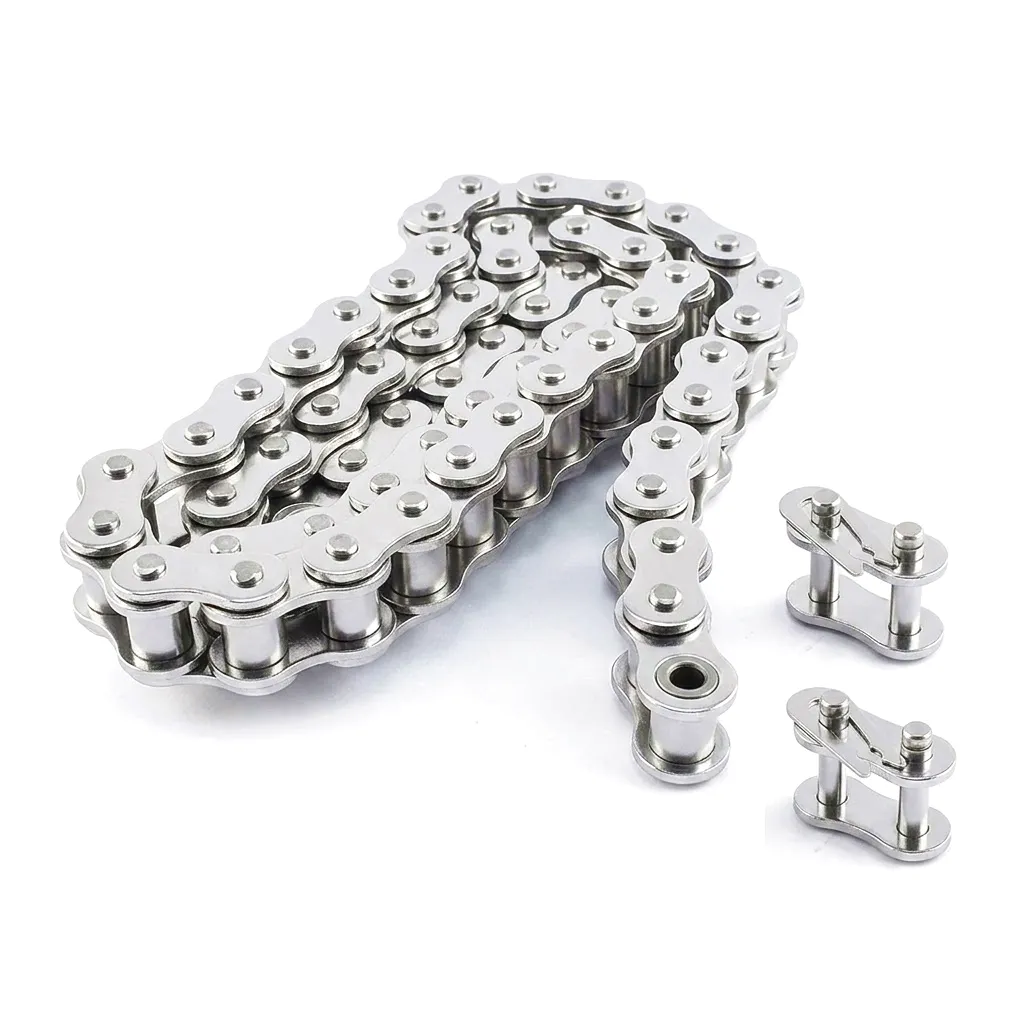
Ever Power: Manufacturing Capability & Customisation Services
Factory & Supply Chain
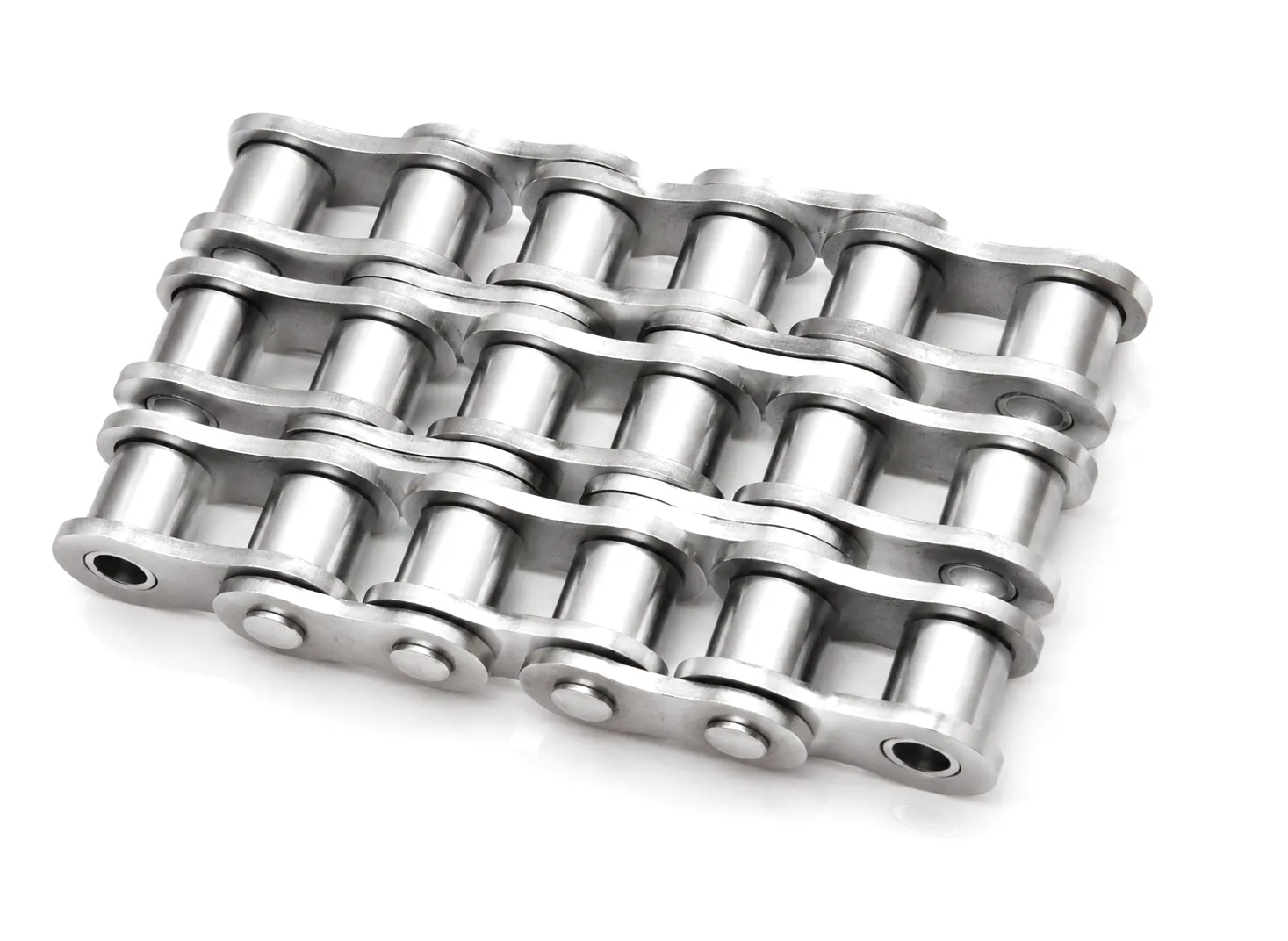
Ever Power operates a dedicated heavy-duty roller chain manufacturing facility equipped with cold-forging press lines, precision CNC pin-turning centres, continuous mesh-belt carburising furnaces, and automated assembly and inspection lines. Our production capacity is structured to fulfil both standard catalogue orders and fully bespoke engineered solutions within commercially competitive lead times, serving UK distributors with ex-stock availability on common ANSI and ISO metric pitches alongside custom-specification delivery for non-standard requirements.
Custom Pitch Engineering
Non-standard pitch intervals from 15.875 mm to 152.4 mm, including metric and imperial variants, produced against customer drawings or reverse-engineered from physical samples.
Material Specification Control
Full material traceability with mill certificates. Grade selection from standard carbon-steel through to 316L stainless, Duplex 2205, and heat-resistant alloys — documented for UK client audit requirements.
QC & Certification
ISO 9001:2015 quality management with batch-level Vickers hardness testing, dimensional CMM inspection, and destructive tensile break-load testing — results supplied with each shipment.
UK Logistics & Lead Time
Sea freight via Felixstowe and Southampton with bonded warehouse partners near Birmingham’s import logistics hub. Standard delivery to UK mainland sites within 18–25 working days; airfreight expedite available on confirmed purchase orders.
Customer Success Story: Barnsley Quarry Operations
📍 Barnsley, South Yorkshire · Hard Rock Quarrying
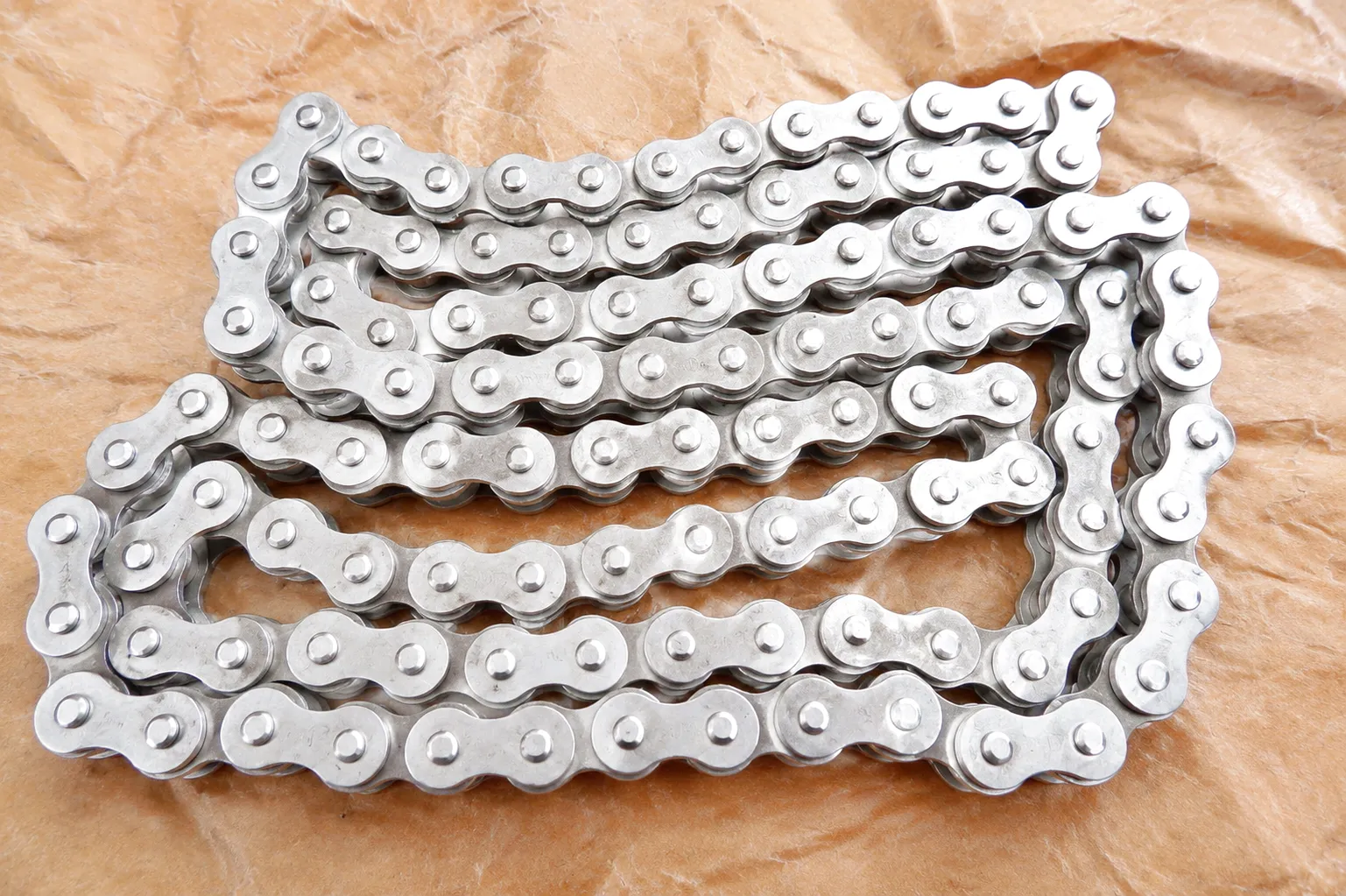 A major hard-rock aggregate producer operating two primary jaw crushers and a double-deck vibrating screen plant outside Barnsley had been experiencing unacceptable downtime due to roller chain failure on their main feeder conveyor system. The operation runs two production shifts daily, six days per week, producing approximately 4,500 tonnes of crushed gritstone per day for road construction contracts across South Yorkshire and North Lincolnshire. Their existing chain — an unsealed ANSI 160 carbon-steel product sourced from a domestic UK distributor — was requiring full replacement every four to five months, with the associated crane-assisted changeout taking 14 hours of planned production stoppage per event.
The plant engineering team contacted Ever Power following a recommendation from their cat equipment dealer’s parts department, who had observed the 120HSP-00 chain’s performance in a comparable Yorkshire coal handling facility. After a site survey and review of the plant’s torque and speed duty data, Ever Power’s technical team recommended transitioning to a sealed X-ring ANSI 160 heavy-duty roller chain with alloy-steel construction and a factory pre-loaded synthetic grease charge.
The trial order covered two full feeder conveyor chains plus a maintenance inventory of six connecting links and two half-links. Installed in March, the chains completed their first 12-month inspection interval with a measured elongation of 1.1% — comfortably within the 2% maximum that triggers replacement. The second planned inspection at 18 months confirmed continued serviceability. The plant engineering manager estimated the annualised saving from extended chain life and eliminated unplanned downtime at approximately £38,000 per year across both crusher lines — making the premium-specification roller chain investment self-liquidating within the first chain set’s lifetime.
★★★★★
“We ran the Ever Power X-ring sealed chain through a full Yorkshire winter — constant freeze-thaw, sleet and abrasive grit blasting. At the 12-month mark, elongation was still under 1.2%. That’s a completely different performance picture from what we were used to. The technical support during sizing was excellent — they actually understood our crusher duty cycle, not just the catalogue numbers.”
— Plant Engineering Manager, Barnsley Aggregate Operations
★★★★★
“The C100HSP-00 fits our Cat 315 excavator sprockets precisely — no shimming, no grinding, just bolt-on replacement. On a remote Scottish forestry site, that kind of dimensional reliability is not a nice-to-have, it’s the whole job. Ordering was straightforward, documentation pack arrived ahead of the shipment, and the chain was on-machine within two days of delivery. We’ve ordered six more sets for our fleet.”
— Plant Hire Fleet Manager, Central Scotland Civil Contractor
★★★★★
“We approached Ever Power for a stainless-steel roller chain to a non-standard 44.45 mm pitch for our marine crane hoisting system at the Bristol facility. They quoted within 48 hours, provided a full material traceability pack with the delivery, and the chain certified to the load we needed without any back-and-forth. For a niche specification like ours, finding a supplier that actually has the manufacturing range to deliver — not just promise it — makes the price difference completely worthwhile.”
— Procurement Engineer, Bristol Port Infrastructure Group
Roller Chain Selection: Key Considerations for UK Procurement Engineers
Specifying the correct heavy-duty roller chain for a mining or construction application requires more than matching the pitch number from an existing chain. The service factor — a multiplier applied to the nominal design load that accounts for shock, reversal frequency, and misalignment — determines the effective required tensile rating. A drive running smooth single-direction loading might apply a service factor of 1.0 to 1.3, while a crusher feeder experiencing severe intermittent shock loads might require a service factor of 1.7 to 2.0, substantially increasing the minimum acceptable chain grade.
Chain speed is equally critical. At elevated speeds above 3–4 m/s, roller impact forces on sprocket teeth increase non-linearly. Heavy-duty roller chains in fast-running conveyor return circuits therefore need consistent pitch accuracy across their full length to prevent cumulative polygon-effect vibration that accelerates tooth wear. Specifying pre-stretched or post-assembled length-certified chains adds cost but substantially reduces commissioning time and early-life elongation on fast drives in screening plant applications across Yorkshire and Lincolnshire operations.
The decision between O-ring and X-ring sealed variants versus open-construction chains also warrants careful analysis. In clean or well-guarded indoor environments — such as covered aggregate transfer conveyors — open chains with an automatic lubrication system can achieve excellent life at lower initial cost. In exposed outdoor mining environments, however, the sealed chain’s self-contained lubrication reservoir consistently proves more economical over a three-year total cost of ownership horizon, because the labour and material cost of field lubrication under difficult conditions exceeds the sealed chain’s cost premium within the first 12 months of operation.
Soalan Lazim
How do I know which size of heavy-duty roller chain is right for my mining conveyor in the UK?
Chain selection starts with identifying your drive’s power (kW), shaft speed (rpm), and the service factor appropriate to your load type — typically 1.4–2.0 for mining conveyors with shock loading. From these three figures you can calculate the design chain tension, which directly maps to an ANSI or ISO pitch class. Ever Power’s technical team can assist with free sizing support — just email your duty data to
[email protected].
What is the typical price range and how can I get a quote for custom heavy-duty roller chain supplied to a construction site in Birmingham or Sheffield?
Pricing depends on pitch class, seal type, material specification, and order quantity — standard ANSI 80 open chain runs at a significantly lower unit price than sealed ANSI 160 stainless product. To get an accurate, site-specific quote for delivery to Birmingham, Sheffield, or any other UK location, send your specification or existing chain details to
[email protected] and Ever Power will respond within one business day with a CIF UK port price and estimated delivery schedule.
Which roller chain supplier in the UK can provide certified documentation and material traceability for heavy mining equipment maintenance contracts?
Maintenance contracts for underground mining equipment and large surface quarry plant in the UK increasingly demand batch-level material certificates, hardness test results, and dimensional inspection reports. Ever Power routinely supplies a full quality documentation package — including EN 10204 3.1 material certificates, hardness test records, and dimensional inspection data — with every order, at no additional charge on orders above minimum batch quantities.
How long does a heavy-duty roller chain typically last on a jaw crusher feeder conveyor operating in a UK quarry environment?
Service life depends heavily on chain specification, maintenance regime, and operating environment. An unsealed standard chain in an abrasive UK quarry might require replacement every 4–6 months. An X-ring sealed heavy-duty roller chain of the same pitch, correctly tensioned and operating with protected sprockets, typically achieves 14–22 months before elongation reaches the 2% replacement threshold. The Barnsley case study documented on this page achieved 18+ months with measured 1.1% elongation at the first annual inspection.
Where can I find a reliable roller chain manufacturer who can supply CAT-compatible chains for excavator undercarriages on large UK construction projects?
Ever Power manufactures the 120HSP-00 and C100HSP-00 series specifically to Caterpillar OEM dimensional requirements, providing a fully interchangeable alternative to dealer-supplied chains with the benefit of direct manufacturer pricing. These products are available to UK construction companies and plant hire firms through direct purchase — visit the product pages linked in this article or contact
[email protected] with your Cat model and undercarriage specification for a prompt, accurate quotation.
What is the cost difference between sealed and unsealed roller chains when calculating total cost of ownership over a three-year period for a Yorkshire aggregate plant?
Sealed roller chains typically carry a 25–45% unit price premium over comparable unsealed equivalents. However, in aggregate plants operating in Yorkshire’s abrasive environment, sealed chains often achieve two to three times the service life — meaning the total cost of chain material over three years is frequently lower with sealed product even before accounting for the labour, crane hire, and production lost during changeover. On a two-shift, six-day operation, each avoided changeover event saves an estimated 14–18 hours of chargeable production time.
Ready to Specify the Right Roller Chain for Your Project?
Send your duty data, chain dimensions, or CAT model reference to Ever Power’s technical team. UK-compatible documentation supplied with every order.
Get a Quote: [email protected]
suntingan oleh gzl