 Across the shop floors of Birmingham, the fabrication yards of Sheffield, and the food processing plants scattered through the East Midlands, one question surfaces more often than almost any other in conveyor and drive system maintenance: how much slack is actually acceptable in a roller chain, and when does sag become a liability? The answer is not as simple as a single measurement. Correct tensioning sits at the intersection of chain pitch, sprocket geometry, centre distance, operating temperature, and the dynamic load behaviour of whatever machinery the chain is driving.
Too tight, and you impose unnecessary radial loads on shaft bearings, accelerate bushing and pin wear, and risk catastrophic fatigue failure under cyclic loading. Too loose, and the chain skips on the sprocket teeth, generates impact loads at re-engagement, and eventually derails — taking connected equipment with it. Getting the tensioning window right is not a matter of feel or rule-of-thumb guessing; it is an engineering discipline built on measurable tolerances, load curves, and an understanding of how roller chains actually work under real industrial conditions.
The Mechanics of Roller Chain: Understanding What You Are Tensioning
Drive Principle
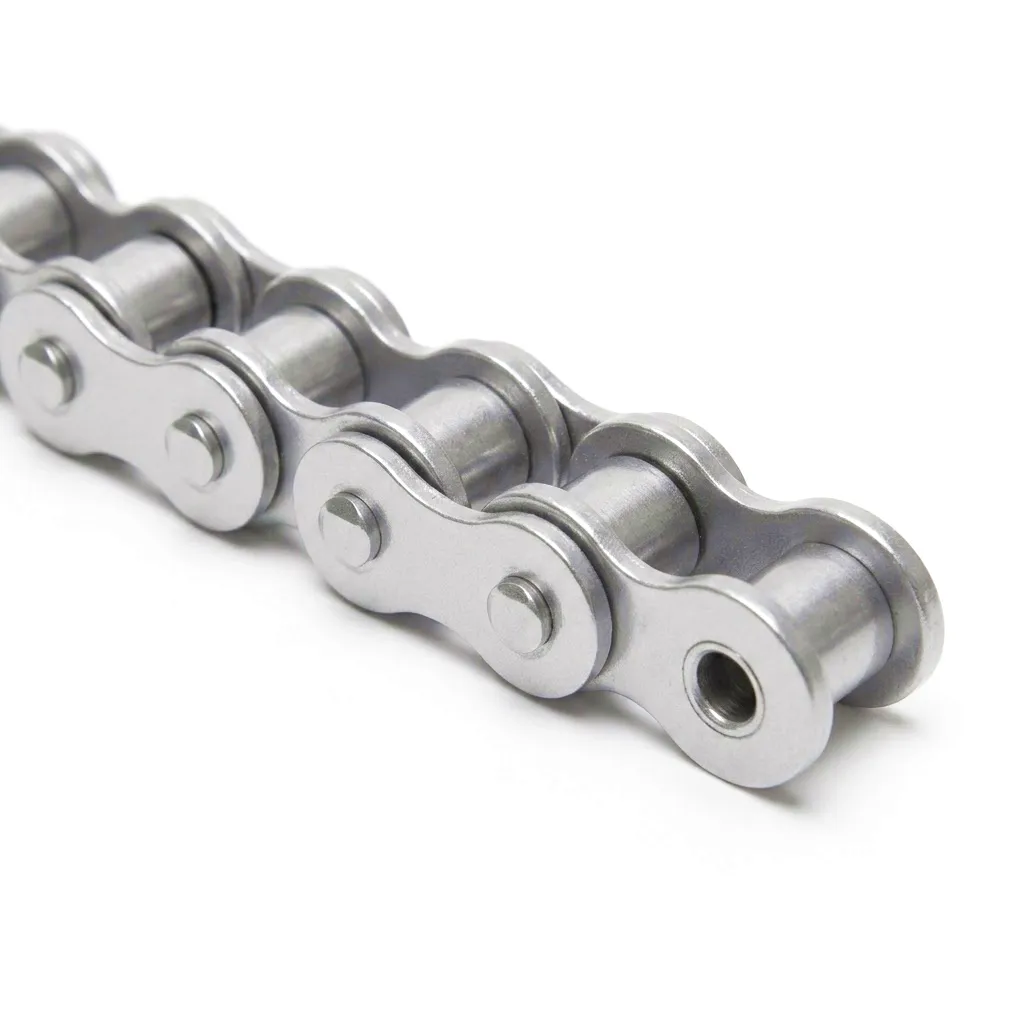
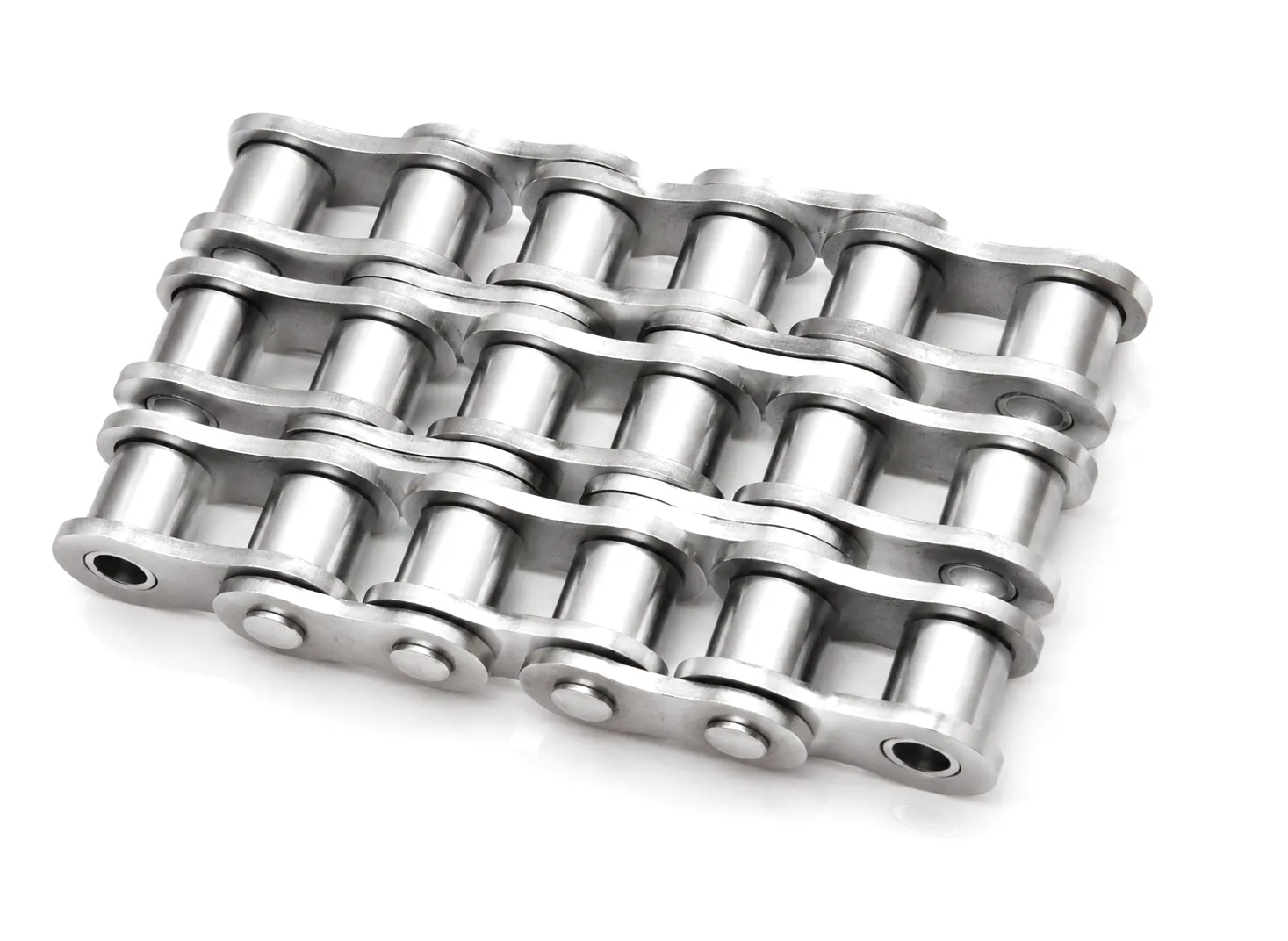
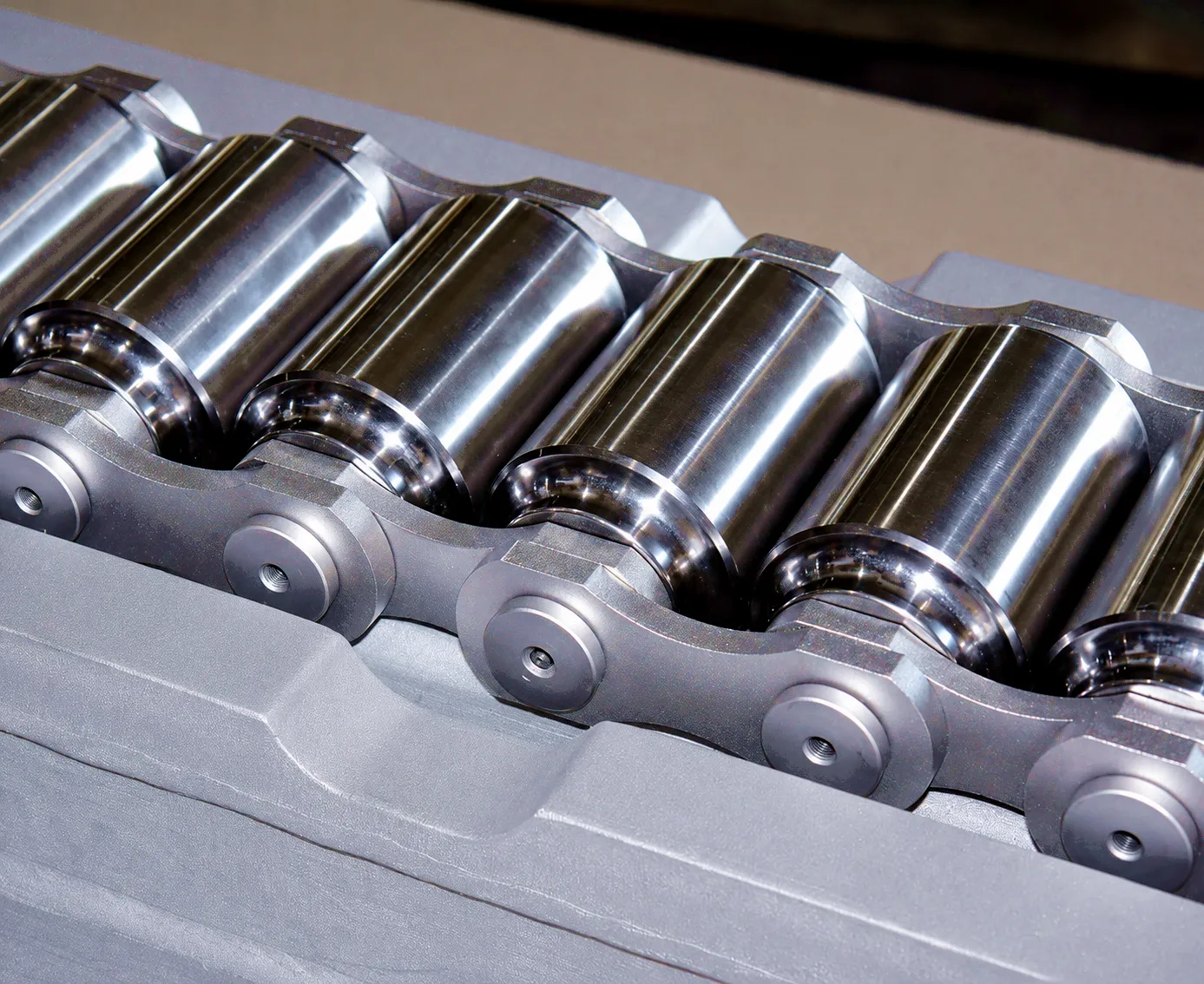
A roller chain transmits power by engaging hardened steel rollers with the teeth of matched sprockets. The chain is an assembly of alternating inner links — each consisting of two inner plates, two bushings, and a roller — and outer links, each formed by two outer plates and a pin. When the driving sprocket pulls the chain, tensile force travels through the pins and plates while the rollers roll, rather than slide, over the sprocket teeth. This rolling contact is what gives roller chain its high mechanical efficiency, typically above 98%, and it is also what makes correct tensioning so critical: rollers that are forced to engage teeth under impact because of excessive slack do not roll cleanly — they smash, deform, and wear at a dramatically accelerated rate.
Chain Elongation Reality
All roller chains elongate over time. This is not a defect — it is the predictable result of pin-to-bushing wear at every articulation point. As the chain circulates around its sprockets, each link joint rotates by a small angle twice per revolution, and each rotation removes a microscopic amount of material from the contacting surfaces. Over millions of cycles, this wear accumulates into what is commonly called chain stretch. A chain is typically considered end-of-life when elongation reaches 3% for standard drives and 1.5% for precision indexing applications. Understanding this wear mechanism is essential before addressing tensioning, because the tensioning system must accommodate progressive elongation while keeping slack within safe operating limits throughout the chain’s service life.
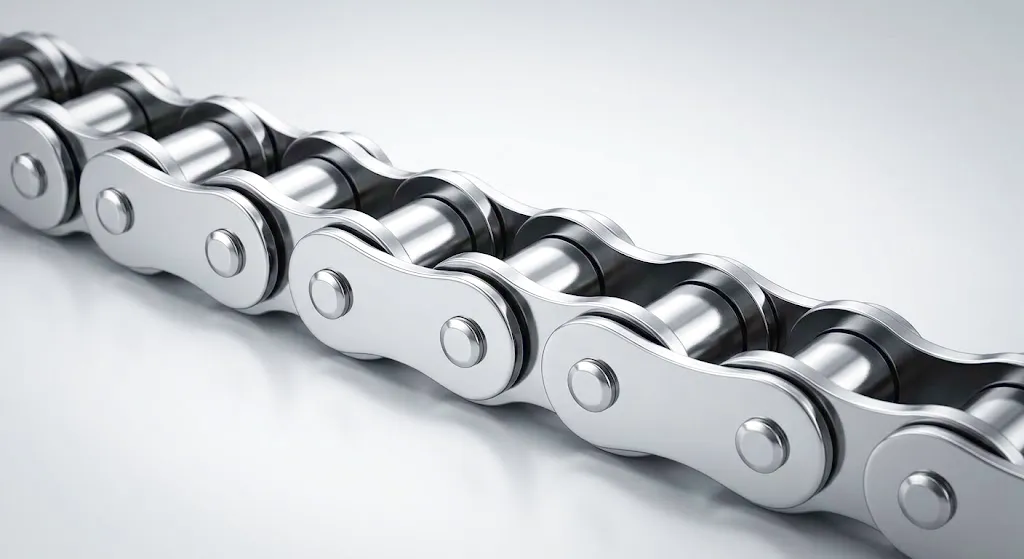
The relationship between chain pitch accuracy and tensioning behaviour is direct. A chain manufactured to tight pitch tolerances — meaning the nominal distance between pin centres is consistent across every link — will distribute tensile load evenly and sit correctly on sprocket teeth. A chain with pitch variation caused by poor manufacturing will create a polygonal effect even when correctly tensioned, producing vibration and accelerated wear on specific links. This is why sourcing roller chain from a manufacturer with precision machining capability and rigorous quality inspection is not simply a cost consideration — it is a fundamental technical requirement for any drive that must operate reliably over a full maintenance interval.
Material Science Behind Roller Chain Components
Pins & Bushings
High-carbon alloy steel, case-hardened to 58–62 HRC on the surface with a tough core. The hardening depth is controlled to prevent brittleness while maximising wear resistance at the contact zone.
Silindirler
Low-carbon steel shells, carburised and quenched. The outer surface achieves 58–62 HRC; the inner surface remains softer to absorb impact without cracking when the roller seats against the sprocket tooth.
Bağlantı Plakaları
Medium-carbon steel, shot-blasted and heat-treated to improve fatigue strength. The figure-eight profile of standard link plates is engineered to keep stress concentration at the pin holes below the material’s fatigue limit under rated loads.
Stainless & Specialty Grades
304 and 316L stainless steel variants are available for corrosive environments. Nickel-plated, self-lubricating sintered bushing, and O-ring sealed versions extend relubrication intervals, which directly affects how quickly a chain elongates and how tensioning requirements evolve over time.
Defining Acceptable Slack: The Engineering Standard
The industry-standard rule, consistent with BS/ISO 606 guidance and the recommendations published by major roller chain standards bodies, places acceptable slack at approximately 2% of the centre distance between sprocket shafts for horizontal drives with both shafts at the same elevation. This means that on a drive with a 500 mm shaft centre distance, the total vertical deflection of the slack-side span when pushed by hand should measure around 10 mm. For drives where the slack-side span is inclined — where the lower run of chain lies on the loose side — the permitted sag reduces, typically to 1% to 1.5% of centre distance, because gravity compounds the sag effect and increases the risk of chain jump at start-up under load.
2%
of centre distance — standard horizontal drive slack allowance
1–1.5%
for inclined drives or drives with significant shock loading
3%
elongation limit — replacement threshold for standard drives
Vertical drives — where both shafts are stacked and the chain moves vertically — require the tightest tensioning approach of all, because gravity acts uniformly on the entire slack span. The standard practice for vertical drives is to minimise slack to the lowest practical value that prevents the chain from running under tension on both sides simultaneously. Achieving this typically requires a tensioner sprocket or a chain guide on the slack side. High-speed drives above 600 rpm also call for tighter tensioning control, as the increased centrifugal force causes the chain to stiffen and behave differently compared to low-speed power transmission applications.
Warning: Over-tensioning Is Equally Destructive
Many engineers, having witnessed chain skip or derailment caused by excessive slack, overcorrect by running chains extremely tight. This introduces very high radial bearing loads — sometimes three to five times the load from the transmitted torque alone — and causes rapid fatigue in link plates. On larger drives operating in the UK’s heavy fabrication sector, this is a frequent cause of premature bearing replacement intervals and unexplained plate fracture failures. The answer is not maximum tightness; it is correct tightness within the defined tolerance window.
Makaralı Zincir Teknik ve Performans Parametreleri
| Parametre | BS/ISO Range | Typical Value | Notes |
|---|---|---|---|
| Ses Aralığı | 6,35 mm – 76,2 mm | 12.7 mm (No. 40); 15.875 mm (No. 50) | Per ISO 606 / BS 228 |
| Breaking Load (08B) | min. 17.8 kN | 18.2 – 19.5 kN | 12.7 mm pitch, BS standard |
| Breaking Load (16B) | min. 60 kN | 62 – 66 kN | 25.4 mm pitch, BS standard |
| Allowable Slack (Horizontal) | 1.5% – 2.5% of C/D | 2% of centre distance | Measured as span deflection |
| Allowable Slack (Inclined) | 1% – 1.5% of C/D | 1.2% of centre distance | Incline angle > 45 degrees |
| Elongation Limit (Standard) | 3% max | Replace at or before 3% | Measured over 12 pitches |
| Elongation Limit (Precision) | 1.5% maks. | Replace at 1.5% | Indexing and timing drives |
| Surface Hardness (Pin) | 58 – 62 HRC | 60 HRC typical | Case hardened alloy steel |
| Operating Temperature (Standard) | -10 C to +150 C | Ambient up to 120 C typical | Stainless / heat-treat for higher |
| Speed Limit (No. 40 / 08B) | up to 2,800 rpm | 600 – 1,500 rpm most common | Depends on lubrication method |
| Transmission Efficiency | 97% – 98.5% | 98% well-lubricated | Higher than V-belt for most applications |
| Lubrication Interval (Oil Bath) | Continuous | Check/change every 3–6 months | Most effective method |
Specialist Chain Options for Demanding UK Applications
Standard roller chain covers the majority of drive and conveyor applications across UK manufacturing, but certain material handling and food processing environments in the West Midlands and across Yorkshire’s processing sector demand chains designed specifically for surface contact, contamination resistance, or grip under load. Ever Power’s rubber top chain range addresses these requirements with precision-manufactured attachments moulded directly onto standard BS-pitch chain assemblies.
24B-G1 Kauçuk Üst Makaralı Zincir
With a 38.1 mm pitch and high-load break strength, the 24B-G1 is designed for heavy conveying applications where rubber top contact protects delicate goods or provides non-slip transport on inclined runs. Correct tensioning on inclined conveyor drives using this chain should target 1.2% to 1.5% of centre distance.
20B-G1 Kauçuk Üst Makaralı Zincir
The 20B-G1 at 31.75 mm pitch covers the mid-range conveyor market — widely used across Birmingham’s automotive components logistics and Leeds packaging machinery. Its rubber pad bonding withstands repeated flexion and the tensioning protocol matches standard 20B: 2% sag on horizontal runs.
Tensioner Methods: Choosing the Right Approach for Your Drive
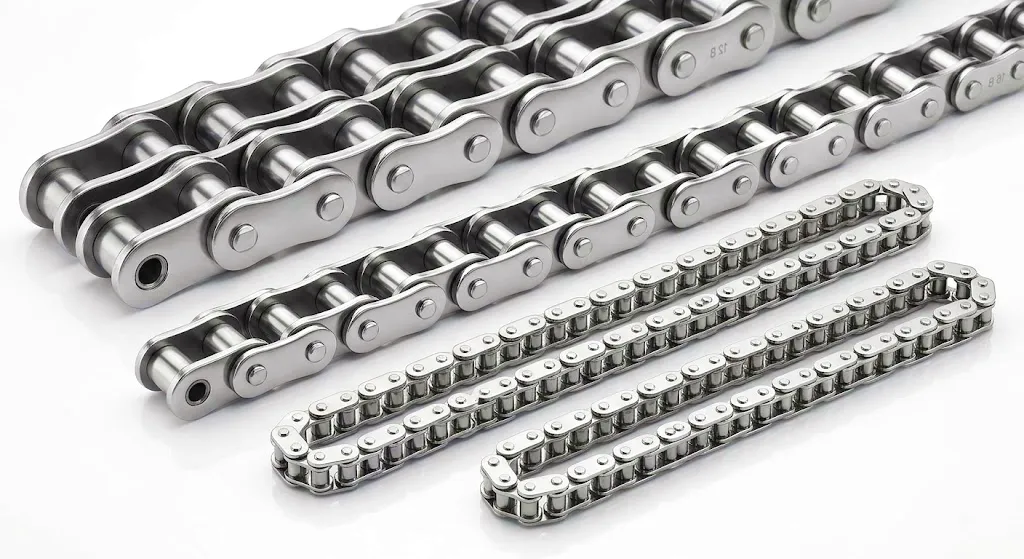
Adjustable Centre Distance
The most common method on enclosed drives. One shaft housing is mounted on slotted plates, allowing the engineer to slide it further from the drive shaft as the chain elongates. Simple, effective, and requires no additional components. Recommended as the primary tensioning strategy on new drive designs wherever layout permits.
Jockey / Idler Sprocket
A free-running sprocket on a fixed or spring-loaded arm presses against the slack side of the chain. Idler sprockets engage on the outside of the chain (adding tension by pulling the slack side taut) or the inside (reducing effective centre distance). Spring-loaded idlers automatically compensate for elongation and are favoured in UK agricultural machinery and conveyor systems where access for manual re-tensioning is restricted.
Chain Guides / Slipper Rails
Polymer-faced guides support the chain’s slack span between sprockets, preventing excessive sag on long centre distances. Particularly relevant for conveyor applications in Sheffield’s materials handling sector, where sprocket centre distances may exceed 2,000 mm. Guides do not actively tension the chain but hold sag within the 2% limit without requiring mechanical adjustment.
Link Removal
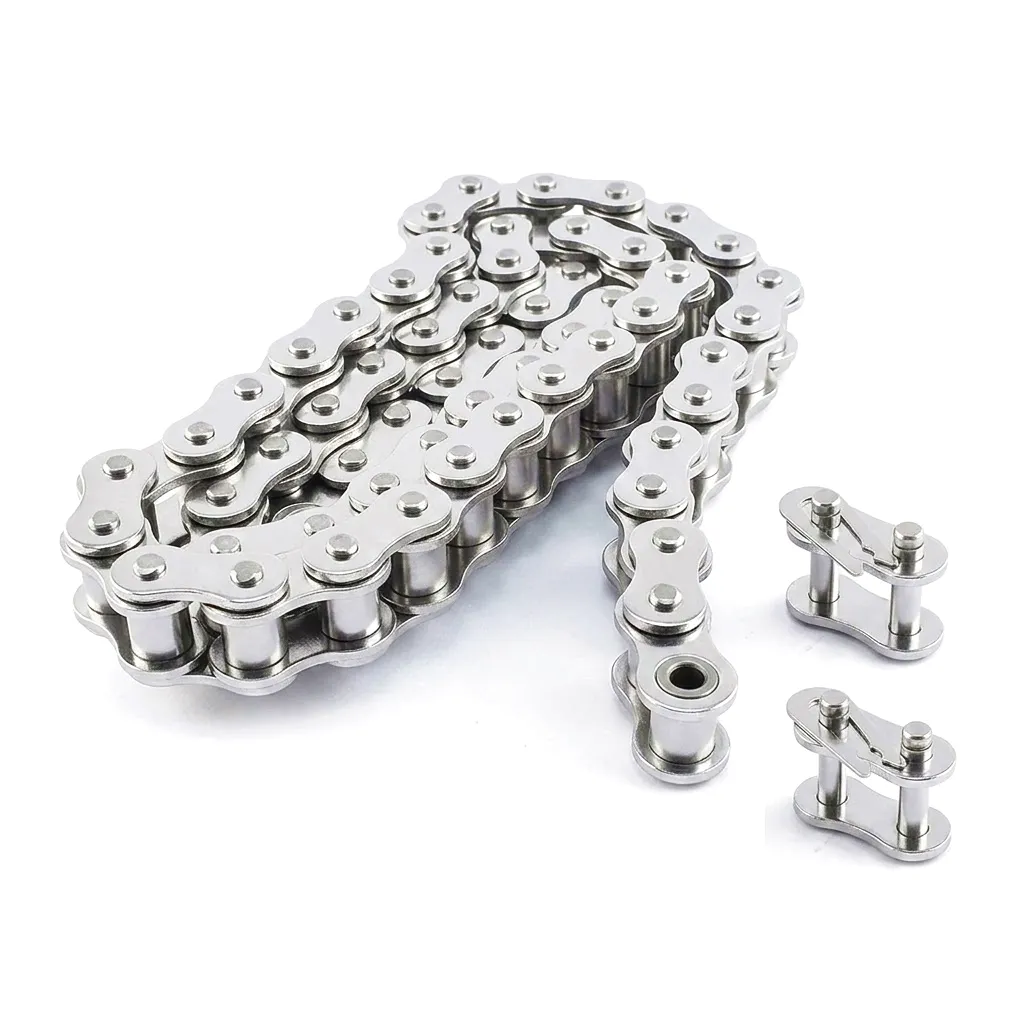
When a chain has elongated to the point where the adjustable centre distance range is exhausted, removing a link pair — one inner and one outer link — effectively shortens the chain and restores correct tension. This requires a chain breaker tool and a connecting link of the correct pitch. Link removal is a legitimate maintenance operation but should not be done more than once on any chain without re-evaluating whether the chain has reached its replacement threshold.
Application Scenarios: Where Tensioning Precision Matters Most
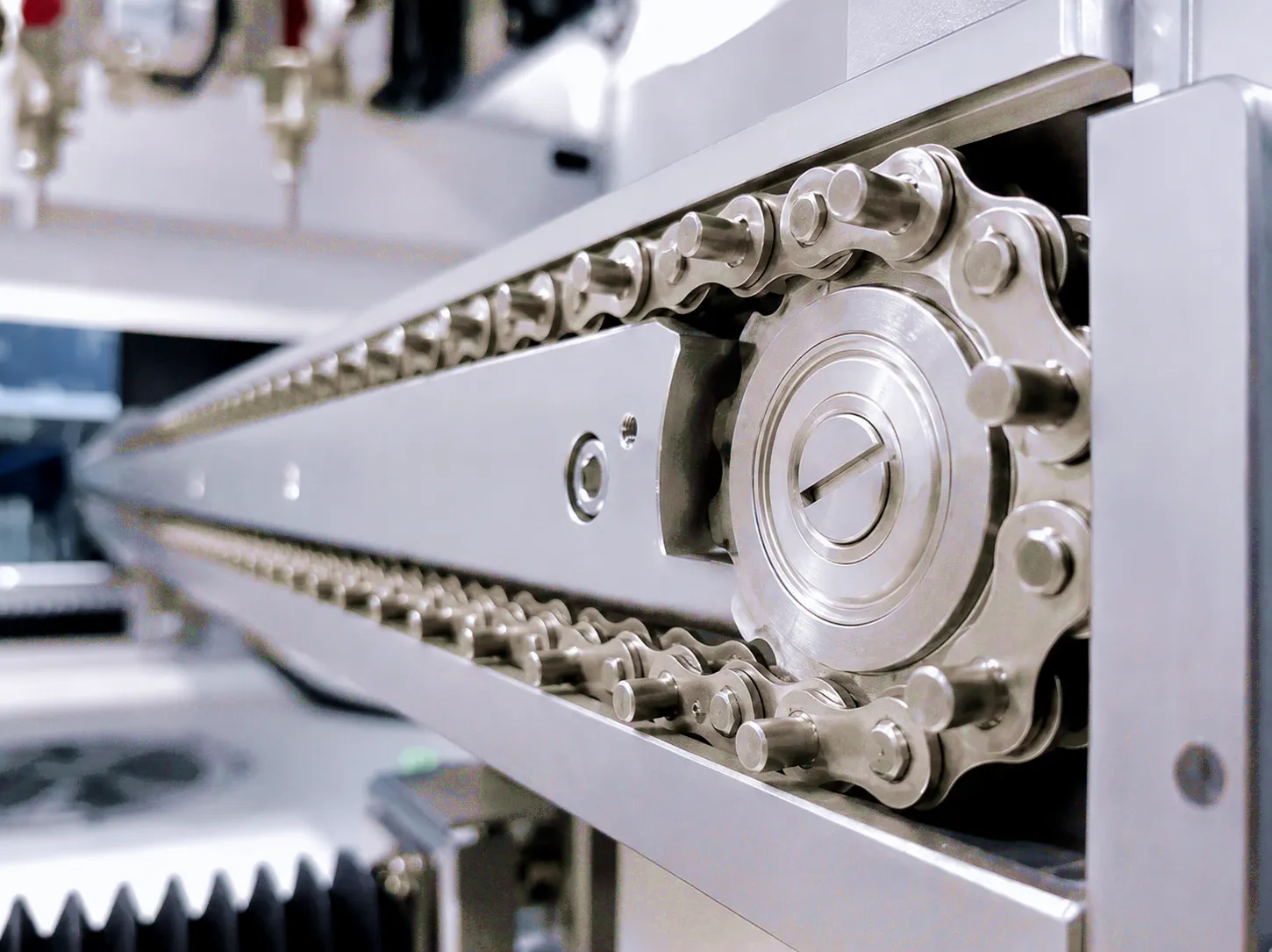
Automotive Manufacturing — Birmingham and Coventry
Transfer conveyors and body-in-white assembly lines in Birmingham’s automotive supply chain run continuous duty cycles, often 20 hours per day. Chain tensioning in these environments is scheduled into planned maintenance windows and monitored with elongation gauges rather than measured by deflection alone. Correct tension here is not simply about avoiding skip — it determines the dimensional accuracy of the transferred components across the line length, which feeds directly into assembly tolerance stacks.
Steel and Fabrication — Sheffield and Rotherham
Roller chain drives on rolling mill tables and furnace conveyors in Sheffield’s steel sector experience thermal expansion alongside mechanical load. At operating temperatures above 80 degrees Celsius, chain pitch effectively increases, which reduces the tension in a previously correctly set drive. Engineers in this sector must account for thermal expansion in the initial cold-set tension, typically reducing cold slack to 1.5% rather than 2% to allow for thermal relaxation at working temperature.
Food and Beverage Processing — Yorkshire and the North West
Food grade conveyors across Yorkshire’s dairy and bakery sectors demand stainless steel or nickel-plated roller chain to meet hygiene standards. These chains are typically washed down with high-pressure water jets, which strips lubrication rapidly. The consequence is accelerated wear and faster elongation, which means tensioning inspection intervals must be significantly shorter — typically weekly rather than monthly — to prevent sag from exceeding the safe limit between scheduled maintenance stops.
Agricultural Machinery — East Midlands and Lincolnshire
Combine harvester threshing drives, baler feeders, and grain conveyor auger drives operate under highly variable shock loads as material density fluctuates. Roller chain on these drives must be tensioned conservatively — typically towards the tight end of the 1.5% to 2% window — because shock loading on an overtly slack chain causes instantaneous impact loads that can fracture connecting links. PTO driveline chains on agricultural equipment are particularly sensitive to tensioning errors because they see rapid speed changes during engagement and disengagement.
Why Precision-Manufactured Roller Chain Delivers Superior Tensioning Stability
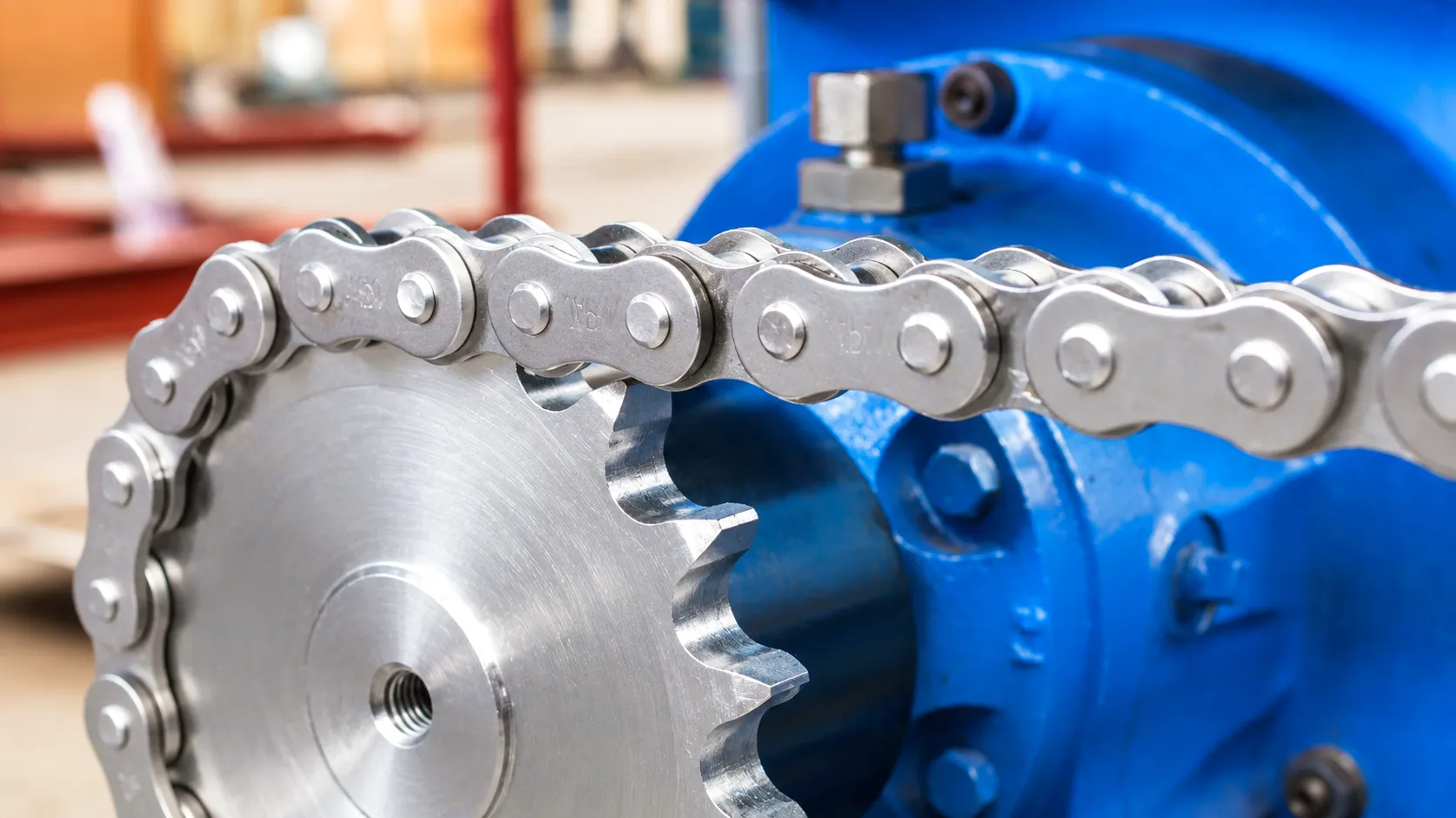
Tight Pitch Tolerance Manufacturing
Precision-ground pins and reamed bushing bores hold pitch tolerance within ±0.05 mm, dramatically reducing the polygonal effect at the sprocket and ensuring that tension distributes evenly rather than varying link-by-link. This is the single most important manufacturing parameter for tensioning stability over the chain’s operating life.
Controlled Case Hardening Depth
Case hardening depth on pins and bushings is controlled to 0.3 – 0.6 mm. A too-shallow case wears through rapidly; a too-deep case creates a brittle component that cracks under impact. Correct hardening profile means wear occurs at the predicted rate, making elongation — and therefore tensioning intervention — predictable and plannable.
Pre-loading at Assembly
Quality roller chain undergoes controlled pre-stretching during assembly to seat the pin-to-bushing interface and stabilise initial pitch. This reduces the rapid elongation that otherwise occurs in the first hours of operation — the so-called ‘running-in stretch’ — and means a correctly tensioned chain at commissioning remains within tolerance for longer before requiring its first re-tension.
High Breaking Load Safety Margin
Standard drives are designed with a safety factor of 7:1 to 10:1 against the chain’s minimum breaking load. This margin exists because a correctly tensioned chain still experiences dynamic load amplifications from shock, misalignment, and speed variation. A chain that meets its rated minimum breaking load gives the design’s intended safety margin; a chain that falls short — from poor material selection or substandard heat treatment — compresses that margin and increases failure risk at normal operating tensions.
Ever Power: Precision Manufacturing & Custom Roller Chain Supply
Factory capability built for global B2B supply — including direct delivery to the UK
Custom Chain Fabrication
Ever Power designs and manufactures roller chain to non-standard pitches, extended pin configurations, special attachments, and material specifications. UK buyers requiring metric BS-pitch chain with extended side plates, tab attachments for conveyor flights, or specific coating requirements — whether hot-dip zinc, electroless nickel, or chrome — receive engineering drawings and samples within 10 working days.
Quality Assurance Infrastructure
Every batch leaves the Ever Power facility with hardness test certificates, elongation test data, and dimensional inspection reports. UK procurement teams working within ISO 9001-accredited supply chains receive full traceability documentation as standard. Destructive breaking load tests are available on request for critical applications in the oil and gas, defence, and heavy civil infrastructure sectors.
Supply Chain Reliability
Ever Power maintains buffer stock of standard BS-pitch chain (06B through 24B) to support urgent UK export orders. Standard shipping transit to UK ports from our warehouse is 18 – 22 days by sea freight, with air freight options available for emergency requirement. Blanket purchase order programmes with scheduled call-off are also supported, giving UK maintenance departments consistent supply without the risks of spot purchasing from unknown sources.
Discuss custom specifications, volume pricing, or technical requirements with our engineering team
Customer Success: Solving Chronic Chain Skip on a Sheffield Coil Handling Line
A Sheffield-based steel coil processing facility — operating a multi-strand entry conveyor feeding a slitting line handling coils up to 25 tonnes — experienced repeated chain skip events on their conveyor drive, on average twice per month. Each event required a manual reset of the drive, taking the line offline for 40 minutes and requiring two maintenance personnel. The drive used a 20B duplex roller chain on a 900 mm centre distance, inclined at 22 degrees, with a manually adjustable tensioner bracket that the maintenance team had historically set to approximately 18 mm deflection — nearly 2% of the 900 mm span, which is technically within the horizontal limit but substantially over the 1.2% target for a 22-degree incline.
After contacting Ever Power’s technical team, an engineering consultation established the correct target slack for the incline angle, the appropriate frequency for re-tensioning inspection given the facility’s duty cycle, and a recommendation to switch to an Ever Power 20B duplex chain with extended pre-stretching. New chains were delivered ex-works within 15 working days. The maintenance team installed the new chain and set deflection to 11 mm — matching the 1.2% incline target — and implemented a bi-weekly deflection check using a marked inspection rod. Over the following six months of monitored operation, the facility recorded zero chain skip events. Total downtime avoidance across the period was calculated at over 48 machine-hours, representing a significant improvement in overall equipment effectiveness for the slitting line.
“We had been chasing the same chain skip problem for nearly a year. Ever Power’s engineering team identified the problem as an incorrect tensioning target for our drive angle within a single technical call. The chain they supplied came pre-stretched, which made initial setup much more predictable than anything we’d used before. We’ve now gone six months without a skip event — that speaks for itself.”
— Maintenance Manager, Steel Coil Processing, Sheffield
“Our food processing line in Leeds required nickel-plated 10B chain with custom tab attachments for lane dividers. Ever Power delivered samples for testing within two weeks of our initial enquiry, and production chain followed on schedule. The dimensional consistency across the batch was better than the domestic supplier we’d used previously — chain elongation rate has been lower than our previous service interval predicted.”
— Plant Engineer, Food Processing Equipment, Leeds
“We source 16B heavy-duty chain for our agricultural equipment assembly operation in Lincolnshire through Ever Power on a blanket order basis. The documentation — hardness certs, elongation test reports — is exactly what our quality team requires without having to ask for it twice. Lead times are consistent and the technical support on custom attachment designs is genuinely useful rather than just a sales exercise.”
— Procurement Director, Agricultural Machinery Manufacturer, Lincolnshire
Sıkça Sorulan Sorular
edit by gzl | Ever Power Industrial Chain Division | [email protected]