Ever Power · Roller Chain Manufacturers · UK Technical Guide
How to Properly Tension a Roller Chain Drive System
A complete engineering reference for UK industrial maintenance teams, covering correct tensioning methods, sag calculations, common failure modes, and supplier-grade specifications.
Across the manufacturing heartlands of Birmingham, Sheffield, and the wider West Midlands, roller chain drives sit at the centre of thousands of production lines, conveyors, agricultural machines, and heavy-duty transmission systems. Yet, despite their ubiquity, improper chain tension remains the single most common cause of premature chain failure — responsible for accelerated wear, excessive noise, sprocket damage, and costly unplanned downtime. Getting the tension right is not a minor maintenance footnote. It is a foundational engineering discipline that determines how long a chain lasts, how smoothly a drive operates, and how reliably a production facility meets its output targets. This guide breaks down the complete methodology for tensioning a roller chain drive system properly, drawing on precision engineering principles relevant to both standard pitch chains and heavy-duty industrial variants deployed across the UK’s manufacturing sector.
Whether you are maintaining a compact conveyor in a food processing facility in Leeds or overhauling a high-torque PTO chain system on agricultural equipment in the East Midlands, the fundamentals of correct roller chain tensioning apply universally. The principles that govern elongation, sag, and load distribution are consistent across ANSI/ISO standards, and understanding them equips both maintenance engineers and procurement managers to make better decisions — from workshop floor to supplier specification.
Why Correct Roller Chain Tension Is a Precision Engineering Requirement
⚙️
Too Tight
Overtensioned chains place excessive radial loads on shaft bearings, accelerate roller and pin wear, increase energy consumption, and can cause sprocket tooth fracture under shock loads. In high-speed industrial applications, overtension also generates significant heat at the bush-roller interface, degrading lubricant viscosity and accelerating surface fatigue.
✅
Correct Tension
A correctly tensioned roller chain exhibits a controlled sag on the slack strand — typically 1% to 2% of the centre distance — that allows smooth engagement, even load distribution across all rollers, and adequate clearance for thermal expansion and lubrication film formation. This is the engineering sweet spot that maximises service life.
⚠️
Too Loose
Undertensioned chains slap against guards, skip sprocket teeth, and generate severe vibration that transfers directly to gearboxes and motor mountings. In reversing drives — common in Sheffield’s steel processing plants and automated packing lines — a loose chain can disengage entirely, causing catastrophic machinery stoppage and potential operator injury.
The mechanical relationship between tension and chain performance is governed by ISO 606 and ANSI B29.1 standards. These specify not just dimensional tolerances for roller chain components but define how pitch, roller diameter, and pin diameter interact under dynamic load. A roller chain operating at the correct tension distributes load across multiple teeth simultaneously — typically three to five teeth in mesh at any time — which is what separates a long-lived chain from one that fails within months of installation.
The Engineering Principle Behind Roller Chain Tension
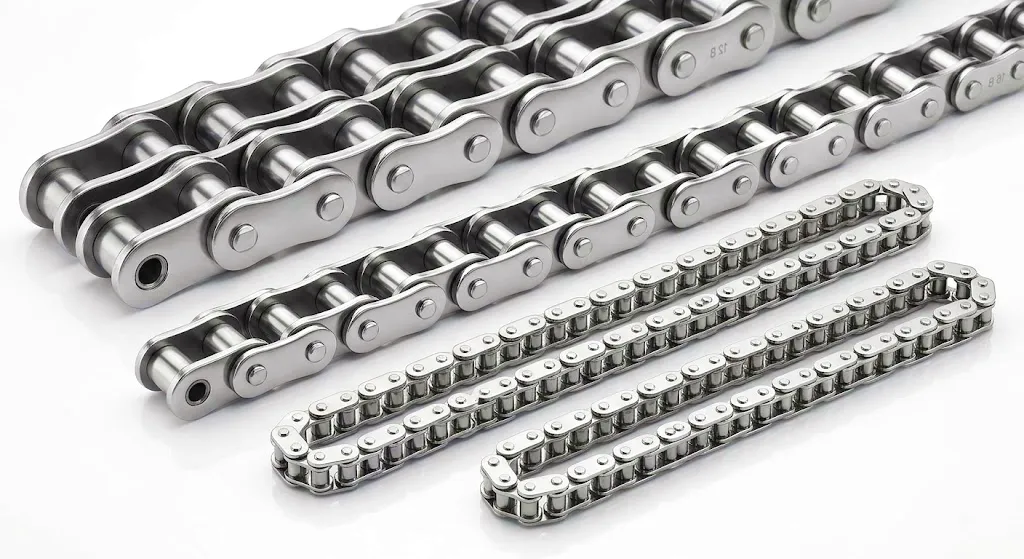
A roller chain drive transmits power through a series of interlinked components: inner plates, outer plates, bushes, rollers, and pins. As the driving sprocket rotates, each roller engages a tooth, absorbs the driving force, and passes the tension wave through the chain links to the driven sprocket. The tight strand — the tension side — carries the full transmitted load plus any additional tension introduced by the tensioning system. The slack strand carries only the residual tension required to maintain contact with the sprocket and prevent derailment.
The fundamental sag formula that UK maintenance engineers rely upon is straightforward in principle: the recommended slack-strand sag (S) equals approximately 2% of the centre-to-centre distance (C) between the two sprocket shaft centrelines. If your sprocket centres are 500 mm apart, the target sag should be approximately 10 mm, measured at the midpoint of the slack strand under its own weight with no applied load. This figure holds for horizontal and near-horizontal drives. For drives inclined beyond 45 degrees, the permissible sag drops to around 0.5% to 1%, because gravitational force on the chain mass contributes to slack in a way that can cause skip or derailment under dynamic reversals.
For vertically oriented roller chain drives — encountered in lift systems, bucket elevators, and vertical conveyor installations common in UK logistics hubs and distribution centres — sag must be eliminated almost entirely. A dedicated idler sprocket or jockey tensioner is required to maintain positive engagement on both strands simultaneously. In these configurations, the tension specification shifts from sag-percentage to minimum strand tension measured in Newtons, calculated from the chain’s self-weight and the dynamic load coefficient for the application.
Core Materials That Govern Roller Chain Performance and Elongation Behaviour
Understanding material composition is inseparable from understanding tensioning behaviour, because chain elongation — the physical change that makes regular tension adjustment necessary — is driven by wear at the pin-bush interface, and wear rate is directly determined by material hardness, surface finish, and heat treatment. The material science of a roller chain is what separates a budget commodity product from a precision-engineered drive component that delivers consistent performance across years of heavy industrial service.
Pins & Bushes
Case-hardened alloy steel (typically 20CrMnTi or equivalent EN36 grades in UK supply chains) with surface hardness of HRC 58–62 and a tough, softer core to resist shock. The pin-bush interface is where 80% of chain elongation occurs, so material quality here directly determines re-tensioning intervals.
Länkplattor
Cold-drawn carbon steel or alloy steel plates, shot-blasted to relieve residual stress and improve fatigue resistance. High-strength variants use pre-stressed plates that increase minimum tensile strength by up to 30% compared to standard BS/ISO grades, critical for automotive assembly lines and heavy conveyor applications.
Rullar
Through-hardened steel rollers (HRC 40–50) sized precisely to ISO 606 roller diameters ensure correct engagement geometry with sprocket tooth profiles. Incorrect roller hardness — either too soft or too brittle — changes the contact stress distribution and causes accelerated sprocket tooth wear that makes re-tensioning ineffective.
Stainless & Specialty Grades
For food processing, pharmaceutical, and coastal/marine applications across the UK, 304 and 316L stainless roller chains offer corrosion resistance at the cost of slightly lower tensile strength. Nickel-plated carbon steel chains provide a middle ground — improved corrosion resistance with full-carbon-steel mechanical performance — for chemical plant environments.
Roller Chain Technical Performance & Specification Parameter Table
The following table covers the principal technical parameters across commonly specified standard pitch roller chain sizes, from the compact 06B used in light machinery to the heavy-duty 24B and 32B series deployed in steel mill conveyors, mining equipment, and large-format agricultural drives across the UK. These figures are consistent with ISO 606 and ANSI B29.1 standards and form the engineering basis for tensioning calculations, lubrication scheduling, and drive replacement planning.
| Chain Size (ISO) | Lutning (mm) | Rulldiameter (mm) | Minsta draghållfasthet (kN) | Max. Allowable Load (kN) | Stiftdiameter (mm) | Plate Height (mm) | Vikt (kg/m²) |
|---|
| 06B-1 | 9.525 | 6.35 | 9.0 | 1.1 | 3.28 | 8.2 | 0.41 |
| 08B-1 | 12.70 | 8.51 | 18.0 | 1.9 | 4.45 | 11.81 | 0.69 |
| 10A-1 / 50 | 15.875 | 10.16 | 22.2 | 2.8 | 5.08 | 15.09 | 1.02 |
| 12A-1 / 60 | 19.05 | 11.91 | 31.8 | 3.8 | 5.96 | 18.11 | 1.50 |
| 16A-1 / 80 | 25.40 | 15.88 | 58.0 | 6.5 | 7.94 | 24.13 | 2.59 |
| 20A-1 / 100 | 31.75 | 19.05 | 88.5 | 10.0 | 9.54 | 30.18 | 3.91 |
| 24A-1 / 120 | 38.10 | 25.40 | 127.0 | 14.5 | 11.11 | 36.20 | 5.62 |
| 32B-1 | 50.80 | 29.21 | 250.0 | 28.0 | 17.81 | 58.55 | 13.45 |
All figures indicative per ISO 606 / ANSI B29.1. Contact Ever Power for application-specific verified specifications and certified material test reports.
Step-by-Step Tensioning Procedure for Industrial Roller Chain Drives
Before any tensioning work begins, lock out and tag out the drive in full compliance with UK HSE Machinery Directive requirements and your site’s LOTO procedure. Roller chain tension adjustment on live machinery is never acceptable under any production pressure. Once the drive is safely isolated, allow it to cool to ambient temperature if it has been running, since thermal expansion of the chain and shafting will affect sag measurement accuracy.
Measure the centre-to-centre distance between the two sprocket shaft centrelines using a steel rule or laser distance tool. Calculate 2% of this figure — this is your target sag value for a horizontal drive. For drives inclined between 45 and 90 degrees, use 1% as your target. Mark the midpoint of the slack strand on the chain itself with a marker or piece of tape, then use a straight edge or taut string stretched between the two sprocket face planes to create a reference baseline. Measure the perpendicular distance from this baseline to the chain at the midpoint: this is the current sag.
If the sag exceeds your target, move the driven machine (or idler sprocket, if fitted) away from the driving sprocket in the direction that tightens the slack strand. If a sliding base plate or slotted mounting holes are fitted, use a calibrated adjustment screw rather than impact tools, advancing the adjustment in increments of approximately 0.5 mm, re-measuring sag after each increment. Re-check sprocket alignment after any axial adjustment, since misalignment of even 1 mm over 500 mm of shaft length creates lateral loads that dramatically reduce chain and sprocket life.
Ever Power High-Strength Roller Chain — Featured Products
Precision-engineered for Caterpillar OEM specifications and heavy-duty industrial drives
⛓️
High Strength Roller Chain 120HSP-00
Designed to match Caterpillar OEM specifications, the 120HSP-00 delivers exceptional tensile strength, precision pitch consistency, and extended service intervals under the demanding load cycles of heavy construction and mining equipment drives. Case-hardened pin-bush assembly and pre-stressed link plates ensure stable tensioning across temperature extremes from -20°C to +120°C — conditions regularly encountered on Scottish offshore support vessels and Northern England quarry machinery.
View Product Details →
🔩
High Strength Roller Chain C100HSP-00
The C100HSP-00 addresses the specific load profiles of Caterpillar earthmoving and track-drive systems, where sudden shock loads and continuous high-cycle fatigue demand roller chain components with superior impact toughness. Shot-peened link plates and precision ground pins deliver an ISO-verified minimum tensile strength that supports reliable tension maintenance even in drives operating at the upper limits of their rated capacity in demanding UK infrastructure construction environments.
View Product Details →
Industrial Application Scenarios: Where Correct Roller Chain Tensioning Is Critical
🏭
Automotive Assembly — West Midlands
Body-in-white conveyor lines and engine assembly overhead power-and-free systems in the West Midlands automotive cluster rely on correctly tensioned roller chains running at precise, repeatable speeds. Even minor chain elongation due to under-tension causes spacing errors between car bodies on the assembly line, triggering costly robot cell faults. Tensioning intervals in these environments are typically set at 250 operating hours.
⚒️
Steel Processing — Sheffield & Rotherham
Rolling mill conveyors and billet transfer systems in Sheffield and Rotherham’s still-active steel sector operate roller chains in ambient temperatures routinely exceeding 60°C near furnace areas. Thermal elongation of the chain itself adds to mechanical stretch, making tension monitoring at multiple points in the shift cycle essential. Large-pitch 32B and 40B chains in these environments require specialist high-temperature lubricants applied at correctly tensioned intervals to prevent accelerated bush-pin seizure.
🌾
Agricultural Machinery — East Anglia & Yorkshire
Combine harvesters, round balers, and grain elevator systems used across the arable farmlands of East Anglia and the Yorkshire Wolds are seasonal heavy-use applications where roller chain tension is often set at the start of harvest and left unchanged for hundreds of hours. This is a maintenance mistake: the initial run-in period of a new chain causes 50% of its total service lifetime elongation in the first 100 hours. Pre-season tensioning and a mandatory re-check after the first 50 hours of seasonal use should be standard practice for every farm machinery fleet in the UK.
📦
Logistics & Warehousing — Milton Keynes & Daventry
High-throughput sortation conveyors and automated picking systems in the UK’s logistics hub corridor between Milton Keynes and Daventry run roller chains continuously across two or three shifts daily. At 20 hours per day, 365 days per year, a chain in these environments accumulates 7,300 operating hours annually — far exceeding typical industrial maintenance cycles. Automatic tensioner mechanisms fitted to these conveyors require specification-matched spring rates to maintain correct roller chain tension without operator intervention between planned maintenance windows.
Recognising the Replacement Threshold: When Tension Adjustment Is No Longer Enough
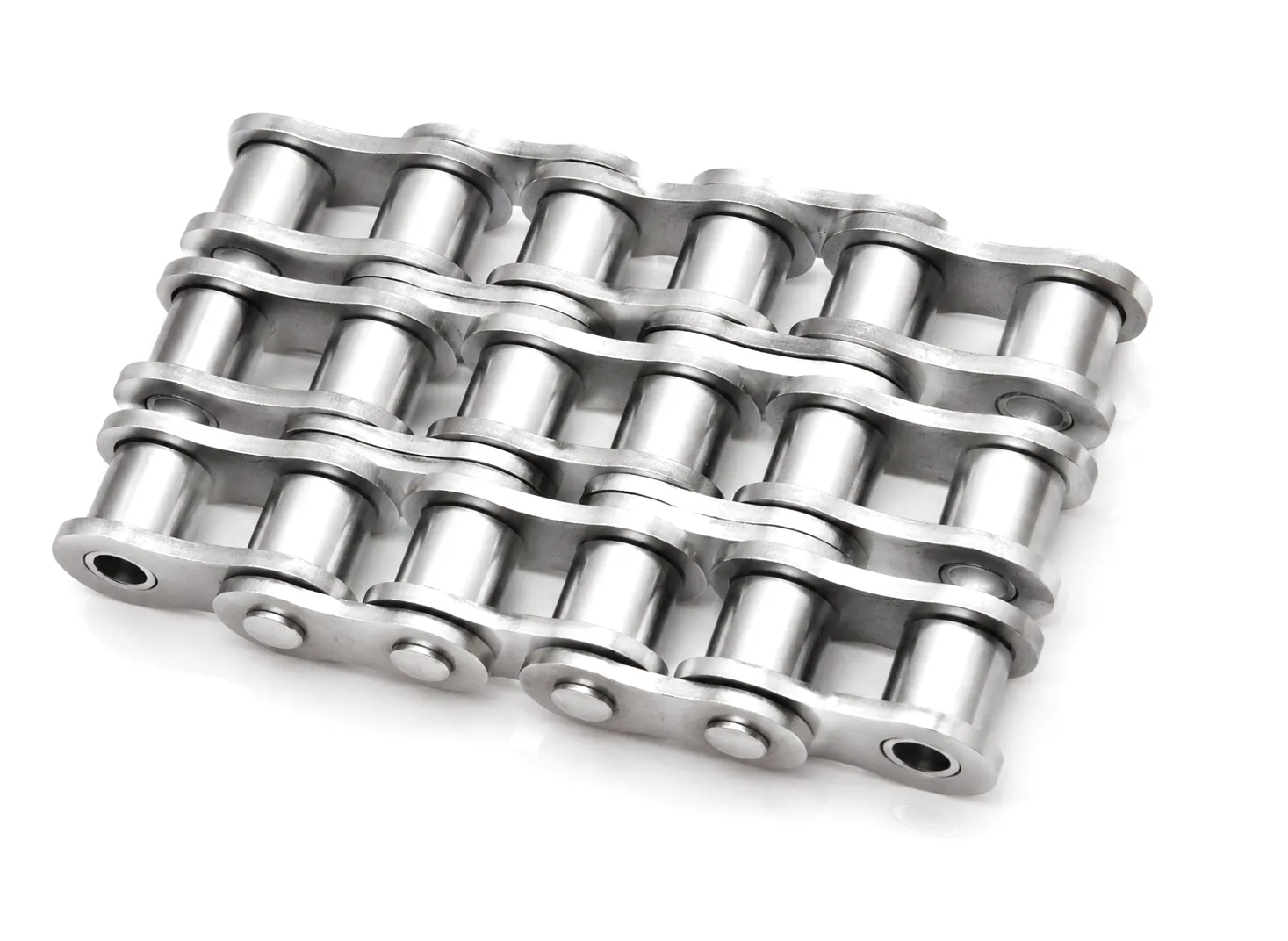
There is a point in every roller chain’s service life when no amount of tension adjustment can compensate for the wear that has accumulated at the pin-bush interface. This wear manifests as elongation — the progressive increase in the effective pitch of the chain links, measured as a percentage of the nominal pitch. ISO and ANSI standards specify a maximum permissible elongation of 2% for most drive chains before replacement is mandatory. At 3% elongation, the chain pitch mismatch with the sprocket tooth profile causes rapid, accelerating wear on the sprocket flanks — meaning that running a worn roller chain to destruction destroys not just the chain but the far more expensive sprockets as well.
Measuring chain elongation accurately requires a calibrated vernier gauge or chain wear indicator tool placed across a minimum of 12 links (equal to 12 pitches) under a known tension load — typically the chain’s own weight if the span is kept horizontal. Divide the measured length by the nominal 12-pitch length and subtract 1.00 to get the elongation fraction. Multiply by 100 for the percentage. A standard 12A-1 (ANSI #60) chain with a 19.05 mm pitch has a nominal 12-pitch length of 228.6 mm. At 2% elongation, this becomes 233.2 mm — a difference that is easily measurable with a basic engineering gauge but practically invisible to the naked eye, which is why systematic measurement rather than visual inspection is the engineering standard.
When chain wear is approaching the 2% limit and an entire chain assembly must be replaced, the sprockets should always be inspected simultaneously and replaced together if tooth wear shows hook-like deformation of the tooth flank profile. Fitting a new roller chain to worn sprockets causes the new chain to rapidly conform to the worn tooth profile, effectively resetting service life to near zero from the first hour of operation. This is a widely observed but chronically under-addressed failure of cost-focused maintenance in UK manufacturing sites.
Ever Power: Precision Manufacturing and Customisation for UK Industrial Buyers
At Ever Power, our manufacturing operations are built around one objective: producing roller chain components that meet and exceed the performance expectations of B2B buyers who cannot afford downtime. Our ISO-certified production lines operate with CNC-controlled precision at every stage — from raw material selection through heat treatment, surface finishing, and final assembly — ensuring that every roller chain that leaves our factory delivers consistent pitch accuracy, surface hardness, and rated tensile strength.
🎯
Custom Pitch & Configuration
Non-standard pitches, extended-pin configurations, attachment chains, and multi-strand assemblies engineered to drawing. We support both ANSI and ISO dimensional standards, with matched sprocket and idler supply available for complete drive system packages.
🧪
Material & Surface Specification
Carbon steel, alloy steel, 304 stainless, 316L stainless, and nickel-plated variants all available with certified material test reports and hardness verification. O-ring and X-ring sealed variants for extended re-lubrication intervals in hard-to-access machinery locations.
🚚
UK-Responsive Supply Chain
Ex-stock standard sizes available for rapid dispatch to UK buyers via established logistics partners. DDP Incoterms available for UK importers. Our dedicated export team manages customs documentation, CE compliance, and freight coordination to minimise lead times across all UK destinations.
📋
Technical Support & Selection
Our engineering team provides drive selection calculations, tension specification guidance, and application review for UK buyers designing new systems or upgrading existing drives. Submit your drive data and we return a verified chain selection with tension parameters, lubrication schedule, and replacement interval estimate.
Customer Success Story: Birmingham Automotive Components Manufacturer Eliminates Conveyor Downtime
Meridian Precision Components Ltd, a Tier 2 automotive parts supplier based in Erdington, Birmingham, was experiencing recurring unplanned stoppages on its two main press-feeding conveyor lines. The 12A-1 roller chains fitted to these conveyors were stretching to their replacement limits within four to five months — far below the twelve-month service life their supplier had indicated. Downtime was averaging six hours per month per line, translating directly to missed delivery schedules for their OEM customer and penalty clause exposure under their supply agreement.
Their engineering manager contacted Ever Power after discovering that their existing chains were manufactured to lower-tolerance specifications than the ISO 606 values stated on the data sheet. The pin material hardness was testing at HRC 54 rather than the specified HRC 60 minimum, and the bush bore had measurable taper — both symptoms of inadequate quality control in the original supply chain. Ever Power’s technical team conducted a drive analysis using the customer’s load data, sprocket geometry, and speed profile, confirming that the application was within the capability of our standard 12A-1 chain when manufactured to correct material specification.
Ever Power supplied a trial batch of 12A-1 chain produced with verified 20CrMnTi pin material at HRC 60–62, precision-bored bushes, and pre-loaded link plates. The customer’s maintenance team followed the re-tensioning schedule we provided — checks at 50, 150, and 500 hours thereafter — and reported zero unplanned stoppages across the first six months of operation. By month ten, elongation measurement showed the chains at 0.9% — comfortably within service limits and tracking toward a full twelve-month-plus service life. Annual maintenance costs for the two lines dropped by an estimated £28,000, and the customer moved to an approved-supplier agreement with Ever Power for all their roller chain requirements across the Birmingham facility.
★★★★★
“We had chain suppliers telling us our application was ‘abnormal’ every time we raised the early wear issue. Ever Power actually ran the numbers, identified the root cause, and delivered a product that performs exactly as specified. The elongation data after ten months is better than anything we have seen from UK domestic suppliers at comparable price points.”
— James Whitfield, Engineering Manager
Meridian Precision Components Ltd, Birmingham
★★★★★
“The custom attachment chain Ever Power produced for our press-to-press transfer system was dimensionally perfect on first delivery — no rework, no fitment issues. Their technical team provided a tensioning specification with it that our maintenance crew could actually use. That level of supplier support is not common in our experience.”
— Sandra Okafor, Procurement Director
Hallfield Industrial Systems, Coventry
★★★★★
“We switched our entire conveyor chain supply to Ever Power after trialling them on two lines. The consistency between batches is noticeably better than what we were getting before — same elongation rate, same tensioning schedule, same service interval every time. For a plant running three shifts, that predictability is worth a great deal.”
— David Lowe, Maintenance Supervisor
Yorkgate Packaging & Logistics, Leeds
How Lubrication Interacts With Roller Chain Tension: The Variable Most Teams Underestimate
Lubrication and chain tension are not independent variables — they are directly coupled through the pin-bush interface wear mechanism. A correctly tensioned but inadequately lubricated roller chain will elongate at two to five times the rate of a properly lubricated chain running at identical loads and speeds. The lubricant film at the pin-bush contact point reduces the metal-to-metal friction that drives microscopic material removal from both surfaces. When that film is absent — due to under-lubrication, incorrect viscosity grade, or contamination from water or swarf — the wear rate accelerates dramatically, requiring more frequent tension adjustments and eventually driving chain replacement forward by months or years relative to the expected service life.
The ISO/ANSI recommendation for drive chain lubrication method selection is based on chain speed and horsepower. Low-speed drives (below 4 m/s) can be adequately served by manual brush lubrication applied at intervals determined by the manufacturer’s data, typically every 40 to 80 operating hours depending on load severity. Medium-speed drives (4–10 m/s) require drip-feed oiling systems or oil bath arrangements that maintain a continuous or semi-continuous supply of oil to the chain. High-speed industrial drives above 10 m/s — common in the power generation sector and high-output assembly lines — require forced-feed spray lubrication systems with filtered, temperature-controlled oil supply to maintain adequate film thickness at the high-pressure contact zones.
When re-tensioning a roller chain, always clean the chain and re-apply fresh lubricant of the correct viscosity grade after any adjustment. Tension adjustment work disturbs the lubricant film in the link joints and exposes fresh metal surfaces that are particularly vulnerable to accelerated initial wear in the first hours after adjustment. Treating lubrication as part of the tensioning procedure rather than a separate maintenance task is the engineering practice that reliably extends roller chain service life in demanding industrial environments.
Ready to Specify Correctly Tensioned Roller Chain for Your Application?
Ever Power’s engineering team is ready to support UK buyers with product selection, custom specifications, and competitive commercial proposals.
✉ [email protected]
redigerad av gzl