Walk onto the engineering floor of a plant in Birmingham, Sheffield, or the East Midlands manufacturing belt and you will almost certainly encounter a roller chain somewhere in the drivetrain. These precision-engineered components transfer mechanical power between sprockets with extraordinary efficiency — and have been doing so for well over a century. Yet a specification that seems perfectly straightforward on a drawing can become a costly headache the moment someone orders to the wrong standard. ANSI and ISO are not interchangeable systems. They share the same mechanical logic but diverge in critical dimensional details that determine whether a chain runs smoothly or fails prematurely in service.
This guide explains exactly where those differences lie — pitch tolerances, roller diameters, plate thickness, inner and outer link dimensions, tensile strength ratings — and why getting the standard right matters as much as selecting the correct pitch and strand count. For UK procurement teams sourcing chain for food processing equipment, agricultural conveyors, steel plant machinery, or automotive production lines, the distinction between ANSI and ISO can determine compatibility with existing sprockets, compliance with engineering drawings, and total cost of ownership over years of operation. Read on for the technical clarity you need before placing an order.
Where the Two Standards Come From
Norma ANSI
The American National Standards Institute roller chain standard — formally designated ASME B29.1 — grew out of the early twentieth-century American bicycle and automobile industries. Its dimensions are expressed primarily in inches, with pitch measured in eighths of an inch. A #40 ANSI chain has a 1/2-inch pitch, a #60 chain has a 3/4-inch pitch, and so on following a well-known coding pattern. This system became dominant across North American plant engineering and is still the default specification in US-built machinery that is exported worldwide, including construction equipment, agricultural hardware from manufacturers like John Deere and Case IH, and a wide range of general industrial conveying systems. When UK engineers work with American OEM equipment or source replacement parts for US-manufactured machinery, ANSI is the standard they will encounter on the drawing — and the one they must match precisely.
ISO Standard
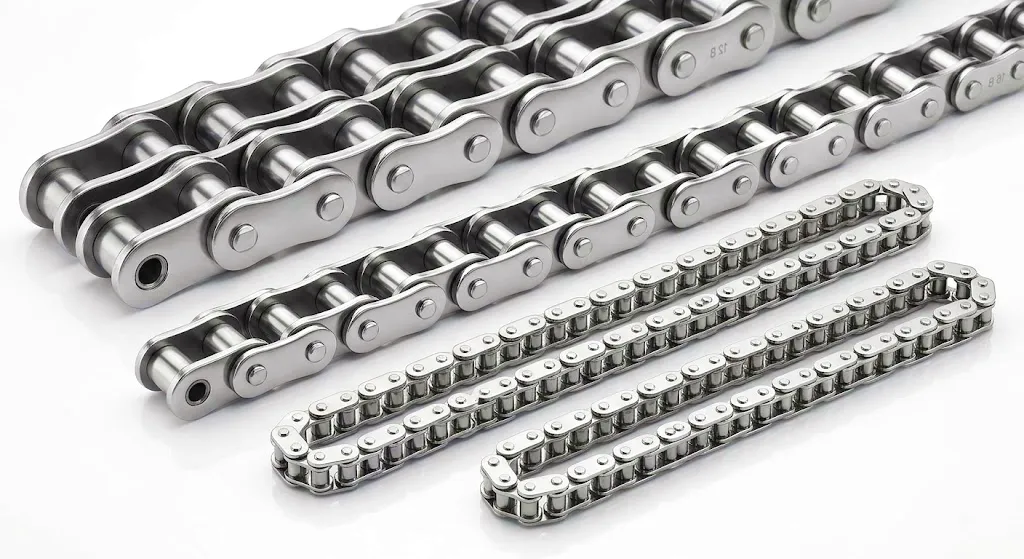
The International Organisation for Standardisation roller chain specification — ISO 606, harmonised in the UK as BS ISO 606 — uses entirely metric dimensions and employs a different designation system built around pitch in millimetres. The familiar “B-series” chains (06B, 08B, 10B, 12B, 16B, 20B, 24B, and so on) reflect British Standard origins and are the format most plant engineers across the UK, Europe, and much of Asia encounter in domestic machinery. The pitch of a 08B chain is 12.7 mm — the same 1/2-inch as an ANSI #40 — but the roller diameter, inner plate height, and pin diameter differ enough to make the chains non-interchangeable on matching sprockets without adjustment. European machinery manufacturers — from German press lines to Italian food processing equipment to Scandinavian forestry machines — default to ISO B-series chain, which means ISO is the standard underpinning most of the UK’s domestically sourced and European-imported plant.
How a Roller Chain Actually Works
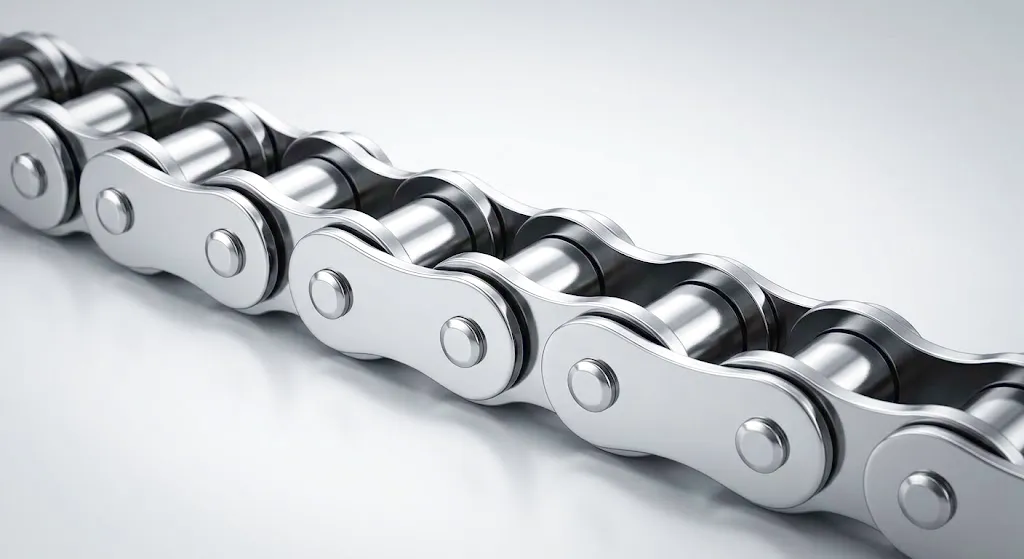
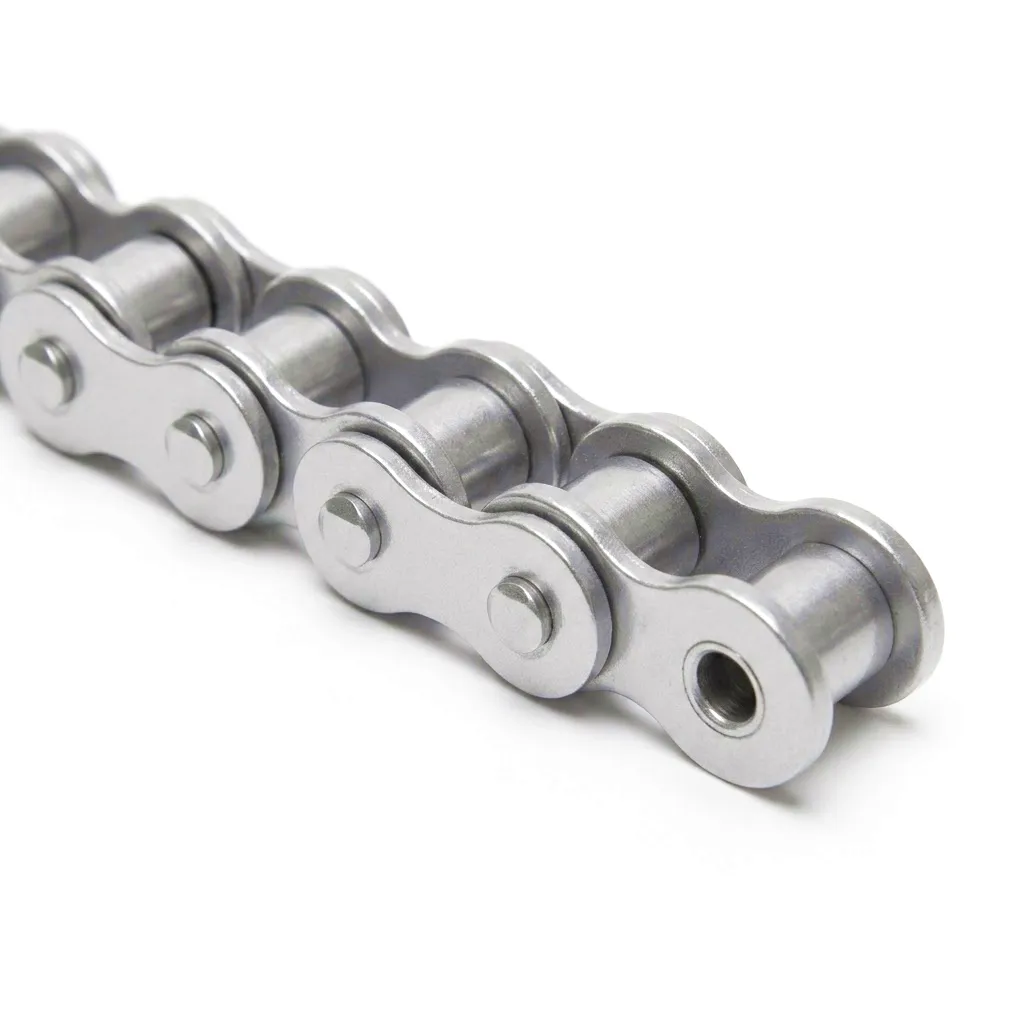
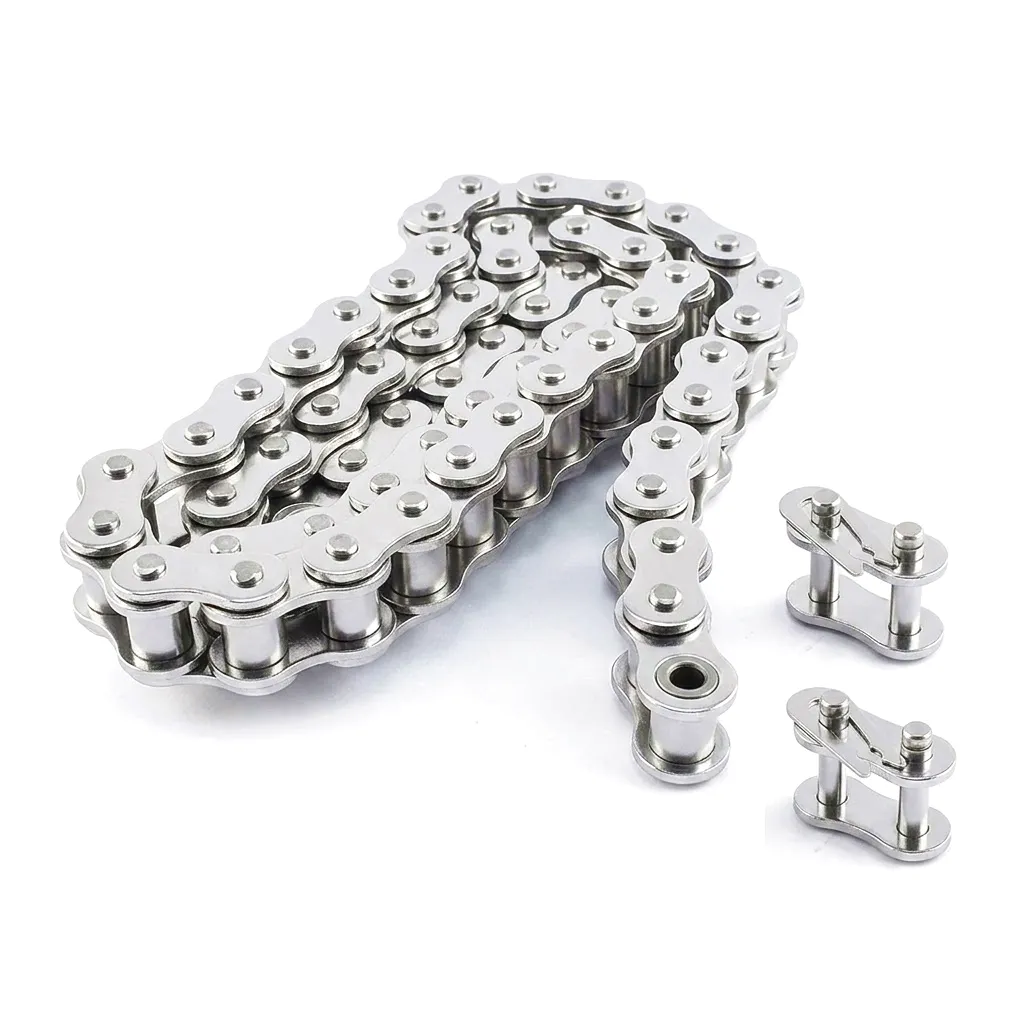
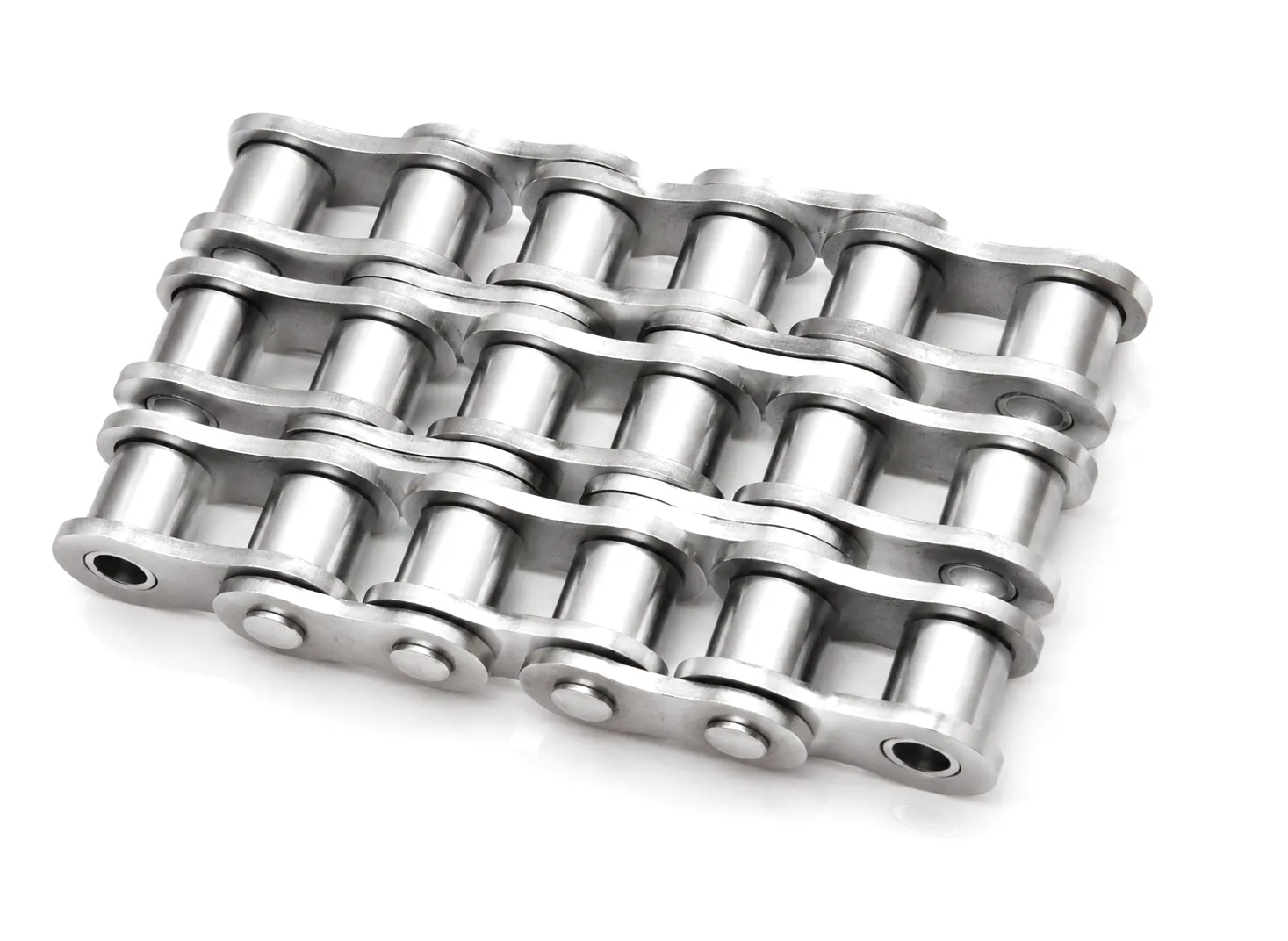
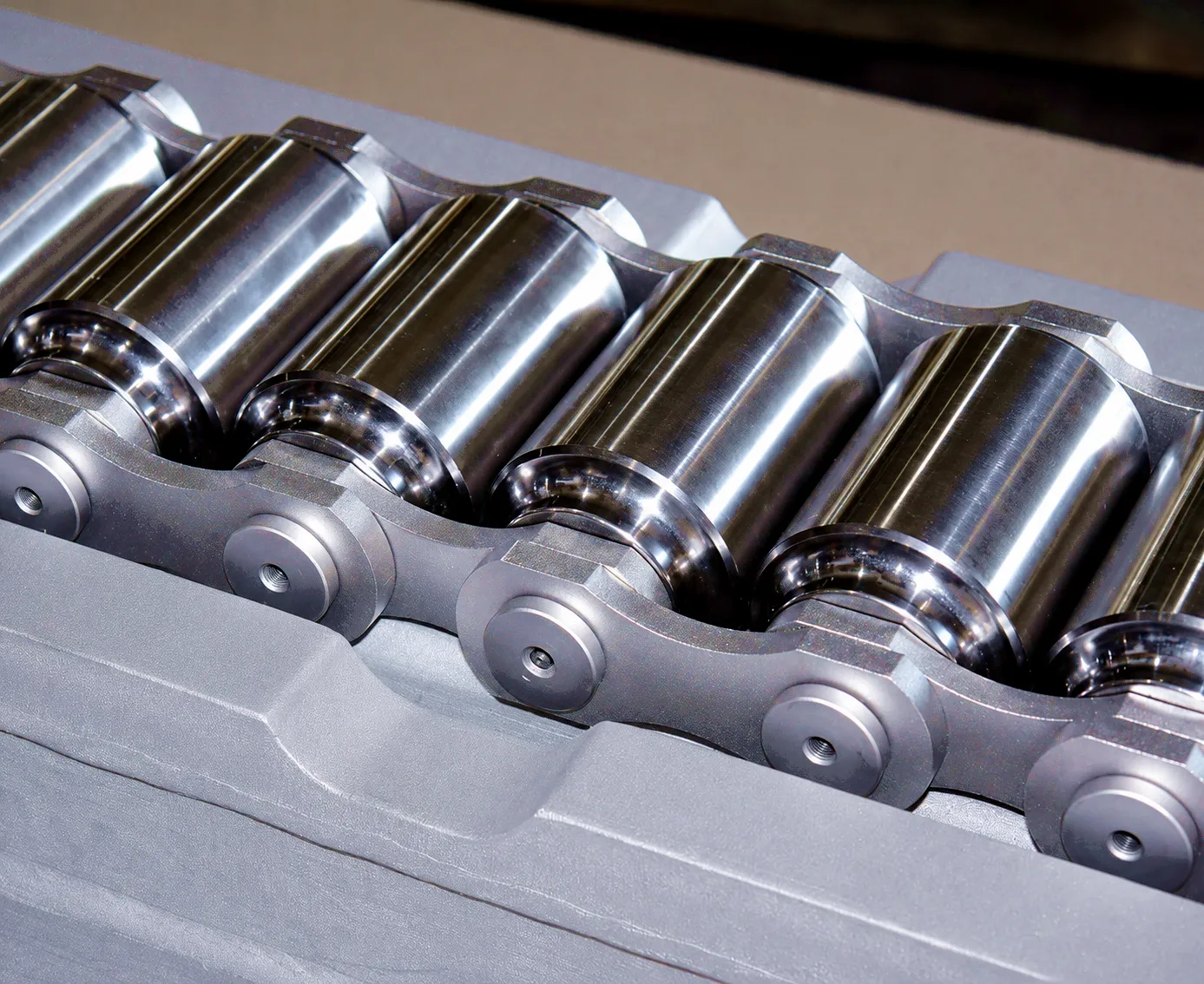
A roller chain is a mechanical power transmission device that operates on an elegantly simple principle: hardened steel rollers engage the teeth of a sprocket, transmitting torque from a driving shaft to a driven shaft with minimal energy loss. The chain is an assembly of alternating inner and outer link plates. Inner links hold a pair of bushings pressed into the plates; each bushing carries a freely rotating roller on its outer surface. Outer links — also called pin links — consist of a pair of plates connected by hardened pins that pass through the bushings of adjacent inner links. The roller rotates freely on its bushing, which means contact with the sprocket tooth is predominantly rolling rather than sliding. This dramatically reduces friction and wear compared with flat chain or gear-driven alternatives of equivalent power density.
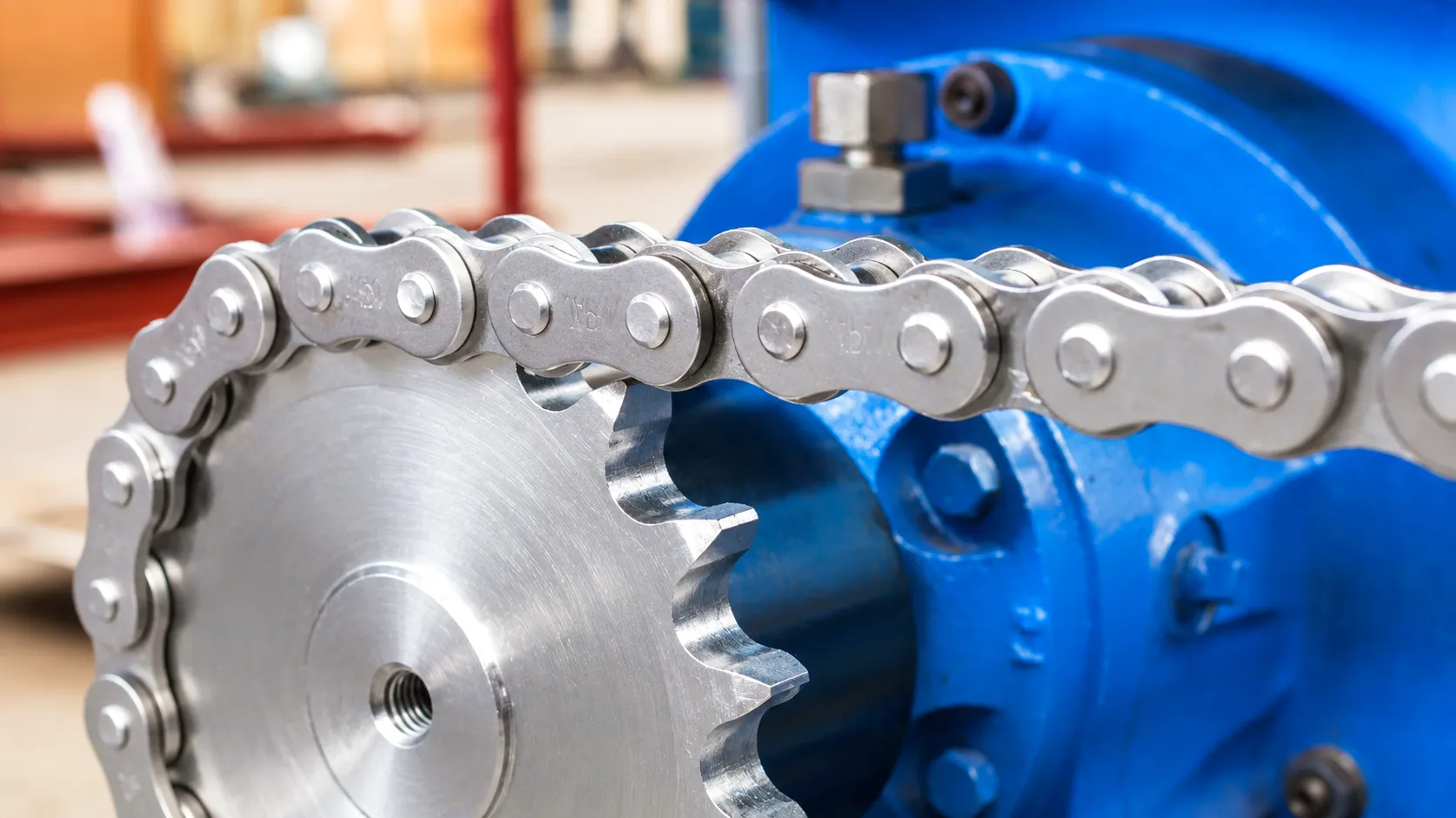
The pitch — the distance between pin centres — is the single most important dimension because it defines which sprocket the chain will seat correctly on. In both ANSI and ISO systems, the pitch is fixed per designation. The difference is that ANSI pitch figures are inch-based fractions (the chain number divided by eight gives pitch in inches), while ISO B-series pitches are expressed directly in millimetres and follow a different scaling convention. Lubrication between the pin and bushing interface is where most chain wear originates; modern precision-manufactured roller chain incorporates pre-lubricated oil-retaining sintered bushings or sealed bearing pins in higher-load variants, reducing maintenance intervals substantially while maintaining the core principle of smooth roller-to-sprocket engagement under dynamic loading conditions.
98%+
Mechanical efficiency
<0,5%
Elongation before replacement
4–6x
Speed range vs belt alternatives
60+
Years of ISO/ANSI convergence
Core Dimensional Differences: Where ANSI and ISO Diverge
The fundamental mechanical principles are shared, but the geometry is not. Understanding precisely where the two systems diverge prevents costly specification errors and ensures sprocket compatibility from day one of installation.
| Dimension / Parameter | ANSI (ASME B29.1) | ISO (BS ISO 606 B-series) | Practical Impact |
|---|---|---|---|
| Unit system | Inch-based | Metric (mm) | Drawing conversion risk |
| 1/2″ pitch chain designation | #40 (12.70 mm pitch) | 08B (12.70 mm pitch) | Same pitch — different geometry |
| Roller diameter (1/2″ pitch) | 7.77 mm (#40) | 8.51 mm (08B) | Sprocket tooth form incompatible |
| Inner plate width (1/2″ pitch) | 7.92 mm (#40) | 7.75 mm (08B) | Affects strand engagement |
| Pin diameter (1/2″ pitch) | 3.97 mm (#40) | 4.45 mm (08B) | Load capacity and wear rate |
| Minimum tensile strength (#40 / 08B) | 14.1 kN | 17,8 kN | ISO B-series carries more load |
| Plate thickness (outer link, 08B / #40) | 1.50 mm | 1.60 mm | Fatigue resistance difference |
| 3/4″ pitch chain — ANSI | #60 (19.05 mm pitch) | 12B (19.05 mm pitch) | Same pitch — geometry diverges more |
| Designation system logic | Chain No. / 8 = pitch (in.) | Prefix No. x 1.5875 = pitch (mm) | Different coding logic entirely |
| Primary market | North America, US OEM global | UK, EU, Asia, most of world | Determines interchangeability zone |
Materials That Define Performance Under Both Standards
Both ANSI and ISO roller chains are manufactured from similar material families, but the heat treatment specifications and tolerances applied to individual components can differ between manufacturers, which is why supplier qualification matters. Pins are typically cold-drawn carbon steel, usually 1045 or equivalent, case-hardened to achieve surface hardness in the range of 58–62 HRC while maintaining a tough core. This surface-versus-core hardness differential is what allows the pin to resist abrasive wear at its engagement surfaces while still absorbing shock loads without brittle fracture — a critical property in agricultural conveyors and press-room transfer systems where impulsive loads are routine.
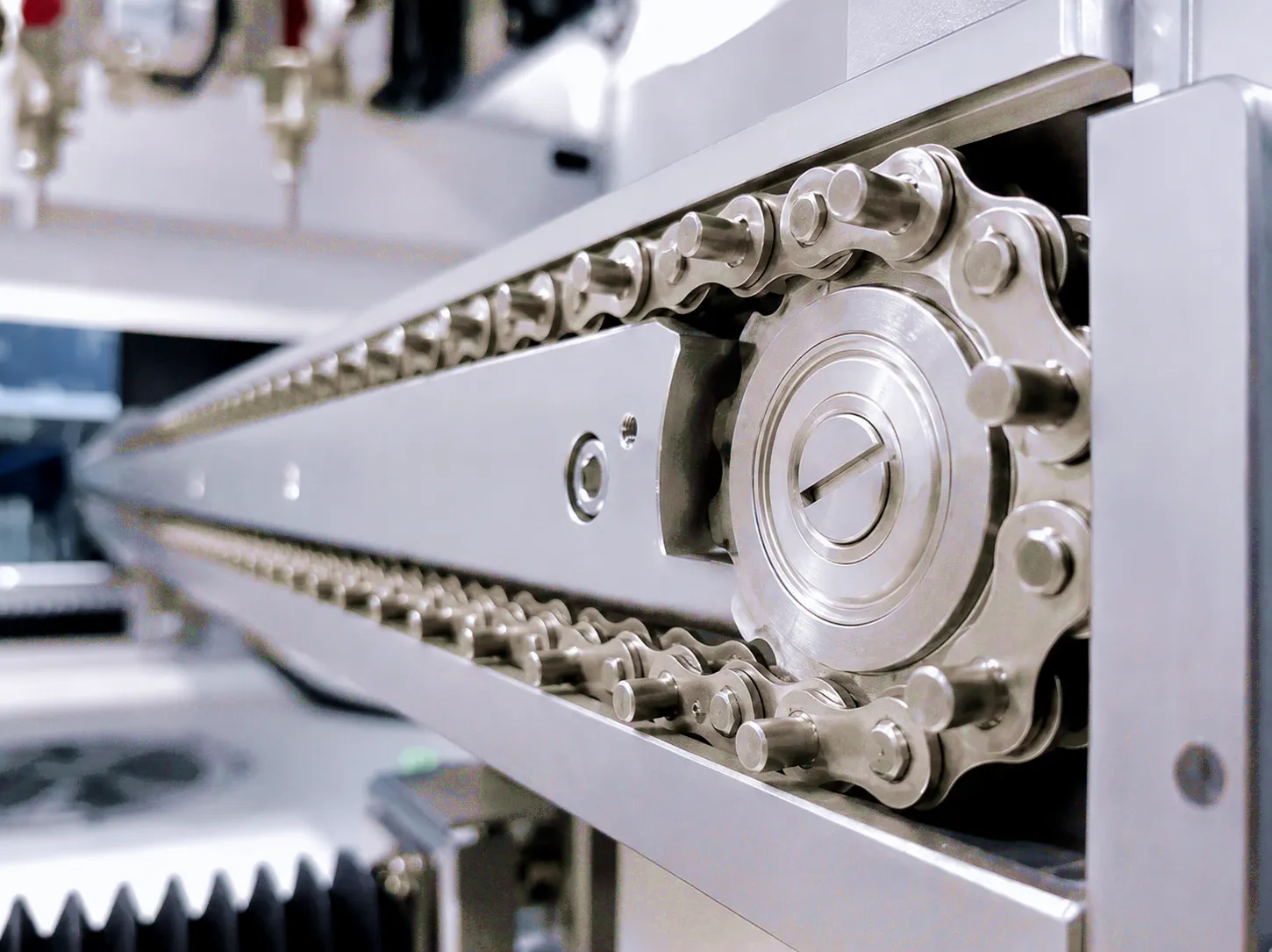
Link plates are stamped and punched from strip steel — commonly carbon grades equivalent to S45C or 40Cr depending on the chain grade — then shot-blasted or tumbled to relieve surface stress before hardening. The sintered bushing, where used, is pressed from powdered metal that retains oil in its porous matrix, functioning as a self-contained lubrication reservoir that dramatically extends maintenance intervals. For stainless steel variants — popular in food processing plants across the UK Midlands and in pharmaceutical manufacturing in the Cambridge and Oxford bio-clusters — 304 and 316 grades are both used, with 316 preferred where sodium hypochlorite washdown is standard practice. Nickel-plated chains offer a cost-effective corrosion-resistance compromise for lighter-duty applications in humid or mildly corrosive environments.
Aço carbono
Standard grade. Case-hardened pins, heat-treated plates. Excellent strength-to-cost ratio. Correct choice for general industrial power transmission.
Alloy Steel (40Cr)
Heavy-duty grade for high shock loads. Superior fatigue resistance. Used in steel plant, mining, and heavy agricultural equipment in Yorkshire and South Wales.
Stainless Steel 316L
Mandated in food-grade and pharma applications. Withstands NaOCl washdown. ISO standard applicable across EU/UK food plant regulations.
Niquelado
Enhanced corrosion resistance at lower cost than full stainless. Ideal for automotive painting lines, outdoor conveyors, and coastal installations in UK port logistics.
Technical Performance Parameters: ANSI vs ISO B-Series
The following table covers both standards across the most commonly specified pitch sizes in UK industrial procurement. These figures represent nominal dimensions and minimum tensile strengths per published standards; individual manufacturer specifications may exceed these minimums, particularly for premium and heavy-duty series chains used in high-cycle applications in Sheffield steel plants, Leeds packaging lines, and Midlands automotive press shops.
| Número ANSI. | ISO Equiv. | Passo (mm) | ANSI Roller Dia. (mm) | ISO Roller Dia. (mm) | ANSI Min. Tensile (kN) | ISO Min. Tensile (kN) | Aplicação típica |
|---|---|---|---|---|---|---|---|
| #25 | 04B | 6.35 | 3.30 | 4.00 | 3.6 | 4.4 | Máquinas leves, instrumentos |
| #35 | 06B | 9.525 | 5.08 | 6.35 | 7.9 | 9.0 | Small conveyors, garage equipment |
| #40 | 08B | 12.70 | 7.77 | 8.51 | 14.1 | 17.8 | General industrial — most common UK size |
| #50 | 10B | 15.875 | 10.16 | 10.16 | 21.8 | 22.2 | Medium conveyors, packaging lines |
| #60 | 12B | 19.05 | 11.91 | 12.07 | 31.8 | 29.0 | Agricultural, materials handling |
| #80 | 16B | 25.40 | 15.88 | 15.88 | 56.7 | 60.0 | Heavy plant, steel processing |
| #100 | 20B | 31.75 | 19.05 | 19.05 | 88.5 | 95.0 | Mining, quarrying, heavy conveyors |
| #120 | 24B | 38.10 | 22.23 | 25.40 | 127.0 | 160.0 | Port equipment, large conveyors |
Featured ISO B-Series Roller Chain Products
Two popular ISO B-series variants that combine the dimensional precision of the international standard with the flexibility of Ever Power’s rubber-top and specialty attachments — widely specified for food processing, logistics sorting, and automotive line applications across the UK.
ISO 20B · B-Series
Corrente de rolos com topo de borracha 20B-G1
Pitch 31.75 mm · ISO B-series · Rubber-cushioned outer plates for gripping delicate products on inclined conveyors. Widely used in UK food processing and distribution centres.
Ver produto →
ISO 24B · B-Series
Corrente de rolos com topo de borracha 24B-G1
Pitch 38.10 mm · ISO B-series · Heavy-duty rubber attachment for high-torque conveying. Suited for steeper inclines, bulk materials handling, and automated sorting systems.
Ver produto →
Cenários de Aplicação Industrial no Reino Unido
Why Precision-Manufactured Roller Chain Outperforms Generic Supply
Not all chains that nominally meet an ANSI or ISO designation perform equivalently in service. The gap between a precision-manufactured chain and a commodity import becomes apparent not at incoming inspection but six months into operation, when elongation rates diverge and maintenance intervals begin to compress. Here is what separates consistently high-performing roller chain from the budget alternatives that appear attractive at initial procurement.
Pitch Consistency
Cumulative pitch error across a chain length determines how well rollers seat on sprocket teeth at speed. High-precision manufacturing holds total length variation within ±0.05% of nominal — compared with ±0.15% or worse from low-grade supply — reducing noise, vibration, and accelerated sprocket wear substantially.
Hardness Uniformity
Case hardness variation between pins in a batch from a poorly controlled supplier causes non-uniform wear across the chain length and introduces stress concentration points. Premium manufacturing uses controlled atmosphere furnaces and statistically monitored batch testing to maintain hardness within ±2 HRC across production runs.
Shot Peening of Plates
Compressive residual stress imparted by shot peening of link plates increases fatigue life by 20–40% under alternating bending loads. This process step is often omitted by lower-cost producers. For chains on reversing drives or those subject to frequent speed changes — common in automated conveyor systems — the impact on service life is substantial.
Pre-Load Assembly
Quality chain is pre-loaded to approximately 1/3 of minimum tensile strength during manufacture to seat bearing surfaces and eliminate initial stretch that would otherwise appear in the first hours of service. This means the chain installed on a production line reaches its operational pitch geometry immediately, requiring no early re-tensioning and simplifying commissioning for plant engineers.
Customer Success Story: Leeds Food Processing Plant
Case Study · Leeds, West Yorkshire · Wet Food Processing
A ready-meals manufacturing facility in the Morley industrial area of Leeds had been running a pair of blending and portioning conveyor lines installed with German-built processing equipment — all specified to ISO B-series chain. When procurement decided to trial a cheaper ANSI #50 chain sourced through a general engineering supplies merchant rather than an ISO 10B chain supplier, the mistake did not become apparent at installation; the pitch was the same 15.875 mm. Within eight weeks, however, the maintenance team was seeing accelerated sprocket tooth wear on both conveyor drive sprockets, increased chain noise during operation, and a measurable reduction in conveyor tracking consistency. The ISO sprockets cut for a 10.16 mm roller had been receiving the ANSI roller of the same nominal diameter — but the tooth form geometry was mismatched enough to produce abnormal contact stress at the entry engagement point. The sprocket set required replacement at a parts and labour cost of approximately £4,200, and a full production shutdown during re-chaining added a further £6,800 in lost output. The facility’s engineering manager contacted Ever Power after a recommendation from an industry contact. Ever Power supplied certified ISO 10B chain in stainless steel 316L — the correct specification for the washdown zone of the conveyor — with documentation confirming compliance with BS ISO 606 and full dimensional test reports. The chains have now been running continuously for fourteen months without measurable elongation beyond 0.3% of original pitch, and the sprocket sets installed at changeover show no abnormal wear profile at the latest scheduled inspection.
What UK Plant Engineers Say About Ever Power
“We’d had three failed chain deliveries from different merchants — all nominally ISO 12B but dimensionally inconsistent from one batch to the next. Ever Power sent us the full CMM report with the first shipment, and every dimension was exactly where the standard says it should be. Fourteen months in and we haven’t touched the tension adjustment on either drive.”
Gerente de Engenharia de Manutenção
Usina de Processamento de Agregados, Peak District
“A corrente de fixação G1 personalizada que precisávamos para nossa esteira inclinada não estava em catálogo. A equipe de engenharia da Ever Power nos enviou um desenho confirmado em 48 horas e entregou a corrente ANSI #60-G1 em nossa unidade de Sheffield dentro do prazo estipulado. A qualidade era exatamente o que havíamos solicitado — e o preço era competitivo em comparação com as opções padrão que já havíamos descartado por questões dimensionais.”
Diretor de Compras
Fabricante de componentes automotivos, Sheffield
“Utilizamos correntes de distribuição ANSI e ISO em toda a nossa frota de colheitadeiras — máquinas John Deere e Claas lado a lado. Ter a Ever Power como fornecedora única para ambos os padrões simplifica enormemente nossa gestão de peças. A documentação que eles fornecem permite que nossos mecânicos identifiquem a especificação correta rapidamente, o que praticamente eliminou os erros de confusão de especificações que costumávamos ver durante a época de colheita.”
Gerente de Engenharia de Frota
Empresa de Contratação Agrícola, Lincolnshire
Perguntas frequentes
Pesquisa por voz e perguntas de cauda longa de engenheiros de fábrica e equipes de compras do Reino Unido.
Pronto para especificar a corrente de rolos correta?
ANSI ou ISO · Padrão ou personalizado · Aço carbono, aço inoxidável ou aço especial
Solicite um orçamento — [email protected]
Ever Power · Corrente de rolos de precisão para a indústria do Reino Unido · Resposta em 24 horas
editado por gzl