Industrial Drive Solutions · UK Market
Attachment Chains: Types of Chain Attachments
and Their Industrial Uses
A technical deep-dive into roller chain attachment systems — from A1 plates to extended pins — and how they power British manufacturing, food processing, and heavy industry across the UK.
🔧 Mechanical Power Transmission
🇬🇧 UK Industrial Focus
📐 3,000+ Words
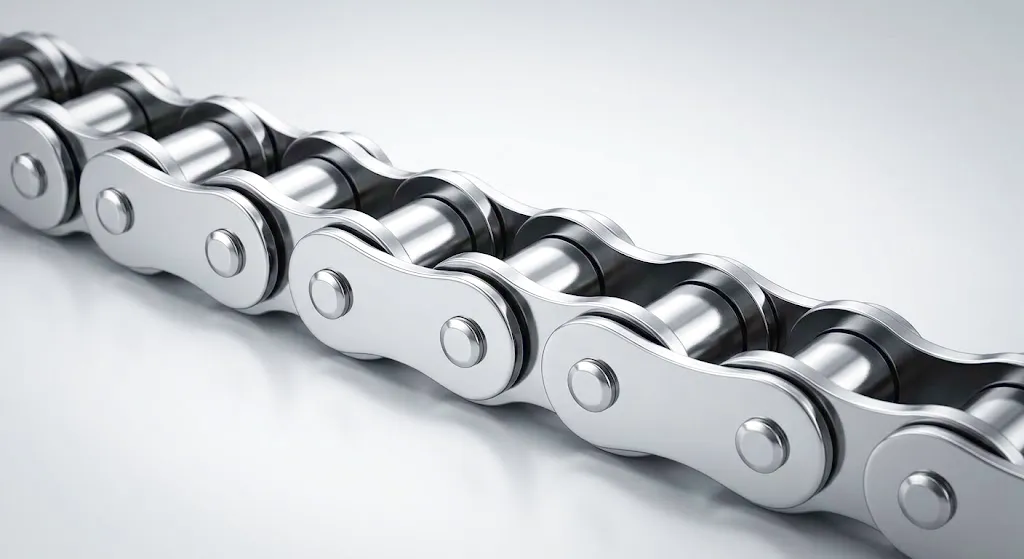
Attachment chains are a specialised evolution of the standard roller chain — purpose-built to do more than simply transmit rotational power between sprockets. At their core, they combine the mechanical strength and precision pitch of conventional roller chains with integrated attachment plates, extended pins, or shaped lugs that allow external components — buckets, flights, carriers, guides — to be mounted directly onto the chain. This transforms a simple power-transmission link into a complete conveying, elevating, or positioning system. Across industries as diverse as cereal milling in Yorkshire and automotive pressing in the West Midlands, attachment chains are the unsung workhorses that keep production lines moving with accuracy and reliability. Understanding the different attachment types, their engineering rationale, and their real-world performance characteristics is essential knowledge for procurement managers, plant engineers, and maintenance teams who cannot afford unplanned downtime.
What Sets Attachment Chains Apart from Standard Roller Chain
⚙️
Structural Integration
Standard roller chains transfer torque between sprockets through interlocking links and rollers. Attachment chains do the same, but specific link plates are replaced with or supplemented by attachment tabs — flat plates with drilled and tapped holes, bent angles at 90°, or extended cylindrical pins. These features accept bolts, brackets, or cleats that connect directly to the material being conveyed. This dual function — power transmission and load carriage — is engineered without sacrificing tensile strength or fatigue life, provided the attachment is correctly matched to the pitch and series of the chain. In Birmingham’s food-packaging sector and Sheffield’s steel-processing plants, this integration eliminates the need for separate conveyor belt systems, reducing machine footprint and simplifying maintenance schedules considerably.
🔩
Pitch Compatibility
Attachment chains are manufactured to the same pitch standards as their plain counterparts — ISO 606, ANSI B29.1, and BS 228 in the UK context — meaning existing sprocket profiles remain usable. This backward compatibility is particularly valuable for plant operators in Manchester and Leeds who need to retrofit conveying capability onto existing drive trains without redesigning the entire power unit. The pitch remains the controlling dimension, but attachment position frequency can be set at every link, every other link, or at defined intervals — giving designers precise control over the spacing of attached components and therefore the throughput rate of any conveying system built around the chain.
How Attachment Chains Work: Engineering Principles
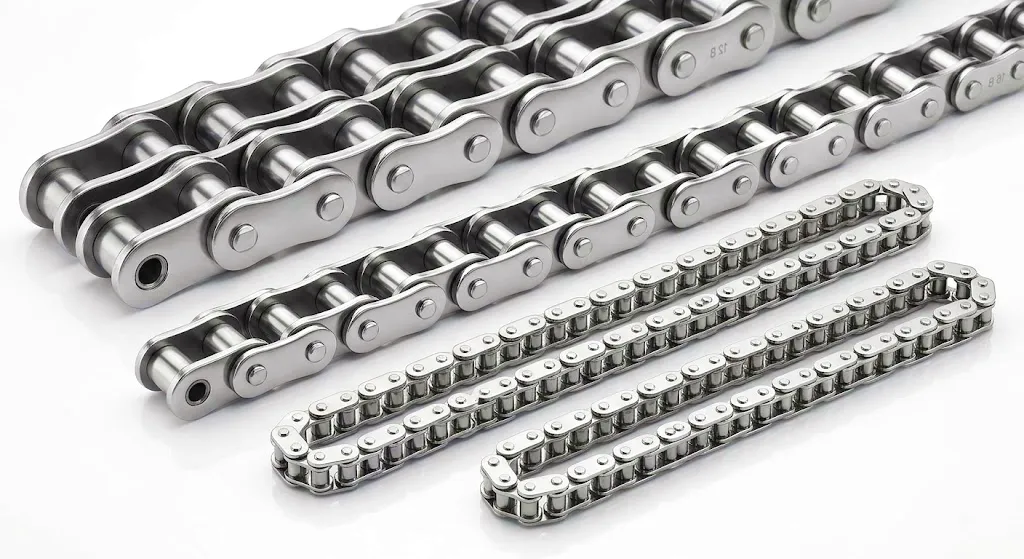
The mechanical behaviour of an attachment chain during operation involves two simultaneous force paths. Along the chain’s length, tensile load passes through the inner and outer link plates, bushings, pins, and rollers in exactly the same sequence as a plain chain — the chain wraps the drive sprocket, receives input torque, and pulls a driven sprocket or linear load. Perpendicular to this primary load path, the attachment plates or extended pins carry the weight or reaction forces of whatever has been bolted to them: a slat, a pushing flight, a bucket, or a product carrier.
This secondary load acts as a bending moment on the attachment relative to the chain pin axis. The magnitude of that bending moment depends on the distance of the load’s centre of mass from the attachment plate face, the speed of the chain, and any dynamic shock loads encountered during start-up or material impact. Properly designed attachment chains — with heat-treated pins and plates matched to the combined tensile and bending stresses — operate at very high duty cycles. The engagement between roller and sprocket tooth remains identical to standard practice, with the roller seating fully in the tooth form during wrap and peeling away cleanly on exit, protecting the attachment hardware from the cyclic contact stress that erodes plain-face links over time.
Dual Load Path Design
Tensile load travels through the chain spine; bending and shear loads travel through the attachment interface — keeping both paths independently optimisable.
Sprocket Engagement Purity
Rollers seat on standard tooth profiles regardless of attachment type — no change to sprocket geometry is required, preserving drive efficiency and tooth life.
Fatigue Life Calculation
Design life is calculated using combined alternating stress theory — engineers sum the tensile stress amplitude with the bending stress amplitude at the attachment root for accurate fatigue prediction.
Core Materials in Attachment Chain Manufacturing
Carbon Steel — The Standard Bearer
Medium-carbon steel (typically 0.40–0.55% C) is the backbone of most industrial attachment chains. After forging or cold-forming, link plates and pins undergo carburising or induction hardening to achieve surface hardness values of HRC 56–62 while retaining a tough core. This combination resists the cyclic bending at attachment roots and maintains pin shear strength under high tensile loads. For attachment plates themselves, a slightly lower surface hardness is sometimes specified — HRC 40–48 — to ensure the drilled and tapped holes remain machinable for field repairs. Carbon steel attachment chains are the default choice across UK plant rooms where oil lubrication is practical and ambient temperatures remain below 150°C.
Stainless Steel — Corrosion-Resistant Grades
Where hygiene, moisture, or mildly corrosive media are present — as in Lancashire’s meat-processing facilities or coastal facilities near ports like Liverpool and Immingham — austenitic stainless steel grades (SS304 and SS316) are specified for attachment chain manufacture. SS304 provides excellent corrosion resistance in neutral environments; SS316, with its molybdenum addition, handles chlorinated cleaning agents and saline atmospheres. The trade-off is lower tensile strength compared to heat-treated carbon steel, so stainless attachment chains are typically used at higher safety factors or in lighter-duty conveying applications. Electropolished surfaces on food-grade stainless attachment plates reduce bacterial adhesion and ease steam-cleaning procedures.
Nickel-Plated & Special Coatings
Electroless nickel plating on carbon steel attachment chains delivers a middle path: near-stainless corrosion performance with carbon-steel tensile properties, at a cost point between the two base materials. Zinc-nickel alloy plating offers similar benefits with superior resistance to galvanic corrosion — useful in outdoor conveyor systems exposed to UK weather on agricultural sites across Lincolnshire and East Anglia. PTFE or self-lubricating coatings on inner bushings are increasingly specified for clean-room electronics assembly in Cambridge’s technology corridor, where oil contamination is unacceptable but lubrication-free operation must still achieve multi-thousand-hour service intervals.
Definitive Guide to Attachment Types
Every attachment designation in ISO and ANSI standards carries a specific geometry. Selecting the wrong type is one of the most common — and costly — installation errors in conveying system design.
K1 / A1 — Single Extended Plate, One Side
The A1 (also denoted K1 in European nomenclature) attachment replaces one outer link plate with an extended plate projecting perpendicular to the chain’s direction of travel. The extension is drilled with one or two bolt holes. This is the most widely used attachment globally — it forms the mounting point for bent-steel pushing flights in bulk material conveyors, for bracket-mounted guide rails in automotive assembly lines, and for individual product carriers in packaging machinery. The asymmetric design means lateral forces from attached loads must be carefully accounted for in guide rail design; without adequate lateral support, single-sided attachments can induce side-load fatigue in the chain link plates over time.
K2 / A2 — Extended Plates, Both Sides
The A2 type features matching extended plates on both sides of the chain at the same link position, providing a symmetrical mounting platform. Symmetric loading through A2 attachments eliminates the side-bending tendency of K1 designs and is preferred for heavy-duty bucket elevators, parallel-guide conveyor systems, and any application where the attached load has a large overhang from the chain centreline. In Sheffield’s steel and metals distribution yards, A2-type attachment chains carry heavy stock-sorting guides that must remain perpendicular to the chain line under loaded conditions — the symmetry ensures even wear distribution across both pin ends.
SK1 / SK2 — Extended Pin Attachments
Rather than extending the plate, SK-type attachments extend the pin laterally beyond the link plate face, providing a protruding cylindrical shaft that can accept drilled brackets, slats with through-holes, or purpose-shaped lugs. Extended-pin designs are favoured when the connected component needs rotational freedom relative to the chain — for instance, hanging carriers on overhead conveyors where the product must remain level despite the chain’s articulation through bends. They are also common in agricultural harvesters and planting equipment across the flat agricultural counties of East Anglia, where the chain must navigate lateral height changes in the field without causing attached tool heads to bind.
D-Type — Bent Tab Attachments
D-type attachments feature an extended plate that is bent at a right angle to create an L-shaped or U-shaped profile. These are used extensively in scraper conveyors that move powders, pellets, and granular solids across flat conveyor beds — common in Humber-side fertiliser handling and bulk-chemical transfer. The bent tab acts as the scraper blade mount, and its 90° geometry ensures the pushing force is aligned with the direction of travel without requiring an additional bracket component. Standardised D-type attachments significantly reduce assembly time during conveyor manufacture.
Customised & Non-Standard Attachments
Many high-value conveying applications require geometries that fall outside any ISO or ANSI catalogue page. Automotive press-transfer lines in Coventry, pharmaceutical blister-pack machinery in Cheshire, and quarry conveyors in the Peak District all impose constraints — clearance envelopes, load positions, material choices — that standard catalogue attachments cannot satisfy. For these applications, manufacturers like Ever Power engineer and produce bespoke attachment profiles machined directly into standard-pitch chain blanks, guaranteeing that the custom geometry does not compromise the base chain’s rated working load.
Featured Products: High-Strength Attachment Chain Solutions
High Strength Roller Chain 120HSP-00 for Caterpillar →
The 120HSP-00 is engineered for the extreme demands of Caterpillar equipment operating in heavy earthmoving, quarrying, and mining environments. With a pitch of 38.10 mm and high-tensile plate alloy construction, it delivers a minimum breaking load well above standard ANSI 120 chain, making it directly applicable to bucket elevator systems and elevated scraper conveyors in the mining and aggregate sectors. Its compatibility with standard sprocket tooth profiles means operators in North Wales quarrying operations and Yorkshire aggregate sites can retrofit this chain without replacing drive sprockets — a critical cost saving when equipment downtime carries significant commercial penalties.
High Strength Roller Chain C100HSP-00 for Caterpillar →
The C100HSP-00 series in 31.75 mm pitch is the preferred specification for Caterpillar track drive systems and affiliated attachment conveyor assemblies where space constraints prevent the use of larger pitch chain. Plate material is uprated alloy steel with shot-peened surfaces to introduce compressive residual stresses that directly improve fatigue resistance — a detail that separates HSP-series chains from budget alternatives where plate surfaces are left in the as-machined condition. Field experience from plant operators in Birmingham’s metalworking corridor confirms extended service intervals compared to standard ANSI 100 chains under equivalent loading conditions.
Technical Advantages of Attachment Chain Systems
01
Design Flexibility
Attachment positions can be configured at every link, every other, or at custom intervals. This allows engineers to space product carriers, pushing flights, or elevator buckets precisely to the throughput specification without modifying any other part of the drive system. A single chain series can serve dozens of different conveying configurations simply by varying attachment spacing and plate geometry.
02
High Load Capacity
Attachment chains based on ISO heavy series (H-series) or HSP-grade plate material carry breaking loads 15–25% higher than equivalent-pitch standard chains. Combined with precise heat treatment, this means a single chain strand can support conveyor loads that would otherwise require duplex or triplex strand arrangements, reducing system width, weight, and cost simultaneously — an argument that resonates strongly with UK plant designers working within tight machine guarding envelopes.
03
Precision Pitch Accuracy
In registration-sensitive applications — printing press sheet delivery, pharmaceutical blister-pack indexing, electronic PCB positioning — attachment chain pitch must remain consistent across thousands of cycles. Modern manufacturing techniques including precision pin grinding, controlled plate hole tolerance (typically ±0.010 mm), and 100% pitch measurement before despatch ensure that the conveying system meets the tight positional tolerance requirements of these demanding processes.
04
Compatibility with Standard Drives
Because attachment chains use the same pitch, roller diameter, and bushing diameter as plain chains of the same ANSI or ISO designation, existing gearboxes, motors, and sprockets remain unchanged when upgrading to an attachment-based conveying system. This compatibility dramatically reduces the capital cost and engineering effort of adding conveying functionality to established manufacturing lines — a persuasive commercial case that procurement teams in Newcastle’s automotive supply chain have leveraged when modernising ageing facilities.
05
Extended Service Life
Properly lubricated and loaded attachment chains regularly achieve 15,000–25,000 operating hours before requiring replacement — provided attachment stresses are correctly calculated and the chain is not overloaded on either the tensile or bending axis. Self-lubricating sintered bushing technology, introduced on selected Ever Power product lines, reduces the dependency on external lubrication schedules and is particularly valued by operators in remote or elevated conveyor positions where manual re-lubrication carries significant safety and access challenges.
Attachment Chain Technical & Performance Data Table
| พารามิเตอร์ | Standard Carbon Steel | SS304 Stainless | SS316 Stainless | HSP High Strength |
|---|
| Pitch Range (mm) | 6.35 – 76.20 | 6.35 – 50.80 | 6.35 – 50.80 | 25.40 – 76.20 |
| Min Breaking Load (kN) — ANSI 80 | 58.0 | 40.0 | 38.5 | 72.0 – 80.0 |
| Plate Hardness (HRC) | 56 – 62 | N/A (not hardened) | N/A (not hardened) | 58 – 64 |
| Max Operating Temp (°C) | 150 (with oil) | 250 | 280 | 160 (with oil) |
| ความต้านทานการกัดกร่อน | Low (plain) / Medium (ZnNi) | สูง | Very High (Cl⁻ resistant) | Low (plain) / Medium (ZnNi) |
| Attachment Spacing Options | Every 1, 2, 3 … N links | Every 1, 2, 3 … N links | Every 1, 2, 3 … N links | Every 1, 2, 3 … N links |
| Attachment Types Supported | A1, A2, SK1, SK2, D, Custom | A1, A2, SK1, SK2, Custom | A1, A2, Custom | A1, A2, SK1, SK2, Custom |
| Typical Service Life (hours) | 10,000 – 18,000 | 8,000 – 14,000 | 8,000 – 14,000 | 15,000 – 25,000 |
| Standard Compliance | ISO 606, ANSI B29.1, BS 228 | ISO 606, ANSI B29.1 | ISO 606, ANSI B29.1 | ISO 606, ANSI B29.1 |
Industrial Application Scenarios
Across every sector where material must be moved, elevated, positioned, or timed, attachment chains provide a solution grounded in decades of mechanical engineering.
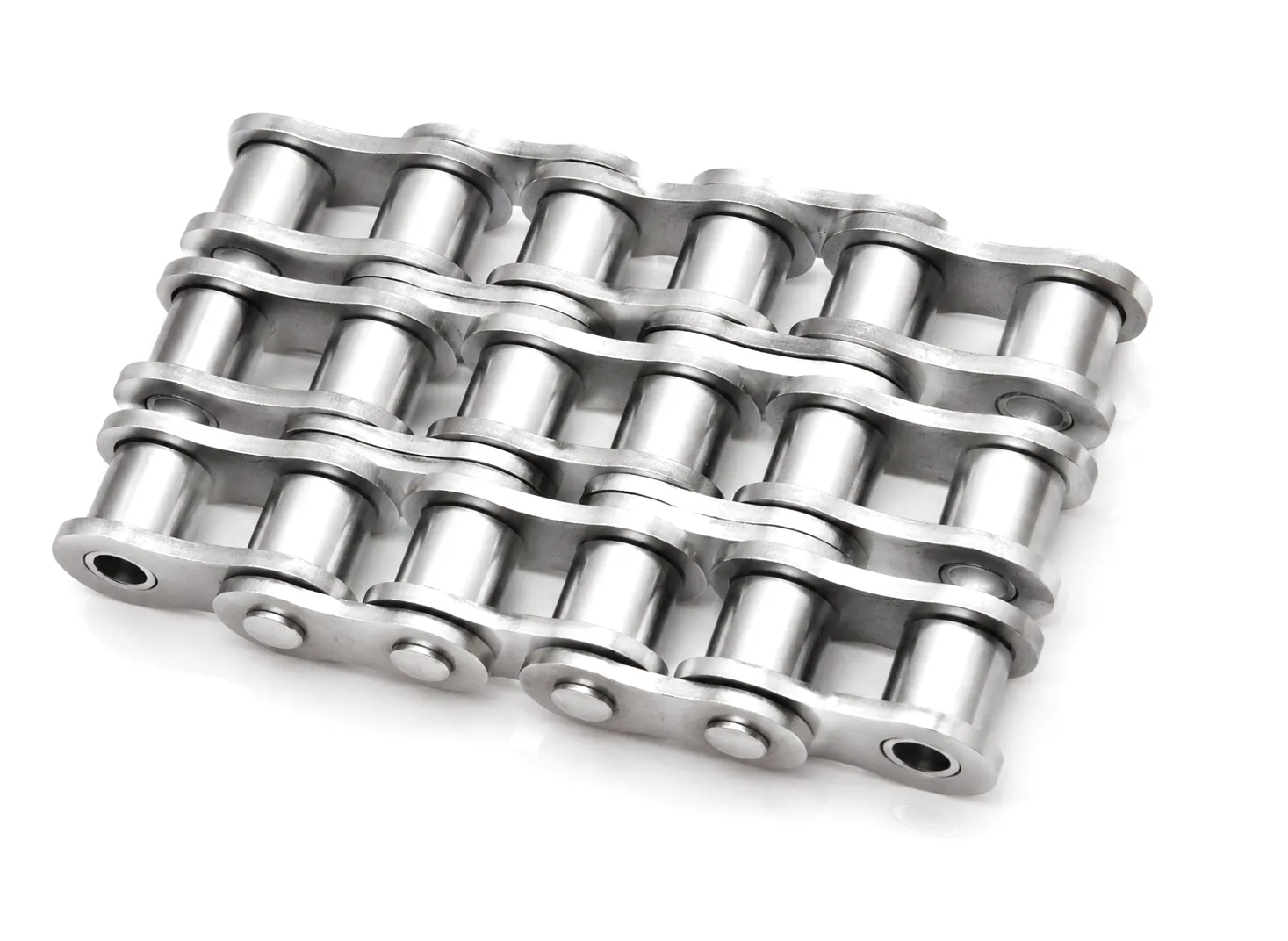
Food and beverage processing lines in Warwickshire and Leicestershire rely on stainless attachment chains with A1 bent-tab configurations to transport packaged goods through pasteurisers, chiller tunnels, and labelling stations. The chains must survive repeated wash-down cycles with caustic cleaning agents while maintaining pitch accuracy so that label applicators and carton sealers remain in registration. Extended-pin attachment chains serve overhead hanging conveyors that carry poultry carcasses through temperature-controlled zones, where the chain must articulate freely through multiple bends without transferring any linear force to the hanging load that could cause product damage or carcass spin.
In the UK’s coal, aggregate, and mineral processing industries — still a significant employer in regions from County Durham through to South Wales — bucket elevator attachment chains handle the continuous vertical lifting of crushed stone, sand, and coal fines. The A2 symmetric attachment design is standard in these elevators because the filled bucket presents a significant weight offset from the chain centreline, and symmetric loading prevents the progressive side-wear that would shorten chain life. Breaking loads must carry substantial safety factors because a failed elevator chain in a fully loaded bucket run results not only in costly downtime but in a potentially dangerous uncontrolled release of material.
🏭 Automotive Assembly — Coventry & Oxford
Body panel transfer across press lines uses duplex-pitch attachment chains with precisely positioned A1 plates that carry the transfer bars holding sheet metal blanks. Pitch accuracy is critical — a positional error of 1 mm over a 10-metre transfer run results in misaligned press tool engagement and expensive tooling damage. Shot-peened HSP-series chains are increasingly specified for these applications because their superior fatigue performance supports higher press cycling rates without chain-induced downtime.
🌾 Agricultural Machinery — Lincolnshire & East Anglia
Grain dryers, potato harvesters, and sugar beet processing equipment operate in highly abrasive, wet-soil environments across the East Midlands and eastern England. Extended-pin and D-type attachment chains fitted with rubber-tipped paddles or polyurethane flights move root crops and grain without bruising or cracking — product quality that directly affects farm gate prices. In harvest season these machines run at near-continuous duty for weeks; the robustness of the attachment chain joint under repeated shock loading from irregular crop-feed rates is the primary factor in selecting chain specification for these applications.
⚗️ Pharmaceutical & Chemical — Cheshire & Teesside
GMP-compliant pharmaceutical production in Macclesfield’s pharmaceutical cluster demands attachment chains that shed zero metallic particles. PTFE-coated stainless SK1 chains with enclosed-joint bushings transport tablet trays through coating drums and packaging lines. Cleanroom electronics assembly in the Cambridge-Oxford arc similarly specifies electroless-nickel or dry-film-lubricated attachment chains where contamination from oil mist would damage sensitive components. These markets set the highest cleanliness and traceability standards in the UK chain market, requiring lot-specific certification and material traceability from mill certificate to finished chain.
Ever Power: Precision Manufacture & Customisation
Built on engineering precision. Delivered with supply chain certainty.
Ever Power approaches attachment chain manufacture as a precision engineering discipline rather than a volume commodity exercise. At our production facilities, every attachment position is machined and inspected individually — plate hole tolerances are held to ±0.010 mm, and attachment face perpendicularity relative to the chain line is verified with digital measurement equipment that flags any deviation exceeding 0.15°. This attention to geometric precision means that when UK plant engineers bolt a flight bar or bucket to an Ever Power attachment chain, the assembly fits correctly on the first attempt, without the shimming and re-machining that can turn a chain replacement job from a planned afternoon into a multi-day exercise.
Customisation capability at Ever Power spans the full attachment chain design space. From modifying the hole pattern on standard A1 plates to accommodate a customer’s proprietary bolt pattern, through to machining entirely new attachment geometries from customer drawings, the engineering team applies FEA analysis to every non-standard attachment design before manufacturing commences — verifying that combined tensile and bending stresses at the attachment root remain within the fatigue limit of the selected material. This engineering rigour translates directly into extended service life and fewer field surprises for UK maintenance teams.
🔬 FEA-Validated Custom Attachments
Every non-standard geometry verified by finite element analysis before production begins.
📋 Full Material Traceability
Mill certificate to finished product — required for pharma, food, and aerospace supply chains.
⚡ Fast-Track Despatch
Standard attachment configurations held in stock for rapid air-freight to UK distribution hubs.
🤝 UK Technical Support
Pre-sales engineering support in GMT — fast response for urgent plant-down situations.
Customer Success Story: Leeds Aggregate Processing Facility
📍 Leeds, West Yorkshire
🏗️ Quarry & Aggregate Processing
✅ Resolved
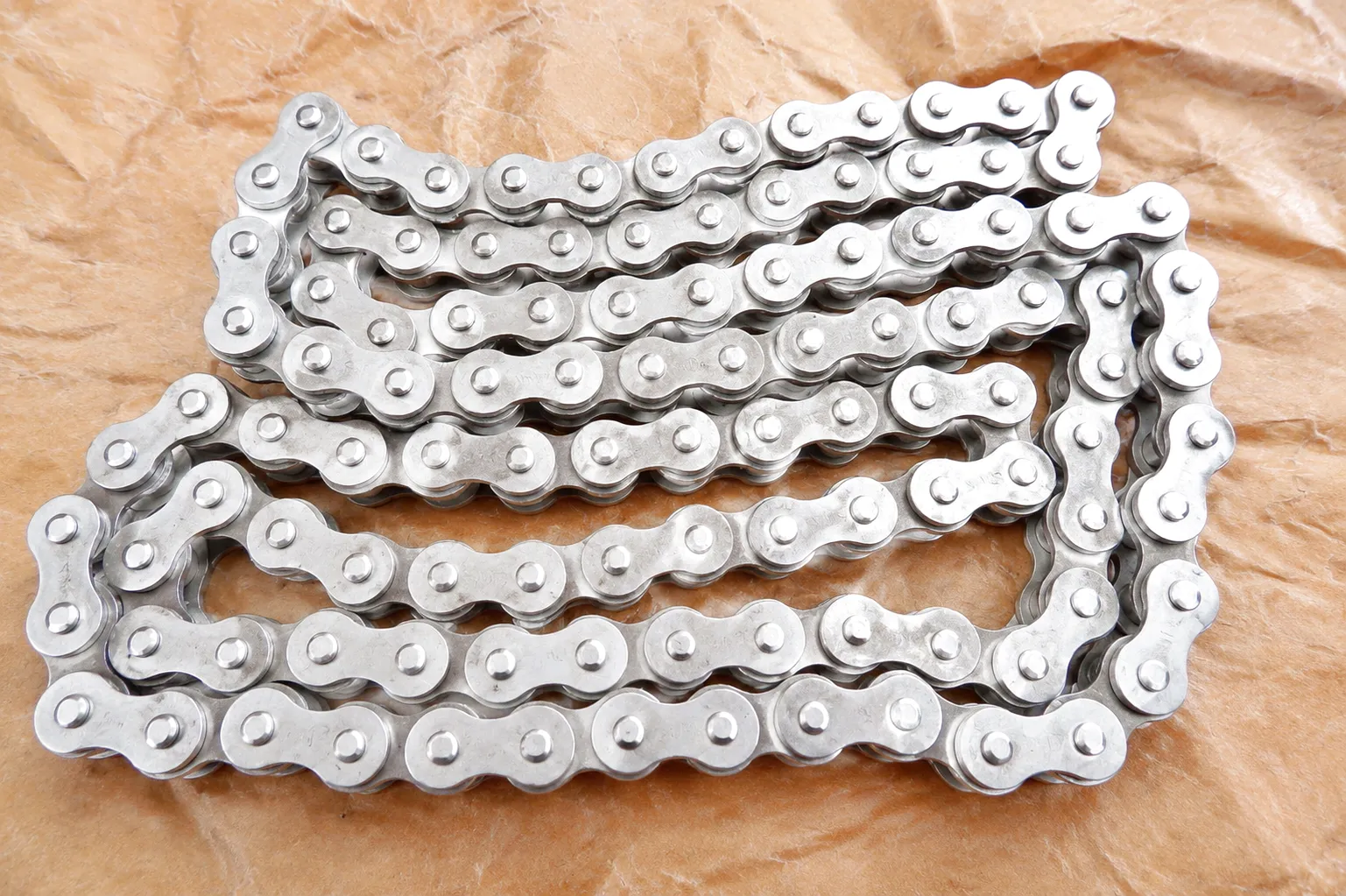 A Leeds-based quarry and aggregate processing business had been operating a bucket elevator line handling crushed limestone at roughly 80 tonnes per hour, feeding a bagging station that supplied construction merchants across Yorkshire and the Humber. The incumbent chain — a standard ANSI 120 attachment chain sourced from a domestic UK distributor — was averaging 8,500 operating hours before replacement became necessary due to chain elongation exceeding 3% and fatigue cracking at attachment plate roots. At a shutdown time of two working shifts per replacement, with associated loss of throughput, the maintenance cost per year was calculated at over £28,000 including lost margin on bagged product.
The plant engineering manager contacted Ever Power through the company’s online enquiry channel and provided chain drawings, sprocket data, and a full description of operating conditions including bucket fill weights and elevator speed. Ever Power’s technical team proposed a custom A2 attachment configuration using HSP-series alloy steel chain blanks with shot-peened plates, upgraded to include sealed O-ring joints in the inner links to prevent the limestone grit ingress that had been accelerating pin and bushing wear. The proposal included a revised attachment plate root geometry with a larger fillet radius — a modification derived from FEA analysis showing that the original design had a stress concentration factor of 2.3 at the plate-attachment junction, which dropped to 1.7 with the proposed change.
After 14,500 operating hours on the replaced elevator — running three shifts, six days per week — the chain was removed for inspection and found to have elongated by only 1.1%, with no evidence of attachment plate cracking. The facility has since ordered three further sets, and the saved maintenance cost over two years was reported by the plant manager as sufficient to fund a separate conveyor project that had previously been deferred on budget grounds. The seal system also eliminated the hydraulic oil top-up intervals previously required to counter grit-contaminated lubrication, a secondary saving estimated at several hundred pounds per year in oil and technician time.
รีวิวจากลูกค้า
★★★★★
“The HSP attachment chain Ever Power supplied has now been running in our Leeds elevator for over 14,000 hours without any attachment failures. The custom fillet radius they engineered into the A2 plates made a measurable difference — our previous chain had cracked at that exact point every time. The technical support during the quotation stage was thorough and genuinely saved us from specifying the wrong duty rating.”
— Plant Engineering Manager, Aggregate Processing, Leeds
★★★★★
“We trialled Ever Power’s stainless SK1 attachment chain on our poultry processing line in Lincolnshire and the result was immediate — no more rust staining on the line after weekend shutdown, and the PTFE bushing treatment means we’ve halved lubrication intervals. The certification pack they provided satisfied our BRC audit requirements without any additional paperwork chasing. Would not hesitate to extend to our other lines.”
— Maintenance Director, Food Processing Facility, Lincolnshire
★★★★★
“We operate automated press-transfer lines at our West Midlands facility and the positional accuracy of Ever Power’s A1 attachment chains has been outstanding. After six months running, we measured cumulative elongation at under 0.4% across the full 18-metre transfer length — well within our tool-alignment tolerance. The price competitiveness compared to what we were paying our previous domestic supplier was also a genuine surprise. We’ve now standardised on Ever Power for all attachment chain requirements across the site.”
— Process Equipment Engineer, Automotive Stamping, West Midlands
Selection Guide & Maintenance Best Practices
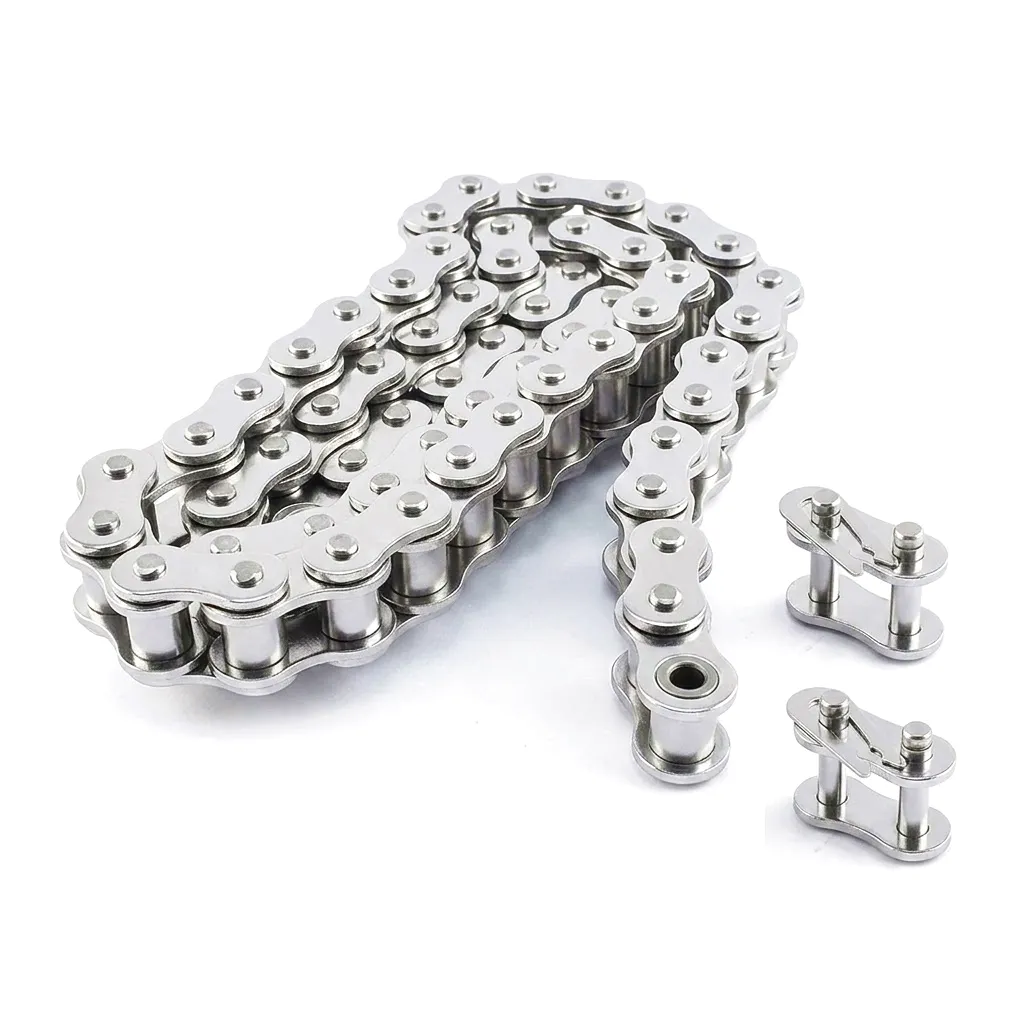
Selecting the correct attachment chain for a new or retrofit conveying application involves four parallel decisions: attachment type geometry (A1/A2/SK/D/custom), attachment frequency (links per pitch), base chain series and pitch, and material or surface finish. Of these, the most commonly mishandled is attachment frequency — specifying too-frequent attachments increases overall chain weight, reduces chain sag clearance at unsupported spans, and adds cost; too-infrequent attachments force product-holding components to span excessive distances between mounting points, introducing deflection and vibration under load.
Maintenance of attachment chains in service follows the same core intervals as plain chain — periodic elongation measurement (replacement at 2% for precision conveyors, 3% for general conveyors), sprocket tooth inspection for hooked or pointed profiles, and lubrication schedule compliance. The additional maintenance item specific to attachment chains is attachment integrity checking: bolt torque on attachment-bolted components must be verified at the same interval as lubrication, because vibration tends to loosen fasteners over time. Torque paint marks applied during installation make this check quick and definitive. For chains running in enclosed, splash-lubricated housings, UK engineering practice typically specifies quarterly lubrication inspection; open-running chains in abrasive environments should receive lubrication attention every two to four weeks depending on dust loading and humidity.
| Selection Factor | Consideration | Recommended Action |
|---|
| Chain Elongation >2% | Precision conveyor | Replace immediately |
| Chain Elongation >3% | General conveyor | Replace at next planned shutdown |
| Corrosive / wet environment | Food / coastal / chemical | Specify SS316 or ZnNi-plated |
| High shock loading | Mining / quarrying / harvesting | Specify HSP series + O-ring seals |
| Lubrication-free required | Pharma / electronics / cleanroom | PTFE bushing or sintered self-lubricating |
| Asymmetric load on attachment | Single-sided overhang | Use A2 symmetric or add lateral guide rail |
คำถามที่พบบ่อย
Real questions from UK plant engineers, procurement teams, and maintenance managers.
คิว What is the difference between an A1 and an A2 attachment plate on a roller chain, and which one should I use for my bucket elevator in Sheffield?
An A1 attachment plate extends from one side of the chain only, providing a single-sided mounting point with bolt holes for attaching flights, brackets, or carriers. An A2 attachment features matching extended plates on both sides at the same link position, creating a symmetrical platform. For a bucket elevator in Sheffield — or anywhere the bucket presents a significant offset weight from the chain centreline — A2 is the correct choice. The symmetric design balances the bending load equally across both pin ends, preventing the progressive side-plate fatigue that causes premature failure in A1-fitted elevators under heavy, eccentric bucket loads. A1 is more appropriate where the attached load is light, laterally guided, or where cost and chain width constraints rule out the wider A2 geometry.
คิว How much does a custom attachment roller chain typically cost from a UK supplier, and what factors affect the price I should expect to pay?
Pricing for custom attachment chains from a UK-supplied source depends on four main factors: base chain pitch and series (larger pitch and H-series commands higher material cost), attachment complexity (a simple drilled A1 plate costs less than a machined custom profile), order quantity (short runs of 5–10 metres carry significantly higher per-metre costs than 100-metre orders), and material specification (SS316 runs roughly 2.5–3x the price of equivalent carbon steel). As a general guide, standard ANSI 80 A1 attachment chain in carbon steel from a stocking distributor runs between £12 and £22 per metre for modest quantities; stainless versions at SS316 will be £30–£55 per metre. Custom-geometry attachments require an engineering quotation — Ever Power provides these at no charge, and turnaround on a quote is typically within one working day for standard configurations.
คิว Where can I find a reliable roller chain attachment supplier in the UK who can deliver quickly for a plant breakdown in Birmingham or the West Midlands?
For plant-down situations in Birmingham and the West Midlands, the fastest route to a reliable supply is a manufacturer or distributor with stocked standard configurations and a clear fast-track despatch process. Ever Power maintains stock of the most commonly specified attachment chain series — ANSI 60, 80, 100, and 120 in A1 and A2 carbon steel configurations — and can process emergency orders for air-freight to UK destination warehouses within 48–72 hours of order confirmation. For longer lead-time custom orders, a proactive approach — establishing a preferred supplier relationship and holding a small emergency stock — is the most effective plant protection strategy. Contact
[email protected] with your ANSI designation, attachment type, and required length for an immediate availability check.
คิว Which type of roller chain attachment is best for a food processing conveyor in a UK facility that needs to pass regular BRC and BRCGS hygiene audits?
For BRC/BRCGS-audited food processing environments, the specification typically needs to satisfy three audit criteria simultaneously: material compliance (food-safe, non-toxic), cleanability (no crevices that trap food residue), and documentation (material certificates and traceability). The preferred chain specification for these environments is SS316 stainless with electropolished attachment plate surfaces (Ra ≤ 0.8 µm), enclosed-joint inner links to eliminate oil-migration risk, and PTFE-coated or sintered self-lubricating bushings to remove the need for food-grade lubricant application during production hours. Extended-pin (SK-type) attachments are preferred over bent-tab types on overhead conveyors because there are fewer flat surfaces to collect wash-down water and debris. Ever Power provides full mill certificates and a declaration of conformity with food-contact material regulations for all stainless attachment chain series — documentation that satisfies BRCGS audit requirements without additional paperwork requests.
คิว How do I calculate the correct attachment chain pitch and attachment spacing for a new scraper conveyor design handling limestone in a quarry near Leeds?
Designing a scraper conveyor for limestone involves calculating the required chain pull (total material weight per metre of conveyor length multiplied by the friction coefficient and conveyor angle factor), then selecting a chain series whose working load rating provides a minimum safety factor of 7:1 against the calculated chain pull. Attachment spacing is then determined by the required scraper blade pitch — typically equal to or slightly less than the internal conveyor trough width to ensure complete material sweep. A useful rule of thumb: for horizontal or near-horizontal scrapers handling aggregates, attachment spacing of 150–200 mm (corresponding to every 4–6 links on a 38.1 mm pitch chain) provides adequate blade density without excessive chain weight per metre. For inclined scrapers above 15°, reduce spacing by 25–30% to prevent material rollback between blades. Ever Power’s engineering team can verify these calculations against your specific conveyor geometry and throughput specification — contact us with your conveyor layout drawing for a written recommendation.
คิว What is the typical lead time when ordering a custom attachment roller chain from an overseas manufacturer for delivery to a UK distribution centre or directly to site?
Lead times for custom attachment chains ordered from specialist overseas manufacturers and delivered to UK addresses vary based on configuration complexity and shipping method. Standard attachment configurations — A1 or A2 on common ANSI pitch chains — are typically held in stock or available within 3–5 working days from production, with air freight adding 3–5 calendar days for UK delivery, giving a total door-to-door time of 6–12 working days for non-complex orders. Custom-machined attachment profiles require a drawing review and first-article inspection period of typically 10–15 working days before despatch, after which shipping adds the same 3–5 days. Sea freight options, while cheaper, add 25–35 days transit and are only practical for planned orders where there is adequate forward notice. Ever Power recommends that UK customers requiring frequent or large-volume attachment chain supply establish a call-off stock arrangement to avoid lead-time exposure on operational chains — a commercial model we support with flexible minimum-order structures.
Ready to Specify Your Attachment Chain?
Ever Power supplies custom and standard attachment chains to UK plant operators, machine builders, and engineering distributors. Send us your specification — drawing, ANSI designation, attachment type, quantity, and operating environment — and receive a detailed technical quotation within one business day.
📩 Get a Quote Today
แก้ไขโดย gzl