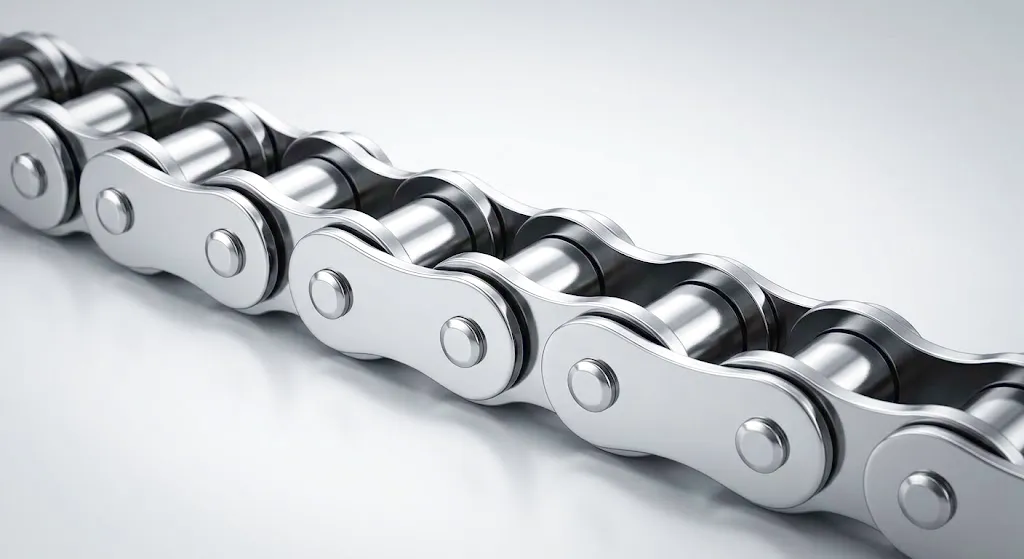
Roller chain sits at the heart of mechanical power transmission across virtually every sector of British manufacturing. From the steel mills of Sheffield and the automotive suppliers clustered around Birmingham’s Tyseley industrial estate to the packaging lines running twenty-four hours a day in West Yorkshire, the roller chain is the unglamorous workhorse that keeps production turning. Its design is deceptively simple — interlinked steel components that engage with a sprocket to transfer rotational force — yet its manufacture demands extraordinary precision. A tolerance deviation of even a few microns across thousands of links can cause premature wear, vibration, or catastrophic failure mid-production. Understanding how roller chain goes from raw steel strip to finished drive component is not merely academic; it is essential knowledge for any procurement manager, plant engineer, or maintenance supervisor who depends on chain reliability for uptime and output.
The manufacturing journey of a roller chain passes through a precisely sequenced series of metallurgical, mechanical, and quality stages. Each stage determines the performance envelope of the finished product — its tensile strength, its fatigue resistance, its ability to operate under high loads or in contaminated environments. This guide walks through that entire process in technical depth, covering raw material selection, the forming and heat treatment of individual components, assembly methods, and the final performance testing that separates a precision-grade drive chain from a commodity-grade substitute. Along the way, the guide surfaces the key factors that UK industrial buyers should interrogate when qualifying a chain supplier, and explains why the manufacturing process directly determines real-world chain life in applications ranging from conveyor drives to agricultural machinery.
✉ Richiedi un preventivo — [email protected]
Bespoke specification. Rapid turnaround. UK-ready supply chain.
Section 01 — Raw Material Foundations
The Steel Strip: Where Every Roller Chain Begins
A roller chain’s entire service life is determined before a single component is stamped or formed. The quality of raw steel strip — its carbon content, its grain uniformity, its surface condition — sets the ceiling on everything that follows. Industry-standard roller chain plate is cut from high-carbon steel strip with carbon content typically in the range of 0.45% to 0.60% by mass, a composition that allows the material to accept case-hardening heat treatment while retaining core ductility. The steel must exhibit consistent Rockwell hardness across its width, with surface defects such as seams, laps, or scale inclusions representing automatic rejection criteria for any serious manufacturer. In practice, precision roller chain manufacturers specify steel to tight internal standards — often more demanding than the nominal requirements of ISO 606 or BS/ISO 1275 — because incoming material variability translates directly into scatter in finished chain tensile strength.
Pin and bush stock calls for a different steel specification. Pins — the cylindrical members that carry shear load between inner and outer plates — are machined from cold-drawn steel bar with alloy additions of chromium and molybdenum to elevate hardenability. Bushings, which must resist both wear from roller contact and fatigue cracking from repeated bending, are often produced from a low-to-medium carbon steel that responds well to through-hardening. Rollers themselves are formed from strip steel and must achieve a surface hardness after treatment in the HRC 58–64 range to resist the Hertzian contact stresses generated when the roller seats into the sprocket tooth root. The selection and certification of these three distinct steel grades — plate, pin/bush, and roller — is the uncompromising starting point that distinguishes a premium chain from one destined for early replacement.
Section 02 — Component Forming
Precision Stamping, Cold Drawing, and Component Formation
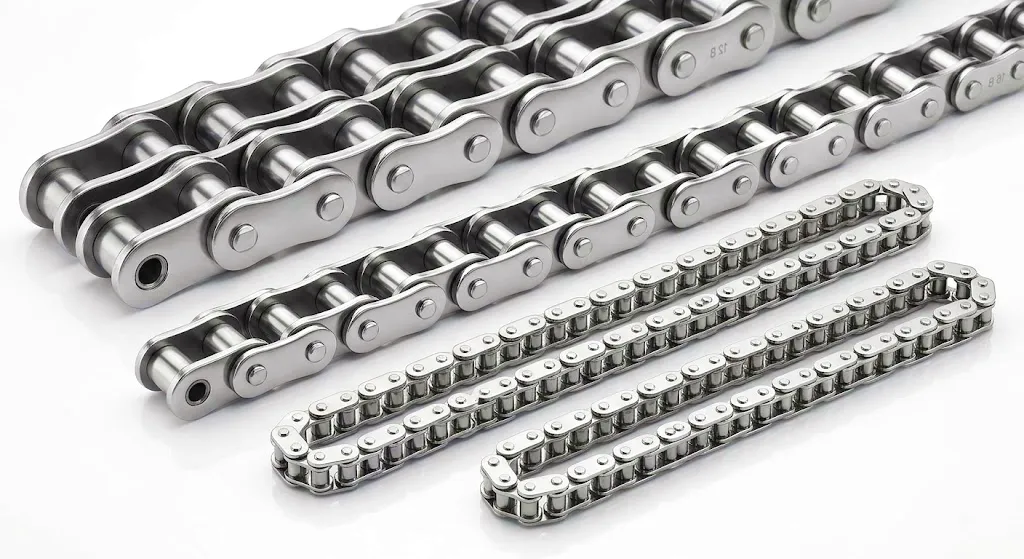
With the correct steel specifications locked in, the manufacturing process moves into component forming — a phase that encompasses stamping, blanking, drawing, and machining operations, each requiring its own specialised tooling. Plate blanking is performed on high-tonnage progressive die presses that, in a single continuous stroke, stamp the plate outline, punch the pin holes, and form the distinctive waist contour that gives the chain plate its figure-8 profile. The geometry of this contour matters considerably: a well-designed plate concentrates mass at the pin hole bosses where stress is highest, while reducing material in the waist to lower weight without compromising fatigue strength. The pin holes are punched slightly undersized and then finished by a precision broaching or reaming operation that brings the diameter and roundness into specification. In a quality factory, plate hole roundness is measured on a coordinate measuring machine (CMM) rather than by go/no-go gauge alone, because ovality creates stress concentrations that seed fatigue cracks at lower-than-expected loads.
Bush and pin forming follows a separate process route. Pins are cut from cold-drawn bar and centreless-ground to diameter, with the grinding wheel dress and feed rate optimised to achieve a surface roughness Ra of less than 0.4 µm on the final pass. This low roughness is not cosmetic: it directly controls the film thickness of the lubricant that separates the pin surface from the bush bore under operating load, and a rougher surface will puncture that film and initiate adhesive wear at far lower loads. Bushings are cold-formed from strip: the flat strip is progressively rolled into a cylindrical shell and press-fitted into the inner plate with an interference designed to generate a clamping stress that prevents bush rotation during service. Bush rotation — where the bush spins within the plate hole rather than being held stationary — is one of the principal causes of premature chain wear and elevated noise levels in high-speed transmission applications.
Section 03 — Heat Treatment & Metallurgy
Heat Treatment: Creating the Dual-Hardness Microstructure That Defines Chain Life
Heat treatment is the single process step that most dramatically distinguishes a precision roller chain from an ordinary one, and it is an area where shortcuts have severe long-term consequences. The objective is to produce components with a hard, wear-resistant surface layer — the case — over a tough, shock-absorbing core. This is achieved through carburising or carbonitriding: the components are loaded into a sealed atmosphere furnace and held at elevated temperature (typically 820–870°C for carburising) in an atmosphere rich in carbon-bearing gas. Carbon diffuses into the surface layer to a depth of 0.15–0.5 mm depending on the component type, raising the surface carbon content to approximately 0.7–0.9% and creating the conditions for martensite formation on subsequent quench. The quench — usually in oil — must be fast enough to suppress pearlite and bainite formation at the case, yet controlled enough to avoid quench cracking in plates and pins. Immediately after quenching, components are drawn back at 160–200°C to convert retained austenite, relieve quench stresses, and optimise the balance of hardness and toughness.
The resulting microstructure — a martensitic case over a tempered core — gives roller chain components a performance profile that neither all-hard nor all-soft components could achieve alone. A fully hard pin would be wear-resistant at its surface but would shatter under the shock loading that occurs when the chain engages a sprocket at speed or under sudden load reversal. A soft pin would not be brittle but would score and gall rapidly against the inner bush surface, generating metallic debris that accelerates abrasive wear throughout the chain. The case depth specification is therefore not a nominal — it is a precisely engineered value that the manufacturer must consistently achieve and verify through destructive testing of batch samples. Hardness traverse measurement using a Vickers micro-hardness tester, cross-sectioning, and etching with nital are the standard verification techniques, and these results must be recorded, retained, and available on request as part of the quality documentation package.
Atmosphere: Endo + enriching gas
Soak time: 90–240 min (component-dependent)
Target case depth: 0.15–0.50 mm
Surface C after carb: ~0.80%
Bush surface: HRC 56–62
Roller surface: HRC 58–64
Plate core: HRC 38–46
Pin core: HRC 34–40
Hold: 60–90 minutes
Cooling: still air
Purpose: retained austenite conversion, stress relief
Verification: Vickers HV0.3 traverse
Section 04 — Assembly & Working Principle
Chain Assembly and the Mechanical Principle of Power Transmission
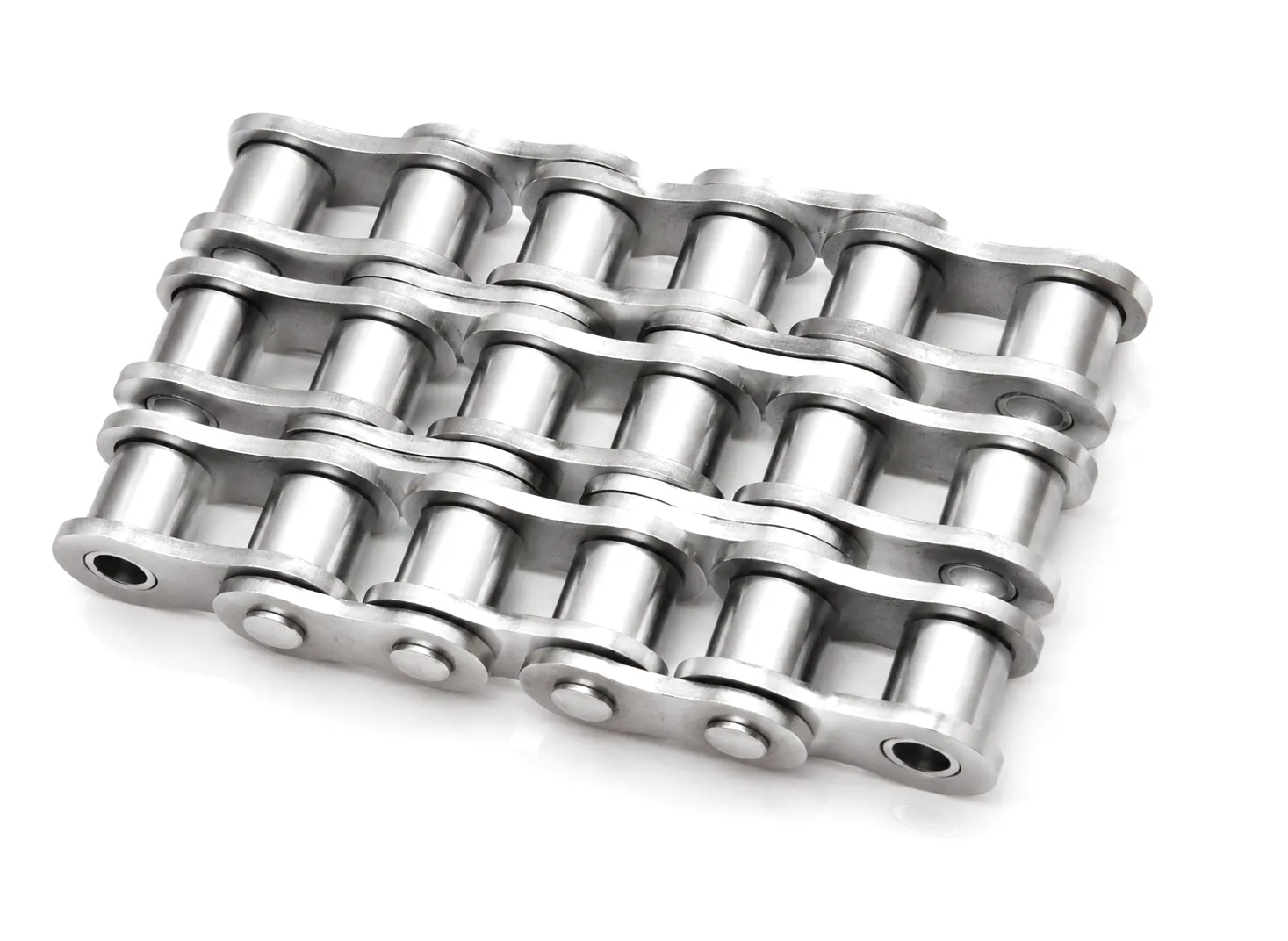
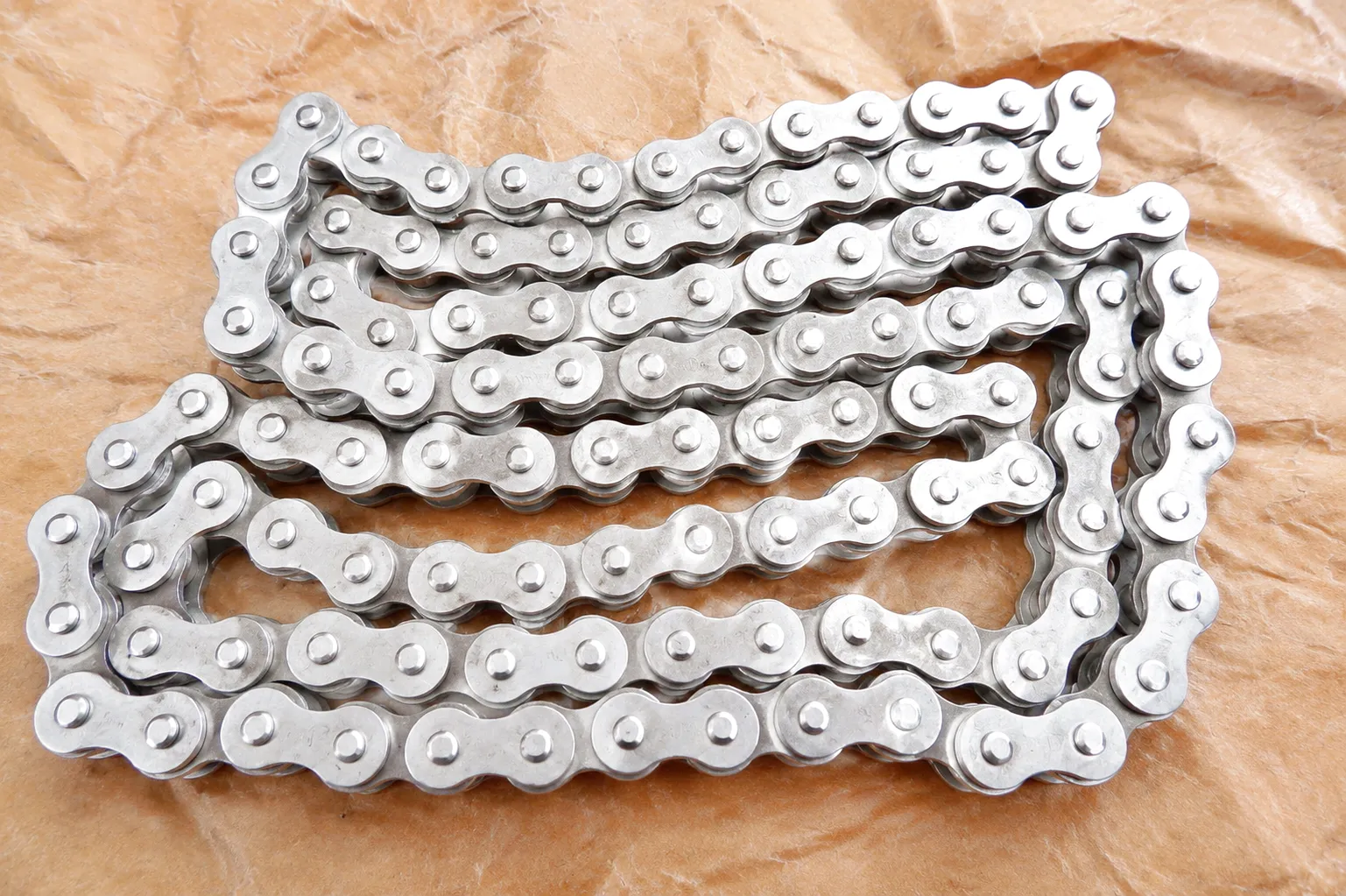
Chain assembly is where individually verified components are combined into the functional unit, and it is an operation that demands both precision machinery and consistent process control. The assembly sequence begins with the inner link: two inner plates are pressed onto a bush — which already carries a roller on its outer diameter — to form an inner link unit. The press-fit interference between the bush and the inner plate hole is specified to generate a hoop stress sufficient to prevent bush rotation under all anticipated service loads, yet not so large that it induces fracture during pressing. Modern assembly lines use servo-controlled presses with in-line force-displacement monitoring to verify that each press-fit falls within the specified envelope. An assembly where the press force is too low indicates an undersize plate hole or oversize bush — both rejection conditions. Too high a force indicates dimensional non-conformance on the opposite side and risks cracking the plate boss.
Once inner links are assembled, pins are inserted through the bush bores and the outer plates pressed onto the pin ends. The pin must rotate freely within the bush bore to allow the chain to articulate as it engages and disengages with the sprocket teeth. This articulation — the angular movement between inner and outer links as each link seates onto the sprocket — is where lubrication is most critical. A lubricant film must be maintained at the pin-bush interface throughout service life; its absence causes metal-to-metal contact that generates heat, wear particles, and rapid elongation of chain pitch. The outer plates are secured by heading or riveting the pin ends, with the formed head shape engineered to provide both axial retention and a controlled residual stress distribution that improves fatigue performance. After assembly, every unit goes through a pre-lubrication bath — a low-viscosity penetrating oil applied under vacuum to ensure the pin-bush annulus is fully wetted before the chain enters service.
A roller chain transmits power through positive engagement — the rollers seat into the tooth root of a sprocket, and rotational torque is transferred as a shear force through the pins. Unlike belt drives, which rely on friction, the positive engagement of chain with sprocket tooth means slip losses are negligible and the transmission ratio is exact. As the drive sprocket rotates, it imparts a tensile force to the chain strand on the tight side; the slack side carries a much lower tension. The torque transmitted (T) equals the tight-side tension multiplied by the sprocket pitch radius: T = (T1 – T2) × r, where T1 is tight-side tension and T2 is slack-side tension. Power (P) is then simply P = T × ω, where ω is angular velocity in radians per second. The chain speed is the product of sprocket tooth number, pitch, and rotational frequency — a relationship that defines the operating speed regime and the lubrication requirements.
The roller plays a key role in smoothing the engagement polygon effect. As each pin rises onto the sprocket tooth and the roller drops into the tooth root, the roller rotates freely to distribute the contact load around its circumference, converting sliding contact into rolling contact. This dramatically reduces the friction at the tooth-roller interface, lowers heat generation, and extends both chain and sprocket life relative to bush chains or block chains, which make sliding contact directly with the sprocket.
Section 05 — Performance Data Table
Roller Chain Technical and Performance Parameter Reference Table
The following table covers standard ISO 606 series chain sizes most commonly specified across UK industrial applications, from light-duty agricultural conveyors through to heavy manufacturing drive systems. Tensile strength values quoted are minimum breaking load for single-strand chains manufactured to BS/ISO 1275 standards; actual values for premium-grade chains often exceed these by 10–20%. Elongation limit of 3% is the standard replacement criterion; pitch tolerance values reflect precision-grade manufacture.
| Chain Size (ISO) | Passo (mm) | Roller Dia (mm) | Plate Height (mm) | Pin Dia (mm) | Resistenza minima alla trazione (kN) | Max. Allowable Load (kN) | Typical Max. Speed (m/s) | Peso (kg/m) |
|---|---|---|---|---|---|---|---|---|
| 08B-1 (50) | 12.70 | 8.51 | 11.81 | 4.45 | 17.8 | 4.4 | 18.0 | 0.69 |
| 10B-1 (60) | 15.875 | 10.16 | 14.73 | 5.08 | 22.2 | 5.6 | 17.0 | 1.02 |
| 12B-1 (60H) | 19.05 | 12.07 | 16.13 | 5.72 | 28.9 | 7.3 | 16.0 | 1.50 |
| 16B-1 (80) | 25.40 | 15.88 | 21.08 | 8.28 | 60.0 | 15.0 | 14.0 | 2.71 |
| 20B-1 (100) | 31.75 | 19.05 | 26.42 | 10.19 | 95.0 | 23.8 | 12.0 | 3.85 |
| 24B-1 (120) | 38.10 | 25.40 | 33.40 | 14.63 | 160.0 | 40.0 | 10.0 | 7.00 |
| 28B-1 (140) | 44.45 | 27.94 | 37.08 | 15.90 | 200.0 | 50.0 | 9.0 | 9.70 |
| 32B-1 (160) | 50.80 | 29.21 | 42.29 | 17.81 | 250.0 | 62.5 | 8.0 | 12.60 |
Values per ISO 606 / BS/ISO 1275. Tensile strength = minimum breaking load, single strand. Max speed = guidance value at standard lubrication; reduced for heavy shock load service. Custom pitch tolerances available on request from Ever Power.
Section 06 — Key Product Advantages
Why Precision Roller Chain Outperforms in Industrial Drive Systems
When the manufacturing process is executed with consistent metallurgical control and dimensional precision, the roller chain as a drive element offers a performance profile that belt drives and gear drives frequently cannot match in harsh industrial environments.
Section 07 — Application Scenarios
Industrial Application Scenarios: Where Roller Chain Performs in UK Industry
Roller chain is not a single-market component — it is a drive element whose design principles scale across an extraordinarily wide range of industrial contexts. In the UK, where manufacturing is distributed from the Midlands engine of automotive and aerospace supply chains to the northern food processing clusters and Scottish energy sector, the roller chain appears in applications spanning sub-kilowatt agricultural conveyors to multi-hundred-kilowatt mining drives. Understanding where and how chain is used in these contexts — what load profiles, speeds, environmental conditions, and maintenance regimes apply — is the starting point for any effective specification exercise.
In Birmingham’s automotive supply chain facilities, roller chain drives the transfer mechanisms that move body shells between welding stations and paint booths. These applications demand chains with tight pitch tolerances — typically ±0.025 mm per link — to maintain registration accuracy across long conveyor runs, and corrosion resistance appropriate to the wash-down and painting environment. In Sheffield’s steel processing industry, heavy-duty roller chain is specified for billet transfer conveyors operating at elevated ambient temperatures, where the chain must endure both radiant heat and intermittent scale contamination. Here, the key specification criteria are high tensile strength, thick-plate construction, and an appropriate selection of surface treatment to resist oxidation between lubrication intervals.
for Caterpillar
for Caterpillar
Section 08 — Ever Power Manufacturing
Ever Power: Precision Chain Manufacturing and Bespoke Industrial Supply
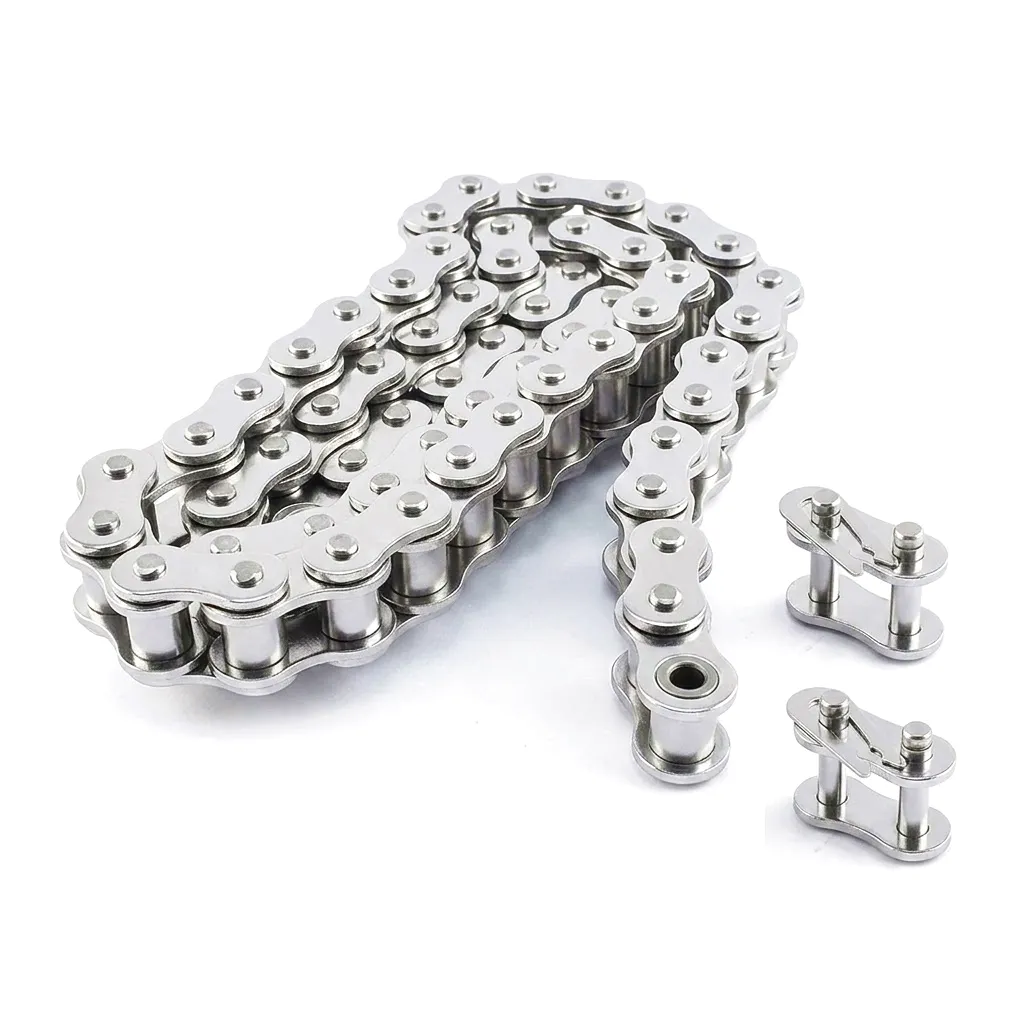
Ever Power operates a vertically integrated manufacturing operation in which raw steel selection, component forming, heat treatment, assembly, and quality assurance all happen within a single controlled production environment. This integration is not an operational preference — it is a fundamental quality assurance strategy. When all process stages are performed in-house, the chain between incoming steel certification and outgoing finished-product test report is unbroken. There is no outsourced heat treatment batch where temperature profiles were not directly monitored, no sub-contracted grinding operation where feed rates may have varied. Every component in an Ever Power roller chain is traceable back to its steel coil certificate, its furnace run chart, and its dimensional inspection records. For UK procurement teams managing ISO 9001 or IATF 16949 compliance requirements, this traceability capability is a supply qualification criterion, not merely a preference.
Ever Power’s customisation capability is particularly relevant for UK customers with non-standard requirements. The standard ISO 606 range is held in stock and available for rapid despatch on DDP Incoterms to UK distribution points. Beyond the standard range, the engineering team routinely supports: extended-pitch chains for slow-speed heavy conveyor applications; short-pitch double-strand chains for high-power compact drives; chains with specific attachment plates in customer-defined configurations; corrosion-resistant surface treatments including electroless nickel, Dacromet coating, and mechanical zinc; and OEM-replacement chains built to drawings rather than published standards. For Caterpillar-compatible drives, the 120HSP-00 and C100HSP-00 high-strength chains are held as standard stock items with lead times measured in days, not weeks — a critical distinction for customers managing machine breakdowns with production on hold.
Section 09 — Customer Success Story
Customer Success Story: Sheffield Special Steel — Billet Conveyor Drive Upgrade
A specialist alloy steel processing facility in the Lower Don Valley area of Sheffield — operating three electric arc furnace lines producing tool steel and high-speed steel for the UK aerospace and cutting tool markets — was experiencing an unacceptable frequency of unplanned stoppages on its billet transfer conveyor system. The conveyor used a 24B-1 single-strand roller chain to transport steel billets weighing between 80 kg and 340 kg from the continuous casting section to the walking beam furnace. The chain was sourced from a commodity supplier at low unit cost, and the facility’s maintenance records showed an average service life of approximately 1,800 hours before replacement was required — against an original design expectation of 4,500 hours. Each replacement required an eight-hour planned shutdown, and the frequency of unplanned failures was running at three to four incidents per year, each costing an estimated £18,000 in lost production and emergency maintenance labour.
The facility’s chief engineer contacted Ever Power following a recommendation from a plant at another Sheffield steel processor. An Ever Power technical representative visited site to conduct a detailed application audit, measuring sprocket tooth profiles, analysing lubrication system delivery volumes, documenting the temperature cycle in the ambient environment adjacent to the furnace, and extracting a section of the failed commodity chain for cross-section metallographic examination. The examination findings were unambiguous: the failed chain exhibited a case depth on the pins of less than 0.10 mm — well below the 0.25–0.35 mm specified for this application — and the core hardness was insufficient to resist the plastic deformation that had caused visible elongation of the pin holes in the inner plates. The heat treatment process used by the commodity supplier had not achieved the required furnace soak time for this pin diameter, resulting in insufficient carbon diffusion depth.
Ever Power supplied a custom 24B-1 heavy-series chain with extended-case-depth pins (0.35 mm minimum verified case depth), pre-lubricated with a high-viscosity penetrating oil appropriate to the elevated ambient temperature, and supplied in a continuous roll with connecting links, allowing the facility’s maintenance team to replace the entire chain circuit in a single four-hour planned outage rather than the previous eight-hour procedure. After 14 months of operation — over 9,800 hours of service — the chain had not required replacement, and the elongation measurement at 12-month inspection stood at 1.4% — comfortably within the 3% replacement threshold. The three-to-four unplanned failures per year were reduced to zero. The procurement manager estimated that the premium paid for Ever Power chain against the commodity alternative was recovered within the first three months of operation through avoided downtime costs alone.
“The difference in chain life was night and day. We ran the Ever Power 24B heavy-series chain for almost 10,000 hours before our first elongation check flagged it approaching 50% of the replacement threshold. The case-depth verification data they provided with the delivery gave our maintenance manager confidence the specification was genuinely being delivered — not just claimed on a data sheet.”
“We specified the C100HSP-00 Caterpillar-compatible chain from Ever Power for two of our surface mining draglines after a field trial. The tensile test reports that came with the shipment showed breaking loads 14% above the published minimum — that kind of consistency matters when the chain is pulling loads where failure puts people at risk. Delivery to our Derbyshire site was five working days from order confirmation, which for a non-standard chain is exceptional.”
“Our potato processing line in Lincolnshire runs 22 hours a day through the harvest season, and we cannot afford to be chasing overseas chain suppliers for documentation when our food safety auditor arrives. Ever Power supplied stainless 304 food-grade chains with full material certification, EHEDG-compatible build specification confirmed in writing, and accurate dimensional reports I could hand straight to the auditor. That kind of paperwork reliability is as valuable as the chain itself in our business.”
Section 10 — Frequently Asked Questions
Frequently Asked Questions About Roller Chain
Common questions from UK engineers and procurement teams — answered in plain terms.