Seleziona una pagina

Engineering Knowledge Series

Che cos'è una catena a rulli?
Struttura, componenti e funzionamento

A deep-dive technical guide for engineers, procurement specialists, and industrial buyers across the UK and global markets.

ISO 606 · ANSI B29.1
3,000+ Words In-Depth
UK Industrial Focus

Roller Chain Manufacturing - Ever Power

Roller chain is one of the most enduring and versatile mechanical power transmission components ever engineered. Found in applications ranging from industrial conveyor systems in Birmingham’s manufacturing corridors to agricultural machinery rolling across the Yorkshire Dales, the roller chain converts rotational motion into linear drive force with a mechanical simplicity that belies its engineering sophistication. Despite the proliferation of belt drives, hydraulic systems, and electromechanical actuators over the decades, roller chain remains a cornerstone of industrial machinery worldwide — a testament to its unmatched combination of strength, precision, and adaptability.

For engineers sourcing transmission components, procurement managers evaluating supply chain options, or operations teams maintaining heavy-duty equipment, a thorough understanding of roller chain structure, materials, and working principles is not merely academic — it is operationally critical. The right chain specification can mean the difference between years of low-maintenance productivity and costly downtime in a Sheffield steel processing plant or a Leeds packaging facility. This guide dissects every aspect of roller chain from the ground up.

What Exactly Is a Roller Chain — and Why Does It Matter?

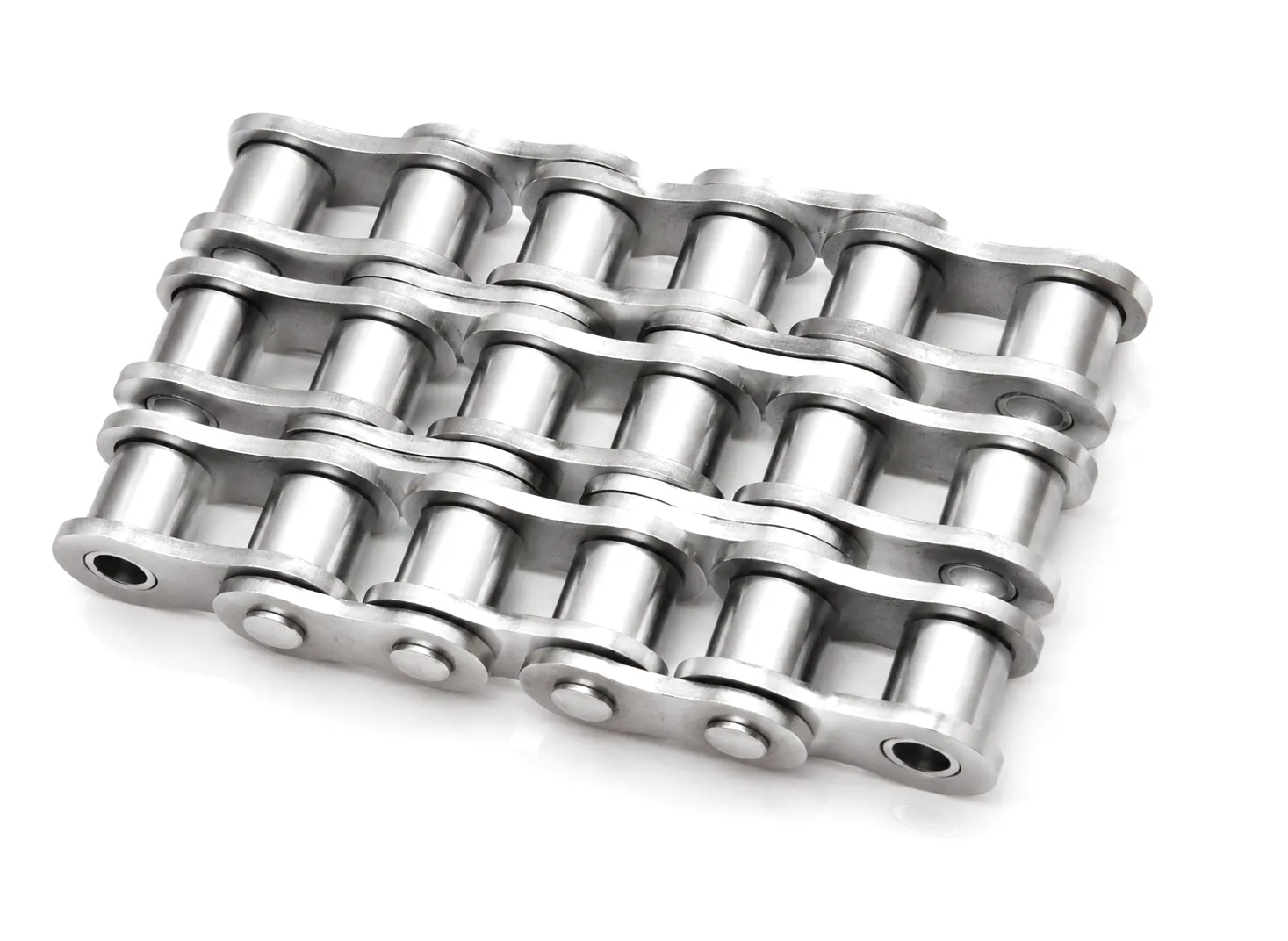
A roller chain is a type of chain drive used for the mechanical transmission of power from one rotating shaft to another. It consists of a series of short cylindrical rollers held together by side links, where each roller engages precisely with the teeth of a sprocket — a toothed wheel designed to mesh with the chain’s geometry. The result is a positive, slip-free drive that transmits torque with an efficiency typically exceeding 97% under well-lubricated conditions. Unlike friction-based belt drives, roller chain does not creep or slip under load, meaning the drive ratio between input and output shafts remains constant and predictable regardless of loading variations.

📈

The concept of the roller chain traces back to Hans Renold’s landmark 1879 patent, and the fundamental design has proven so effective that it remains largely unchanged in modern industry. What has evolved is the precision of manufacturing tolerances, the quality of materials, and the engineering of specialty variants for extreme environments. Today, roller chains are classified under international standards including ISO 606 (European standard) and ANSI B29.1 (American National Standard), ensuring dimensional interchangeability across global supply chains. For UK manufacturers and engineering buyers, ISO compliance is typically the governing specification for procurement, though ANSI-compatible chains are also widely stocked and supplied across British industry.
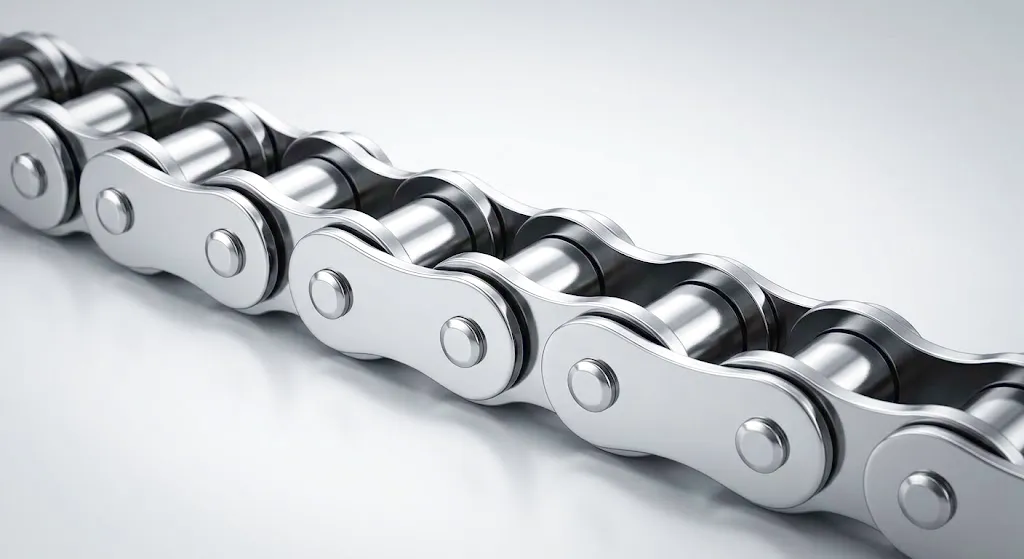
Core Structure: The Anatomy of a Roller Chain

01
Inner Link Plate
The inner link plates are flat, punched steel components that form the sides of the inner chain links. They connect to the bushings and maintain the chain’s geometry under tensile load. Manufactured to tight dimensional tolerances, they provide lateral rigidity while the chain articulates around sprocket teeth during operation.
02
Outer Link Plate
Outer link plates sit on the exterior of the chain assembly and are press-fitted onto the connecting pins. They alternate with inner link plates to create the chain’s modular, articulating structure. The outer plates bear a portion of the tensile load and also protect the internal components from debris and contamination in industrial environments.
03
Boccola
The bushing is a hollow cylindrical component press-fitted into the inner link plates. It serves as the bearing surface upon which the roller rotates freely. The bushing-to-pin interface is the primary wear zone in the chain; quality chains use heat-treated, case-hardened bushings to resist this wear. Bushing material selection and heat treatment are often differentiating factors between premium and economy chains.
04
Rullo
The roller is the cylindrical component that sits on the bushing and makes direct contact with the sprocket teeth. Its free rotation converts the sliding friction that would otherwise occur at the sprocket-chain interface into rolling friction — dramatically reducing wear and energy losses. Rollers are precision-hardened and ground to exact diameters to ensure consistent engagement across each sprocket tooth.
05
Connecting Pin
The pin is a solid cylindrical rod that passes through the bushing and is press-fitted into the outer link plates. It is the backbone of the chain’s tensile strength. Pins are manufactured from medium- or high-carbon steel, then heat-treated to achieve a hard outer surface with a tough, ductile core — providing both wear resistance and resistance to fatigue fracture under cyclic loading.
06
Connecting Link / Master Link
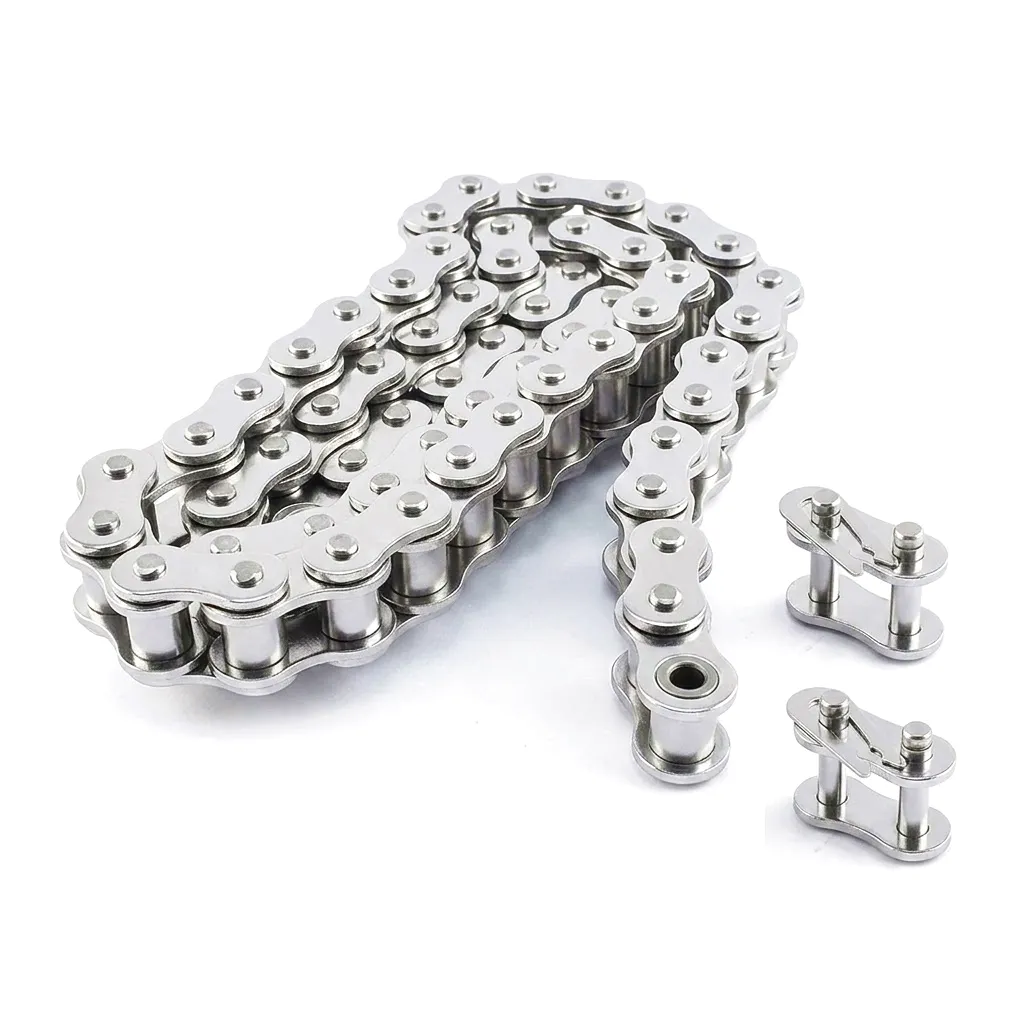
The master link (also called a connecting link) allows the chain to be easily joined end-to-end without specialist tools. It consists of a U-shaped outer plate, a slip-fit pin, and a retaining spring clip. For high-load applications, cotter pin-type master links provide more secure retention. Proper selection and installation of the connecting link is critical — it is often the first failure point if incorrectly assembled.

How a Roller Chain Works: The Principle of Power Transmission

Roller Chain Power Transmission Principle

The operational principle behind a roller chain drive is elegantly direct. Power is input at a driving sprocket — typically mounted on the output shaft of a motor or gearbox. As the sprocket rotates, its teeth engage with successive rollers along the chain’s inner surface. The chain, now pulled by the driving sprocket, travels across any intermediate idler sprockets and ultimately meshes with a driven sprocket mounted on the output shaft. The result is mechanical power — torque and rotational speed — transferred from one shaft to another across a defined centre distance.

The speed ratio between driver and driven shafts is determined purely by the tooth count ratio of the sprockets — a ratio that remains perfectly consistent under varying loads, unlike friction drives that may slip. If the driving sprocket has 20 teeth and the driven sprocket has 40 teeth, the driven shaft will rotate at exactly half the input speed, regardless of torque variations. This positive-drive characteristic makes roller chain particularly suitable for precision timing applications and heavy-duty drives where consistent speed ratios are operationally critical.

Rolling action at the sprocket-chain interface is the key mechanism behind the chain’s low-friction operation. Rather than the chain plate sliding across sprocket teeth — which would generate significant heat and wear — each roller freely rotates on its bushing as it seats into the sprocket tooth gap. This converts damaging sliding friction into low-energy rolling friction, enabling mechanical efficiency levels of 97–99% under optimum lubrication conditions. For a high-power industrial drive running continuously in a Birmingham automotive components plant, this efficiency advantage translates directly into measurable energy cost savings over the operating life of the system.

Engineering Note: Chordal Action

An important physical phenomenon in roller chain drives is chordal action — a slight, periodic variation in the chain’s linear velocity as it wraps around a sprocket. Because the chain is composed of discrete rigid links rather than a continuous flexible belt, the effective pitch radius of the sprocket varies slightly as successive links engage. This causes a small cyclical fluctuation in driven-shaft speed, typically described as chordal variation. The effect is minimised by using sprockets with higher tooth counts and maintaining adequate chain tension. Engineers specifying roller chain for precision-motion applications in sectors like robotic automation or servo-driven conveyors must account for chordal action in their drive design calculations.

Materials That Define Performance: What Roller Chains Are Made From
Roller Chain Materials Steel Stainless

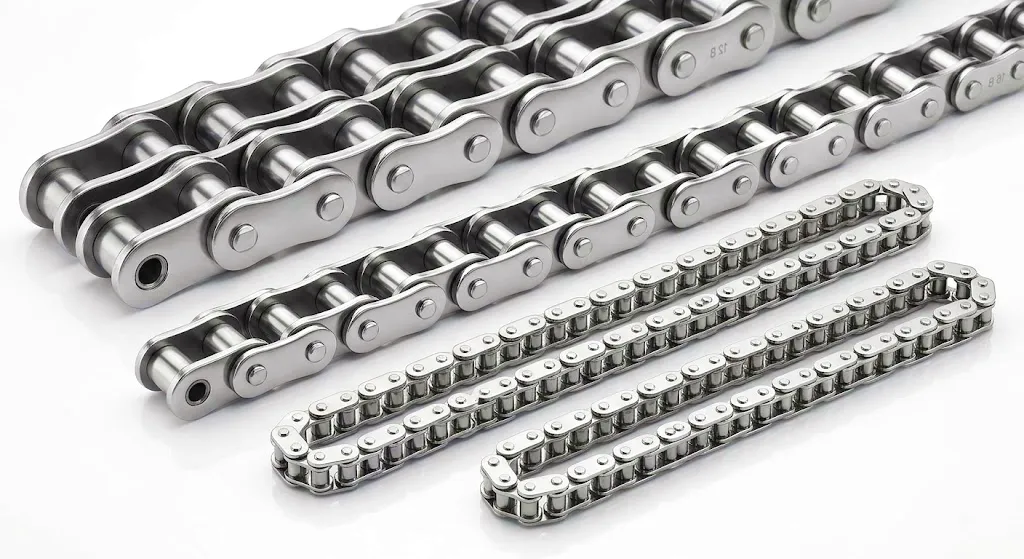
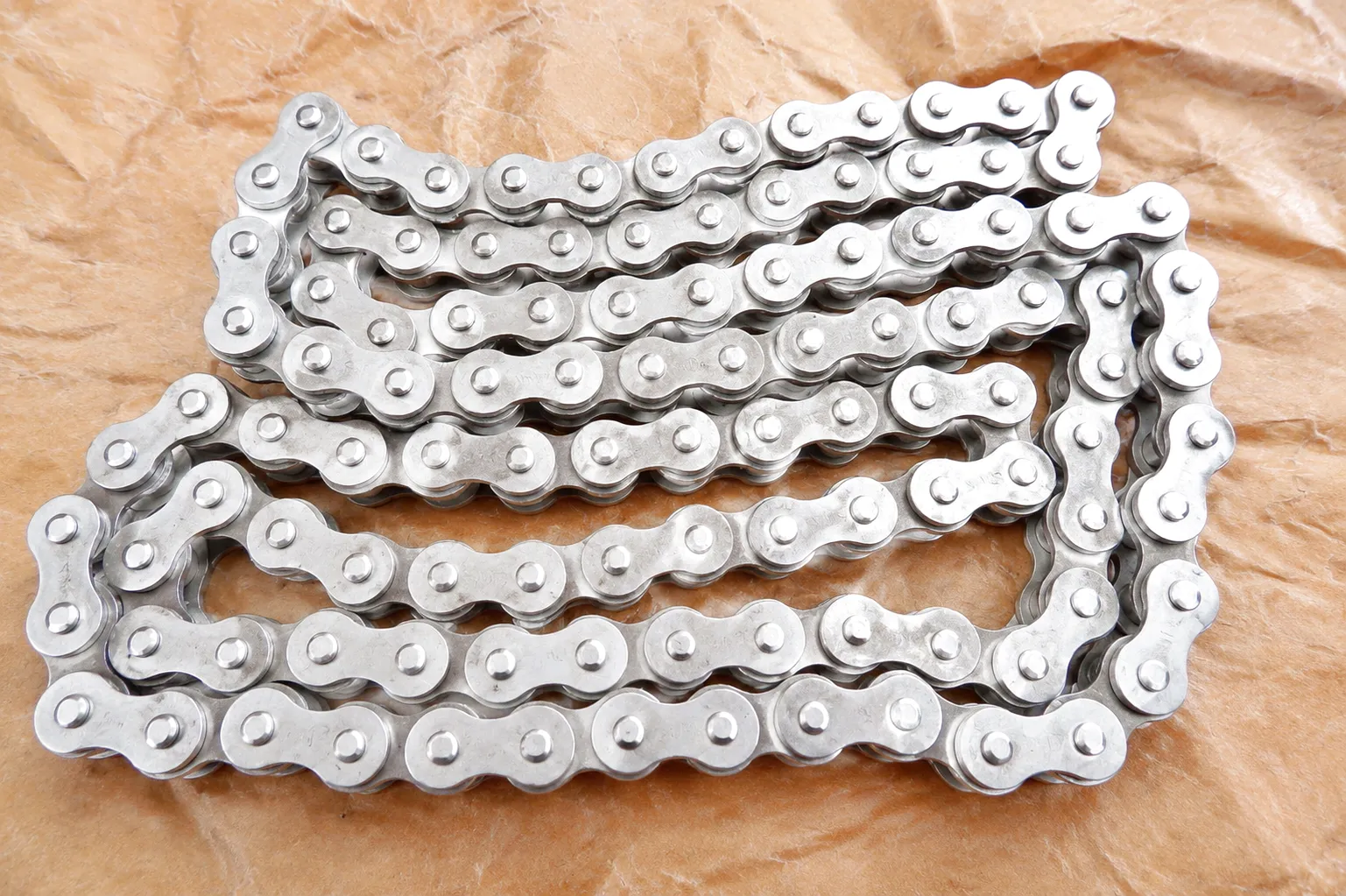
Material selection is the single most influential factor in roller chain performance and service life. For standard industrial applications — the vast majority of roller chain usage in UK manufacturing — the chain components are fabricated from medium or high-carbon steel grades. Carbon steel offers an excellent combination of strength, machinability, and responsiveness to heat treatment processes, including case-hardening and through-hardening. The surface hardening process creates a wear-resistant outer layer while preserving a tough, impact-resistant core — an engineering balance critical for components that must withstand both surface abrasion and cyclic tensile fatigue simultaneously.

For corrosive environments — such as food processing facilities in Edinburgh, chemical plants along the Humber Estuary, or marine equipment operations around the Bristol Channel — stainless steel roller chain provides superior resistance to oxidation and chemical attack. Common grades include 304 stainless for general corrosion resistance and 316 stainless for more aggressive chemical or saline environments. Stainless steel chains are inherently lower in tensile strength than their carbon steel equivalents at equivalent dimensions, so engineers must size these chains appropriately with a suitable service factor applied to the calculated design load.

acciaio al carbonio
High tensile strength, excellent case-hardenability, wide availability. Best suited for standard industrial, automotive, and agricultural applications. Most cost-effective option for non-corrosive environments.
acciaio inossidabile
Grades 304 and 316. Corrosion-resistant for food, chemical, and marine applications. Lower tensile strength than carbon steel — requires correct service factor calculation during specification.
Nickel-Plated
Carbon steel chain with electroplated nickel coating. Balances improved corrosion protection with near-standard tensile strength. Popular in light food processing and pharmaceutical packaging environments.
Self-Lubricating
Sintered metal bushings impregnated with oil or PTFE inserts at the pin-bushing interface. Eliminates need for periodic lubrication — vital for clean-room, overhead, or difficult-to-access installations.
High Strength / Heavy Series
Thicker link plates and larger-diameter pins for applications where standard chains would be over-stressed. Used in mining, crane drives, and heavy agricultural machinery operating under severe shock loading.

★ Featured Products

High Strength Roller Chains for Demanding Caterpillar Applications

120HSP-00 Series
Catena a rulli ad alta resistenza 120HSP-00 per Caterpillar
Engineered to meet the extreme tensile and fatigue demands of Caterpillar heavy equipment. Precision case-hardened components, extended service life, direct-fit replacement compatibility. Widely deployed in UK quarrying and civil engineering equipment fleets.
Visualizza il prodotto →


C100HSP-00 Series
Catena a rulli ad alta resistenza C100HSP-00 per Caterpillar
The C100HSP-00 series delivers outstanding breaking load performance with enhanced plate profile geometry for improved fatigue resistance. Ideal for the UK construction equipment aftermarket and bulk material handling systems in the Midlands.
Visualizza il prodotto →


Why Engineers Choose Roller Chain: Core Technical Advantages

Alta densità di potenza

Roller chains transmit remarkably high levels of power relative to their physical size and weight. A single standard simplex roller chain can reliably transmit tens of kilowatts, while duplex and triplex configurations multiply this capacity further. For space-constrained machine designs in Sheffield’s precision engineering workshops, this power density advantage is a consistent specification driver.

Positive, Slip-Free Drive

Unlike V-belt or flat-belt drives, roller chain delivers an absolutely constant speed ratio between input and output shafts. There is no creep, no slip, and no ratio variation under load. This makes roller chain the preferred choice wherever precise timing, synchronisation, or indexing is required — such as multi-axis transfer lines in automotive assembly plants or bottling plant conveyors in the North West of England.

📈
Flexible Centre Distance

Roller chain drives function effectively across a wide range of centre distances between sprockets — from very close-coupled drives to widely separated arrangements spanning metres. The drive can easily accommodate multiple sprockets (enabling branched power distribution to several output shafts) and can navigate around obstacles using idler sprockets, offering machine designers a level of routing flexibility unavailable with direct gear trains.

🔧
Ease of Maintenance & Repair

Roller chain drives are inherently simple to inspect, maintain, and replace. Chain elongation (wear-related pitch increase) is easily measured with a chain wear indicator tool, allowing condition-based replacement planning. When a chain does reach end of life, the replacement process is straightforward and can typically be completed without specialist tooling. This maintainability is especially valued in 24/7 production environments where downtime directly impacts output and profitability.

Tolleranza alla temperatura

Standard carbon steel roller chains operate reliably across a temperature range of approximately -10°C to +300°C with appropriate lubricant selection. High-temperature variants with special alloy link plates and heat-stable lubricants extend the operating range significantly. This compares favourably with rubber or polyurethane belt drives, which have narrower temperature tolerances — a practical consideration for drives adjacent to heat-generating process equipment in foundries and glass manufacturing plants.

💰
Cost-Effectiveness Over Lifecycle

When total cost of ownership is calculated across a drive’s full service life — including acquisition cost, maintenance intervals, energy consumption, and replacement frequency — roller chain consistently delivers competitive lifecycle economics. The initial hardware cost is generally lower than equivalent gearbox configurations, and the sprocket-based speed ratio can be adjusted simply and inexpensively by fitting different sprocket combinations without replacing the entire drive system.

Product Technical & Performance Parameters

The table below presents representative technical parameters for standard roller chain series commonly used in UK industrial applications. Chain designation follows the ISO 606 / DIN 8187 numbering system. Actual values vary by chain series, manufacturer specifications, and application conditions — always consult the full technical datasheet and apply appropriate service factors when sizing a drive.

Chain Designation
ISO 606
Pece
(mm)
Diametro rullo
(mm)
Carico di rottura
(kN) min.
Peso
(kg/m)
Pin Dia.
(mm)
Materiale Applicazione tipica
06B-1 9.525 6.35 8.9 0.41 3.28 acciaio al carbonio Light machinery, instruments
08B-1 12.70 8.51 17.8 0.69 4.45 acciaio al carbonio General industry, conveyors
10B-1 15.875 10.16 22.2 0.93 5.08 acciaio al carbonio Agricultural, packaging
12B-1 19.05 12.07 28.9 1.15 5.72 acciaio al carbonio Construction equipment
16B-1 25.40 15.88 60.0 2.71 8.28 acciaio al carbonio Heavy conveying, drives
20B-1 31.75 19.05 95.0 3.55 10.19 Carbon / Alloy Steel Mining, steel works
120HSP-00
(High Strength)
38.10 22.23 155+ (Enhanced) 6.80 14.29 Alloy Steel, Case-Hardened Caterpillar heavy equipment

* Breaking load values shown are minimum values per ISO 606. High-strength series values reflect enhanced plate geometry and alloy materials. Consult full datasheet for all dimensional parameters.

Industrial Application Scenarios Across the UK and Beyond
Roller Chain Industrial Applications UK

The versatility of roller chain as a power transmission medium means its applications span virtually every sector of industrial activity. The chain’s ability to handle high torques, operate in harsh environments, function across wide temperature ranges, and deliver a positive, synchronised drive makes it the default choice in contexts where belts lack the load capacity and gearboxes lack the flexibility. From the automotive assembly lines of the West Midlands to food processing facilities in the agricultural heartlands of East Anglia, roller chain is woven into the operational fabric of British manufacturing.

🚗
Automotive Manufacturing — West Midlands

Automotive assembly plants around Birmingham, Coventry, and Wolverhampton rely heavily on roller chain drives in conveyor systems, transfer lines, and index drives. The chain’s precise timing capability is critical for synchronising assembly operations across multi-station production lines. High-strength chains handle the demanding loads of vehicle body and drivetrain conveying, while specialty variants operate in paint shop ovens at elevated temperatures.

🏗
Construction Equipment — Quarrying and Civil Engineering

Heavy-duty roller chain is the drive medium of choice for crawler tracks and final-drive systems on construction machinery — from excavators working on infrastructure projects across the UK’s major road and rail expansion programmes to crawler dozers in the quarrying industry. The shock-load tolerance and high tensile strength of high-series and heavy-series roller chains make them indispensable in this sector, where sudden overloads and abrasive environments are routine operating conditions.

🌿
Agricultural Machinery — Yorkshire and East Anglia

From combine harvesters traversing the flat grain fields of Lincolnshire to potato harvesters operating through the heavy soils of Norfolk, roller chain is the workhorse of agricultural drive systems. Crop processing machinery, baler drives, header conveyors, and grain auger drives all rely on chains to transmit power reliably through harvest seasons that demand continuous, high-load operation with minimal downtime. Agricultural chains are typically manufactured to heavy-duty specifications to cope with crop debris contamination and intermittent shock loading.

🍽
Food and Beverage Processing — UK National Facilities

Food processing is one of the UK’s largest manufacturing sectors, and roller chain drives are embedded throughout its infrastructure. Conveyor drives for product transport, slat conveyors in pasteurisation tunnels, can-filling line drives, and freezer tunnel conveyors all rely on food-grade roller chains. For these applications, stainless steel or nickel-plated chains are required to meet hygiene standards, while self-lubricating variants eliminate the contamination risk associated with conventional petroleum-based lubricants. Chains certified to NSF H1 food-grade lubricant standards are mandatory in direct-contact zones.

Steel Processing — Sheffield and Scunthorpe

Steel mills and rolling mills operate some of the most extreme drive environments that roller chain encounters. Mill table drives, coiler drives, and roller-way conveyors must handle massive loads, elevated temperatures from adjacent processes, scale and debris contamination, and the inherent shock loading of heavy steel sections being processed. Heavy-series roller chains with alloy-steel components, high-temperature lubricants, and sealed or stainless variants for specific zones are standard practice in Sheffield’s world-renowned special steel production facilities.

📦
Logistics and Warehousing — National Distribution Centres

The rapid growth of e-commerce and just-in-time logistics across the UK has driven massive investment in automated sortation and conveying systems in distribution centres across the Midlands logistics corridor and the M62 belt. Roller chain drives power the backbone conveying infrastructure of these facilities — from gravity roller conveyors with powered zones to high-speed sortation diverters and pallet handling systems. The combination of reliability, ease of replacement, and compatibility with standard sprocket geometries makes roller chain the primary mechanical drive element in these environments.
🏭 Manufacturing Excellence

Ever Power: Precision Roller Chain Manufacturing & Custom Engineering Solutions

Ever Power has built its reputation on precision manufacturing and an unwavering commitment to customisation capability. Our manufacturing facilities operate to exacting dimensional tolerances, supported by in-house quality control processes including coordinate measuring machine (CMM) inspection, hardness testing, tensile load verification, and fatigue life testing. Every batch of roller chain leaving our facility is traceable to its raw material certificates — a supply chain transparency that UK procurement managers and quality-conscious buyers across Europe rely on.

Where standard roller chain catalogue items do not meet the specific demands of a customer’s application, Ever Power’s engineering team works directly with clients to develop custom chain solutions. This encompasses modification of standard series chains — altered attachment plates, extended pins, special lubrication provisions, and non-standard pitch lengths — through to fully bespoke designs for unique drive geometries and operating environments. Our in-house design team brings decades of application knowledge to each custom brief, ensuring the delivered solution performs optimally across the intended service conditions.

Full ISO 606 and ANSI B29.1 compliance across standard product range, with full dimensional certification available on request for UK buyers.
Custom attachment plates, extended pins, bent attachment links, and specialty coatings available on standard-series chains with short lead times.
High-strength and heavy-series chains engineered for Caterpillar, Komatsu, and other OEM equipment platforms — with full interchange compatibility guaranteed.
Consolidated export logistics with DDP delivery options to UK addresses and established customs documentation for post-Brexit compliance.

Request a custom quote or technical specification review — our engineering team responds within one business day.

📧 Richiedi un preventivo — [email protected]

Customer Success Story: Sheffield Steel Conveyor Overhaul

Ever Power Roller Chain Customer Success Sheffield Steel

A mid-sized special steels producer in Sheffield — operating a long-running specialty alloy division supplying the UK aerospace and defence sectors — was experiencing premature failure of drive chains across three of its mill table conveyor drives. The chains, sourced from a general industrial distributor, were standard ISO 16B-1 simplex chains operating in conditions well beyond their design intent: ambient temperatures consistently exceeding 120°C adjacent to rolling equipment, heavy scale contamination, and intermittent shock loading from steel billets averaging 800 kg.

The facility’s engineering manager contacted Ever Power following a recommendation from a plant maintenance consultant. After reviewing the application data — chain speed, load calculations, operating temperature profiles, and observed failure modes — our engineering team proposed a custom solution: a heavy-series 20B-2 duplex chain with alloy-steel plates (heat-treated to enhanced hardness specifications), extended-diameter pins for increased fatigue resistance, and a batch-applied high-temperature dry-film lubricant treatment rated to +250°C. The chains were also supplied pre-measured and pre-cut to the required drive lengths, reducing installation downtime.

The outcome was a substantial improvement in service life — from an average chain replacement interval of approximately four months under the previous supply to an interval exceeding fourteen months under the Ever Power solution across all three conveyor drives. Annual maintenance cost savings were estimated at approximately 60% for that specific drive system, excluding the reduction in production downtime. The client subsequently extended the Ever Power supply arrangement to cover six additional drive points across the facility.

Cosa dicono i nostri clienti

★★★★★

“We’d been fighting chain failures on our mill table drives for years. Ever Power’s engineering team actually read our application data before quoting — something most suppliers never bother with. The custom high-temperature chain they specified has been running for over a year without a single intervention. Outstanding product performance and technical support.”

— Plant Engineering Manager, Special Alloys Producer, Sheffield
★★★★★

“We run a substantial fleet of Caterpillar equipment across our civil engineering contracts in the North West. The 120HSP-00 chains from Ever Power have been a direct-fit replacement that outperforms the original-equipment chains in terms of wear life. The lead time is competitive and the pre-sales support on specification matching has saved us several costly mistakes. Genuinely impressed.”

— Procurement Director, Civil Engineering Contractor, Manchester
★★★★★

“Our packaging line runs three-shift, five days a week. We switched to Ever Power’s stainless series for our food-grade conveyor drives twelve months ago and the chains have performed without fault. The documentation pack they supplied — material certificates, dimension records, compliance data — was exactly what our quality assurance team needed. We are now standardising Ever Power chains across our second site in Leeds.”

— Maintenance Manager, Food Packaging Facility, Nottingham

Selecting and Maintaining Roller Chain: Practical Engineering Guidance

Correct chain selection begins with an accurate assessment of the design power requirement — not merely the rated motor power, but the effective transmitted power incorporating service factors for start-stop frequency, shock loading character, and hours of operation per day. ISO 10823 provides a structured methodology for roller chain drive design that most UK machinery designers follow as the basis for specification. The design load, once established with appropriate service factors applied, is matched against the rated power capacity tables published for each chain series at the relevant operating speed.

Lubrication is the single most important maintenance variable affecting roller chain service life. Under-lubricated chains wear far faster at the pin-bushing interface, progressing through increased pitch (elongation) and ultimately towards fatigue fracture. The correct lubricant viscosity and application method depend on chain speed: manual or drip lubrication for low-speed applications, bath or disc lubrication for medium speeds, and forced oil jet systems for high-speed drives. Selecting a lubricant incompatible with operating temperature or environmental conditions is a common and avoidable error.

🔭
Monitor chain elongation with a wear gauge — replace when elongation reaches 2% of nominal pitch length (per ISO 10823). Beyond this point, the chain begins to ride up sprocket teeth, accelerating both chain and sprocket wear rapidly.
📈
Maintain chain tension within specification — excessive sag leads to whip and dynamic overloads; over-tensioning overloads bearings and accelerates pin-bushing wear. Use automatic tensioners on drives with variable loads or where vibration is present.
Inspect sprocket tooth profiles at each chain replacement. Worn sprockets — characterised by hooked, asymmetric, or worn tooth profiles — will rapidly destroy a new chain. Replace sprockets when tooth profile wear exceeds acceptable limits or when the tooth gap has widened noticeably.
🔧
Check sprocket alignment at installation — misaligned sprockets cause the chain to run laterally across the sprocket face, generating destructive side loads on link plates and accelerating lateral wear. A straightedge or laser alignment tool used at installation prevents this common failure mode.

Frequently Asked Questions About Roller Chain

Q How do I know which roller chain size is right for my industrial application in the UK?

Correct roller chain sizing for UK industrial applications involves calculating the design power by multiplying the transmitted power (kW) by the appropriate service factor from ISO 10823 based on application type, daily operating hours, and power source characteristics. The resulting design power figure is then matched against chain power rating tables for the relevant sprocket tooth count and operating speed. When uncertain, contacting a specialist supplier like Ever Power for a free application review is the most reliable approach — our engineering team can size the chain correctly from your motor nameplate data and a brief application description.

Q What is the typical cost and price range for industrial roller chain supplied to buyers in the UK, and how do I get a quote?

Roller chain pricing varies substantially with chain series, pitch size, material specification, and order quantity. Standard ISO simplex chains in common sizes are competitive in the industrial market, while specialty variants (stainless steel, heavy-series, self-lubricating) command a premium reflecting the higher material and manufacturing costs. High-strength OEM-compatible chains such as the Ever Power 120HSP-00 and C100HSP-00 are priced in accordance with their enhanced performance specifications. To receive an accurate price for your specific requirements, contact us at [email protected] with your chain specification, quantity requirement, and delivery location within the UK.

Q Where can I find a reliable roller chain supplier in the UK who can handle custom specifications and short lead times?

Ever Power supplies roller chain to buyers across the UK, including engineering firms in Birmingham, Sheffield, Manchester, Leeds, Bristol, and beyond. Our export logistics include DDP delivery options to UK addresses with full post-Brexit customs documentation. For custom specification chains, our engineering team typically turns around a technical review and quotation within one business day of receiving application data. Standard in-stock chains can be despatched within 48–72 hours. Reach us at [email protected] for an initial discussion about your requirements.

Q How often should roller chain be replaced on heavy industrial machinery operating in a Sheffield or Birmingham manufacturing plant?

Replacement interval depends on chain quality, lubrication regime, loading character, and environmental conditions. The engineering standard (ISO 10823) recommends replacement when chain elongation due to wear reaches 2% of nominal pitch length — measurable with a chain wear indicator tool. In practice, well-lubricated, correctly tensioned chains in moderate industrial environments often achieve service lives of 15,000–25,000 operating hours. In harsh environments — high temperatures, heavy shock loads, abrasive contamination — intervals may be considerably shorter. Condition-based monitoring and periodic wear measurement are far more reliable than fixed calendar-based replacement intervals.

Q Which type of roller chain should I specify for a food processing conveyor drive in a UK facility that requires hygiene certification?

For UK food processing environments, the minimum specification is typically stainless steel (316 grade for wet or saline conditions, 304 grade for general food environments) or nickel-plated carbon steel for non-contact zones. Self-lubricating chains with PTFE-impregnated bushings eliminate the need for petroleum-based lubricants entirely, which is the preferred solution for zones where chain lubricant could contact food product. Lubricants used on food-zone chains must be NSF H1 registered. Ever Power can supply food-grade roller chain with full material traceability and compliance documentation suitable for audit purposes.

Q What is the difference between ANSI and ISO roller chain, and which standard should UK buyers use when sourcing from a supplier?

ISO 606 (commonly called BS/DIN chain in the UK) and ANSI B29.1 are both widely used chain standards, but they are not interchangeable — the sprocket tooth profiles and inner width dimensions differ between the two. UK buyers should default to ISO 606 (designated with “B” suffix, e.g. 08B, 12B) as this is the standard most UK machinery is designed to and most domestic distributors stock. American-built equipment may use ANSI series chains (designated with “A” suffix, e.g. ANSI 50, ANSI 60). When replacing chain on imported machinery, always verify the standard from the original equipment documentation or by measuring the existing chain before ordering.

Pronti per l'approvvigionamento?

Get a Custom Roller Chain Quote from Ever Power Today

Whether you need standard ISO simplex chain, stainless steel food-grade variants, or custom-engineered high-strength chain for OEM equipment, our team delivers technical expertise and competitive pricing with reliable UK export logistics.


📧 Contact Us: [email protected]

modifica a cura di gzl