Roller chain drive systems remain among the most reliable and efficient mechanisms for transmitting mechanical power in heavy industry. Whether found on a bottling conveyor in Leeds, an agricultural harvester rolling across East Anglia, or a coal processing plant in South Yorkshire, roller chain offers a unique combination of strength, flexibility and engineering simplicity that no belt or gear solution can fully replicate. For plant engineers and mechanical designers, understanding the mathematics behind drive design — specifically speed ratio, centre distance and wrap angle — is the difference between a drive that lasts a decade and one that fails within months. This article delivers a thorough, calculation-grounded approach to roller chain drive design, covering the underlying physics, material science, performance parameters, industrial applications across the UK, and the manufacturing capabilities that leading suppliers bring to bespoke projects.
How a Roller Chain Drive Actually Works
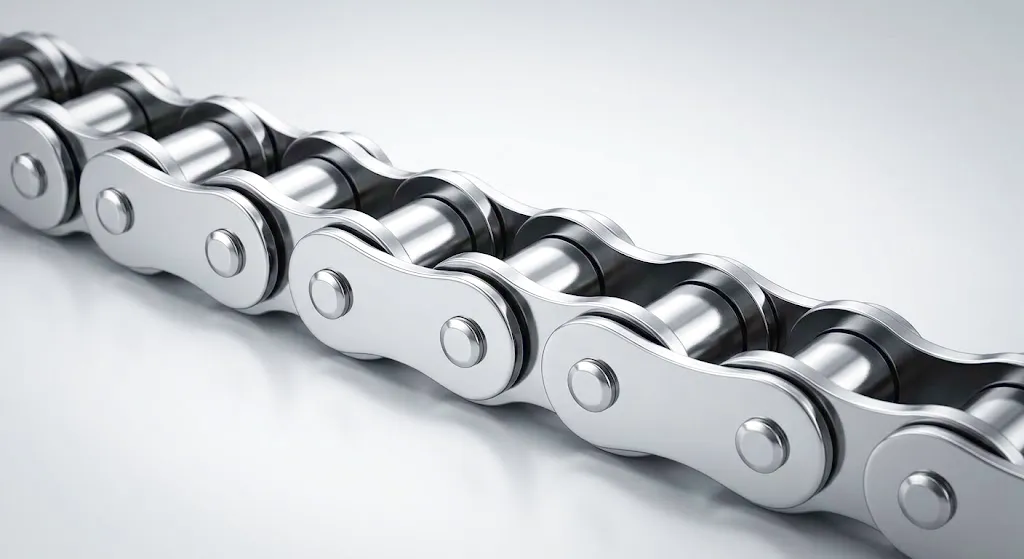
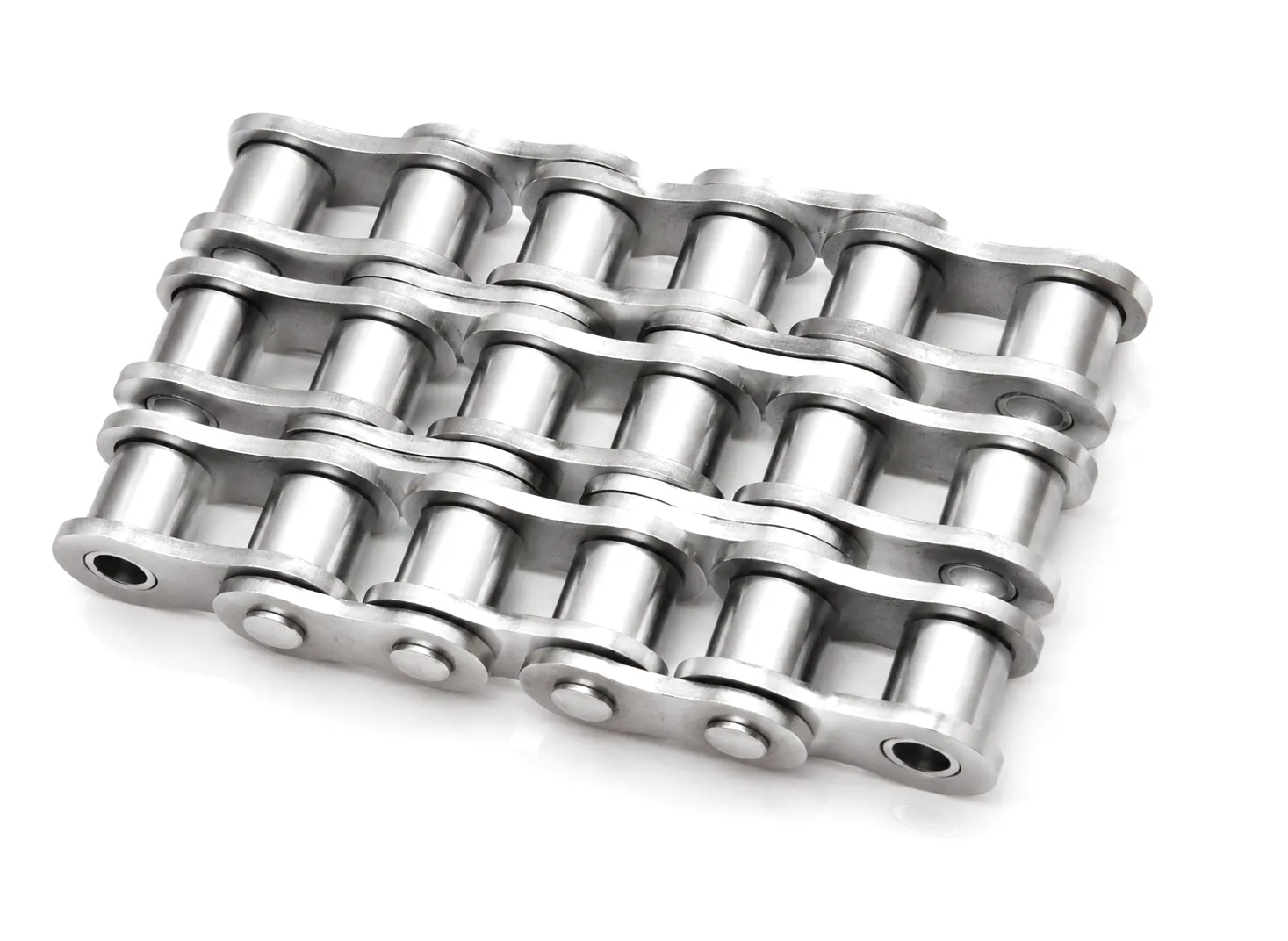
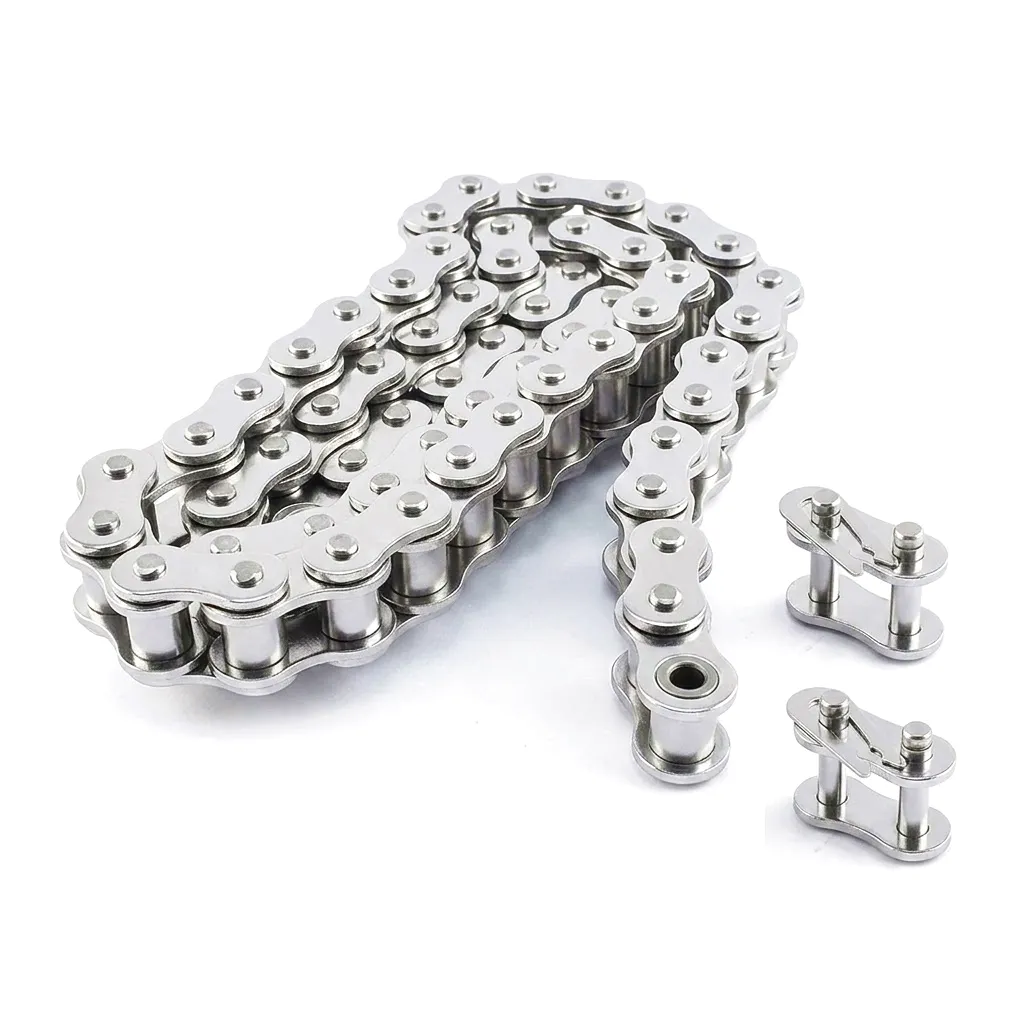
A roller chain transmits torque through positive mechanical engagement between hardened steel rollers and the precisely machined teeth of a sprocket. Unlike a friction drive, there is no slip — every tooth contact results in a deterministic transfer of motion. The chain wraps around the driving sprocket (also called the driver or pinion sprocket) and the driven sprocket, with each roller seating cleanly into the tooth gap under tension. As the driving sprocket rotates, it pulls the chain’s tight side, which then rotates the driven sprocket at a speed governed by the ratio of tooth counts. The return strand, known as the slack side, loops back under minimal tension. This positive engagement also means that roller chain drives tolerate shock loads far better than belt drives — a critical advantage in environments like press shops in Coventry or mineral processing plants near Durham, where cyclical peak torques are common.
The fundamental speed ratio of any roller chain drive is determined by a straightforward relationship between sprocket tooth counts. If the driving sprocket has N1 teeth and the driven sprocket has N2 teeth, the velocity ratio i = N2 / N1. Equivalently, the output speed n2 = n1 x (N1 / N2), where n1 is the input shaft speed in RPM. For example, a 19-tooth driver running at 1,450 RPM meshed with a 57-tooth driven sprocket produces an output speed of 483 RPM and a speed ratio of 3:1. This calculation appears deceptively simple but has profound implications for drive sizing: a high reduction ratio means a significantly larger driven sprocket, which directly affects centre distance, chain length, and the wrap angle at the small sprocket. In multi-stage reduction applications — common in conveyor drives at ports like Bristol or automated warehouse systems in Northampton — each stage must be calculated and balanced individually to avoid resonance and unequal chain loading.
Centre Distance, Chain Length and Wrap Angle: The Engineering Detail
Centre distance — the measured gap between the centrelines of the driver and driven sprocket shafts — sits at the heart of any competent roller chain drive design. Getting this figure right balances three competing demands: adequate chain wrap at the small sprocket, manageable sag on the slack side, and a chain length that corresponds to a whole number of pitches. The recommended centre distance for most standard drives falls between 30 and 50 times the chain pitch, though compact machine designs in sectors like food processing or textile machinery (historically significant in Lancashire and West Yorkshire) often require closer centres, demanding more careful tension management.
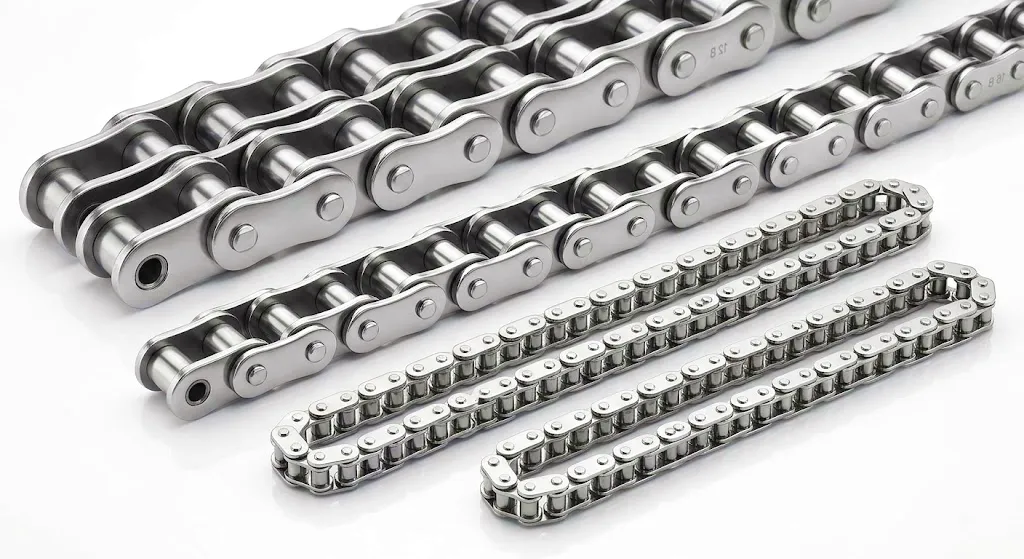
The chain length L (in pitches) can be calculated using the formula: L = 2C/p + (N1 + N2)/2 + ((N2 – N1) / (2 x pi))^2 x (p / C), where C is the centre distance and p is the pitch. This formula is an approximation derived from the geometry of two circles connected by tangent lines, and it must always be rounded up to the nearest even number of pitches to allow use of a standard connecting link. Odd-pitch chains require an offset link, which reduces fatigue strength by approximately 20%, and should be avoided in high-cycle, high-load applications wherever possible.
Wrap angle (also called angle of contact or arc of engagement) describes how much of the small sprocket’s circumference is in active contact with the chain. It is calculated as: alpha = 180 – 60 x (D – d) / C, where D is the pitch diameter of the large sprocket, d is the pitch diameter of the small sprocket, and C is the centre distance. All values in the same unit (mm or inches).
The minimum permissible wrap angle for a roller chain drive is generally accepted as 120 degrees. Below this threshold, insufficient teeth are engaged simultaneously, leading to elevated loads per tooth, accelerated sprocket wear, and an elevated risk of the chain riding up and jumping teeth under shock loading. The wrap angle can be improved by increasing the centre distance, reducing the speed ratio, or installing an idler sprocket on the slack side — a technique frequently adopted in automated assembly line designs across the Midlands automotive supply chain.
Material Science Behind High-Performance Roller Chain
The durability and load capacity of a roller chain are almost entirely determined by the grades of steel used in its individual components and the heat treatment processes applied to each. Understanding these material choices helps procurement engineers at UK manufacturing firms — particularly those in demanding sectors like offshore energy in Aberdeen or heavy fabrication along the Humber estuary — specify chains that genuinely match their operating environments.
Inner and outer link plates are stamped from medium-carbon alloy steel — typically SAE 1045 or equivalent grades — and undergo controlled heat treatment to achieve tensile strengths ranging from 600 to 900 MPa for standard chains, and exceeding 1,000 MPa in heavy-duty variants. The plates are designed with a waisted profile to distribute fatigue stress away from pin-hole edges, extending service life significantly under oscillating loads. Shot peening of the plate surfaces after heat treatment introduces compressive residual stresses, further raising fatigue resistance by up to 30% compared to untreated plates.
Chain pins endure the highest contact stresses in the entire assembly, pressed between the hardened bushing bore under combined bending and shear forces. They are manufactured from SAE 8620 or similar low-alloy carburising grade, carburised to a case depth of 0.5–1.2 mm, then oil-quenched and tempered. The result is a surface hardness of 58–62 HRC — hard enough to resist fretting wear against the bushing — supported by a tough, ductile core that prevents catastrophic brittle fracture under impact. Pin diameter tolerance is held to within ±0.003 mm in premium-grade production, ensuring consistent press-fit assembly and reliable fatigue performance across every link in the chain.
The roller is the component that directly contacts the sprocket tooth, and its dimensional accuracy is therefore paramount to both noise performance and tooth wear rate. High-performance rollers are turned from seamless tube in SAE 1010 or SAE 1015 low-carbon steel, then carburised and hardened to achieve hardness of 56–62 HRC on the outer surface. Internally, the bushing — which forms the bearing surface for the pin — is separately heat treated and interference-fitted into the inner link plates. In specialist applications such as food-grade conveyor systems used by UK meat processors in Lincolnshire, rollers may be manufactured from 316L stainless steel or engineered plastic to satisfy hygiene and chemical resistance requirements without compromising operational performance.
Podstawowe zalety techniczne napędów łańcuchowych rolkowych
Roller chains can transmit significantly higher power per unit cross-sectional area than most belt drive alternatives, allowing more compact drive arrangements in constrained machine layouts. This is especially valuable in modern CNC machining centres and robotic assembly platforms common in Birmingham’s automotive component sector, where machine footprint directly determines production floor cost per unit output.
The positive engagement between chain rollers and sprocket teeth guarantees an exact, repeatable speed ratio under all load conditions. This makes roller chain indispensable in applications where synchronisation is essential — such as timing and indexing mechanisms on pharmaceutical packaging lines or in multi-axis winding machines used by UK wire and cable manufacturers in the East Midlands. The absence of slip also means no overheating due to frictional losses at the drive interface.
Unlike synchronous belts or timing belts, roller chains tolerate intermittent shock and impact loads through their inherent flexibility and the energy-absorbing capacity of the chain link assembly. Drives subject to sudden load spikes — such as bucket elevators in grain handling terminals along the River Thames or jaw crushers in aggregate quarries in Derbyshire — rely on this property to avoid catastrophic sprocket tooth fracture or sudden chain failure during overload events.
Roller chains can be field-shortened or extended using standard tools, and individual damaged links replaced without removing entire assemblies. This reduces planned maintenance downtime significantly in continuous-process environments such as paper and board mills in the Scottish Lowlands or cement clinker conveyors in the south-east. Compared to synchronous belt drives, chain replacement in the field requires no special tensioning equipment and can be performed by maintenance technicians without specialist training.
Roller Chain Technical & Performance Parameters
The table below summarises key technical parameters for standard ANSI/ISO roller chain series relevant to UK industrial and agricultural applications. Data reflects typical values for single-strand, single-pitch chains at the specified pitch.
| Numer łańcucha | Skok (mm) | Średnica rolki (mm) | Min. wytrzymałość na rozciąganie (kN) | Max. Allowable Load (kN) | Waga (kg/m) | Typowe zastosowanie |
|---|---|---|---|---|---|---|
| 25 | 6.35 | 3.30 | 3.1 | 0.7 | 0.17 | Light instrumentation, printers |
| 40 | 12.70 | 7.92 | 14.1 | 3.2 | 0.60 | Motorcycles, small conveyors |
| 50 | 15.875 | 10.16 | 21.8 | 4.9 | 0.92 | Machine tools, food processing |
| 60 | 19.05 | 11.91 | 31.3 | 7.0 | 1.51 | Agricultural machinery, pumps |
| 80 | 25.40 | 15.88 | 55.6 | 12.5 | 2.69 | Heavy conveyors, steel mills |
| 100 | 31.75 | 19.05 | 86.7 | 19.5 | 4.46 | Mining equipment, construction |
| 120 HSP | 38.10 | 22.23 | 125.0+ | 28.0 | 7.20 | Caterpillar earthmoving, quarrying |
Featured High-Strength Roller Chain Products for Heavy Machinery
For high-demand earthmoving, quarrying and plant operations — fields where equipment downtime is acutely costly — Ever Power offers two specialist high-strength roller chain products engineered for OEM replacement precision and extended service life under extreme duty cycles.
Designed as a direct OEM-equivalent replacement for Caterpillar earthmoving and quarrying machines, the 120HSP-00 features enhanced plate geometry and premium-grade carburised pins that deliver superior fatigue life in continuous high-load applications. The chain has been engineered specifically for operations requiring maximum tensile reserve against shock loading — conditions regularly encountered on UK construction sites and open-cast mineral sites in Staffordshire and Derbyshire. Its performance profile suits both new machine builds and in-service fleet maintenance programmes.
The C100HSP-00 targets mid-range Caterpillar equipment with a 31.75 mm pitch specification and a compact weight-to-strength ratio that eases installation access in confined undercarriage configurations. It is frequently specified for fleet maintenance contracts covering construction and civil engineering plant in the North of England and Scotland, where multi-machine sites benefit from a standardised spare part stocked in common. The chain’s enhanced shot-peened link plates deliver measurable improvements in fatigue life versus standard C100 specifications, reducing unexpected field failures during peak project delivery windows.
Industrial Application Scenarios: Where Roller Chain Drives Prove Their Worth
Across the breadth of UK heavy industry, roller chain drives occupy a central role that is difficult to overstate. The mechanical simplicity, durability and load-handling capability of roller chain make it the default specification for power transmission wherever conditions preclude the use of lighter belt or gear solutions.
In the steel fabrication sector — still a significant employer along Sheffield’s Lower Don Valley — roller chains are used in rolling mill tables, slab transfer conveyors and bar-straightening machines. The combination of heavy static loads, thermal cycling and occasional scale contamination on the chain path demands chains manufactured to the highest specifications for hardness, dimensional precision and corrosion resistance. Chains used in these environments are regularly specified in Class X (heavy-duty) variants with solid bushings and reinforced plates.
Agricultural equipment manufacturers operating from market towns in Lincolnshire, Yorkshire and East Anglia build roller chain drives into combine harvesters, rotary tedders, round balers and straw choppers. These applications feature highly variable load profiles driven by crop density variations, and the chain must tolerate sudden spike forces without elongation or link plate fracture. The C60 and C80 series agricultural chains — conforming to ISO 487 — are most commonly selected, often with pre-lubricated sealed links to extend service intervals between field operations.
Construction and quarrying plant — from hydraulic excavators working gravel pits in the Thames Valley to tracked dumpers operating on road-building projects in the Scottish Highlands — rely on undercarriage drive chains that must cope with dirt, moisture, abrasive grit and extreme tension loads simultaneously. For Caterpillar equipment in particular, the 120HSP series and C100HSP series chains described in the previous section are precision-engineered to OEM dimension and metallurgical specifications, ensuring optimal engagement geometry throughout the service life.
Ever Power: Precision Manufacturing & Bespoke Customisation
 Ever Power has built its reputation across global B2B supply chains through an uncompromising commitment to dimensional precision, material traceability and bespoke manufacturing flexibility. The company’s production facility operates advanced CNC pin-turning centres, automated shot-peening lines, and in-line dimensional inspection systems capable of measuring pin diameter, roller roundness and plate hole position to sub-micron tolerances — standards that satisfy the exacting requirements of OEM customers replacing Caterpillar, Komatsu and Volvo undercarriage components.
Customisation is a genuine core capability at Ever Power, not a marketing afterthought. The engineering team routinely produces modified-link roller chains, chains with extended pins for attachment brackets, specialised corrosion-resistant variants using 316L stainless plates and ceramic-coated rollers, and chains with integrated sensor lugs for condition monitoring systems. For UK customers operating in sectors from marine engineering along the Clyde to process chemicals in Teesside, Ever Power’s engineering team can review application drawings and return a validated custom specification with sample lead times typically within 15 working days.
- ANSI B29.1 and ISO 606 standard chains
- Heavy-duty and super-strength (HSP) grades
- Modified attachment chains (K1, K2, A1, A2)
- Stainless steel & nickel-plated chains
- Self-lubricating (O-ring, X-ring) sealed chains
- Double-pitch conveyor chains
- 100% tensile proof-load testing per batch
- CMM dimensional inspection reports
- Full material traceability with mill certificates
- Hardness verification (HRC) on every lot
- DHL/FedEx export packaging for UK delivery
Customer Success Story: Aggregate Processing Plant, Derbyshire
A mid-size aggregate processing company operating limestone quarrying plant in the Matlock area of Derbyshire was experiencing recurring failures of the drive chains on its primary jaw crusher feed conveyors. The environment — dense limestone dust, outdoor exposure to freezing winter temperatures and occasional submersion in flood water during heavy rainfall — was proving too severe for the standard commercial-grade chains previously purchased from domestic distributors. Chain elongation was being detected after as little as 600 operating hours, and two separate instances of chain fracture had caused unplanned shutdowns lasting between 18 and 36 hours each, with significant knock-on effects on the site’s contracted stone delivery commitments to a major road infrastructure project in the Peak District.
The operations manager contacted Ever Power following a recommendation from a plant equipment supplier at a trade show in Birmingham. After reviewing the site’s duty cycle data — specifically the calculated peak chain pull of 38 kN at startup with average running loads of 19 kN, combined with the abrasive and wet operating environment — Ever Power’s application engineers recommended a sealed, shot-peened heavy-duty roller chain in the 80H series with custom corrosion-inhibiting pre-lubrication treatment and enhanced outer link plates using a higher-grade alloy steel. A trial batch of 12 metres was shipped from China with full material certification and dimensional inspection reports included in the delivery documentation, arriving in Matlock within nine working days via express freight.
At the 2,800 operating hour mark — measured over a 14-month period including two full winters — the Ever Power chains showed elongation within the ISO tolerance for continued service, with no signs of link plate cracking or roller surface spalling. The site maintenance engineer measured an elongation of 0.8% against a maximum permissible elongation of 2.0%, indicating substantial remaining service life. The operations manager has since placed a standing order for annual chain stock replenishment, and three further conveyors on site have been converted to Ever Power specification chains.
“We’d replaced our conveyor chains twice in one season using off-the-shelf stock. Since switching to Ever Power’s 80H sealed chains, we haven’t had a single failure in 14 months. The performance gain in this kind of dusty, wet environment is night and day.”
“The technical support from Ever Power’s engineering team was genuinely impressive. They reviewed our load data, suggested the right pitch and grade, and the chains arrived with full material certs. That level of documentation matters for our ISO audit trail.”
“We manage a fleet of 14 Caterpillar machines across two sites in the Midlands. Ever Power’s 120HSP chains have matched OEM service life at a cost that’s significantly better than going back to the original dealer. They’ve become our standard spec for undercarriage chain replacement.”
Drive Design Checklist: Before You Finalise Your Roller Chain Specification
 Proper verification before procurement avoids the most costly roller chain failures. The checklist below draws on engineering practice from UK machinery designers and maintenance specialists. Working through these items systematically — and documenting the calculated values — creates a defensible engineering record that also satisfies the requirements of UK Machinery Directive CE marking assessments for new builds.
✔
✔
✔
✔
✔
✔
✔
Frequently Asked Questions
How do I calculate the correct speed ratio for a roller chain drive in a UK manufacturing application?
What is the minimum recommended wrap angle for a roller chain drive, and how can I increase it when designing equipment in Birmingham?
Where can I get a competitive price quote for heavy-duty roller chain supply in the UK for a Sheffield steel plant or similar heavy industry application?
Which roller chain series is best suited for Caterpillar plant equipment used on construction sites across the North of England?
How does roller chain centre distance affect chain elongation and wear rate in continuous-duty conveyor systems operating in UK food processing facilities?
Who is a reliable roller chain supplier in the UK that can provide custom chain specifications with full material traceability certificates for ISO-audited manufacturing plants?
Ever Power’s engineering team is ready to help with drive calculations, custom specifications and competitive pricing for UK delivery. Trusted by plant engineers from Birmingham to Aberdeen.