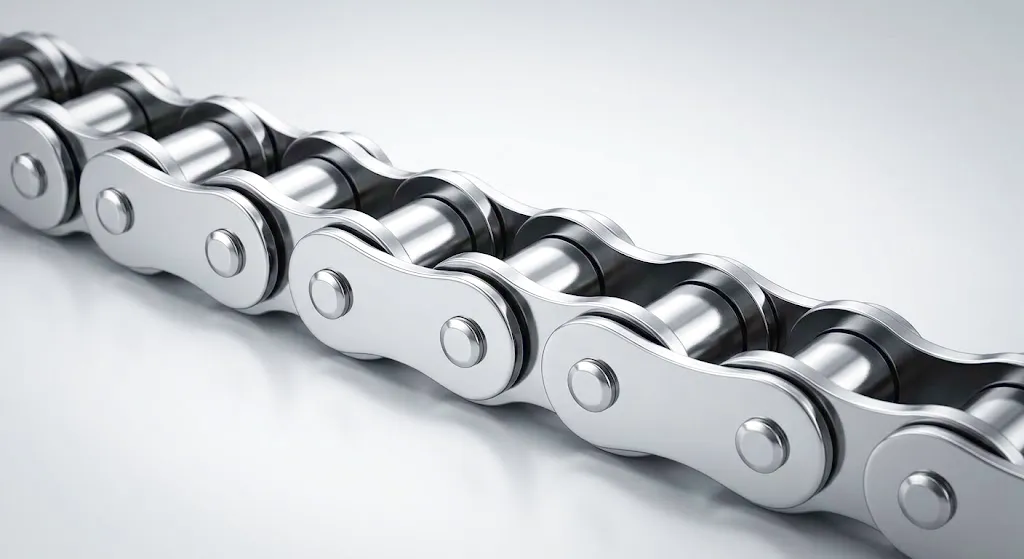
Roller chain is one of the most widely deployed power transmission components in industrial machinery worldwide, and nowhere is this more apparent than across the UK’s dense manufacturing corridors. From the heavy fabrication plants of the West Midlands to the agricultural machinery workshops of Lincolnshire, roller chain drives form the mechanical backbone of thousands of production lines, conveyor systems, and automated handling equipment. Yet despite its mechanical simplicity, roller chain is surprisingly sensitive to the cumulative effects of load, lubrication quality, and environmental exposure — and a chain that appears intact to the naked eye may already be operating dangerously beyond its service threshold. Understanding precisely how to inspect a roller chain for elongation, wear, and structural damage is not merely a maintenance best practice; in regulated industrial environments, it is a matter of operational safety and production continuity.
This guide provides a technically rigorous, field-tested framework for conducting roller chain inspections — covering the measurement of pitch elongation, recognition of wear patterns across pins, bushings and rollers, identification of physical damage indicators, and the decision logic for replacement versus continued service. Whether you are a maintenance engineer performing routine checks on a Birmingham food processing line, a plant manager auditing conveyor drives in a Leeds distribution warehouse, or a mechanical buyer evaluating supplier chain quality for a Midlands automotive subassembly operation, this article gives you the methodology, the metrics, and the contextual knowledge to make confident, defensible decisions about your chain’s condition.
Understanding Roller Chain Elongation: What It Is and Why It Happens
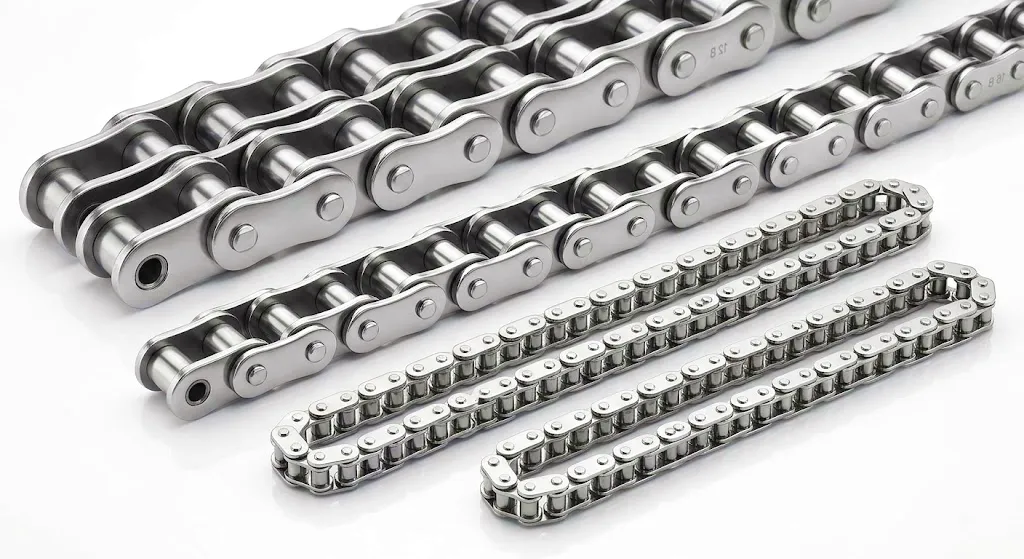
Chain elongation — often called “chain stretch,” though the term is mechanically imprecise — does not result from the metal links literally stretching under tension. The actual mechanism is wear-induced pitch increase: as the pin and bushing contact surfaces wear together under repeated cycling, material is progressively removed from these interfaces, and the effective pin-to-pin distance (pitch) increases incrementally. Over thousands of operating hours, this accumulated dimensional growth manifests as measurable length increase across the entire chain. Even a small per-link elongation multiplied across a long chain run can result in significant total pitch deviation, causing the chain to skip sprocket teeth, ride high on tooth flanks, and ultimately fail catastrophically.
The rate of elongation is governed by several interacting factors: load intensity, lubrication effectiveness, operating speed, ambient contamination (particularly abrasive particulate in environments like Sheffield steel processing or West Midlands foundry operations), and the inherent material quality of the chain’s wear surfaces. Hardened steel pins with precision ground profiles resist elongation far longer than softer alternatives, which is why material specification is so consequential during procurement. Industry consensus, and the guidance established in BS/ISO 1275 chain standards applicable to UK operations, identifies a 2% elongation limit as the standard replacement threshold for most general industrial applications — though for precision drives and high-speed conveyors, a 1% threshold may be appropriate.
The most reliable field measurement technique is the 12-link or 24-link measurement method. With the chain under tension (or with consistent manual tension applied), measure the distance across 12 complete links — pin centre to pin centre — using a vernier calliper or a dedicated roller chain wear gauge. Compare this measurement against the nominal 12-link length derived from the chain’s specified pitch. For example, a #50 chain (5/8″ pitch, 15.875mm) has a nominal 12-link length of 190.5mm. A reading of 194.3mm represents approximately 2% elongation — the standard UK replacement trigger point.
At 2% elongation, the chain’s pitch has deviated sufficiently that the rollers no longer engage correctly with sprocket tooth root geometry. Contact shifts toward the tooth tips, generating increased impact loading, accelerated sprocket wear, and vibration. Left unaddressed, this wear spiral accelerates non-linearly: the sprockets begin wearing to accommodate the elongated chain, meaning that even a new replacement chain may slip on worn sprockets — creating expensive double-replacement scenarios that UK plant managers in conveyor-intensive sectors like logistics and food production are well familiar with.
Identifying Pin, Bushing and Roller Wear in Roller Chain Drives
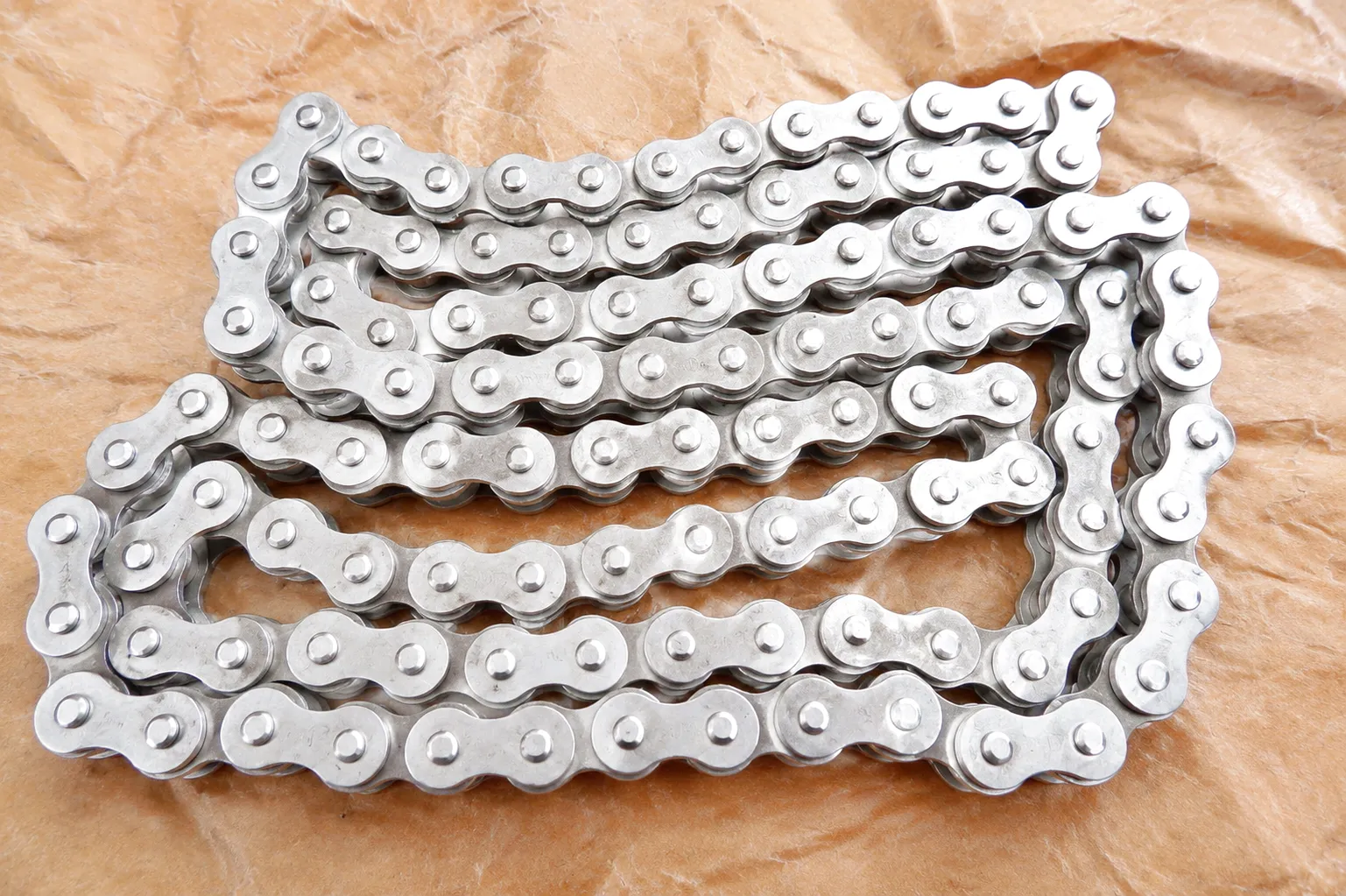
While elongation measurement gives you a quantified overall condition assessment, visual and tactile inspection of individual chain components reveals the specific wear mechanisms at work — information that is essential for root cause analysis and for making appropriate adjustments to lubrication schedules, load management, or operating environments. The three primary internal wear surfaces in a roller chain are the pin outer diameter, the bushing inner diameter, and the roller inner/outer surfaces. Each wears through a distinct mechanism and produces characteristic visual signatures.
Pin wear manifests as a D-shaped cross-sectional deformation on the pin’s load-bearing arc, visible when side plates are spread and the pin is extracted or when a worn chain is examined end-on. In correctly lubricated chains, pin wear progresses slowly as a thin film of oil maintains separation between the oscillating pin and bushing surfaces. In under-lubricated or contaminated chains — a common issue in Birmingham manufacturing environments where airborne metallic particulate from grinding operations enters chain assemblies — pin wear accelerates dramatically, with abrasive particles acting as micro-cutting media between the contact surfaces. Bushing wear shows as bore enlargement and surface roughening on the bushing’s inner diameter.
Roller surfaces are subject to repeated impact loading each time a roller seats in a sprocket tooth root. Over time, this repeated contact stress can initiate subsurface fatigue cracks that propagate to the surface, generating small material fragments — a failure mode called spalling. Visually, spalled rollers display irregular pitting or flaking on their cylindrical contact surface. Spalled rollers also produce irregular noise during operation: a characteristic rhythmic knocking or rattling that experienced maintenance personnel on UK production lines learn to recognise as a chain replacement indicator without measurement instruments. Any roller showing surface spalling warrants immediate chain replacement, as the associated debris can damage sprockets and contaminate lubrication systems.
Link plates are the outer structural members of a roller chain assembly, and while they are not primary wear surfaces in normal operation, they carry the full tensile load and can sustain damage from several sources. Corrosion is the most common surface degradation mode encountered in UK coastal or chemical-processing environments — reddish-brown surface rust on carbon steel plates indicates the protective surface treatment has been compromised, and deeper pitting rust weakens the plate section and can initiate fatigue cracking under cyclic load. Mechanical damage — nicks, gouges, or deformation from contact with external structures — concentrates stress at the damage site and must be assessed individually. Any plate showing visible cracking, deformation, or deep corrosion pitting should be treated as a replacement trigger for the entire chain.
A roller chain in good condition will flex smoothly through every pitch when manipulated by hand or when observed passing around a small-diameter sprocket. Tight or stiff links — individual joints that resist articulation — are a reliable indicator of localised internal corrosion, inadequate lubrication, or debris entrapment between pin and bushing. Stiff links are particularly problematic in roller chain drives because they prevent the chain from conforming correctly to the sprocket’s tooth circle, generating a pulsing tension variation every time the stiff link engages. This pulsation creates vibration, accelerates bearing fatigue throughout the gearbox and motor drivetrain, and can cause shock loading that significantly exceeds the nominal operating tension. Systematic checking for stiff links by hand-flexing each joint remains one of the most valuable and underused inspection techniques.
High-Strength Roller Chain for Caterpillar & Heavy Machinery Applications
In demanding earthmoving, quarrying, and construction equipment contexts — categories where Caterpillar machinery is dominant across UK civil engineering operations from Scottish infrastructure projects to HS2 subcontract work in the Midlands — roller chain performance requirements move substantially beyond standard industrial grades. The pins must resist extreme impact loading, the plates must maintain structural integrity under shock loads, and the chain-to-sprocket fit must remain precise despite the abrasive soil and aggregate environments these machines operate in.
Itu Rantai Rol Kekuatan Tinggi 120HSP-00 untuk Caterpillar is engineered specifically to meet and exceed the demanding operational requirements of Caterpillar heavy equipment. Manufactured with shot-peened link plates and precision-ground pins produced from high-alloy steel, this chain delivers superior fatigue resistance — an essential property when the chain experiences repeated shock loads during bucket tooth contact or track engagement in rocky terrain. The 120HSP-00 series carries a breaking load of 133.0 kN and maintains dimensional accuracy under sustained high-cycle fatigue conditions that would rapidly degrade standard replacement chain, making it the preferred choice for UK groundworks contractors and plant hire operations requiring genuine OEM-level performance from aftermarket supply chains.
For medium-displacement Caterpillar equipment where the C100 pitch configuration is specified, the Rantai Rol Kekuatan Tinggi C100HSP-00 untuk Caterpillar provides the same elevated material specification — induction-hardened pins, thickened plates, and enhanced anti-corrosion surface treatment — in a configuration matched to the sprocket geometry of C-series Caterpillar applications. This chain is particularly well suited to UK construction plant operators running compact track loaders, mini excavators, and mid-range crawler dozers in the ground conditions typical of British construction sites, where clay-heavy soil with embedded flint and shale presents a particularly aggressive wear environment for undercarriage drive components.
A Systematic Inspection Procedure for Industrial Roller Chain Drives
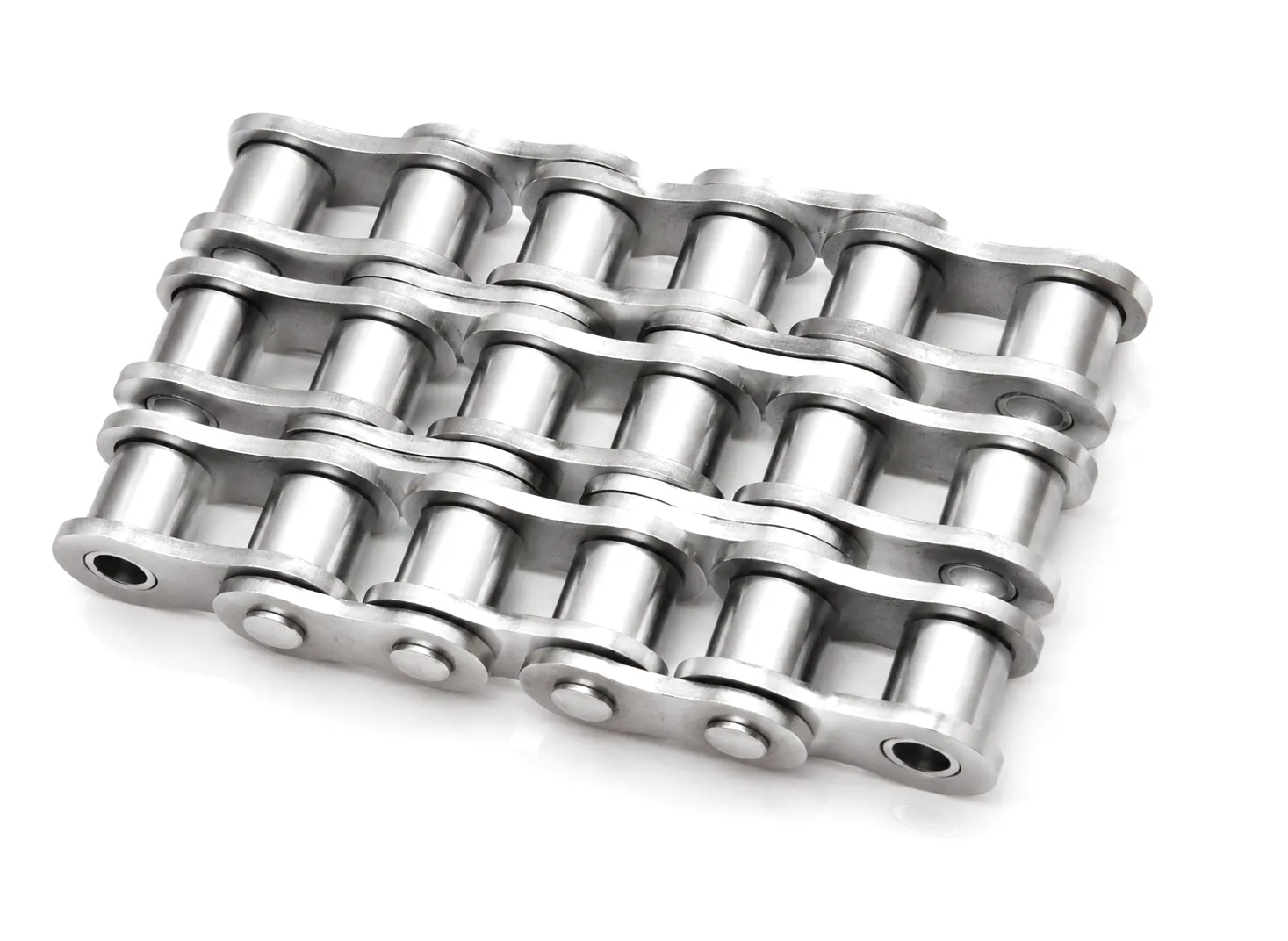
A competent roller chain inspection follows a logical sequence that moves from system-level observation through component-level measurement to decision documentation. Before any close examination takes place, the equipment must be isolated from its power source following the site’s Lockout/Tagout (LOTO) procedures — a non-negotiable requirement under UK PUWER 1998 (Provision and Use of Work Equipment Regulations). Once secured, the chain should be lightly cleaned of gross debris and dried before inspection begins, as heavy grease and contamination can conceal crack initiation sites and make dimensional measurements unreliable.
Begin with a visual survey of the entire accessible chain run, looking for obvious damage indicators: bent or cracked link plates, displaced or missing master link clips, rollers that appear to have shifted axially, or sections showing discolouration consistent with heat exposure or chemical attack. In Sheffield engineering plants that work with cutting oils and coolants, chemical discolouration is a documented issue — chain exposed to water-miscible cutting fluid without adequate post-exposure lubrication rapidly develops subsurface corrosion that weakens the link plate fatigue life without being visually obvious from the outer surface.
Apply LOTO, de-energise the drive, allow rotating components to stop completely. Using a dry cloth or low-pressure air, remove loose surface debris from the accessible chain section. Avoid solvent washing at this stage — residual solvent can mask corrosion signatures and dissolve the lubricant film needed for meaningful lubrication assessment.
Using a calibrated vernier calliper or dedicated chain wear gauge, measure the 12-link or 24-link span under consistent tension. Record the measurement and calculate elongation percentage against the nominal pitch. Measure at three or four different positions around the chain run to detect localised wear zones — particularly important in chains that operate over small-radius sprockets, where a specific section cycles through the high-load contact zone far more frequently than the rest of the chain.
With the chain off-tension or with a section accessible on the slack side of the drive, manually flex each joint through its articulation arc. Each pin-to-plate joint should move freely with minimal resistance. Any joint requiring more than finger-tip pressure to articulate is potentially stiff and should be marked, counted, and assessed — more than two or three stiff joints in any 500mm section typically warrants chain replacement regardless of elongation measurement.
Examine accessible rollers under adequate lighting — a UV inspection torch is valuable for identifying fine cracks in ferrous components. Look for flat spots, spalling, cracked rollers, or rollers that have deformed from circular cross-section. Inspect link plates for surface rust depth, mechanical damage, or plate deformation. Document any observed abnormalities with photographic records for maintenance logs — increasingly required for ISO 9001 quality system compliance in UK Tier 1 and Tier 2 manufacturing suppliers.
A chain inspection is incomplete without examining the mating sprockets. Hooked tooth flanks — where sprocket tooth geometry has deformed from symmetric to asymmetric under the pull of an elongated chain — indicate severe system wear and mean that installing a new chain on worn sprockets will rapidly re-elongate the replacement. Sprocket wear measuring tools are available, but for field assessment, a chain and sprocket template gauge provides a quick visual check. UK maintenance standards increasingly recommend simultaneous chain and sprocket replacement when sprocket hook wear exceeds 10% of nominal tooth height.
Industrial Application Scenarios for Roller Chain Across UK Manufacturing Sectors
Roller chain’s combination of precise pitch engagement, high tensile capacity, and relative accessibility for inspection and maintenance makes it the transmission medium of choice across a remarkably wide range of UK industrial sectors. Unlike belt drives that require pre-tensioned pulleys and cannot transmit reversing loads without slippage, or gear trains that demand precise centre-distance control, roller chain accommodates moderate centre-distance variation, reversal, and inclined drive angles with equal facility — making it adaptable to the diverse plant configurations encountered across Britain’s legacy manufacturing infrastructure, much of which was designed and built across multiple decades with varying design standards.
Birmingham and Coventry’s automotive subassembly plants rely extensively on precision roller chain drives in press-line automation, transfer systems, and component assembly conveyors. In these environments, chain reliability is directly linked to production throughput targets — an unplanned chain failure on a press transfer line can halt thousands of pounds of production per hour. Operators specify premium-grade chain with thickened plates and hardened pins, and inspection intervals are shortened to weekly visual checks supplemented by monthly measurement checks during planned maintenance windows.
The South Yorkshire steel corridor presents some of the most demanding roller chain operating conditions in the UK. Mill drive chains must transmit very high loads at relatively low speeds, resist elevated ambient temperatures near rolling mills, and survive in environments saturated with metallic scale particles and process lubricants. Heavy-series roller chain with case-carburised pins and corrosion-resistant surface treatment is standard. These applications typically operate against a 1.5% elongation replacement threshold, and chains are frequently pre-wetted with high-temperature chain oil before installation to ensure immediate pin-bushing lubrication from start-up.
Grain handling elevators, seed processing equipment, and vegetable washing lines in the UK’s agricultural heartlands — Lincolnshire, East Yorkshire, and the Fens — consume substantial quantities of roller chain annually. The seasonal operation pattern creates a distinctive inspection challenge: chains are often returned to service after months of dormant storage, during which internal corrosion can develop even in chains that appeared in acceptable condition when shut down. Pre-season inspection must include specific checks for rust-induced joint stiffness and link plate pitting, with corrosion-resistant stainless or zinc-plated chain increasingly preferred for the most vulnerable positions in wash-down zones.
Across UK road construction, rail infrastructure maintenance, and civil engineering operations, roller chain in heavy plant and ancillary equipment routinely encounters the most aggressive wear conditions in any commercial sector. Excavators, chain-driven material handlers, and site lighting towers all carry chain components that must be inspected on tight service schedules. For Caterpillar and equivalent heavy equipment, high-strength HSP-grade roller chain — purpose-designed with reinforced plate sections and improved fatigue limits — represents the responsible specification choice for operators seeking to minimise total life-cycle chain and sprocket replacement costs.
Customer Success Story: Sheffield Precision Fabrication, South Yorkshire
Langton Precision Engineering, a mid-tier steel section fabricator operating three production lines from a facility in the Attercliffe industrial corridor of Sheffield, faced a recurring operational problem: their main transfer conveyor chain — carrying steel section billets weighing up to 800 kg each between cutting and profiling stations — was requiring replacement every four months, generating significant unplanned downtime and a mounting spare parts cost that was affecting line profitability. The chains in use were standard-grade BS 16B simplex roller chain sourced through a national industrial distributor, and inspection logs showed elongation reaching the 2% replacement threshold in as few as fourteen weeks of operation despite monthly re-lubrication.
Langton’s maintenance manager contacted Ever Power after an industry contact recommended the company’s bespoke heavy-duty chain specification service. Ever Power’s engineering team conducted a load analysis of the conveyor drive — reviewing the drive motor torque curve, the billet weight distribution across the chain span, and the start-stop cycle frequency — and recommended a transition to heavy-series 16B duplex roller chain with thickened plates, carburised pins, and an extended-life solid lubricant pre-treatment applied during manufacturing. The chains were manufactured to Langton’s specified length and delivered to the Sheffield facility within twelve working days of order confirmation.
Following installation and a revised re-lubrication interval schedule developed in collaboration with Ever Power’s technical team, the replacement chain has now operated through seven months without reaching the elongation replacement threshold. Subsequent inspection measurements show the chain at just 0.9% elongation at the seven-month mark — a service life more than double what the previous specification achieved. Langton’s engineering director estimated the chain specification change, including the slightly higher unit cost of the Ever Power heavy-duty chain, will deliver a net saving in combined chain and downtime costs of over £8,000 annually on this single conveyor line.
Customer Reviews
“The Ever Power team took our wear problem seriously and came back with a technically sound solution rather than just selling us more of what we’d been using. The custom heavy-duty chain specification has more than doubled our service life on the billet transfer conveyor, and the dimensional accuracy is faultless — no shim adjustments needed on installation. For anyone running demanding roller chain drives in a UK heavy manufacturing environment, I wouldn’t hesitate to recommend them.”
“We switched to Ever Power’s pre-treated stainless roller chain for our grain elevator boot drives after repeated corrosion failures on standard carbon steel chain through the winter storage period. The difference has been remarkable — no stiff joints on start-up in March, and the elongation measurement at the end of the harvest season was well within tolerance. The lead time was competitive, and communication throughout the order process was clear and professional.”
“We run a mixed fleet of Caterpillar compact and mid-range plant, and Ever Power’s 120HSP chain for Caterpillar applications has become our go-to replacement specification. The performance is genuinely on par with OEM supply, the price point is significantly better, and the technical data sheets they provide are detailed enough to satisfy our equipment warranty documentation requirements. Delivery to our Leeds depot has consistently been within the quoted lead time.”
Frequently Asked Questions About Roller Chain Inspection & Replacement in the UK
From standard ANSI/ISO replacement chain to custom-engineered heavy-duty specifications — Ever Power delivers quality, precision, and responsive technical support across the UK market.