Reach our UK-serving technical sales team at [email protected]
The Mechanics of Wear Elongation: What Is Actually Happening Inside Your Chain
When a roller chain roller chain engages a sprocket tooth, the pin inside each link outer plate is subjected to both rotational and compressive stress simultaneously. With each articulation — every time the chain bends around the sprocket — the pin surface slides fractionally against the bushing bore under load. Even with adequate lubrication, this contact generates surface fatigue, and over time, the steel at the contact interface is removed. This process is distinct from corrosion or fatigue cracking: it is adhesive and abrasive wear occurring at the microscale, invisible without magnification but cumulative in its engineering effect.
Roller chain pitch, which is the fundamental dimensional standard (measured in inches for BS series chains common across the UK and in millimetres for ISO metric variants), increases as this pin-bushing clearance grows. A new BS 12B-1 roller chain, for instance, has a nominal pitch of 19.05 mm. By the time wear has added just 1% to this pitch — approximately 0.19 mm — the chain’s seating position on a 19-tooth sprocket has already shifted outward by a measurable amount. The pitch error multiplies: link by link, the cumulative displacement along the chain’s arc of wrap around the sprocket creates a loading condition where only the outermost teeth are taking the full tangential force rather than the full set of teeth in contact.
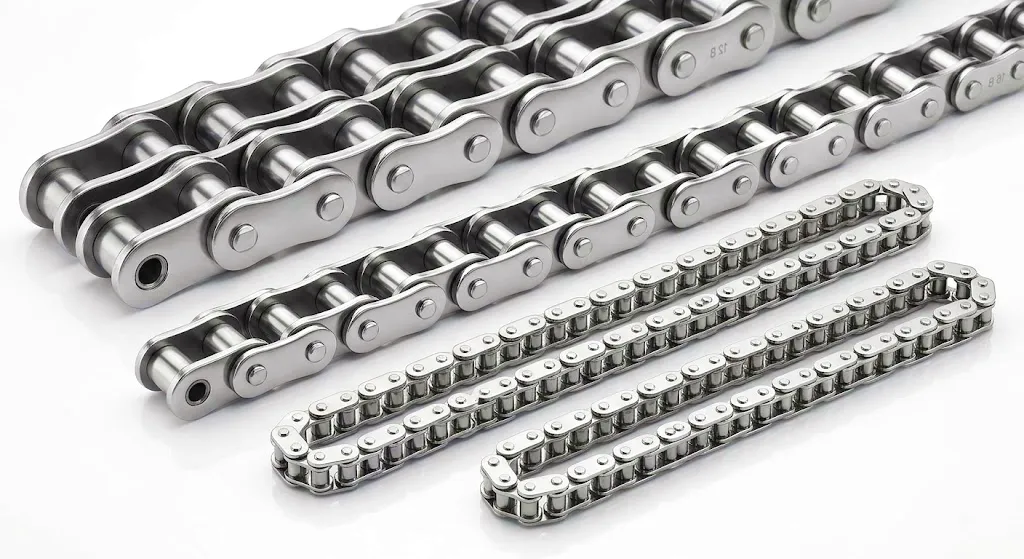
Pin-bushing interface: the primary site of wear elongation
The rollers themselves contribute an additional layer of complexity. Unlike the pin-bushing wear which directly governs pitch elongation, roller wear affects the depth at which the chain seats against the sprocket tooth face. A roller that has lost diameter through wear will ride lower in the tooth space, changing the pressure angle and the effective moment arm through which the sprocket transmits torque to the chain. Maintenance teams in UK heavy industry — particularly those operating roller chain systems in the Leeds textile machinery sector or the Midlands press-forming lines — often measure roller wear as a secondary diagnostic indicator after detecting elongation, because together these two parameters give a complete picture of drive system health.
How Elongated Roller Chain Destroys Sprocket Tooth Profiles
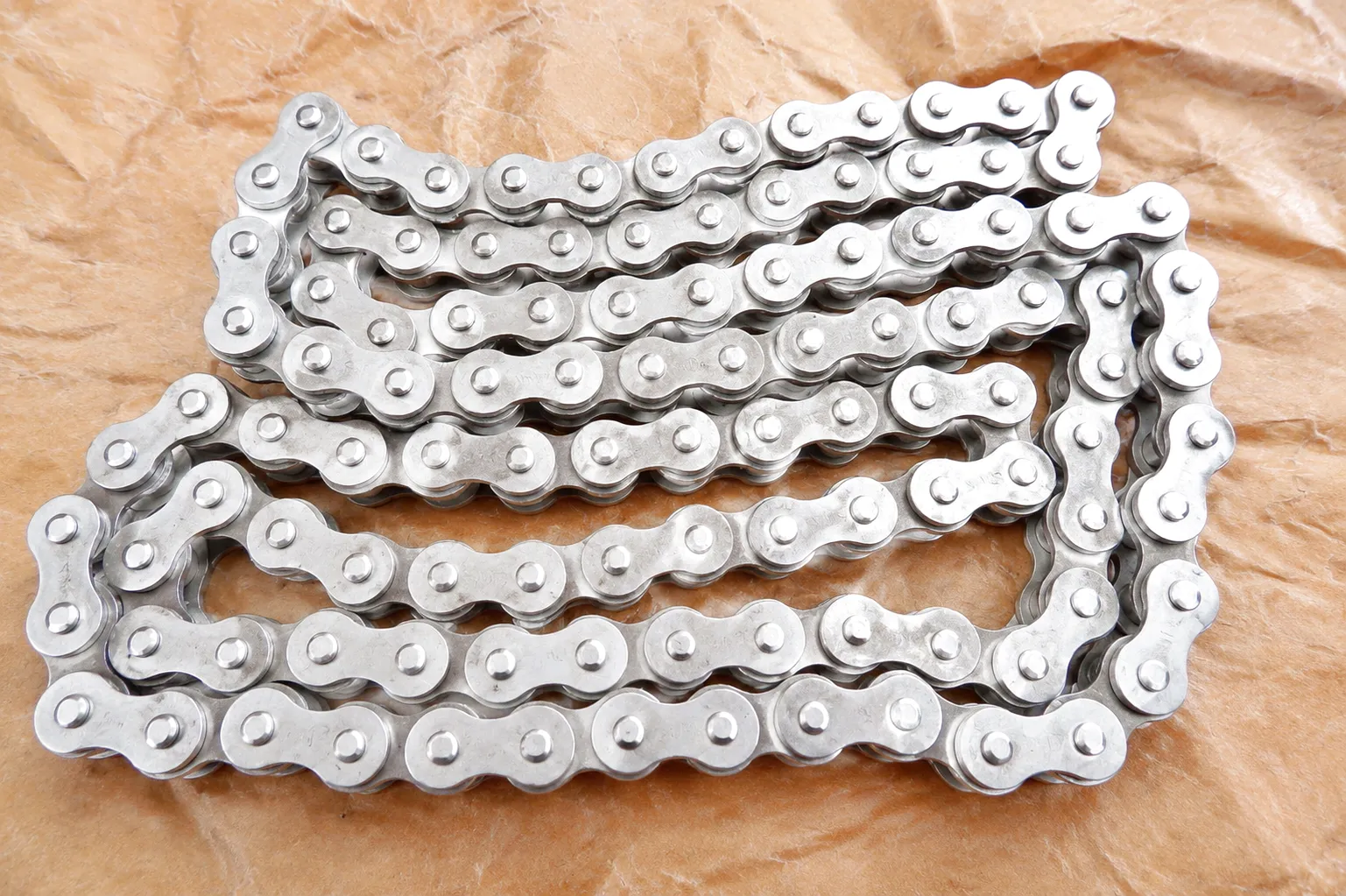
The relationship between roller chain pitch elongation and sprocket tooth geometry is not linear — it accelerates. When a chain with 1% elongation begins operating on a sprocket, the chain rollers no longer seat at the theoretical pitch circle diameter. Instead, they climb outward toward the sprocket tooth tips. ISO 606 and the corresponding BS 228 standards define the tooth form for roller chain sprockets with a very specific pitch-circle-based geometry: the seat radius, the topping radius, and the working depth are all calculated on the assumption that chain pitch matches nominal. Once the chain pitch increases, every one of these carefully engineered dimensions is effectively mismatched.
The practical consequence is that load transfer concentrates on the tooth flank rather than the tooth seating curve. The flank, designed for roller guidance rather than primary load bearing, begins to yield under this abnormal contact stress. In hardened steel sprockets (typically manufactured to surface hardness specifications of 50–60 HRC for industrial applications), this manifests as a characteristic hooked or undercut tooth profile visible to the naked eye after several thousand additional hours of operation under an elongated chain. UK maintenance engineers familiar with the Renold and HKK chain standards will recognise this hook as the definitive indicator that a sprocket has consumed its usable service life and requires replacement alongside the chain.
Hook Formation
Elongated chain causes rollers to load the tooth flank, creating a progressive hooked profile that locks the chain and causes shock loads on every engagement cycle.
Pitch-Circle Climb
Worn chain rollers ride progressively higher on sprocket teeth — increasing effective chain wrap diameter and altering tension distribution across the entire drive.
Accelerated Fatigue
Abnormal tooth-face loading creates surface stress concentrations that initiate fatigue cracks, leading to rapid tooth breakage — the most catastrophic failure mode in industrial chain drives.
Core Materials in Roller Chain Manufacturing and Their Influence on Wear Rate
The rate at which wear elongation accumulates is directly governed by the material choices made during chain manufacture. A roller chain is a precision assembly of multiple components — outer plates, inner plates, bushings, pins, and rollers — each of which ideally carries a different material specification optimised for its specific mechanical role. Understanding these material choices explains why chains from different manufacturers operating in identical conditions can show dramatically different elongation curves over their service lives, and why quality procurement decisions made in Sheffield or Coventry are genuine engineering decisions, not merely commercial ones.
Manufactured from case-hardened or through-hardened alloy steel — typically 20CrMnTi or equivalent grades — with surface hardness targets of 58–62 HRC after carburising. The pin carries the full shear and bending load of the drive, and its wear resistance against the bushing bore is the primary determinant of elongation rate. Premium grades use shot-peened surfaces to introduce compressive residual stress, significantly extending fatigue life in high-cycle applications such as automotive assembly line conveyors.
The bushing is the counter-face to the pin and is typically manufactured from sintered steel or precision-formed alloy tube, with a hardness specification slightly below the pin to ensure that controlled wear occurs at the interface in a predictable manner. In oil-retaining sintered bushings — a technology increasingly specified by UK food processing and pharmaceutical plant operators who require extended lubrication intervals — the porous structure holds a reservoir of lubricant that is released under pressure during operation, substantially reducing the wear coefficient and extending the elongation-free service interval.
Rollers are typically formed from carbon steel strip, hardened to 40–50 HRC, and must be dimensionally precise: roller diameter tolerance directly governs how cleanly the chain seats against the sprocket tooth seating curve. Link plates — the structural backbone carrying tensile load — are stamped from medium carbon steel and often undergo a dedicated heat treatment cycle to achieve the correct combination of yield strength and ductility. Stainless steel variants (304 or 316 grade) are available for corrosive environments, accepting some trade-off in tensile rating in exchange for dramatically improved corrosion resistance.
Roller Chain Technical & Performance Parameters Reference Table
BS/ISO standard series — typical values for industrial grade chains
| Chain Type / Size | Passo (mm) | Breaking Load (kN) | Max Elongation Limit | Pin Diameter (mm) | Roller Diameter (mm) | Plate Material | Applicazione tipica |
|---|---|---|---|---|---|---|---|
| BS 06B-1 | 9.525 | 9.0 | +1% (0.95 mm per 100 links) | 3.28 | 6.35 | acciaio al carbonio | Light machinery, packaging |
| BS 10B-1 | 15.875 | 22.2 | +1% | 5.08 | 10.16 | Alloy Steel HT | Agricultural, general industry |
| BS 12B-1 | 19.05 | 29.0 | +1% | 5.72 | 12.07 | Alloy Steel HT | Conveyor systems, press lines |
| BS 16B-1 | 25.40 | 60.0 | +1% | 8.28 | 15.88 | Alloy Steel HT | Heavy conveyors, mining |
| 120HSP-00 (High Str.) | 38.10 | 125+ (enhanced) | +0.8% (extended service) | 11.10 | 22.23 | High-alloy Shot-Peened | Caterpillar OEM, heavy drive |
| C100HSP-00 (High Str.) | 31.75 | 100+ (enhanced) | +0.8% | 9.53 | 19.05 | High-alloy Shot-Peened | Caterpillar drive systems |
| Stainless 08B-1 | 12.70 | 18.0 | +1% | 4.45 | 8.51 | 316L Stainless | Food processing, pharma |
HT = Heat Treated. Breaking loads are minimum values. Always consult manufacturer data for design calculations. Elongation limits per ISO 606 / BS 228.
Featured High-Strength Roller Chain Products
Core Engineering Advantages of Premium Roller Chain Design
Extended Pitch Stability
Precision-ground pins and hardened bushings slow the rate of wear elongation, keeping the chain within the service pitch tolerance for significantly longer duty cycles. This directly reduces the frequency at which sprocket sets must be replaced alongside the chain, lowering both planned maintenance material cost and associated labour hours.
Reduced Shock Load Transmission
Premium roller chain designs incorporate tighter dimensional control on roller diameter and plate flatness, ensuring smoother tooth engagement throughout the chain’s operating life. This translates into lower vibration signatures at the driven sprocket — a measurable benefit for precision machinery in manufacturing environments across the UK Midlands where surface finish quality depends on drive smoothness.
Higher Fatigue Resistance
Shot-peened link plates introduce compressive surface stress that substantially resists the initiation of bending fatigue cracks — the failure mode most commonly observed after extended operation at high cyclic loads. For UK industrial sectors such as steel processing, quarry equipment, and port handling machinery, this fatigue resistance directly supports continuous-operation reliability requirements where unscheduled chain breakage carries significant production penalty costs.
Corrosion Resistance Options
Nickel-plated, zinc-plated, and stainless steel roller chain variants are available for environments where moisture, wash-down chemicals, or atmospheric contamination would accelerate corrosion-enhanced wear. UK coastal industrial facilities and food production sites — particularly across North-West England and the Scottish lowlands — frequently specify these grades as part of compliance-driven asset management programmes aligned with BFPA and FDA industry standards.
Industrial Application Scenarios: Where Wear Elongation Management Is Mission-Critical
Automotive Assembly and Press Lines — West Midlands Manufacturing
In the automotive supply chain concentrated around Coventry, Solihull, and the broader West Midlands, roller chain drives are embedded in everything from body panel pressing operations to engine component conveyor systems. The high cycle rates in these facilities — often exceeding 20 million chain articulations per year in continuous production — mean that wear elongation management is a front-line reliability engineering concern. Maintenance teams in this sector typically operate on condition-based replacement intervals, using chain measurement tools calibrated to ISO 606 elongation limits. Selecting roller chain grades with demonstrably lower wear rates directly translates into extended intervals between planned stoppages and reduced annual chain consumption across multi-line facilities.
Agricultural Equipment and Harvesting Machinery — Yorkshire and East Anglian Farming
Roller chain drives in combine harvesters, balers, and grain handling equipment are exposed to highly abrasive crop debris, variable loading conditions, and the infrequent lubrication that field conditions impose. The resulting elevated wear elongation rate is a persistent challenge for UK agricultural machinery dealers and farm maintenance teams across Yorkshire, Lincolnshire, and East Anglia. In these applications, the choice of chain grade is particularly consequential: a roller chain that reaches its elongation limit during harvest season creates a breakdown scenario with high economic penalties. Agricultural-grade roller chains with oil-impregnated sintered bushings have demonstrated substantially better wear curves under these dirty-environment conditions compared with standard open-joint variants.
Steel Processing and Heavy Metals — Sheffield and South Yorkshire Industry
Sheffield’s steel industry, though transformed from its Victorian peak, remains a significant consumer of heavy-duty roller chain for coil handling, bar and section rolling lines, and furnace conveyors. In these environments, chains are subject to high ambient temperatures, scale contamination, and shock loads from material handling operations. Thermal expansion effects on chain pitch must be accounted for in installation specifications, and the wear elongation behaviour of high-temperature chain variants differs from standard room-temperature grades. UK steel processors in the South Yorkshire corridor typically specify chains to more conservative elongation replacement thresholds — often 0.75% rather than the standard 1% — because the sprocket cost penalty in large rolling mill equipment is considerably higher than the chain cost alone.
Food Processing and Pharmaceutical Production — Hygienic Grade Chain Applications
UK food manufacturing facilities — concentrated in areas including Grimsby’s seafood processing sector, the dairy processing belt of Somerset and Wiltshire, and pharmaceutical manufacturing clusters in the North-West — operate roller chain drives under strict hygiene and wash-down regimes. In these environments, conventional petroleum-based lubricants are prohibited, and chains must either be self-lubricating through oil-impregnated bushings or operated with food-grade lubricants at extended application intervals. The consequence is a higher baseline wear rate than comparable industrial applications. Engineers in these sectors monitor elongation with greater frequency — typically at every scheduled sanitation downtime — and specify chain grades with sintered bushing technology as a baseline requirement, not a premium option.
Customer Success Story: Reducing Drive Failures at a Sheffield Steel Processing Site
📍 Location: Sheffield, South Yorkshire
🏭 Sector: Specialty Steel Processing and Bar Rolling
📅 Challenge Duration: 18-month resolution programme
Hadfield Precision Bar Ltd, a specialty steel processor operating a bar rolling line in the Lower Don Valley, Sheffield, was experiencing an average of 4.2 unplanned drive chain failures per quarter across its three rolling mill chain drives. Each failure required an average of 6.5 hours of downtime to clear the jam, re-thread the replacement chain, and perform a safety restart procedure — representing an annual production loss the maintenance manager calculated at over £340,000 when product opportunity cost was included.
Investigation revealed that the facility had been operating a standard grade BS 16B-2 roller chain purchased on a lowest-price procurement basis, with replacement scheduled at calendar intervals of 6 months regardless of actual elongation measurement. In practice, chain elongation was reaching 1.8–2.2% before replacement — well beyond the 1% service limit — and the sprocket sets were being routinely damaged to the point of hook formation at the tooth tips. The root cause was compounded by intermittent lubrication: the oil drip system had been disconnected during a machine guarding upgrade and had not been reinstated.
Results After Ever Power Solution:
→ Failures reduced from 4.2 to 0.4 per quarter
→ Annual chain cost savings: ~22%
→ Sprocket replacement interval extended 3x
→ Condition monitoring programme established
Ever Power’s technical sales team engaged with the Hadfield Precision Bar engineering department over a 6-week investigation period, conducting on-site measurement of existing chain elongation, hardness testing of the worn sprocket sets, and a drive system load analysis to confirm that the installed chain rating was appropriate for the actual torque demand. The recommendation combined three actions: upgrading from standard to a premium high-alloy grade BS 16B-2 roller chain with sintered bushing technology; replacing all three sprocket sets simultaneously to remove the hooked tooth profiles; and reinstating an automatic oil drip lubrication system with documented inspection intervals. Within two quarters, the unplanned failure frequency had reduced to 0.4 events per quarter — a 90% improvement — and the condition-based elongation monitoring programme that Ever Power helped to implement has since been adopted as a site-wide standard for all chain-driven equipment.
Recensioni dei clienti
“The elongation curve on Ever Power’s premium BS 16B-2 is genuinely different from what we were running before. We measured our first replacement interval at 14 months — nearly double our previous chain life — and the sprocket teeth looked healthy at that point. The sintered bushing technology made a real difference in this dirty environment.”
— David H., Senior Maintenance Engineer, Sheffield Steel Processing
“We specified a non-catalogue pitch configuration for our bespoke conveyor system, and Ever Power turned around certified drawings and a sample batch within three weeks. The custom chain has performed exactly to the wear elongation predictions in their technical data sheet. That level of accuracy in a supplier is not common, and it builds genuine confidence in the procurement decision.”
— Rachel P., Reliability Engineer, West Midlands Automotive Components
“Our harvest season is a narrow window and a chain failure in a combine harvester is a serious commercial event. Switching to Ever Power’s oil-impregnated bushing chain grade three seasons ago has given us zero in-season failures. The chain reaches its elongation limit cleanly at the predicted interval, which makes winter workshop maintenance genuinely predictable for the first time in years.”
— James W., Farm Machinery Manager, North Yorkshire Agricultural Co-operative
Domande frequenti
Conversational answers to the questions UK industrial buyers and maintenance engineers ask most often.
How do I know when my roller chain has reached its wear elongation limit and needs replacing in a UK industrial facility?
The standard measurement method is to count a defined number of links — typically 10 to 20 — and measure the pin-centre to pin-centre span with a vernier calliper or dedicated chain elongation gauge. For a BS 12B-1 chain with a 19.05 mm pitch, a 20-link section should measure 381.0 mm new; a reading of 384.8 mm or more indicates 1% elongation and the chain should be scheduled for replacement at the next maintenance window. Many UK industrial maintenance teams now use digital chain wear gauges that give a direct percentage reading, eliminating manual calculation error.
What is the typical cost of a high-strength roller chain in the UK, and where can I get a competitive price quote for a bulk supply order?
Roller chain pricing in the UK varies widely based on pitch, grade, quantity, and material specification — a standard BS 10B-1 simplex chain may cost £8–£22 per metre for general industrial grade, while premium shot-peened high-alloy variants for OEM applications command higher pricing that is more than offset by extended service life. For accurate cost comparisons and volume pricing, the most effective approach is to contact a manufacturer directly with your specification. Ever Power’s sales team at [email protected] provides detailed quotations for any quantity, including customs clearance documentation for UK import compliance.
Which type of roller chain supplier in Birmingham or Sheffield can provide BS-standard certified chain with short lead times for urgent maintenance replacement?
For urgent replacement requirements in Birmingham or Sheffield, the fastest route to a certified BS-standard chain is typically to source through a manufacturer who holds UK-bound stock or who partners with a UK distribution warehouse. Ever Power maintains supply agreements that support rapid delivery to UK industrial customers, with standard BS series sizes available for dispatch within short lead windows. Certification documentation confirming ISO 606 compliance and material grade is provided as standard with each supply.
How does roller chain wear elongation specifically damage sprocket teeth, and when should I replace sprockets alongside the chain?
As chain pitch increases through wear, the rollers climb progressively higher on the sprocket tooth faces during each engagement cycle, concentrating load on the tooth flank rather than the designed seating curve. This creates a hooked or undercut profile at the tooth tip over time. Industry guidance consistently recommends replacing sprockets whenever a new chain is installed if the sprocket has been running against a worn chain, because a new chain running on hooked sprocket teeth will wear at an accelerated rate — negating the investment in chain replacement and compressing the next replacement interval significantly.
What makes the Ever Power 120HSP-00 high-strength roller chain worth the price premium over standard chain for Caterpillar equipment in UK construction and quarrying?
The 120HSP-00’s value proposition is built on its lower wear elongation rate over an extended duty cycle — a consequence of its shot-peened high-alloy plates and precision-ground pins. In UK quarrying and construction applications, where Caterpillar equipment operates in highly abrasive, contaminated environments, a chain that reaches its elongation limit 40% later than a standard grade translates directly into fewer equipment stoppages and reduced maintenance labour cost. When this is set against the sprocket replacement cost that a standard chain would trigger more frequently, the total-cost case for the premium grade is typically compelling within a single replacement cycle.
How often should roller chain lubrication be checked in UK food processing plants, and what does inadequate lubrication do to wear elongation rates?
In UK food processing environments operating under FSA hygiene guidelines, roller chain lubrication intervals depend critically on the chain type. Standard chains with open pin-bushing joints in unlubricated or minimal-lube conditions can exhibit wear elongation rates 3–5 times faster than the same chain operating with adequate food-grade lubricant application. Chains with oil-impregnated sintered bushings extend the effective lubrication interval significantly, making them the preferred choice in areas where conventional drip or mist lubrication systems are impractical due to product contamination risk. Inspection at each scheduled cleaning cycle — typically weekly in most UK food facilities — is the minimum recommended frequency for elongation trend monitoring.
Ever Power — Precision Roller Chain Manufacturer
Supplying BS/ISO standard and custom roller chain to UK and global industrial customers. Technical enquiries welcome.
modifica a cura di gzl