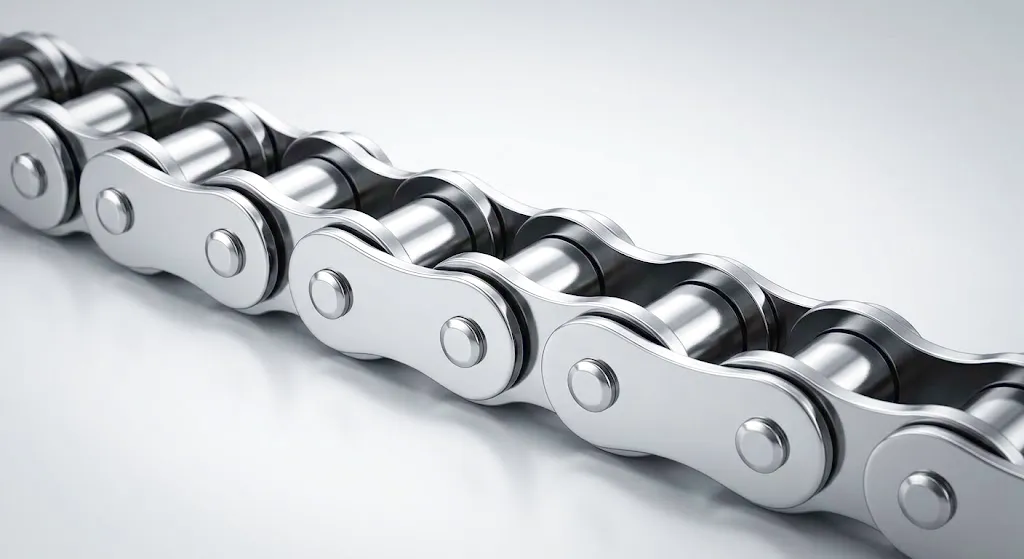
Roller chains are among the most widely deployed mechanical power transmission components in British industry, turning up on everything from the vast automated conveyor lines of Midlands automotive plants to the high-speed bottling rigs of Yorkshire food and beverage facilities. At its core, a roller chain is a precisely engineered loop of interlinked metal elements designed to transmit rotary motion and torque between two or more sprockets — a deceptively simple concept that conceals a remarkable degree of engineering refinement. The chain converts the rotational output of a motor or engine into useful mechanical work, maintaining a fixed velocity ratio as long as the sprocket tooth count remains unchanged. Unlike belt drives, roller chains do not slip, do not require the extremely high initial tension that puts bearing loads through the roof, and can be easily extended or shortened in the field by adding or removing links. These characteristics have made roller chains the backbone of power transmission across decades of UK manufacturing history.
Understanding how a roller chain is constructed — and why each sub-component is designed the way it is — separates engineers who can specify the right chain for a given duty from those who rely on guesswork and end up with premature failures, unplanned downtime, and avoidable replacement costs. Whether you are commissioning a new conveyor system in Birmingham, retrofitting a drive on an agricultural combine harvester in Lincolnshire, or sourcing replacement chains for a packaging line in Sheffield, the knowledge packed into the sections below will help you make better, faster, more confident decisions.
The Anatomy of a Roller Chain: Every Component Explained
Precision-engineered sub-components working in harmony
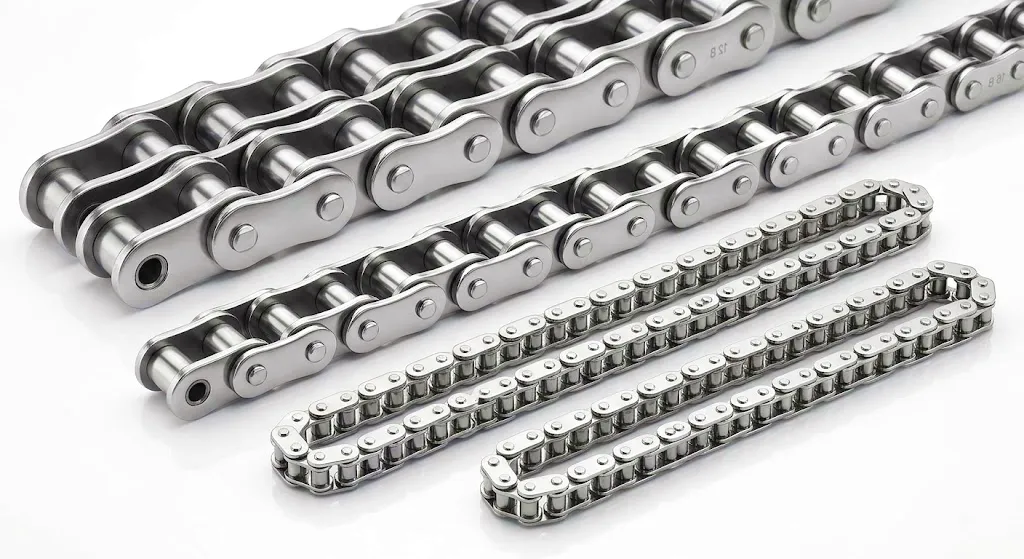
A roller chain is made up of alternating inner link assemblies and outer link assemblies joined in a continuous loop. The inner link assembly consists of two inner plates connected by two hollow bushings that are press-fitted into precisely machined holes. A freely rotating roller sits over each bushing, forming the contact element that engages the sprocket teeth. The outer link assembly — sometimes called the pin link — comprises two outer plates connected by two hardened pins that pass through the bushings of the adjacent inner links, locking everything together. The genius of this arrangement is that each roller revolves independently on its bushing as the chain engages and disengages the sprocket, converting the sliding friction that plagued earlier chain designs into rolling friction. This single design insight is responsible for the dramatically lower friction losses and extended service life that roller chains offer over older driving chain types.
The pin is the tensile load-carrying member of the chain. It must resist shear forces at its cross-sections and bending loads caused by the polygonal action as the chain wraps around a sprocket. Pins are manufactured from high-carbon steel or alloy steel, case-hardened to a depth calculated to resist both fatigue and abrasion while preserving a tough core that resists impact. Bushings are similarly hardened and finished to a surface roughness that promotes oil film retention. The outer and inner plates are the chain’s structural backbone, designed with a figure-of-eight profile that maximises tensile cross-section at the hole positions while minimising weight — a solution that evolved through decades of empirical testing on British and European drive systems and now sits at the heart of every ISO-standard roller chain specification.
Working Principle: How a Roller Chain Transmits Power
From rotary input to mechanical output — the physics made clear
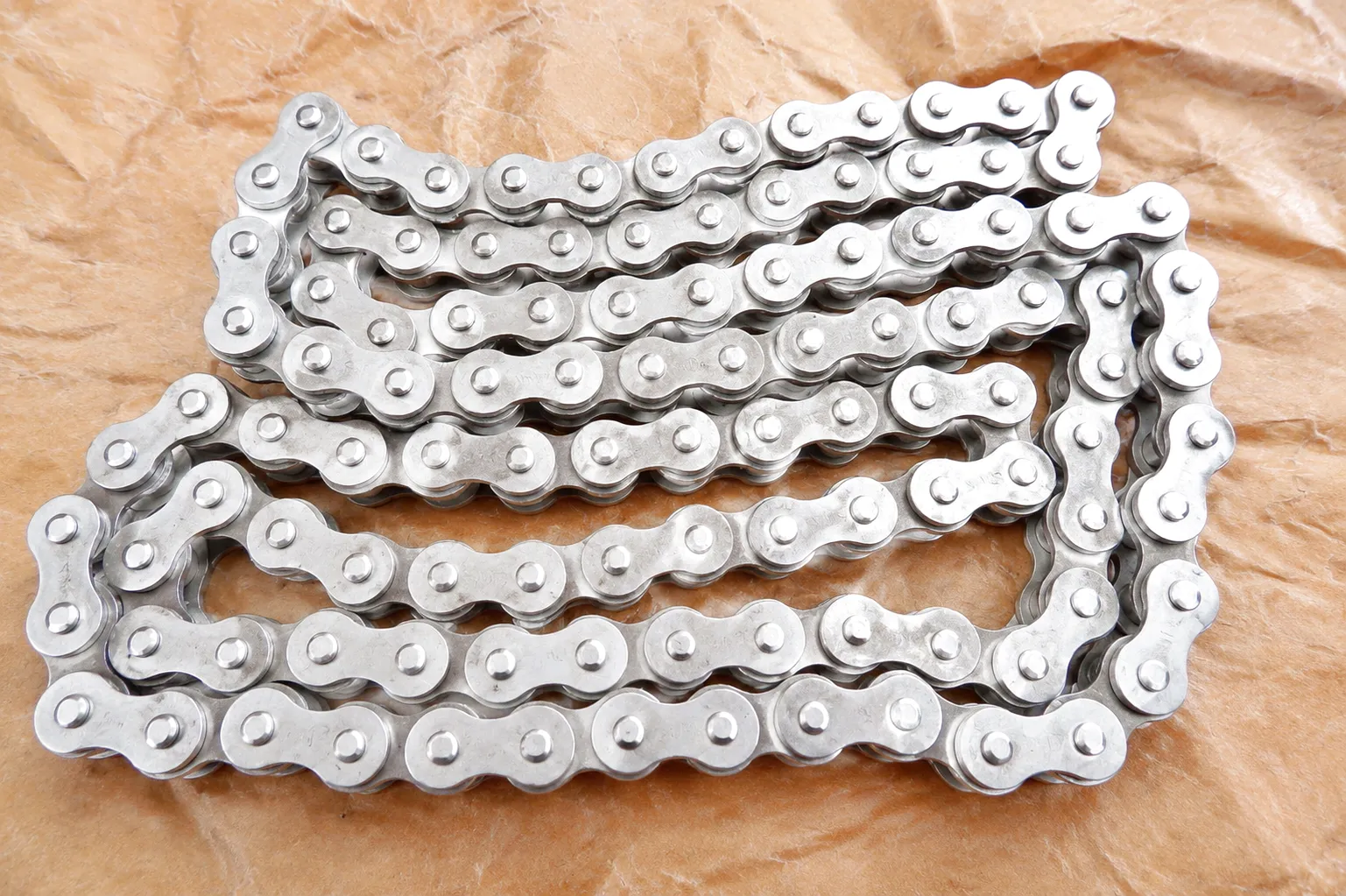
The operating principle of a roller chain drive is grounded in positive engagement: the chain’s rollers seat into the tooth spaces of a hardened sprocket, so torque is transmitted not by friction but by direct mechanical interference. When the driving sprocket rotates, each tooth catches a roller and pushes it — and therefore the entire chain — forward. At the driven sprocket, the arriving rollers push the teeth in sequence, rotating the output shaft. Because every roller is geometrically locked to a sprocket tooth during engagement, the velocity ratio is theoretically exact: output shaft speed equals input shaft speed multiplied by the ratio of driving sprocket teeth to driven sprocket teeth. This positive, non-slip characteristic is one of the primary reasons engineers across the UK favour roller chains wherever precise speed ratios must be maintained under load.
As the chain wraps around each sprocket, it undergoes a regular articulation at every pin-bushing junction. This articulation is the design’s primary wear mechanism, which is why lubrication between pin and bushing is so critical to chain service life. A correctly lubricated drive will see the oil film separate the metal surfaces during articulation, keeping wear to an absolute minimum and allowing the chain to reach or exceed its rated tensile-fatigue life. On high-speed drives — such as the gearbox output drives found in Sheffield steel rolling mills — the chain enters and leaves the sprocket at speeds that create brief impact loads as each roller seats. This chord-to-arc transition, known as polygonal action, generates vibration at a frequency equal to the sprocket tooth count multiplied by the chain speed. Careful sprocket tooth count selection and speed matching are used in engineering design to push this vibration frequency away from the resonant frequencies of the drive and its supporting structure, ensuring smooth, quiet, long-lived operation.
Core Materials: What Industrial Roller Chains Are Made From
Material science is the foundation of performance and durability
The dominant material for standard roller chain components is medium-to-high carbon steel — typically with carbon content between 0.45% and 0.65% — that is subsequently heat-treated through a combination of carburising or carbonitriding plus quenching and tempering. This sequence gives the final component a hard, wear-resistant case (typically 55–62 HRC at the surface) over a tough, shock-absorbing core. For pins, the alloy steel route is common, introducing elements such as chromium, manganese, and molybdenum to increase hardenability and fatigue strength. This is not a trivial distinction: a poorly alloyed pin may achieve the same surface hardness as a properly alloyed one but will fail in fatigue far earlier because the core does not have sufficient yield strength to redistribute stress under cyclic loading.
Основные технические преимущества цепных приводов
Why engineers across UK industry keep coming back to roller chain
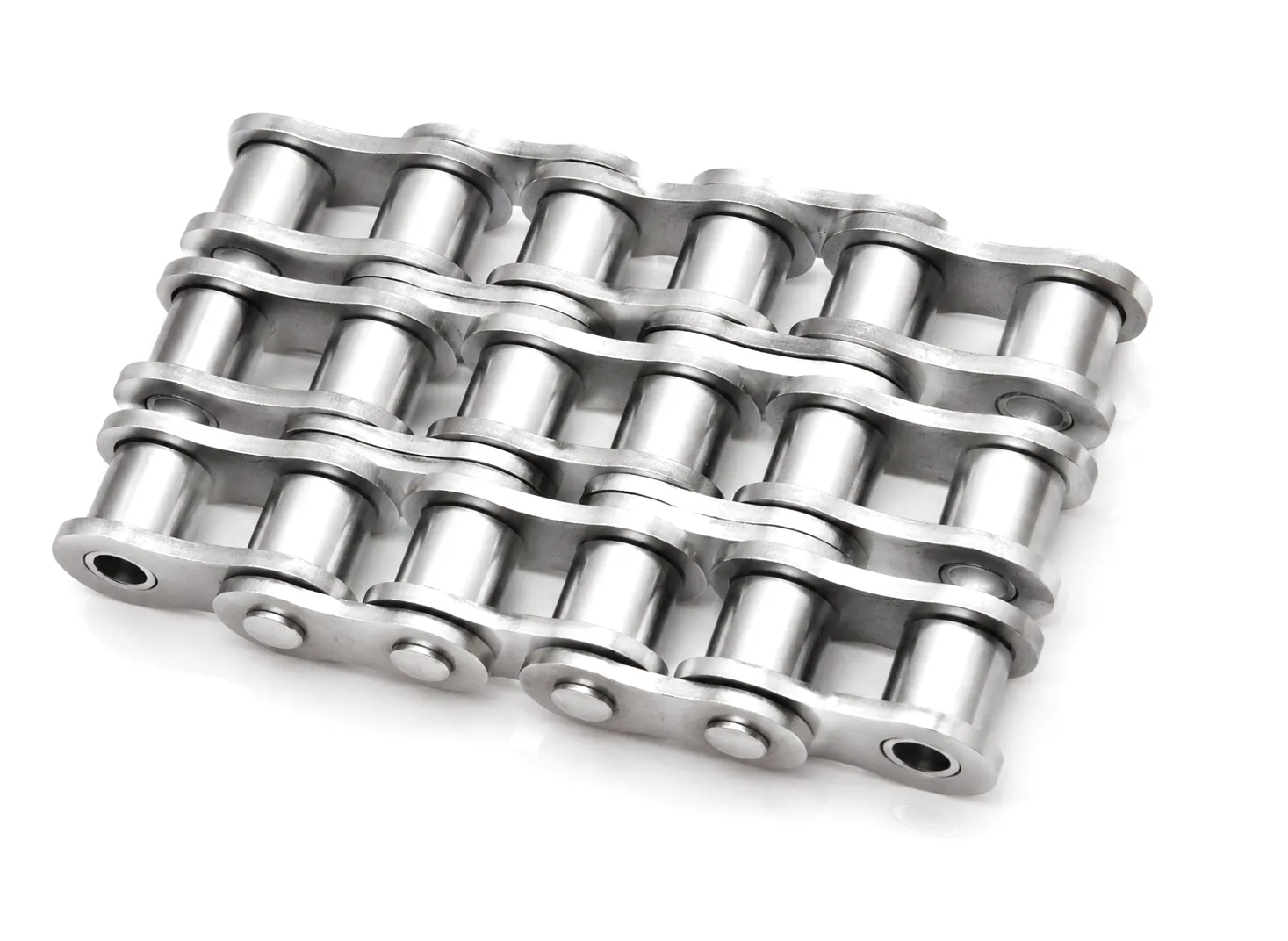
Roller chains deliver a combination of performance attributes that competing power transmission technologies find difficult to replicate across the breadth of industrial applications. Efficiency is the headline advantage: a well-lubricated roller chain drive routinely achieves mechanical efficiency of 97% to 99%, compared with the 95% to 97% achievable from a V-belt in the same duty. Over the course of a year on a high-utilisation machine, the difference in energy consumption between chain and belt drives can amount to thousands of kilowatt-hours — a meaningful consideration for UK plant operators facing consistently high industrial electricity tariffs. In a Sheffield forge shop running three shifts, or a Birmingham components manufacturer with twenty CNC machine tool conveyors, those savings accumulate to a tangible reduction in overhead cost.
Load capacity is another area where roller chains outperform belt alternatives by a wide margin. A heavy-duty roller chain can transmit tens of kilonewtons of tensile force without failure, making it the default choice for the large conveyor lines found in UK quarrying, mining support, and bulk materials handling. Roller chain drives also tolerate radial shaft loads that would destroy most belt drive shaft-bearing systems, because the chain does not require the high pre-tension that creates destructive bearing side loads. In multi-shaft gearbox and drive systems, this characteristic allows designers to use smaller bearings, which reduces both component cost and maintenance outlay. The compact, positive-drive nature of roller chains — combined with their ability to drive multiple sprockets from a single chain loop — gives designers layout flexibility that gear trains and belt drives simply cannot match at equivalent power levels.
Featured: High Strength Roller Chains for Heavy-Duty Applications
Engineered for demanding Caterpillar equipment and equivalent heavy plant
Roller Chain Technical & Performance Specification Table
Key data across ISO standard chain sizes — indicative values for standard carbon steel simplex roller chains per BS EN ISO 606
| Номер цепи. (ISO / BSS) | Подача (mm) | Roller Dia. (mm) | Min. Breaking Load (kN) | Max. Allow. Load (kN) | Масса (kg/m) | Max. Speed (m/s) | Тарелка Материал |
|---|---|---|---|---|---|---|---|
| 06B-1 | 9.525 | 6.35 | 8.9 | 1.2 | 0.41 | ≤ 25 | Carbon steel |
| 08B-1 | 12.70 | 8.51 | 17.8 | 2.4 | 0.69 | ≤ 20 | Carbon / Alloy steel |
| 10Б-1 | 15.875 | 10.16 | 22.2 | 3.0 | 0.93 | ≤ 18 | Alloy steel |
| 12Б-1 | 19.050 | 12.07 | 28.9 | 3.8 | 1.15 | ≤ 16 | Alloy steel |
| 16Б-1 | 25.40 | 15.88 | 60.0 | 8.0 | 2.71 | ≤ 14 | Alloy steel |
| 20Б-1 | 31.75 | 19.05 | 95.0 | 12.5 | 3.85 | ≤ 12 | Alloy steel |
| 24Б-1 | 38.10 | 25.40 | 160.0 | 21.0 | 7.10 | ≤ 10 | Alloy steel |
| 120HSP-00 | 38.10 | 22.23 | 222.0+ | Heavy plant | — | Low-speed | CrMo alloy |
* Values are indicative for standard simplex carbon/alloy steel chains. Consult current BS EN ISO 606 and manufacturer data sheets for design calculations. HSP values are application-specific — contact Ever Power for full specification sheets.
Industrial Application Scenarios: Where Roller Chains Deliver
From Midlands automotive plants to Scottish quarry conveyors
Automotive assembly lines represent one of the largest single-industry consumers of roller chain in the UK, particularly in the West Midlands manufacturing corridor centred on Birmingham and Coventry. Body shells travel on overhead conveyor systems driven by heavy-duty roller chain; sub-assembly stations use chain-driven indexing tables to present components at the correct angle and height for robot welding and human assembly alike. The precise, repeatable positioning capability of roller chain-driven indexers is critical here — a velocity ratio error of even 0.1% would cause misalignment errors that accumulate through hundreds of stations and result in quality failures. Birmingham’s automotive supply chain, which feeds the region’s final assembly plants, relies on roller chain drives at every level from feeder sub-assembly through to body-in-white conveyor systems handling loads up to several tonnes per carrier.
Agriculture is another dominant UK application sector. Combine harvesters, balers, forage harvesters, and potato harvesters all use multiple roller chain drives throughout their crop handling, threshing, and separating mechanisms. The agricultural roller chain operates in one of the most challenging environments imaginable: abrasive crop residue, mud, moisture, and temperature extremes from Scottish highland harvests to the warmer, drier conditions of East Anglian arable farming. Agricultural chains are typically designed with larger-than-standard rollers and plates to accommodate the abrasive environment, and they are often run without enclosed lubrication systems, relying instead on periodic manual or automatic lubrication with penetrating oils or greases.
Ever Power Manufacturing: Precision, Customisation & Supply Chain Excellence
Your trusted global roller chain supplier with deep UK market commitment
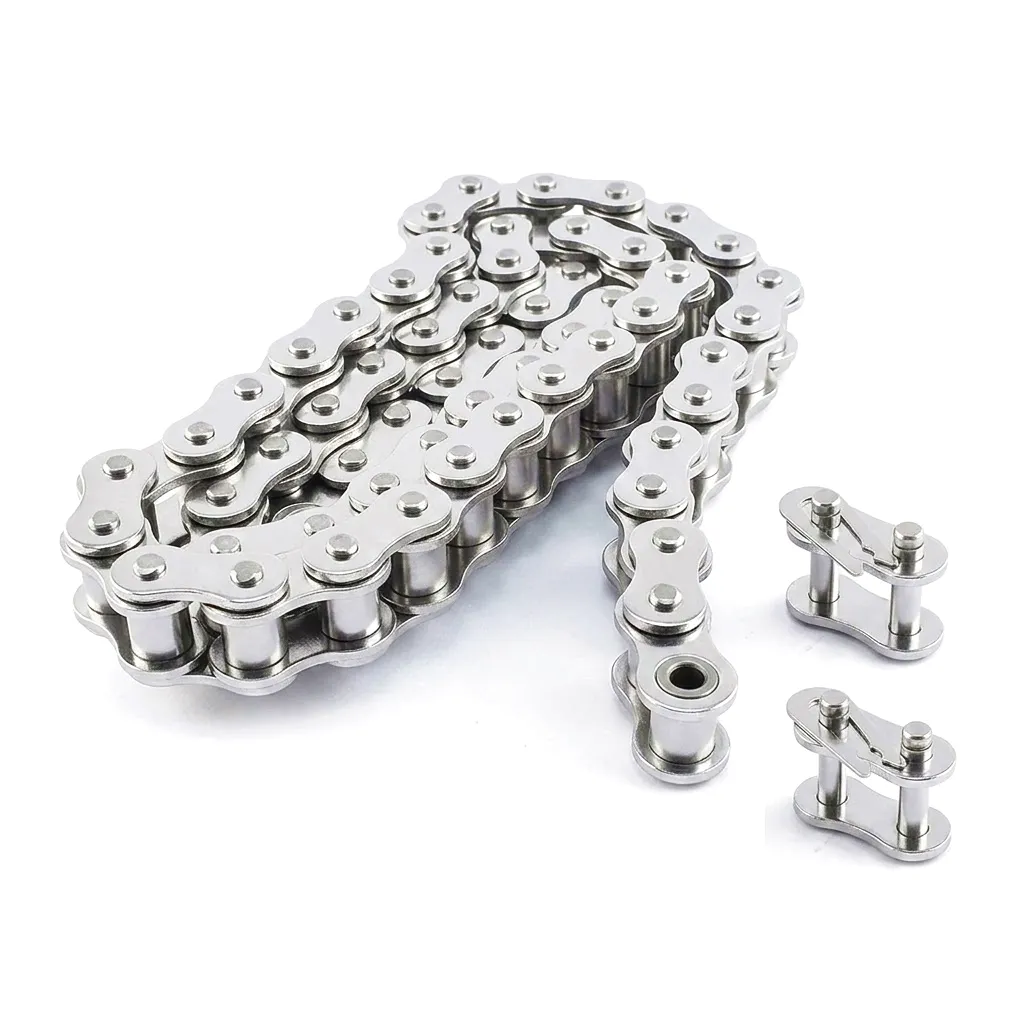
Ever Power has developed over decades into one of the most capable and reliable roller chain manufacturers serving the global industrial market, with particular depth of relationship with UK engineering procurement teams seeking a dependable offshore manufacturing partner who understands British technical standards and delivery expectations. Our manufacturing facilities operate to a level of metallurgical and dimensional process control that enables us to produce roller chains to BS EN ISO 606, ANSI B29.1, and application-specific custom specifications with consistent, repeatable quality across large production runs. Every batch of chain that leaves our facility carries traceable material certification, heat treatment records, and dimensional inspection data — documentation that our UK customers appreciate when they need to satisfy their own quality management system audits under ISO 9001 or sector-specific quality frameworks.
What sets Ever Power apart in a crowded global marketplace is the depth and flexibility of our customisation capability. We do not simply stock standard catalogue chains. Our engineering team works directly with customers to design and manufacture roller chains to bespoke specifications: non-standard pitch dimensions, extended pin lengths for attachment plates, solid bush designs for high-temperature environments, special plate profiles for particular load cases, and surface treatments ranging from zinc-nickel electroplating to hot-dip galvanising and proprietary anti-corrosion coatings. UK customers sourcing chains for offshore oil support vessels, North Sea wind farm equipment, or coastal materials handling operations regularly take advantage of this customisation capability, specifying stainless steel in grades and surface finishes that standard catalogue offerings do not cover. Our supply chain infrastructure supports UK importers with consolidated sea freight shipments, flexible order quantities, and lead times that are genuinely competitive with European manufacturers — an increasingly important consideration as UK engineering procurement managers look to optimise the balance between inventory holding cost and supply security following recent global supply chain disruptions.
Customer Success Story: Sheffield Forgemasters Conveyor Reliability Transformation
Heavy industry meets precision manufacturing — a partnership that delivered measurable results
A major Sheffield-based heavy forging and steel processing company — supplying components to the UK defence, nuclear energy, and offshore industries — had been experiencing repeated, unpredictable failures in the roller chains driving the elevated transfer conveyors that move heavy forged billets between heat treatment furnaces and cooling beds. The chains were standard-catalogue 24B-3 triplex chains sourced from a European distributor, replaced on a time-based maintenance schedule every eight months. Actual failure frequency had crept upward to roughly five to six months, and each failure event required a full production stoppage of four to six hours — a significant cost in an operation where furnace temperatures cannot simply be held indefinitely and production schedules are tightly committed to defence prime contractors.
The company’s maintenance engineering manager contacted Ever Power after a referral from a West Midlands automotive components supplier who had already achieved positive results using our custom alloy steel chains on a high-temperature forging press conveyor. Our engineering team conducted a remote technical review of the duty parameters, examining the billet load weights, conveyor speeds, thermal cycle data from the furnace environment, and the lubrication regime in use. The analysis identified two compounding root causes: the standard chain alloy composition was marginal for the combined temperature and shock load, and the as-installed lubrication intervals were too long for the operating conditions.
Ever Power manufactured a custom 24B-3 triplex chain using a high-chromium-molybdenum alloy steel with an elevated case depth specification and modified heat treatment to improve core toughness at elevated temperature. We also supplied an automated chain lubrication specification recommendation as part of the package. The replacement chains have now completed fourteen months of service — nearly three times the previous failure interval — with no failures. The reduction in unplanned downtime has recovered the additional unit cost of the upgraded chain specification many times over within the first year alone, and the Sheffield site has since standardised Ever Power chains across four other conveyor circuits.
“The uplift in chain life has been transformational for our maintenance planning. Going from a five-month failure cycle to fourteen months and counting is the kind of result that gets noticed at board level. Ever Power’s willingness to analyse the application rather than just supply a catalogue part is exactly what we needed.”
“We were sceptical about moving away from our European supplier, but the material traceability documentation that Ever Power provides is better than anything we have received before. Every coil carries full heat treatment records, and the chains have performed without a single unplanned failure since installation twelve months ago.”
“Ever Power handled our stainless steel chain requirement for a coastal materials handling installation in the Port of Grimsby with a level of application knowledge that impressed our engineering team. The grade 316 chains have been in service through two full North Sea winters with no corrosion concerns. Delivery was on time, and pricing was genuinely competitive.”
Frequently Asked Questions: Roller Chains in UK Industry
Answers to the questions UK engineers and buyers ask most