Technical Guide · Power Transmission
Xích con lăn so với xích giảm tiếng ồn: Những điểm khác biệt chính và khi nào nên sử dụng từng loại.
A comprehensive technical breakdown for UK industrial engineers, procurement managers, and OEM designers who need to make the right chain selection — first time, every time.
🔧 Ever Power Engineering
🇬🇧 UK Market Optimised
📐 3,000+ Word Technical Guide
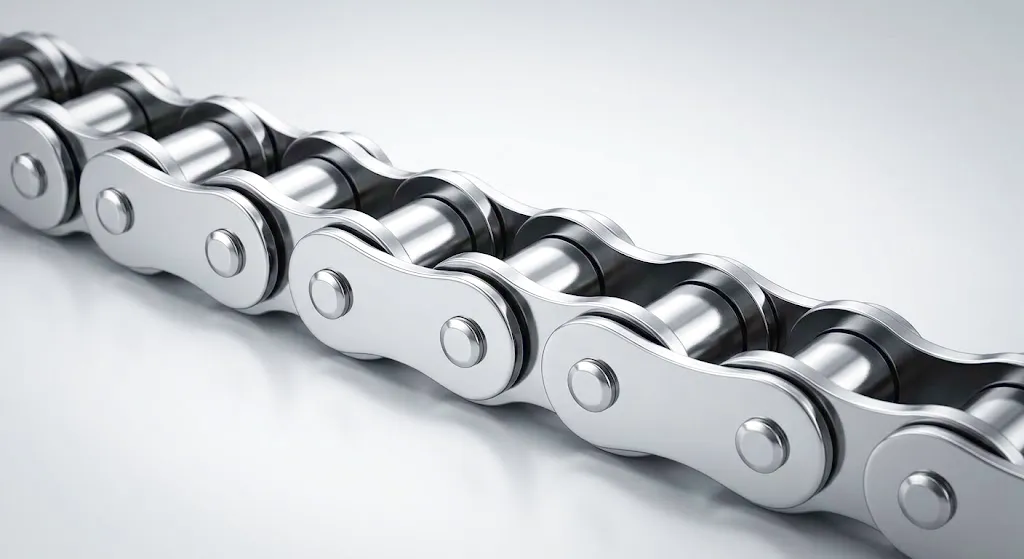
Walk through any steel mill in Sheffield, a food processing facility on the outskirts of Birmingham, or an agricultural equipment plant in Lincolnshire, and you will find chain drives doing the invisible work that keeps production moving. Yet for all their ubiquity, the question of which chain type is genuinely right for a given duty cycle remains one of the most under-discussed decisions in mechanical engineering. Two families dominate industrial power transmission: the roller chain and the silent chain. They share a common job — transferring torque between rotating shafts — but they diverge sharply in construction, acoustic profile, speed capability, and total cost of ownership.
This guide strips away the ambiguity. Drawing on real-world applications across UK manufacturing sectors, we examine the engineering anatomy of each chain type, set out the performance metrics that matter most to design engineers and procurement teams, and give you a practical framework for making the right selection. Whether you are speccing a conveyor drive in a Leeds packaging plant or replacing an OEM chain on heavy plant equipment, the information here is designed to be immediately actionable.
What Is a Roller Chain? Construction, Geometry, and Working Principle
⛓
A roller chain is built from a precise sequence of alternating inner and outer link plates, joined by cylindrical pins. Each pin passes through a tubular bushing, and a free-rotating roller sits over that bushing. When the chain engages a sprocket, the rollers — rather than the pins or plates — make contact with the sprocket teeth. This rolling contact reduces the friction generated during engagement dramatically compared to a sliding contact design, and it is the single most important feature that defines the roller chain’s operational character.
⚙️
The pitch — the centre-to-centre distance between adjacent pins — is the defining dimensional parameter. Standard roller chains are manufactured to ANSI/ISO specifications, with pitch sizes typically ranging from 6.35 mm (¼ inch) for light-duty applications up to 76.2 mm (3 inch) for heavy industrial machinery. The load is distributed across multiple teeth simultaneously, which gives roller chains a remarkably robust load-carrying profile even at relatively modest chain widths. This distributed engagement also means the wear is spread across a larger contact area, extending service life considerably when a proper lubrication regime is maintained.
The working principle of a roller chain drive relies on positive engagement: the sprocket teeth physically lock into the chain’s link geometry and pull it around with zero slippage. Unlike a V-belt or flat belt drive, a roller chain cannot slip under load overrun, which makes it the preferred choice wherever a fixed, verifiable speed ratio between input and output shafts must be maintained at all times. In high-torque applications — think quarry crushers in the Peak District or press-line drives in Sheffield’s remaining special steel facilities — that positive engagement is not a luxury but an absolute requirement for process integrity.
What Is a Silent Chain? Inverted-Tooth Design and Core Operating Logic
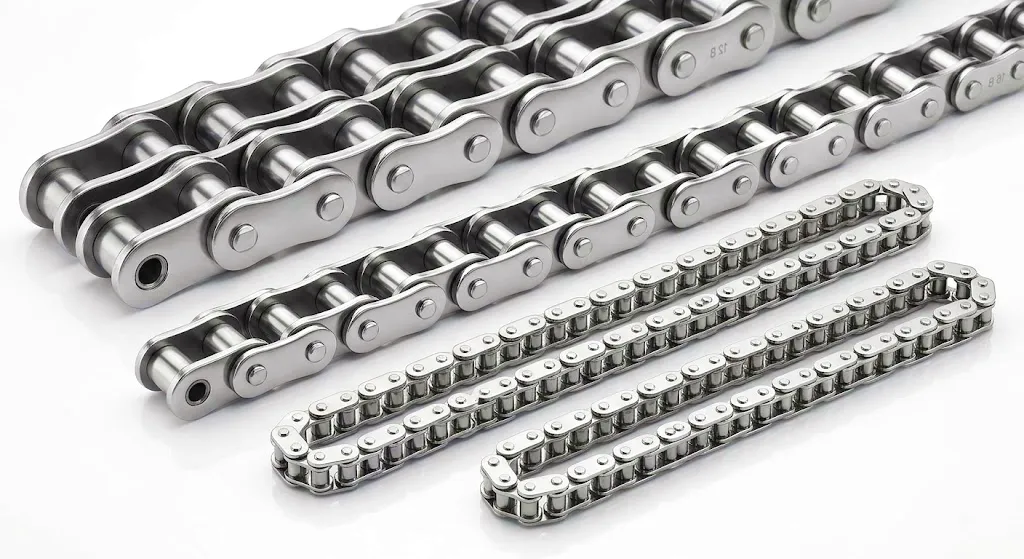
A silent chain — sometimes called an inverted-tooth chain or a Morse-type chain after one of its early patent holders — operates on a fundamentally different geometry. Rather than relying on rollers to contact sprocket teeth, a silent chain uses flat link plates whose edges are shaped with angled, inverted tooth profiles. These toothed link plates mesh with the sprocket’s grooves in a wedging action. As the chain seats into the sprocket, the tooth flanks bear the load in a distributed contact pattern that generates far less impact noise than the periodic roller-tooth engagement of a conventional roller chain.
The name is not marketing hyperbole: a properly maintained silent chain running on matched sprockets in a well-enclosed drive can produce sound levels 10–15 dB lower than an equivalent roller chain drive at the same speed. For applications where operational noise is regulated — automotive camshaft drives, food processing environments, or pharmaceutical manufacturing lines — this acoustic performance is often the decisive engineering argument. Silent chains also run more smoothly at high peripheral speeds, making them a staple in precision timing and synchronisation applications where chain dynamics at elevated RPM would cause a standard roller chain to vibrate unacceptably.
Silent chains are typically wider relative to their pitch than roller chains of equivalent load rating, because the load is shared across multiple link plates stacked side by side. A guide link or guide plate runs centrally or along the outer edges to keep the chain tracking correctly on the sprocket, preventing lateral drift under high-speed conditions. The construction demands more precise manufacturing tolerances than a standard roller chain, which is reflected in the higher unit cost — but for the right application, the performance payback in noise reduction, smoothness, and component longevity more than justifies the premium.
Core Materials: What Each Chain Type Is Actually Made From
Roller Chain Materials
Tấm nối
Cold-rolled or heat-treated carbon steel (typically AISI 1035–1050). High-strength variants use alloy steel such as SCM415 or 20CrMo5, achieving tensile strengths above 800 MPa for demanding duty cycles.
Ghim
Through-hardened alloy steel, ground to tight tolerances. Case-hardened surface with a tough core prevents brittle fracture while resisting surface wear. Surface hardness typically HRC 58–64.
Bushings & Rollers
Sintered steel bushings are sometimes oil-impregnated for extended lubrication intervals. Rollers are case-hardened to HRC 56–62. Stainless steel (AISI 304/316) or nickel-plated variants are available for food-grade or corrosive environments.
Silent Chain Materials
Toothed Link Plates
High-quality alloy steel, precision stamped and case-hardened. The tight dimensional tolerances required for smooth meshing demand tighter material grades than standard roller chain plates — often 20CrMnTi or equivalent case-hardening steel.
Joint Pins
Larger-diameter pins relative to pitch, through-hardened. The articulation between link plates occurs directly at the pin-plate interface, so pin surface finish is critical to noise performance and longevity.
Guide Plates
Typically manufactured from the same alloy steel as link plates but left unhardened to allow slight flexibility. Their primary role is lateral constraint, preventing the chain from walking off the sprocket at speed.
Technical Performance Comparison Table
Roller Chain vs. Silent Chain — Key Engineering Parameters
| Tham số |
Xích con lăn |
Silent Chain |
| Typical Pitch Range |
6.35 mm – 76.2 mm |
6.35 mm – 25.4 mm |
| Max Operating Speed |
Up to ~25 m/s (standard); ~35 m/s (precision) |
Up to ~40 m/s |
| Noise Level (Relative) |
Moderate–High (impact noise at sprocket engagement) |
Low (10–15 dB quieter) |
| Mechanical Efficiency |
97%–99% |
98%–99% |
| Load Capacity (High Torque) |
Excellent |
Tốt |
| Shock Load Resistance |
Cao |
Moderate |
| Lubrication Requirement |
Regular (oil bath, drip, or spray) |
Typically enclosed oil bath |
| Relative Unit Cost |
Thấp hơn |
Higher (30%–80%+ premium) |
| Tensile Strength (Typical) |
35 kN – 900+ kN (by pitch) |
15 kN – 300+ kN (by width/pitch) |
| Primary Material |
Alloy/carbon steel; SS options available |
Precision alloy steel; case-hardened |
| Sprocket Design |
Toothed wheel; standard profiles (DIN/ISO/ANSI) |
Grooved sprocket; matched to chain width |
| Replacement / Sourcing |
Widely available; standardised |
Typically OEM or specialist supplier |
Featured Ever Power High-Strength Roller Chain Products
Engineered for demanding Caterpillar equipment and heavy-duty industrial drives
Heavy-Duty Series
120HSP-00
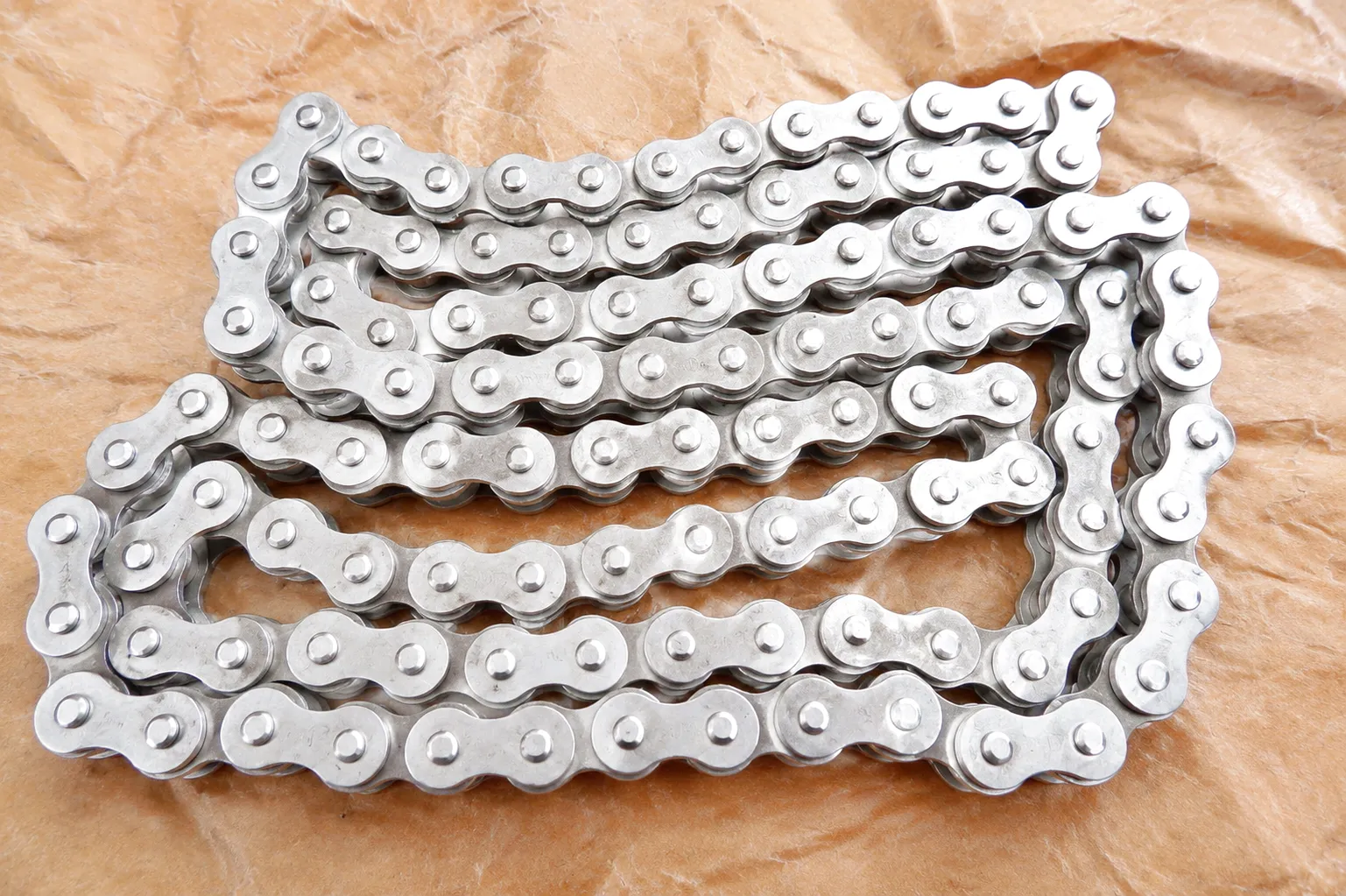
Designed specifically for Caterpillar equipment operating under sustained heavy loads. Features premium alloy steel construction with advanced heat treatment for exceptional fatigue resistance across extended service intervals. Ideal for UK quarrying, mining, and plant hire sectors where maximum uptime is non-negotiable.
View 120HSP-00 Details →
Heavy-Duty Series
C100HSP-00
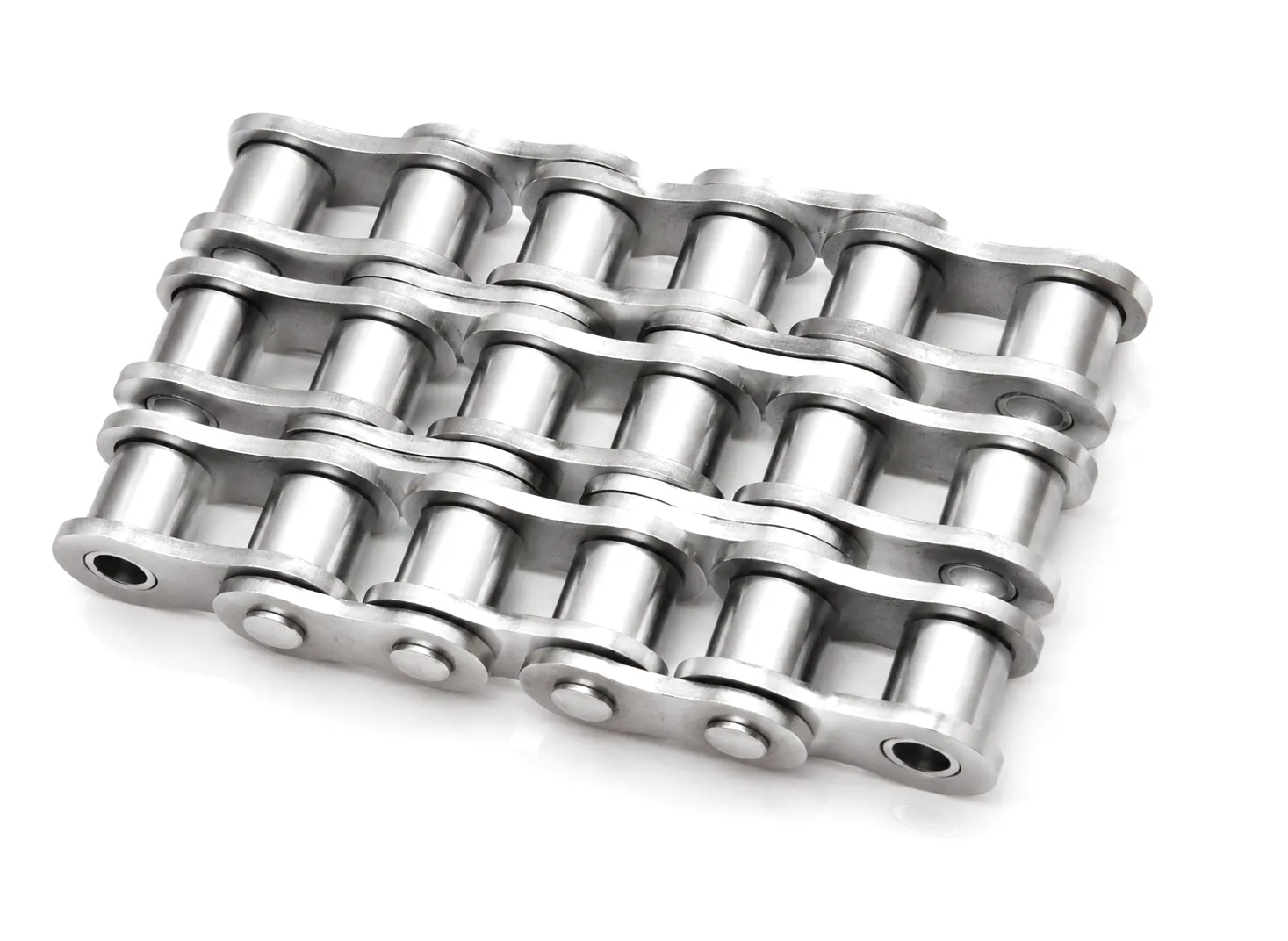
The C100HSP-00 delivers enhanced breaking load and improved wear life compared to standard 100 pitch chains, making it the benchmark choice for Caterpillar undercarriage and drive applications. Its tight dimensional consistency ensures smooth operation and minimises sprocket wear — a key TCO consideration for fleet-scale operations across the British construction and infrastructure sectors.
View C100HSP-00 Details →
Core Technical Advantages: Roller Chain vs. Silent Chain
RRoller Chain Advantages
Exceptional Torque Capacity
Multi-pitch designs and double/triple strand configurations can handle torque loads that would physically destroy a same-size belt drive, making roller chains the default choice for primary drive systems in heavy manufacturing and extraction industries.
Broad Temperature Tolerance
All-steel construction allows roller chains to operate reliably from sub-zero temperatures (common in UK cold-store logistics facilities) up to approximately 400°C in standard grades, or higher with specialised alloy and heat-resistant coatings.
Standardised and Interchangeable
ANSI B29.1 and ISO 606 standardisation means roller chains from reputable manufacturers are functionally interchangeable, which dramatically reduces procurement lead times and simplifies spares management across multi-site UK manufacturing operations.
Lower Initial and Maintenance Cost
The unit cost of a roller chain is significantly lower than a silent chain of comparable rated capacity. Combined with the easier maintenance access and the wide availability of replacement parts through standard distribution channels, the total cost of ownership case for roller chain is compelling for most industrial applications.
SSilent Chain Advantages
Superior Noise Performance
The wedging tooth engagement mechanism avoids the sharp impact noise characteristic of roller-sprocket contact. In environments where noise regulations apply — including under UK Health and Safety Executive guidance on workplace noise exposure — this can be the difference between compliance and enforcement action.
Smooth Operation at High Speed
As peripheral speed climbs above 15–20 m/s, roller chains begin to exhibit chordal action and dynamic loading that limit smooth running. Silent chains maintain a substantially more consistent velocity at the output shaft, making them the right choice for precision camshaft drives, machine tool spindles, and high-speed conveyors.
Precision Timing Capability
Where valve timing or synchronisation between multiple shafts must be held to tight tolerances over millions of cycles, silent chains outperform roller chains due to lower elongation rates and the consistent meshing geometry that characterises the inverted-tooth design.
Reduced Vibration Transmission
The smoother engagement of silent chains means less vibration energy is transmitted into housings and frames. This extends the service life of bearings, seals, and ancillary components — a measurable benefit in precision machine tools where surface finish quality depends on minimising structural vibration.
Industrial Application Scenarios Across UK Industry
Roller Chain Application: Heavy Quarrying and Aggregate Processing in the Peak District
Some of the most demanding roller chain duty cycles in the UK exist in the limestone quarries and aggregate processing plants of the Peak District and the Yorkshire Dales. Primary crusher drives, conveyor discharge systems, and vibrating screen drives all impose severe cyclic shock loading on any chain selected for the duty. Roller chains in these environments are typically sized at 200% to 250% of the calculated working load to provide adequate safety margins against the random overloads that characterise rock crushing operations. Double-strand and triple-strand configurations are common, using pitch sizes from 38.1 mm to 50.8 mm with alloy steel construction throughout.
Lubrication in these environments is always oil bath or forced circulation, given the high contamination risk from rock dust. Operators in this sector prioritise the roller chain’s ability to absorb and survive impact loads that would fatigue a silent chain in a fraction of the expected service life. The interchangeability of standard roller chain sizes also matters enormously to quarry maintenance teams who need to keep a lean spares inventory while supporting multi-machine fleets across geographically remote sites.
🏗️
Construction & Plant Hire — Birmingham and the West Midlands
The West Midlands manufacturing corridor remains one of the UK’s most concentrated zones of heavy plant usage. Roller chains feature extensively in excavator and loader undercarriage systems, concrete mixer drive trains, and mobile screening plants. The roller chain’s tolerance of intermittent operation, contamination exposure, and rough handling during on-site maintenance makes it the standard choice for this sector without exception.
🚗
Silent Chain Application: Automotive Engine Production — Sunderland
High-volume engine assembly plants — including the Nissan facility in Sunderland, one of the largest in Europe — use silent chains extensively in camshaft and balance shaft drive systems. The requirement for precise valve timing, low noise, and consistent operation across an engine’s full RPM range makes silent chain the only viable option in this application. The low-vibration output of the inverted-tooth chain also helps meet increasingly strict acoustic targets for passenger vehicle NVH (noise, vibration, and harshness) standards.
🌾
Agricultural Machinery — Lincolnshire and East Anglia
Combine harvesters, baler drives, and grain handling conveyors across the arable expanses of Lincolnshire and East Anglia rely overwhelmingly on roller chains. The seasonal nature of agricultural work means these drives may sit idle for months before being called on to perform at full capacity in harvest conditions. Roller chains tolerate this intermittent-use profile far better than most alternatives, and the availability of agri-spec chains with extended pin lengths and attachment links for flight conveyors is well established through the UK agricultural supply chain.
🔬
Silent Chain Application: Pharmaceutical and Medical Device Production — Cambridge Bio-Campus
Pharmaceutical and life science manufacturing environments impose noise controls, vibration limits, and cleanliness requirements that essentially eliminate most roller chain configurations from consideration. Silent chains in stainless steel or with food-grade lubrication run in enclosed housings, delivering the synchronised motion control required for filling, capping, and inspection machinery while generating minimal audible output and vibration that might interfere with sensitive weighing or measurement systems adjacent to the drive.
🏭
Roller Chain Application: Steel Processing Lines — Sheffield and Rotherham
Sheffield and Rotherham remain home to significant special steel and engineering steel producers whose rolling mill and heat treatment line drives continue to place roller chain at the centre of their process technology. At temperatures where most polymer-based drive elements would fail immediately, roller chains in high-temperature grades continue to operate reliably. The specific combination of high torque, elevated temperature tolerance, and the ability to survive occasional overloads without sudden catastrophic failure keeps roller chain firmly in place in the special steel sector.
When to Use Each: A Practical Decision Framework
A practical engineering guide for selecting the right chain type for your application
Choose Roller Chain When:
✓Your drive must handle high torque loads or severe shock loading from machinery like crushers, presses, or conveyors
✓Operating speed is below 15–20 m/s and smooth output velocity variation is acceptable
✓Drive centre distance is long or variable — roller chains tolerate centre distance variations that would cause problems for a silent chain installation
✓The application is in an exposed or contaminated environment (outdoor, agricultural, quarrying, construction) where an enclosed chain case is impractical
✓Cost constraints are significant and the drive operates in an environment where the noise difference between chain types is immaterial to operators or regulatory compliance
✓You need standardised spare parts available through multiple UK distribution channels at short notice
Choose Silent Chain When:
✓Noise levels in the machine or facility are governed by regulatory requirements or customer-driven NVH targets that a roller chain drive would fail to meet
✓Operating speed exceeds 20 m/s, where roller chain chordal action causes unacceptable output velocity variation and dynamic loading
✓The drive is fully enclosed with access to a reliable oil bath or circulating lubrication system, making the higher initial cost justifiable through extended service intervals
✓Timing precision between shafts is a hard engineering requirement — such as in camshaft drives, multi-head printing machinery, or synchronised conveyor systems
✓Vibration transmission into the machine frame must be minimised to protect measurement accuracy, surface finish quality, or sensitive ancillary equipment
✓The load is steady and predictable rather than heavily shock-loaded — silent chains are not the ideal choice for primary crusher or mining equipment drives
Manufacturing Partner
Ever Power: Precision Chain Manufacturing and Custom Engineering
Ever Power has built its reputation on the ability to manufacture roller chains and related drive components to specifications that standard catalogue products simply cannot meet. Our production facilities operate to ISO 9001 quality management standards, and our engineering team works directly with customers — including a growing number of UK OEM manufacturers and MRO procurement specialists — to develop chain solutions that address the exact combination of load, speed, environment, and life expectancy the application demands.
Customisation capabilities at Ever Power span the full range of chain engineering variables: pitch, strand count, attachment type and spacing, link plate geometry, pin diameter, surface treatment (including nickel plating, zinc plating, and polymer coating), material grade (including stainless steel grades 304 and 316 for food-grade and marine applications), and breaking load. We also manufacture to customer-supplied samples where original drawings are no longer available — a service that has proven particularly valuable to UK maintenance engineering teams working on legacy equipment in foundries, printing works, and textile manufacturing facilities.
Our supply chain model is structured to support UK customers with consistent lead times, pre-production sample review, and direct technical dialogue with our engineering team — no intermediaries, no uncertainty about what you are receiving. Whether your requirement is a standard catalogue roller chain or a completely bespoke multi-strand conveyor chain engineered to a specific attachment drawing, Ever Power has the manufacturing capability and the quality assurance infrastructure to deliver with confidence.
📧 Request a Custom Quote from Ever Power
Vương quốc Anh
Market Ready
Customer Success Story: Precision Aggregate Processing — Derbyshire, UK
A mid-scale aggregate processing company operating across three sites in the Derbyshire Peak District came to Ever Power in early 2024 with a persistent maintenance challenge: the primary conveyor drive chains on their rotary screening plants were requiring replacement every four to five months, generating significant unplanned downtime during peak production periods. The existing chains, sourced through a local MRO distributor, met standard specification but were experiencing accelerated wear at the pin-bushing interface in the highly abrasive limestone dust environment.
Ever Power’s engineering team reviewed the application in detail — duty cycle, sprocket condition, lubrication method, and dust exposure levels — and proposed a customised roller chain with a higher alloy content pin and bushing set, combined with a factory-applied solid lubricant treatment to extend the re-lubrication interval and reduce the rate of abrasive particle ingestion into the bearing surfaces. The proposed chain was produced to sample stage within six weeks and trialled on one of the three sites.
The Outcome
After 12 months of operation under the same duty conditions, the Ever Power customised chain showed less than 0.8% pitch elongation against a replacement threshold of 3%, compared to the previous standard chain that was already failing at month four or five. The company subsequently converted all three sites to the Ever Power specification, reducing their annual chain expenditure by approximately 35% on a total-cost basis once labour, downtime, and parts costs were factored together. The Derbyshire maintenance team now operates on a planned six-month inspection cycle rather than reactive replacement, and the screener drives have run without an unscheduled chain-related stoppage across all three sites since the changeover.
Khách hàng của chúng tôi nói gì?
★★★★★
“We went from replacing conveyor chains four times a year to a planned annual inspection that hasn’t yet required a replacement. Ever Power’s engineers understood our exact application, not just the catalogue spec, and the custom treatment they applied to the pins made a noticeable difference from the first month. The cost saving is real and the downtime reduction is even more valuable to us.”
— Maintenance Manager
Aggregate Processing, Derbyshire
★★★★★
“The dimensional consistency on the Ever Power roller chains we’ve been using across our Birmingham press-line drives is genuinely impressive. We spec’d a heavy-duty double strand arrangement for one particularly punishing press, and after eighteen months of three-shift production the chain is showing wear levels that suggest we’ll get well over two years from each set. For any UK manufacturer looking at long-term procurement, the price point versus performance ratio is extremely competitive.”
— Procurement Director
Precision Press Components, Birmingham
★★★★★
“We needed a stainless steel roller chain to a non-standard pitch for a food processing conveyor at our Yorkshire facility — not something most suppliers can turn around quickly. Ever Power had samples to us within four weeks and the production order was delivered on time and to exact spec. The technical support during the enquiry stage was the level you’d expect from a proper engineering supplier, not a catalogue house.”
— Engineering Manager
Food Processing Equipment, West Yorkshire
Frequently Asked Questions
Common questions from UK industrial buyers, maintenance engineers, and procurement teams
What is the main difference between a roller chain and a silent chain in terms of how they engage with a sprocket?
A roller chain uses free-rotating cylindrical rollers that contact the sprocket tooth faces in a rolling — rather than sliding — motion. This reduces friction significantly, but it does generate a brief impact each time a link engages a tooth. A silent chain uses inverted-tooth link plates that wedge into grooves on the sprocket, spreading the load across a larger contact area and eliminating the sharp engagement impact. The result is a substantially quieter and smoother-running drive, particularly at higher speeds, though the silent chain requires more precise manufacturing and a fully enclosed lubrication environment to deliver its performance advantage reliably over the long term.
How much does a heavy-duty roller chain cost in the UK, and where can I get a quote for a custom specification?
Roller chain pricing varies considerably depending on pitch, strand count, material grade, and order volume. Standard catalogue roller chains in common pitches (12.7 mm to 25.4 mm) are available from UK distributors at prices ranging from a few pounds per metre for light-duty grades up to several hundred pounds per metre for large-pitch, multi-strand, alloy-steel configurations. Custom specifications — including non-standard attachments, special materials, or bespoke breaking loads — require a direct quotation from the manufacturer. Ever Power provides prompt written quotations for both standard and custom roller chain requirements; contact [email protected] with your pitch, working load, operating speed, and environment details for a response within one business day.
Which type of roller chain should I use for a Caterpillar excavator or heavy plant equipment operating on a UK construction site?
For Caterpillar excavators and similar heavy plant equipment used on UK construction sites, a high-strength roller chain specifically engineered to the OEM pitch and breaking load specification is essential. Ever Power’s 120HSP-00 and C100HSP-00 series are manufactured to exceed the original Caterpillar specification in terms of tensile strength and wear resistance, using premium alloy steel with controlled case-hardening profiles on all wearing surfaces. These chains are dimensionally compatible with Caterpillar sprockets and link components and are designed to perform reliably in the wet, abrasive, and shock-loaded conditions characteristic of British construction and groundworks operations.
Where can I find a reliable roller chain supplier in the UK who can deliver custom specifications with short lead times?
UK buyers have access to both local distribution and direct-from-manufacturer supply routes. For standard catalogue sizes, regional MRO distributors in manufacturing hubs like Birmingham, Sheffield, Leeds, and Manchester typically carry stock. For custom or high-specification roller chains, sourcing directly from a manufacturer with a dedicated UK export capability — such as Ever Power — delivers better technical support, tighter quality consistency, and competitive pricing at volumes above a few hundred metres. Established direct-supply relationships also allow for faster re-order processing and priority production scheduling during peak demand periods.
How do I know when my roller chain needs replacing, and what signs of wear should a UK maintenance engineer look for during inspection?
The primary wear indicator for a roller chain is pitch elongation — the increase in pin-to-pin spacing that results from progressive wear at the pin-bushing interface. Most manufacturers recommend replacement when elongation reaches 1.5% to 3% of nominal pitch length, measurable over a 12-link span using a roller chain wear gauge or vernier calliper. Visual indicators include visible rust, plate cracking, rollers that no longer rotate freely on their bushings, and lateral stiffness in individual links. In UK quarrying and agricultural applications, abrasive contamination significantly accelerates wear, so inspection intervals should be shortened in those environments — typically every 250 to 500 operating hours rather than the 1,000-hour intervals sometimes recommended for clean industrial drives.
What is the typical price premium for a silent chain compared to a roller chain of equivalent power rating, and is it worth paying for a food processing plant in the UK?
Silent chains typically carry a 30% to 80% unit price premium over roller chains of comparable power rating, depending on the specific dimensions and manufacturer. For food processing applications in the UK — particularly those subject to BRCGS, Red Tractor, or retailer-specific hygiene and noise standards — the silent chain’s acoustic and vibration performance usually justifies its higher initial cost when viewed across the full asset life. The enclosed lubrication requirement of a silent chain must be built into the machine design, but the resulting low noise and smooth operation can be decisive factors when line operators spend full shifts adjacent to drive systems, and where Health and Safety Executive noise assessment obligations apply. For general-purpose food conveyor drives where noise is less critical, a stainless steel roller chain remains the more economical and easily maintained solution.
How long does it take to get a custom roller chain delivered to a UK address from an overseas manufacturer like Ever Power?
Standard samples for approval from Ever Power typically ship within four to six weeks of confirmed order specification. Production quantities for custom roller chain specifications normally require eight to twelve weeks from drawing sign-off, depending on material availability and production scheduling. For urgent requirements or breakdown replacements involving non-standard specifications, Ever Power’s team can assess expedited production options on a case-by-case basis. Standard catalogue sizes and high-volume stock items may be available for faster shipment. UK customers who maintain a consignment stock arrangement or pre-approved blanket order with Ever Power benefit from significantly shorter replenishment lead times — a supply model we actively recommend for maintenance-critical applications at facilities in Sheffield, Birmingham, Leeds, and across the broader UK industrial base.
Ready to Source the Right Chain for Your Application?
Tell Ever Power your pitch, load, speed, and environment. Our engineering team will confirm the right specification — standard or fully custom — and provide a competitive written quotation for UK delivery.
📧 Get Your Quote: [email protected]
Response within 1 business day · Custom specifications welcome · UK delivery available
© Ever Power Engineering · roller-chain-manufacturers.com · Technical content for informational purposes. Contact our engineering team for application-specific advice.
chỉnh sửa bởi gzl