Anatomie d'une chaîne à rouleaux : explication de chaque composant
A complete technical reference for engineers, procurement managers, and maintenance professionals across the UK manufacturing sector — from Birmingham’s metal fabrication plants to Sheffield’s steel-processing facilities.
Inner Link Plates: The Load-Bearing Backbone
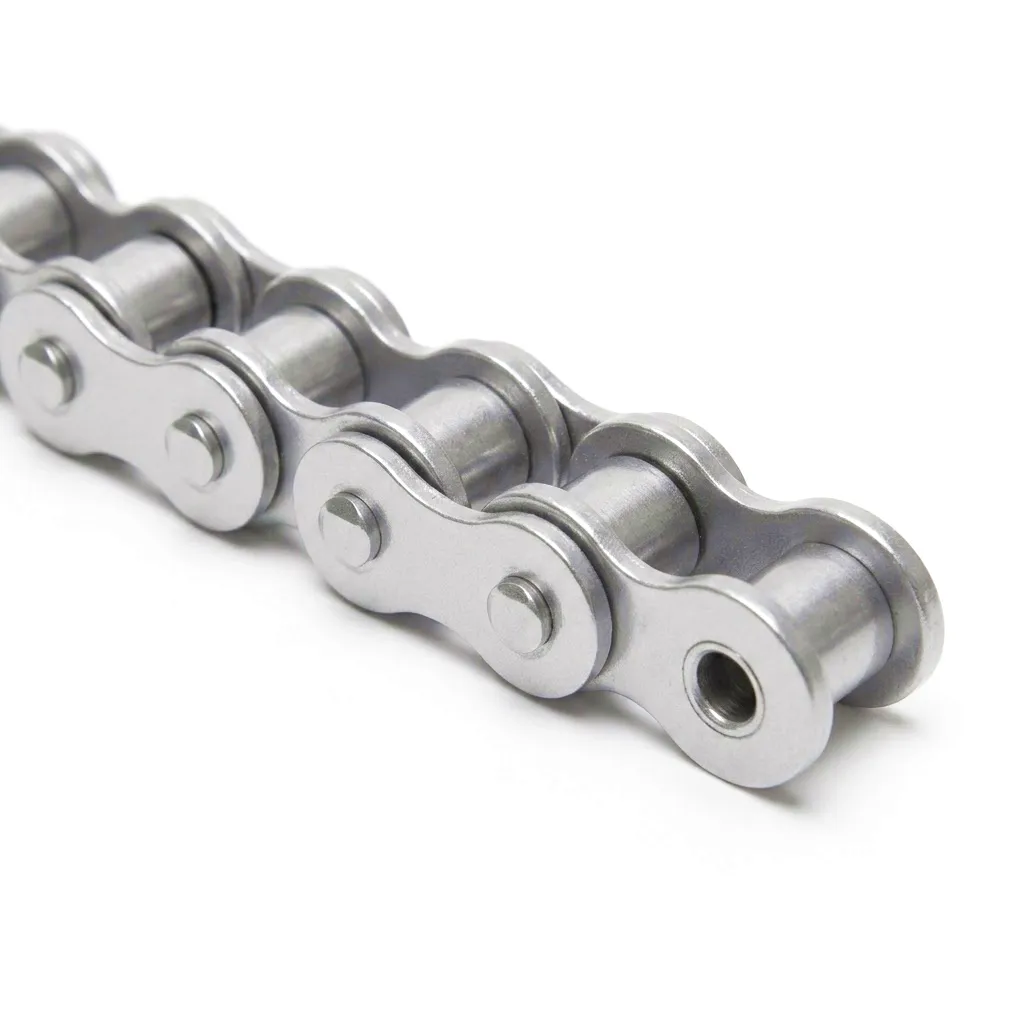
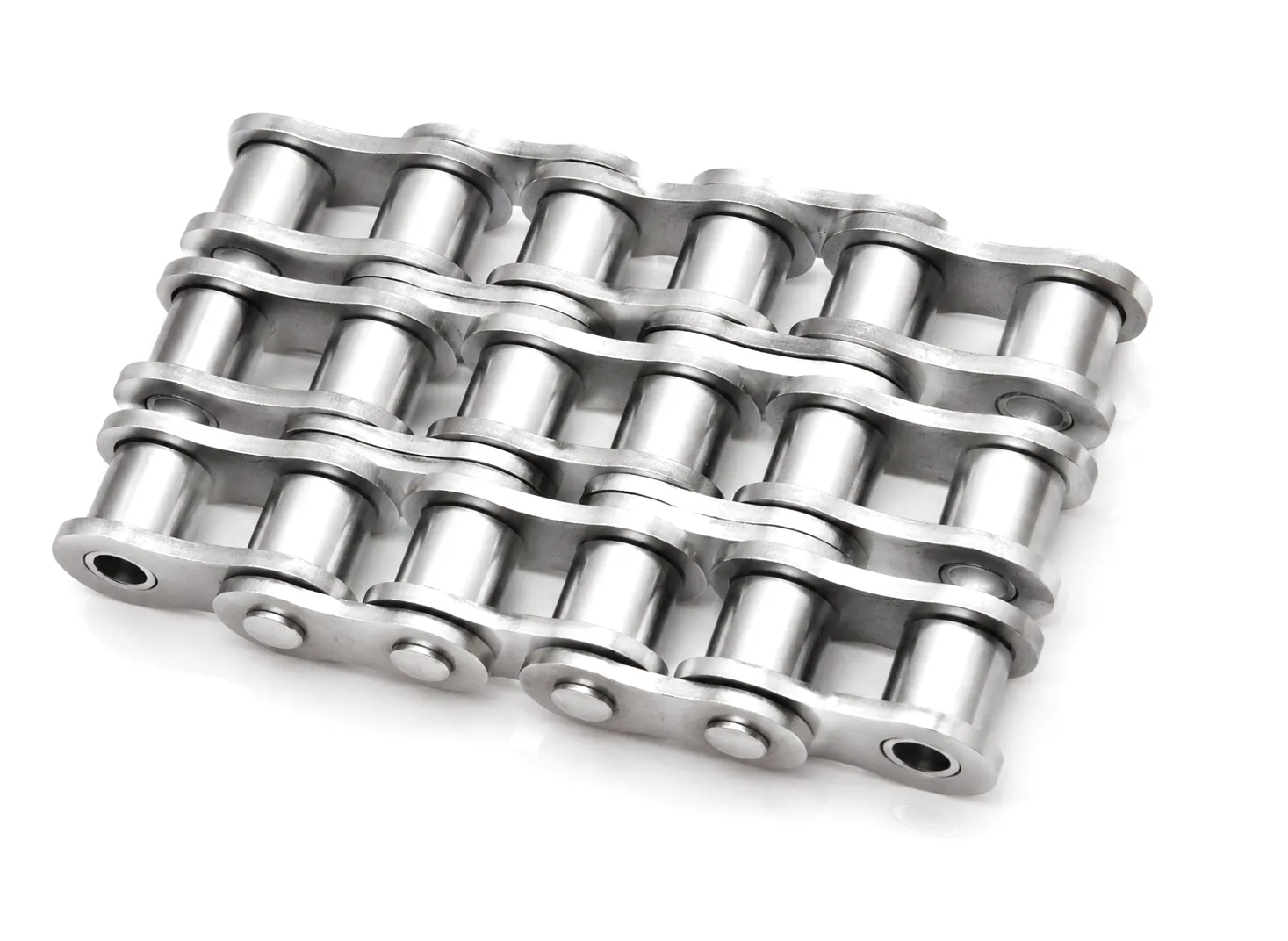
The inner link plates are the primary tension-carrying members of a roller chain. Stamped from medium-carbon or alloy steel strip — typically SAE 1045 to 1085 in the higher-load grades — these plates are profiled with two precisely punched holes that will receive the bushings press-fitted into position. The hole geometry is not arbitrary; the interference fit between bushing outer diameter and plate bore must fall within a tolerance band tight enough to prevent rotation under load but loose enough to survive the stamping process without cracking the heat-treated plate. In British Standard chains conforming to BS ISO 606, the plate thickness and height are defined for each pitch size, and manufacturers that deviate even fractionally expose their customers to premature fatigue cracking.
The lateral surfaces of the inner plates are shot-peened in quality-grade chains. This compressive surface treatment closes micro-cracks introduced during stamping and dramatically extends fatigue life under cyclic tensile loading — a critical consideration in the high-cycle drives found in Birmingham’s automotive body-pressing lines, where chain tension can reverse direction thousands of times per shift. The plate profile is slightly waist-shaped to move stress concentration away from the bushing holes, and the edges are deburred to prevent fretting against mating components.
Outer Link Plates: Containment and Pin Retention
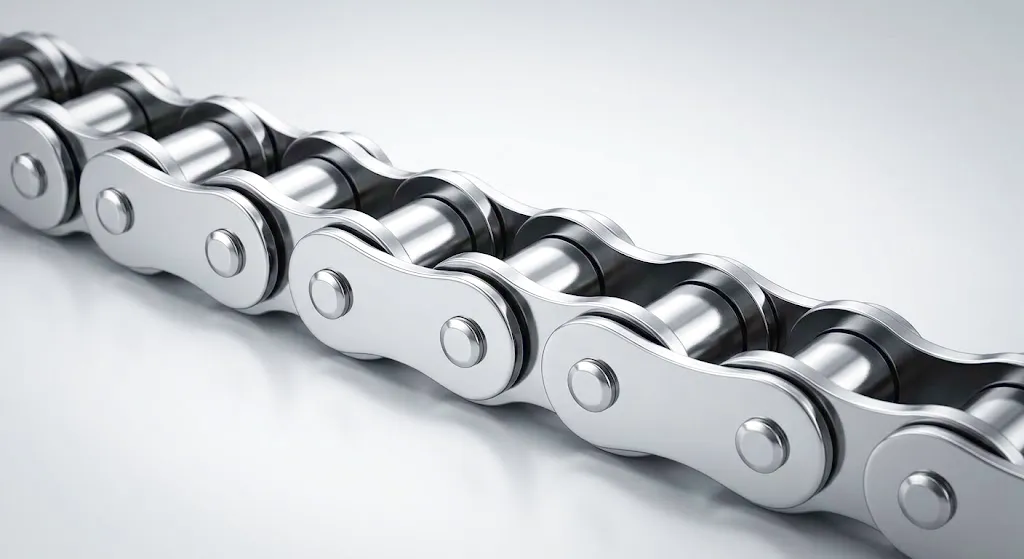
Outer link plates — sometimes called pin link plates — are the counterpart to the inner set, and they carry the same tensile loads while performing the additional function of retaining the connecting pins. Their bore diameter is sized to accept the pin in a press or interference fit, locking the pin against axial movement without the need for separate retention hardware in most chain designs. The punched holes are smooth and circular to a tolerance of a few micrometres, because any out-of-round condition would create a bearing stress concentration that initiates fatigue cracking from the pin hole outward through the plate width.
In corrosive environments common to UK coastal and chemical-processing sites — such as the petrochemical complexes on Teesside or the food-grade processing facilities in East Anglia — outer plates are often specified in stainless steel grades such as AISI 304 or 316L. The material choice shifts from carbon steel’s high-strength-to-weight advantage toward corrosion immunity, and this trade-off is reflected in the rated working load, which may be reduced by 15–20 percent compared to a carbon steel equivalent. The plates are still heat-treated where the alloy permits, and dimensional tolerances are held to the same standards as the carbon steel range.
One dimension that receives particular attention during quality inspection is the inner face distance between a matched pair of outer plates. This dimension directly controls the side clearance available for the inner plate assembly, and if it deviates outside tolerance, the chain will either bind against the inner plates — causing abnormal side wear — or rattle with excessive slop that increases noise, vibration, and shock loading on sprocket teeth.
Connecting Pins: The Pivot Around Which Everything Rotates
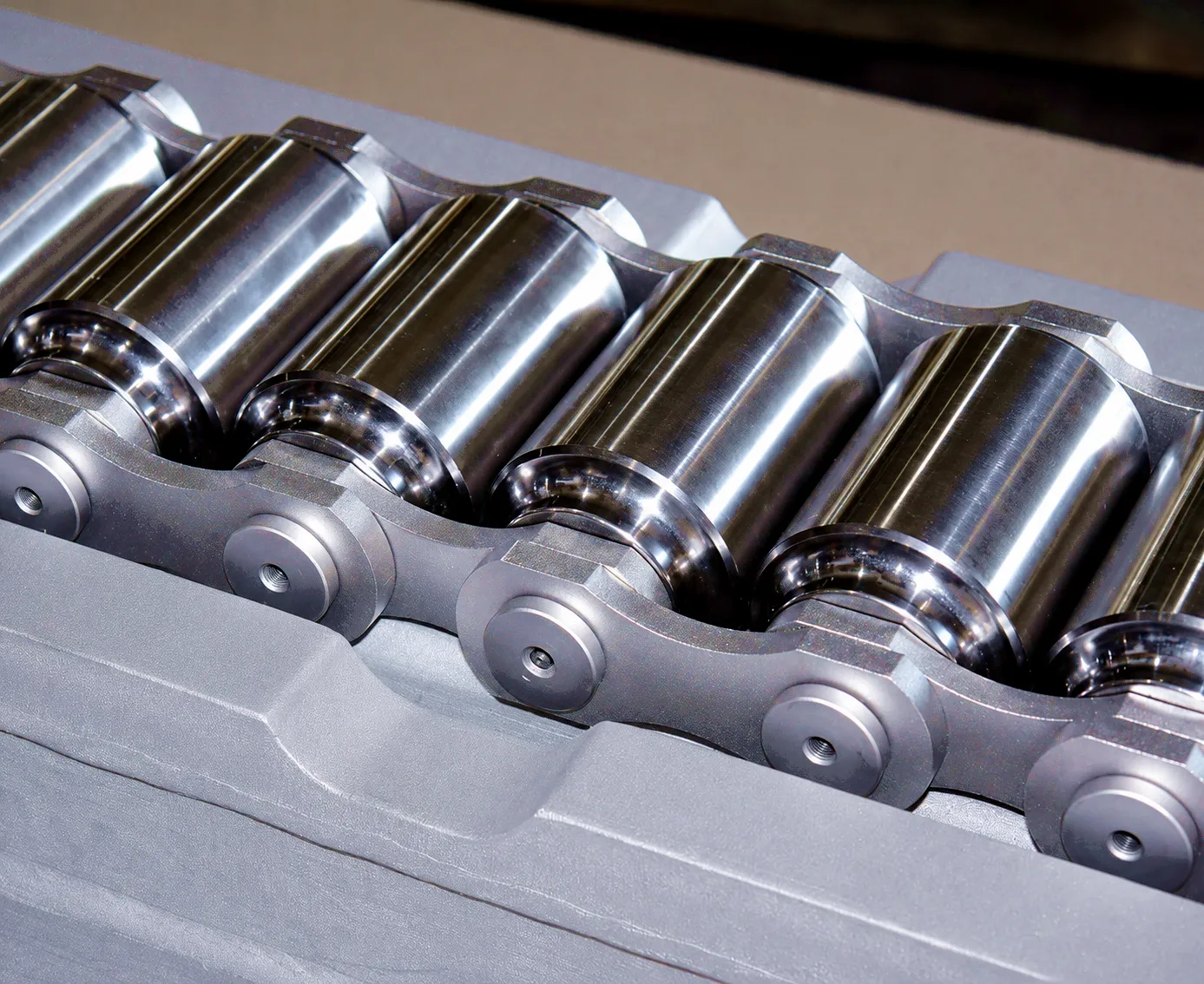
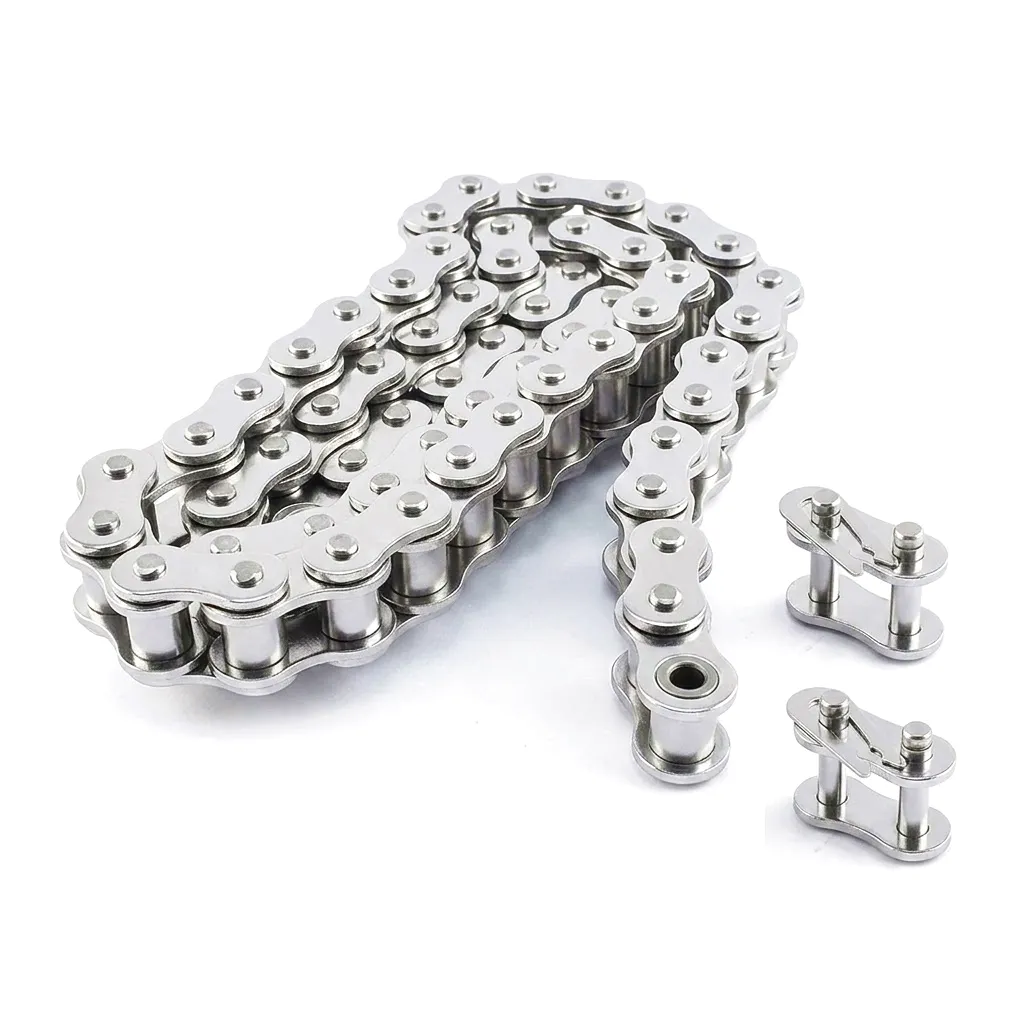 The connecting pin is the component that bears the most complex combination of stresses in the roller chain assembly. As the chain wraps around a sprocket, the pin articulates within the bushing bore, experiencing simultaneous bending, torsion, and contact pressure from the bushing inner surface. Its surface hardness must therefore be high enough to resist fretting and galling — typically in the range of 58 to 62 HRC on the outer case — while the core remains tough enough to absorb the shock loading that occurs when a link engages a sprocket tooth at speed.
This combination is achieved through case-hardening of alloy steels such as SAE 5120 or 8620, where carbon is diffused into the surface layer under controlled atmosphere conditions, creating a hard case over a ductile core. The case depth is monitored precisely: too shallow and the surface crushes under Hertzian contact pressure; too deep and the core toughness is compromised. Pin diameter tolerances are held to within a few micrometres on the cylindrical surface, and the barrel is ground and lapped to a finish that ensures hydrodynamic lubrication films can form at the pin-bushing interface during normal operation.
In high-speed roller chain applications — such as the drive systems on automated conveyor lines in the logistics hubs near Coventry and Milton Keynes — pin straightness is critical to the chain’s dynamic balance. A pin that is bowed even a few micrometres will cause the chain to oscillate laterally as it runs, accelerating wear on sprocket flanges and increasing noise beyond the levels acceptable in modern factory environments.
Bushings: The Articulation Interface
The bushing is a hollow cylindrical sleeve pressed into the bore of the inner link plates, and it forms the articulating interface through which the connecting pin rotates as the chain flexes. Its outer surface must be dimensionally precise to maintain the interference fit with the inner plate without cracking the plate during assembly; its inner bore must be smooth and accurately cylindrical to distribute load evenly across the pin contact area. Any eccentricity between the outer and inner diameters — run-out — translates directly into uneven load distribution and accelerated wear of both the bushing bore and the pin surface.
The bushing material is typically the same alloy family as the pins, case-hardened to similar surface hardness values, but the geometry and stress state are different enough that the two components wear as a tribological pair. The lubrication regime at the pin-bushing interface governs chain life more than any other single variable. In a correctly lubricated drive, oil forms a separating film during the loaded arc of engagement; in an under-lubricated or contaminated system, metal-to-metal asperity contact occurs, and wear debris particles become trapped between the pin and bushing, acting as a three-body abrasive that accelerates elongation catastrophically.
Chain elongation — often called “chain stretch” in field usage, though the plates and pins do not elastically stretch — is almost entirely the result of accumulated wear material removed from the pin-bushing interface. British Standard BS ISO 606 specifies a maximum elongation of 3 percent for general-purpose drive chains before replacement is required, though precision applications such as CNC indexing tables or timing drives on packaging lines in Sheffield may require replacement at as little as 1.5 percent elongation to maintain positional accuracy.
Rollers: Reducing Sprocket Engagement Wear
The roller is the component that most distinguishes a roller chain from a bush chain, and its presence has a transformative effect on the wear rate at the chain-sprocket interface. Without a roller, the bushing outer surface contacts the sprocket tooth flank directly, and the relative sliding motion that occurs as the link wraps onto the sprocket causes both bushing and tooth to wear rapidly. With a free-running roller fitted over the bushing, the contact geometry changes from sliding to rolling: the roller rotates as it seats into the sprocket tooth, reducing the sliding velocity to near-zero and shifting the predominant wear mechanism from adhesive and abrasive to rolling contact fatigue.
Roller hardness is typically in the range of 60 to 64 HRC on the outer surface, achieved through through-hardening of high-carbon steel followed by low-temperature tempering. The outer diameter is ground to a tight cylindrical tolerance, and the bore-to-outside-diameter concentricity — run-out — must be controlled to ensure the roller seats centrally in the sprocket tooth profile. An eccentric roller wobbles as it engages and disengages, creating impact loading that accelerates both roller and tooth wear and introduces vibration into the drive system.
In roller chains for agricultural machinery — such as the round balers and forage harvesters operating across the arable land of Lincolnshire and Yorkshire — rollers are frequently specified with a larger outer diameter relative to the pitch than in a standard drive chain. The larger roller presents a greater bearing area to the sprocket tooth flank, reducing contact stress and extending the chain life in the intermittent, high-shock loading patterns characteristic of agricultural field use. Manufacturers who understand this application distinction provide separate catalogue grades for agricultural and industrial roller chains rather than treating them as interchangeable.
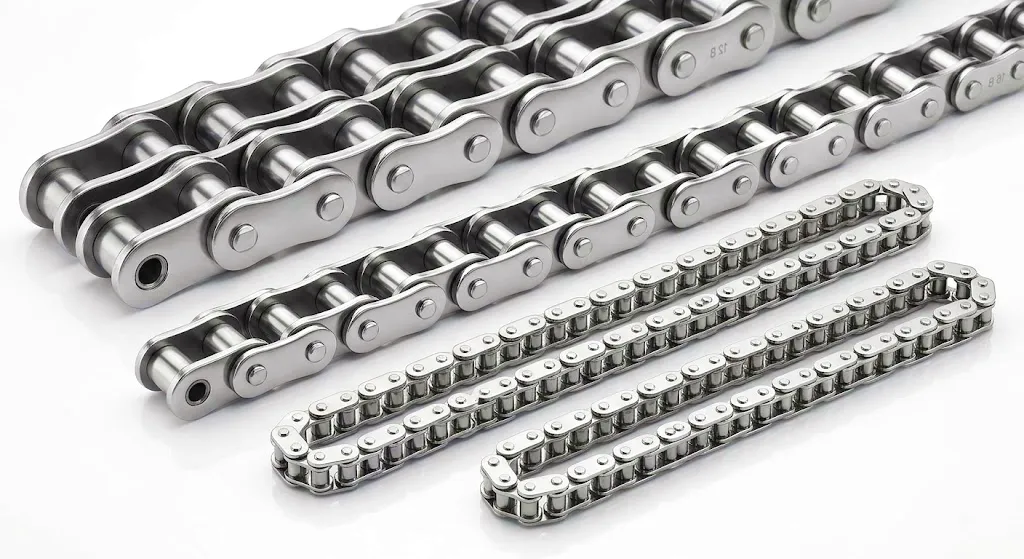
Roller Chain Technical Performance & Specification Table
BS ISO 606 conforming grades — data applies to single-strand standard series
| Chain ISO No. | Pas (mm) | Diamètre du rouleau (mm) | Diamètre de la broche (mm) | Plate Thick. (mm) | Charge de rupture (kN) | Pin Material | Surface Hardness (HRC) |
|---|---|---|---|---|---|---|---|
| 08B-1 | 12.70 | 8.51 | 4.45 | 1.60 | 18.0 | SAE 5120 Case | 58–62 |
| 10B-1 | 15.875 | 10.16 | 5.08 | 1.70 | 22.2 | SAE 5120 Case | 58–62 |
| 12B-1 | 19.05 | 12.07 | 5.72 | 1.85 | 29.0 | SAE 8620 Case | 60–64 |
| 16B-1 | 25.40 | 15.88 | 8.28 | 3.10 | 60.0 | SAE 8620 Case | 60–64 |
| 20B-1 | 31.75 | 19.05 | 10.19 | 3.50 | 95.0 | Alloy Steel Case | 60–64 |
| 24B-1 | 38.10 | 25.40 | 14.63 | 4.80 | 160.0 | Alloy Steel Case | 60–64 |
Specialised Roller Chain Variants for Demanding Applications
Rubber Top Roller Chain
Designed for conveying applications where the product surface must not be scuffed or marked, rubber top roller chains add a vulcanised rubber pad to the outer link plate. The Chaîne à rouleaux supérieure en caoutchouc 20B-G1 is widely used in bottling lines and packaged goods facilities across the UK Midlands, where glass or polymer containers must be conveyed without surface damage while the chain itself operates under the full mechanical rating of the 20B pitch series. The rubber compound is selected for resistance to the cleaning chemicals used in food and beverage processing, including dilute acids and alkaline rinse solutions.
Heavy-Duty Extended Pitch
Le Chaîne à rouleaux supérieure en caoutchouc 24B-G1 sits at the larger end of the standard-pitch range and is selected for applications combining high conveying speed with the need for gentle product handling. Typical deployment includes palletising systems in large UK distribution centres and timber-handling lines in Scottish sawmills, where bulk product weight demands a chain with a breaking load above 160 kN while the rubber pads protect sawn timber surfaces from contact marking that would reduce grade classification and sale value.
Stainless Steel Corrosion-Resistant
All-stainless roller chains fabricated from AISI 316L are the standard choice for pharmaceutical manufacturing, marine deck equipment, and washdown applications in UK facilities operating under BRC or SALSA food safety schemes. Every component — plates, pins, bushings, and rollers — is produced from the same corrosion-resistant alloy family, eliminating galvanic couples that would otherwise accelerate localised corrosion at metal interfaces. The trade-off in breaking load is accepted in exchange for the freedom to use high-concentration cleaning agents without accelerating chain degradation between scheduled maintenance intervals.
Scénarios d'applications industrielles au Royaume-Uni
Automotive Body Pressing — West Midlands
In the transfer press lines of Birmingham and Coventry’s automotive suppliers, roller chains serve as the primary synchronisation elements between successive press stations. The chains must maintain pitch accuracy under cyclic tensile loads exceeding 40 percent of the rated breaking load, and the shock loading profile — generated by the cam-driven stripper plates — places a premium on plate fatigue strength rather than static breaking load.
Steel Processing — Sheffield
Sheffield’s special steels and engineering materials sector relies on heavy-duty roller chains for furnace conveyor drives, rolling mill auxiliary drives, and billet transfer systems. Ambient temperatures in these environments can exceed 200 degrees C near heat treatment furnaces, requiring chains with high-temperature grease fill and heat-resistant seal materials where O-ring sealed variants are used. The chains must resist scale contamination and occasional thermal shock.
Food and Beverage Processing — East Anglia
Poultry, vegetable processing, and malted beverages production facilities across Norfolk, Suffolk, and Cambridgeshire demand stainless steel roller chains that can withstand twice-daily caustic washdowns at 70 degrees C. All-stainless or NSF-certified plastic roller variants are deployed on conveyor lines where the regulatory burden of demonstrating food safety compliance makes any metallic particle contamination risk unacceptable from both a commercial and a legal standpoint.
Agricultural Machinery — Lincolnshire
Combine harvesters, potato harvesters, and root crop handling lines operating across Lincolnshire and East Yorkshire impose intermittent shock loading on roller chain drives that standard industrial selection methods significantly underestimate. Agricultural roller chains are specified with an application factor of 1.5 to 2.0 times the calculated working load to account for stone strikes, vine entanglement, and sudden engagement of headers encountering dense crop standing material.
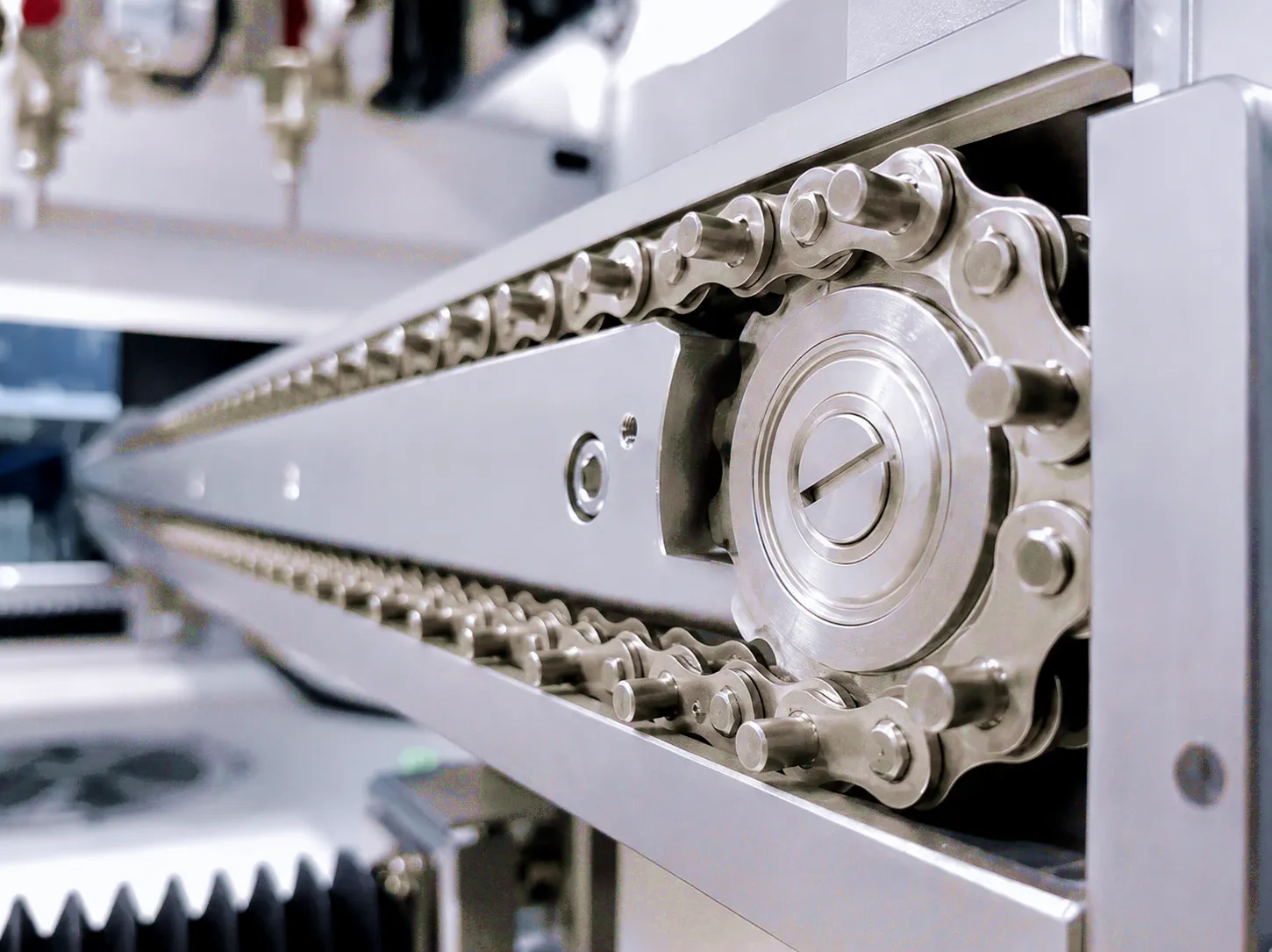
Ever Power : Fabrication de chaînes à rouleaux de précision et ingénierie sur mesure
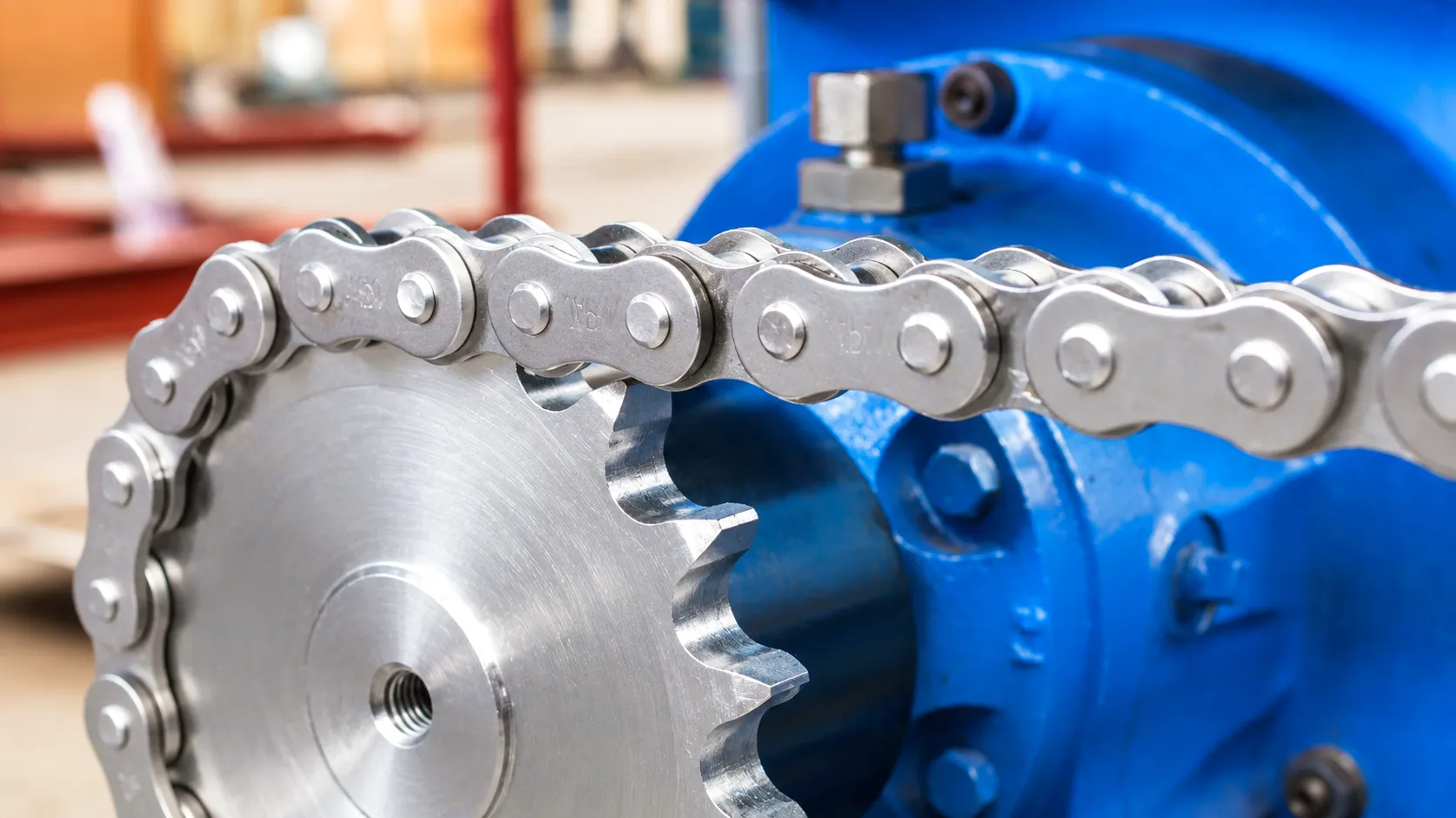
Ever Power operates dedicated roller chain manufacturing lines equipped with CNC-controlled progressive stamping presses, induction case-hardening furnaces, and coordinate measuring machines capable of verifying component dimensions to micrometre-level precision. Every batch of inner plates, outer plates, pins, bushings, and rollers passes through 100 percent hardness spot-checks and dimensional sampling before assembly, ensuring that only components meeting the full BS ISO 606 specification reach the chain assembly line.
The customisation capability at Ever Power extends well beyond standard pitch sizes. The engineering team works directly with UK procurement professionals and design engineers to specify non-standard attachments, extended pin configurations for conveyor flights, hollow pins for integrated lubrication systems, and bespoke plate profiles for constrained installation envelopes. Material substitutions — such as duplex stainless steel for severe marine environments or nickel-chrome alloy pins for elevated-temperature furnace applications — are handled within the standard quotation process rather than as special development projects, because the material and heat-treatment expertise is resident on site rather than outsourced.
Supply chain assurance for UK customers is supported by held inventory of the most common BS-series pitches, enabling ex-stock despatch of standard items and lead times of 10 to 15 working days for custom configurations. Ever Power’s quality documentation pack — including material certificates, hardness test records, and dimensional inspection reports — is available for every order, supporting the audit requirements of customers operating under ISO 9001 or IATF 16949 quality management frameworks.
Customer Success: Sheffield Precision Components Ltd
Special Steels Processing | Sheffield, South Yorkshire
Sheffield Precision Components Ltd operates a continuous annealing furnace line processing high-alloy tool steel strip for the UK cutting tool and die-making industry. The furnace conveyor system relies on a 16B-1 roller chain to carry steel strip carriers through a 22-metre heated zone at ambient temperatures between 180 and 220 degrees C. Prior to engaging Ever Power, the facility had experienced an average chain replacement interval of nine months, with unplanned failures occurring three times in an 18-month period, each causing a six-to-eight-hour shutdown and significant scrap costs on the work-in-progress strip within the furnace zone.
Ever Power’s technical team reviewed the application data — conveyor speed, chain tension under full load, ambient temperature profile, and the existing lubrication regime — and identified two root causes: the standard roller chain in use had a case-hardening depth insufficient for the operating temperature (which reduces hardness by approximately 5 HRC at 200 degrees C), and the lubrication interval had been set for a lower-temperature conveyor application. Ever Power specified a modified-grade 16B-1 chain with an increased case depth of 0.6 mm and a surface hardness of 63 HRC at room temperature (providing adequate residual hardness at operating temperature), together with a high-temperature lithium-complex grease pre-packed into the pin-bushing clearance during assembly.
Over the following 26 months of operation, Sheffield Precision Components recorded zero unplanned chain failures. The scheduled replacement interval was extended from nine months to 18 months based on wear elongation measurements taken at three-month intervals, and the facility’s maintenance manager estimated a net saving of approximately 34,000 GBP per year when combining the reduced labour for emergency call-outs, scrap material recovery, and the reduced chain consumption cost from the longer service life.
Ce que les clients britanniques disent de la chaîne à rouleaux Ever Power
“The hardness test reports and dimensional certificates that came with our first order gave our quality manager exactly what was needed for our IATF audit. We’ve been running the 12B-1 standard drive chains on our press transfer lines for 14 months now without a single replacement — previously we were on an eight-month cycle with a different supplier.”
— Engineering Procurement Manager, Automotive Tier 1 Supplier, Coventry
“We needed a custom hollow-pin configuration with attachment plates at 300 mm centres for a bottle conveyor upgrade — a highly specific requirement that most suppliers either couldn’t quote or quoted with a 16-week lead time. Ever Power came back with a technical drawing within three working days and delivered the finished chains in 12 days. The dimensional accuracy was verified on arrival and matched the drawing exactly.”
— Maintenance Director, Beverage Packaging Facility, Milton Keynes
“The stainless 16B-1 chains we specified for our washdown conveyor system have now completed 18 months without any visible corrosion or measurable elongation beyond 0.8 percent. Considering the twice-daily caustic cleaning regime at 75 degrees C, this exceeds our best-case expectation by a significant margin. Ever Power’s willingness to provide a material certification to ASTM A276 on request sealed the decision.”
— Operations Manager, Food Processing Facility, Norfolk
Foire aux questions
Technical and commercial questions from UK procurement teams and maintenance engineers
How do I know which roller chain pitch size is right for my drive system in the UK? ▼
The correct pitch is selected by calculating the design power — actual transmitted power multiplied by an application service factor that accounts for the loading type (smooth, moderate shock, or heavy shock). This design power is then mapped against the speed of the smaller sprocket using a power rating table for the candidate pitch. The smallest pitch that satisfies the design power at the operating speed should be selected, as smaller pitch chains run quieter, last longer at equivalent safety factors, and are typically cheaper. BS ISO 10823 provides the selection methodology used by UK machinery designers and is the appropriate reference for any drive operating under British or European machinery safety directives.
What is the typical cost of a custom roller chain order from a UK supplier, and how quickly can I get a quote? ▼
The price of a custom roller chain depends on pitch, strand count, material grade, attachment configuration, and order quantity. Standard BS-series pitches in carbon steel are competitively priced and stocked for immediate despatch; custom configurations in stainless or alloy grades attract a materials premium of typically 40 to 80 percent over the carbon steel equivalent before machining or attachment costs. Ever Power provides formal quotations for standard items within 24 hours and for custom specifications within three working days of receiving the full technical brief. To receive a tailored quote, contact Ever Power’s UK enquiries team at [email protected].
Which roller chain manufacturer in the UK can supply stainless steel chains for food processing washdown environments in Sheffield or Birmingham? ▼
Ever Power supplies all-stainless roller chains in AISI 304 and 316L grades to food manufacturing facilities across the UK, including sites in Sheffield, Birmingham, and the surrounding industrial regions. Material traceability certificates are provided as standard, and the product range includes pitch sizes from 08B through to 24B in single and multi-strand configurations. The 316L grade is recommended for facilities using chlorinated cleaning agents, as the molybdenum alloying in 316L provides significantly better resistance to chloride-induced pitting corrosion than the 304 grade.
How often should roller chain elongation be measured in a heavy industrial drive, and what is the replacement threshold? ▼
In continuously operating drives, elongation measurement is best carried out at every planned maintenance shutdown using a calibrated chain wear gauge or by measuring a 20-link span with a steel tape. For drives critical to production continuity — such as the main drives on automated press transfer lines or furnace conveyors — a monthly check is prudent in the first year of a new chain installation to establish the wear rate specific to that application. BS ISO 606 specifies a replacement threshold of 3 percent elongation for standard drives, but precision applications such as indexing tables or registration-critical packaging lines should be replaced at 1.5 percent to preserve positional accuracy.
Where can a UK agricultural machinery business find a reliable roller chain supplier who can ship quickly to rural Lincolnshire or Yorkshire? ▼
Ever Power holds ex-stock inventory of the most commonly specified agricultural roller chain pitches and can despatch same-day or next working day via express parcel services that provide next-day delivery to addresses throughout Lincolnshire, Yorkshire, and the wider UK agricultural belt. Agricultural chains are supplied in the standard lengths used by the major OEM manufacturers of combine harvesters, potato harvesting equipment, and forage machinery, with custom cutting and connecting link inclusion available on request. Contact Ever Power at [email protected] with your current chain part number or the pitch and length required.
What makes Ever Power roller chain different from standard catalogue roller chain in terms of pin and bushing hardness and quality control? ▼
Ever Power’s manufacturing process includes 100 percent surface hardness spot-checking on pins and rollers using calibrated Rockwell testing equipment, case depth verification on production samples from each heat-treatment batch, and coordinate measuring machine inspection of critical dimensions including pin diameter, bushing bore, and plate hole diameter. These controls go beyond the minimum required by BS ISO 606 and are the foundation of the extended service life that Ever Power’s customers consistently report compared to their previous supply chain. Full inspection records are retained for five years and provided to customers on request for traceability purposes.
Prêt à spécifier la chaîne à rouleaux adaptée à votre application ?
Send us your application data and technical requirements. Our engineering team responds to all UK enquiries within one working day.
✉ Demandez un devis — [email protected]
édité par gzl