What Roller Chain Wear Actually Means in a Production Environment
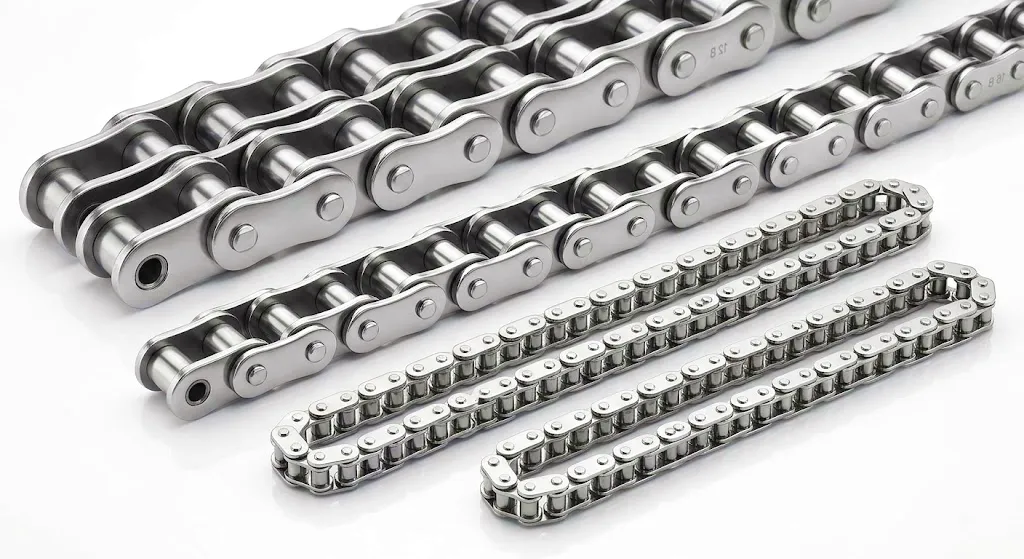
The term “roller chain wear” is frequently misunderstood, even by experienced maintenance personnel. Wear does not primarily occur on the outer surfaces of the chain — it happens at the interface between the inner link plates and the pins passing through them. Under load, pin and bushing surfaces rub against each other with every chain articulation. Even with adequate lubrication, microscopic material is removed at each contact point. Over time, this material loss causes the pitch — the centre-to-centre distance between adjacent pins — to increase slightly. The cumulative effect across many links is what engineers refer to as “chain elongation” or “chain stretch,” though the steel itself has not elastically stretched. Rather, the chain has grown longer because material has been worn away at every pin-bushing interface. In a standard roller chain, this elongation is perfectly quantifiable and directly maps to replacement thresholds defined by ISO 606 and by the chain’s manufacturer. Understanding this distinction between true material fatigue and progressive wear elongation is the starting point for any reliable maintenance programme.
Root Causes of Premature Roller Chain Wear
Inadequate or Incorrect Lubrication
Lubrication failure is responsible for the largest share of premature roller chain wear across all industrial sectors. The lubricant’s role is to form a protective film between pin and bushing surfaces, displacing metal-to-metal contact under load. When lubrication is absent, insufficient in quantity, or of the wrong viscosity grade for the operating temperature, direct metallic contact occurs at every articulation. In Sheffield’s heavy fabrication environments, where chains operate near heat sources or in atmospheres laden with metallic particulate, standard mineral oils may degrade or become displaced within hours. The correct approach involves selecting an oil viscosity matched to both ambient and operating temperatures, applying it at the correct frequency — typically via a drip, bath, or forced-circulation system — and ensuring it penetrates into the pin-bushing gap rather than merely coating the outer surfaces. For food-grade or pharmaceutical applications in facilities around Nottingham and Leicester, NSF H1-approved lubricants must be used, which carry their own performance trade-offs that must be accounted for in replacement scheduling.
Overloading Beyond Design Capacity
Roller chains are engineered to operate within specific tensile and fatigue load limits. When a drive system undergoes sudden shock loads — common in aggregate crushing operations around Barnsley, in timber processing machinery throughout Wales, or during abrupt start-stop cycles in automated warehouses — the peak tensile forces can far exceed the chain’s rated working load. Each overload event accelerates wear at the pin-bushing interface, strains the link plates beyond their designed deflection, and may cause microscopic cracking of the hardened surfaces. Repeated shock loading dramatically shortens chain service life, often reducing it to a fraction of the catalogue-quoted figure. The solution involves selecting chains with an appropriate service factor applied to the rated load — typically a factor of 1.5 to 3.0 depending on shock severity — and, where possible, implementing mechanical or electronic soft-start systems to reduce the magnitude of impact loads on chain drive components.
Environmental Contamination and Corrosion
Abrasive particulate — sand, swarf, mineral dust, or agricultural soil — acts as a grinding compound between pin and bushing surfaces, dramatically amplifying the natural wear rate. Moisture, particularly in the UK’s frequently damp operating environments, promotes oxidation and pitting on chain components, further roughening contact surfaces and undermining lubricant film integrity. In coastal processing plants along the East Anglian seaboard or in chemical facilities near Teesside, combined salt spray and chemical exposure creates a corrosive environment that demands either stainless steel chain construction or aggressive re-lubrication schedules. Enclosures, sealed chain covers, and corrosion-resistant platings are all mitigating strategies, but none eliminates the need for systematic inspection. A contaminated chain wears at two to five times the rate of a clean, well-lubricated equivalent operating under identical loads.
Misalignment and Improper Tensioning
Sprocket misalignment — whether angular, parallel, or a combination of both — forces the chain to articulate in a plane other than its design axis. This side-loading creates edge contact between rollers and sprocket teeth, accelerating wear on the roller outer diameter and the flanks of sprocket teeth simultaneously. The chain may also begin riding up the sprocket teeth under load, dramatically increasing the dynamic tension spikes that generate wear. Equally damaging is incorrect chain tension. A chain that is too slack will whip and slap, generating impact loading on links and sprocket teeth. A chain that is too tight eliminates the running clearance needed for articulation, concentrating load on pin-bushing interfaces and bearing surfaces. Across Birmingham’s precision engineering and automotive supply-chain facilities, misalignment accounts for a substantial proportion of warranty claims on newly installed chain drive systems.
Featured High-Performance Roller Chain Products
Heavy-Duty Series
High Strength Roller Chain 120HSP-00 for Caterpillar →
Engineered specifically for Caterpillar heavy equipment platforms, the 120HSP-00 delivers exceptional tensile strength and fatigue resistance in demanding extraction, earth-moving, and construction environments. Its heat-treated pin and bushing components are manufactured to tight dimensional tolerances, ensuring precise pitch consistency that minimises elongation rates even under sustained shock loading. For plant operators in Yorkshire’s aggregate quarrying sector or Scotland’s infrastructure construction projects, this chain represents a direct uplift in service intervals and system reliability. The 120HSP-00’s design philosophy — tighter tolerances, superior case depth on wearing surfaces — means it genuinely outlasts standard ISO-grade chains in high-cycle applications.
Performance Series
High Strength Roller Chain C100HSP-00 for Caterpillar →
The C100HSP-00 extends Ever Power’s Caterpillar-compatible range into the C-pitch specification, providing a precision-matched replacement and upgrade option for a broad range of Caterpillar machine models across material handling, forestry, and underground mining applications. Like its sibling product, it features through-hardened pins with carburised case depths engineered to resist abrasive wear and to maintain pitch accuracy under cyclic fatigue loading. For procurement managers at facilities in Derbyshire or the East Midlands sourcing reliable, high-specification Caterpillar-grade chain with shorter lead times than OEM channels, the C100HSP-00 presents a compelling technical and commercial proposition.
How to Measure Roller Chain Wear Accurately
Step 1 — Prepare the Chain
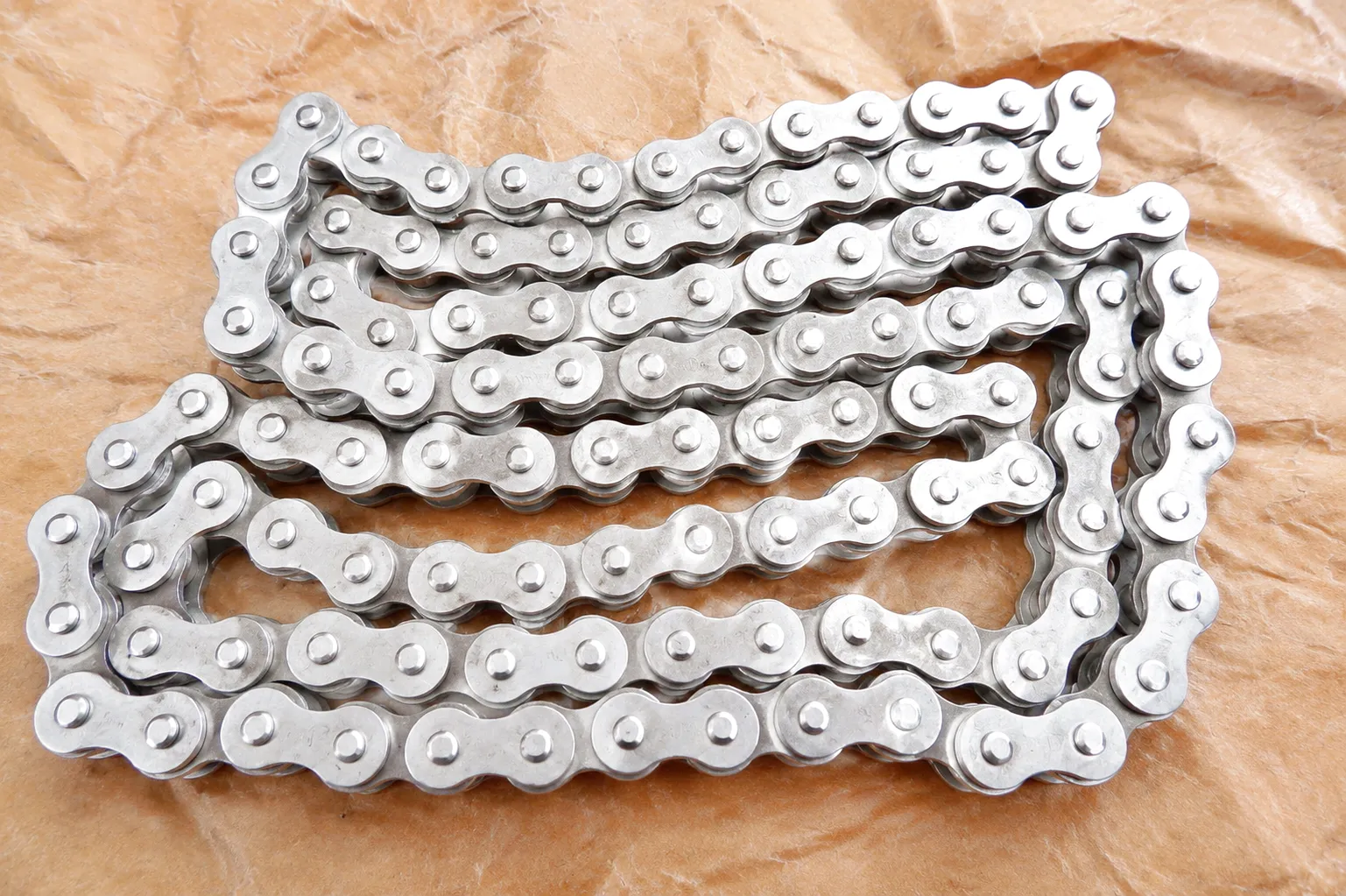
Remove all accumulated grease and contamination from at least twenty consecutive links using a suitable degreasing agent. This is non-negotiable — a build-up of hardened lubricant mixed with metal debris can add as much as 0.5mm to the apparent pitch measurement, leading to a premature or, more dangerously, delayed replacement decision. Clean links also allow visual inspection for cracked plates, deformed rollers, or seized pins, all of which may require immediate chain removal regardless of elongation figures.
Step 2 — Apply Measurement Load
Measurements should be taken with the chain under tension. The taut side of a still-running chain, or a chain deliberately pre-tensioned to approximately ten percent of its rated working load, will give more consistent results than a slack chain. Pin-to-pin clearance, which is the dimensional difference between pin diameter and bushing bore diameter, is where wear actually accumulates; tensioning the chain removes this clearance and reflects real operating conditions during measurement.
Step 3 — Span 15+ Pitches
Measure from the centre of the first pin to the centre of a pin at least fifteen pitches away. Record the measurement and compare it against the theoretical length for that number of pitches (number of pitches multiplied by nominal pitch dimension). The percentage difference gives you elongation. For a number 50 chain with a 15.875mm pitch, fifteen links nominally span 238.125mm. A measurement of 241.5mm indicates approximately 1.42% elongation — approaching the standard replacement threshold of 1.5% for most industrial applications.
Roller Chain Technical & Performance Parameters
| Paramètre | Chain No. 40 | Chain No. 50 | Chain No. 80 | Chain No. 120 |
|---|---|---|---|---|
| Pas (mm) | 12.700 | 15.875 | 25.400 | 38.100 |
| Roller Diameter (mm) | 7.92 | 10.16 | 15.88 | 22.23 |
| Résistance à la traction minimale (kN) | 17.8 | 21.8 | 60.0 | 131.0 |
| Pin Diameter (mm) | 3.97 | 5.09 | 7.94 | 11.10 |
| Inner Plate Height (mm) | 12.00 | 15.09 | 24.00 | 36.20 |
| Replacement Elongation Limit (%) | 1.5% | 1.5% | 1.5% | 1.0% |
| Standard Material (Pin/Bushing) | Alloy Steel (Carburised) | Alloy Steel (Carburised) | Alloy Steel (Carburised) | Alloy Steel (Carburised) |
| Max. Allowable Speed (m/s) | up to 7 | up to 6 | up to 4 | up to 3 |
Data represents standard ISO 606 performance benchmarks. Ever Power custom-specification chains may achieve enhanced values. Contact our technical team for application-specific datasheets.
Establishing Practical Replacement Intervals for UK Industrial Operations
Time-Based Replacement
Replacing chains at fixed calendar intervals regardless of measured condition. Suitable for critical applications where unplanned downtime risk outweighs chain material cost, and where historical data has established a reliable life expectancy for the specific operating context.
Condition-Based Replacement
Replacing chains when measured elongation reaches a defined threshold — typically 1.5% for standard applications, 1.0% for high-precision drives. This approach maximises chain service life while maintaining safety margins, and is most effective when measurement records are maintained over time to reveal wear trends before they become failures.
Predictive Replacement
Using measured wear rate data to forecast the exact date when the elongation limit will be reached, then scheduling replacement within the next planned maintenance window before that date arrives. This approach combines the safety of condition-based monitoring with the operational efficiency of planned maintenance cycles, and represents best practice in high-value industrial installations.
Industrial Application Scenarios: Where Roller Chain Wear Management Is Critical
Automotive Manufacturing — West Midlands & Oxford
In automotive body-in-white production lines across Coventry, Solihull, and Swindon, roller chains drive conveyor systems that carry vehicle bodies through stamping, welding, and paint processes at controlled speeds around the clock. A worn or failed chain in this context can halt an entire production line, with downtime costs measured in tens of thousands of pounds per hour. The precision requirements for body panel alignment mean that drive chains must maintain consistent pitch accuracy throughout their service life — chain elongation that would be acceptable in a general conveyor application may cause positioning errors that affect panel fit and finish quality in automotive use. These facilities typically operate condition-based monitoring programmes with weekly elongation checks and maintain ready-to-install chain sets for critical drives.
Food & Beverage Processing — Yorkshire & East Midlands
Food production environments in facilities around Grimsby’s seafood processing sector and Lincolnshire’s agricultural processing corridor present a uniquely demanding combination of requirements for roller chain management. Washdown regimes using high-pressure water and cleaning chemicals at elevated temperatures strip conventional lubricants from chain surfaces within hours, dramatically accelerating wear. Chains operating in these environments must either use food-grade lubricants applied at very high frequency or be specified in stainless steel or nickel-plated construction to resist the corrosive effects of cleaning chemicals. Wear measurement protocols in food facilities must also account for the possibility that chain contamination with food residue will affect measurement accuracy, necessitating thorough cleaning before any elongation assessment is performed. BSI standards for food machinery safety add a further layer of regulatory compliance to chain maintenance programmes in this sector.
Mining & Aggregate Processing — North of England & Wales
Surface and underground mining operations in North Yorkshire potash mines, Welsh slate quarries, and limestone aggregate extraction sites across the Pennines operate roller chains in some of the most abrasive environments imaginable. Fine mineral particulate infiltrates chain joints despite protective covers, acting as a grinding compound that can reduce chain service life to a fraction of its clean-running equivalent. Chains in these applications are typically specified in heavy-duty series with larger cross-sections and thicker link plates than standard industrial drives. Replacement intervals must be established empirically for each installation, as the particle size distribution and hardness of the abrasive material vary significantly between sites and geological formations. Ever Power’s custom heavy-duty roller chain options, including strengthened link plate specifications and extended bushing case depths, are designed specifically for these high-abrasion environments.
Customer Success Story: Sheffield Steel Fabrication Facility
Case Study
Reducing Unplanned Downtime by 73% at a Heavy Steel Section Manufacturer, Sheffield, South Yorkshire
A Sheffield-based manufacturer of structural steel sections, supplying fabricated beams and column profiles to construction contractors across Northern England, was experiencing chronic unplanned downtime across three roller conveyor lines used to transport heavy steel sections through their shot-blasting and painting processes. Each conveyor line used number 80 pitch roller chain in a double-strand configuration, operating at low speed but carrying substantial loads of up to four tonnes of steel section per pass. The facility’s existing maintenance approach was entirely reactive — chains were replaced only when they either snapped or caused drive sprockets to jump teeth. The average frequency of chain-related incidents was approximately one per six weeks per line, with each incident requiring four to six hours of unplanned maintenance at significant direct and indirect cost.
Ever Power’s technical sales team conducted a site visit and identified two compounding issues: the chains in service were standard grade rather than heavy-duty, which was inadequate for the actual working loads; and the existing lubrication application was intermittent and insufficient in volume, leaving pin-bushing interfaces inadequately protected during multi-hour production runs. Ever Power recommended a transition to a heavier specification chain with enhanced plate thickness and a controlled-carburising depth specification on the pin and bushing components, paired with a gravity drip lubrication system timed to deliver a specific oil volume per hour based on the measured operating parameters. A baseline elongation measurement was taken on all newly installed chains, and inspection intervals were set at monthly intervals using pocket-sized wear gauge tools supplied by Ever Power with each chain order.
Within six months of implementation, the facility had recorded zero unplanned chain-related stoppages. Monthly elongation measurements showed a significantly reduced wear rate compared to the previous chain specification, and the maintenance team was able to forecast the first required replacement with sufficient lead time to order and install during a planned quarterly shutdown. The total annual cost of chain consumables and planned maintenance labour for the three lines fell by over forty percent compared to the previous reactive maintenance regime, while production throughput reliability improved markedly — a particularly valuable outcome given the facility’s commitments to project-critical steel deliveries across the UK construction sector.
What UK Customers Say About Ever Power Roller Chain
“We moved to Ever Power’s heavy-duty specification chain on our main conveyor lines eight months ago. The elongation data we’ve been tracking shows roughly sixty percent less wear per month compared to our previous supplier. The wear gauge they sent with the order has made our monthly checks quick and consistent — our maintenance team can now plan replacements at least three months ahead, which has completely changed how we approach chain inventory.”
— Senior Maintenance Engineer, Steel Section Manufacturer, Sheffield
“The custom stainless specification Ever Power developed for our seafood processing lines has been operating for fourteen months without a single replacement. Previous chains from other suppliers needed changing every four to five months at best due to corrosion damage. The price per unit is slightly higher but the total cost of ownership — including maintenance time and lost production during changeovers — is dramatically lower. The technical support throughout the specification process was genuinely impressive.”
— Procurement Manager, Fish Processing Facility, Grimsby
“We run Caterpillar equipment across three aggregate extraction sites in North Yorkshire, and finding consistently reliable OEM-specification chain through UK distributors has always been a challenge. Ever Power’s 120HSP-00 gives us exactly the specification we need at shorter lead times and with better technical documentation than we were getting through the OEM channel. The dimensional accuracy on every batch has been spot-on — no fitting issues, no adjustments needed during installation.”
— Operations Director, Aggregate Quarrying Company, Harrogate
Foire aux questions
How do I know when a roller chain on industrial conveyor equipment in the UK needs replacing?
Measure the chain elongation by spanning at least fifteen pitches under tension and comparing the actual length against the nominal. For most industrial conveyor roller chains, a measured elongation of 1.5% or greater against nominal pitch length indicates the chain should be replaced promptly. Some high-precision drives use a tighter threshold of 1.0%. Visual signs such as chain skipping on sprockets, visible side-to-side movement, or loud clatter under load are strong indicators that elongation has likely already reached or exceeded the replacement threshold.
What causes roller chains to wear out faster in food processing plants in Yorkshire and the East Midlands?
The primary causes in food processing environments are frequent high-pressure washdowns that strip lubricants from chain joints, combined with the use of caustic cleaning chemicals that promote corrosion on standard steel chain components. The elevated operating temperatures common in cooking, blanching, and pasteurisation process areas accelerate oil evaporation and reduce lubricant viscosity effectiveness. Specifying stainless steel chain with food-grade lubricants applied at higher frequency, or using self-lubricating O-ring sealed chain variants, are the most effective approaches to extending service intervals in these conditions.
Where can I get a competitive price quote for custom heavy-duty roller chain for mining operations in North Yorkshire or South Wales?
Ever Power provides application-specific quotations for custom heavy-duty roller chain directly through our technical sales team at [email protected]. To receive an accurate quote, please include the chain pitch and standard number, the drive configuration (single or multi-strand), the operating load and speed, the environmental conditions, and whether stainless, plated, or special alloy material is required. Our team typically provides a detailed technical proposal with pricing within 48 hours of receiving complete application information.
How often should roller chains on Caterpillar construction equipment be inspected for wear when operating in the UK?
For Caterpillar equipment operating in the variable and often wet and muddy conditions typical of UK construction and infrastructure sites, elongation inspection every 250 to 500 operating hours is a sensible baseline. In particularly abrasive conditions — working in excavated clay, crushed rock aggregate, or road-building materials — shortening the inspection interval to 150 to 250 hours is advisable. The Ever Power 120HSP-00 and C100HSP-00 Caterpillar-specification chains are engineered to extend these intervals compared to standard-grade chain, but any chain operating in heavy abrasion must still be measured rather than assumed to be within specification.
Which type of roller chain supplier in the UK can offer the fastest lead times for bespoke non-standard chain specifications?
The fastest lead times for bespoke roller chain specifications are generally available from manufacturers with vertically integrated production — those who control the component manufacturing, heat treatment, and assembly processes internally rather than sourcing semi-finished components from third parties. Ever Power’s manufacturing infrastructure is structured around this model, with in-house component production enabling custom specification changes to be incorporated without dependence on external component suppliers. This structure allows lead times for bespoke orders that would typically take six to eight weeks through a standard distribution channel to be compressed significantly, particularly for established customers with repeat requirements.
What is the typical cost difference between a standard roller chain and a high-strength Caterpillar-specification chain when buying for a Birmingham or Sheffield facility?
High-strength Caterpillar-specification roller chain, such as the Ever Power 120HSP-00, typically carries a price premium of between twenty and forty percent compared to a standard ISO-grade equivalent in the same pitch. This premium reflects the enhanced material specification, tighter manufacturing tolerances, additional heat treatment processing steps, and pre-load cycling that characterise the high-strength product. When assessed on a total cost of ownership basis — accounting for the extended service intervals, reduced maintenance labour, and lower risk of unplanned downtime — the high-strength specification consistently delivers a lower cost per hour of operation than the lower-priced standard alternative in high-load or abrasive applications.
Ever Power Industrial Chain Division — ISO 606 Compliant Manufacturing | Serving UK Industrial & B2B Markets
édité par gzl