Why Belt Drive Systems Reach Their Operational Ceiling
Belt drives have earned their place in light to medium-duty applications. They are quiet, tolerant of minor shaft misalignment, and inexpensive to install. But they carry inherent constraints that manifest the moment load requirements escalate. V-belts depend on friction to transmit torque, which means that under high load conditions they slip — and every slip episode accelerates wear, raises operating temperature, and erodes the belt’s elastomeric core. In environments like automotive stamping plants in Coventry or aggregate processing facilities in Yorkshire, where shock loads arrive unpredictably and peak torque can spike far beyond nominal ratings, belt slippage is not an occasional inconvenience — it is a chronic source of downtime.
Synchronous (toothed) belts address the slippage issue by engaging with sprocket teeth, but they introduce their own vulnerabilities. The rubber or polyurethane compounds used in their construction are sensitive to oils, coolants, and the temperature swings common in UK industrial environments. Their maximum power ratings fall well below what a comparable roller chain can sustain, and the tensile cords embedded in the belt body are notoriously susceptible to fatigue when operating under cyclic loading — the precise loading profile found on conveyor drives, agricultural machinery takeoffs, and packaging line indexers throughout Britain. When the load capacity ceiling of a belt system is reached, the only reliable path forward is to replace it with a positive-drive, metal-body power transmission solution: the roller chain.
Working Principle: How Roller Chain Transmits Power
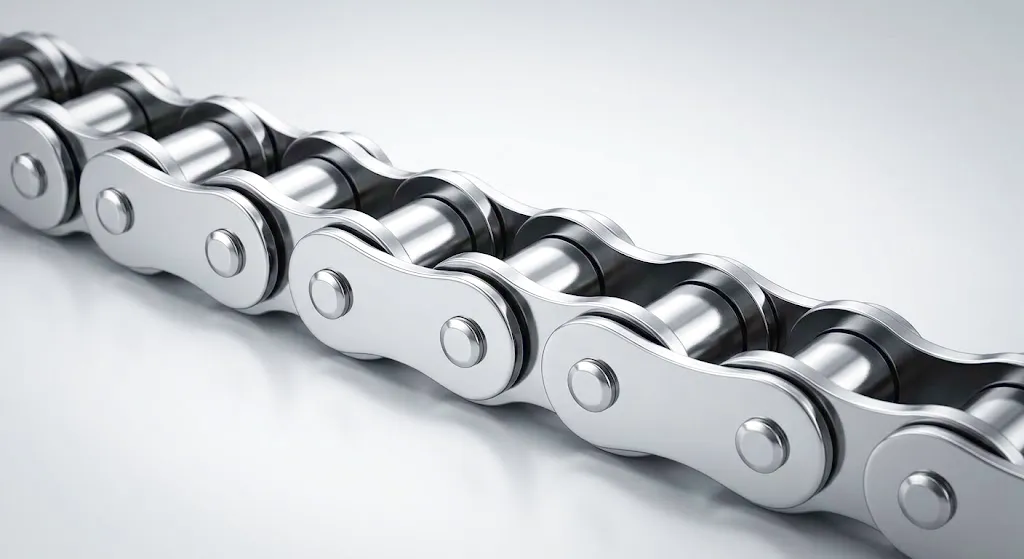
A roller chain operates on the principle of positive mechanical engagement. Unlike a belt that wraps around a pulley and relies on friction, each link of a roller chain wraps around a toothed sprocket and the rollers seat firmly in the sprocket valleys. Power is transferred directly through this mesh contact — there is no slip, no tension loss, and no dependency on surface friction coefficients. The rollers rotate as they engage and disengage the sprocket teeth, reducing the contact stress between roller and tooth to a rolling friction regime rather than sliding friction, which is the fundamental reason roller chains sustain such extraordinary loads relative to their cross-sectional footprint.
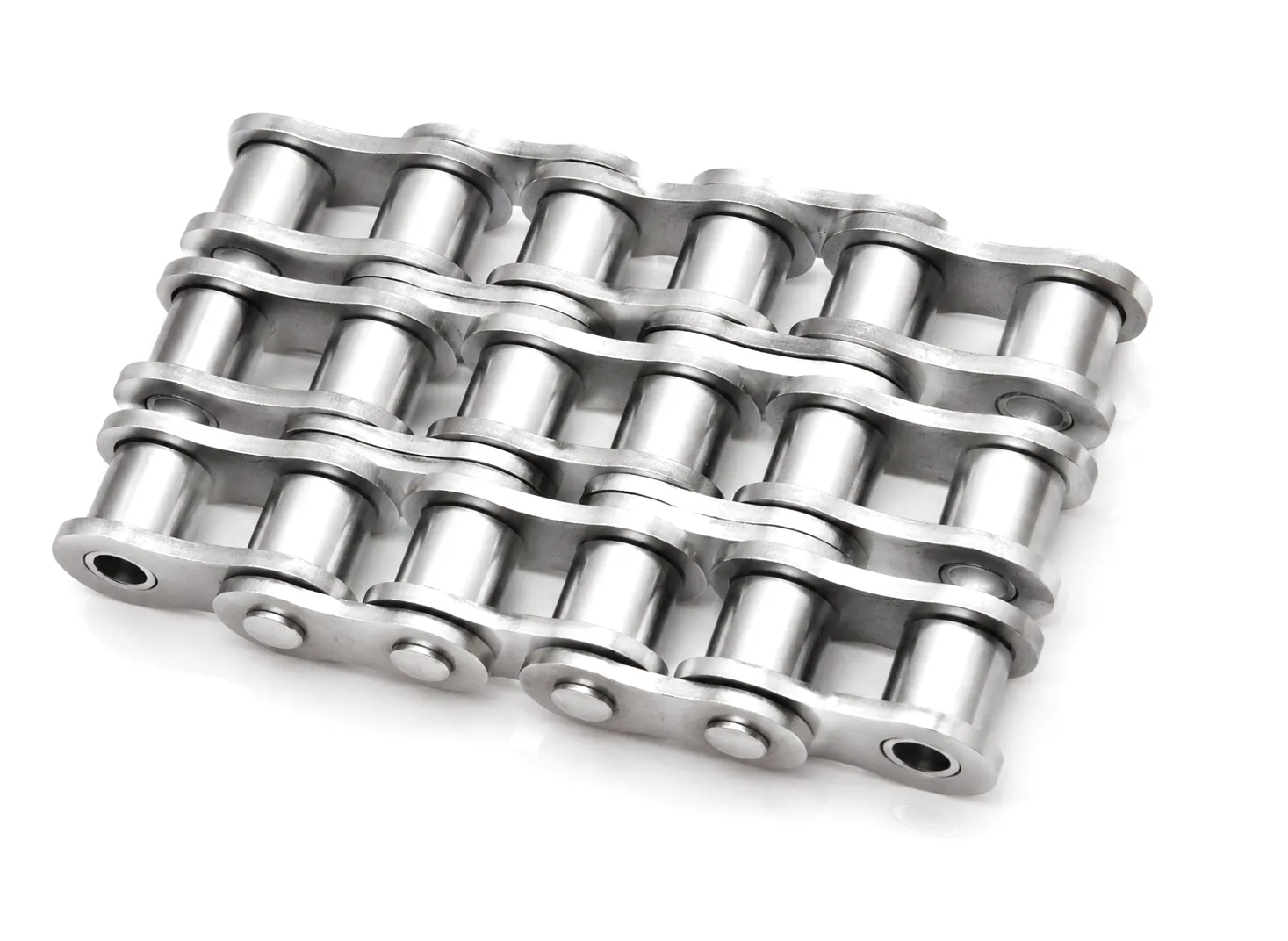
The chain link assembly consists of alternating inner and outer link plates connected through precisely dimensioned pins and bushings, with the roller rotating freely around the bushing on each pin axis. When the chain wraps around the drive sprocket, the roller contacts the sprocket tooth at the pitch circle diameter — the geometric foundation for speed ratio calculations. Because the link pitch (distance between pin centres) matches the sprocket tooth spacing exactly, the transmission ratio is mathematically precise and maintains constant velocity output regardless of load variation, a quality that is critical in timing-sensitive applications such as automated packaging machinery and CNC feed drives across Britain’s engineering sector.
Core Materials Used in Precision Roller Chain Manufacturing
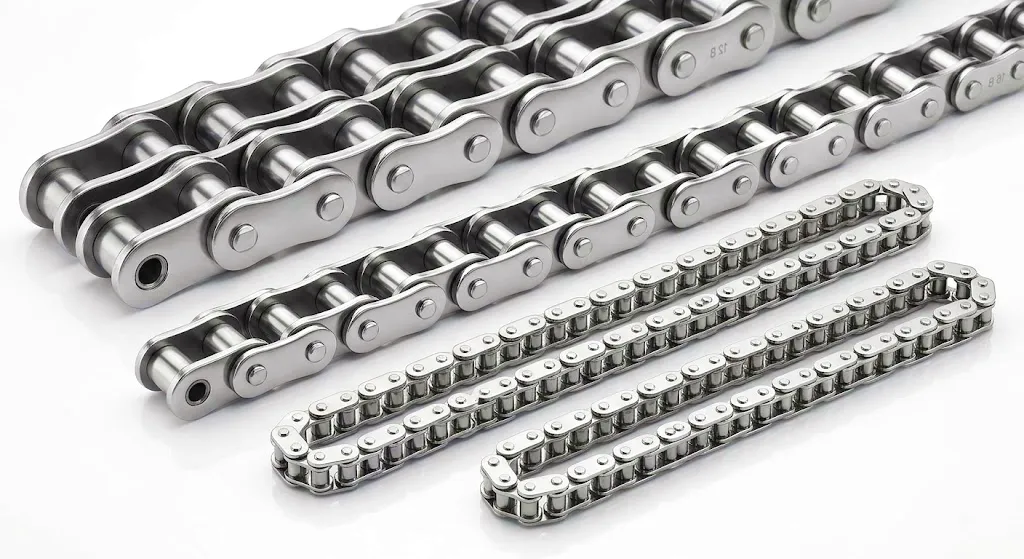
High-carbon steel (typically 50Mn or 40Cr grades), punched and formed to tight tolerances. Shot-blasted and heat-treated for fatigue resistance. Stainless steel 304 or 316 used for food-grade and corrosive environments.
Case-hardened alloy steel (20CrMnTi or equivalent) with surface hardness of HRC 58–64. Ground to h6 tolerance for precise fit in outer plates. Critical for fatigue life under reversed bending stress.
Through-hardened steel, carburised and quenched. Interference-pressed into inner plates. The bushing bore is the primary bearing surface for pin rotation and directly governs wear rate under oscillating load.
Formed from cold-drawn tube stock, through-hardened to HRC 54–62. Free-rotating around the bushing, the roller converts sliding contact at the sprocket tooth into rolling contact — the core mechanism of the chain’s load distribution and wear resistance.
Tableau des paramètres techniques et de performance du produit
| Paramètre | ISO Standard Chain | Heavy Series (H) | High-Strength (HSP) | Acier inoxydable |
|---|---|---|---|---|
| Plage de pas (mm) | 6,35 – 76,2 | 9.525 – 76.2 | 15.875 – 44.45 | 6.35 – 38.1 |
| Charge de rupture (kN) | 8.9 – 560 | 17.8 – 900 | Up to 1,200+ | 6.0 – 320 |
| Operating Speed (m/s) | Up to 20 | Up to 15 | Up to 12 | Up to 10 |
| Temperature Range (°C) | -10 à +150 | -10 à +150 | -10 to +200 | -40 to +300 |
| Elongation at Wear Limit (%) | 3.0 | 3.0 | 3.0 | 3.0 |
| Lubrication Requirement | Manuel / Bain | Bath / Forced | Forced / Pressurised | Self-lubricated (O-ring) |
| Dureté de surface (HRC) | 54 – 60 | 56 – 62 | 58 – 64 | As-formed |
| Conformité aux normes | ISO 606 / BS 228 | ISO 606 / ANSI B29.1 | ANSI B29.1M | ISO 606 |
Produits vedettes de chaînes à rouleaux haute résistance
For retrofit projects demanding exceptional tensile performance — particularly in construction equipment, mining, and heavy material handling — the following Caterpillar-compatible high-strength roller chains represent the cutting edge of what modern precision manufacturing can deliver. Both products are designed to match OEM sprocket geometry while substantially exceeding the breaking load figures of standard replacement chains.
Chaîne à rouleaux haute résistance 120HSP-00 pour Caterpillar
Engineered for the demanding power transmission requirements of Caterpillar equipment, the 120HSP-00 features shot-peened link plates, fully hardened pins, and an extended bushing bore length that delivers measurably superior fatigue life under cyclic shock loading. Ideal for heavy-duty retrofit situations where the original chain specification is no longer adequate for increased production demands.
Chaîne à rouleaux haute résistance C100HSP-00 pour Caterpillar
The C100HSP-00 is a precision-matched replacement chain for Caterpillar C-series applications where original equipment specifications have been upgraded for higher throughput. Its carbon steel alloy composition, combined with controlled induction hardening of the pin and bushing surfaces, delivers measurable improvements in wear life versus standard replacement chains — critical for retrofit projects where maintenance windows are limited and machine availability is commercially paramount.
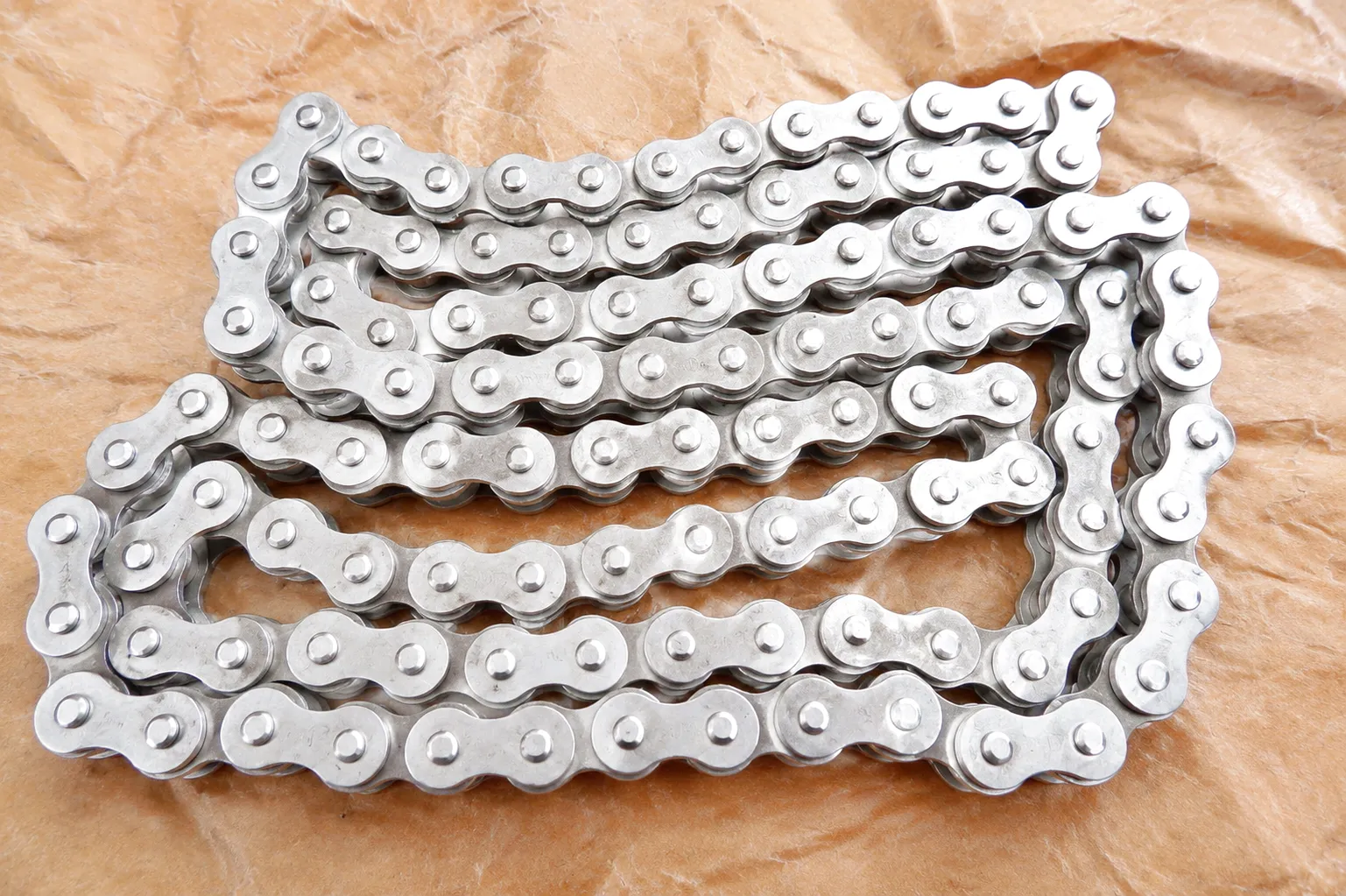
Roller chains sustain shock loads, impact loads, and sustained tensile forces that would rapidly destroy a belt, with breaking loads from under 10 kN to well over 1,000 kN in heavy-series configurations.
When properly lubricated and maintained within design load limits, roller chains routinely achieve 15,000–25,000 hours of service before requiring replacement, far exceeding typical belt service life in comparable conditions.
Positive engagement with sprocket teeth guarantees zero slip at any load, delivering a fixed speed ratio that is critical in timing-sensitive processes such as automated assembly lines and precision feed mechanisms.
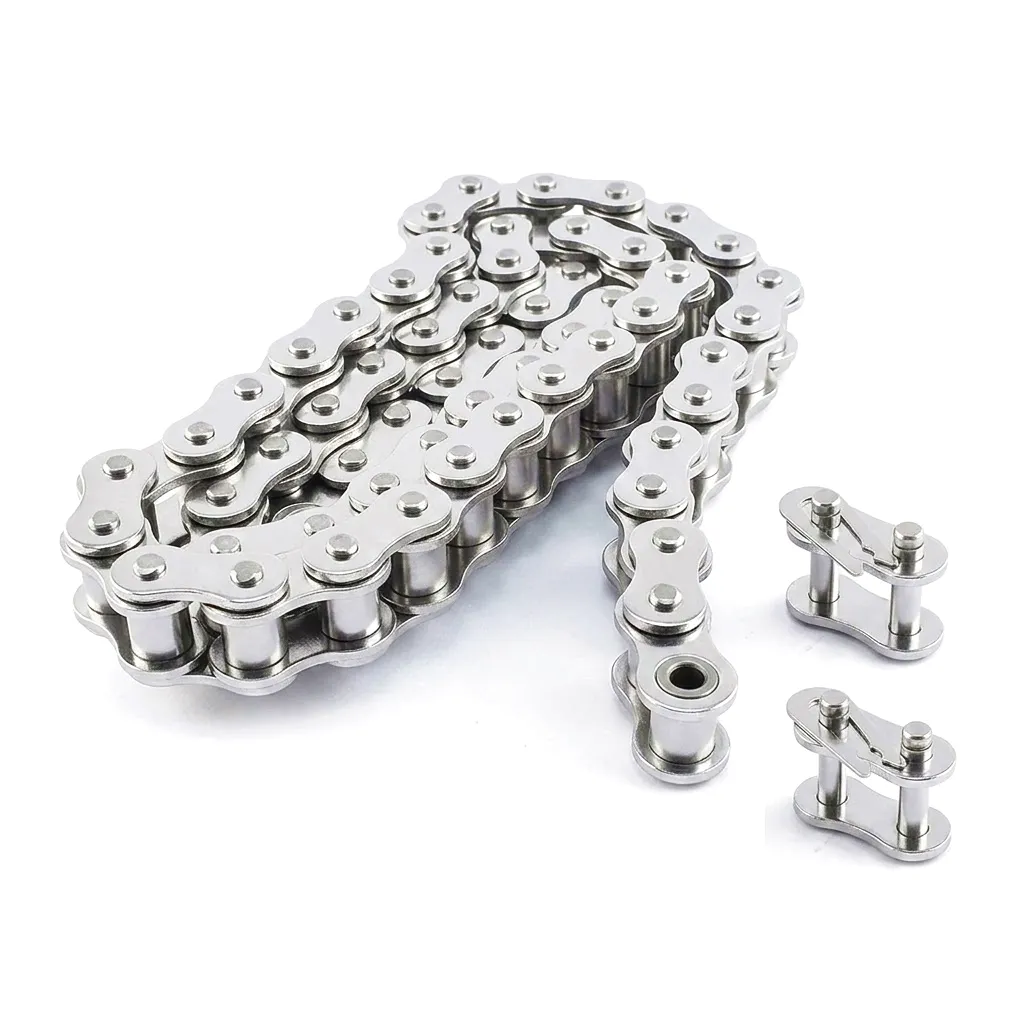
Chain length can be modified on-site by adding or removing links with simple tooling, enabling rapid re-configuration of drive geometry without sourcing bespoke belt lengths. Centre-distance adjustment is straightforward with a tensioner sprocket.
Industrial Application Scenarios for Roller Chain Retrofits in the UK
Transfer presses, stamping lines, and automated welding jigs in Birmingham and Coventry often run belt drives on conveyors that now carry higher payload than originally specified. Roller chain retrofits on these drives eliminate slippage, reduce heat buildup from belt friction, and allow the drive to run across multiple shifts without requiring re-tensioning. Sheffield’s steel processing plants similarly benefit from roller chain on descaler drum drives and slab transfer tables, where abrasive scale contamination rapidly degrades belt surfaces but barely affects a properly sealed roller chain.
Canning lines, poultry processing conveyors, and bottling plant infeed systems across Yorkshire and the East Anglian food belt face a unique combination of high throughput, frequent wash-down with high-pressure water jets, and regulatory requirements for hygienic design. Stainless steel roller chains with O-ring seals are the retrofit solution of choice here — they survive the wash-down environment, eliminate the risk of belt rubber contamination entering the product stream, and can be specified in food-grade nickel-plated variants to meet retailer traceability audit requirements.
Aggregate screening plants in South Wales and limestone quarry conveyors across the Pennines routinely challenge power transmission components with shock loading, stone contamination, and vibration levels that consume belts in weeks. Heavy-series roller chains, often duplex or triplex configurations to distribute load across multiple chain widths, provide the durability and serviceability that belt systems simply cannot match in these environments. The ability to replace individual links on-site, without returning an entire belt to the supplier, reduces plant downtime by hours per maintenance event.
Combine harvester feeder house drives, grain auger takeoffs, and potato harvester web drives in Lincolnshire’s flat arable land and the Scottish Borders’ hill farms have long relied on roller chains as the primary power transmission medium. Retrofitting older belt-driven feeder systems with roller chain upgrades on modern high-output machines is now a standard dealer service, extending the seasonal duty cycle that these machines can sustain. The ability to carry high starting torques during crop slug events — when a dense wad of material enters the machine — is an inherent characteristic of roller chain that belt drives cannot replicate.
Alignment, Tensioning, and Lubrication: The Three Pillars of Retrofit Success
No retrofit project achieves its potential without rigorously addressing shaft alignment. Roller chain drives require that both shafts run parallel in the horizontal plane to within approximately 0.5 mm per metre of shaft separation, and that the sprocket faces lie in the same vertical plane to within 1 mm per 300 mm of centre distance. Laser alignment tools have made this task achievable in field conditions, but many retrofit engineers in older UK facilities still rely on precision straight-edges and dial gauges — perfectly adequate when applied with care. Misalignment loads are not absorbed by the chain’s mechanical design; they transfer directly into accelerated bushing and sprocket tooth wear, so the investment of time in alignment pays back within the first service interval.
Tensioning a roller chain differs fundamentally from tensioning a belt. Belts require significant pre-tension to generate the friction that transmits torque; chains must have a defined sag on their slack strand — typically 2–4% of the centre distance — but must not be over-tensioned. Excessive tension in a roller chain increases bearing loads, promotes fatigue in link plates, and significantly reduces service life. Many retrofit failures that plant managers attribute to “poor chain quality” are in reality the consequence of over-tensioning during commissioning, often because the installer applied the belt-tightening mindset to a fundamentally different component.
Lubrication is where roller chain drive performance is ultimately determined. For drives running below approximately 4 m/s chain speed, manual application of a quality chain oil at defined intervals is adequate. Between 4 and 12 m/s, drip or bath lubrication systems are appropriate. Above 12 m/s, forced pressure lubrication delivered to the chain’s slack strand is required to maintain the oil film between pin and bushing. The lubricant itself matters — mineral oils of ISO VG 68–220 grade are standard, but for food contact applications, NSF H1-registered synthetic lubricants are mandatory. Getting lubrication right from the first day of operation is the single most impactful decision in the entire retrofit process.
Ever Power — Fabrication de chaînes à rouleaux de précision et ingénierie sur mesure
Ever Power has built its reputation as a precision roller chain manufacturer on the foundation of rigorous process control, advanced metallurgical testing, and a genuine commitment to customisation that goes beyond simply selecting a standard catalogue item. Where your retrofit application demands a non-standard pitch, an unusual alloy specification for extreme temperature or corrosion resistance, or a chain assembly with integrated attachments for specialist conveying duties, Ever Power’s engineering team has the capability and the manufacturing infrastructure to design, prototype, and deliver to your specification — at lead times that support UK manufacturing schedules rather than frustrating them.
Ever Power’s production facility operates advanced CNC chain assembly equipment, automated heat treatment lines, and a full in-house quality laboratory equipped for tensile load testing, dimensional inspection to ISO 606 and ANSI B29.1 standards, and fatigue life evaluation under simulated service loading. Every chain leaving the facility carries full material traceability documentation — a requirement that procurement teams at UK Tier 1 automotive suppliers and accredited food manufacturers consistently specify. The supply chain is structured for reliability: strategic stockholding of common pitches and widths ensures that urgent retrofit requirements can be met without the lead times associated with made-to-order manufacturing, while bespoke orders are managed through a dedicated project coordination process that keeps UK customers informed at every stage.
What UK Engineers Say About Ever Power Roller Chain
“We specified Ever Power’s heavy-series duplex chain for our blast furnace material elevator retrofit in Scunthorpe. Tensile testing certificates matched the published data exactly, and the first inspection at 6,000 hours showed elongation well within the 1.5% mark. These are not catalogue chains dressed up with marketing claims — the metallurgical quality is genuinely there.”
“Our Leicester distribution centre has eight conveyor drive systems that we retrofitted from V-belt to roller chain over two years. Ever Power handled the sprocket design for our non-standard shaft sizes without issue and turned around the first delivery in under ten working days. The lead time on subsequent call-off orders has been consistently reliable — critical for our planned maintenance schedule.”
“We needed an O-ring sealed, NSF H1 lubricated stainless chain for a poultry line wash-down environment in our Norfolk processing plant. Ever Power was one of very few suppliers who understood the combination of requirements without needing lengthy back-and-forth clarification. The technical correspondence before order was precise and efficient. Price was competitive and the chain has been in service for 14 months without a single intervention.”
Belt Drive vs Roller Chain: Head-to-Head Comparison
| Paramètre | V-Belt Drive | Roller Chain Drive |
|---|---|---|
| Efficacité de transmission de puissance | 94 – 96% | 97 – 99% |
| Slip Under Peak Load | Yes — chronic issue | None — positive drive |
| Max Transmittable Load | Limited by friction | Extremely high (positive mesh) |
| Sensitivity to Oil/Contamination | Very high — belt degrades | Requires lubrication — tolerates dirty env. |
| Length Adjustability | Requires new belt order | Add/remove links on-site |
| Shaft Misalignment Tolerance | Moderate tolerance | Low — precise alignment required |
| Noise Level | Quiet | Higher — speed/lubrication dependent |
| Typical Service Life (well maintained) | 2,000 – 8,000 hours | 15,000 – 25,000 hours |