Comprendre la nomenclature et les désignations de taille des chaînes à rouleaux
Un guide technique de référence pour les ingénieurs, les responsables des achats et les professionnels de la maintenance britanniques qui s'orientent dans le dédale des normes internationales des chaînes d'approvisionnement.
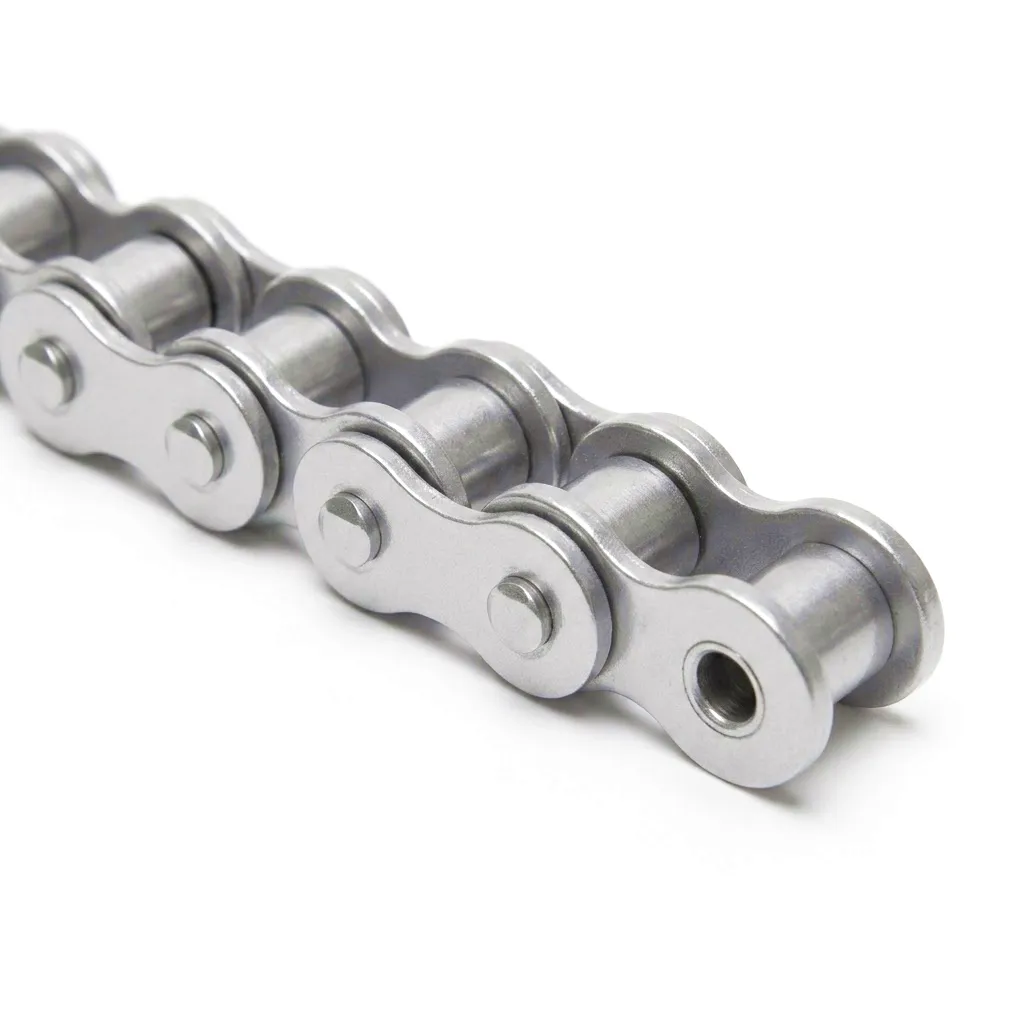 If you have ever tried to order a replacement roller chain for a production line in Birmingham and found yourself staring at codes like 10B-1, 12A-2, or 50H, you already know that the naming system for these components is far from intuitive. Roller chains are among the most widely used power transmission components in British manufacturing — found in everything from food processing conveyors in Leeds to agricultural machinery across the East Midlands — yet their designation standards continue to confuse engineers and buyers alike. The confusion typically stems from the coexistence of two major standards: the British Standard (BS) system and the American National Standards Institute (ANSI) system, each with its own logic, its own numerical sequences, and its own unit of measurement at its core.
The Foundation — Pitch as the Primary Identifier
Pitch is the single most important dimension in roller chain nomenclature. It describes the centre-to-centre distance between adjacent pins, and every other dimension of a chain — roller diameter, inner plate width, pin diameter, breaking load — is determined in proportion to it. In the British Standard (BS ISO 606) system, pitch is expressed in sixteenths of an inch, which is then multiplied by a prefix number to give the chain’s designation. So a 10B chain has a pitch of 10 sixteenths of an inch, which is 5/8 inch or 15.875 mm. A 16B chain has a pitch of 16 sixteenths — exactly one inch (25.4 mm). This mathematical relationship makes British chain codes straightforward once the sixteenth-of-an-inch rule is memorised.
In the ANSI/ASME B29.1 system, used predominantly in North America but encountered frequently in global trade, the numbering logic is slightly different. The first one or two digits of the chain number, when divided by 8, give the pitch in inches. An ANSI 40 chain therefore has a pitch of 40/8 = 0.5 inch (12.7 mm). An ANSI 80 chain has a pitch of 80/8 = 1 inch (25.4 mm). The absence of a suffix letter in the base code is itself informative: it indicates a standard ANSI chain, whereas a suffix letter signals something else (heavy series, offset link plate, etc.). Understanding both numbering systems is essential for any UK buyer dealing with machinery imported from North America, Japan, or mainland Europe, where ANSI specifications are routinely mixed with ISO-based designations.
Example: 10B → 10/16 = 0.625 in (15.875 mm)
Example: 40 → 40/8 = 0.5 in (12.7 mm)
Suffix Codes — The Letters After the Number
 Once the pitch prefix is clear, the suffix letters and strand-count designations become the second tier of information embedded in a roller chain code. In the British Standard system, the suffix B indicates a metric-pitch BS chain — this distinguishes it from the ANSI numbering family. A chain labelled 16B is unambiguously a British Standard chain with a 1-inch pitch, conforming to BS ISO 606. The suffix R (e.g., 10B-R) sometimes appears in specialist catalogues to denote a roller chain with a large roller diameter variant, though this is less common in mainstream UK industrial supply.
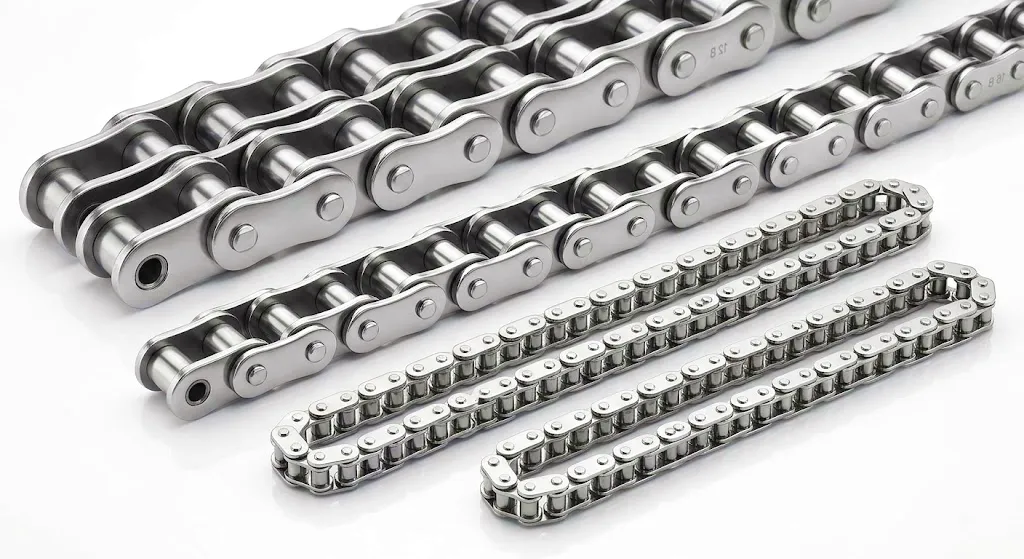
Strand count is encoded by a hyphen and number immediately following the core code. A simplex (single-strand) chain carries no strand suffix in many catalogue conventions, though some suppliers append -1 explicitly. Duplex (two-strand) chains are written with -2 (e.g., 10B-2), and triplex (three-strand) with -3 (e.g., 16B-3). In heavy-duty applications — such as the drive systems found in large-scale industrial presses common in Sheffield’s manufacturing sector — multiple-strand configurations are routinely specified to distribute load rather than moving to a larger pitch chain, which might necessitate a full redesign of sprocket geometry. For ANSI chains, the heavy series is marked with an H suffix (e.g., 60H) indicating thicker plates and a higher static breaking load for the same pitch.
BS versus ANSI — Why Both Standards Matter in UK Industry
- Pitch in sixteenths of an inch (suffix B)
- Inner link width in millimetres for B-series
- Dominant in UK, EU, and Commonwealth markets
- Common sizes: 06B, 08B, 10B, 12B, 16B, 20B, 24B
- Preferred by OEMs in Birmingham, Manchester, Bristol
- Used in most British-manufactured agricultural machinery
- Pitch = number ÷ 8 (in inches)
- Narrower inner width than BS at same pitch
- Widely used in imported US/Japanese machinery
- Common sizes: #25, #35, #40, #50, #60, #80, #100
- H suffix = heavy series with thicker plates
- Encountered in automotive and packaging plant imports
The practical consequence of this dual-standard environment is significant for UK maintenance engineers. A BS 16B chain and an ANSI 80 chain share the same pitch — exactly one inch — but are not interchangeable. The inner plate width, roller diameter, and overall chain width differ, meaning sprockets designed for one standard will not properly engage the other. This distinction becomes critical in facilities like the large food processing plants found across Yorkshire and the East Midlands, where a production stoppage caused by an incompatible replacement chain can mean thousands of pounds in lost output per hour. The rule of thumb taught to apprentice engineers in Birmingham’s manufacturing colleges still applies: match the standard, not just the pitch.
Modern BS ISO 606 has moved to align pitch designations in millimetres for documentation purposes, though the legacy B-suffix numbering persists universally in trade. When dealing with contemporary roller chain catalogues, you will frequently encounter both the B-number designation and the metric pitch value printed side by side — for example, “10B / 15.875 mm pitch.” This dual-labelling reflects the industry’s accommodation of both engineering traditions and makes cross-referencing between British and continental European suppliers considerably more manageable for procurement teams operating across post-Brexit supply chains.
Paramètres techniques et de performance du produit
Comprehensive dimensional and mechanical data for the most widely used BS (ISO 606) and ANSI simplex roller chains. All values are nominal; working loads assume a service factor of 1.0 in clean, well-lubricated conditions.
Working Principle and Core Materials in Roller Chain Construction
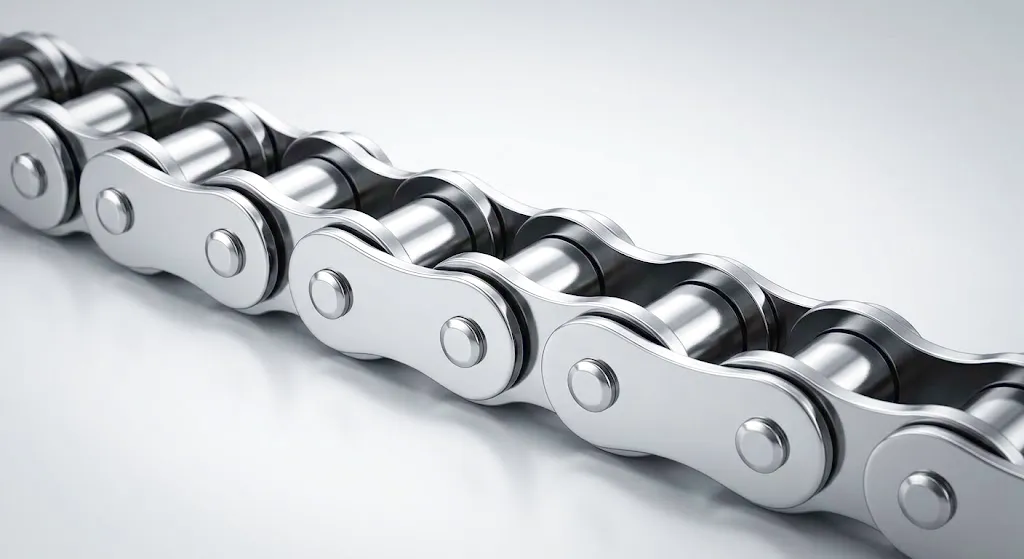
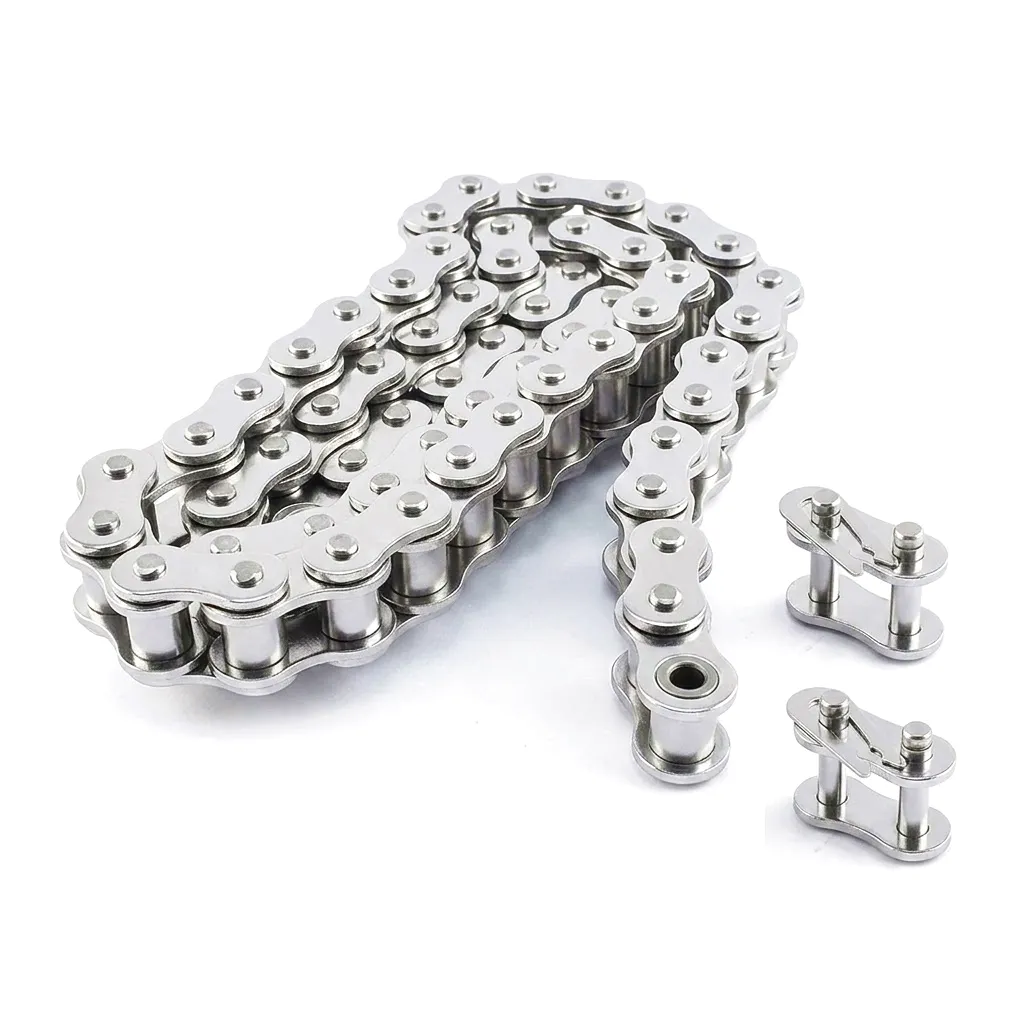
A roller chain transmits mechanical power through a sequence of interlocked links where each roller engages a sprocket tooth, rotates freely on its bushing, and disengages cleanly as the chain wraps around the sprocket arc. The rolling contact between roller and tooth minimises sliding friction, which is the primary reason roller chains achieve transmission efficiencies routinely above 97% — a figure that even well-maintained flat belts cannot match at equivalent loads. The chain’s inner link plates are pressed tightly onto the bushings, whilst the outer link plates hold the pins. The pin rotates inside the bushing as the chain articulates around the sprocket, and the bushing itself is what the roller rides upon.
The material selection for each component is a carefully engineered balance. Link plates are typically cut from medium-carbon or alloy steel strip, heat-treated to a core hardness that provides toughness against shock loading while the surface remains machinable. Pins are produced from case-hardened alloy steel and ground to close tolerances — typical pin roundness tolerances in precision-grade chains are held within 0.005 mm. Bushings and rollers are made from low-carbon steel that is carburised and case-hardened, giving a hard outer shell capable of withstanding the rolling/sliding contact with the sprocket tooth and pin surface respectively. The differential hardness between pin and bushing is deliberately engineered to ensure the bushing wears preferentially, since it is the less expensive component to replace in a rebuild scenario. For stainless steel chains — increasingly popular in UK food factories, chemical plants in Teesside, and pharmaceutical facilities in the Midlands — AISI 304 or AISI 316 is used throughout, accepting a lower tensile strength in exchange for substantially improved corrosion resistance.
Scénarios d'application industrielle dans le secteur manufacturier britannique
Correct size designation knowledge translates directly into correct chain selection for each application environment.
Precision timing chains and transmission drive chains on assembly lines demand exact pitch compliance and low elongation rates. The West Midlands automotive corridor — covering plants from Coventry to Solihull — typically specifies 10B-1 and 12B-2 roller chains for conveyor systems, with ANSI 50 and ANSI 60 used on American-sourced pressing equipment. Precise size designation ensures interoperability during planned maintenance windows where downtime is measured in vehicle units per hour, not minutes.
Combine harvesters, balers, and grain auger systems in Lincolnshire and Cambridgeshire rely extensively on large-pitch BS chains — 16B, 20B, and 24B are standard across British agricultural OEM output. Duplex chains (-2) are common on main drive shafts where high torque is transmitted, while straw-handling conveyors may use specialist attachment chains with bent or extended link plates. The naming code must account for pitch, strand count, and attachment specification simultaneously when ordering replacement parts during the short harvest window.
Abattoirs, dairy processing facilities, and ready-meal production lines across Yorkshire require stainless steel roller chains (SS suffix, AISI 304 or 316) to meet HACCP compliance and withstand repeated washdown cycles. The size designation must include both pitch and the SS specification; substituting a standard carbon steel 08B-1 for an 08B-1-SS due to a misreading of the code carries serious food safety implications. Many modern UK food processing sites have migrated to chains with self-lubricating sintered bushings (ZB suffix) to eliminate external lubrication in food-contact zones entirely.
Rolling mills, coil handling lines, and slag processing equipment in South Yorkshire demand chains at the extreme end of the size range — 24B-3 and larger, or ANSI 160H heavy series — where breaking loads exceed 400 kN and shock resistance is paramount. At these sizes, chain mass itself becomes a factor in dynamic load calculation, making precise weight-per-metre data from the size designation table directly relevant to drive engineering. Sheffield-based maintenance teams typically hold critical spares in the 16B to 24B range due to long lead times on very large pitch chains from European suppliers.
Automated sortation conveyors, pallet movers, and overhead trolley systems at UK distribution hubs along the M1 and M6 corridors use predominantly small-pitch BS chains — 06B-1 and 08B-1 are the workhorse specifications. The volume of chain consumed in a large distribution centre can run to hundreds of metres per maintenance cycle, making accurate size designation critical for bulk ordering accuracy. Rubber-top attachment chains (G suffix) are used in manual-picking zones where product surfaces must be protected during conveying.
A 20B-pitch chain with factory-fitted rubber top plates — ideal for conveyor lines handling fragile or surface-sensitive goods in packaging and light manufacturing. The rubber bonding meets food-grade contact specifications and withstands routine washdown.
Core Technical Advantages of Precision-Grade Roller Chain
Ever Power — Precision Manufacturing and Custom Roller Chain Solutions for UK Industry
Factory capability | Customisation | Supply chain reliability
Ever Power’s manufacturing operation runs across dedicated roller chain production lines equipped with CNC pin and bushing grinding centres, automated plate blanking presses, and continuous chain assembly and tensioning equipment. The result is dimensional consistency that meets or exceeds BS ISO 606 tolerance classes across the entire product range, from the smallest 04B pitch chains up to 48B heavy industrial chains. Every batch undergoes load testing — each completed roller chain is proof-loaded to 50% of its published minimum breaking load before despatch, generating a traceable test record that accompanies the shipment documentation.
For UK buyers, Ever Power’s supply chain infrastructure means genuinely fast turnaround on standard sizes — warehouse stock in the most-used BS and ANSI designations supports ex-stock fulfilment with DDP (Delivered Duty Paid) shipping options direct to UK mainland addresses, eliminating import customs uncertainty from the procurement equation. For engineered or custom specifications, a dedicated project engineering team handles drawing review, prototype production, and first-article inspection before full-production orders are released. Lead times for custom roller chain configurations — including bespoke attachment patterns, extended pitch series, or corrosion-protected finishes outside the standard stainless grade — are agreed contractually and monitored against milestone reporting.
- Any BS / ANSI pitch from 06B to 48B
- Simplex, duplex, triplex strand configurations
- Attachment link patterns: K1, K2, K2F, bent plates
- Stainless (304/316), nickel-plated, zinc finish
- Rubber-top and plastic-top G-series chains
- Sintered self-lubricating bush (ZB) option
- Extended pin, carrier attachment, tab configurations
- Shot-peened heavy-duty plate variants
- BS ISO 606 / ANSI B29.1 dimensional compliance
- 100% proof load test on production batches
- Material traceability from steel mill to despatch
- ISO 9001 quality management framework
- DDP shipping — UK mainland, no import duty surprise
Discuss your roller chain specification with our engineering team
The 24B-G1 occupies the intersection between the large-pitch drive chain world and the conveying chain market. With a 38.1 mm pitch providing substantial breaking load capacity and the factory-bonded rubber top plate offering non-slip, product-safe carrying surfaces, this variant is particularly well-suited to inclined conveyor applications in bottling plants, tyre manufacturing, and general automotive parts handling — industries with a strong presence in the Midlands and North of England. The G1 designation specifies a single rubber pad per link, centred above the outer link plate, providing smooth contact without aggressive grip that could mark finished surfaces.
| Pas | 38.1 mm |
| Standard | BS ISO 606 |
| Charge de rupture minimale | 160 kN |
| Plaque supérieure | Caoutchouc, collé |
| Matériel | acier allié |
| Poids | ~7,1 kg/m |
Témoignage client : Wakefield Precision Components Ltd, West Yorkshire
Wakefield Precision Components Ltd exploite à Wakefield un atelier d'usinage CNC de taille moyenne, fournissant des composants tournés et fraisés en sous-traitance aux secteurs de l'automobile et des équipements hydrauliques du Yorkshire. Ses tours à double broche et ses centres d'usinage sont reliés par un système de convoyeur aérien sur mesure qui achemine les bacs de pièces en cours de fabrication entre les stations de chargement. Ce système, installé initialement en 2009, utilisait une combinaison de chaînes à rouleaux duplex 10B-2 et de sections simplex 08B-1 sur les retours. En 2024, les chaînes d'origine totalisaient plus de 45 000 heures de fonctionnement et présentaient des allongements proches de 2,8% sur les sections les plus sollicitées, dépassant largement le seuil de remplacement recommandé de 2%.
Le responsable de l'ingénierie, qui s'était auparavant approvisionné en chaînes de remplacement auprès d'un distributeur local, a constaté que les stocks britanniques de la spécification 10B-2 affichaient des délais de livraison allongés (six à huit semaines) en raison des perturbations de la chaîne d'approvisionnement post-Brexit affectant les importations de chaînes européennes. Un collègue du réseau de production de Sheffield lui a conseillé de contacter directement Ever Power. Après avoir soumis les plans des maillons usés de la chaîne existante et demandé des performances équivalentes, voire supérieures, l'équipe d'ingénierie d'Ever Power a déterminé que les sections critiques pouvaient être renforcées avec une chaîne 10B-2 plus dure et des maillons grenaillés, pour un coût unitaire sensiblement identique. Ceci permettrait d'obtenir une durée de vie supplémentaire estimée entre 35 et 401 TP5T, compte tenu du profil de charge spécifique de l'installation.
La commande initiale, portant sur 180 mètres de 10B-2 et 95 mètres de 08B-1, a été honorée et livrée à Wakefield sous 18 jours ouvrés par transport combiné air-mer DDP, accompagnée des certificats de conformité et des rapports d'essais par lot. Après installation, le suivi des intervalles de maintenance n'a révélé aucun allongement mesurable supérieur à 0,41 TP5T sur les 8 000 premières heures de service, soit une amélioration significative des performances. Ce gain de performance a permis d'espacer les arrêts de maintenance prévus d'un an à 28 mois, générant ainsi une économie d'environ 12 000 £ par cycle sur les coûts d'immobilisation.
Wakefield, Yorkshire de l'Ouest
10B-2 + 08B-1
275 m au total
18 jours ouvrables
~12 000 £/cycle
« La chaîne 10B-2 grenaillée fournie par Ever Power a véritablement dépassé nos attentes en termes de résistance à l'allongement. Après 8 000 heures d'utilisation, elle reste largement en deçà du seuil de remplacement, ce qui représente une amélioration considérable par rapport à notre système précédent. Les certificats de test par lot ont fourni à notre équipe qualité la documentation de traçabilité dont elle avait besoin. »
« Ce qui m'a le plus impressionné, c'est que l'équipe d'ingénierie d'Ever Power a pris le temps d'analyser nos données de charge et de nous recommander une plaque plus performante, au lieu de simplement nous fournir un modèle identique. Ce type d'implication technique proactive est rare dans la chaîne d'approvisionnement ; la plupart des distributeurs se contentent de traiter un numéro de commande. La livraison DDP en 18 jours à Wakefield a été excellente compte tenu des volumes. »
« Depuis, nous avons passé trois commandes supplémentaires pour des tailles BS plus petites (06B-1 et 08B-1 pour des équipements auxiliaires), et la constance entre les lots est exactement ce qu'il faut pour un programme de maintenance. Aucun réglage de l'engrènement n'est nécessaire lors du montage de nouveaux segments, ce qui prouve que les tolérances de fabrication sont bien respectées. Ever Power est désormais notre principal fournisseur de chaînes. »
Questions fréquentes — Tailles et approvisionnement des chaînes à rouleaux au Royaume-Uni
Réponses aux questions que se posent le plus souvent les ingénieurs et les acheteurs britanniques concernant la désignation, l'approvisionnement et les spécifications des chaînes à rouleaux.
Ever Power fournit des chaînes à rouleaux conformes aux normes BS ISO 606 et ANSI, en configurations standard et sur mesure, avec livraison DDP sur le territoire britannique. Soumettez votre cahier des charges pour une étude technique le jour même.